H.I.C INDICATORS
VIKRAM SINGH RAJAWAT
M.Sc (M), M.Sc (N), MBA
• Joint Commission International (JCI)
• National Accreditation Board for Hospitals and
Healthcare Providers (NABH)
• Toastmasters International
• Rotary International is an international service
organization (RIISO)
DEFINITION
• Health care-associated infection
(HCAI), also referred to as "nosocomial" or
"hospital" infection, is an infection
occurring in a patient during the process of
care in a hospital or other health care
facility which was not present or incubating
at the time of admission.
HCAI
• Common organisms:
– Staph aureus
– E.Coli
– Pseudomonas aeruginosa
– Vancomycin resistant enterococci
– MARSA (HAND)
• Common systems involved
– Urinary Tract—UTI
– Respiratory Tract—VAP
– Surgical Sites—SSI
– Blood Stream—CLABSI
– Bacteremia
– Skin
– Eyes
– GI Tract
Standard Precaution
• PPE
• Hand hygiene( Hand washing 40-60 secs )
( Hand rubbing 15-20 secs)
• Isolation
• Barrier Nursing
Hand Wash – WHO
Hand Hygiene
PPEs (Personal Protective
Equipment)
PPEs for infection control( Prevention of cross infection)
• Cap
• Eye shield/Goggles- Glasses with side shields
• Mask/N-95 Mask
• Hearing protective devices in high noise areas
• Gowns/ Fluid resistant gowns for lab etc.
• Hand Sanitizers
• Gloves/double gloving
• Fluid impermeable shoes -, synthetic
• Emergency eye washers in labs
PPEs (Personal Protective Equipment)
Sequence of Donning and Doffing of PPEs (Wearing and Removal)
Perform Hand Hygiene
Donning
• Hand Hygiene
• Gown
• Mask
• Goggles
• Gloves
Doffing
• Gloves  Hand hygiene
• Gown
• Hand Hygiene
• Goggles/Face Mask
• Mask
(Remove mask after you leave patient room and
shut the door)
• Hand Hygiene
HIC Quality Indicators
• VAE -(VENTILLATOR ASSOCIATED PNEUMONIA)VAP
• CLABSI- (CENTRAL LINE ASSOCIATED BLOOD STEAM INFECTION)
• CAUTI- (CATHETER ASSOCIATED URINARY TRACT INFECTION)
most common
• SSI- (SURGICAL SITE INFECTION)
HIC Critical Care Bundles
• Ventilator CARE Bundle
• Central Line CAREBundle
• CATHETER CARE Bundles
• SURGICAL SITE CARE Bundles
Ventilator Associated Infections (VAP)
 Ventilator-associated pneumonia (VAP) is pneumonia that
develops 48 hours or longer after mechanical ventilation is
given by means of an endotracheal tube or tracheostomy.
 VAP is the second most common nosocomial infection.
 VAP increases a patient's hospital stay by approximately 7-9 days
VAE BUNDLE
• Ventilator-Associated Pneumonia (VAP)Bundle:
–DVT prophylaxis
–GI prophylaxis
–Head of bed (HOB) elevated to 30-45
–Daily Sedation Vacation
–Daily Spontaneous Breathing Trial
–3. ET suctioning to remove secretions.
– Peptic ulcer prophylaxis.
–Chlorhexidine mouth wash (every shift) in those
above 10 years of age.
connected
• A central line associated blood stream
infection is a laboratory-confirmed
bloodstream infection (BSI) in a patient who
had a central line within the 48 hour period
before the development of the BSI, and that is
not related to an infection at another site
-Center line
-femoral line
-Jugular line
-Peripheral line
CENTER LINE TYPE
Risk factors of CRBSI
Poor personal hygiene,
Occlusive transparent dressing,
Moisture around the exit site,
S. Aureus nasal colonization,
Contiguous infections
 Catheter site selection & method matters in all the
patient
1. The need for line use has been reviewed and recorded
today, keep line cover
2. The dressing is intact and was changed within the past 7
days. AS PER ORDER
3.Hand hygiene before and after, is performed on all line
maintenance/access procedures.
4.Alcohol hub decontamination is performed before each
hub access. Optimal catheter site selection*
5.Chlorhexidin Skin Antiseptic (solution compatible with
CVC) is used for cleaning the insertion site during dressing
changes.
6.Maximum Barrier Precaution Upon Insertion
A UTI in a patient who had an indwelling urinary
catheter in place at the time of or within 48 hours
prior to infection onset.
Types of CAUTI
 Symptomatic
 Asymptomatic
CATHETER ASSOCIATED URINARY TRACT
INFECTIONS (CAUTI)
CAUSES
the catheter may become contaminated upon
insertion
the drainage bag may not be emptied often enough
bacteria from a bowel movement may get on the
catheter
urine in the catheter bag may flow backward into
the bladder
the catheter may not be regularly cleaned
Symptoms
Cloudy urine
Blood in the urine
Strong urine odor
Urine leakage around your catheter
Pressure, pain, or discomfort in your lower back or
stomach
Chills
Fever
Unexplained fatigue
Vomiting
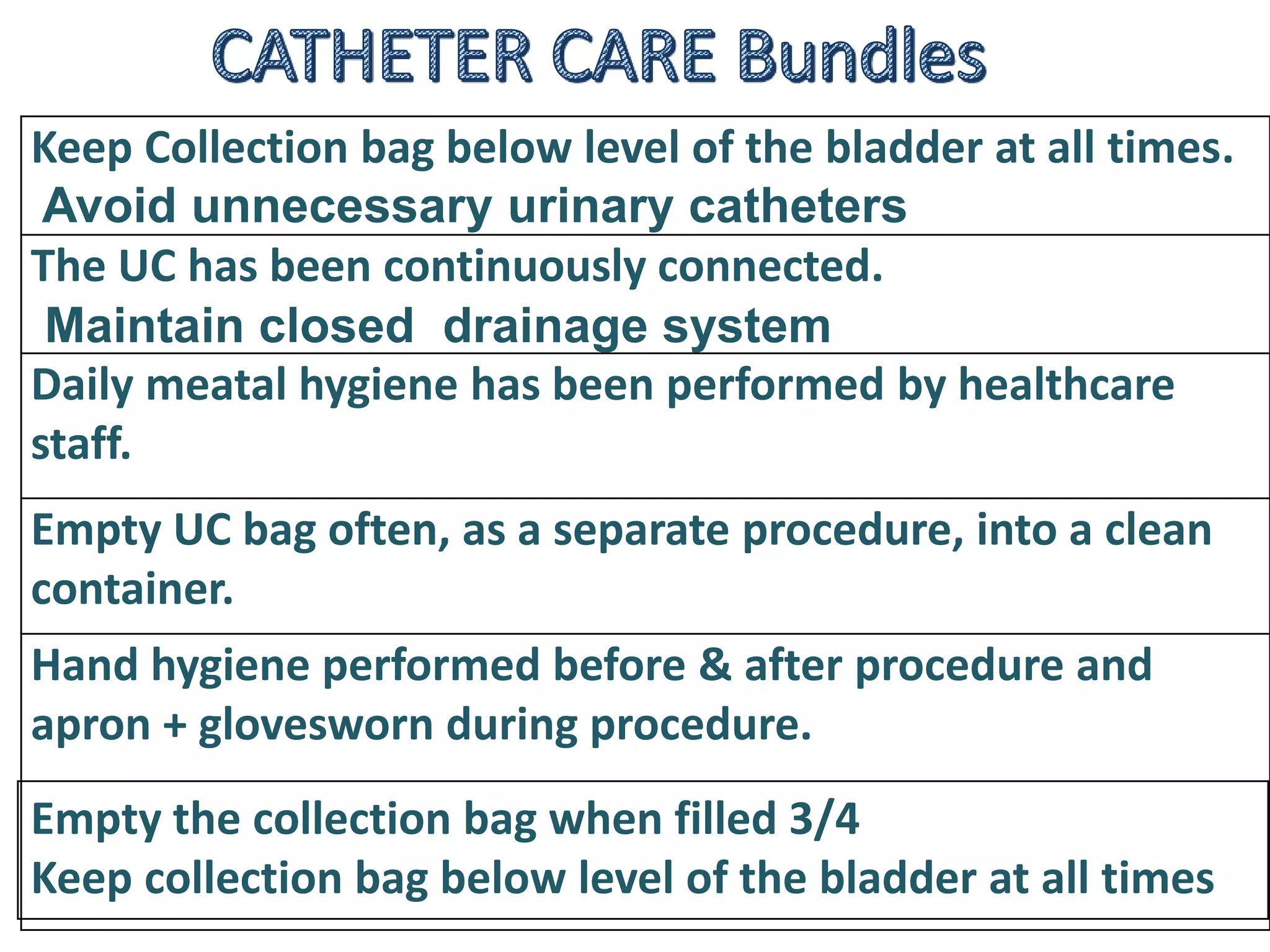
Keep Collection bag below level of the bladder at all times.
Avoid unnecessary urinary catheters
The UC has been continuously connected.
Maintain closed drainage system
Daily meatal hygiene has been performed by healthcare
staff.
Empty UC bag often, as a separate procedure, into a clean
container.
Hand hygiene performed before & after procedure and
apron + glovesworn during procedure.
Empty the collection bag when filled 3/4
Keep collection bag below level of the bladder at all times
• A surgical site infection is an infection that occurs
after surgery in the part of the body where the
surgery took place. Surgical site infections can
sometimes be superficial infections involving the
skin only.
TYPE OF SSI
Superficial incision SSI
Date of event for infection occurs within 30 days
operative procedure (where day 1 = the procedure
date) AND involves only skin and subcutaneous
tissue of the incision
Deep incision SSI
The date of event for infection occurs within 30 or
90 days after the operative procedure (where day 1
= the procedure date) involves deep soft tissues of
the incision (e.g., fascial and muscle layers)
Classification
• surgical wound type
1. Hand washing each after movement.
2. Daily dressing on site & surgical area assessment .
3. Sterile item used for dressing
4. education patient & relative regarding symptoms of SSI .
5. Sterilization of surgical instrument and dressing tray .
 Hand washing before & after the procedure
 Maximal barrier precaution upon insertion
 Chlorhexidine skin antisepsis
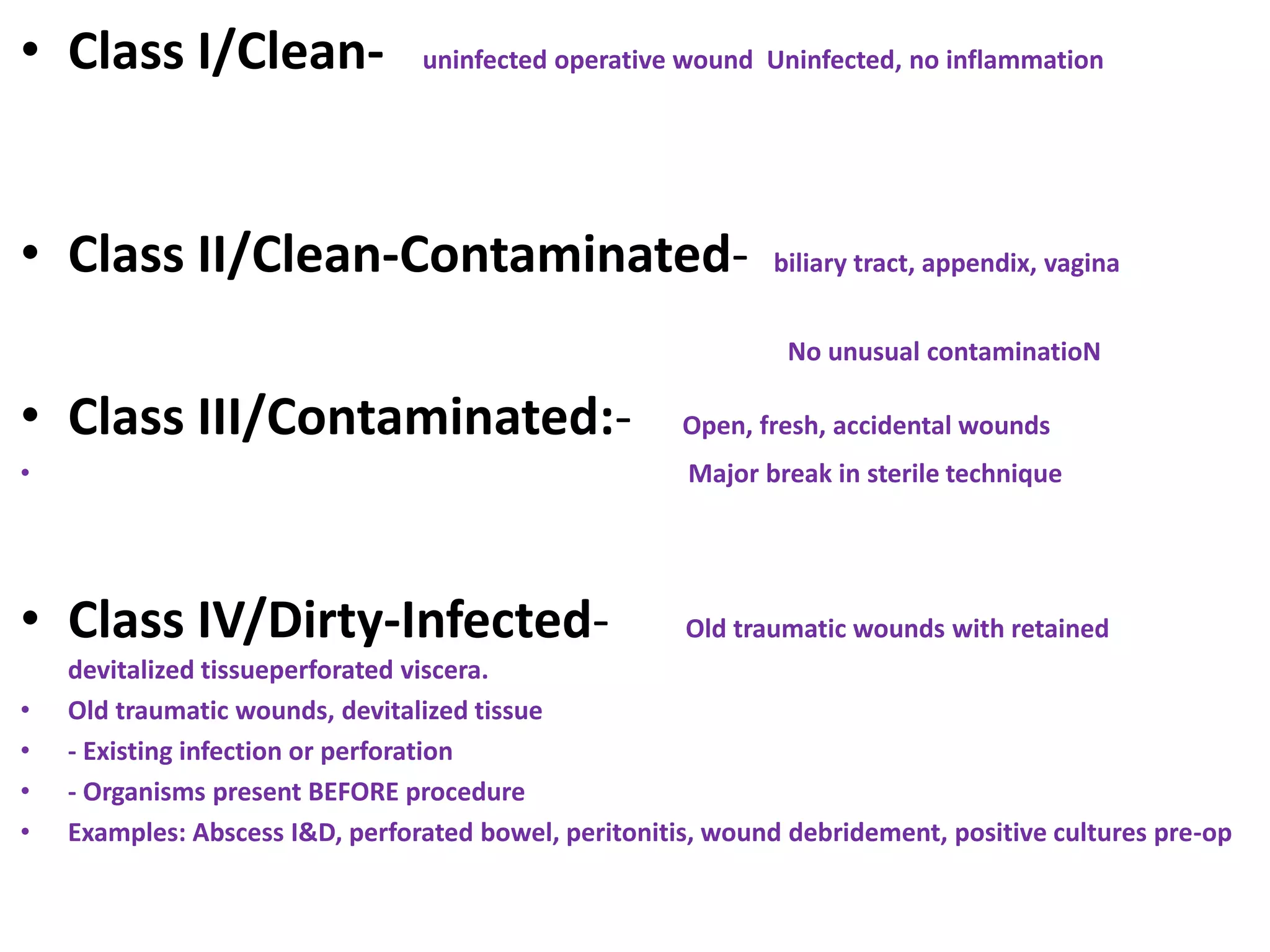
• Class I/Clean- uninfected operative wound Uninfected, no inflammation
• Class II/Clean-Contaminated- biliary tract, appendix, vagina
No unusual contaminatioN
• Class III/Contaminated:- Open, fresh, accidental wounds
• Major break in sterile technique
• Class IV/Dirty-Infected- Old traumatic wounds with retained
devitalized tissueperforated viscera.
• Old traumatic wounds, devitalized tissue
• - Existing infection or perforation
• - Organisms present BEFORE procedure
• Examples: Abscess I&D, perforated bowel, peritonitis, wound debridement, positive cultures pre-op
Classification of
surgical wounds
1. Superficial SSI
•i.The surgical procedure must have been performed within 30
days before the infection.
•ii.The infection involves only skin and subcutaneous tissue of
the incision.
•iii.The patient has at least one of the following:
•a.purulent drainage from the superficial incision.
•b.superficial incision that is deliberately opened by a surgeon
due to infection
•c.
2.Deep SSI
i.Infection occurs within 90 days after
thesurgical procedure
ii.The infection involves the deep tissues / deep spaces / organs related to
the site of surgery (e.g., fascia / muscle / bone).
iii.The patient has at least one of the following:
a.Purulent drainage which is originating from the deep tissues.
b.The wound that spontaneously dehisces or is deliberately opened by a
surgeon and the patient has at least one of the following signs or
symptoms: fever (>100.4°C); localized pain or tenderness
c.an abscess or collection in the deep tissues / organ / body spaces that is
found on examination, during invasive procedure or by imaging.
d.diagnosis of a deep SSI by a surgeon.
• A. Endogenous: B. Exogenous
Prevention of SSI:
• i.Smoking cessation advice, if applicable.
• disposable razors for each patient
• ii.Identification and treatment of infections pre-
operatively before elective operation. Elective
surgery is postponed until infection has resolved.
• iii.Use of topical chlorhexidine (Eg:
Chlorhexidine bath / Chlorhexidine foam
application) for 48 hours before surgery
• iv.Skin Preparation: An appropriate antiseptic
agent (Chlorhexidine or Povidone Iodine) is used
prior to surgery.
• v.Prophylactic antibiotic administration (given 1
hour prior to skin incision) according to the
antibiotic policy. Further dose of antibiotic
would be necessary if the duration of surgery is
>4 hours or in case of excessive blood loss.
• vi.Hair at the operative site is not removed
unless it will interfere with the operation. In
such cases, the hair is removed by clipping.
Razors are not to be used.
• vii.Strict pre-operative blood glucose control (to
be maintained <180mg/dl).
• viii.Short pre-operative hospital stay.
END
• Questions? QUARY

Hospital Acquired Infection & Hospital Infection Control

  • 1.
    H.I.C INDICATORS VIKRAM SINGHRAJAWAT M.Sc (M), M.Sc (N), MBA
  • 2.
    • Joint CommissionInternational (JCI) • National Accreditation Board for Hospitals and Healthcare Providers (NABH) • Toastmasters International • Rotary International is an international service organization (RIISO)
  • 3.
    DEFINITION • Health care-associatedinfection (HCAI), also referred to as "nosocomial" or "hospital" infection, is an infection occurring in a patient during the process of care in a hospital or other health care facility which was not present or incubating at the time of admission.
  • 5.
    HCAI • Common organisms: –Staph aureus – E.Coli – Pseudomonas aeruginosa – Vancomycin resistant enterococci – MARSA (HAND) • Common systems involved – Urinary Tract—UTI – Respiratory Tract—VAP – Surgical Sites—SSI – Blood Stream—CLABSI – Bacteremia – Skin – Eyes – GI Tract
  • 6.
    Standard Precaution • PPE •Hand hygiene( Hand washing 40-60 secs ) ( Hand rubbing 15-20 secs) • Isolation • Barrier Nursing
  • 7.
  • 8.
  • 9.
    PPEs (Personal Protective Equipment) PPEsfor infection control( Prevention of cross infection) • Cap • Eye shield/Goggles- Glasses with side shields • Mask/N-95 Mask • Hearing protective devices in high noise areas • Gowns/ Fluid resistant gowns for lab etc. • Hand Sanitizers • Gloves/double gloving • Fluid impermeable shoes -, synthetic • Emergency eye washers in labs
  • 10.
    PPEs (Personal ProtectiveEquipment) Sequence of Donning and Doffing of PPEs (Wearing and Removal) Perform Hand Hygiene Donning • Hand Hygiene • Gown • Mask • Goggles • Gloves
  • 11.
    Doffing • Gloves Hand hygiene • Gown • Hand Hygiene • Goggles/Face Mask • Mask (Remove mask after you leave patient room and shut the door) • Hand Hygiene
  • 12.
    HIC Quality Indicators •VAE -(VENTILLATOR ASSOCIATED PNEUMONIA)VAP • CLABSI- (CENTRAL LINE ASSOCIATED BLOOD STEAM INFECTION) • CAUTI- (CATHETER ASSOCIATED URINARY TRACT INFECTION) most common • SSI- (SURGICAL SITE INFECTION)
  • 13.
    HIC Critical CareBundles • Ventilator CARE Bundle • Central Line CAREBundle • CATHETER CARE Bundles • SURGICAL SITE CARE Bundles
  • 14.
    Ventilator Associated Infections(VAP)  Ventilator-associated pneumonia (VAP) is pneumonia that develops 48 hours or longer after mechanical ventilation is given by means of an endotracheal tube or tracheostomy.  VAP is the second most common nosocomial infection.  VAP increases a patient's hospital stay by approximately 7-9 days
  • 17.
  • 18.
    • Ventilator-Associated Pneumonia(VAP)Bundle: –DVT prophylaxis –GI prophylaxis –Head of bed (HOB) elevated to 30-45 –Daily Sedation Vacation –Daily Spontaneous Breathing Trial –3. ET suctioning to remove secretions. – Peptic ulcer prophylaxis. –Chlorhexidine mouth wash (every shift) in those above 10 years of age. connected
  • 19.
    • A centralline associated blood stream infection is a laboratory-confirmed bloodstream infection (BSI) in a patient who had a central line within the 48 hour period before the development of the BSI, and that is not related to an infection at another site
  • 20.
    -Center line -femoral line -Jugularline -Peripheral line CENTER LINE TYPE
  • 22.
    Risk factors ofCRBSI Poor personal hygiene, Occlusive transparent dressing, Moisture around the exit site, S. Aureus nasal colonization, Contiguous infections  Catheter site selection & method matters in all the patient
  • 23.
    1. The needfor line use has been reviewed and recorded today, keep line cover 2. The dressing is intact and was changed within the past 7 days. AS PER ORDER 3.Hand hygiene before and after, is performed on all line maintenance/access procedures. 4.Alcohol hub decontamination is performed before each hub access. Optimal catheter site selection* 5.Chlorhexidin Skin Antiseptic (solution compatible with CVC) is used for cleaning the insertion site during dressing changes. 6.Maximum Barrier Precaution Upon Insertion
  • 25.
    A UTI ina patient who had an indwelling urinary catheter in place at the time of or within 48 hours prior to infection onset. Types of CAUTI  Symptomatic  Asymptomatic CATHETER ASSOCIATED URINARY TRACT INFECTIONS (CAUTI)
  • 26.
    CAUSES the catheter maybecome contaminated upon insertion the drainage bag may not be emptied often enough bacteria from a bowel movement may get on the catheter urine in the catheter bag may flow backward into the bladder the catheter may not be regularly cleaned
  • 27.
    Symptoms Cloudy urine Blood inthe urine Strong urine odor Urine leakage around your catheter Pressure, pain, or discomfort in your lower back or stomach Chills Fever Unexplained fatigue Vomiting
  • 29.
    Keep Collection bagbelow level of the bladder at all times. Avoid unnecessary urinary catheters The UC has been continuously connected. Maintain closed drainage system Daily meatal hygiene has been performed by healthcare staff. Empty UC bag often, as a separate procedure, into a clean container. Hand hygiene performed before & after procedure and apron + glovesworn during procedure. Empty the collection bag when filled 3/4 Keep collection bag below level of the bladder at all times
  • 30.
    • A surgicalsite infection is an infection that occurs after surgery in the part of the body where the surgery took place. Surgical site infections can sometimes be superficial infections involving the skin only.
  • 31.
    TYPE OF SSI Superficialincision SSI Date of event for infection occurs within 30 days operative procedure (where day 1 = the procedure date) AND involves only skin and subcutaneous tissue of the incision Deep incision SSI The date of event for infection occurs within 30 or 90 days after the operative procedure (where day 1 = the procedure date) involves deep soft tissues of the incision (e.g., fascial and muscle layers)
  • 32.
  • 33.
    • surgical woundtype 1. Hand washing each after movement. 2. Daily dressing on site & surgical area assessment . 3. Sterile item used for dressing 4. education patient & relative regarding symptoms of SSI . 5. Sterilization of surgical instrument and dressing tray .  Hand washing before & after the procedure  Maximal barrier precaution upon insertion  Chlorhexidine skin antisepsis
  • 34.
    • Class I/Clean-uninfected operative wound Uninfected, no inflammation • Class II/Clean-Contaminated- biliary tract, appendix, vagina No unusual contaminatioN • Class III/Contaminated:- Open, fresh, accidental wounds • Major break in sterile technique • Class IV/Dirty-Infected- Old traumatic wounds with retained devitalized tissueperforated viscera. • Old traumatic wounds, devitalized tissue • - Existing infection or perforation • - Organisms present BEFORE procedure • Examples: Abscess I&D, perforated bowel, peritonitis, wound debridement, positive cultures pre-op
  • 35.
  • 36.
    1. Superficial SSI •i.Thesurgical procedure must have been performed within 30 days before the infection. •ii.The infection involves only skin and subcutaneous tissue of the incision. •iii.The patient has at least one of the following: •a.purulent drainage from the superficial incision. •b.superficial incision that is deliberately opened by a surgeon due to infection •c.
  • 37.
    2.Deep SSI i.Infection occurswithin 90 days after thesurgical procedure ii.The infection involves the deep tissues / deep spaces / organs related to the site of surgery (e.g., fascia / muscle / bone). iii.The patient has at least one of the following: a.Purulent drainage which is originating from the deep tissues. b.The wound that spontaneously dehisces or is deliberately opened by a surgeon and the patient has at least one of the following signs or symptoms: fever (>100.4°C); localized pain or tenderness c.an abscess or collection in the deep tissues / organ / body spaces that is found on examination, during invasive procedure or by imaging. d.diagnosis of a deep SSI by a surgeon.
  • 38.
    • A. Endogenous:B. Exogenous
  • 39.
  • 40.
    • i.Smoking cessationadvice, if applicable. • disposable razors for each patient • ii.Identification and treatment of infections pre- operatively before elective operation. Elective surgery is postponed until infection has resolved. • iii.Use of topical chlorhexidine (Eg: Chlorhexidine bath / Chlorhexidine foam application) for 48 hours before surgery • iv.Skin Preparation: An appropriate antiseptic agent (Chlorhexidine or Povidone Iodine) is used prior to surgery.
  • 41.
    • v.Prophylactic antibioticadministration (given 1 hour prior to skin incision) according to the antibiotic policy. Further dose of antibiotic would be necessary if the duration of surgery is >4 hours or in case of excessive blood loss. • vi.Hair at the operative site is not removed unless it will interfere with the operation. In such cases, the hair is removed by clipping. Razors are not to be used. • vii.Strict pre-operative blood glucose control (to be maintained <180mg/dl). • viii.Short pre-operative hospital stay.
  • 42.