Data Discovery and PCI DSS
By Kishor Vaswani, CEO - ControlCase
Agenda
• About Data Discovery
• PCI DSS Requirements and need for Data Discovery in
the context of PCI DSS
• Challenges in the Data Discovery space
• Live Demo of ControlCase Data Discovery
• Q&A
1
About Data Discovery
Current Technology Environment
• Servers – Windows, Unix etc.
• Databases – SQL Server, Oracle etc.
• Email
• File systems
2
What is Data Discovery
• Ability to identify and pinpoint sensitive data
across
› File Shares
› Servers
› Databases
› Email
› Log files
› Etc.
3
Why is it important
• GRC focuses on confidentiality, integrity and
availability
• Confidentiality is always focused on “Data”
• Data that is sensitive must be protected, however
the first step of that is to know where the data
resides
• Hence, it is important to identify where sensitive
data resides
4
PCI DSS Requirements and Data
Discovery
What is PCI DSS?
Payment Card Industry Data Security Standard:
• Guidelines for securely processing, storing, or
transmitting payment card account data
• Established by leading payment card issuers
• Maintained by the PCI Security Standards Council
(PCI SSC)
5
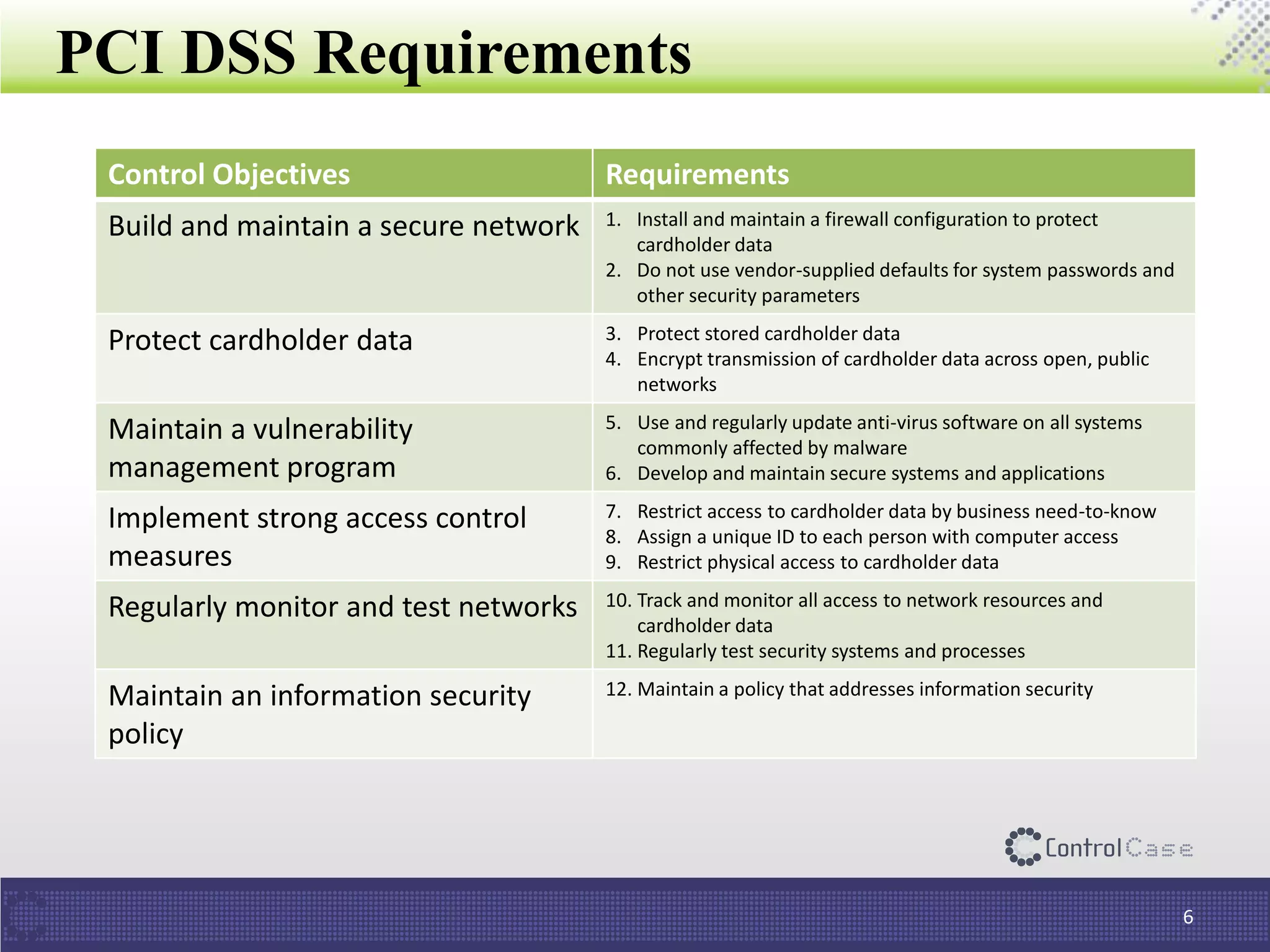
PCI DSS Requirements
Control Objectives Requirements
Build and maintain a secure network 1. Install and maintain a firewall configuration to protect
cardholder data
2. Do not use vendor-supplied defaults for system passwords and
other security parameters
Protect cardholder data 3. Protect stored cardholder data
4. Encrypt transmission of cardholder data across open, public
networks
Maintain a vulnerability
management program
5. Use and regularly update anti-virus software on all systems
commonly affected by malware
6. Develop and maintain secure systems and applications
Implement strong access control
measures
7. Restrict access to cardholder data by business need-to-know
8. Assign a unique ID to each person with computer access
9. Restrict physical access to cardholder data
Regularly monitor and test networks 10. Track and monitor all access to network resources and
cardholder data
11. Regularly test security systems and processes
Maintain an information security
policy
12. Maintain a policy that addresses information security
6
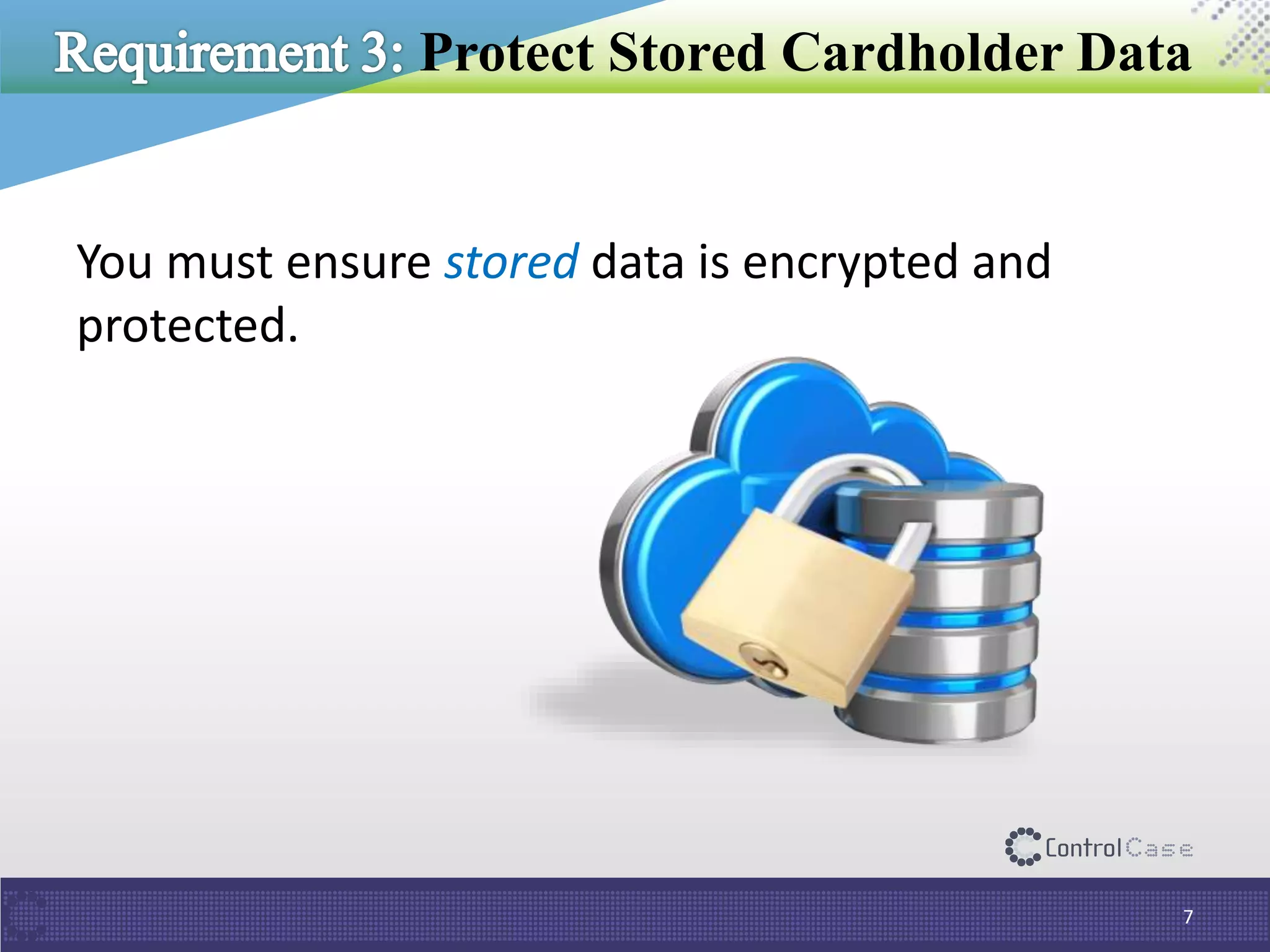
Protect Stored Cardholder Data
You must ensure stored data is encrypted and
protected.
7
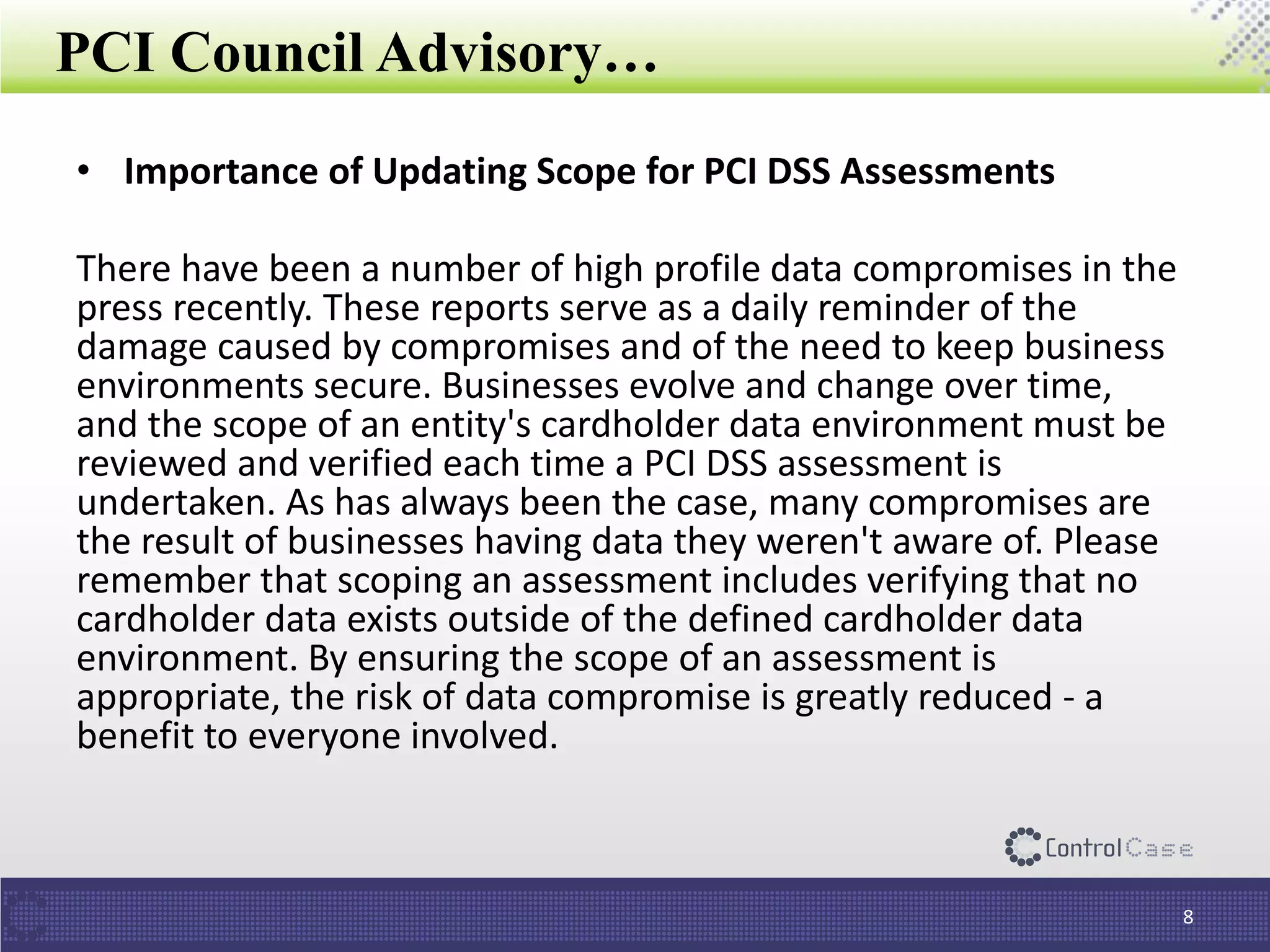
PCI Council Advisory…
• Importance of Updating Scope for PCI DSS Assessments
There have been a number of high profile data compromises in the
press recently. These reports serve as a daily reminder of the
damage caused by compromises and of the need to keep business
environments secure. Businesses evolve and change over time,
and the scope of an entity's cardholder data environment must be
reviewed and verified each time a PCI DSS assessment is
undertaken. As has always been the case, many compromises are
the result of businesses having data they weren't aware of. Please
remember that scoping an assessment includes verifying that no
cardholder data exists outside of the defined cardholder data
environment. By ensuring the scope of an assessment is
appropriate, the risk of data compromise is greatly reduced - a
benefit to everyone involved.
8
Challenges in Data Discovery
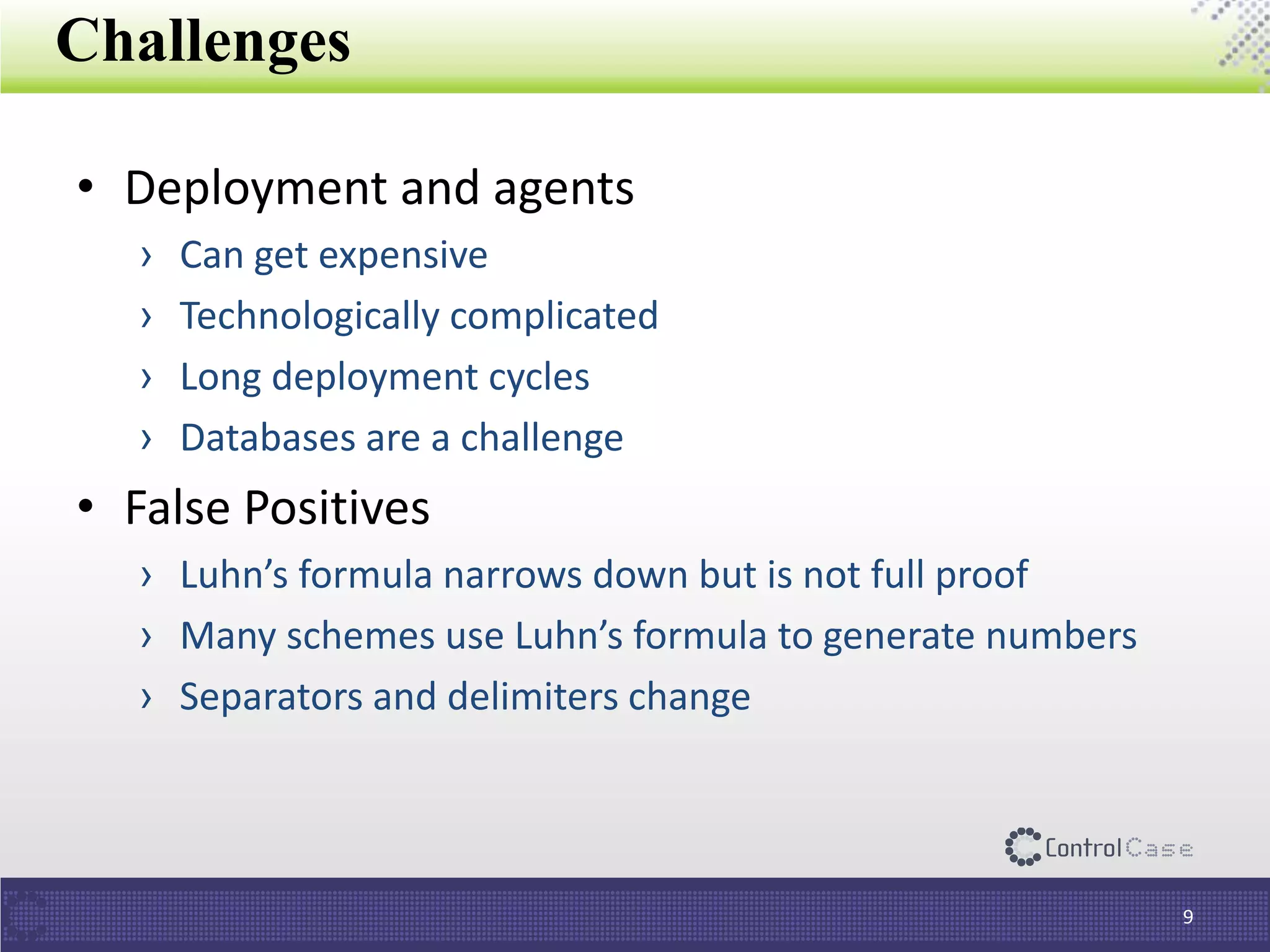
Challenges
• Deployment and agents
› Can get expensive
› Technologically complicated
› Long deployment cycles
› Databases are a challenge
• False Positives
› Luhn’s formula narrows down but is not full proof
› Many schemes use Luhn’s formula to generate numbers
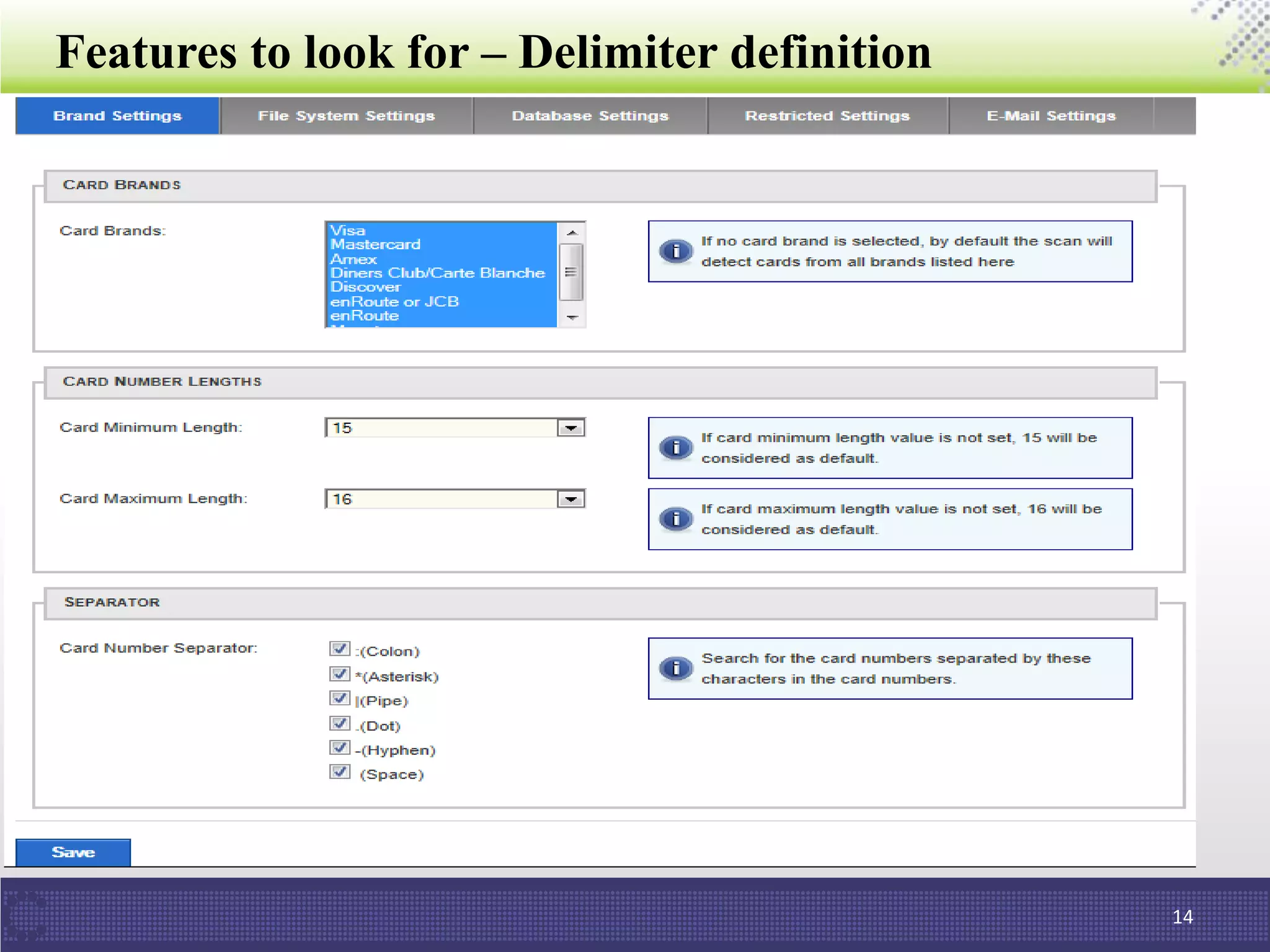
› Separators and delimiters change
9
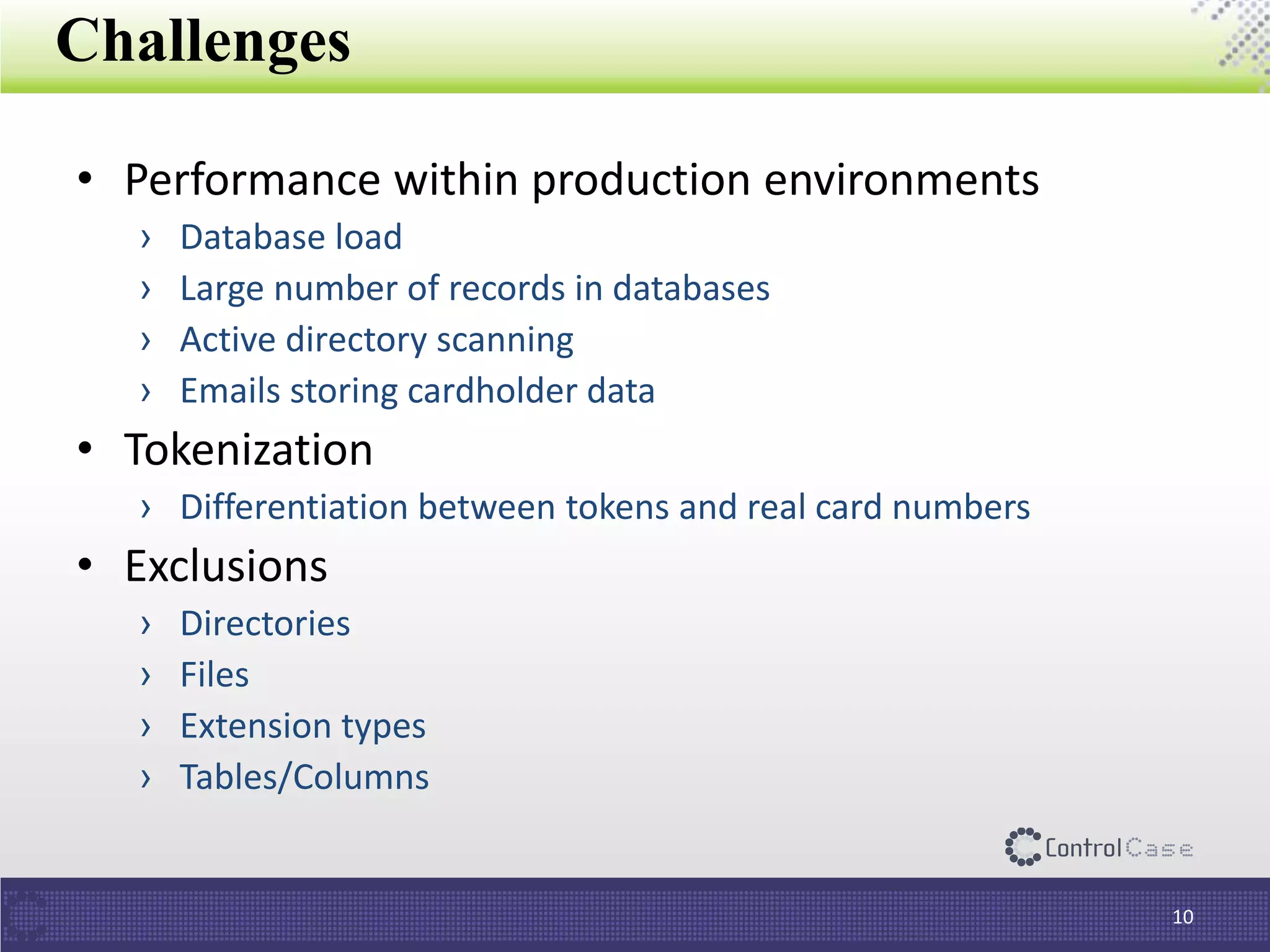
Challenges
• Performance within production environments
› Database load
› Large number of records in databases
› Active directory scanning
› Emails storing cardholder data
• Tokenization
› Differentiation between tokens and real card numbers
• Exclusions
› Directories
› Files
› Extension types
› Tables/Columns
10
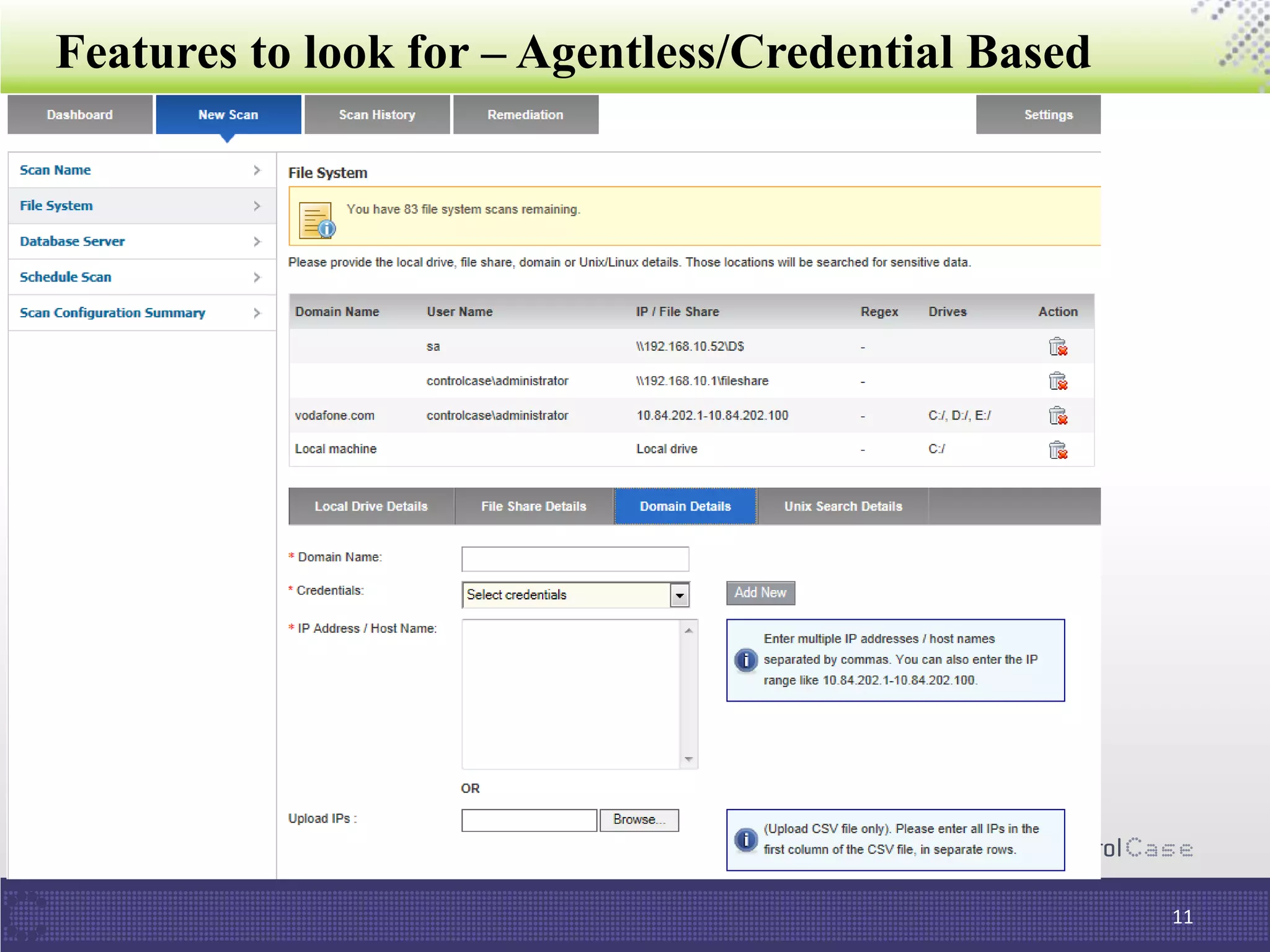
Features to look for – Agentless/Credential Based
11
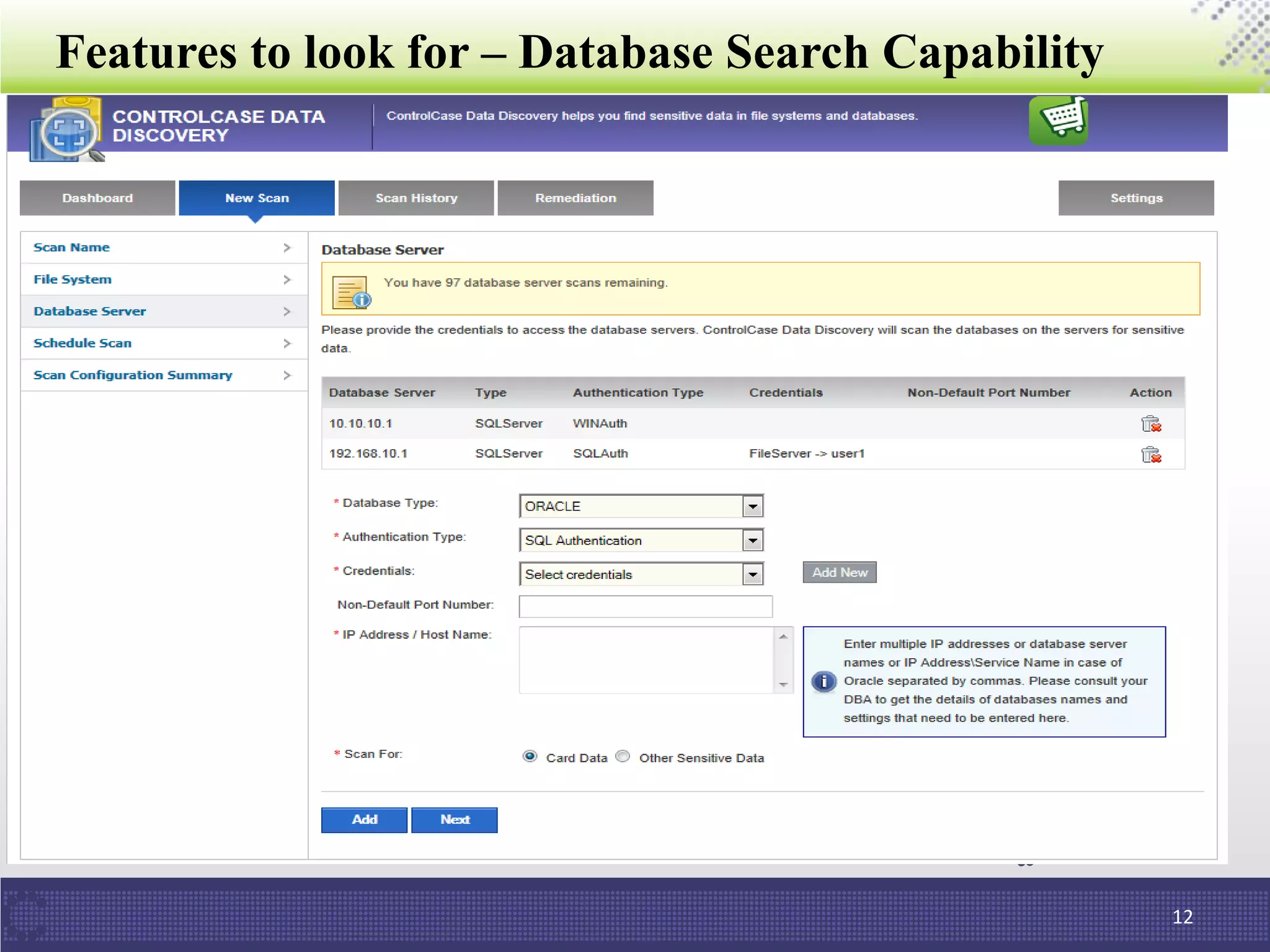
Features to look for – Database Search Capability
12
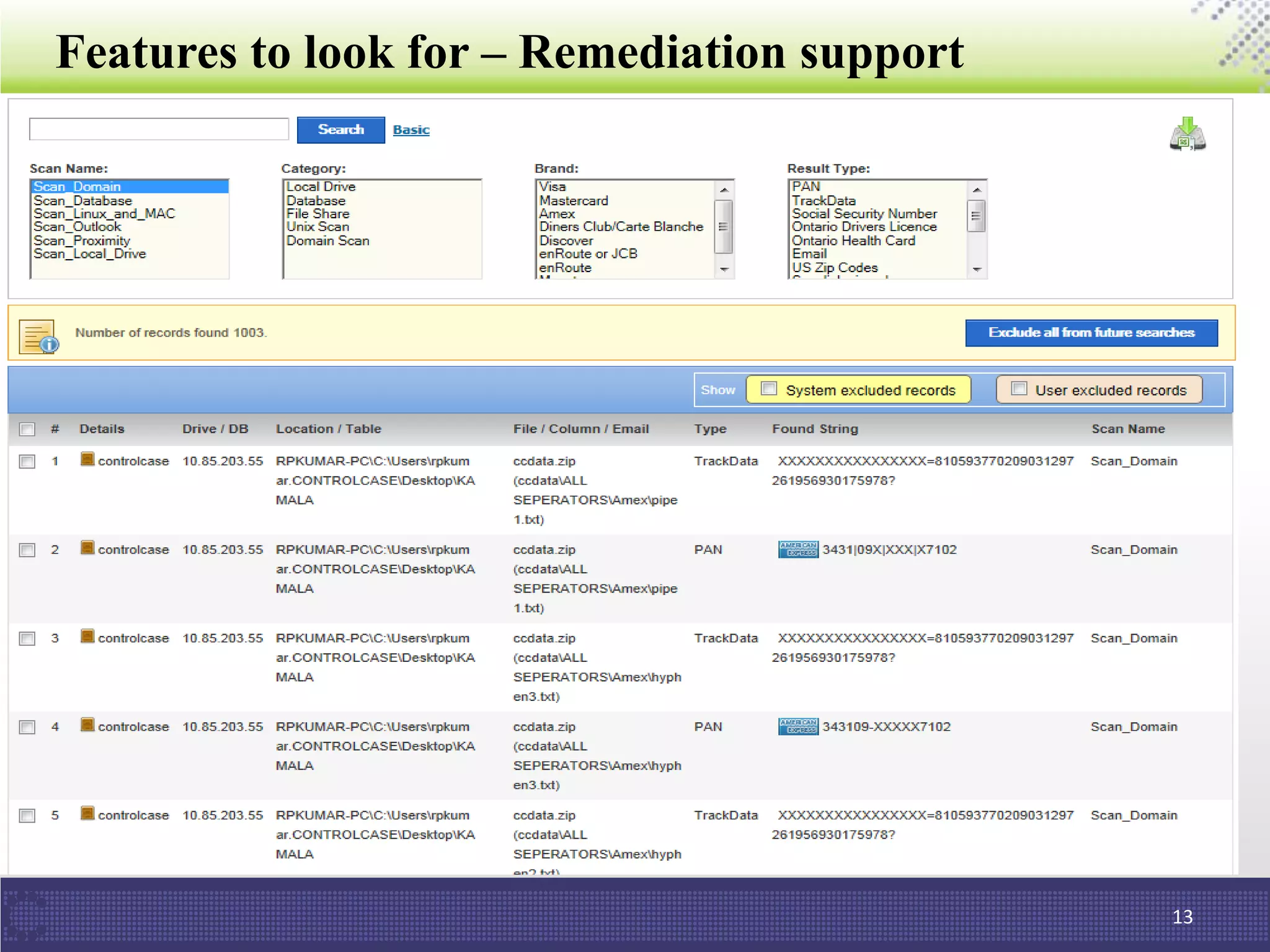
Features to look for – Remediation support
13
Features to look for – Delimiter definition
14
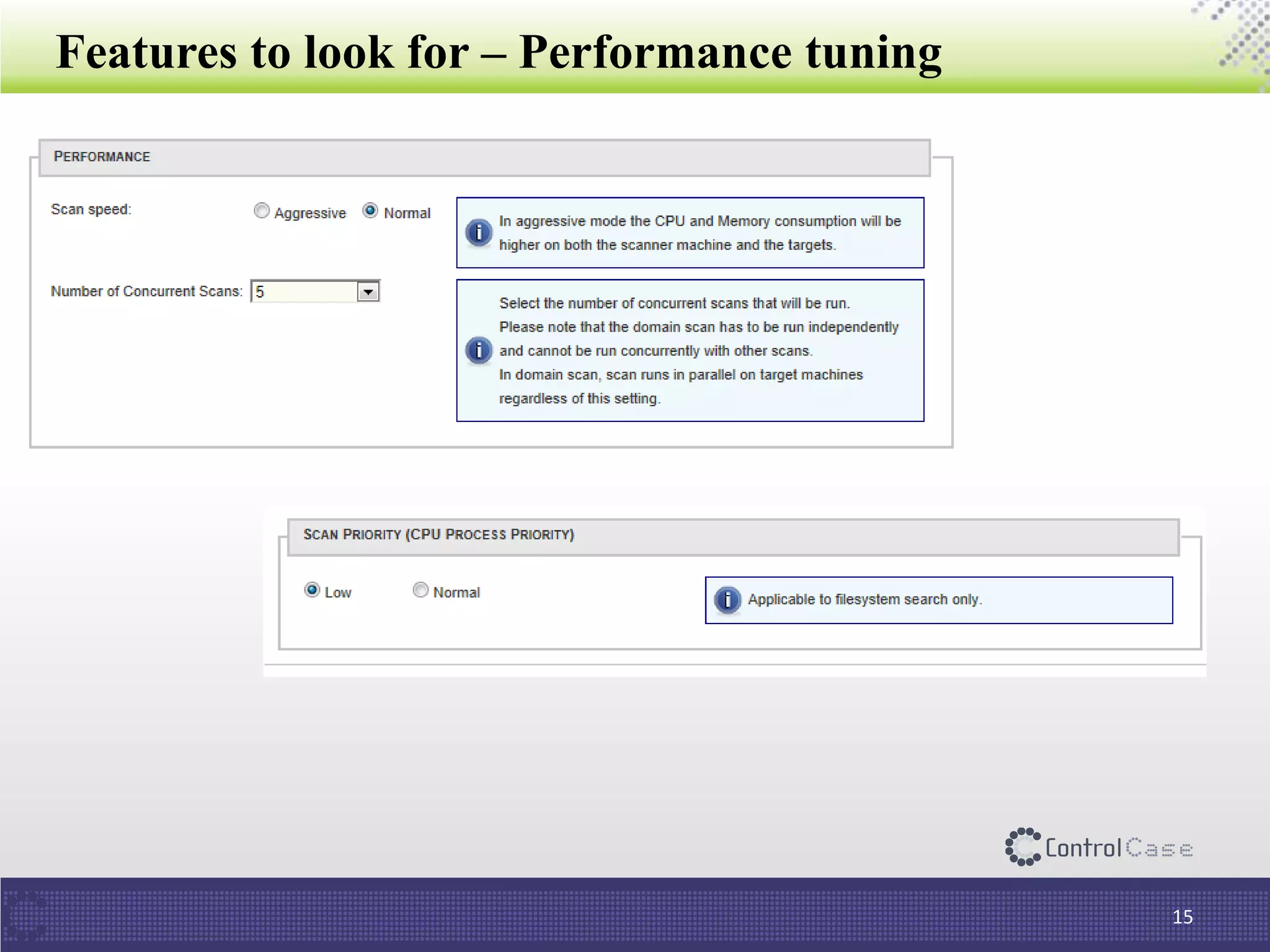
Features to look for – Performance tuning
15
Features to look for – Token exclusion capability
16
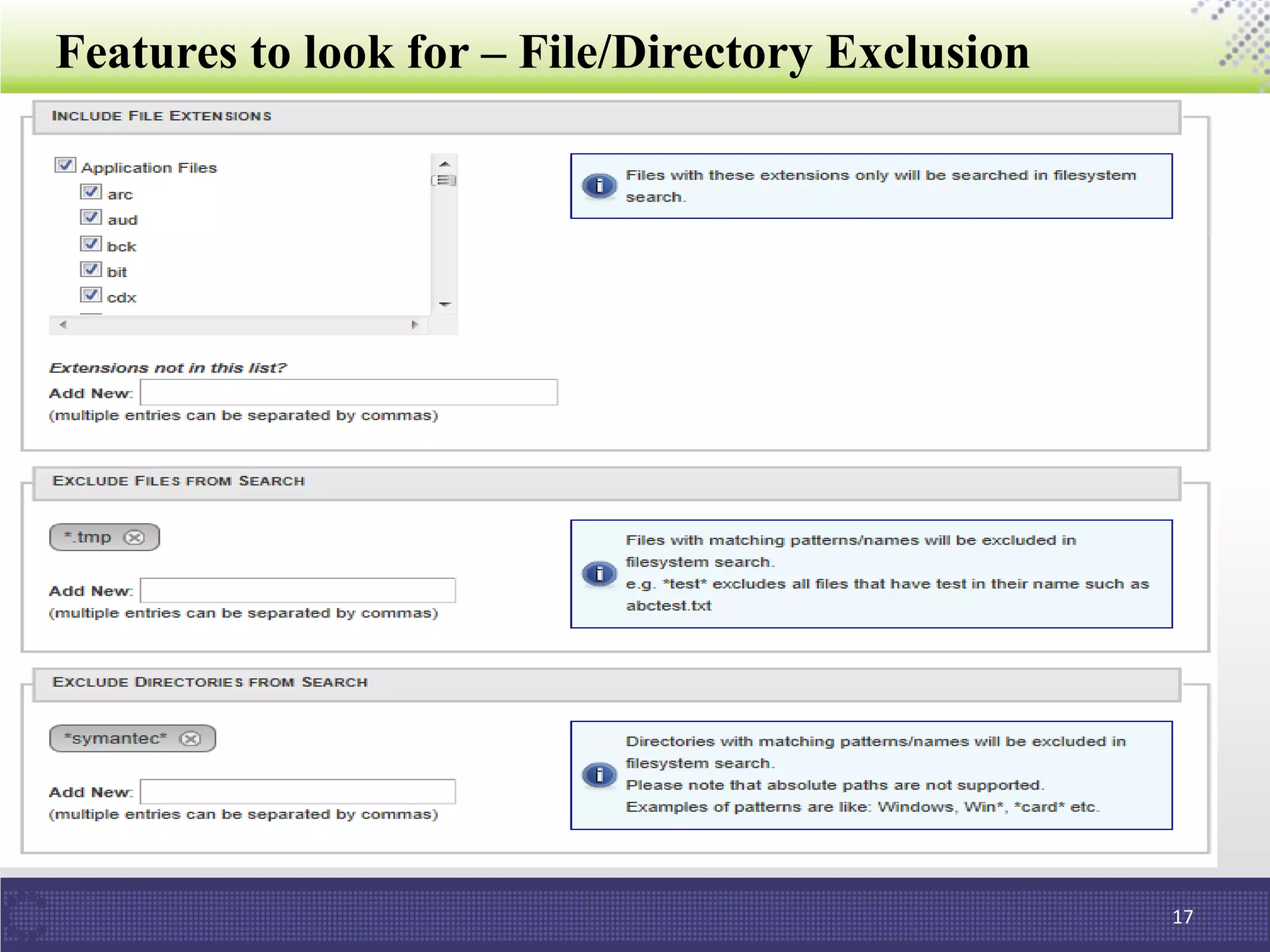
Features to look for – File/Directory Exclusion
17
Why Choose ControlCase?
• Global Reach
› Serving more than 400 clients in 40 countries and rapidly
growing
• Certified Resources
› PCI DSS Qualified Security Assessor (QSA)
› QSA for Point-to-Point Encryption (QSA P2PE)
› Certified ASV vendor
18
To Learn More About PCI Compliance or Data Discovery…
• Visit www.controlcase.com
• Call +1.703.483.6383 (US)
• Call +91.9820293399 (India)
• Kishor Vaswani (CEO) – kvaswani@controlcase.com
19
Demo of ControlCase Solution
Thank You for Your Time

Card Data Discovery and PCI DSS

  • 1.
    Data Discovery andPCI DSS By Kishor Vaswani, CEO - ControlCase
  • 2.
    Agenda • About DataDiscovery • PCI DSS Requirements and need for Data Discovery in the context of PCI DSS • Challenges in the Data Discovery space • Live Demo of ControlCase Data Discovery • Q&A 1
  • 3.
  • 4.
    Current Technology Environment •Servers – Windows, Unix etc. • Databases – SQL Server, Oracle etc. • Email • File systems 2
  • 5.
    What is DataDiscovery • Ability to identify and pinpoint sensitive data across › File Shares › Servers › Databases › Email › Log files › Etc. 3
  • 6.
    Why is itimportant • GRC focuses on confidentiality, integrity and availability • Confidentiality is always focused on “Data” • Data that is sensitive must be protected, however the first step of that is to know where the data resides • Hence, it is important to identify where sensitive data resides 4
  • 7.
    PCI DSS Requirementsand Data Discovery
  • 8.
    What is PCIDSS? Payment Card Industry Data Security Standard: • Guidelines for securely processing, storing, or transmitting payment card account data • Established by leading payment card issuers • Maintained by the PCI Security Standards Council (PCI SSC) 5
  • 9.
    PCI DSS Requirements ControlObjectives Requirements Build and maintain a secure network 1. Install and maintain a firewall configuration to protect cardholder data 2. Do not use vendor-supplied defaults for system passwords and other security parameters Protect cardholder data 3. Protect stored cardholder data 4. Encrypt transmission of cardholder data across open, public networks Maintain a vulnerability management program 5. Use and regularly update anti-virus software on all systems commonly affected by malware 6. Develop and maintain secure systems and applications Implement strong access control measures 7. Restrict access to cardholder data by business need-to-know 8. Assign a unique ID to each person with computer access 9. Restrict physical access to cardholder data Regularly monitor and test networks 10. Track and monitor all access to network resources and cardholder data 11. Regularly test security systems and processes Maintain an information security policy 12. Maintain a policy that addresses information security 6
  • 10.
    Protect Stored CardholderData You must ensure stored data is encrypted and protected. 7
  • 11.
    PCI Council Advisory… •Importance of Updating Scope for PCI DSS Assessments There have been a number of high profile data compromises in the press recently. These reports serve as a daily reminder of the damage caused by compromises and of the need to keep business environments secure. Businesses evolve and change over time, and the scope of an entity's cardholder data environment must be reviewed and verified each time a PCI DSS assessment is undertaken. As has always been the case, many compromises are the result of businesses having data they weren't aware of. Please remember that scoping an assessment includes verifying that no cardholder data exists outside of the defined cardholder data environment. By ensuring the scope of an assessment is appropriate, the risk of data compromise is greatly reduced - a benefit to everyone involved. 8
  • 12.
  • 13.
    Challenges • Deployment andagents › Can get expensive › Technologically complicated › Long deployment cycles › Databases are a challenge • False Positives › Luhn’s formula narrows down but is not full proof › Many schemes use Luhn’s formula to generate numbers › Separators and delimiters change 9
  • 14.
    Challenges • Performance withinproduction environments › Database load › Large number of records in databases › Active directory scanning › Emails storing cardholder data • Tokenization › Differentiation between tokens and real card numbers • Exclusions › Directories › Files › Extension types › Tables/Columns 10
  • 15.
    Features to lookfor – Agentless/Credential Based 11
  • 16.
    Features to lookfor – Database Search Capability 12
  • 17.
    Features to lookfor – Remediation support 13
  • 18.
    Features to lookfor – Delimiter definition 14
  • 19.
    Features to lookfor – Performance tuning 15
  • 20.
    Features to lookfor – Token exclusion capability 16
  • 21.
    Features to lookfor – File/Directory Exclusion 17
  • 22.
    Why Choose ControlCase? •Global Reach › Serving more than 400 clients in 40 countries and rapidly growing • Certified Resources › PCI DSS Qualified Security Assessor (QSA) › QSA for Point-to-Point Encryption (QSA P2PE) › Certified ASV vendor 18
  • 23.
    To Learn MoreAbout PCI Compliance or Data Discovery… • Visit www.controlcase.com • Call +1.703.483.6383 (US) • Call +91.9820293399 (India) • Kishor Vaswani (CEO) – kvaswani@controlcase.com 19
  • 24.
  • 25.
    Thank You forYour Time