PCI DSS 3.2 – Making Compliance
Business As Usual
By Kishor Vaswani – CEO, ControlCase
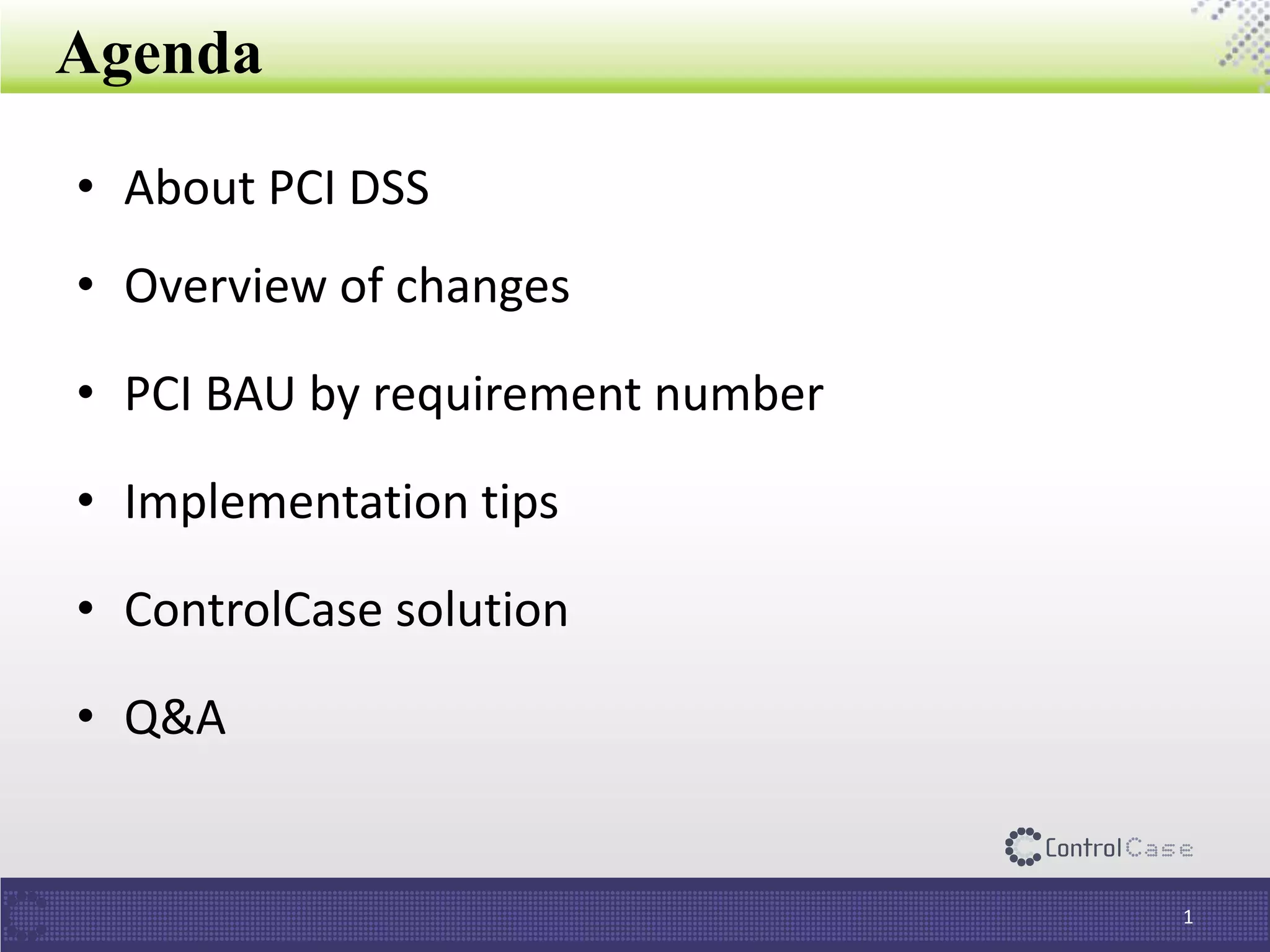
Agenda
• About PCI DSS
• Overview of changes
• PCI BAU by requirement number
• Implementation tips
• ControlCase solution
• Q&A
1
About PCI DSS
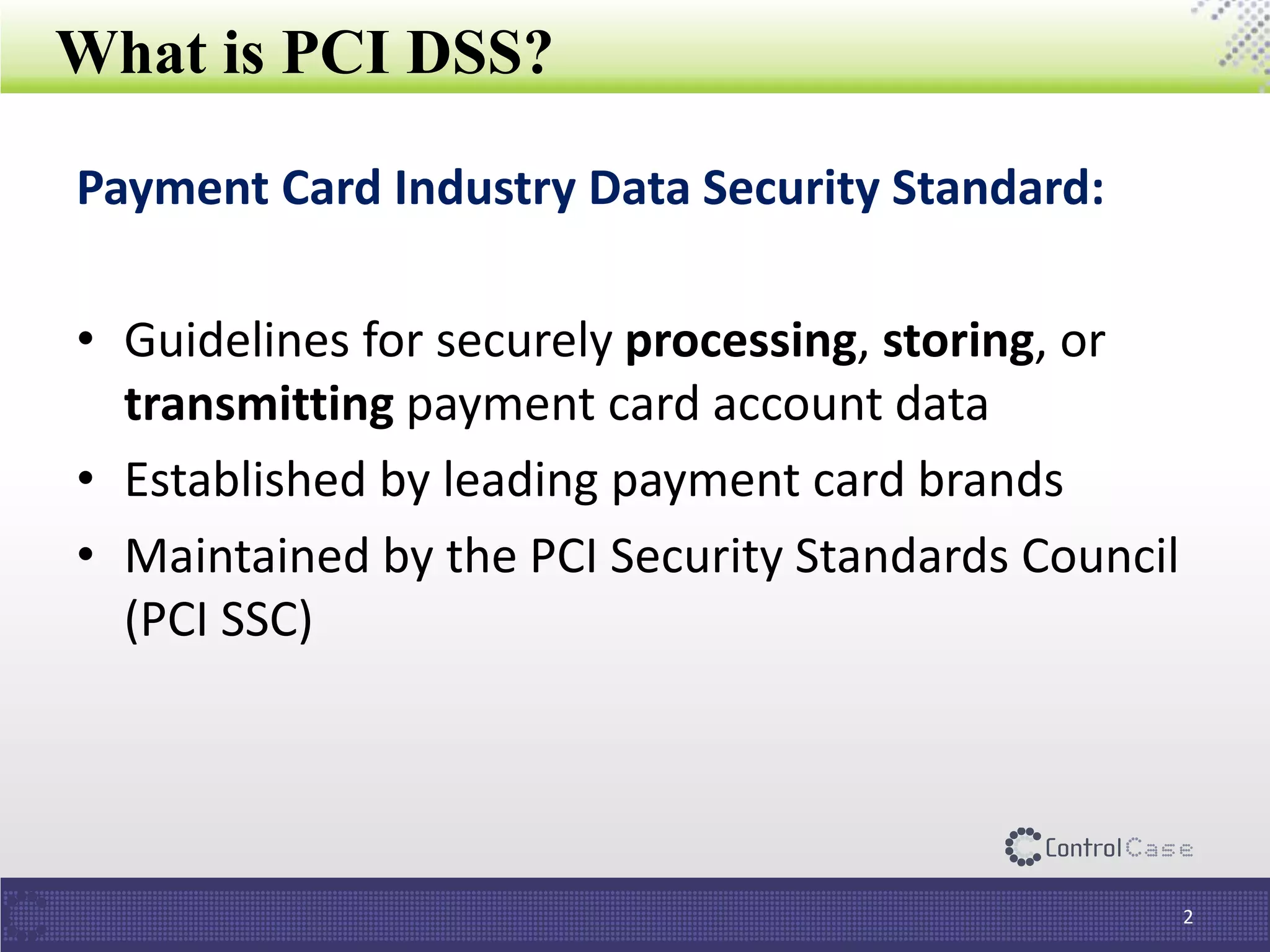
What is PCI DSS?
Payment Card Industry Data Security Standard:
• Guidelines for securely processing, storing, or
transmitting payment card account data
• Established by leading payment card brands
• Maintained by the PCI Security Standards Council
(PCI SSC)
2
PCI DSS Requirements
Control Objectives Requirements
Build and maintain a secure network 1. Install and maintain a firewall configuration to protect
cardholder data
2. Do not use vendor-supplied defaults for system passwords and
other security parameters
Protect cardholder data 3. Protect stored cardholder data
4. Encrypt transmission of cardholder data across open, public
networks
Maintain a vulnerability
management program
5. Use and regularly update anti-virus software on all systems
commonly affected by malware
6. Develop and maintain secure systems and applications
Implement strong access control
measures
7. Restrict access to cardholder data by business need-to-know
8. Assign a unique ID to each person with computer access
9. Restrict physical access to cardholder data
Regularly monitor and test networks 10. Track and monitor all access to network resources and
cardholder data
11. Regularly test security systems and processes
Maintain an information security
policy
12. Maintain a policy that addresses information security
3
Timeline of PCI DSS 3.x
4
• PCI 3.0 was effective Jan 1st, 2014
• Current version is PCI DSS 3.2
Overview of changes
Overview of 3.2 changes
5
SSL/early TLS
• Work towards remediation
• No new SSL/early TLS
• Service provider offering by June 30, 2016
• No SSL/early TLS after June 30, 2018
• Some exceptions for POS POI terminals
Display of PAN
• Permits display of PAN beyond first 6/last 4
• Justification and business need must exist
• Only the digits needed by business need must be displayed
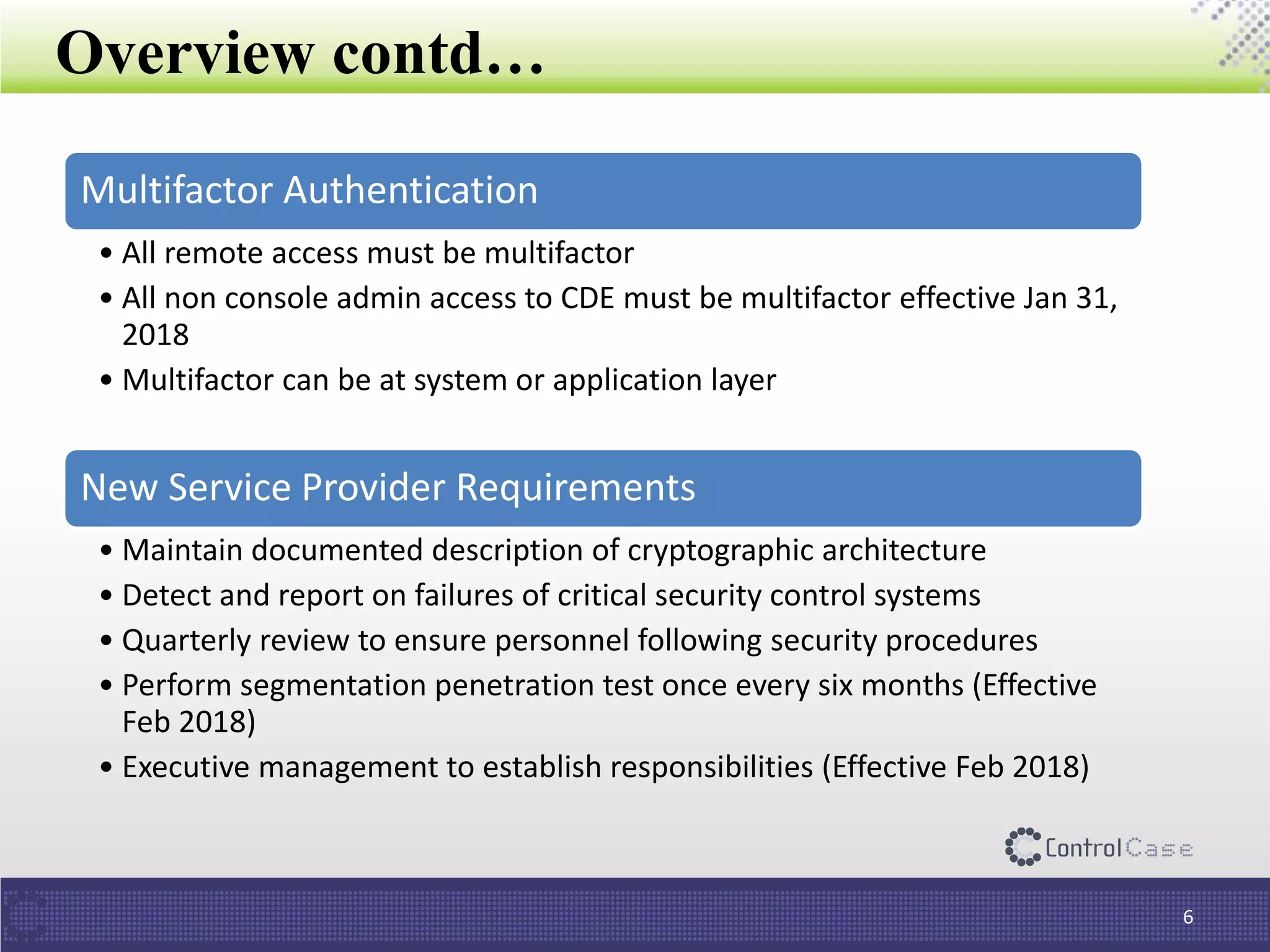
Overview contd…
6
Multifactor Authentication
• All remote access must be multifactor
• All non console admin access to CDE must be multifactor effective Jan 31,
2018
• Multifactor can be at system or application layer
New Service Provider Requirements
• Maintain documented description of cryptographic architecture
• Detect and report on failures of critical security control systems
• Quarterly review to ensure personnel following security procedures
• Perform segmentation penetration test once every six months (Effective
Feb 2018)
• Executive management to establish responsibilities (Effective Feb 2018)
PCI DSS 3.2 Business As Usual by
Requirement Number
PCI Council Guidance on BAU
7
Monitoring of
security controls
• Firewalls
• IDS/IPS
• File Integrity Monitoring (FIM)
• Anti Virus
Ensuring failures
in security
controls are
detected and
responded
• Restoring the security control
• Identifying the root cause
• Identifying any security issues because of the failure
• Mitigation
• Resume monitoring of security control
• Segregation of duties between detective and
preventive controls
PCI Council Guidance on BAU
8
Review changes
to environment
• Addition of new systems
• Changes or organizational structure
• Impact of change to PCI DSS scope
• Requirement applicable to new scope
• Implement any additional security controls because of
change
• New hardware and software (and older ones) continue
to be supported and do not impact compliance
Periodic reviews
• Configuration
• Physical security
• Patches and Anti Virus
• Audit logs
• Access rights
Firewalls
9
People
- PCI project manager to
escalate non-compliance
- Segregation of duties
between operations
performing change and
compliance personnel
reviewing change
Process
- PCI impact analysis as part of
firewall change management
process
Technology
- Automated/Periodic ruleset
reviews
- Weekly port scans from CDE
to Internet to verify no
outbound connections
Configuration Standards
10
People
- PCI project manager to
escalate non-compliance
Process
- Periodic update to
configuration standards
- New infrastructure
onboarding process to include
PCI configuration standards
check
Technology
- Automated/Periodic
configuration scans
- Reminders to update
configuration standards
quarterly
- Technology to flag new assets
that have not formally
undergone PCI configuration
standards check
Protect Stored Cardholder Data
11
People
- PCI project manager to
escalate non-compliance to
highest levels within
organization
Process
- Periodic false positive
management
- Search for cardholder data
during roll out tests/quality
assurance
Technology
- Automated/Periodic
cardholder data scans
- Alerts in case of new
cardholder data found
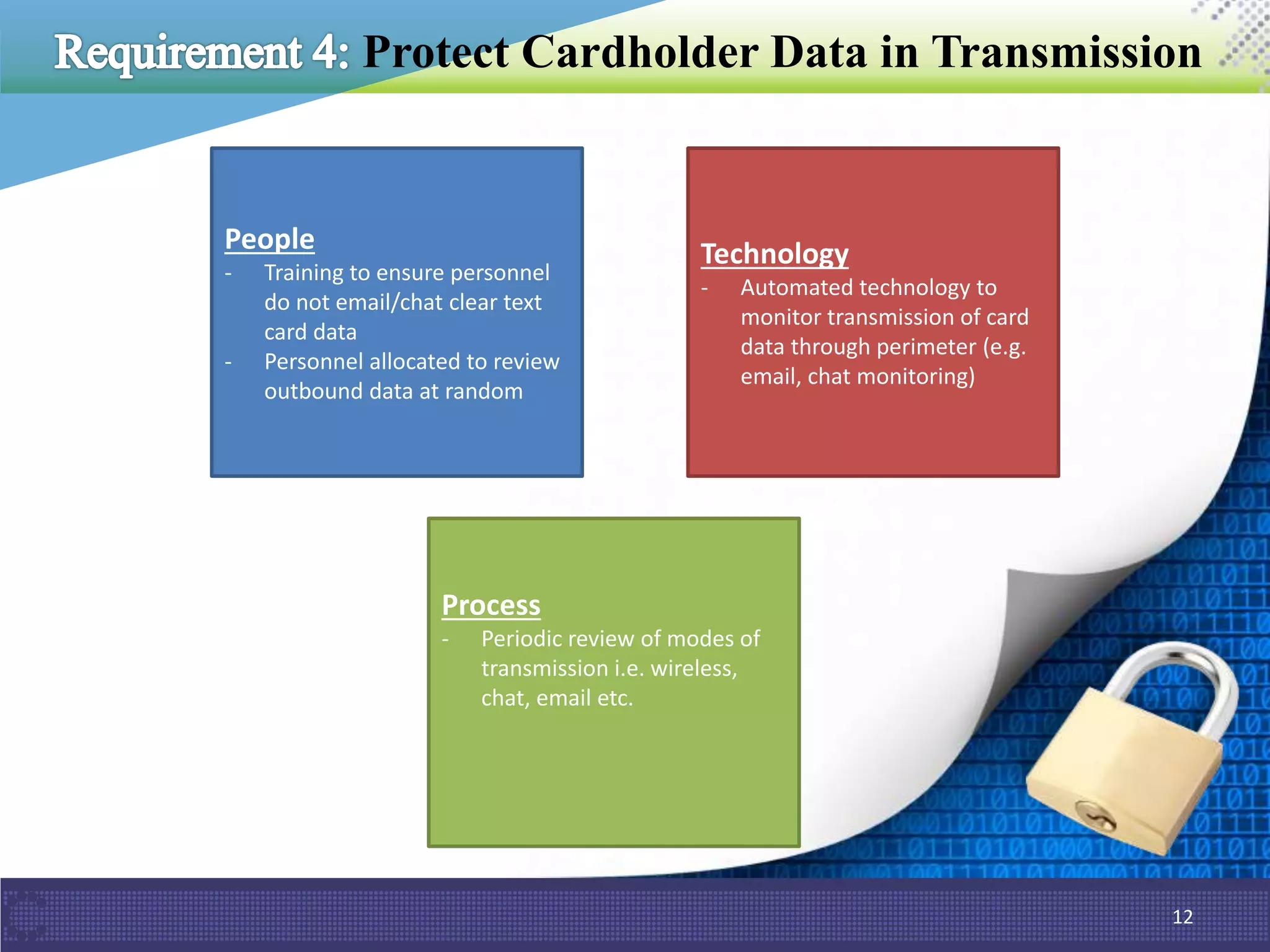
Protect Cardholder Data in Transmission
12
People
- Training to ensure personnel
do not email/chat clear text
card data
- Personnel allocated to review
outbound data at random
Process
- Periodic review of modes of
transmission i.e. wireless,
chat, email etc.
Technology
- Automated technology to
monitor transmission of card
data through perimeter (e.g.
email, chat monitoring)
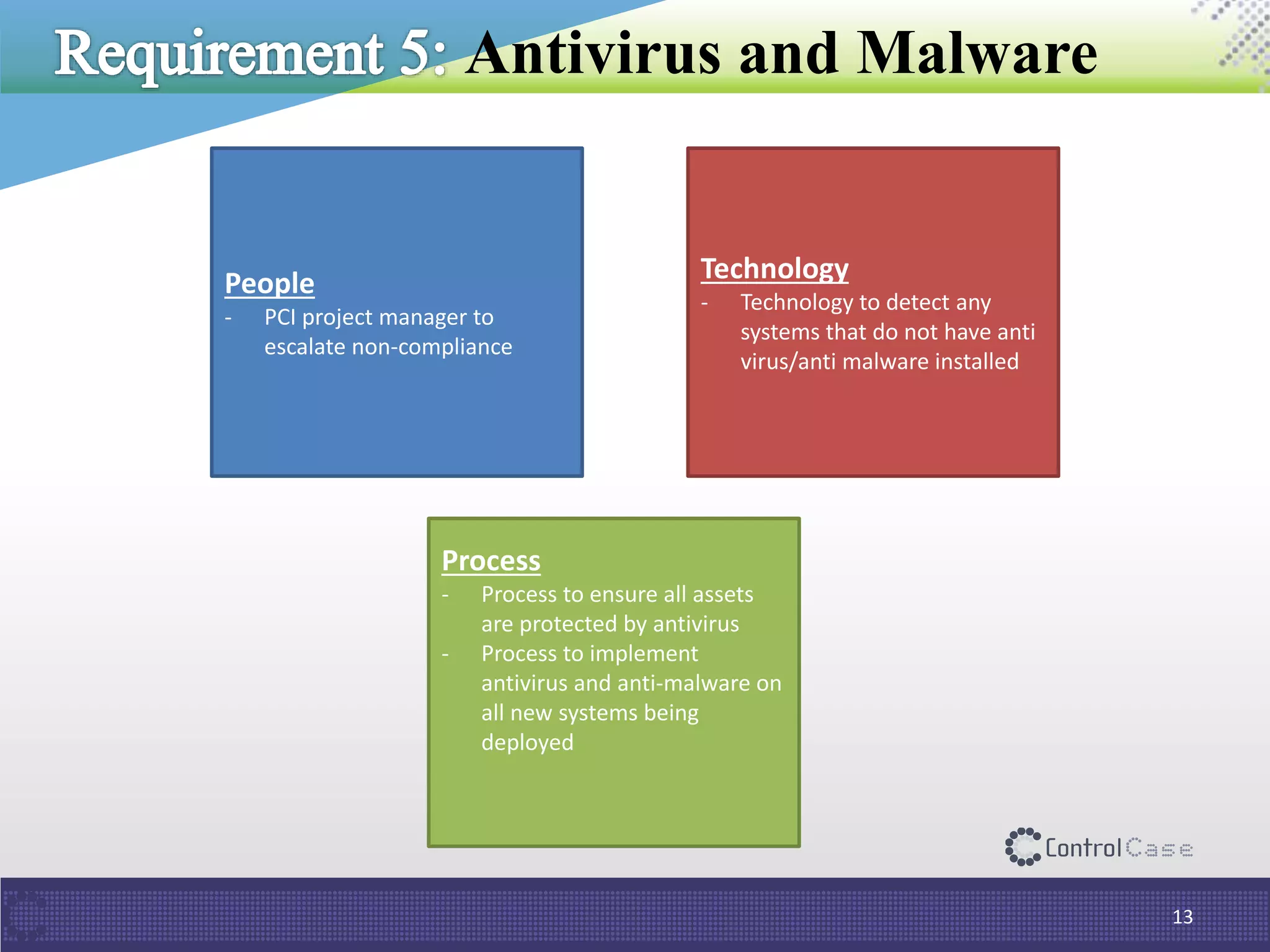
Antivirus and Malware
13
People
- PCI project manager to
escalate non-compliance
Process
- Process to ensure all assets
are protected by antivirus
- Process to implement
antivirus and anti-malware on
all new systems being
deployed
Technology
- Technology to detect any
systems that do not have anti
virus/anti malware installed
Secure Applications
14
People
- Segregation of development
and security duties
- Periodic training of
developers to security
standards such as OWASP
Process
- Continuous scanning of
applications
- Scanning of applications as
part of SDLC
- Code review as part of SDLC
- Review of QA/test cases on a
periodic basis to ensure all of
them have a security
checkpoint and approval
Technology
- Application scanning software
- Code review software
- Identification of instances
where changes have occurred
to applications
- Application firewalls
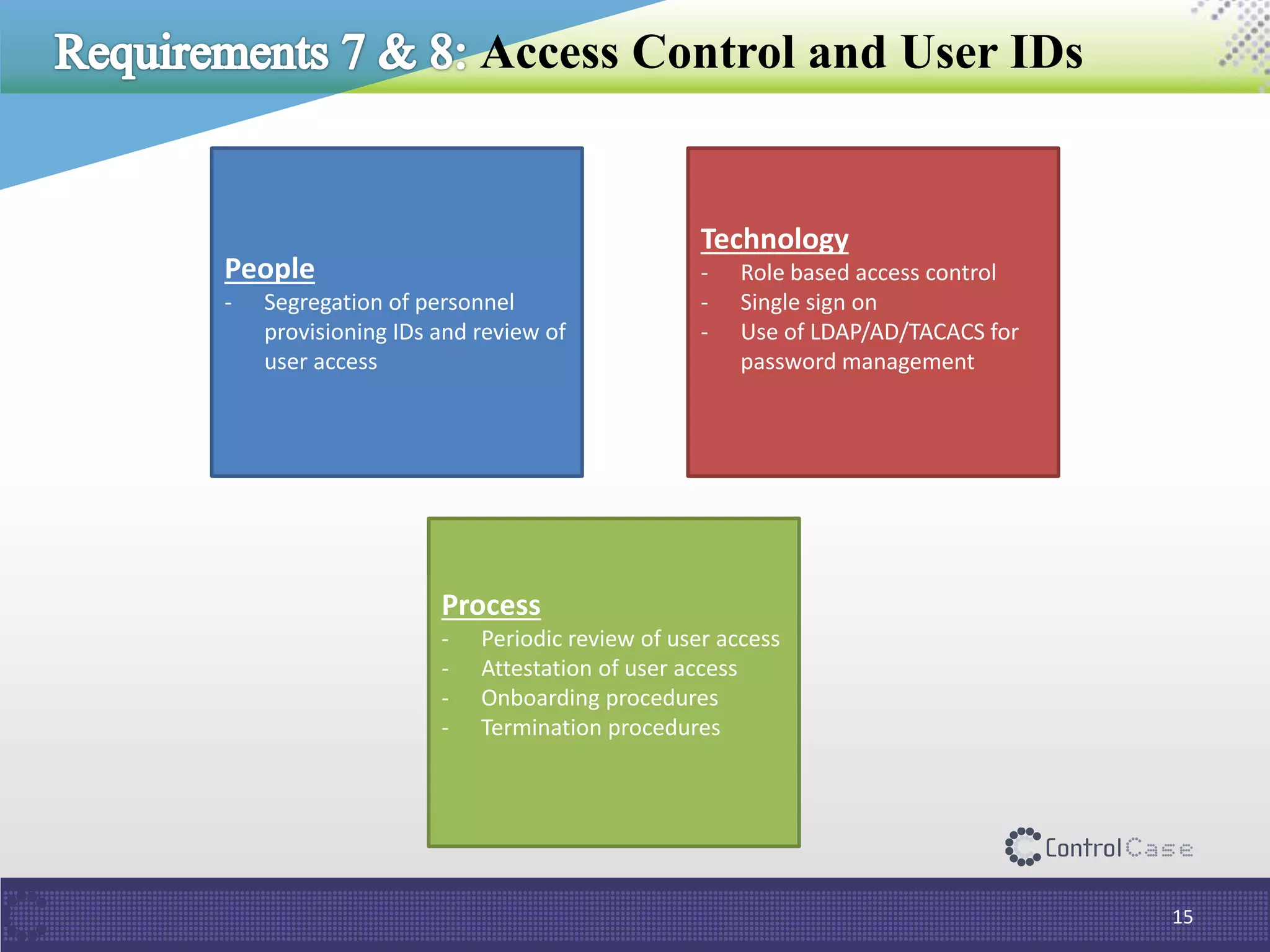
Access Control and User IDs
15
People
- Segregation of personnel
provisioning IDs and review of
user access
Process
- Periodic review of user access
- Attestation of user access
- Onboarding procedures
- Termination procedures
Technology
- Role based access control
- Single sign on
- Use of LDAP/AD/TACACS for
password management
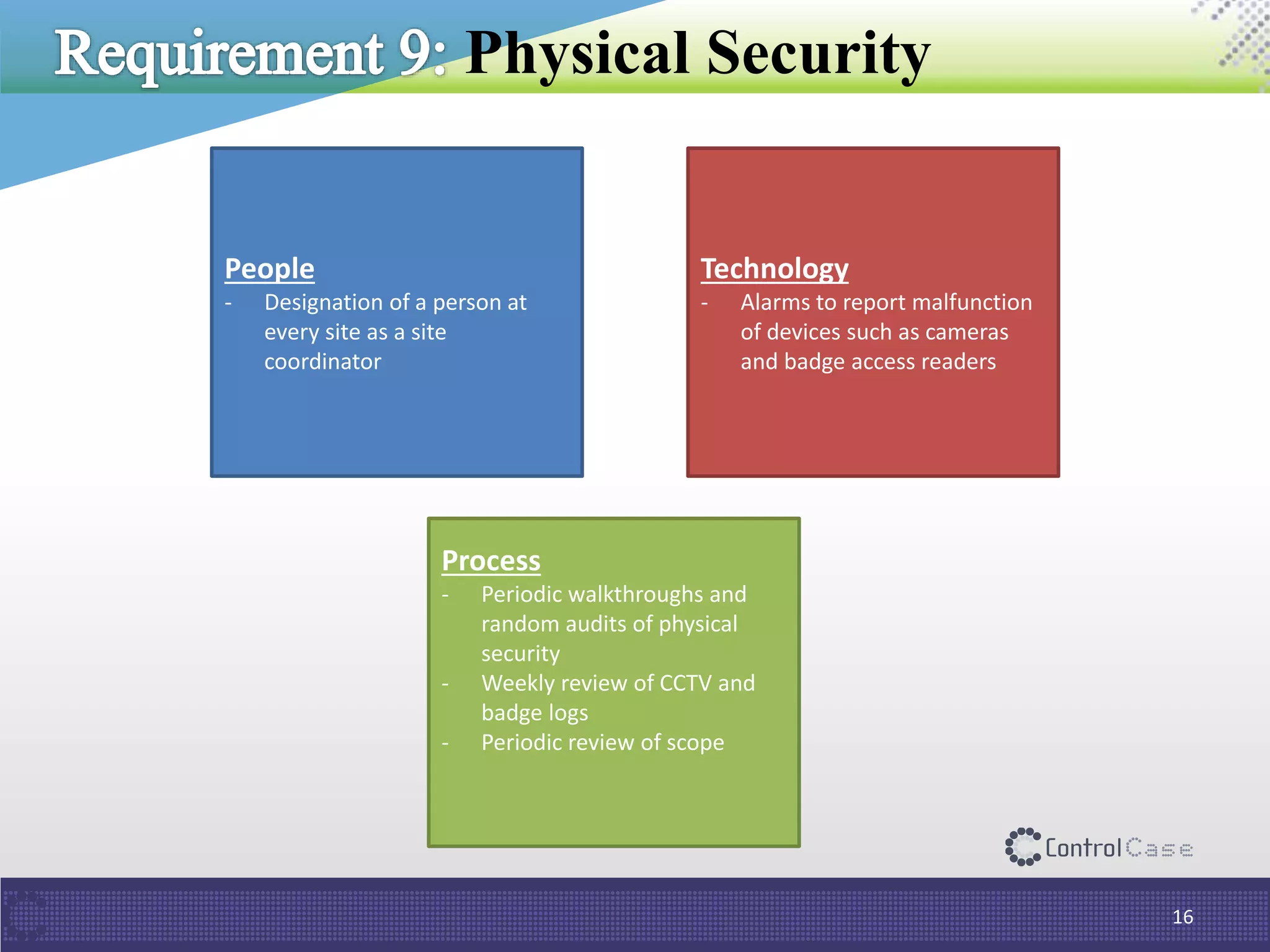
Physical Security
16
People
- Designation of a person at
every site as a site
coordinator
Process
- Periodic walkthroughs and
random audits of physical
security
- Weekly review of CCTV and
badge logs
- Periodic review of scope
Technology
- Alarms to report malfunction
of devices such as cameras
and badge access readers
Logging and Monitoring
17
People
- Personnel to actively monitor
logs 24/7/365
Process
- Periodic review of asset inventory
- Periodic review of scope
- Process to ensure logs from all
assets are feeding the SIEM solution
- Restoration of logs from 12 months
back every week/month
Technology
- Security and Event
Management (SIEM)
- Technology to identify new
assets not covered within
SIEM
Vulnerability Management
18
People
- Segregation of personnel
responsible for scanning vs
remediation of anomalies
- PCI project manager to
escalate non-compliance
Process
- Ongoing review of target
assets vs asset inventory for
appropriateness/change
- Periodic testing of IDS/IPS
effectiveness through random
penetration
tests/vulnerability scans
Technology
- Automated scanning
technology
- Technology to manage false
positives and compensating
controls
- Asset management repository
- File Integrity Monitoring (FIM)
technology
Policies and Procedures
19
People
- Coordination between
procurement and compliance
personnel
Process
- PCI DSS requirements tied to
procurement process
- PCI anomalies to be tracked
within vendor/third party
management solution
Technology
- Vendor management/Third
party management solution
PCI DSS Requirements
20
Control Objectives Requirements
Build and maintain a secure network 1. Install and maintain a firewall configuration to protect
cardholder data
2. Do not use vendor-supplied defaults for system passwords and
other security parameters
Protect cardholder data 3. Protect stored cardholder data
4. Encrypt transmission of cardholder data across open, public
networks
Maintain a vulnerability
management program
5. Use and regularly update anti-virus software on all systems
commonly affected by malware
6. Develop and maintain secure systems and applications
Implement strong access control
measures
7. Restrict access to cardholder data by business need-to-know
8. Assign a unique ID to each person with computer access
9. Restrict physical access to cardholder data
Regularly monitor and test networks 10. Track and monitor all access to network resources and
cardholder data
11. Regularly test security systems and processes
Maintain an information security
policy
12. Maintain a policy that addresses information security
Key Implementation Tips
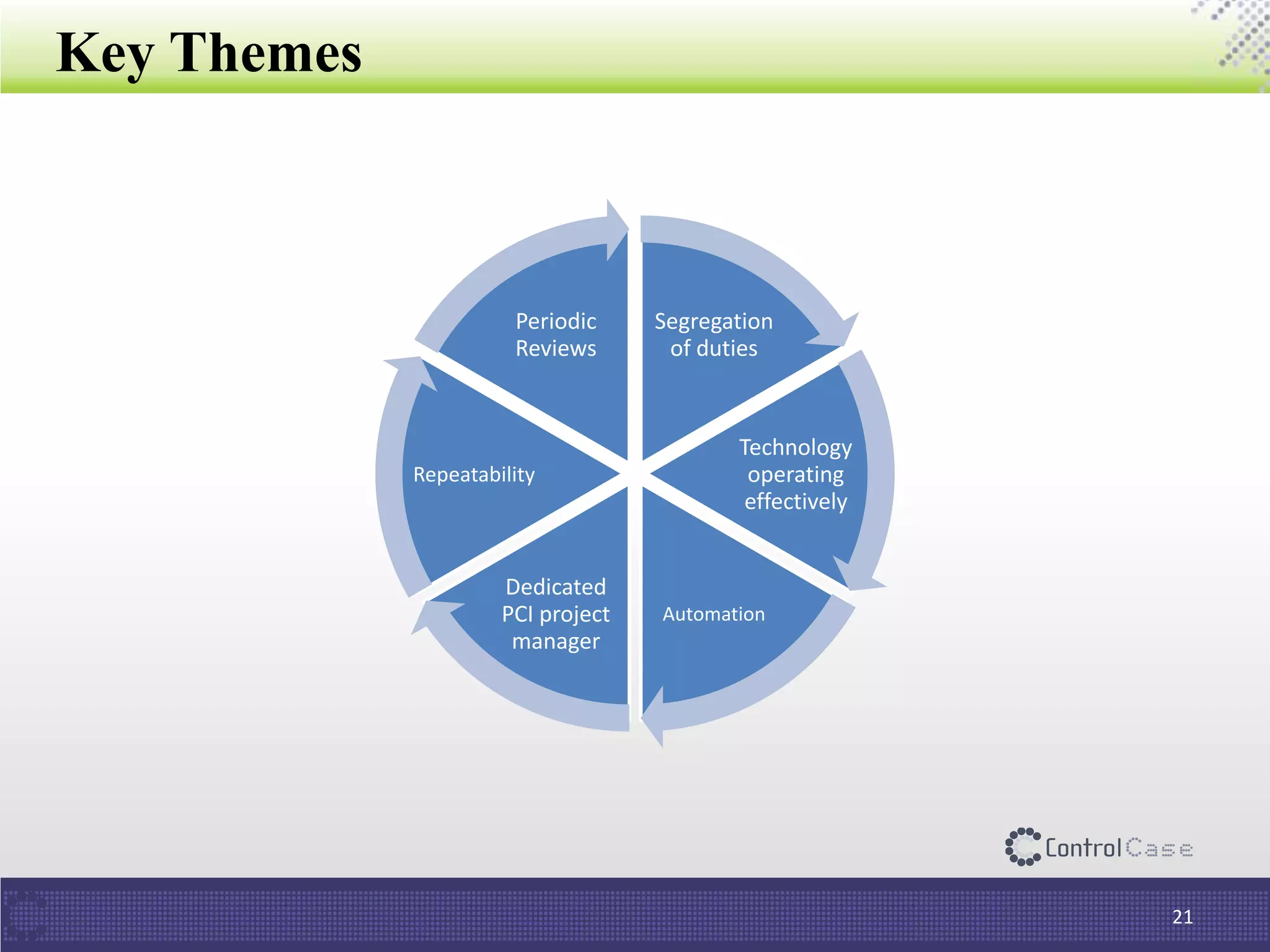
Key Themes
21
Segregation
of duties
Technology
operating
effectively
Automation
Dedicated
PCI project
manager
Repeatability
Periodic
Reviews
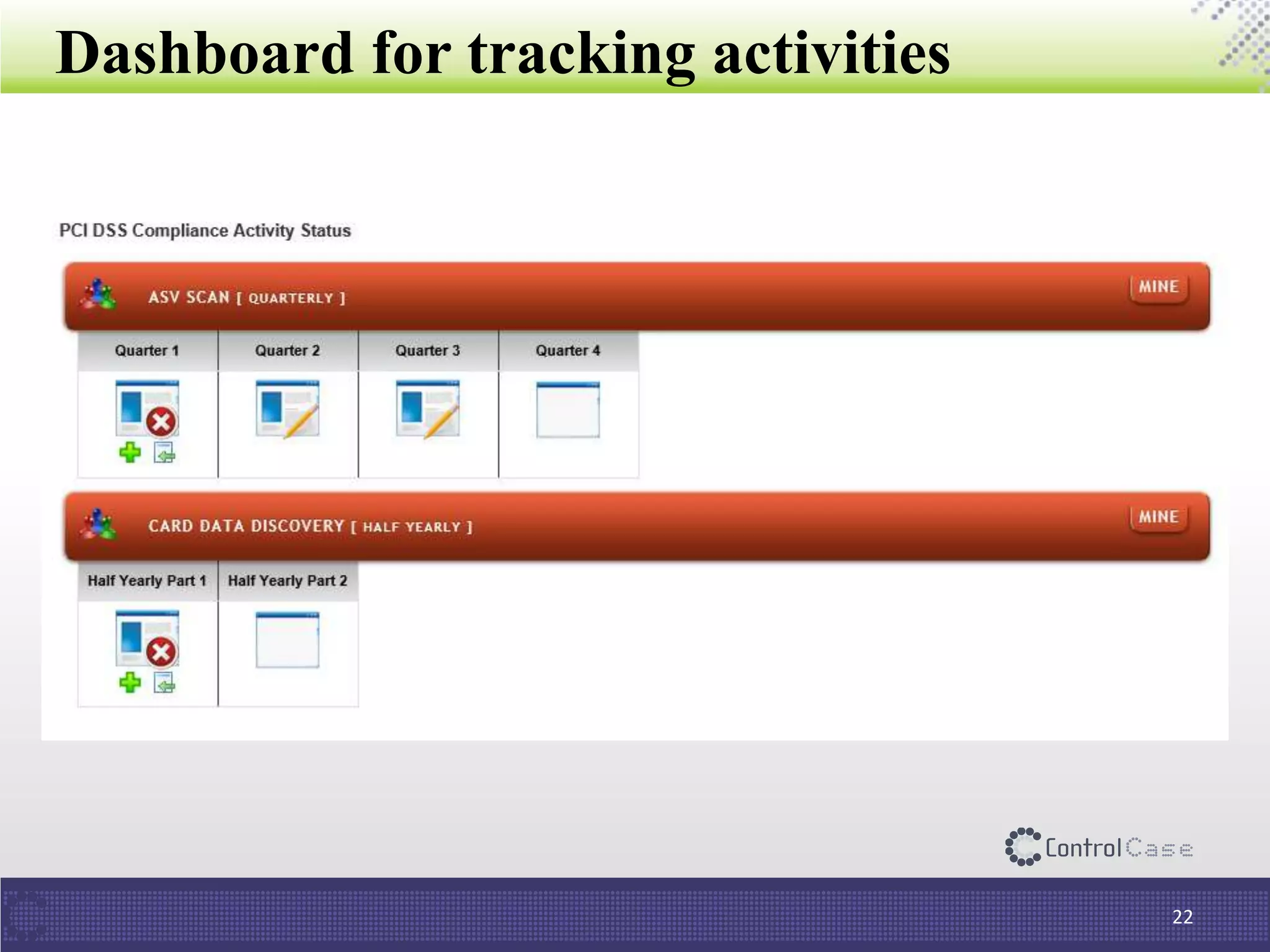
Dashboard for tracking activities
22
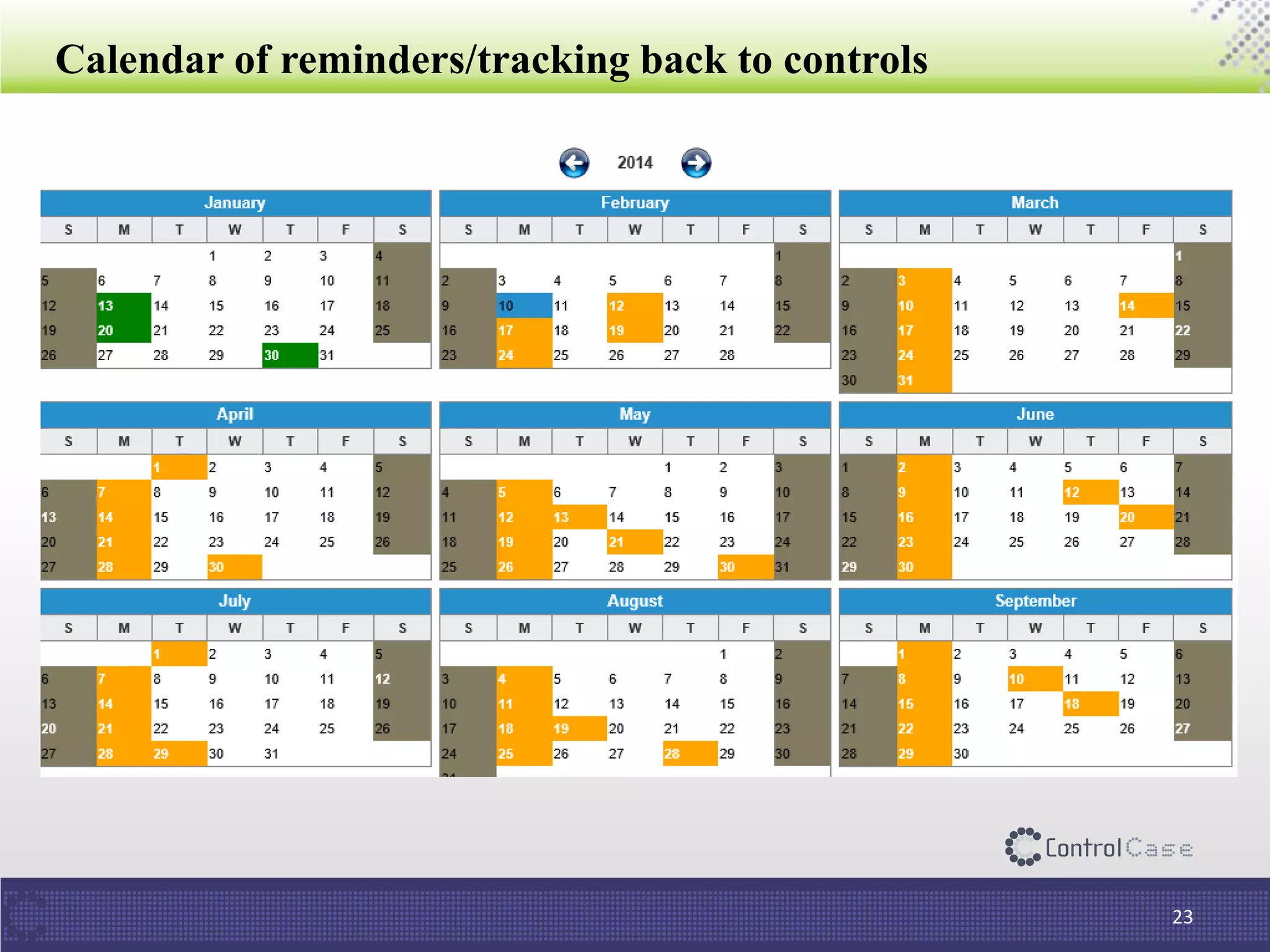
Calendar of reminders/tracking back to controls
23
ControlCase Solutions
Compliance as Usual (CaU)
› This solution aims to capitalize on your current compliance and
security investment by actually monitoring and analyzing the data you
collect
› ControlCase will draw data from client’s security controls (log
management systems, security scanners and other security systems)
and systematically analyze and evaluate this data on an ongoing basis
to develop a business as usual layer into the business.
› The deliverables will be:
• A periodic compliance status report that reflects data from all your
security controls.
• Outline of remediation actions required to maintain compliance with
multiple regulations.
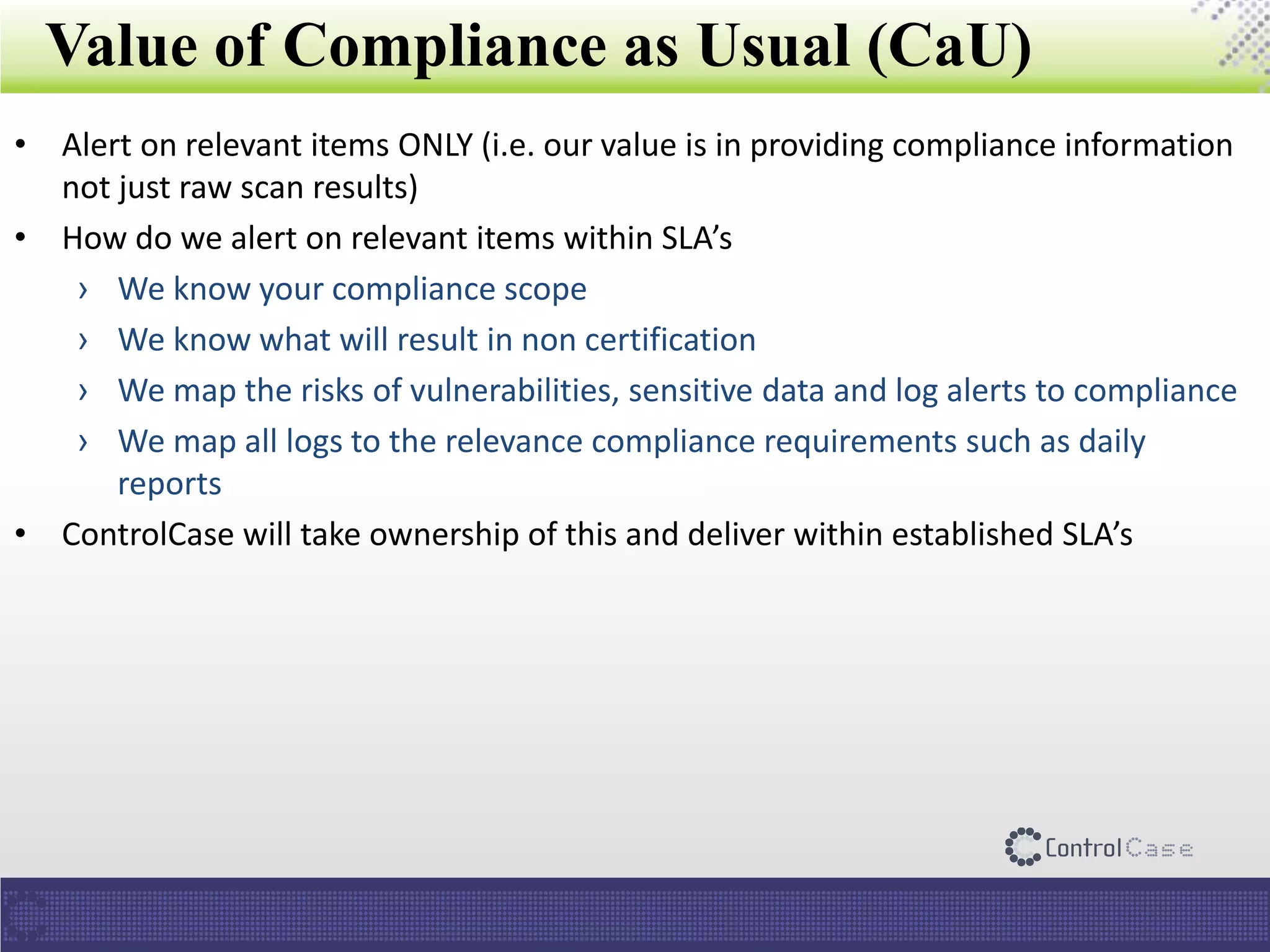
Value of Compliance as Usual (CaU)
• Alert on relevant items ONLY (i.e. our value is in providing compliance information
not just raw scan results)
• How do we alert on relevant items within SLA’s
› We know your compliance scope
› We know what will result in non certification
› We map the risks of vulnerabilities, sensitive data and log alerts to compliance
› We map all logs to the relevance compliance requirements such as daily
reports
• ControlCase will take ownership of this and deliver within established SLA’s
To Learn More About PCI Compliance…
• Visit www.controlcase.com
• Call +1.703.483.6383 (US)
• Call +91.9820293399 (India)
25
Thank You for Your Time

PCI DSS Business as Usual (BAU)

  • 1.
    PCI DSS 3.2– Making Compliance Business As Usual By Kishor Vaswani – CEO, ControlCase
  • 2.
    Agenda • About PCIDSS • Overview of changes • PCI BAU by requirement number • Implementation tips • ControlCase solution • Q&A 1
  • 3.
  • 4.
    What is PCIDSS? Payment Card Industry Data Security Standard: • Guidelines for securely processing, storing, or transmitting payment card account data • Established by leading payment card brands • Maintained by the PCI Security Standards Council (PCI SSC) 2
  • 5.
    PCI DSS Requirements ControlObjectives Requirements Build and maintain a secure network 1. Install and maintain a firewall configuration to protect cardholder data 2. Do not use vendor-supplied defaults for system passwords and other security parameters Protect cardholder data 3. Protect stored cardholder data 4. Encrypt transmission of cardholder data across open, public networks Maintain a vulnerability management program 5. Use and regularly update anti-virus software on all systems commonly affected by malware 6. Develop and maintain secure systems and applications Implement strong access control measures 7. Restrict access to cardholder data by business need-to-know 8. Assign a unique ID to each person with computer access 9. Restrict physical access to cardholder data Regularly monitor and test networks 10. Track and monitor all access to network resources and cardholder data 11. Regularly test security systems and processes Maintain an information security policy 12. Maintain a policy that addresses information security 3
  • 6.
    Timeline of PCIDSS 3.x 4 • PCI 3.0 was effective Jan 1st, 2014 • Current version is PCI DSS 3.2
  • 7.
  • 8.
    Overview of 3.2changes 5 SSL/early TLS • Work towards remediation • No new SSL/early TLS • Service provider offering by June 30, 2016 • No SSL/early TLS after June 30, 2018 • Some exceptions for POS POI terminals Display of PAN • Permits display of PAN beyond first 6/last 4 • Justification and business need must exist • Only the digits needed by business need must be displayed
  • 9.
    Overview contd… 6 Multifactor Authentication •All remote access must be multifactor • All non console admin access to CDE must be multifactor effective Jan 31, 2018 • Multifactor can be at system or application layer New Service Provider Requirements • Maintain documented description of cryptographic architecture • Detect and report on failures of critical security control systems • Quarterly review to ensure personnel following security procedures • Perform segmentation penetration test once every six months (Effective Feb 2018) • Executive management to establish responsibilities (Effective Feb 2018)
  • 10.
    PCI DSS 3.2Business As Usual by Requirement Number
  • 11.
    PCI Council Guidanceon BAU 7 Monitoring of security controls • Firewalls • IDS/IPS • File Integrity Monitoring (FIM) • Anti Virus Ensuring failures in security controls are detected and responded • Restoring the security control • Identifying the root cause • Identifying any security issues because of the failure • Mitigation • Resume monitoring of security control • Segregation of duties between detective and preventive controls
  • 12.
    PCI Council Guidanceon BAU 8 Review changes to environment • Addition of new systems • Changes or organizational structure • Impact of change to PCI DSS scope • Requirement applicable to new scope • Implement any additional security controls because of change • New hardware and software (and older ones) continue to be supported and do not impact compliance Periodic reviews • Configuration • Physical security • Patches and Anti Virus • Audit logs • Access rights
  • 13.
    Firewalls 9 People - PCI projectmanager to escalate non-compliance - Segregation of duties between operations performing change and compliance personnel reviewing change Process - PCI impact analysis as part of firewall change management process Technology - Automated/Periodic ruleset reviews - Weekly port scans from CDE to Internet to verify no outbound connections
  • 14.
    Configuration Standards 10 People - PCIproject manager to escalate non-compliance Process - Periodic update to configuration standards - New infrastructure onboarding process to include PCI configuration standards check Technology - Automated/Periodic configuration scans - Reminders to update configuration standards quarterly - Technology to flag new assets that have not formally undergone PCI configuration standards check
  • 15.
    Protect Stored CardholderData 11 People - PCI project manager to escalate non-compliance to highest levels within organization Process - Periodic false positive management - Search for cardholder data during roll out tests/quality assurance Technology - Automated/Periodic cardholder data scans - Alerts in case of new cardholder data found
  • 16.
    Protect Cardholder Datain Transmission 12 People - Training to ensure personnel do not email/chat clear text card data - Personnel allocated to review outbound data at random Process - Periodic review of modes of transmission i.e. wireless, chat, email etc. Technology - Automated technology to monitor transmission of card data through perimeter (e.g. email, chat monitoring)
  • 17.
    Antivirus and Malware 13 People -PCI project manager to escalate non-compliance Process - Process to ensure all assets are protected by antivirus - Process to implement antivirus and anti-malware on all new systems being deployed Technology - Technology to detect any systems that do not have anti virus/anti malware installed
  • 18.
    Secure Applications 14 People - Segregationof development and security duties - Periodic training of developers to security standards such as OWASP Process - Continuous scanning of applications - Scanning of applications as part of SDLC - Code review as part of SDLC - Review of QA/test cases on a periodic basis to ensure all of them have a security checkpoint and approval Technology - Application scanning software - Code review software - Identification of instances where changes have occurred to applications - Application firewalls
  • 19.
    Access Control andUser IDs 15 People - Segregation of personnel provisioning IDs and review of user access Process - Periodic review of user access - Attestation of user access - Onboarding procedures - Termination procedures Technology - Role based access control - Single sign on - Use of LDAP/AD/TACACS for password management
  • 20.
    Physical Security 16 People - Designationof a person at every site as a site coordinator Process - Periodic walkthroughs and random audits of physical security - Weekly review of CCTV and badge logs - Periodic review of scope Technology - Alarms to report malfunction of devices such as cameras and badge access readers
  • 21.
    Logging and Monitoring 17 People -Personnel to actively monitor logs 24/7/365 Process - Periodic review of asset inventory - Periodic review of scope - Process to ensure logs from all assets are feeding the SIEM solution - Restoration of logs from 12 months back every week/month Technology - Security and Event Management (SIEM) - Technology to identify new assets not covered within SIEM
  • 22.
    Vulnerability Management 18 People - Segregationof personnel responsible for scanning vs remediation of anomalies - PCI project manager to escalate non-compliance Process - Ongoing review of target assets vs asset inventory for appropriateness/change - Periodic testing of IDS/IPS effectiveness through random penetration tests/vulnerability scans Technology - Automated scanning technology - Technology to manage false positives and compensating controls - Asset management repository - File Integrity Monitoring (FIM) technology
  • 23.
    Policies and Procedures 19 People -Coordination between procurement and compliance personnel Process - PCI DSS requirements tied to procurement process - PCI anomalies to be tracked within vendor/third party management solution Technology - Vendor management/Third party management solution
  • 24.
    PCI DSS Requirements 20 ControlObjectives Requirements Build and maintain a secure network 1. Install and maintain a firewall configuration to protect cardholder data 2. Do not use vendor-supplied defaults for system passwords and other security parameters Protect cardholder data 3. Protect stored cardholder data 4. Encrypt transmission of cardholder data across open, public networks Maintain a vulnerability management program 5. Use and regularly update anti-virus software on all systems commonly affected by malware 6. Develop and maintain secure systems and applications Implement strong access control measures 7. Restrict access to cardholder data by business need-to-know 8. Assign a unique ID to each person with computer access 9. Restrict physical access to cardholder data Regularly monitor and test networks 10. Track and monitor all access to network resources and cardholder data 11. Regularly test security systems and processes Maintain an information security policy 12. Maintain a policy that addresses information security
  • 25.
  • 26.
  • 27.
  • 28.
    Calendar of reminders/trackingback to controls 23
  • 29.
  • 30.
    Compliance as Usual(CaU) › This solution aims to capitalize on your current compliance and security investment by actually monitoring and analyzing the data you collect › ControlCase will draw data from client’s security controls (log management systems, security scanners and other security systems) and systematically analyze and evaluate this data on an ongoing basis to develop a business as usual layer into the business. › The deliverables will be: • A periodic compliance status report that reflects data from all your security controls. • Outline of remediation actions required to maintain compliance with multiple regulations.
  • 31.
    Value of Complianceas Usual (CaU) • Alert on relevant items ONLY (i.e. our value is in providing compliance information not just raw scan results) • How do we alert on relevant items within SLA’s › We know your compliance scope › We know what will result in non certification › We map the risks of vulnerabilities, sensitive data and log alerts to compliance › We map all logs to the relevance compliance requirements such as daily reports • ControlCase will take ownership of this and deliver within established SLA’s
  • 32.
    To Learn MoreAbout PCI Compliance… • Visit www.controlcase.com • Call +1.703.483.6383 (US) • Call +91.9820293399 (India) 25
  • 33.
    Thank You forYour Time