Sushovan Dalui (15/BT/31)
Department of Biotechnology
Haldia Institure of Technology
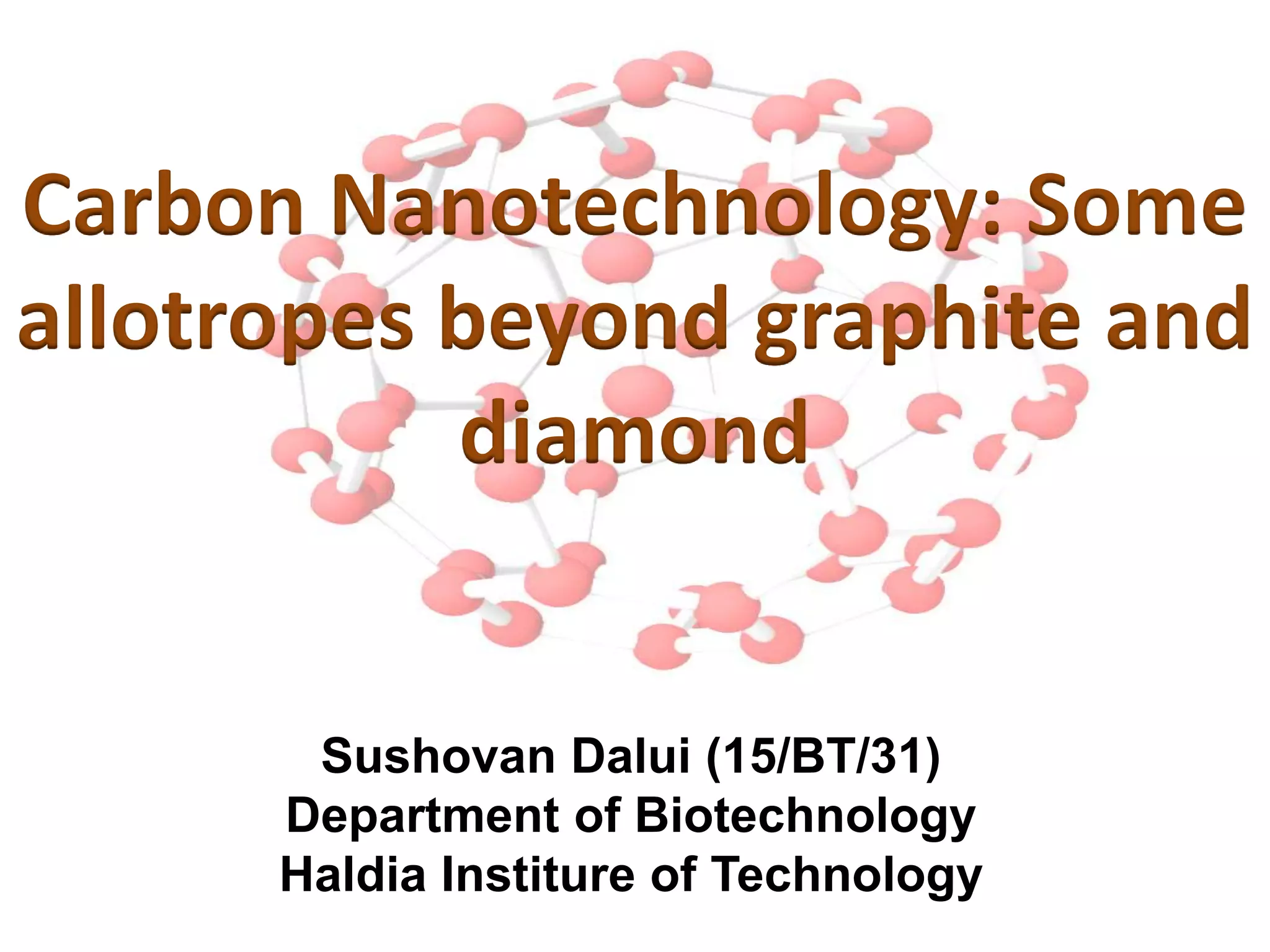
Carbon Nanotechnology: Some
allotropes beyond graphite and
diamond
Nanotechnology
Nanotech nology
What is this
Nanotechnology?
It deals with dimensions and tolerances of less
than 100 nanometres, especially the
manipulation of individual atoms and
molecules.
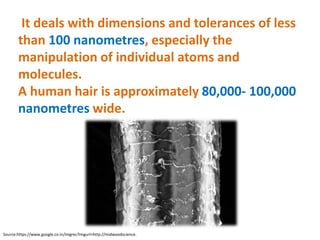
A human hair is approximately 80,000- 100,000
nanometres wide.
Source:https://www.google.co.in/imgres?imgurl=http://midwoodscience.
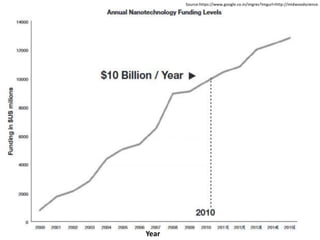
Year
Source:https://www.google.co.in/imgres?imgurl=http://midwoodscience.
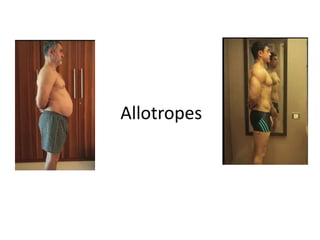
Allotropes
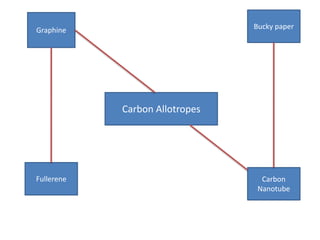
Bucky paperGraphine
Fullerene Carbon
Nanotube
Carbon Allotropes
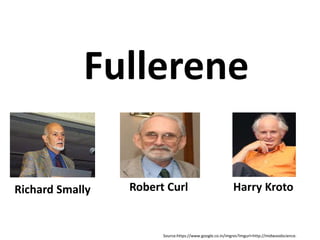
Fullerene
Richard Smally Robert Curl Harry Kroto
Source:https://www.google.co.in/imgres?imgurl=http://midwoodscience.
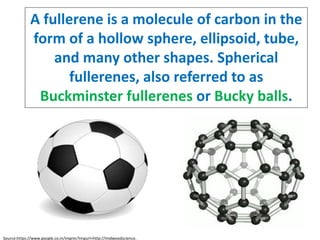
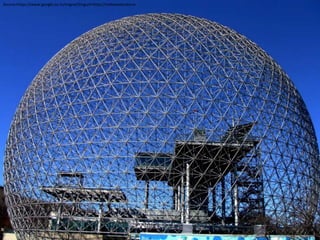
A fullerene is a molecule of carbon in the
form of a hollow sphere, ellipsoid, tube,
and many other shapes. Spherical
fullerenes, also referred to as
Buckminster fullerenes or Bucky balls.
Source:https://www.google.co.in/imgres?imgurl=http://midwoodscience.
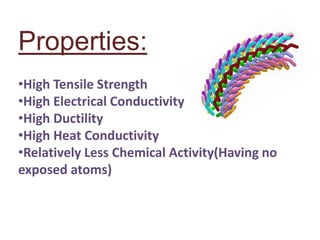
Properties:
•High Tensile Strength
•High Electrical Conductivity
•High Ductility
•High Heat Conductivity
•Relatively Less Chemical Activity(Having no
exposed atoms)
Applications
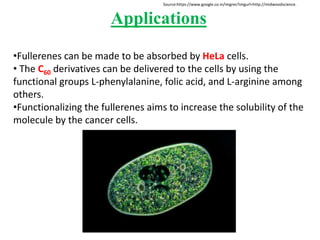
•Fullerenes can be made to be absorbed by HeLa cells.
• The C60 derivatives can be delivered to the cells by using the
functional groups L-phenylalanine, folic acid, and L-arginine among
others.
•Functionalizing the fullerenes aims to increase the solubility of the
molecule by the cancer cells.
Source:https://www.google.co.in/imgres?imgurl=http://midwoodscience.
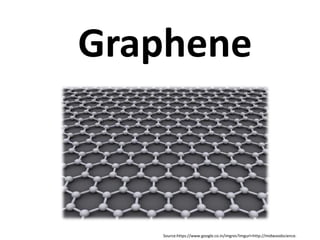
Graphene
Source:https://www.google.co.in/imgres?imgurl=http://midwoodscience.
Properties:
Graphene is an allotrope of carbon
consisting of a single layer of carbon
atoms arranged in an hexagonal
lattice.
•It is the strongest material ever
tested
•Efficiently conducts heat
•Efficiently conducts electricity
•Graphene shows a large and
nonlinear diamagnetism.
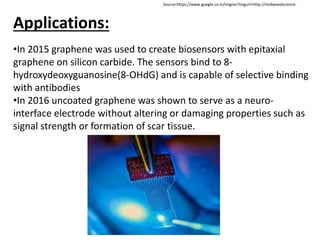
Applications:
•In 2015 graphene was used to create biosensors with epitaxial
graphene on silicon carbide. The sensors bind to 8-
hydroxydeoxyguanosine(8-OHdG) and is capable of selective binding
with antibodies
•In 2016 uncoated graphene was shown to serve as a neuro-
interface electrode without altering or damaging properties such as
signal strength or formation of scar tissue.
Source:https://www.google.co.in/imgres?imgurl=http://midwoodscience.
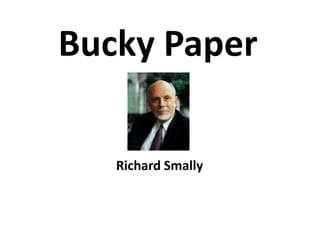
Bucky Paper
Richard Smally
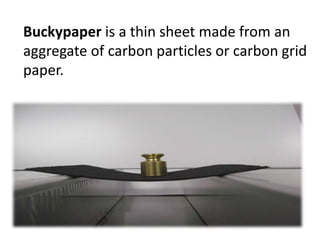
Buckypaper is a thin sheet made from an
aggregate of carbon particles or carbon grid
paper.
Properties:
Source:https://www.google.co.in/imgres?imgurl=http://midwoodscience.
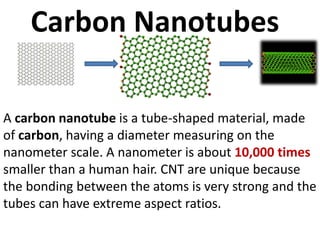
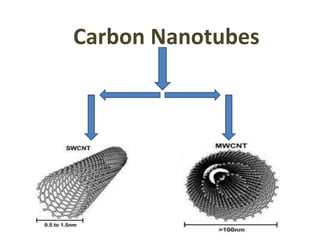
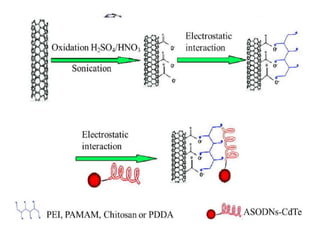
Carbon Nanotubes
A carbon nanotube is a tube-shaped material, made
of carbon, having a diameter measuring on the
nanometer scale. A nanometer is about 10,000 times
smaller than a human hair. CNT are unique because
the bonding between the atoms is very strong and the
tubes can have extreme aspect ratios.
Carbon Nanotubes
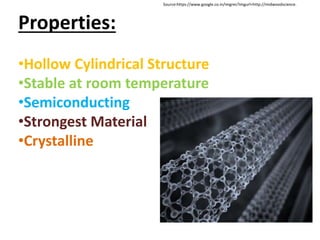
Properties:
•Hollow Cylindrical Structure
•Stable at room temperature
•Semiconducting
•Strongest Material
•Crystalline
Source:https://www.google.co.in/imgres?imgurl=http://midwoodscience.
Applications
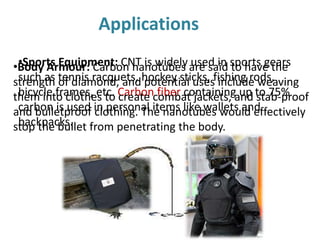
•Sports Equipment: CNT is widely used in sports gears
such as tennis racquets, hockey sticks, fishing rods,
bicycle frames, etc. Carbon fiber containing up to 75%
carbon is used in personal items like wallets and
backpacks.
•Body Armour: Carbon nanotubes are said to have the
strength of diamond, and potential uses include weaving
them into clothes to create combat jackets, and stab-proof
and bulletproof clothing. The nanotubes would effectively
stop the bullet from penetrating the body.
Applications
•Gene Therapy and Cancer Therapy: Carbon nanotubes can
be used to target tumours and as multifunctional biological
transporters, and near-infrared agents for selective cancer
cell destruction. Carbon nanotubes have been proposed as a
possible gene delivery vehicle and for use in combination with
radiofrequency fields to destroy cancer cells.
•Drug Delivery: Carbon nanotubes can be used as a vessel for
transporting drugs into the body. The nanotube could
effectively localize the distribution and hence lower the
dosage of the drug.
Applications
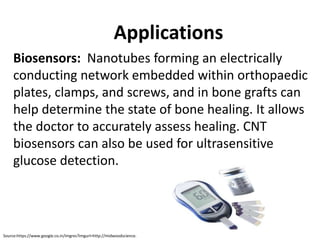
Biosensors: Nanotubes forming an electrically
conducting network embedded within orthopaedic
plates, clamps, and screws, and in bone grafts can
help determine the state of bone healing. It allows
the doctor to accurately assess healing. CNT
biosensors can also be used for ultrasensitive
glucose detection.
Source:https://www.google.co.in/imgres?imgurl=http://midwoodscience.
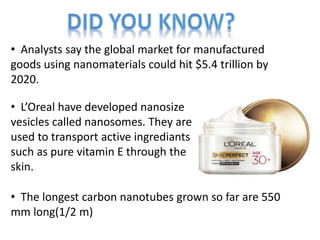
• Analysts say the global market for manufactured
goods using nanomaterials could hit $5.4 trillion by
2020.
• L’Oreal have developed nanosize
vesicles called nanosomes. They are
used to transport active ingrediants
such as pure vitamin E through the
skin.
• The longest carbon nanotubes grown so far are 550
mm long(1/2 m)
References
•S Iijima, Helical microtubules of graphitic carbon, Nature, Vol.354,
p.6348, pp.56–58, 7 November 1991.
•This Month in Physics History: October 22, 2004: Discovery of Graphene, APS
News, Series II, Vol.18, No.9, p.2, 2009.
•S Gullapalli, M S Wong, Nanotechnology: A Guide to Nano-Objects (PDF),
Chemical Engineering Progress, Vol.107, No.5, pp.2832, 2011.
•P Surabhi, From Carbon To Bucky Paper, Resonance- Journal of Science Education,
Vol.22, Issue 3, pp 257-268, March 2017
Thank
You

Carbon Nanotechnology

  • 1.
    Sushovan Dalui (15/BT/31) Departmentof Biotechnology Haldia Institure of Technology Carbon Nanotechnology: Some allotropes beyond graphite and diamond
  • 2.
  • 3.
  • 4.
  • 5.
    It deals withdimensions and tolerances of less than 100 nanometres, especially the manipulation of individual atoms and molecules. A human hair is approximately 80,000- 100,000 nanometres wide. Source:https://www.google.co.in/imgres?imgurl=http://midwoodscience.
  • 6.
  • 7.
  • 8.
  • 9.
    Fullerene Richard Smally RobertCurl Harry Kroto Source:https://www.google.co.in/imgres?imgurl=http://midwoodscience.
  • 10.
    A fullerene isa molecule of carbon in the form of a hollow sphere, ellipsoid, tube, and many other shapes. Spherical fullerenes, also referred to as Buckminster fullerenes or Bucky balls. Source:https://www.google.co.in/imgres?imgurl=http://midwoodscience.
  • 11.
  • 12.
    Properties: •High Tensile Strength •HighElectrical Conductivity •High Ductility •High Heat Conductivity •Relatively Less Chemical Activity(Having no exposed atoms)
  • 13.
    Applications •Fullerenes can bemade to be absorbed by HeLa cells. • The C60 derivatives can be delivered to the cells by using the functional groups L-phenylalanine, folic acid, and L-arginine among others. •Functionalizing the fullerenes aims to increase the solubility of the molecule by the cancer cells. Source:https://www.google.co.in/imgres?imgurl=http://midwoodscience.
  • 14.
  • 15.
    Properties: Graphene is anallotrope of carbon consisting of a single layer of carbon atoms arranged in an hexagonal lattice. •It is the strongest material ever tested •Efficiently conducts heat •Efficiently conducts electricity •Graphene shows a large and nonlinear diamagnetism.
  • 16.
    Applications: •In 2015 graphenewas used to create biosensors with epitaxial graphene on silicon carbide. The sensors bind to 8- hydroxydeoxyguanosine(8-OHdG) and is capable of selective binding with antibodies •In 2016 uncoated graphene was shown to serve as a neuro- interface electrode without altering or damaging properties such as signal strength or formation of scar tissue. Source:https://www.google.co.in/imgres?imgurl=http://midwoodscience.
  • 17.
  • 18.
    Buckypaper is athin sheet made from an aggregate of carbon particles or carbon grid paper.
  • 19.
  • 20.
  • 21.
    Carbon Nanotubes A carbonnanotube is a tube-shaped material, made of carbon, having a diameter measuring on the nanometer scale. A nanometer is about 10,000 times smaller than a human hair. CNT are unique because the bonding between the atoms is very strong and the tubes can have extreme aspect ratios.
  • 22.
  • 23.
    Properties: •Hollow Cylindrical Structure •Stableat room temperature •Semiconducting •Strongest Material •Crystalline Source:https://www.google.co.in/imgres?imgurl=http://midwoodscience.
  • 24.
    Applications •Sports Equipment: CNTis widely used in sports gears such as tennis racquets, hockey sticks, fishing rods, bicycle frames, etc. Carbon fiber containing up to 75% carbon is used in personal items like wallets and backpacks. •Body Armour: Carbon nanotubes are said to have the strength of diamond, and potential uses include weaving them into clothes to create combat jackets, and stab-proof and bulletproof clothing. The nanotubes would effectively stop the bullet from penetrating the body.
  • 25.
    Applications •Gene Therapy andCancer Therapy: Carbon nanotubes can be used to target tumours and as multifunctional biological transporters, and near-infrared agents for selective cancer cell destruction. Carbon nanotubes have been proposed as a possible gene delivery vehicle and for use in combination with radiofrequency fields to destroy cancer cells. •Drug Delivery: Carbon nanotubes can be used as a vessel for transporting drugs into the body. The nanotube could effectively localize the distribution and hence lower the dosage of the drug.
  • 27.
    Applications Biosensors: Nanotubes formingan electrically conducting network embedded within orthopaedic plates, clamps, and screws, and in bone grafts can help determine the state of bone healing. It allows the doctor to accurately assess healing. CNT biosensors can also be used for ultrasensitive glucose detection. Source:https://www.google.co.in/imgres?imgurl=http://midwoodscience.
  • 28.
    • Analysts saythe global market for manufactured goods using nanomaterials could hit $5.4 trillion by 2020. • L’Oreal have developed nanosize vesicles called nanosomes. They are used to transport active ingrediants such as pure vitamin E through the skin. • The longest carbon nanotubes grown so far are 550 mm long(1/2 m)
  • 30.
    References •S Iijima, Helicalmicrotubules of graphitic carbon, Nature, Vol.354, p.6348, pp.56–58, 7 November 1991. •This Month in Physics History: October 22, 2004: Discovery of Graphene, APS News, Series II, Vol.18, No.9, p.2, 2009. •S Gullapalli, M S Wong, Nanotechnology: A Guide to Nano-Objects (PDF), Chemical Engineering Progress, Vol.107, No.5, pp.2832, 2011. •P Surabhi, From Carbon To Bucky Paper, Resonance- Journal of Science Education, Vol.22, Issue 3, pp 257-268, March 2017
  • 31.