Carbon Dioxide
Utilization
CO2 is a friend and a foe, and the greatest greenhouse gas by volume.
Downstream products of CO2 and applications make the commodity less
of a foe. These uses include making chemicals and useful materials, such
as plastics, fuels, building materials, carbonic acid, supercritical extraction
uses, sodium bicarbonate (baking soda); replacement molecules for
enhanced coal bed methane, enhanced oil recovery (EOR) ventures; and
much more.
Useful applications for CO2 represent a partial
solution toward reduction of greenhouse gases.
• Some estimates indicate a CO2 atmospheric presence of 0.036% (v), where many
hoped we would stay clear of 0.04%, which poses an even greater danger of
irreversible climate changes, per some accounts.
• CO2 from biofuels, such as fermentation can make these biofuels projects even
greener, when using CO2 in a number of recycling and environmentally friendly
applications.
• Beyond fermentation, even greater sums of CO2 are emitted by coal – based
power plants, some 40% of all CO2 emissions; then CO2 emissions from engine
exhaust may be second in volume, and many combustion processes make for
ever greater CO2 reduction challenges.
Applying & converting CO2 into useful products;
one being plastics is of great interest.
• CO2 as a feedstock for plastics is important for carbon reduction schemes; as
well as applications for the production of fuels, chemicals, and building
materials.
• In the case of polymers, over 40% of the product weight can be replaced with
CO2; and the applications can range from solid plastics to soft foam – like
products.
• The range in plastics density and form is a function of the size of the polymer
chain.
• Conventional polyethylene and polyproplene are heavily dependent upon fossil
fuels. Some CO2 applications in plastics can replace this petroleum – based
content by 50%. Such processes include Novomer.
Other CO2 applications and useful products which
represent better methods, and a net greenhouse gas
reduction.
• CO2 (when dissolved in water) represents carbonic acid (H2CO3), which safely
replaces mineral acids such as sulfuric; and leads to a benign by-product as
carbonates and bicarbonates v. environmentally harmful sulfate compounds.
• CO2 usage for enhanced photosynthesis in commercial greenhouse settings and
the production of algae for biofuels and other commercial uses, is an excellent
CO2 sink.
• Supercritical extraction of essential oils, spices, etc., replace hydrocarbon
materials such as hexane results in a non-toxic alternative, with no hydrocarbon
disposal requirements.
More useful applications and products of
CO2 usage in industry
• Grain fumigation with CO2 v. use of halogenated hydrocarbon (carbon
tetrachloride) and other agents represents a non-carcinogenic approach to
fumigation.
• Sequestration of CO2 in pre-cast concrete, enhances concrete curing. One such
process can sequester 60 tons of CO2 in 100 tons of pre-cast concrete.
• Common commodity chemicals sequester CO2 in their manufacture, such as
urea, methanol, sodium bicarbonate, and calcium carbonate.
• Enhanced recovery of fossil fuels is well proven in EOR (enhanced oil recovery),
and CBM (enhanced coal bed methane) projects.
CO2 uptake in algae
projects
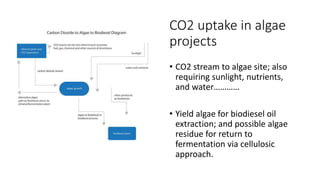
• CO2 stream to algae site; also
requiring sunlight, nutrients,
and water…………
• Yield algae for biodiesel oil
extraction; and possible algae
residue for return to
fermentation via cellulosic
approach.

Advanced Biofuels Feedstocks Conference

  • 1.
    Carbon Dioxide Utilization CO2 isa friend and a foe, and the greatest greenhouse gas by volume. Downstream products of CO2 and applications make the commodity less of a foe. These uses include making chemicals and useful materials, such as plastics, fuels, building materials, carbonic acid, supercritical extraction uses, sodium bicarbonate (baking soda); replacement molecules for enhanced coal bed methane, enhanced oil recovery (EOR) ventures; and much more.
  • 2.
    Useful applications forCO2 represent a partial solution toward reduction of greenhouse gases. • Some estimates indicate a CO2 atmospheric presence of 0.036% (v), where many hoped we would stay clear of 0.04%, which poses an even greater danger of irreversible climate changes, per some accounts. • CO2 from biofuels, such as fermentation can make these biofuels projects even greener, when using CO2 in a number of recycling and environmentally friendly applications. • Beyond fermentation, even greater sums of CO2 are emitted by coal – based power plants, some 40% of all CO2 emissions; then CO2 emissions from engine exhaust may be second in volume, and many combustion processes make for ever greater CO2 reduction challenges.
  • 3.
    Applying & convertingCO2 into useful products; one being plastics is of great interest. • CO2 as a feedstock for plastics is important for carbon reduction schemes; as well as applications for the production of fuels, chemicals, and building materials. • In the case of polymers, over 40% of the product weight can be replaced with CO2; and the applications can range from solid plastics to soft foam – like products. • The range in plastics density and form is a function of the size of the polymer chain. • Conventional polyethylene and polyproplene are heavily dependent upon fossil fuels. Some CO2 applications in plastics can replace this petroleum – based content by 50%. Such processes include Novomer.
  • 4.
    Other CO2 applicationsand useful products which represent better methods, and a net greenhouse gas reduction. • CO2 (when dissolved in water) represents carbonic acid (H2CO3), which safely replaces mineral acids such as sulfuric; and leads to a benign by-product as carbonates and bicarbonates v. environmentally harmful sulfate compounds. • CO2 usage for enhanced photosynthesis in commercial greenhouse settings and the production of algae for biofuels and other commercial uses, is an excellent CO2 sink. • Supercritical extraction of essential oils, spices, etc., replace hydrocarbon materials such as hexane results in a non-toxic alternative, with no hydrocarbon disposal requirements.
  • 5.
    More useful applicationsand products of CO2 usage in industry • Grain fumigation with CO2 v. use of halogenated hydrocarbon (carbon tetrachloride) and other agents represents a non-carcinogenic approach to fumigation. • Sequestration of CO2 in pre-cast concrete, enhances concrete curing. One such process can sequester 60 tons of CO2 in 100 tons of pre-cast concrete. • Common commodity chemicals sequester CO2 in their manufacture, such as urea, methanol, sodium bicarbonate, and calcium carbonate. • Enhanced recovery of fossil fuels is well proven in EOR (enhanced oil recovery), and CBM (enhanced coal bed methane) projects.
  • 6.
    CO2 uptake inalgae projects • CO2 stream to algae site; also requiring sunlight, nutrients, and water………… • Yield algae for biodiesel oil extraction; and possible algae residue for return to fermentation via cellulosic approach.