By Suresh Chaudhary
Chapter 12
Some gases
Carbon Dioxide
Introduction of CO2
 Carbon Dioxide molecules consist of a carbon atom covalently double
bonded to two oxygen atoms.
 CO2 (Carbon Dioxide) is a colorless gas with a density of about 60%.
 It is also referred as dry ice and its molecular formula is CO2.
 It occurs naturally in the atmosphere.
 It is a non-combustible gas and its molecular mass is 44 amu.
 Discovered by Van Helmot carbon dioxide for the first time in 1630 AD
by burning wood.
 Prepared by Joseph Black by burning magnesium in 1977 AD.
 Lavoisier proved it as compound of carbon and oxygen in 1783 AD.
Natural sources – process of breathing, combustion of organic matter, volcanic
eruptions, cellular respiration by aerobic entities, wood and fossil burning,
Artificial sources -Industrial fermentation process, heating of metallic carbonates
and bicarbonates, exhaust of automobiles etc.
Occurrence of CO2
 It is found in combined state as well as in Free State.
 The atmosphere of the earth contains 0.03% of CO2 by volume in Free State.
 Carbon dioxide gas is released when chemical reaction takes place in
carbonates like limestone, magnetite, carbohydrate, etc.
General Method of preparation:
a. By burning carbon in excess air:
C+O2 ∆ CO2↑
b. By burning organic compounds in oxygen:
CH4 + 2O2 ∆  CO2↑ + 2H2O+ Energy
Methane
2C2H6 + 7O2 →4CO2↑ + 6H20+Energy
c. By the reaction of acid with metallic carbonates and bicarbonates:
Na2CO3 + 2HCl 2NaCl + H2O + CO2
Ca (HCO3)2 + 2HCL/H2SO4 → CaCl2/CaSO4 + 2H2O+2CO2 ↑
Laboratory preparation of carbon dioxide
Carbon dioxide is produced whenever an acid reacts with a carbonate. This makes
carbon dioxide easy to make in the laboratory. Calcium carbonate and hydrochloric
acid are usually used because they are cheap and easy to obtain.
Principle:
When calcium carbonate (marble or limestone or chalk) is treated with dilute
hydrochloric acid, carbon dioxide is produced.
CaCO3 + 2HCL [dil] →CaCl2 + H2O+ CO2 ↑
Assignments
1. Write the molecular weight of CO2.
2. Mention two chemicals required for laboratory preparation of CO2
gas.
3. Write down any two methods for general preparation CO2 gas.
4. Draw a well labeled figure of laboratory preparation CO2 gas with its
chemical equation.
Precautions to be taken during laboratory preparation:
a. Caron dioxide should be collected by upward displacement of air carbon
dioxide gas is heavier than air.
b. The apparatus must be airtight.
c. The end of the thistle funnel should be dipped in the acid of the Woulfe’s
bottle to prevent the CO2 escape out from it.
d. The end of the delivery tube should not touch the acid inside the Woulfe’s
bottle to allow the CO2 gas easily passes through gas jar.
e. Dilute/Conc H2SO4 cannot be used instead of dilute HCL for the laboratory
preparation of CO2 gas because the calcium sulphate so formed covers the
remaining part of the marble chips which stops the further reactions and CO2
gas is not produced.
Ca CO3 + H2SO4 [dil]→CaSO4 [insoluble] + H2O+ CO2 ↑
Tests for carbon dioxide:
a. When CO2 is passed into lime water, it turns milky white in colour due to the
formation of insoluble calcium carbonate.
b. When wet blue litmus paper is inserted into the jar containing carbon
dioxide gas, it turns into red since it is acid in nature.
c. When burning magnesium is inserted into the jar containing CO2, it burns
continuously and forms magnesium oxide (white) and carbon (black).
d. When a burning candle is inserted into the jar containing CO2, it
extinguishes as it non-combustible gas.
Manufacture of carbon dioxide:
When carbonate materials are heated at a high temperature, they are
decomposed into calcium oxide and carbon dioxide.
CaCO3 →CaO + CO2 ↑
Physical properties of CO2:
a. It is colourless, odourless gas with faint acidic taste.
b. It is 1.5 times heavier than the air. Thus, it is present in deep wells, mines,
etc. and can be poured from one vessel to another.
c. It is acidic in nature so it turns blue litmus into red colour.
d. It is non-combustible in nature.
e. It is not poisonous but living beings die when there is lack of oxygen as it
can cause impact on the respiratory system.
f. It liquefies at -55.60
C and solidifies at -780
C. The solid form of carbon
dioxide is called dry ice. It is called so since it smelts without causing wet in
which it is kept. For example, if dry ice is kept in paper, it melts but paper
does not get wets.
Chemical properties of CO2:
a. When carbon dioxide dissolves in water, it produces carbonic acid.
CO2 + H20 →H2CO3
b. [Mg] form magnesium oxides and carbon.
2Mg + CO2
∆
2MgO + C
c. When CO2 is passed in lime water, for short it turns milky due to the
formation of insoluble calcium carbonate.
Ca (OH)2 + CO2 →CaCO3 ↓+H2O
When CO2 is passed in lime water, for long it turns milkyness disappear
due to the formation of soluble calcium bicarbonate.
CaCO3 ↓+H2O+ CO2→Ca (HCO3)2
d. CO2 reacts with water in the presence of chlorophyll and sunlight during
photosynthesis.
6CO2 + 6H2O →C6H12O6 + 602 ↑
e. Carbon monoxide is produced when CO2 is heated with red hot coke.
CO2+ C→ 2CO
f. Alkalis react with CO2 and form carbonate/bicarbonates and water.
2NaOH + CO2→ Na2CO3 + H2O
Na2CO3 + H2O+ CO2→ 2NaHCO3
2KOH + CO2 →K2CO3 + H2O
K2CO3 + H2O+ CO2→ 2KHCO3
g. CO2 reacts with metal oxides of metal to form corresponding carbonates
Na2O + CO2→Na2CO3
h. Reaction with ammonia
CO2+2NH3 1500degreeC
/ Pressure
NH2-CO-NH2 [Urea] +H2O
Assignments
a. Why carbon dioxide gas is collected upward displacement of air?
b. Carbon dioxide gas cant collected over water. Give reason with
chemical equation.
c. What will happen when CO2 gas reacted with slaked lime for short
time and long time? Write with chemical equation.
d. Which litmus paper is used to test CO2 gas? Why?
e. Why magnesium does give bright light when reacted with CO2 gas
for short time only? Write its chemical equation.
Uses of CO2:
a. It is used in the manufacture of aerated water/Soda water.
b. It is used in extinguishing fire being CO2 non-supporter of combustion.
c. The solid form of CO2 called dry ice is used to preserve food and as a
cooling agent as it does not melt.
d. It is used for inflating rafts and life jackets, foaming rubber and plastics,
promoting the growth of plants in green house, etc.
e. It is used by plants during photosynthesis to synthesize their food.
f. It is used to form urea, a chemical fertilizer and washing soda by
Solvay’s Soda process.
g. It is used for the purification of sugarcane juice during manufacture of
sugar which is called carbonation.
h. The mixture of O2 and CO2 [2-5%] is called carbogen which is used to
provide artificial respiration to the patient of pneumonia.
Working mechanism of fire extinguisher:
 When CO2 is required to extinguish the fire, the glass vessel is
easily broken by pressing the knob so that reaction between
NaHCO3 and concentration H2SO4 produces carbon dioxide and
under high temperature which comes out forcibly through the
nozzle.
 Carbon dioxide covers the burning flame of fire making just like a
blanket. As a result, CO2 does not allow oxygen to pass and finally
puts out the fire.
 NaHCO3 +conc H2SO4 → NaHSO4 + H2O + CO2↑
Assignments
a. Define: dry ice, carbogen and carbonation.
b. Write any two uses of CO2 gas.
c. Draw a well labeled diagram of fire extinguisher. Explain its working
mechanism with chemical equation.
Please go through the following you tube links for more information:
https://www.youtube.com/watch?v=VTbxS9evlkQ
https://www.youtube.com/watch?v=Du8Exmj9sW4
Ammonia (NH3)
Introduction of NH3:
a) Ammonia is a compound formed by one atom of nitrogen and three shared
electrons of Nitrogen with three electrons from three hydrogen atoms.
b) Its molecular formula is NH3 and molecular weight if 17 amu.
c) Its composition was established by French chemist Berthelot and English
chemist Davy.
d) Priestly prepared gaseous ammonia by heating lime with Sal ammoniac.
e) It is highly soluble in water.
Occurrence of Ammonia:
1. Ammonia is present in small quantities in air, rainwater and soil.
2. During rain, ammonia is dissolved in water and forms nitrogenous
compounds, which gets mixed in soil.
3. In soil, it is found as the mixture of ammonium chloride and ammonium
sulphate.
4. A very small quantity of ammonia is present in such places where decaying
organic matter is rich in nitrogen like in dumping sites.
5. Ammonia occurs naturally in the body, and is secreted by the kidneys to
neutralize excess acid.
General method of preparation of NH3:
a. By heating ammonium salts:
(NH4)2 CO3 + Heat → 2NH3↑ + H2O + CO2
Ammonium carbonate
(NH4)2 SO4 + heat →2NH3↑ + H2SO4
Ammonium sulphate
b. By heating ammonium salts with a strong base:
(NH4)2 SO4 + 2NaOH → Na2SO4 + 2H2O + 2NH3 ↑
NH4Cl + KOH + heat → KCL + H2O + NH3
Laboratory preparation of NH3
Chemical equation:
Ammonium + Calcium + heat → calcium + water + ammonia
Chloride hydroxide chloride
2NH4Cl + Ca (OH)2 + heat → CaCl2 +2H2O + 2NH3↑
0
Method of collection of gas
 It is collected by downward displacement of air since it is lighter than
air.
 It cannot collect over water because it is highly soluble in water and
after dissolving with water, it forms ammonium hydroxide.
Precautions:
i. The apparatus must be made airtight and dry solid ammonium
chloride and slaked lime [Ca (OH)2] must be in the ratio of 1:3.
ii. The hard glass tube should be fixed in an inclined position toward its
mouth in order to prevent it from cracking.
iii. Heat should be provided uniformly.
iv. The gas jar should be dried.
v. The product should be passed through a lime tower before its
collection in the gas jar because lime tower has quick lime which
absorbs the moisture gas so that pure and dry ammonia is obtained in
the gas jar.
Note: Gas evolved is dried by a rather unusual drying agent, quick
lime CaO, because it reacts with all usual drying agents like conc.
H2SO4, CaCl2. For example: 2NH3 + Conc H2SO4→ (NH4)2SO4
Assignments
1. Write the molecular weight of NH3.
2. Mention two chemicals required for lab. preparation of NH3gas.
3. Write down any two methods for general preparation NH3gas.
4. Draw a well labeled figure of laboratory preparation NH3gas with its
chemical equation.
5. Quick lime is used in lime tower. Why?
6. The mouth of hard glass test tube is slightly slanted during lab.
Preparation of ammonia gas. Give reason.
Test of NH3:
a) A moist red litmus paper when inserted in the jar containing the gas
turns into blue due to its basic in nature.
b) It forms white fume of NH4Cl when a glass rod dipped in HCl is taken
in this gas jar.
NH3 + HCl → NH4Cl
c) It can be identified by its pungent smell.
Manufacture of ammonia gas (Haber’s Synthesis)
The process of manufacturing large scale of ammonia gas by direct
combination of nitrogen and hydrogen gas in the ratio of 1:3 at the specific
condition is called Haber's process.
Fe/Mo (400-500°C)
N2 + 3H2 ——————–>2 NH3
(200-900atm)
Required condition for Haber's process:
1. Direct combination of nitrogen and hydrogen in the ratio of 1:3.
2. Temperature: about 400-5000
c
3. Pressure: about 250 atm
4. Catalyst: Iron powder
5. Promoter: Molybdenum (Mo)
Physical properties:
a. It is lighter than air with vapor density 8.5.
b. It liquefies at -33.4⁰C and solidifies at - 78⁰C
c. It is colorless gas, tasteless but with a pungent smell.
d. It brings tears to our eyes.
e. It is highly soluble in water due to strong intermolecular H-
bonding.
f. Non-combustible.
Chemical Properties;
i. NH3 + H2O → NH4OH
ii. 2NH4OH + H2SO4 (dil) →(NH4)2SO4 + 2H2O
NH4OH + HCl (dil) → NH4Cl + H2O
iii. NH3 + HCl(Conc) → NH4Cl
2NH3 + H2SO4 (Conc) → (NH4)2 SO4
iv. 2NH3 + CO2 → NH2 – CO – NH2 [Urea]+ H2O
v. 4NH3 + 3O2 → 6H2O + 2N2 ↑
vi. 2NH3 ⇌ N2 + 3H2 ↑
vii. 8NH3 + 3Cl2 → 6NH4Cl + N2
viii. 3PbO+2NH3→3Pb+3H2O+N2
[ Reducing agent ammonia]
ix. 2NH3+2Na→2NaNH2+H2
[Sodium Amide]
Assignments
a. Which litmus paper is used to test ammonia gas? Why?
b. How will you manufacture ammonia gas on industrial scale? Write with
the balanced chemical equation.
c. Write any two differences between promoter and catalyst.
d. What will happen when…..write with chemical equation.
i. Ammonia is treated with HCl.
ii. Ammonia reacted with carbondioxide.
Uses of ammonia:
i. Ammonia is used in the manufacture of chemical fertilizers such as
ammonium sulphate, ammonium phosphate, urea, etc.
ii. It is used as a cleansing agent for removing oils and grease.
iii. It is used for developing the blue prints of maps.
iv. Liquid ammonia is very good refrigerant and it is used in factories, cold
storage, etc. since it produces immense cooling on vaporization. Its latent
heat of vaporization is 330 Cal and accordingly it produces intense cold
on evaporation.
v. It is used in manufacture of washing soda by Solvay’s soda process.
NH3+H2O+CO2+NaCl→Na2CO3
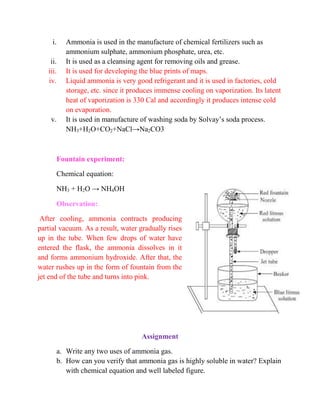
Fountain experiment:
Chemical equation:
NH3 + H2O → NH4OH
Observation:
After cooling, ammonia contracts producing
partial vacuum. As a result, water gradually rises
up in the tube. When few drops of water have
entered the flask, the ammonia dissolves in it
and forms ammonium hydroxide. After that, the
water rushes up in the form of fountain from the
jet end of the tube and turns into pink.
Assignment
a. Write any two uses of ammonia gas.
b. How can you verify that ammonia gas is highly soluble in water? Explain
with chemical equation and well labeled figure.
[ Note: Copy only contents, no need to do assignments]
Link:
https://www.youtube.com/watch?v=8AFiNRoECIo
https://www.youtube.com/watch?v=7OBgan6rRcI
Other links:
https://tyrocity.com/topic/manufacture-of-ammonia-by-habers-process/
https://www.chemicalsafetyfacts.org/ammonia/#:~:text=Ammonia%2C%20also%2
0known%20as%20NH,vital%20components%20of%20metabolic%20processes.
Some gases.docx

Some gases.docx

  • 1.
    By Suresh Chaudhary Chapter12 Some gases Carbon Dioxide Introduction of CO2  Carbon Dioxide molecules consist of a carbon atom covalently double bonded to two oxygen atoms.  CO2 (Carbon Dioxide) is a colorless gas with a density of about 60%.  It is also referred as dry ice and its molecular formula is CO2.  It occurs naturally in the atmosphere.  It is a non-combustible gas and its molecular mass is 44 amu.  Discovered by Van Helmot carbon dioxide for the first time in 1630 AD by burning wood.  Prepared by Joseph Black by burning magnesium in 1977 AD.  Lavoisier proved it as compound of carbon and oxygen in 1783 AD. Natural sources – process of breathing, combustion of organic matter, volcanic eruptions, cellular respiration by aerobic entities, wood and fossil burning, Artificial sources -Industrial fermentation process, heating of metallic carbonates and bicarbonates, exhaust of automobiles etc. Occurrence of CO2  It is found in combined state as well as in Free State.  The atmosphere of the earth contains 0.03% of CO2 by volume in Free State.  Carbon dioxide gas is released when chemical reaction takes place in carbonates like limestone, magnetite, carbohydrate, etc. General Method of preparation:
  • 2.
    a. By burningcarbon in excess air: C+O2 ∆ CO2↑ b. By burning organic compounds in oxygen: CH4 + 2O2 ∆  CO2↑ + 2H2O+ Energy Methane 2C2H6 + 7O2 →4CO2↑ + 6H20+Energy c. By the reaction of acid with metallic carbonates and bicarbonates: Na2CO3 + 2HCl 2NaCl + H2O + CO2 Ca (HCO3)2 + 2HCL/H2SO4 → CaCl2/CaSO4 + 2H2O+2CO2 ↑ Laboratory preparation of carbon dioxide Carbon dioxide is produced whenever an acid reacts with a carbonate. This makes carbon dioxide easy to make in the laboratory. Calcium carbonate and hydrochloric acid are usually used because they are cheap and easy to obtain. Principle: When calcium carbonate (marble or limestone or chalk) is treated with dilute hydrochloric acid, carbon dioxide is produced. CaCO3 + 2HCL [dil] →CaCl2 + H2O+ CO2 ↑
  • 3.
    Assignments 1. Write themolecular weight of CO2. 2. Mention two chemicals required for laboratory preparation of CO2 gas. 3. Write down any two methods for general preparation CO2 gas. 4. Draw a well labeled figure of laboratory preparation CO2 gas with its chemical equation. Precautions to be taken during laboratory preparation: a. Caron dioxide should be collected by upward displacement of air carbon dioxide gas is heavier than air. b. The apparatus must be airtight. c. The end of the thistle funnel should be dipped in the acid of the Woulfe’s bottle to prevent the CO2 escape out from it. d. The end of the delivery tube should not touch the acid inside the Woulfe’s bottle to allow the CO2 gas easily passes through gas jar. e. Dilute/Conc H2SO4 cannot be used instead of dilute HCL for the laboratory preparation of CO2 gas because the calcium sulphate so formed covers the remaining part of the marble chips which stops the further reactions and CO2 gas is not produced. Ca CO3 + H2SO4 [dil]→CaSO4 [insoluble] + H2O+ CO2 ↑ Tests for carbon dioxide: a. When CO2 is passed into lime water, it turns milky white in colour due to the formation of insoluble calcium carbonate. b. When wet blue litmus paper is inserted into the jar containing carbon dioxide gas, it turns into red since it is acid in nature. c. When burning magnesium is inserted into the jar containing CO2, it burns continuously and forms magnesium oxide (white) and carbon (black). d. When a burning candle is inserted into the jar containing CO2, it extinguishes as it non-combustible gas.
  • 4.
    Manufacture of carbondioxide: When carbonate materials are heated at a high temperature, they are decomposed into calcium oxide and carbon dioxide. CaCO3 →CaO + CO2 ↑ Physical properties of CO2: a. It is colourless, odourless gas with faint acidic taste. b. It is 1.5 times heavier than the air. Thus, it is present in deep wells, mines, etc. and can be poured from one vessel to another. c. It is acidic in nature so it turns blue litmus into red colour. d. It is non-combustible in nature. e. It is not poisonous but living beings die when there is lack of oxygen as it can cause impact on the respiratory system. f. It liquefies at -55.60 C and solidifies at -780 C. The solid form of carbon dioxide is called dry ice. It is called so since it smelts without causing wet in which it is kept. For example, if dry ice is kept in paper, it melts but paper does not get wets. Chemical properties of CO2: a. When carbon dioxide dissolves in water, it produces carbonic acid. CO2 + H20 →H2CO3 b. [Mg] form magnesium oxides and carbon. 2Mg + CO2 ∆ 2MgO + C c. When CO2 is passed in lime water, for short it turns milky due to the formation of insoluble calcium carbonate. Ca (OH)2 + CO2 →CaCO3 ↓+H2O When CO2 is passed in lime water, for long it turns milkyness disappear due to the formation of soluble calcium bicarbonate. CaCO3 ↓+H2O+ CO2→Ca (HCO3)2 d. CO2 reacts with water in the presence of chlorophyll and sunlight during photosynthesis. 6CO2 + 6H2O →C6H12O6 + 602 ↑ e. Carbon monoxide is produced when CO2 is heated with red hot coke.
  • 5.
    CO2+ C→ 2CO f.Alkalis react with CO2 and form carbonate/bicarbonates and water. 2NaOH + CO2→ Na2CO3 + H2O Na2CO3 + H2O+ CO2→ 2NaHCO3 2KOH + CO2 →K2CO3 + H2O K2CO3 + H2O+ CO2→ 2KHCO3 g. CO2 reacts with metal oxides of metal to form corresponding carbonates Na2O + CO2→Na2CO3 h. Reaction with ammonia CO2+2NH3 1500degreeC / Pressure NH2-CO-NH2 [Urea] +H2O Assignments a. Why carbon dioxide gas is collected upward displacement of air? b. Carbon dioxide gas cant collected over water. Give reason with chemical equation. c. What will happen when CO2 gas reacted with slaked lime for short time and long time? Write with chemical equation. d. Which litmus paper is used to test CO2 gas? Why? e. Why magnesium does give bright light when reacted with CO2 gas for short time only? Write its chemical equation. Uses of CO2: a. It is used in the manufacture of aerated water/Soda water. b. It is used in extinguishing fire being CO2 non-supporter of combustion. c. The solid form of CO2 called dry ice is used to preserve food and as a cooling agent as it does not melt. d. It is used for inflating rafts and life jackets, foaming rubber and plastics, promoting the growth of plants in green house, etc. e. It is used by plants during photosynthesis to synthesize their food. f. It is used to form urea, a chemical fertilizer and washing soda by Solvay’s Soda process.
  • 6.
    g. It isused for the purification of sugarcane juice during manufacture of sugar which is called carbonation. h. The mixture of O2 and CO2 [2-5%] is called carbogen which is used to provide artificial respiration to the patient of pneumonia. Working mechanism of fire extinguisher:  When CO2 is required to extinguish the fire, the glass vessel is easily broken by pressing the knob so that reaction between NaHCO3 and concentration H2SO4 produces carbon dioxide and under high temperature which comes out forcibly through the nozzle.  Carbon dioxide covers the burning flame of fire making just like a blanket. As a result, CO2 does not allow oxygen to pass and finally puts out the fire.  NaHCO3 +conc H2SO4 → NaHSO4 + H2O + CO2↑ Assignments a. Define: dry ice, carbogen and carbonation. b. Write any two uses of CO2 gas. c. Draw a well labeled diagram of fire extinguisher. Explain its working mechanism with chemical equation.
  • 7.
    Please go throughthe following you tube links for more information: https://www.youtube.com/watch?v=VTbxS9evlkQ https://www.youtube.com/watch?v=Du8Exmj9sW4 Ammonia (NH3) Introduction of NH3: a) Ammonia is a compound formed by one atom of nitrogen and three shared electrons of Nitrogen with three electrons from three hydrogen atoms. b) Its molecular formula is NH3 and molecular weight if 17 amu. c) Its composition was established by French chemist Berthelot and English chemist Davy. d) Priestly prepared gaseous ammonia by heating lime with Sal ammoniac. e) It is highly soluble in water. Occurrence of Ammonia: 1. Ammonia is present in small quantities in air, rainwater and soil. 2. During rain, ammonia is dissolved in water and forms nitrogenous compounds, which gets mixed in soil. 3. In soil, it is found as the mixture of ammonium chloride and ammonium sulphate. 4. A very small quantity of ammonia is present in such places where decaying organic matter is rich in nitrogen like in dumping sites. 5. Ammonia occurs naturally in the body, and is secreted by the kidneys to neutralize excess acid. General method of preparation of NH3: a. By heating ammonium salts:
  • 8.
    (NH4)2 CO3 +Heat → 2NH3↑ + H2O + CO2 Ammonium carbonate (NH4)2 SO4 + heat →2NH3↑ + H2SO4 Ammonium sulphate b. By heating ammonium salts with a strong base: (NH4)2 SO4 + 2NaOH → Na2SO4 + 2H2O + 2NH3 ↑ NH4Cl + KOH + heat → KCL + H2O + NH3 Laboratory preparation of NH3 Chemical equation: Ammonium + Calcium + heat → calcium + water + ammonia Chloride hydroxide chloride 2NH4Cl + Ca (OH)2 + heat → CaCl2 +2H2O + 2NH3↑ 0 Method of collection of gas
  • 9.
     It iscollected by downward displacement of air since it is lighter than air.  It cannot collect over water because it is highly soluble in water and after dissolving with water, it forms ammonium hydroxide. Precautions: i. The apparatus must be made airtight and dry solid ammonium chloride and slaked lime [Ca (OH)2] must be in the ratio of 1:3. ii. The hard glass tube should be fixed in an inclined position toward its mouth in order to prevent it from cracking. iii. Heat should be provided uniformly. iv. The gas jar should be dried. v. The product should be passed through a lime tower before its collection in the gas jar because lime tower has quick lime which absorbs the moisture gas so that pure and dry ammonia is obtained in the gas jar. Note: Gas evolved is dried by a rather unusual drying agent, quick lime CaO, because it reacts with all usual drying agents like conc. H2SO4, CaCl2. For example: 2NH3 + Conc H2SO4→ (NH4)2SO4 Assignments 1. Write the molecular weight of NH3. 2. Mention two chemicals required for lab. preparation of NH3gas. 3. Write down any two methods for general preparation NH3gas. 4. Draw a well labeled figure of laboratory preparation NH3gas with its chemical equation. 5. Quick lime is used in lime tower. Why? 6. The mouth of hard glass test tube is slightly slanted during lab. Preparation of ammonia gas. Give reason. Test of NH3: a) A moist red litmus paper when inserted in the jar containing the gas turns into blue due to its basic in nature.
  • 10.
    b) It formswhite fume of NH4Cl when a glass rod dipped in HCl is taken in this gas jar. NH3 + HCl → NH4Cl c) It can be identified by its pungent smell. Manufacture of ammonia gas (Haber’s Synthesis) The process of manufacturing large scale of ammonia gas by direct combination of nitrogen and hydrogen gas in the ratio of 1:3 at the specific condition is called Haber's process. Fe/Mo (400-500°C) N2 + 3H2 ——————–>2 NH3 (200-900atm) Required condition for Haber's process: 1. Direct combination of nitrogen and hydrogen in the ratio of 1:3. 2. Temperature: about 400-5000 c 3. Pressure: about 250 atm 4. Catalyst: Iron powder 5. Promoter: Molybdenum (Mo) Physical properties: a. It is lighter than air with vapor density 8.5. b. It liquefies at -33.4⁰C and solidifies at - 78⁰C c. It is colorless gas, tasteless but with a pungent smell. d. It brings tears to our eyes. e. It is highly soluble in water due to strong intermolecular H- bonding. f. Non-combustible. Chemical Properties; i. NH3 + H2O → NH4OH
  • 11.
    ii. 2NH4OH +H2SO4 (dil) →(NH4)2SO4 + 2H2O NH4OH + HCl (dil) → NH4Cl + H2O iii. NH3 + HCl(Conc) → NH4Cl 2NH3 + H2SO4 (Conc) → (NH4)2 SO4 iv. 2NH3 + CO2 → NH2 – CO – NH2 [Urea]+ H2O v. 4NH3 + 3O2 → 6H2O + 2N2 ↑ vi. 2NH3 ⇌ N2 + 3H2 ↑ vii. 8NH3 + 3Cl2 → 6NH4Cl + N2 viii. 3PbO+2NH3→3Pb+3H2O+N2 [ Reducing agent ammonia] ix. 2NH3+2Na→2NaNH2+H2 [Sodium Amide] Assignments a. Which litmus paper is used to test ammonia gas? Why? b. How will you manufacture ammonia gas on industrial scale? Write with the balanced chemical equation. c. Write any two differences between promoter and catalyst. d. What will happen when…..write with chemical equation. i. Ammonia is treated with HCl. ii. Ammonia reacted with carbondioxide. Uses of ammonia:
  • 12.
    i. Ammonia isused in the manufacture of chemical fertilizers such as ammonium sulphate, ammonium phosphate, urea, etc. ii. It is used as a cleansing agent for removing oils and grease. iii. It is used for developing the blue prints of maps. iv. Liquid ammonia is very good refrigerant and it is used in factories, cold storage, etc. since it produces immense cooling on vaporization. Its latent heat of vaporization is 330 Cal and accordingly it produces intense cold on evaporation. v. It is used in manufacture of washing soda by Solvay’s soda process. NH3+H2O+CO2+NaCl→Na2CO3 Fountain experiment: Chemical equation: NH3 + H2O → NH4OH Observation: After cooling, ammonia contracts producing partial vacuum. As a result, water gradually rises up in the tube. When few drops of water have entered the flask, the ammonia dissolves in it and forms ammonium hydroxide. After that, the water rushes up in the form of fountain from the jet end of the tube and turns into pink. Assignment a. Write any two uses of ammonia gas. b. How can you verify that ammonia gas is highly soluble in water? Explain with chemical equation and well labeled figure.
  • 13.
    [ Note: Copyonly contents, no need to do assignments] Link: https://www.youtube.com/watch?v=8AFiNRoECIo https://www.youtube.com/watch?v=7OBgan6rRcI Other links: https://tyrocity.com/topic/manufacture-of-ammonia-by-habers-process/ https://www.chemicalsafetyfacts.org/ammonia/#:~:text=Ammonia%2C%20also%2 0known%20as%20NH,vital%20components%20of%20metabolic%20processes.