CARBON
COMPOUNDS
CARBON COMPOUNDS
• Carbon compounds are compounds whose molecules
contain a carbon atom.
• They are chemical substances where a carbon atom has
bonded to an atom of another element.
• These compounds are generally organic in nature.
• However many students are under the false impression can
if a molecule contains carbon it implies that it is organic in
nature. This is incorrect.
• There are various inorganic carbon compounds as well like
for example CO2 (carbon dioxide)
TYPES OF CARBON
COMPOUNDS
1.ORGANIC COMPOUNDS
• This is the biggest class of carbon compounds.
• An organic compound must contain carbon and
hydrogen.
• The four major categories of organic
compounds that are present in all living things
are carbohydrates, lipids, proteins and nucleic
acid.
NUCLEIC ACIDS
The nucleic acids are DNA and RNA, or deoxyribonucleic acid and ribonucleic
acid, respectively. They make the proteins that are present in almost every
structure and perform almost every function in your body. DNA has a twisted
ladder-like form, while RNA has many different shapes, depending on its
function. DNA typically remains within the center, or nucleus, of a cell; RNA can
travel throughout the cell to where it is needed.
PROTEINS
• Proteins are probably the most versatile of all the organic
molecules, making up many structures and executing
various functions within organisms.
• Building blocks called amino acids make up proteins. About
20 different amino acids combine to form all of the various
types of proteins on Earth.
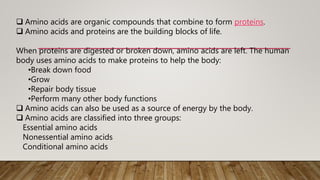
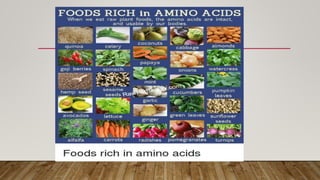
 Amino acids are organic compounds that combine to form proteins.
 Amino acids and proteins are the building blocks of life.
When proteins are digested or broken down, amino acids are left. The human
body uses amino acids to make proteins to help the body:
•Break down food
•Grow
•Repair body tissue
•Perform many other body functions
 Amino acids can also be used as a source of energy by the body.
 Amino acids are classified into three groups:
Essential amino acids
Nonessential amino acids
Conditional amino acids
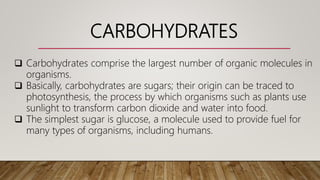
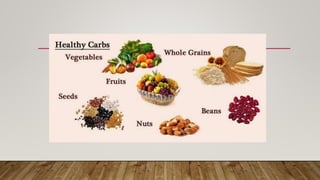
CARBOHYDRATES
 Carbohydrates comprise the largest number of organic molecules in
organisms.
 Basically, carbohydrates are sugars; their origin can be traced to
photosynthesis, the process by which organisms such as plants use
sunlight to transform carbon dioxide and water into food.
 The simplest sugar is glucose, a molecule used to provide fuel for
many types of organisms, including humans.
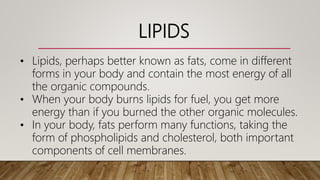
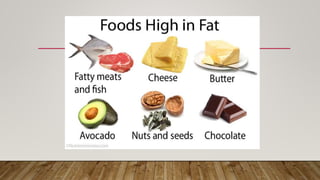
LIPIDS
• Lipids, perhaps better known as fats, come in different
forms in your body and contain the most energy of all
the organic compounds.
• When your body burns lipids for fuel, you get more
energy than if you burned the other organic molecules.
• In your body, fats perform many functions, taking the
form of phospholipids and cholesterol, both important
components of cell membranes.
GET TO KNOW
MORE ABOUT
ORGANIC
COMPOUNDS
HYDROCARBONS
• Hydrocarbons are organic compounds that contain only
carbon and hydrogen.
• The four general classes of hydrocarbons are: alkanes,
alkenes, alkynes and arenes.
• Aromatic compounds derive their names from the fact that
many of these compounds in the early days of discovery
were grouped because they were oils with fragrant odors.
ALKANES
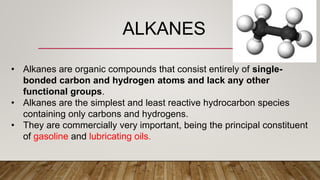
• Alkanes are organic compounds that consist entirely of single-
bonded carbon and hydrogen atoms and lack any other
functional groups.
• Alkanes are the simplest and least reactive hydrocarbon species
containing only carbons and hydrogens.
• They are commercially very important, being the principal constituent
of gasoline and lubricating oils.
ALKENES
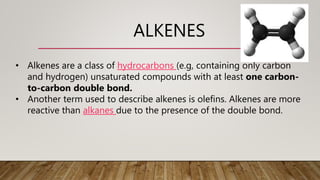
• Alkenes are a class of hydrocarbons (e.g, containing only carbon
and hydrogen) unsaturated compounds with at least one carbon-
to-carbon double bond.
• Another term used to describe alkenes is olefins. Alkenes are more
reactive than alkanes due to the presence of the double bond.
ALKYNES
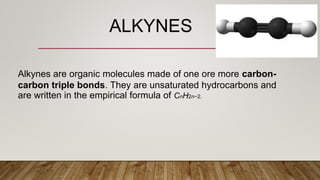
Alkynes are organic molecules made of one ore more carbon-
carbon triple bonds. They are unsaturated hydrocarbons and
are written in the empirical formula of CnH2n−2.
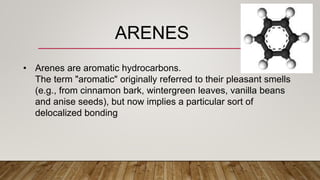
• Arenes are aromatic hydrocarbons.
The term "aromatic" originally referred to their pleasant smells
(e.g., from cinnamon bark, wintergreen leaves, vanilla beans
and anise seeds), but now implies a particular sort of
delocalized bonding
ARENES
NON- HYDROCARBONS
• Non-hydrocarbons that occur in crude oils and petroleum products
may be small in quantity but some of them have considerable
influence on product quality.
• In many cases they have noxious or harmful effects and must be
removed or converted to less harmful compounds during the refining
process. The most common occurring non-hydrocarbons are Sulphur,
nitrogen, and oxygen. There may also be small amounts of vanadium,
nickel, sodium, and potassium.
SULPHUR COMPOUNDS
• Sulphur is common in crude oils but it varies from 0.2% by
weight to 6% by weight in crude oils.
• There are corrosive and non-corrosive sulphur compounds. One
corrosive compound is Hydrogen Sulphide, the deadly H2S which
can kill an operator in 10 seconds.
NITROGEN COMPOUNDS
Nitrogen compounds in crude oils are complex and distillation may
give rise to nitrogen compounds. T
hese may cause discoloration in gasoline and kerosene, or may
produce a "lacquer" quality, reducing the effectiveness of lubricating
oils.
2. INORGANIC CARBON COMPOUNDS
• It is not necessary that the presence of a carbon means the
compound has to be classified as organic.
• Inorganic carbon compounds are rarer than organic
compounds, but they do occur. They are mostly found in
minerals and other natural sources, Some examples of
inorganic compounds are carbon disulfide (CS2), Hydrogen
Cyanide (HCN)
•Carbides: Binary compounds formed with the atoms
of carbon and another element with an
electronegativity lower than carbon. An example
would be Titanium Carbide.
•Carbonates: A carbonate is a salt of a carbonic acid.
The most common one is Calcium Carbonate CaCO3
•Cyanides: Chemical compound that contains
the cyano group. It is a carbon atom triple-
bonded to a nitrogen atom. An example would
be Sodium Cyanide.
EXAMPLES OF
INORGANIC
COMPOUNDS:
1.H2O - Water is a simple inorganic compound,
even though it contains hydrogen, a key atom
(along with carbon) in many organic
compounds.
The atoms in a molecule of water have formed
very simple bonds due to this lack of carbon.
2. HCl - Hydrochloride, also known as hydrochloric
acid when it is dissolved in water, is a colorless,
corrosive acid with a fairly strong pH.
It is found in the gastric juices of many animals,
helping in digestion by breaking down food.
3. CO2 - Carbon dioxide, despite the presence of a carbon atom in
the formula, is classified as an inorganic compound. This has
caused a dispute within the scientific community, with questions
being raised as to the validity of our current methods of classifying
compounds.
Currently, organic compounds contain a carbon or a hydrocarbon,
which forms a stronger bond. The bond formed by carbon in CO2 is
not a strong bond.
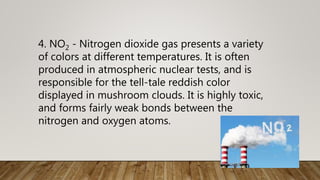
4. NO2 - Nitrogen dioxide gas presents a variety
of colors at different temperatures. It is often
produced in atmospheric nuclear tests, and is
responsible for the tell-tale reddish color
displayed in mushroom clouds. It is highly toxic,
and forms fairly weak bonds between the
nitrogen and oxygen atoms.
5. Fe2O3 - Iron (III) oxide is one of the three main oxides of
iron, and is an inorganic compound due to the lack of a
carbon atom or a hydrocarbon.
Iron (III) oxide occurs naturally as hematite, and is the source
of most iron for the steel production industry. It is commonly
known as rust, and shares a number of characteristics with its
naturally occurring counterpart.

Carbon Compounds

  • 1.
  • 2.
    CARBON COMPOUNDS • Carboncompounds are compounds whose molecules contain a carbon atom. • They are chemical substances where a carbon atom has bonded to an atom of another element. • These compounds are generally organic in nature. • However many students are under the false impression can if a molecule contains carbon it implies that it is organic in nature. This is incorrect. • There are various inorganic carbon compounds as well like for example CO2 (carbon dioxide)
  • 3.
  • 4.
    1.ORGANIC COMPOUNDS • Thisis the biggest class of carbon compounds. • An organic compound must contain carbon and hydrogen. • The four major categories of organic compounds that are present in all living things are carbohydrates, lipids, proteins and nucleic acid.
  • 5.
    NUCLEIC ACIDS The nucleicacids are DNA and RNA, or deoxyribonucleic acid and ribonucleic acid, respectively. They make the proteins that are present in almost every structure and perform almost every function in your body. DNA has a twisted ladder-like form, while RNA has many different shapes, depending on its function. DNA typically remains within the center, or nucleus, of a cell; RNA can travel throughout the cell to where it is needed.
  • 6.
    PROTEINS • Proteins areprobably the most versatile of all the organic molecules, making up many structures and executing various functions within organisms. • Building blocks called amino acids make up proteins. About 20 different amino acids combine to form all of the various types of proteins on Earth.
  • 7.
     Amino acidsare organic compounds that combine to form proteins.  Amino acids and proteins are the building blocks of life. When proteins are digested or broken down, amino acids are left. The human body uses amino acids to make proteins to help the body: •Break down food •Grow •Repair body tissue •Perform many other body functions  Amino acids can also be used as a source of energy by the body.  Amino acids are classified into three groups: Essential amino acids Nonessential amino acids Conditional amino acids
  • 9.
    CARBOHYDRATES  Carbohydrates comprisethe largest number of organic molecules in organisms.  Basically, carbohydrates are sugars; their origin can be traced to photosynthesis, the process by which organisms such as plants use sunlight to transform carbon dioxide and water into food.  The simplest sugar is glucose, a molecule used to provide fuel for many types of organisms, including humans.
  • 11.
    LIPIDS • Lipids, perhapsbetter known as fats, come in different forms in your body and contain the most energy of all the organic compounds. • When your body burns lipids for fuel, you get more energy than if you burned the other organic molecules. • In your body, fats perform many functions, taking the form of phospholipids and cholesterol, both important components of cell membranes.
  • 13.
    GET TO KNOW MOREABOUT ORGANIC COMPOUNDS
  • 14.
    HYDROCARBONS • Hydrocarbons areorganic compounds that contain only carbon and hydrogen. • The four general classes of hydrocarbons are: alkanes, alkenes, alkynes and arenes. • Aromatic compounds derive their names from the fact that many of these compounds in the early days of discovery were grouped because they were oils with fragrant odors.
  • 15.
    ALKANES • Alkanes areorganic compounds that consist entirely of single- bonded carbon and hydrogen atoms and lack any other functional groups. • Alkanes are the simplest and least reactive hydrocarbon species containing only carbons and hydrogens. • They are commercially very important, being the principal constituent of gasoline and lubricating oils.
  • 17.
    ALKENES • Alkenes area class of hydrocarbons (e.g, containing only carbon and hydrogen) unsaturated compounds with at least one carbon- to-carbon double bond. • Another term used to describe alkenes is olefins. Alkenes are more reactive than alkanes due to the presence of the double bond.
  • 19.
    ALKYNES Alkynes are organicmolecules made of one ore more carbon- carbon triple bonds. They are unsaturated hydrocarbons and are written in the empirical formula of CnH2n−2.
  • 20.
    • Arenes arearomatic hydrocarbons. The term "aromatic" originally referred to their pleasant smells (e.g., from cinnamon bark, wintergreen leaves, vanilla beans and anise seeds), but now implies a particular sort of delocalized bonding ARENES
  • 21.
    NON- HYDROCARBONS • Non-hydrocarbonsthat occur in crude oils and petroleum products may be small in quantity but some of them have considerable influence on product quality. • In many cases they have noxious or harmful effects and must be removed or converted to less harmful compounds during the refining process. The most common occurring non-hydrocarbons are Sulphur, nitrogen, and oxygen. There may also be small amounts of vanadium, nickel, sodium, and potassium.
  • 22.
    SULPHUR COMPOUNDS • Sulphuris common in crude oils but it varies from 0.2% by weight to 6% by weight in crude oils. • There are corrosive and non-corrosive sulphur compounds. One corrosive compound is Hydrogen Sulphide, the deadly H2S which can kill an operator in 10 seconds.
  • 24.
    NITROGEN COMPOUNDS Nitrogen compoundsin crude oils are complex and distillation may give rise to nitrogen compounds. T hese may cause discoloration in gasoline and kerosene, or may produce a "lacquer" quality, reducing the effectiveness of lubricating oils.
  • 26.
    2. INORGANIC CARBONCOMPOUNDS • It is not necessary that the presence of a carbon means the compound has to be classified as organic. • Inorganic carbon compounds are rarer than organic compounds, but they do occur. They are mostly found in minerals and other natural sources, Some examples of inorganic compounds are carbon disulfide (CS2), Hydrogen Cyanide (HCN)
  • 27.
    •Carbides: Binary compoundsformed with the atoms of carbon and another element with an electronegativity lower than carbon. An example would be Titanium Carbide. •Carbonates: A carbonate is a salt of a carbonic acid. The most common one is Calcium Carbonate CaCO3 •Cyanides: Chemical compound that contains the cyano group. It is a carbon atom triple- bonded to a nitrogen atom. An example would be Sodium Cyanide.
  • 29.
  • 30.
    1.H2O - Wateris a simple inorganic compound, even though it contains hydrogen, a key atom (along with carbon) in many organic compounds. The atoms in a molecule of water have formed very simple bonds due to this lack of carbon.
  • 31.
    2. HCl -Hydrochloride, also known as hydrochloric acid when it is dissolved in water, is a colorless, corrosive acid with a fairly strong pH. It is found in the gastric juices of many animals, helping in digestion by breaking down food.
  • 32.
    3. CO2 -Carbon dioxide, despite the presence of a carbon atom in the formula, is classified as an inorganic compound. This has caused a dispute within the scientific community, with questions being raised as to the validity of our current methods of classifying compounds. Currently, organic compounds contain a carbon or a hydrocarbon, which forms a stronger bond. The bond formed by carbon in CO2 is not a strong bond.
  • 33.
    4. NO2 -Nitrogen dioxide gas presents a variety of colors at different temperatures. It is often produced in atmospheric nuclear tests, and is responsible for the tell-tale reddish color displayed in mushroom clouds. It is highly toxic, and forms fairly weak bonds between the nitrogen and oxygen atoms.
  • 34.
    5. Fe2O3 -Iron (III) oxide is one of the three main oxides of iron, and is an inorganic compound due to the lack of a carbon atom or a hydrocarbon. Iron (III) oxide occurs naturally as hematite, and is the source of most iron for the steel production industry. It is commonly known as rust, and shares a number of characteristics with its naturally occurring counterpart.