Carbohydrates
Ms. N.S.MODHAVE
ASSISTANT PROFESSOR
DEPT. OF PHARMACEUTICAL CHEMISTRY
Carbohydrates
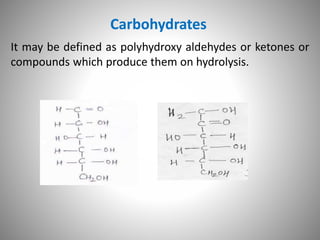
It may be defined as polyhydroxy aldehydes or ketones or
compounds which produce them on hydrolysis.
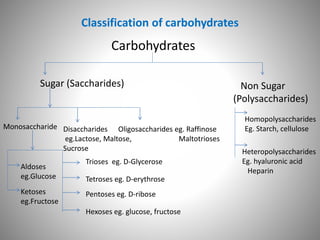
Classification of carbohydrates
Carbohydrates
Sugar (Saccharides) Non Sugar
(Polysaccharides)
Monosaccharide Disaccharides
eg.Lactose, Maltose,
Sucrose
Oligosaccharides eg. Raffinose
Maltotrioses
Trioses eg. D-Glycerose
Tetroses eg. D-erythrose
Pentoses eg. D-ribose
Hexoses eg. glucose, fructose
Aldoses
eg.Glucose
Ketoses
eg.Fructose
Homopolysaccharides
Eg. Starch, cellulose
Heteropolysaccharides
Eg. hyaluronic acid
Heparin
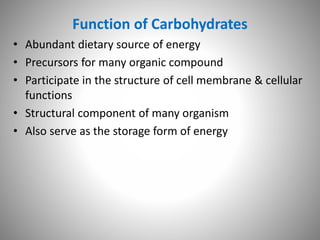
Function of Carbohydrates
• Abundant dietary source of energy
• Precursors for many organic compound
• Participate in the structure of cell membrane & cellular
functions
• Structural component of many organism
• Also serve as the storage form of energy
D-Glyceraldehyde L-Glyceraldehyde
C
C
CH2OH
O
H
H
HO
C
C
CH2OH
O
H
OH
H
Monosaccharide
• D-Glucose L- Glucose
CHO
C
C
C
OH
H
HO H
C
H OH
OH
CH2OH
H
CHO
C
C
C
OH
H
HO H
C
H OH
H
CH2OH
HO
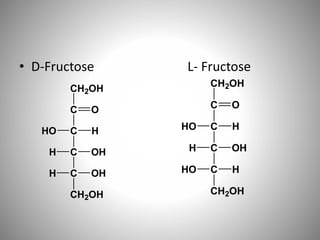
• D-Fructose L- Fructose
CH2OH
C
C
C
O
HO H
C
H OH
H
CH2OH
HO
CH2OH
C
C
C
O
HO H
C
H OH
OH
CH2OH
H
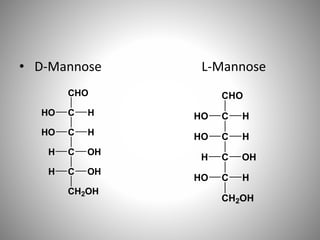
• D-Mannose L-Mannose
CHO
C
C
C
H
HO H
C
H OH
OH
CH2OH
H
HO
CHO
C
C
C
H
HO H
C
H OH
H
CH2OH
HO
HO
D- Galactose L-Galactose
CHO
C
C
C
OH
H
HO H
C
HO H
OH
CH2OH
H
CHO
C
C
C
OH
H
HO H
C
HO H
H
CH2OH
HO
CHO
C
C
C
OH
H
HO H
C
H OH
OH
CH2OH
H
EPIMERS
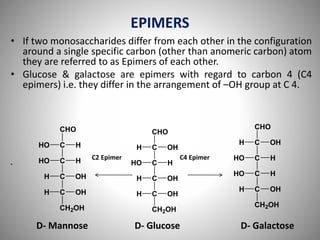
• If two monosaccharides differ from each other in the configuration
around a single specific carbon (other than anomeric carbon) atom
they are referred to as Epimers of each other.
• Glucose & galactose are epimers with regard to carbon 4 (C4
epimers) i.e. they differ in the arrangement of –OH group at C 4.
C2 Epimer C4 Epimer
•
D- Mannose D- Glucose D- Galactose
CHO
C
C
C
OH
H
HO H
C
H OH
OH
CH2OH
H
CHO
C
C
C
OH
H
HO H
C
HO H
OH
CH2OH
H
CHO
C
C
C
H
HO H
C
H OH
OH
CH2OH
H
HO
EPIMERS
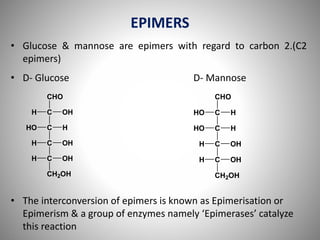
• Glucose & mannose are epimers with regard to carbon 2.(C2
epimers)
• D- Glucose D- Mannose
• The interconversion of epimers is known as Epimerisation or
Epimerism & a group of enzymes namely ‘Epimerases’ catalyze
this reaction
CHO
C
C
C
OH
H
HO H
C
H OH
OH
CH2OH
H
CHO
C
C
C
H
HO H
C
H OH
OH
CH2OH
H
HO
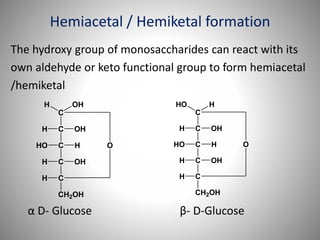
Hemiacetal / Hemiketal formation
The hydroxy group of monosaccharides can react with its
own aldehyde or keto functional group to form hemiacetal
/hemiketal
α D- Glucose β- D-Glucose
C
C
C
C
OH
H
HO H
C
H OH
CH2OH
H
O
H OH
C
C
C
C
OH
H
HO H
C
H OH
CH2OH
H
O
HO H
• α D- Glucose β- D-Glucose
O
H
OH
OH
H
H
OH
H
OH
CH2OH
H
O
OH
H
OH
H
H
OH
H
OH
CH2OH
H
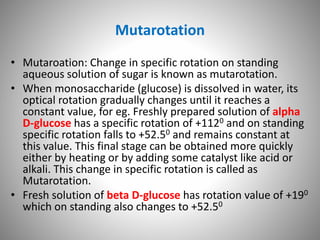
Mutarotation
• Mutaroation: Change in specific rotation on standing
aqueous solution of sugar is known as mutarotation.
• When monosaccharide (glucose) is dissolved in water, its
optical rotation gradually changes until it reaches a
constant value, for eg. Freshly prepared solution of alpha
D-glucose has a specific rotation of +1120 and on standing
specific rotation falls to +52.50 and remains constant at
this value. This final stage can be obtained more quickly
either by heating or by adding some catalyst like acid or
alkali. This change in specific rotation is called as
Mutarotation.
• Fresh solution of beta D-glucose has rotation value of +190
which on standing also changes to +52.50
Mutarotation
• For example:
•
• α—D—Glucose D—Glucose ← β—D—
Glucose.
• (+1120 ) (+52.50 ) (+190)
Reaction of monosaccharide
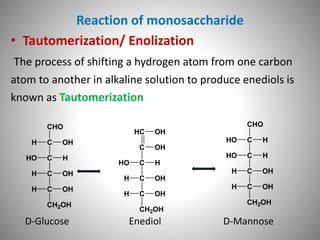
• Tautomerization/ Enolization
The process of shifting a hydrogen atom from one carbon
atom to another in alkaline solution to produce enediols is
known as Tautomerization
D-Glucose Enediol D-Mannose
CHO
C
C
C
OH
H
HO H
C
H OH
OH
CH2OH
H
CHO
C
C
C
H
HO
HO H
C
H OH
OH
CH2OH
H
HC
C
C
C
OH
HO H
C
H OH
OH
CH2OH
H
OH
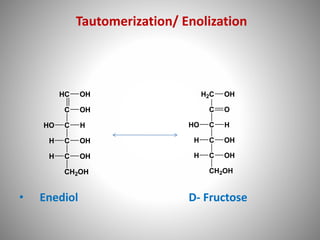
Tautomerization/ Enolization
• Enediol D- Fructose
HC
C
C
C
OH
HO H
C
H OH
OH
CH2OH
H
OH H2C
C
C
C
O
HO H
C
H OH
OH
CH2OH
H
OH
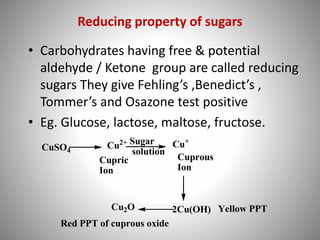
Reducing property of sugars
• Carbohydrates having free & potential
aldehyde / Ketone group are called reducing
sugars They give Fehling’s ,Benedict’s ,
Tommer’s and Osazone test positive
• Eg. Glucose, lactose, maltose, fructose.
CuSO4
Cu2+ Sugar
solution
Cu+
Cupric
Ion
Cuprous
Ion
2Cu(OH) Yellow PPT
Cu2O
Red PPT of cuprous oxide
Osazone test
• In these test phenyl hydrazine is reduce to phenyl hydrazone
by sugar solution. Phenyl hydrazone when heated with more
amount of phenyl hydrazine forms yellow crystalline
compound called osazone.
• Glucose, fructose & mannose gives needle shaped crystals
• Maltose gives sunflower shape crystals & lactose gives
powder puff shape crystals.
• Significance:
• Osazone test helps to differentiate reducing sugars from non
reducing sugars like starch, dextrin, sucrose.
• It also helps in differentiating particular type of reducing
sugars.
• It is used to identify and confirm reducing sugars, e.g. glucose,
fructose, galactose, maltose, lactose
Reaction Osazone test
Oxidation Reaction
• Depending on the oxidizing agent used, the terminal
aldehyde or keto or terminal alcohol or both the groups
may be oxidized.
Oxidation
CHO
C
C
C
OH
H
HO H
C
H OH
OH
CH2OH
H
D- Glucose
PtO2 Br2
Nitric acid
COOH
C
C
C
OH
H
HO H
C
H OH
OH
CH2OH
H
COOH
C
C
C
OH
H
HO H
C
H OH
OH
COOH
H
CHO
C
C
C
OH
H
HO H
C
H OH
OH
COOH
H
Glucoronic Acid Gluconic Acid
Glucosaccharic Acid
Carbohydrates - Defination, Classification

Carbohydrates - Defination, Classification

  • 1.
  • 2.
    Carbohydrates It may bedefined as polyhydroxy aldehydes or ketones or compounds which produce them on hydrolysis.
  • 3.
    Classification of carbohydrates Carbohydrates Sugar(Saccharides) Non Sugar (Polysaccharides) Monosaccharide Disaccharides eg.Lactose, Maltose, Sucrose Oligosaccharides eg. Raffinose Maltotrioses Trioses eg. D-Glycerose Tetroses eg. D-erythrose Pentoses eg. D-ribose Hexoses eg. glucose, fructose Aldoses eg.Glucose Ketoses eg.Fructose Homopolysaccharides Eg. Starch, cellulose Heteropolysaccharides Eg. hyaluronic acid Heparin
  • 4.
    Function of Carbohydrates •Abundant dietary source of energy • Precursors for many organic compound • Participate in the structure of cell membrane & cellular functions • Structural component of many organism • Also serve as the storage form of energy
  • 5.
  • 6.
    Monosaccharide • D-Glucose L-Glucose CHO C C C OH H HO H C H OH OH CH2OH H CHO C C C OH H HO H C H OH H CH2OH HO
  • 7.
    • D-Fructose L-Fructose CH2OH C C C O HO H C H OH H CH2OH HO CH2OH C C C O HO H C H OH OH CH2OH H
  • 8.
    • D-Mannose L-Mannose CHO C C C H HOH C H OH OH CH2OH H HO CHO C C C H HO H C H OH H CH2OH HO HO
  • 9.
    D- Galactose L-Galactose CHO C C C OH H HOH C HO H OH CH2OH H CHO C C C OH H HO H C HO H H CH2OH HO CHO C C C OH H HO H C H OH OH CH2OH H
  • 10.
    EPIMERS • If twomonosaccharides differ from each other in the configuration around a single specific carbon (other than anomeric carbon) atom they are referred to as Epimers of each other. • Glucose & galactose are epimers with regard to carbon 4 (C4 epimers) i.e. they differ in the arrangement of –OH group at C 4. C2 Epimer C4 Epimer • D- Mannose D- Glucose D- Galactose CHO C C C OH H HO H C H OH OH CH2OH H CHO C C C OH H HO H C HO H OH CH2OH H CHO C C C H HO H C H OH OH CH2OH H HO
  • 11.
    EPIMERS • Glucose &mannose are epimers with regard to carbon 2.(C2 epimers) • D- Glucose D- Mannose • The interconversion of epimers is known as Epimerisation or Epimerism & a group of enzymes namely ‘Epimerases’ catalyze this reaction CHO C C C OH H HO H C H OH OH CH2OH H CHO C C C H HO H C H OH OH CH2OH H HO
  • 12.
    Hemiacetal / Hemiketalformation The hydroxy group of monosaccharides can react with its own aldehyde or keto functional group to form hemiacetal /hemiketal α D- Glucose β- D-Glucose C C C C OH H HO H C H OH CH2OH H O H OH C C C C OH H HO H C H OH CH2OH H O HO H
  • 13.
    • α D-Glucose β- D-Glucose O H OH OH H H OH H OH CH2OH H O OH H OH H H OH H OH CH2OH H
  • 14.
    Mutarotation • Mutaroation: Changein specific rotation on standing aqueous solution of sugar is known as mutarotation. • When monosaccharide (glucose) is dissolved in water, its optical rotation gradually changes until it reaches a constant value, for eg. Freshly prepared solution of alpha D-glucose has a specific rotation of +1120 and on standing specific rotation falls to +52.50 and remains constant at this value. This final stage can be obtained more quickly either by heating or by adding some catalyst like acid or alkali. This change in specific rotation is called as Mutarotation. • Fresh solution of beta D-glucose has rotation value of +190 which on standing also changes to +52.50
  • 15.
    Mutarotation • For example: • •α—D—Glucose D—Glucose ← β—D— Glucose. • (+1120 ) (+52.50 ) (+190)
  • 16.
    Reaction of monosaccharide •Tautomerization/ Enolization The process of shifting a hydrogen atom from one carbon atom to another in alkaline solution to produce enediols is known as Tautomerization D-Glucose Enediol D-Mannose CHO C C C OH H HO H C H OH OH CH2OH H CHO C C C H HO HO H C H OH OH CH2OH H HC C C C OH HO H C H OH OH CH2OH H OH
  • 17.
    Tautomerization/ Enolization • EnediolD- Fructose HC C C C OH HO H C H OH OH CH2OH H OH H2C C C C O HO H C H OH OH CH2OH H OH
  • 18.
    Reducing property ofsugars • Carbohydrates having free & potential aldehyde / Ketone group are called reducing sugars They give Fehling’s ,Benedict’s , Tommer’s and Osazone test positive • Eg. Glucose, lactose, maltose, fructose. CuSO4 Cu2+ Sugar solution Cu+ Cupric Ion Cuprous Ion 2Cu(OH) Yellow PPT Cu2O Red PPT of cuprous oxide
  • 19.
    Osazone test • Inthese test phenyl hydrazine is reduce to phenyl hydrazone by sugar solution. Phenyl hydrazone when heated with more amount of phenyl hydrazine forms yellow crystalline compound called osazone. • Glucose, fructose & mannose gives needle shaped crystals • Maltose gives sunflower shape crystals & lactose gives powder puff shape crystals. • Significance: • Osazone test helps to differentiate reducing sugars from non reducing sugars like starch, dextrin, sucrose. • It also helps in differentiating particular type of reducing sugars. • It is used to identify and confirm reducing sugars, e.g. glucose, fructose, galactose, maltose, lactose
  • 20.
  • 21.
    Oxidation Reaction • Dependingon the oxidizing agent used, the terminal aldehyde or keto or terminal alcohol or both the groups may be oxidized.
  • 22.
    Oxidation CHO C C C OH H HO H C H OH OH CH2OH H D-Glucose PtO2 Br2 Nitric acid COOH C C C OH H HO H C H OH OH CH2OH H COOH C C C OH H HO H C H OH OH COOH H CHO C C C OH H HO H C H OH OH COOH H Glucoronic Acid Gluconic Acid Glucosaccharic Acid