Reduction
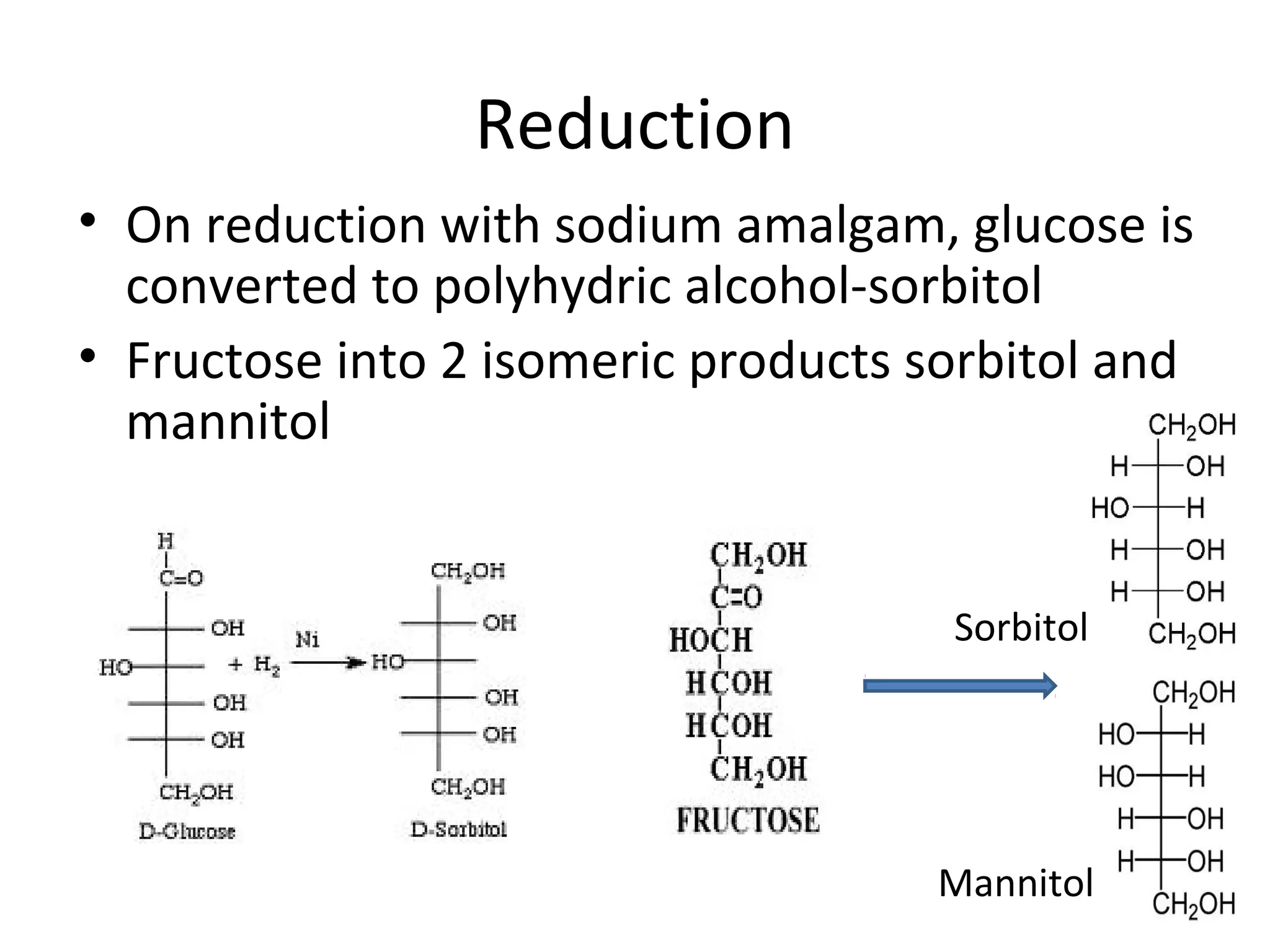
• On reduction with sodium amalgam, glucose is
converted to polyhydric alcohol-sorbitol
• Fructose into 2 isomeric products sorbitol and
mannitol
Sorbitol
Mannitol
Reaction of glucose with weak alkali
In the presence of weak alkali glucose is
converted into fructose and vice versa
Reaction of carbonyl group
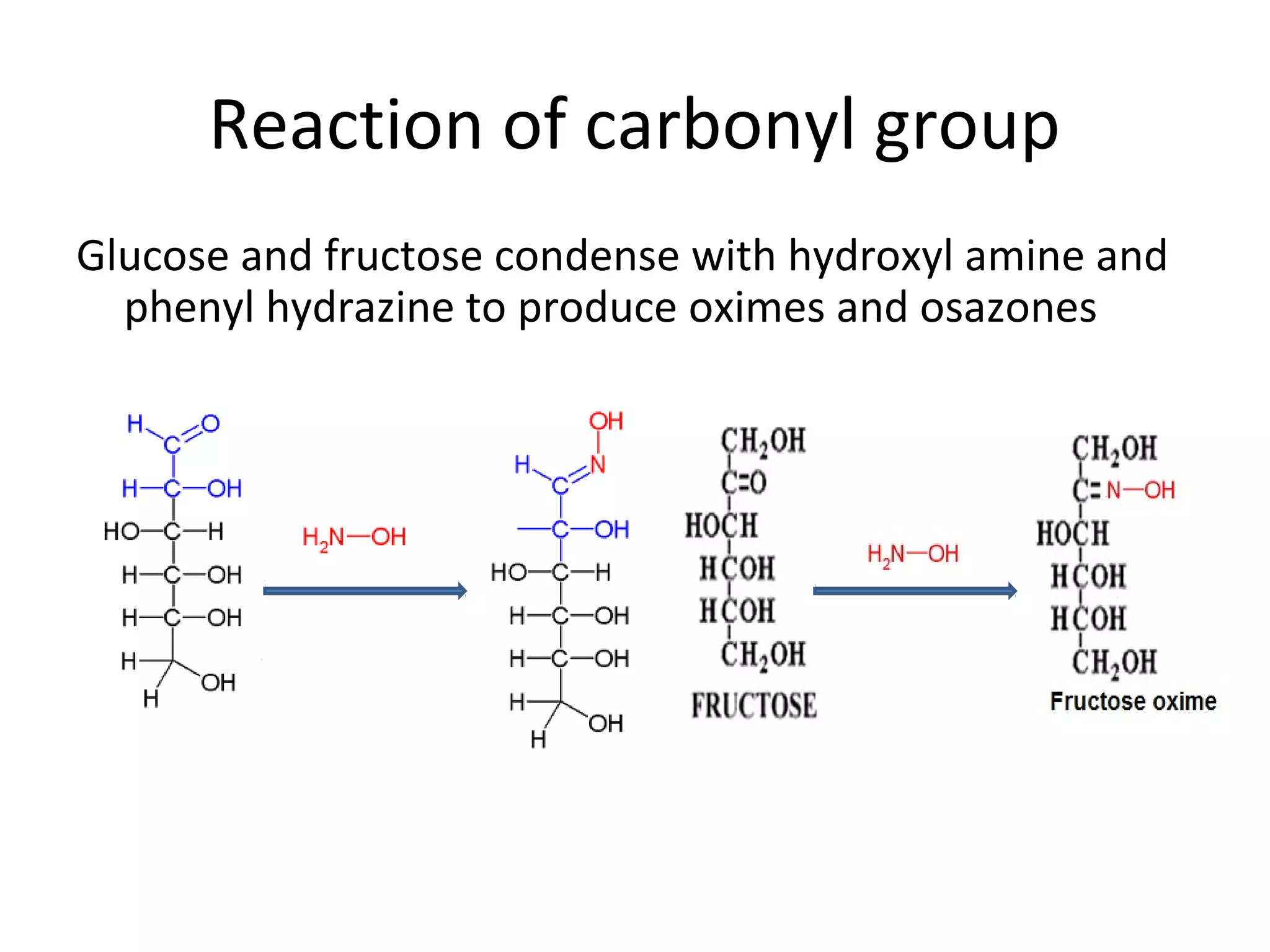
Glucose and fructose condense with hydroxyl amine and
phenyl hydrazine to produce oximes and osazones
Reaction with non-reducing agents
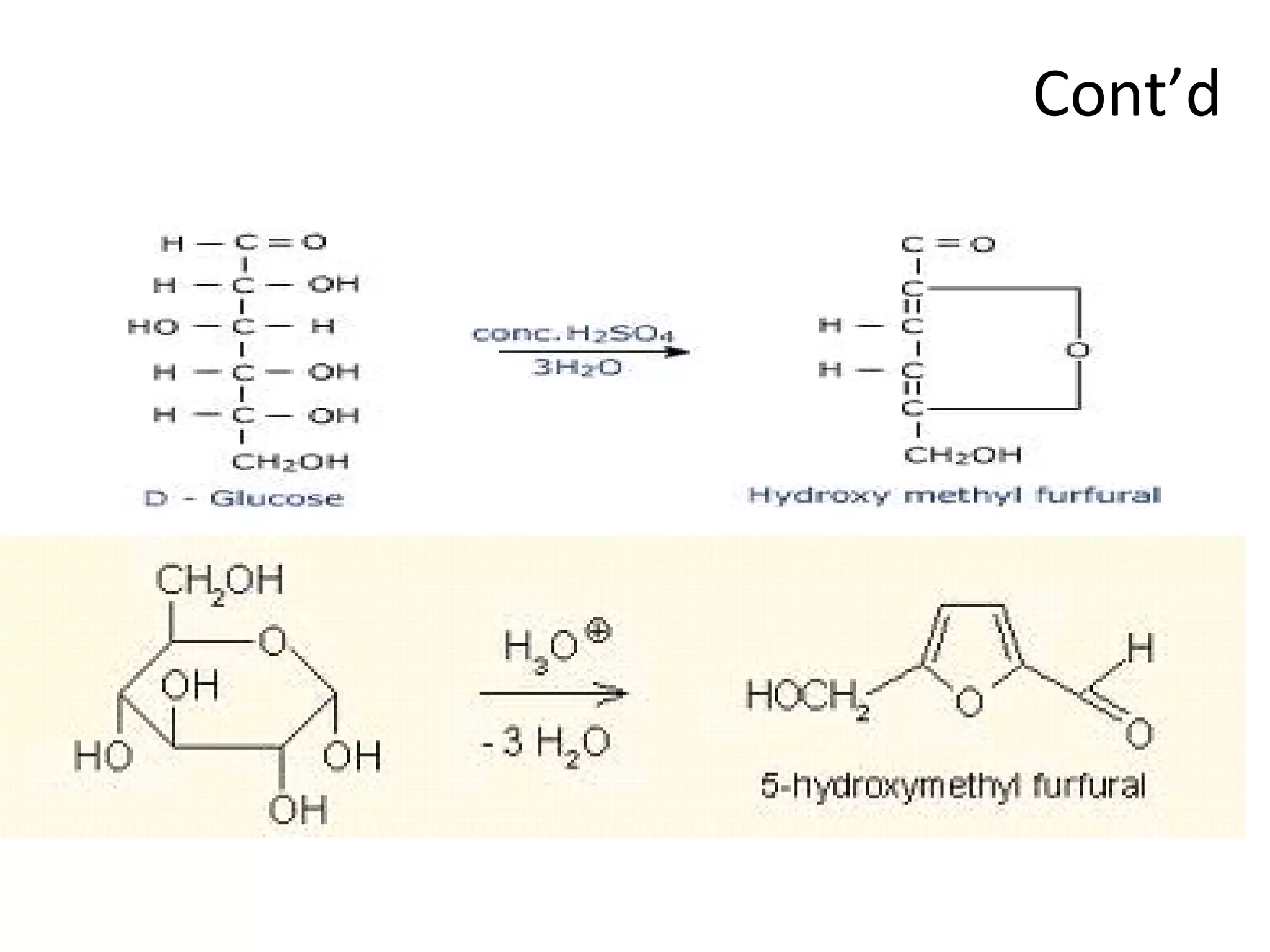
• Pentoses on heating with HCl/H2SO4 produce
furfural-aldehyde of furan, whereas hexoses
produce hydroxy methyl furfural
• This provides the basis of Molisch’s test,
Anthrone test, Seliwanoff’s test etc.
Cont’d
Reaction with calcium hydroxide
On reacting with calcium hydroxide, glucose produces calcium
glucosate
+ Ca (OH)2
Fermentation
Both glucose and fructose are attacked by
enzymes of yeast to produce ethyl alcohol and
carbon dioxide
C6H12O6 → 2C2H5OH + 2CO2
Reaction with acetone
2 acetone
-2 H2O
Methylation
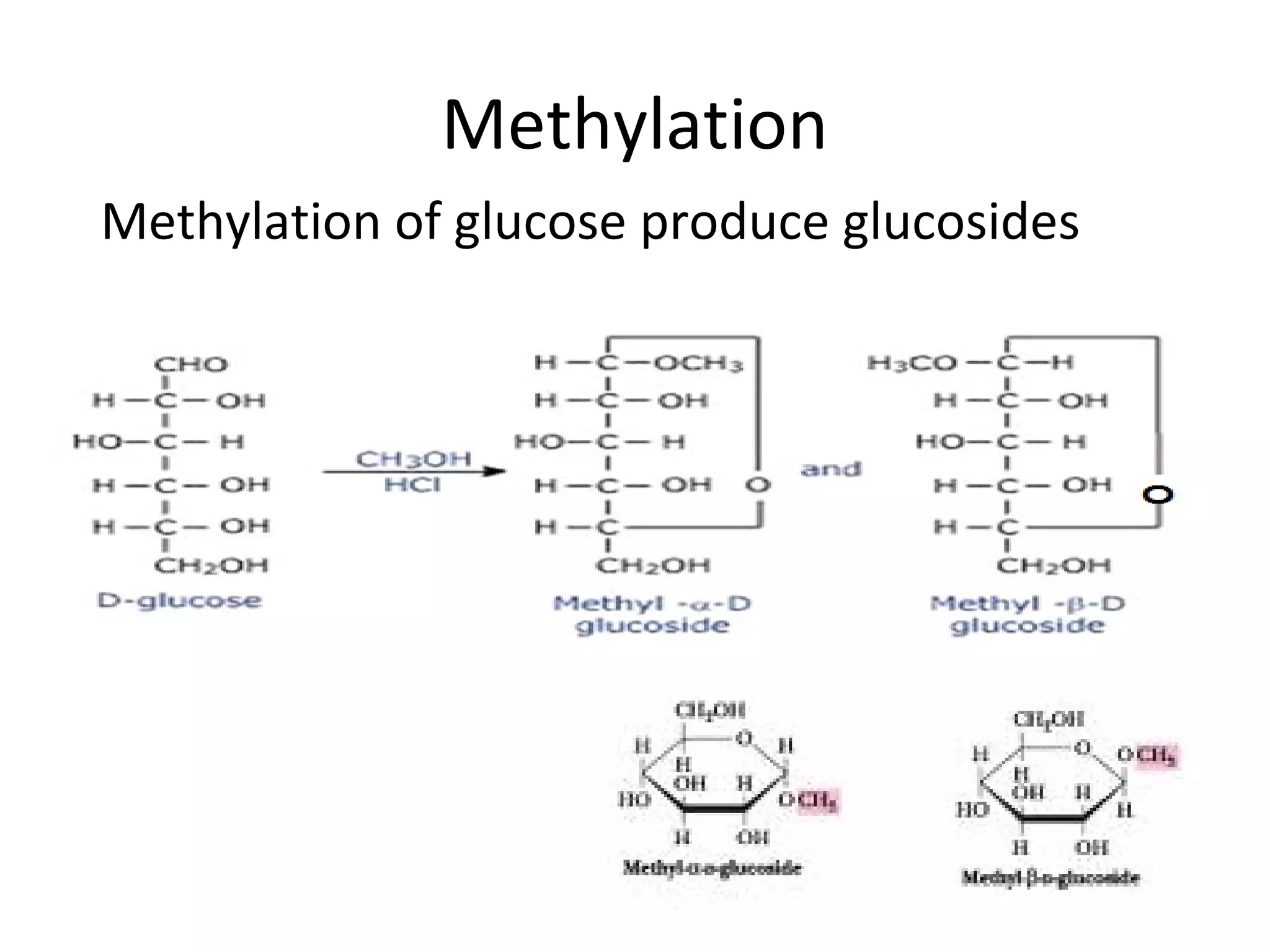
Methylation of glucose produce glucosides
Configuration of monosaccharides
• Due to presence of asymmetric carbon
monosaccharides rotate the plane polarized light
either toward right or left
• Those rotating towards right are dextrorotatory
(d or +) and those towards left are levorotatory
(l, -)
• (d and l) isomers are mirror image of each other
when substituents are arranged in space
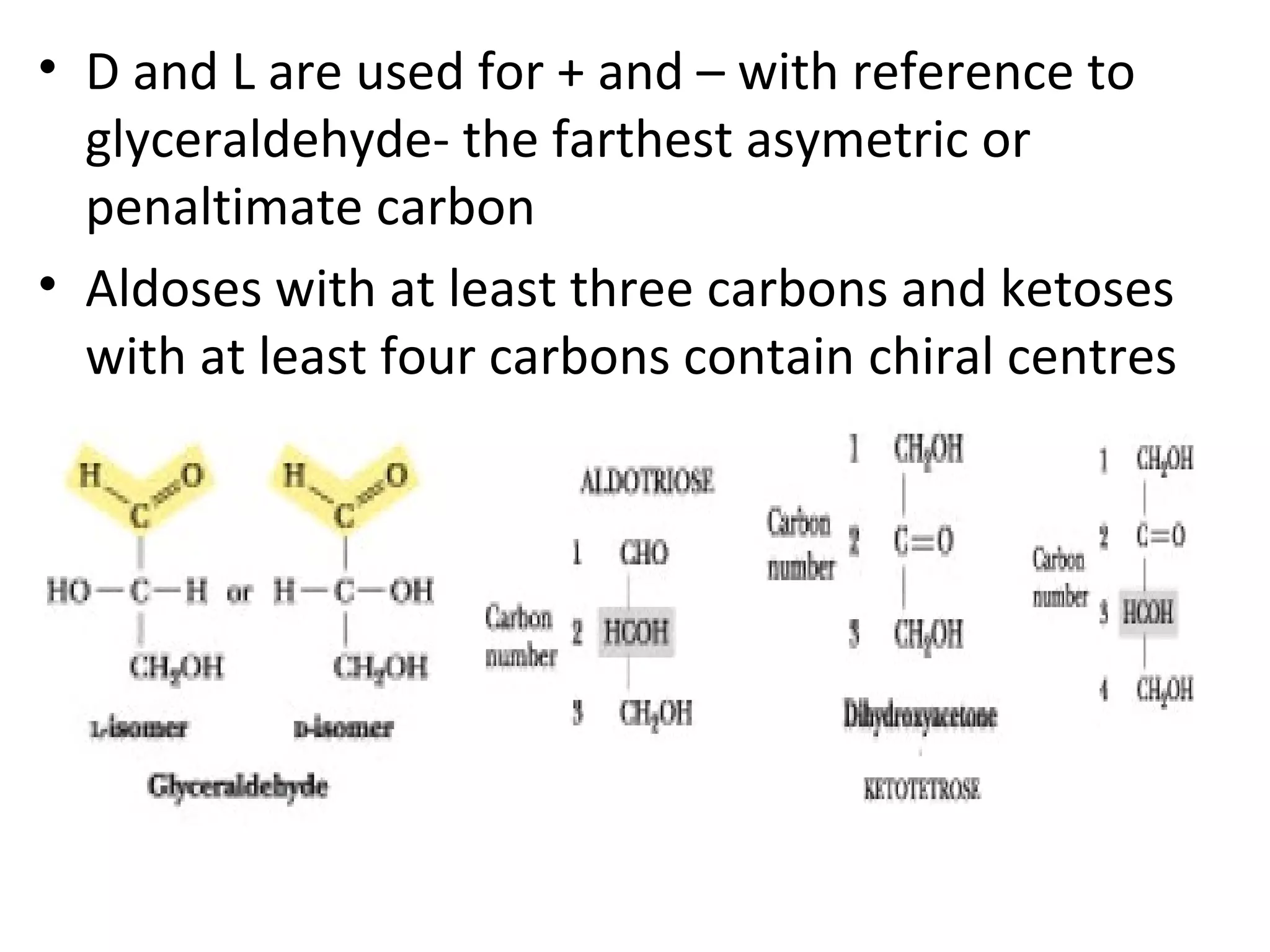
• D and L are used for + and – with reference to
glyceraldehyde- the farthest asymetric or
penaltimate carbon
• Aldoses with at least three carbons and ketoses
with at least four carbons contain chiral centres
Cyclic Structures and Anomeric Forms
• Although Fischer projections are useful for
presenting the structures of a particular
monosaccharide and its stereoisomers,
but
–Such structures ignore one of the most
interesting fact of sugar structure;
—the ability to form cyclic structures with
formation of an additional asymmetric
centre
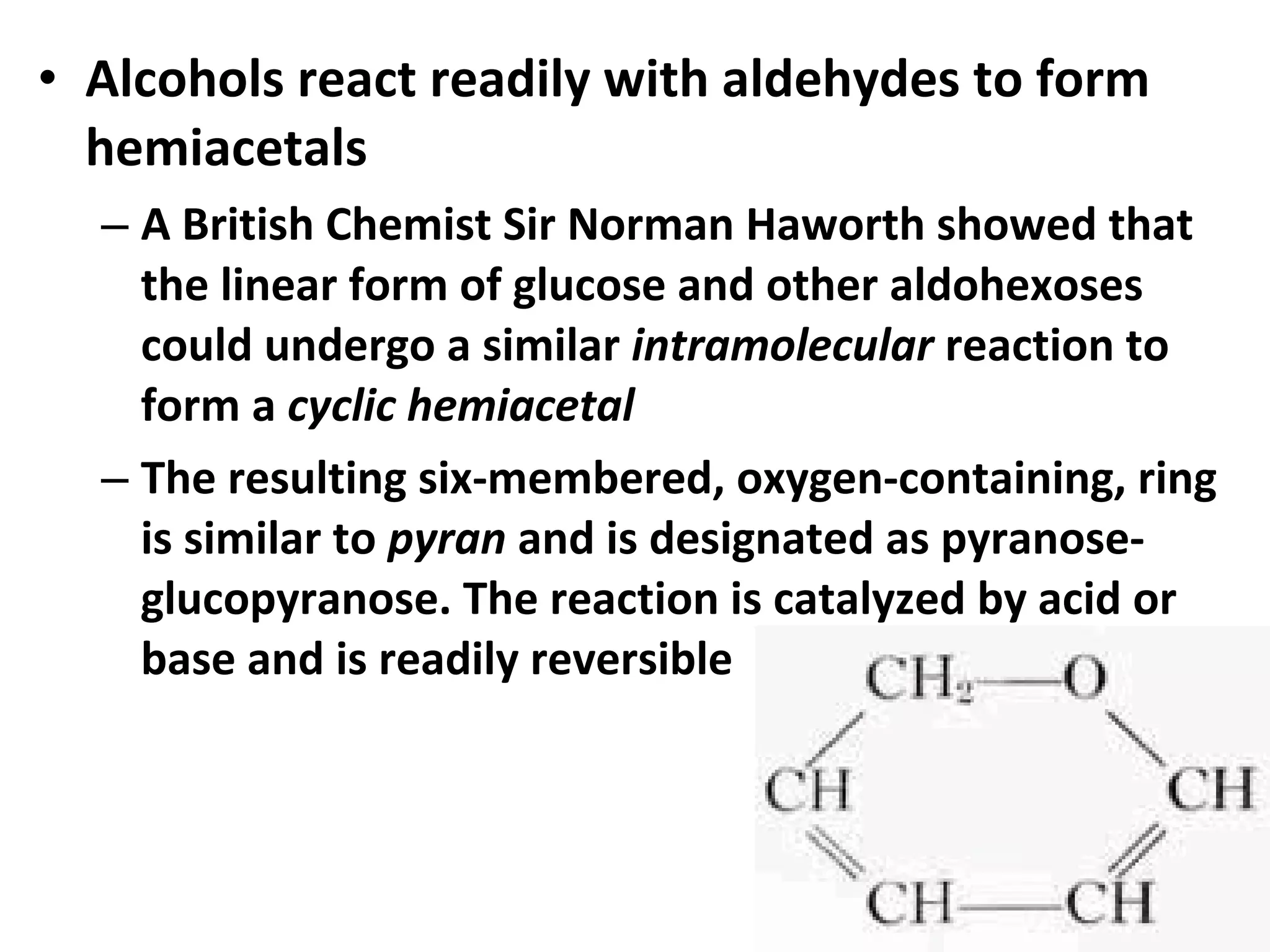
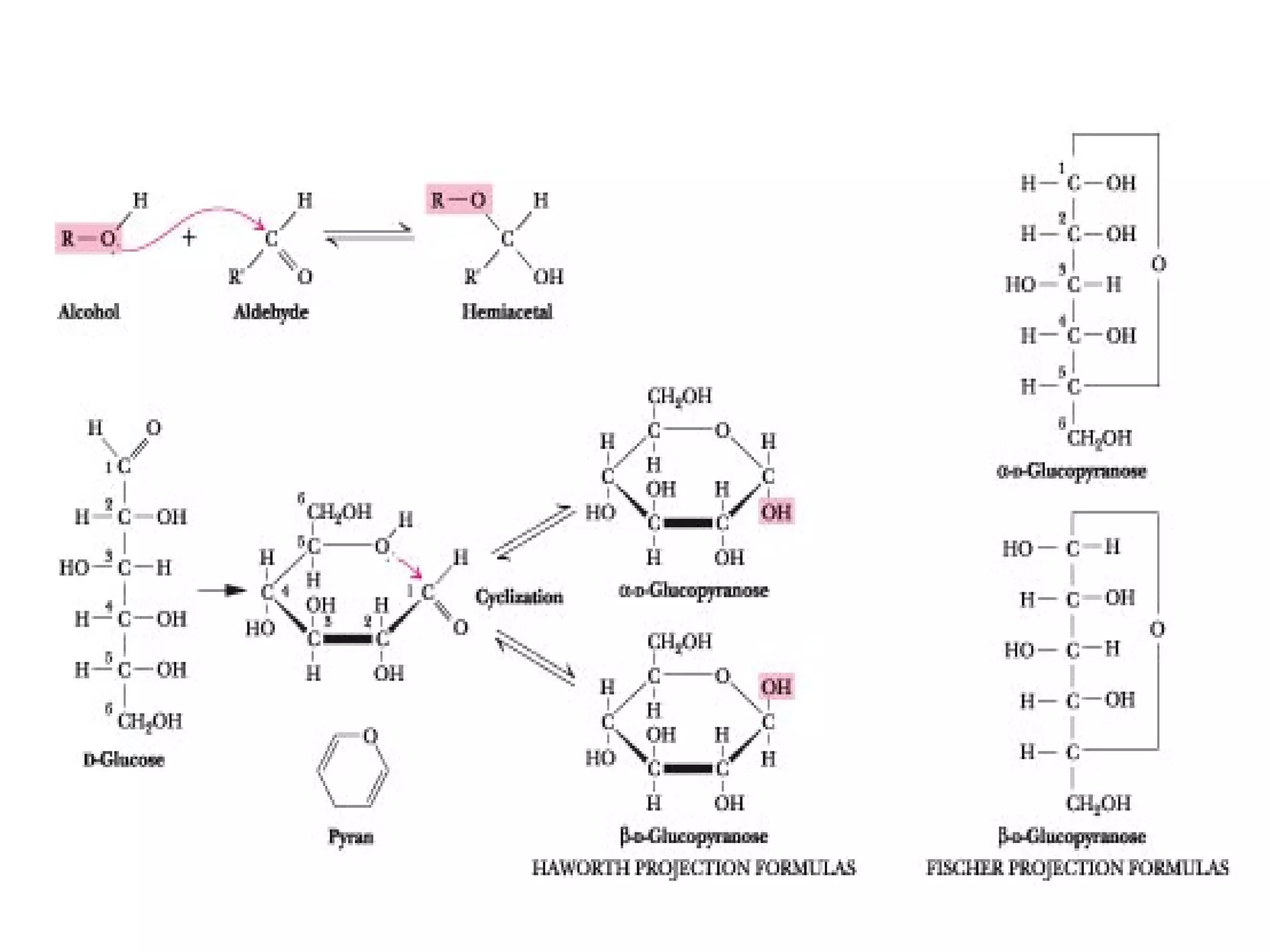
• Alcohols react readily with aldehydes to form
hemiacetals
– A British Chemist Sir Norman Haworth showed that
the linear form of glucose and other aldohexoses
could undergo a similar intramolecular reaction to
form a cyclic hemiacetal
– The resulting six-membered, oxygen-containing, ring
is similar to pyran and is designated as pyranose-
glucopyranose. The reaction is catalyzed by acid or
base and is readily reversible
• An analogous intramolecular reaction of a ketose
sugar such as fructose yields a cyclic hemiketal
• The five-membered ring thus formed is
reminiscent of furan and is referred to as a
furanose
• The cyclic pyranose and furanose forms are the
preferred structures for monosaccharides in
aqueous solution
• At equilibrium, the linear aldehyde or ketone
structure is only a minor component of the
mixture (generally much less than 1%)
• When hemiacetals and hemiketals are formed,
the carbon atom that carried the carbonyl
function becomes an asymmetric carbon atom
– Isomers of monosaccharides that differ only in their
configuration about that carbon atom are called
anomers, designated as α or β
• When the hydroxyl group at the anomeric carbon
is on the same side of a Fischer projection as the
oxygen atom at the highest numbered carbon,
the configuration at the anomeric carbon is α, as
in α-D-glucopyranose
• When the anomeric hydroxyl is on the
opposite side of oxygen in the Fischer
projection, the configuration is β, as in β-D-
glucopyranose
Muta rotation
• The addition of this asymmetric centre
upon hemiacetal and hemiketal formation
alters the optical rotation properties of
monosaccharides
Muta rotation
Early carbohydrate Chemists frequently
observed that the optical rotation of
glucose solution changes with the passage
of time; a process called muta rotation. This
indicated the occurrence of structural
change.
Muta rotation
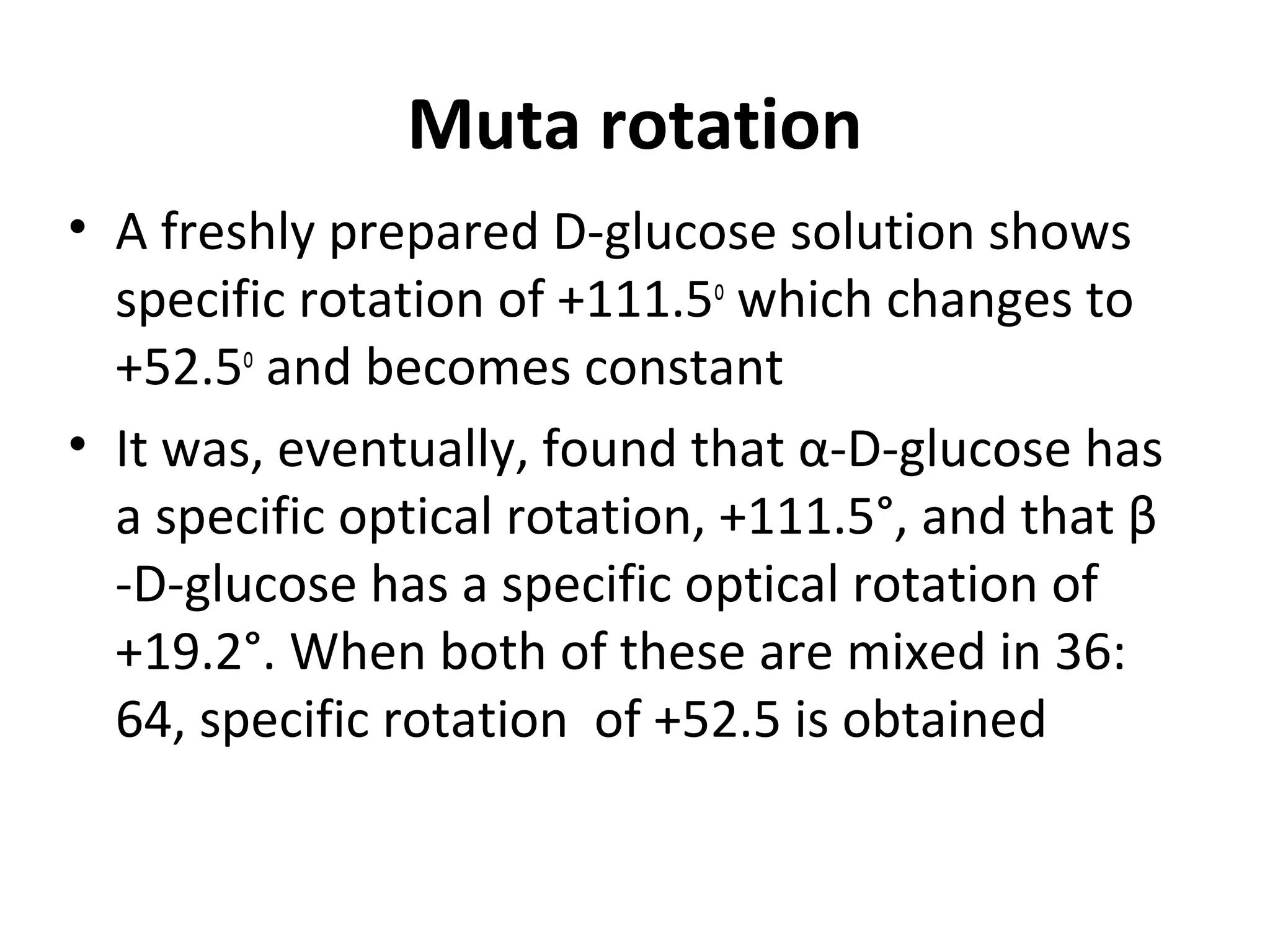
• A freshly prepared D-glucose solution shows
specific rotation of +111.5o
which changes to
+52.5o
and becomes constant
• It was, eventually, found that α-D-glucose has
a specific optical rotation, +111.5°, and that β
-D-glucose has a specific optical rotation of
+19.2°. When both of these are mixed in 36:
64, specific rotation of +52.5 is obtained
Muta rotation
• Hence, naturally occurring glucose solution
contains 36% α and 64% β isomer
• Muta rotation involves inter-conversion of α
form into β form of the monosaccharide with
intermediate linear aldehyde or ketone
Derivatives of Monosaccharides
• Sugar Acids
Sugars with free anomeric carbon atoms are
reasonably good reducing agents and reduce
hydrogen peroxide, ferricyanide , certain
metals (Cu2+
and Ag+
), and other oxidizing
agents. Such reactions convert the sugar to a
sugar acid
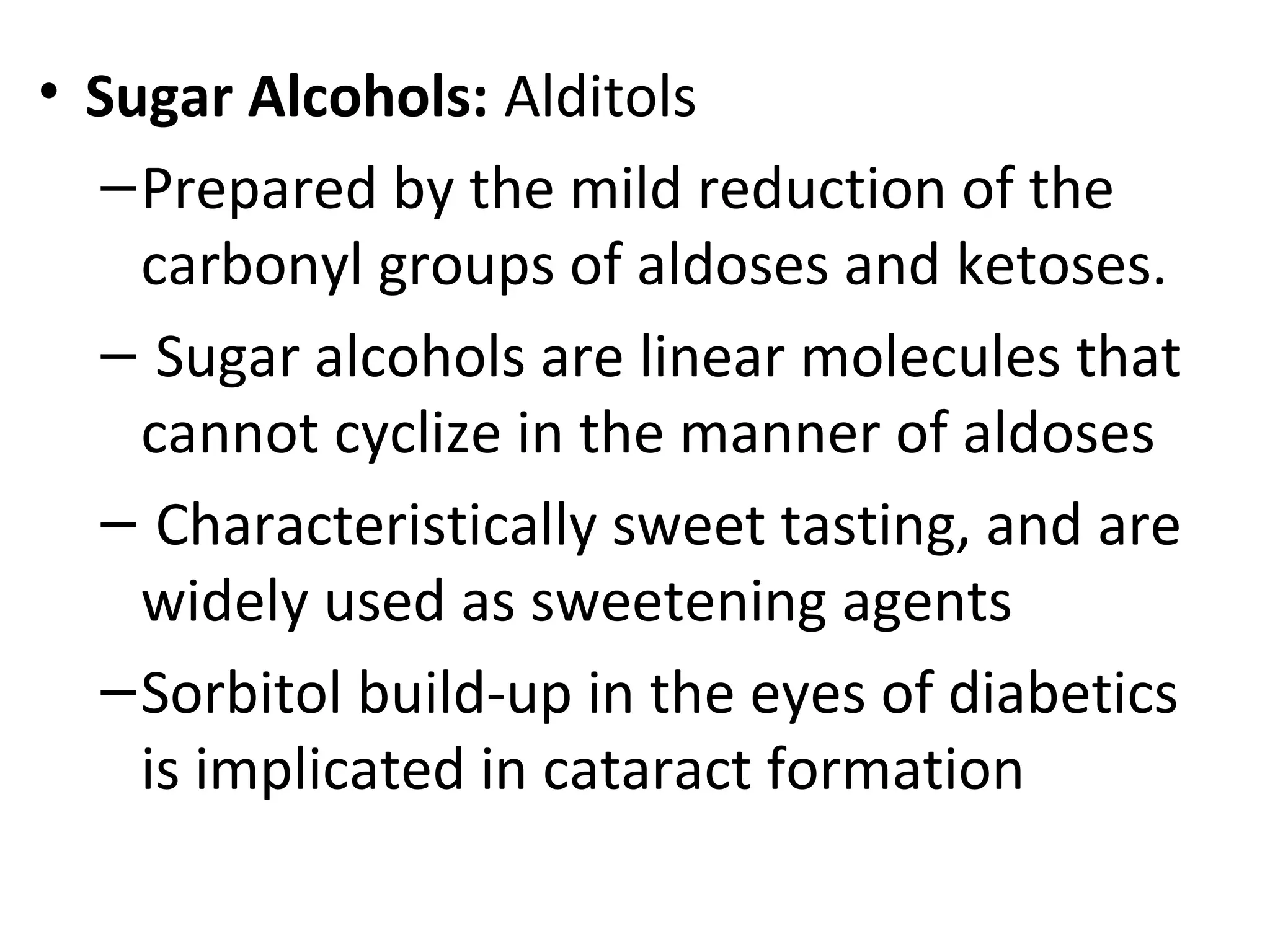
• Sugar Alcohols: Alditols
–Prepared by the mild reduction of the
carbonyl groups of aldoses and ketoses.
– Sugar alcohols are linear molecules that
cannot cyclize in the manner of aldoses
– Characteristically sweet tasting, and are
widely used as sweetening agents
–Sorbitol build-up in the eyes of diabetics
is implicated in cataract formation
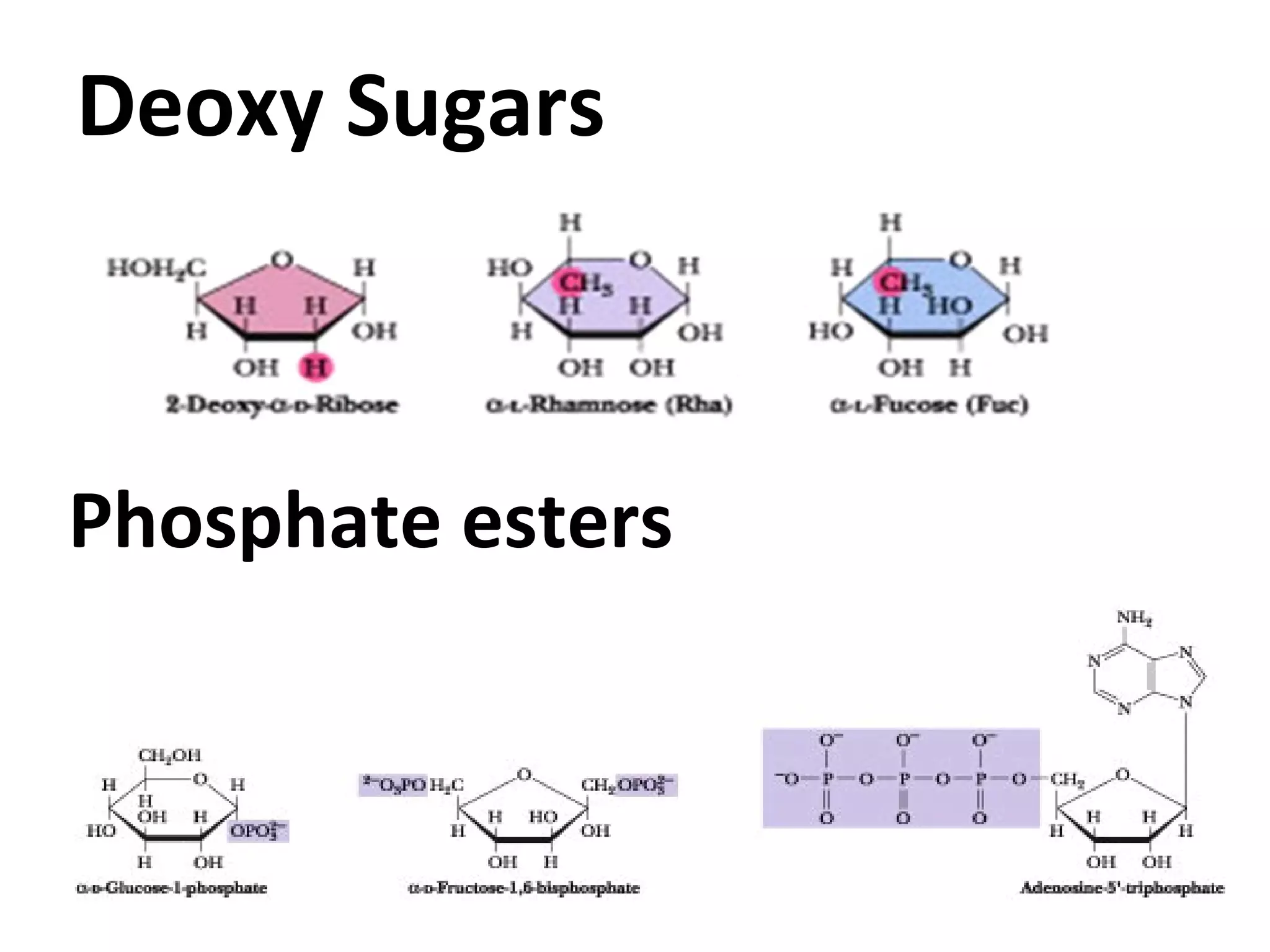
Deoxy Sugars
Phosphate esters
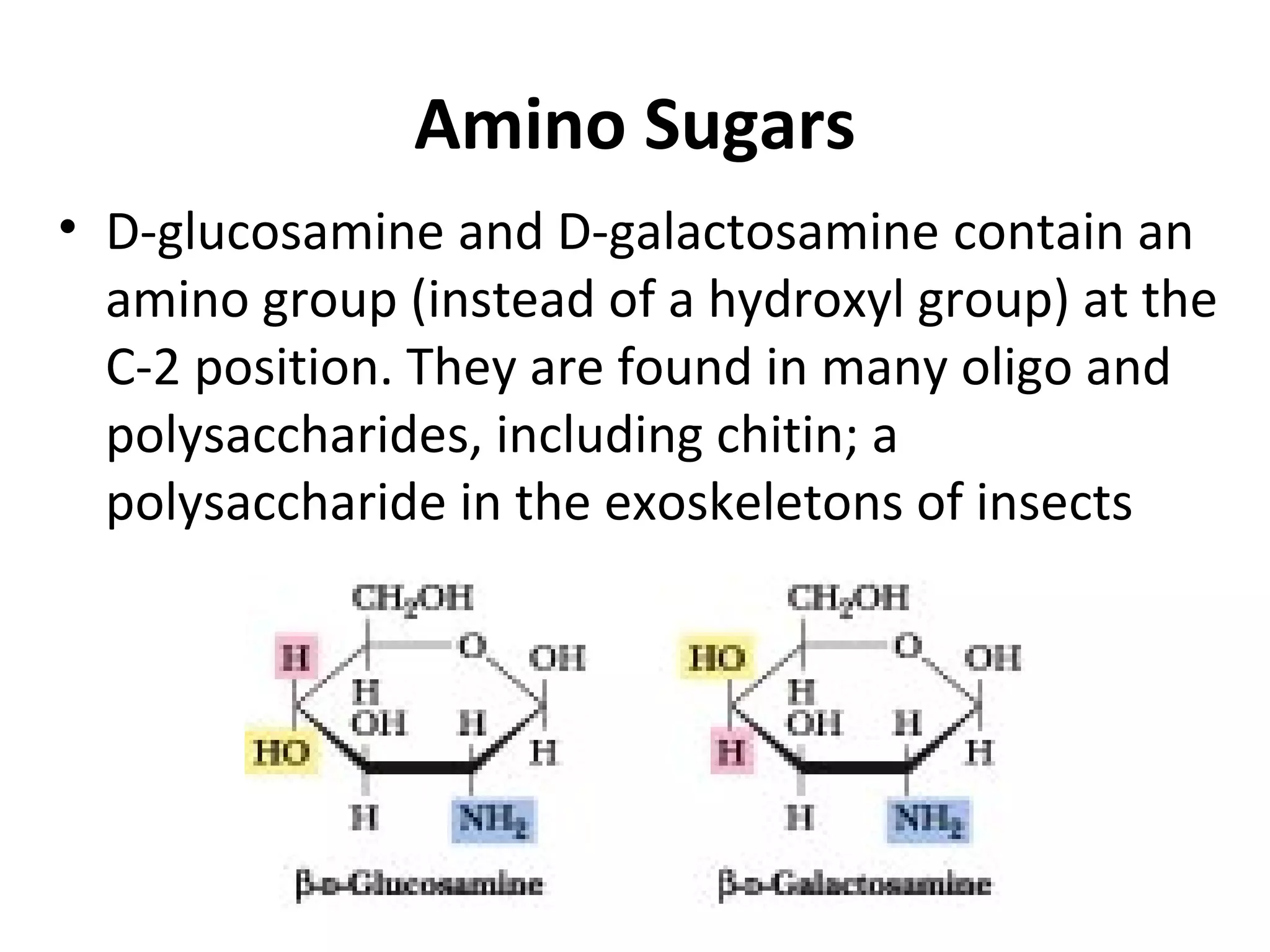
Amino Sugars
• D-glucosamine and D-galactosamine contain an
amino group (instead of a hydroxyl group) at the
C-2 position. They are found in many oligo and
polysaccharides, including chitin; a
polysaccharide in the exoskeletons of insects
Storage Polysaccharides
• Storage polysaccharides are important
carbohydrate forms in plants and animals
• It seems likely that organisms store carbohydrates
in the form of polysaccharides rather than as
monosaccharides to lower the osmotic pressure of
the sugar reserves
• Because, osmotic pressure depends only on
numbers of molecules
– Hence, the osmotic pressure is greatly reduced by
formation of a few polysaccharide molecules out of
thousands (or even millions) of monosaccharide units
Starch
• The most common storage polysaccharide in plants is
starch, which exists in two forms:
– amylose
– amylopectin
• Most forms of the starch in nature are 10-30% amylose
and 70-90% amylopectin
• Amylose is composed of linear chains of D-glucose in
α(1-4) linkages. The chains are of varying length, having
molecular weights from several thousand to half a
million
H O
OH
H
OHH
OH
CH2OH
H
O H
H
OHH
OH
CH2OH
H
O
HH H O
O
H
OHH
OH
CH2OH
H
H H O
H
OHH
OH
CH2OH
H
OH
HH O
O
H
OHH
OH
CH2OH
H
O
H
1
6
5
4
3
1
2
amylose
Reducing endNon-Reducing end
• The chain has a reducing end and a non-
reducing end
• Although poorly soluble in water, α-amylose
forms micelles in which the polysaccharide
chain adopts a helical conformation
• Iodine reacts with α-amylose to give a
characteristic blue colour, which arises from the
insertion of iodine into the middle of the
hydrophobic amylose helix
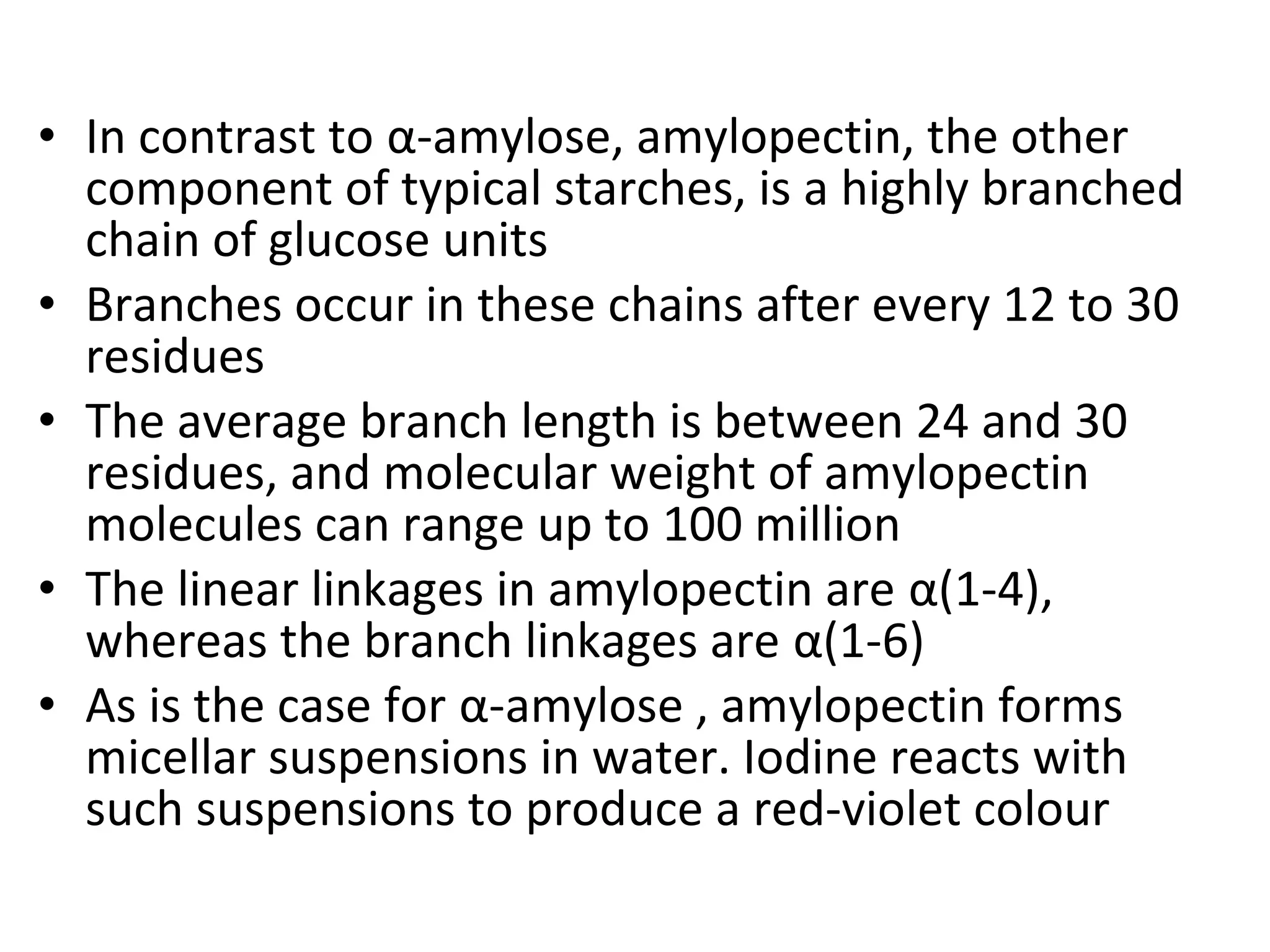
• In contrast to α-amylose, amylopectin, the other
component of typical starches, is a highly branched
chain of glucose units
• Branches occur in these chains after every 12 to 30
residues
• The average branch length is between 24 and 30
residues, and molecular weight of amylopectin
molecules can range up to 100 million
• The linear linkages in amylopectin are α(1-4),
whereas the branch linkages are α(1-6)
• As is the case for α-amylose , amylopectin forms
micellar suspensions in water. Iodine reacts with
such suspensions to produce a red-violet colour
Starch
H O
OH
H
OHH
OH
CH2OH
H
O H
H
OHH
OH
CH2OH
H
O
HH H O
O
H
OHH
OH
CH2OH
H
H H O
H
OHH
OH
CH2OH
H
OH
HH O
O
H
OHH
OH
CH2OH
H
O
H
1
6
5
4
3
1
2
amylose
Glycogen
• The major form of storage polysaccharide in
animals is glycogen
• It is mainly found in the liver (10% of the liver
mass) and skeletal muscle (1-2% of the muscle
mass)
• It highly branched molecules of glucose, α (1-4)
linkage in linear structure and α (1-6) linkage at
branching
• The branching occurs after every 8-12 glucose
units
• Like amylopectin, glycogen yields a red-violet
colour with iodine
• It is hydrolyzed by α-amylase, yielding
glucose
• It is hydrolyzed by glycogen phosphorylase,
an enzyme present in liver and muscle tissue,
to release glucose-1-phosphate
Structural polysaccharides
• Cellulose
• Chitin
• Alginates
• Agarose
• Glycosaminoglycans
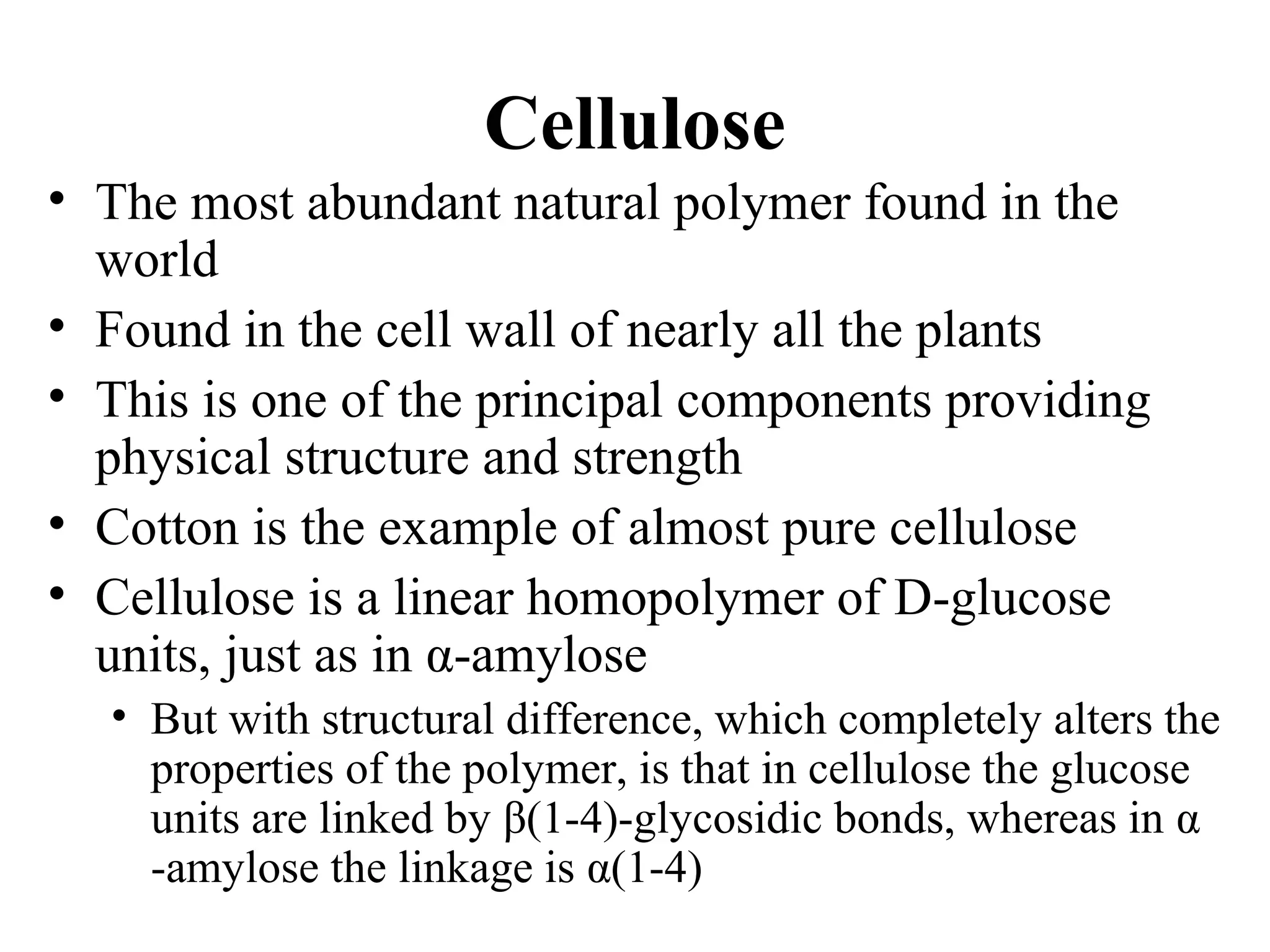
Cellulose
• The most abundant natural polymer found in the
world
• Found in the cell wall of nearly all the plants
• This is one of the principal components providing
physical structure and strength
• Cotton is the example of almost pure cellulose
• Cellulose is a linear homopolymer of D-glucose
units, just as in α-amylose
• But with structural difference, which completely alters the
properties of the polymer, is that in cellulose the glucose
units are linked by β(1-4)-glycosidic bonds, whereas in α
-amylose the linkage is α(1-4)
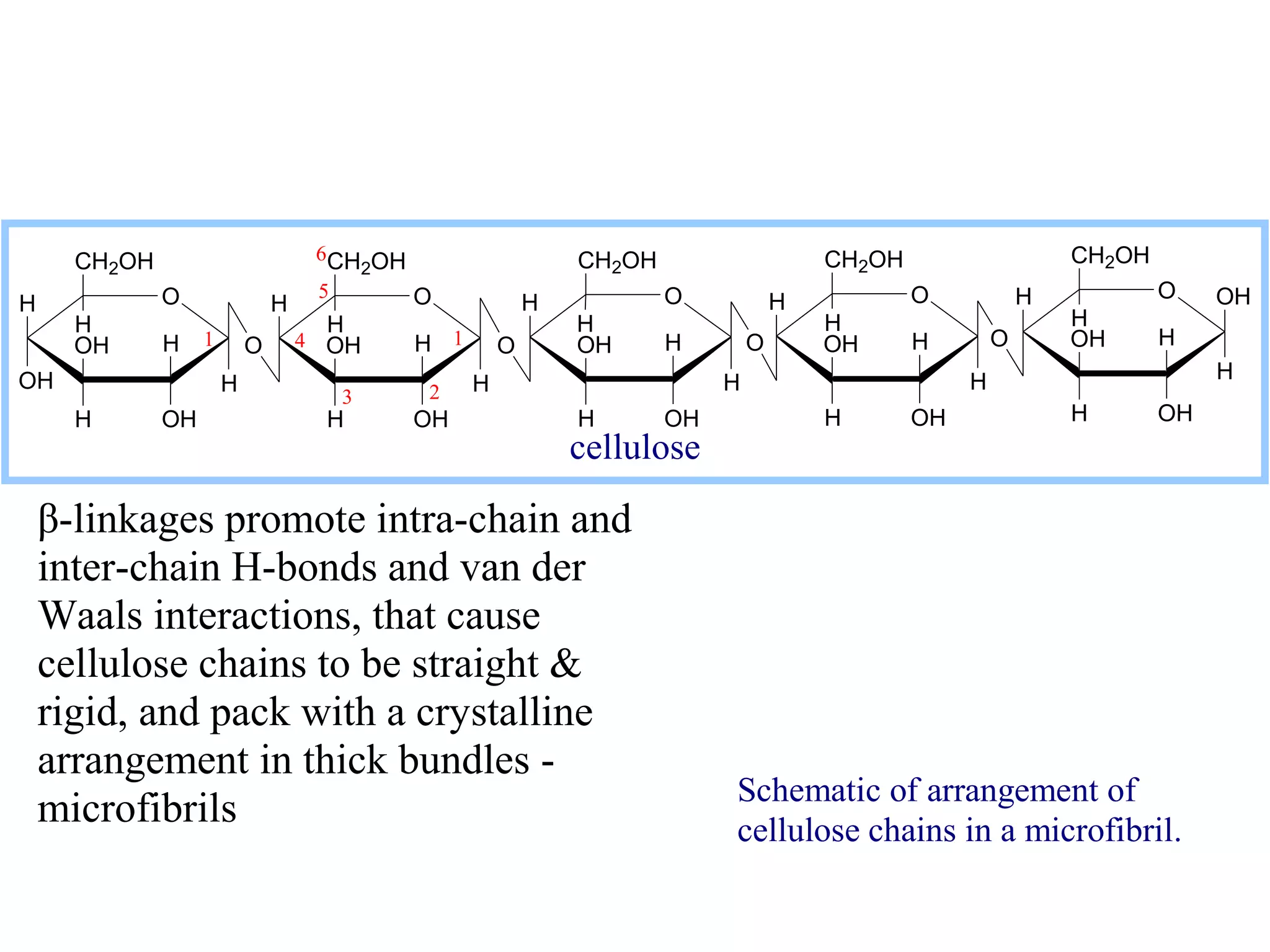
cellulose
H O
OH
H
OHH
OH
CH2OH
H
O
H
OHH
OH
CH2OH
H
O
H H O
O H
OHH
OH
CH2OH
H
H O
H
OHH
OH
CH2OH
H
H
OHH O
O H
OHH
OH
CH2OH
H
O
H H H H
1
6
5
4
3
1
2
β-linkages promote intra-chain and
inter-chain H-bonds and van der
Waals interactions, that cause
cellulose chains to be straight &
rigid, and pack with a crystalline
arrangement in thick bundles -
microfibrils Schematic of arrangement of
cellulose chains in a microfibril.
Glycosaminoglycans
• Previously called mucopolysaccharides
•Linear polymers of repeating disaccharides
–The constituent monosaccharides tend to be modified,
with acidic groups, amino groups, sulfated hydroxyl
groups and amino groups, etc.
•Such compounds tend to be negatively
charged, because of the prevalence of acidic
groups
1-Hyaluronate (Hyaluronic acid)
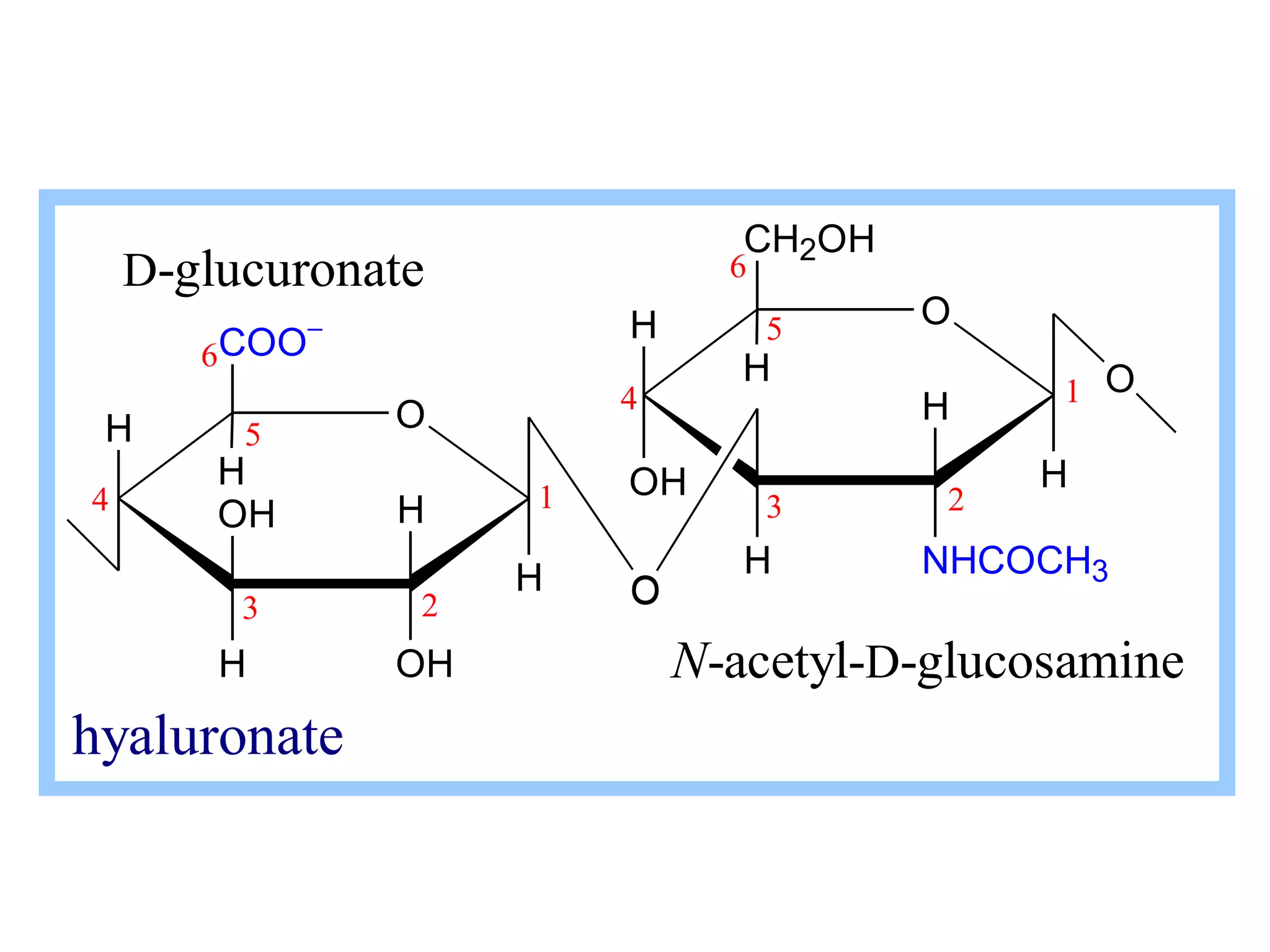
•Hyaluronate is a glycosaminoglycan with a
repeating disaccharide consisting of 2 glucose
derivatives, D-glucuronic acid & N-acetyl-D-
glucosamine
•These monosaccharides are linked
through β(1→3) linkages
•Disaccharides are linked through β(1→4).
H O
H
H
OHH
OH
COO−
H
H O
OH H
H
NHCOCH3H
CH2OH
H
OO
D-glucuronate
O
1
23
4
5
6
1
23
4
5
6
N-acetyl-D-glucosamine
hyaluronate
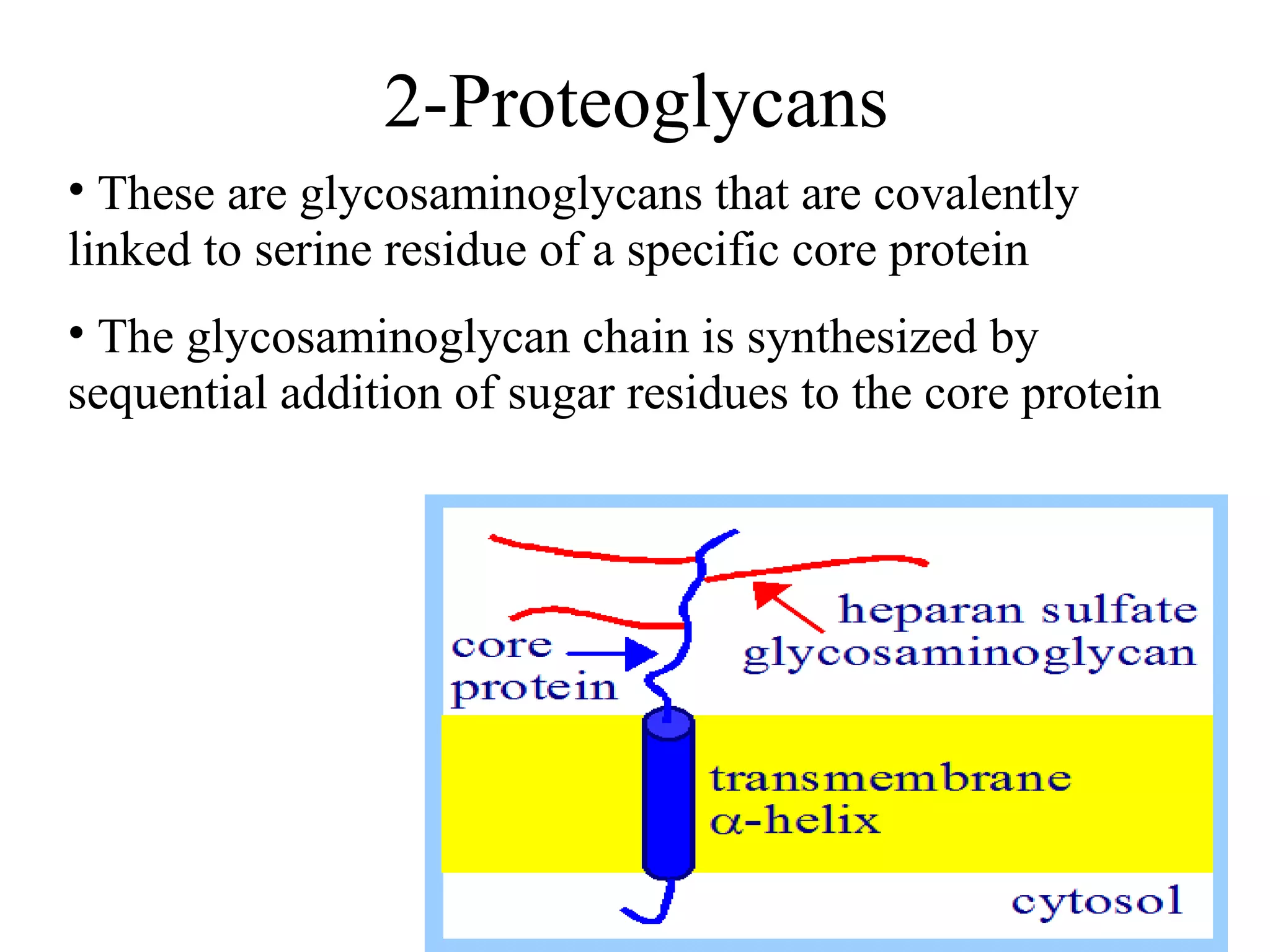
2-Proteoglycans
• These are glycosaminoglycans that are covalently
linked to serine residue of a specific core protein
• The glycosaminoglycan chain is synthesized by
sequential addition of sugar residues to the core protein
H O
H
OSO3
−
H
OH
H
COO−
O H
H
NHSO3
−
H
OH
CH2OSO3
−
H
H
H
O
O
heparin or heparan sulfate - examples of residues
iduronate-2-sulfate N-sulfo-glucosamine-6-sulfate
Heparan sulfate is initially synthesized on a membrane-
embedded core protein as a polymer of alternating
N-acetylglucosamine and glucuronate residues
Later, in segments of the polymer, glucuronate residues
may be converted to the sulfated sugar iduronate 2-
sulfate, while N-acetylglucosamine residues may be
sulfated e.g N-sulfo-glucosamine-6-sulfate
Heparin, a soluble glycosaminoglycan
found in granules of mast cells, has a
structure similar to that of heparan
sulfates, but is more highly sulfated
When released into the blood, it
inhibits clot formation by interacting
with the protein anti-thrombin.
Heparin has an extended helical
conformation
heparin: (IDS-SGN)5
PDB 1RID
Charge repulsion by the many negatively charged groups
may contribute to this conformation
Some proteoglycans of the extracellular matrix bind
non-covalently to hyaluronate via protein domains called
link modules. E.g.
• Aggrecan proteoglycan associates with hyaluronate in
cartilage to form large complexes
• Versican, proteoglycan, binds hyaluronate in the
extracellular matrix of loose connective tissues.
Chitin
• A polysaccharide that is similar to cellulose, both
in its biological function and its primary,
secondary, and tertiary structure
• The structure of chitin is identical to cellulose,
except that the -OH group on each C-2 is
replaced by -NHCOCH3, so that the repeating
units are N-acetyl-D-glucosamines in β-(1-4)
linkage
• An other, significant difference between
cellulose and chitin is that the chains are
arranged;
• Parallel
(all the reducing ends together at one end of a
packed bundle and all the non-reducing ends
together at the other end)
• antiparallel
(each sheet of chains having the chains
arranged oppositely from the sheets above
and below)
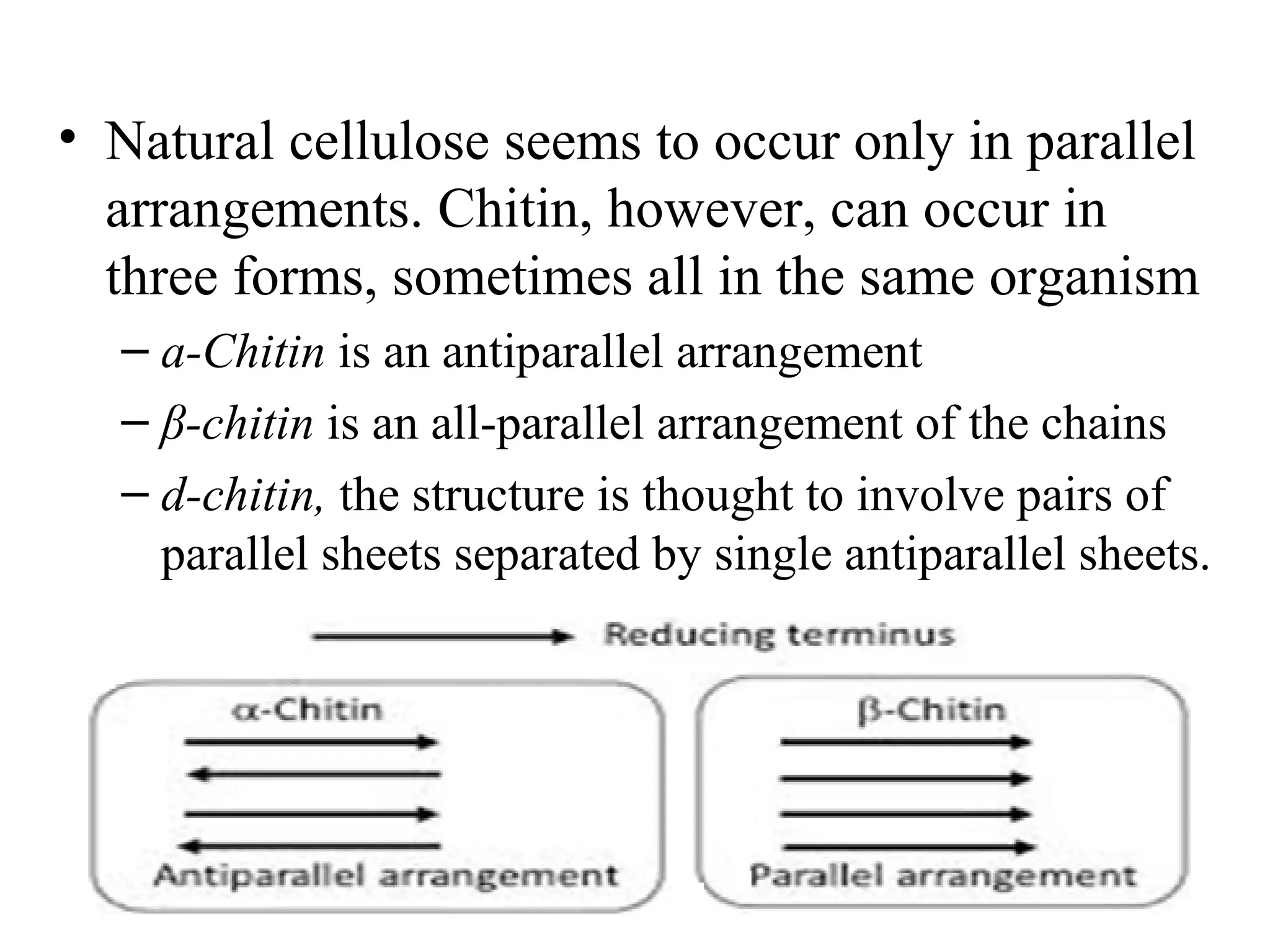
• Natural cellulose seems to occur only in parallel
arrangements. Chitin, however, can occur in
three forms, sometimes all in the same organism
– a-Chitin is an antiparallel arrangement
– β-chitin is an all-parallel arrangement of the chains
– d-chitin, the structure is thought to involve pairs of
parallel sheets separated by single antiparallel sheets.
d-chitin
Carbohydrate 2--Sir Khalid (Biochem)

Carbohydrate 2--Sir Khalid (Biochem)

  • 1.
    Reduction • On reductionwith sodium amalgam, glucose is converted to polyhydric alcohol-sorbitol • Fructose into 2 isomeric products sorbitol and mannitol Sorbitol Mannitol
  • 2.
    Reaction of glucosewith weak alkali In the presence of weak alkali glucose is converted into fructose and vice versa
  • 3.
    Reaction of carbonylgroup Glucose and fructose condense with hydroxyl amine and phenyl hydrazine to produce oximes and osazones
  • 5.
    Reaction with non-reducingagents • Pentoses on heating with HCl/H2SO4 produce furfural-aldehyde of furan, whereas hexoses produce hydroxy methyl furfural • This provides the basis of Molisch’s test, Anthrone test, Seliwanoff’s test etc.
  • 6.
  • 7.
    Reaction with calciumhydroxide On reacting with calcium hydroxide, glucose produces calcium glucosate + Ca (OH)2
  • 8.
    Fermentation Both glucose andfructose are attacked by enzymes of yeast to produce ethyl alcohol and carbon dioxide C6H12O6 → 2C2H5OH + 2CO2
  • 9.
  • 10.
  • 11.
    Configuration of monosaccharides •Due to presence of asymmetric carbon monosaccharides rotate the plane polarized light either toward right or left • Those rotating towards right are dextrorotatory (d or +) and those towards left are levorotatory (l, -) • (d and l) isomers are mirror image of each other when substituents are arranged in space
  • 12.
    • D andL are used for + and – with reference to glyceraldehyde- the farthest asymetric or penaltimate carbon • Aldoses with at least three carbons and ketoses with at least four carbons contain chiral centres
  • 13.
    Cyclic Structures andAnomeric Forms • Although Fischer projections are useful for presenting the structures of a particular monosaccharide and its stereoisomers, but –Such structures ignore one of the most interesting fact of sugar structure; —the ability to form cyclic structures with formation of an additional asymmetric centre
  • 14.
    • Alcohols reactreadily with aldehydes to form hemiacetals – A British Chemist Sir Norman Haworth showed that the linear form of glucose and other aldohexoses could undergo a similar intramolecular reaction to form a cyclic hemiacetal – The resulting six-membered, oxygen-containing, ring is similar to pyran and is designated as pyranose- glucopyranose. The reaction is catalyzed by acid or base and is readily reversible
  • 16.
    • An analogousintramolecular reaction of a ketose sugar such as fructose yields a cyclic hemiketal • The five-membered ring thus formed is reminiscent of furan and is referred to as a furanose • The cyclic pyranose and furanose forms are the preferred structures for monosaccharides in aqueous solution • At equilibrium, the linear aldehyde or ketone structure is only a minor component of the mixture (generally much less than 1%)
  • 18.
    • When hemiacetalsand hemiketals are formed, the carbon atom that carried the carbonyl function becomes an asymmetric carbon atom – Isomers of monosaccharides that differ only in their configuration about that carbon atom are called anomers, designated as α or β • When the hydroxyl group at the anomeric carbon is on the same side of a Fischer projection as the oxygen atom at the highest numbered carbon, the configuration at the anomeric carbon is α, as in α-D-glucopyranose
  • 19.
    • When theanomeric hydroxyl is on the opposite side of oxygen in the Fischer projection, the configuration is β, as in β-D- glucopyranose
  • 20.
    Muta rotation • Theaddition of this asymmetric centre upon hemiacetal and hemiketal formation alters the optical rotation properties of monosaccharides
  • 21.
    Muta rotation Early carbohydrateChemists frequently observed that the optical rotation of glucose solution changes with the passage of time; a process called muta rotation. This indicated the occurrence of structural change.
  • 22.
    Muta rotation • Afreshly prepared D-glucose solution shows specific rotation of +111.5o which changes to +52.5o and becomes constant • It was, eventually, found that α-D-glucose has a specific optical rotation, +111.5°, and that β -D-glucose has a specific optical rotation of +19.2°. When both of these are mixed in 36: 64, specific rotation of +52.5 is obtained
  • 23.
    Muta rotation • Hence,naturally occurring glucose solution contains 36% α and 64% β isomer • Muta rotation involves inter-conversion of α form into β form of the monosaccharide with intermediate linear aldehyde or ketone
  • 24.
    Derivatives of Monosaccharides •Sugar Acids Sugars with free anomeric carbon atoms are reasonably good reducing agents and reduce hydrogen peroxide, ferricyanide , certain metals (Cu2+ and Ag+ ), and other oxidizing agents. Such reactions convert the sugar to a sugar acid
  • 25.
    • Sugar Alcohols:Alditols –Prepared by the mild reduction of the carbonyl groups of aldoses and ketoses. – Sugar alcohols are linear molecules that cannot cyclize in the manner of aldoses – Characteristically sweet tasting, and are widely used as sweetening agents –Sorbitol build-up in the eyes of diabetics is implicated in cataract formation
  • 26.
  • 27.
    Amino Sugars • D-glucosamineand D-galactosamine contain an amino group (instead of a hydroxyl group) at the C-2 position. They are found in many oligo and polysaccharides, including chitin; a polysaccharide in the exoskeletons of insects
  • 28.
    Storage Polysaccharides • Storagepolysaccharides are important carbohydrate forms in plants and animals • It seems likely that organisms store carbohydrates in the form of polysaccharides rather than as monosaccharides to lower the osmotic pressure of the sugar reserves • Because, osmotic pressure depends only on numbers of molecules – Hence, the osmotic pressure is greatly reduced by formation of a few polysaccharide molecules out of thousands (or even millions) of monosaccharide units
  • 29.
    Starch • The mostcommon storage polysaccharide in plants is starch, which exists in two forms: – amylose – amylopectin • Most forms of the starch in nature are 10-30% amylose and 70-90% amylopectin • Amylose is composed of linear chains of D-glucose in α(1-4) linkages. The chains are of varying length, having molecular weights from several thousand to half a million
  • 30.
    H O OH H OHH OH CH2OH H O H H OHH OH CH2OH H O HHH O O H OHH OH CH2OH H H H O H OHH OH CH2OH H OH HH O O H OHH OH CH2OH H O H 1 6 5 4 3 1 2 amylose Reducing endNon-Reducing end • The chain has a reducing end and a non- reducing end
  • 31.
    • Although poorlysoluble in water, α-amylose forms micelles in which the polysaccharide chain adopts a helical conformation • Iodine reacts with α-amylose to give a characteristic blue colour, which arises from the insertion of iodine into the middle of the hydrophobic amylose helix
  • 32.
    • In contrastto α-amylose, amylopectin, the other component of typical starches, is a highly branched chain of glucose units • Branches occur in these chains after every 12 to 30 residues • The average branch length is between 24 and 30 residues, and molecular weight of amylopectin molecules can range up to 100 million • The linear linkages in amylopectin are α(1-4), whereas the branch linkages are α(1-6) • As is the case for α-amylose , amylopectin forms micellar suspensions in water. Iodine reacts with such suspensions to produce a red-violet colour
  • 33.
    Starch H O OH H OHH OH CH2OH H O H H OHH OH CH2OH H O HHH O O H OHH OH CH2OH H H H O H OHH OH CH2OH H OH HH O O H OHH OH CH2OH H O H 1 6 5 4 3 1 2 amylose
  • 34.
    Glycogen • The majorform of storage polysaccharide in animals is glycogen • It is mainly found in the liver (10% of the liver mass) and skeletal muscle (1-2% of the muscle mass) • It highly branched molecules of glucose, α (1-4) linkage in linear structure and α (1-6) linkage at branching • The branching occurs after every 8-12 glucose units
  • 35.
    • Like amylopectin,glycogen yields a red-violet colour with iodine • It is hydrolyzed by α-amylase, yielding glucose • It is hydrolyzed by glycogen phosphorylase, an enzyme present in liver and muscle tissue, to release glucose-1-phosphate
  • 37.
    Structural polysaccharides • Cellulose •Chitin • Alginates • Agarose • Glycosaminoglycans
  • 38.
    Cellulose • The mostabundant natural polymer found in the world • Found in the cell wall of nearly all the plants • This is one of the principal components providing physical structure and strength • Cotton is the example of almost pure cellulose • Cellulose is a linear homopolymer of D-glucose units, just as in α-amylose • But with structural difference, which completely alters the properties of the polymer, is that in cellulose the glucose units are linked by β(1-4)-glycosidic bonds, whereas in α -amylose the linkage is α(1-4)
  • 39.
    cellulose H O OH H OHH OH CH2OH H O H OHH OH CH2OH H O H HO O H OHH OH CH2OH H H O H OHH OH CH2OH H H OHH O O H OHH OH CH2OH H O H H H H 1 6 5 4 3 1 2 β-linkages promote intra-chain and inter-chain H-bonds and van der Waals interactions, that cause cellulose chains to be straight & rigid, and pack with a crystalline arrangement in thick bundles - microfibrils Schematic of arrangement of cellulose chains in a microfibril.
  • 40.
    Glycosaminoglycans • Previously calledmucopolysaccharides •Linear polymers of repeating disaccharides –The constituent monosaccharides tend to be modified, with acidic groups, amino groups, sulfated hydroxyl groups and amino groups, etc. •Such compounds tend to be negatively charged, because of the prevalence of acidic groups
  • 41.
    1-Hyaluronate (Hyaluronic acid) •Hyaluronateis a glycosaminoglycan with a repeating disaccharide consisting of 2 glucose derivatives, D-glucuronic acid & N-acetyl-D- glucosamine •These monosaccharides are linked through β(1→3) linkages •Disaccharides are linked through β(1→4).
  • 42.
    H O H H OHH OH COO− H H O OHH H NHCOCH3H CH2OH H OO D-glucuronate O 1 23 4 5 6 1 23 4 5 6 N-acetyl-D-glucosamine hyaluronate
  • 43.
    2-Proteoglycans • These areglycosaminoglycans that are covalently linked to serine residue of a specific core protein • The glycosaminoglycan chain is synthesized by sequential addition of sugar residues to the core protein
  • 44.
    H O H OSO3 − H OH H COO− O H H NHSO3 − H OH CH2OSO3 − H H H O O heparinor heparan sulfate - examples of residues iduronate-2-sulfate N-sulfo-glucosamine-6-sulfate Heparan sulfate is initially synthesized on a membrane- embedded core protein as a polymer of alternating N-acetylglucosamine and glucuronate residues Later, in segments of the polymer, glucuronate residues may be converted to the sulfated sugar iduronate 2- sulfate, while N-acetylglucosamine residues may be sulfated e.g N-sulfo-glucosamine-6-sulfate
  • 45.
    Heparin, a solubleglycosaminoglycan found in granules of mast cells, has a structure similar to that of heparan sulfates, but is more highly sulfated When released into the blood, it inhibits clot formation by interacting with the protein anti-thrombin. Heparin has an extended helical conformation heparin: (IDS-SGN)5 PDB 1RID Charge repulsion by the many negatively charged groups may contribute to this conformation
  • 46.
    Some proteoglycans ofthe extracellular matrix bind non-covalently to hyaluronate via protein domains called link modules. E.g. • Aggrecan proteoglycan associates with hyaluronate in cartilage to form large complexes • Versican, proteoglycan, binds hyaluronate in the extracellular matrix of loose connective tissues.
  • 48.
    Chitin • A polysaccharidethat is similar to cellulose, both in its biological function and its primary, secondary, and tertiary structure • The structure of chitin is identical to cellulose, except that the -OH group on each C-2 is replaced by -NHCOCH3, so that the repeating units are N-acetyl-D-glucosamines in β-(1-4) linkage
  • 49.
    • An other,significant difference between cellulose and chitin is that the chains are arranged; • Parallel (all the reducing ends together at one end of a packed bundle and all the non-reducing ends together at the other end) • antiparallel (each sheet of chains having the chains arranged oppositely from the sheets above and below)
  • 50.
    • Natural celluloseseems to occur only in parallel arrangements. Chitin, however, can occur in three forms, sometimes all in the same organism – a-Chitin is an antiparallel arrangement – β-chitin is an all-parallel arrangement of the chains – d-chitin, the structure is thought to involve pairs of parallel sheets separated by single antiparallel sheets.
  • 51.