Chapter 9 Spring 2009
 
Alcohol nomenclature using IUPAC rules Step 1 Name the longest carbon chain containing the –OH. Change the –e ending to the suffix –ol.  Step 2 Number the carbon chain to give the –OH group the lower number, and apply all other rules of nomenclature.
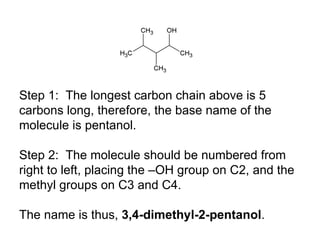
Step 1:  The longest carbon chain above is 5 carbons long, therefore, the base name of the molecule is pentanol. Step 2:  The molecule should be numbered from right to left, placing the –OH group on C2, and the methyl groups on C3 and C4. The name is thus,  3,4-dimethyl-2-pentanol .
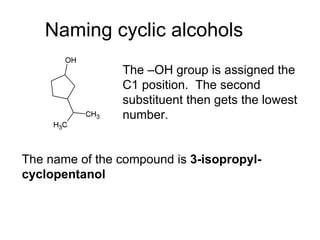
Naming cyclic alcohols The –OH group is assigned the C1 position.  The second substituent then gets the lowest number. The name of the compound is  3-isopropyl-cyclopentanol
 
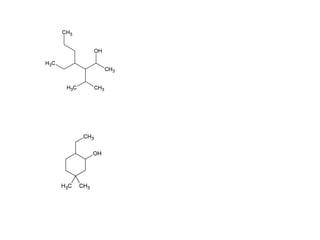
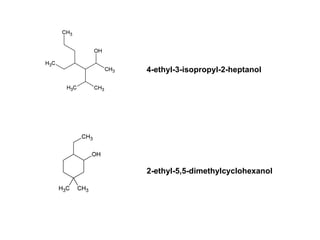
4-ethyl-3-isopropyl-2-heptanol 2-ethyl-5,5-dimethylcyclohexanol
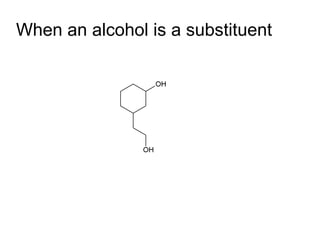
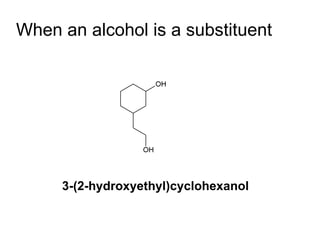
When an alcohol is a substituent
When an alcohol is a substituent 3-(2-hydroxyethyl)cyclohexanol
Ether nomenclature using IUPAC rules  Name the simpler alkyl group + O atom as an alkoxy substituent by changing the –yl ending of the alkyll group to –oxy. (examples on next page) Name the remaining alkyl group as an alkane, with the alkoxy group as a substituent bonded to this chain
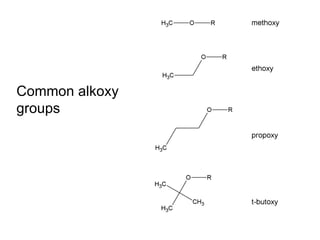
Common alkoxy groups
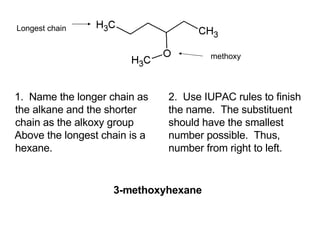
1.  Name the longer chain as the alkane and the shorter chain as the alkoxy group Above the longest chain is a hexane. Longest chain 2.  Use IUPAC rules to finish the name.  The substituent should have the smallest number possible.  Thus, number from right to left. 3-methoxyhexane methoxy
 
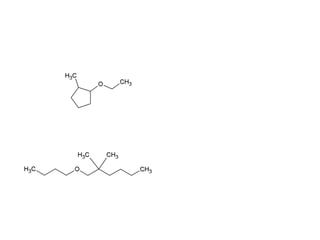
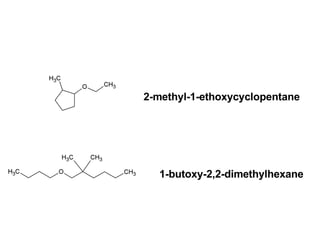
2-methyl-1-ethoxycyclopentane 1-butoxy-2,2-dimethylhexane
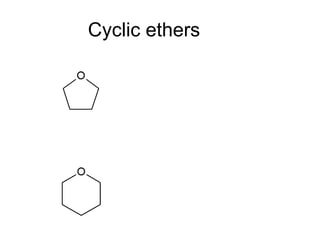
Cyclic ethers
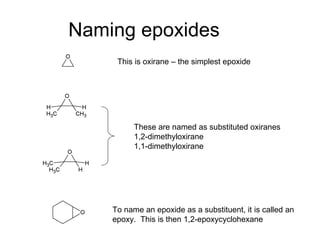
Naming epoxides This is oxirane – the simplest epoxide These are named as substituted oxiranes 1,2-dimethyloxirane 1,1-dimethyloxirane To name an epoxide as a substituent, it is called an epoxy.  This is then 1,2-epoxycyclohexane
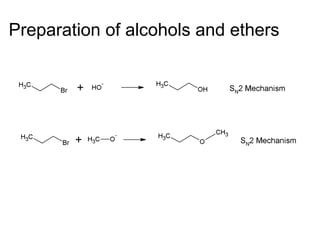
Preparation of alcohols and ethers
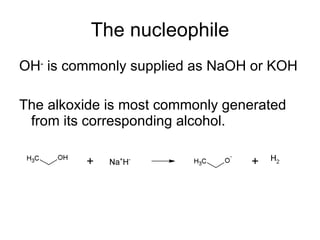
The nucleophile OH -  is commonly supplied as NaOH or KOH The alkoxide is most commonly generated from its corresponding alcohol.
Draw the product of the following two-step sequence [1] In the first step the base NaH removes the proton from the alcohol [2] In the second step of the process the alkoxide acts as a nucleophile displacing the leaving group in an S N 2 reaction
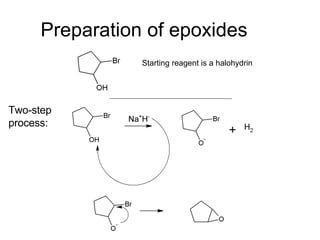
Preparation of epoxides Starting reagent is a halohydrin Two-step process:
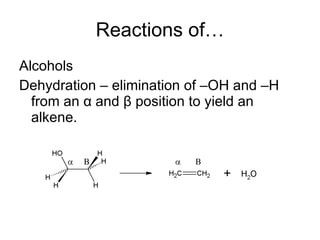
Reactions of… Alcohols Dehydration – elimination of –OH and –H from an  α  and  β  position to yield an alkene.
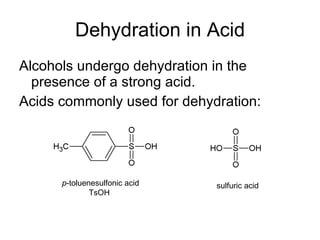
Dehydration in Acid Alcohols undergo dehydration in the presence of a strong acid. Acids commonly used for dehydration: p -toluenesulfonic acid TsOH sulfuric acid
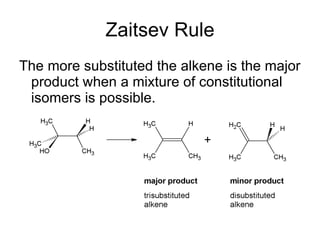
Zaitsev Rule The more substituted the alkene is the major product when a mixture of constitutional isomers is possible.
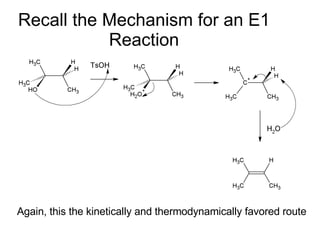
Recall the Mechanism for an E1 Reaction Again, this the kinetically and thermodynamically favored route
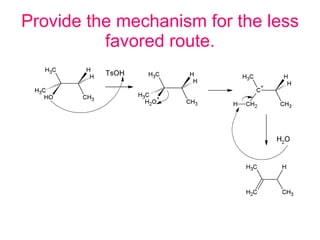
Provide the mechanism for the less favored route.
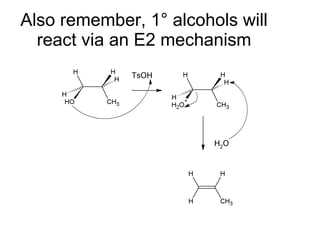
Also remember, 1° alcohols will react via an E2 mechanism
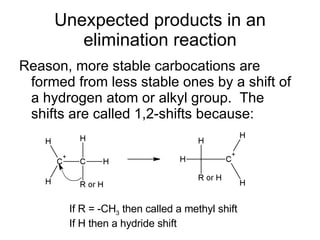
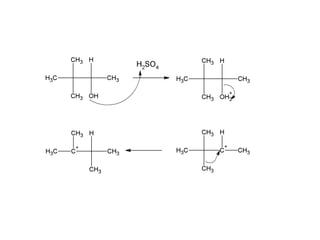
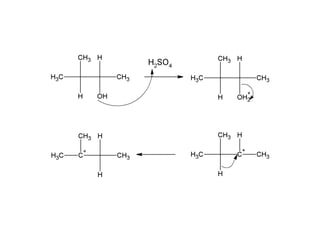
Unexpected products in an elimination reaction Reason, more stable carbocations are formed from less stable ones by a shift of a hydrogen atom or alkyl group.  The shifts are called 1,2-shifts because: If R = -CH 3  then called a methyl shift If H then a hydride shift
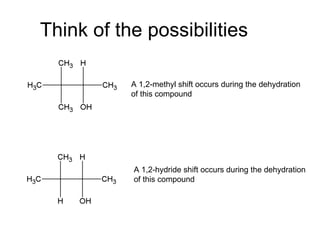
Think of the possibilities A 1,2-methyl shift occurs during the dehydration of this compound A 1,2-hydride shift occurs during the dehydration of this compound
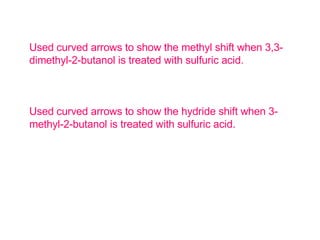
Used curved arrows to show the methyl shift when 3,3-dimethyl-2-butanol is treated with sulfuric acid. Used curved arrows to show the hydride shift when 3-methyl-2-butanol is treated with sulfuric acid.
 
 
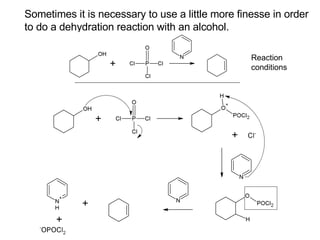
Sometimes it is necessary to use a little more finesse in order to do a dehydration reaction with an alcohol. Reaction conditions
And what I mean by that is… You can execute a dehydration reaction with POCl 3  and pyradine in order to avoid the use of strong acid.
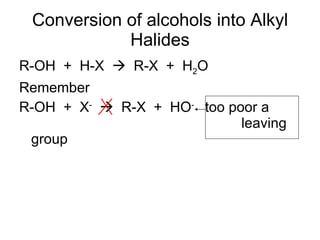
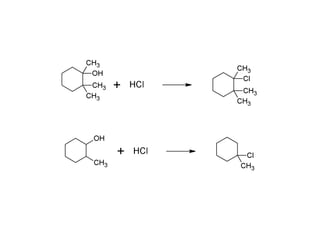
Conversion of alcohols into Alkyl Halides R-OH  +  H-X     R-X  +  H 2 O Remember R-OH  +  X -      R-X  +  HO -  too poor a    leaving group
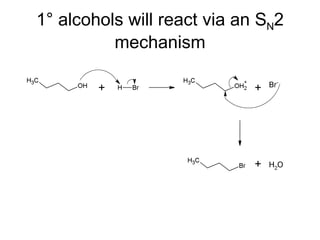
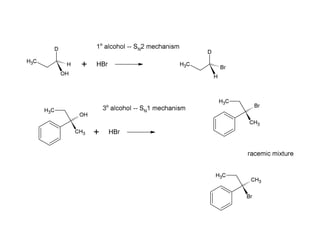
1° alcohols will react via an S N 2 mechanism
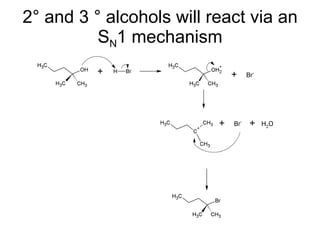
2° and 3 ° alcohols will react via an S N 1 mechanism
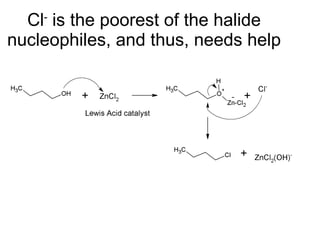
Cl -  is the poorest of the halide nucleophiles, and thus, needs help
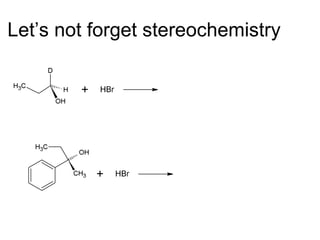
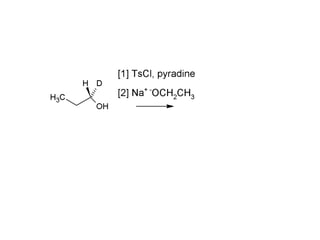
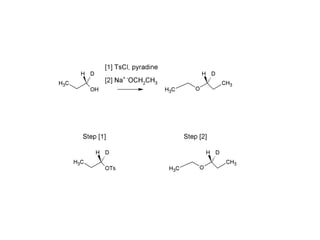
Let’s not forget stereochemistry
 
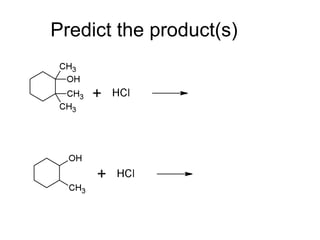
Predict the product(s)
 
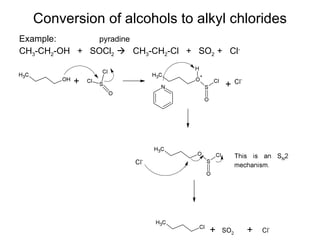
Conversion of alcohols to alkyl chlorides Example:  CH 3 -CH 2 -OH  +  SOCl 2     CH 3 -CH 2 -Cl  +  SO 2  +  Cl - pyradine
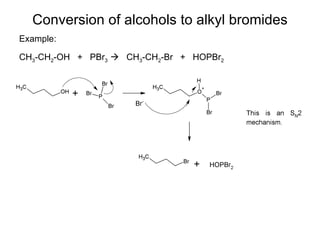
Conversion of alcohols to alkyl bromides Example: CH 3 -CH 2 -OH  +  PBr 3     CH 3 -CH 2 -Br  +  HOPBr 2
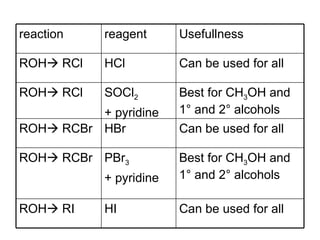
Can be used for all HI ROH   RI Best for CH 3 OH and 1° and 2° alcohols PBr 3 + pyridine ROH   RCBr Can be used for all HBr ROH   RCBr Best for CH 3 OH and 1° and 2° alcohols SOCl 2 + pyridine ROH   RCl Can be used for all HCl ROH   RCl Usefullness reagent reaction
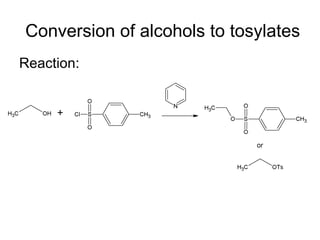
Conversion of alcohols to tosylates Reaction:
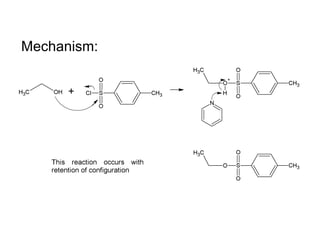
Mechanism:
 
 
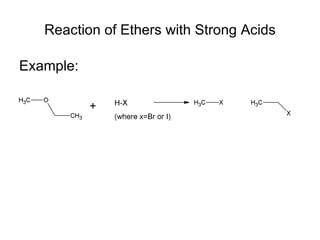
Reaction of Ethers with Strong Acids Example:
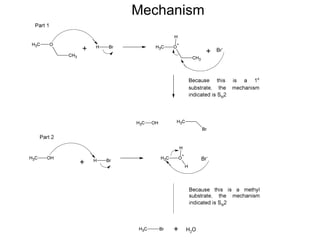
Mechanism
 
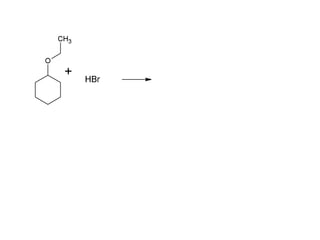
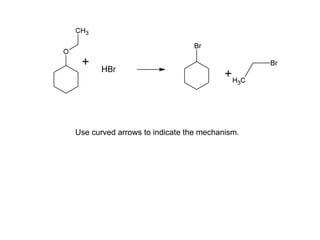
Use curved arrows to indicate the mechanism.
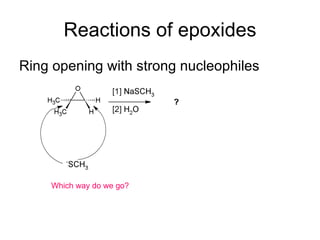
Reactions of epoxides Ring opening with strong nucleophiles Which way do we go?
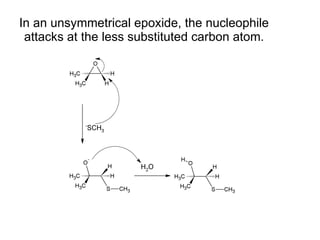
In an unsymmetrical epoxide, the nucleophile attacks at the less substituted carbon atom.
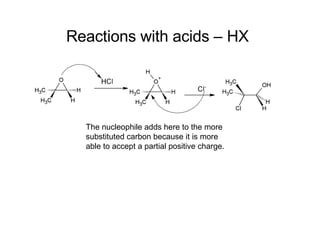
Reactions with acids – HX   The nucleophile adds here to the more substituted carbon because it is more able to accept a partial positive charge.

Chapter9

  • 1.
  • 2.
  • 3.
    Alcohol nomenclature usingIUPAC rules Step 1 Name the longest carbon chain containing the –OH. Change the –e ending to the suffix –ol. Step 2 Number the carbon chain to give the –OH group the lower number, and apply all other rules of nomenclature.
  • 4.
    Step 1: The longest carbon chain above is 5 carbons long, therefore, the base name of the molecule is pentanol. Step 2: The molecule should be numbered from right to left, placing the –OH group on C2, and the methyl groups on C3 and C4. The name is thus, 3,4-dimethyl-2-pentanol .
  • 5.
    Naming cyclic alcoholsThe –OH group is assigned the C1 position. The second substituent then gets the lowest number. The name of the compound is 3-isopropyl-cyclopentanol
  • 6.
  • 7.
  • 8.
    When an alcoholis a substituent
  • 9.
    When an alcoholis a substituent 3-(2-hydroxyethyl)cyclohexanol
  • 10.
    Ether nomenclature usingIUPAC rules Name the simpler alkyl group + O atom as an alkoxy substituent by changing the –yl ending of the alkyll group to –oxy. (examples on next page) Name the remaining alkyl group as an alkane, with the alkoxy group as a substituent bonded to this chain
  • 11.
  • 12.
    1. Namethe longer chain as the alkane and the shorter chain as the alkoxy group Above the longest chain is a hexane. Longest chain 2. Use IUPAC rules to finish the name. The substituent should have the smallest number possible. Thus, number from right to left. 3-methoxyhexane methoxy
  • 13.
  • 14.
  • 15.
  • 16.
    Naming epoxides Thisis oxirane – the simplest epoxide These are named as substituted oxiranes 1,2-dimethyloxirane 1,1-dimethyloxirane To name an epoxide as a substituent, it is called an epoxy. This is then 1,2-epoxycyclohexane
  • 17.
  • 18.
    The nucleophile OH- is commonly supplied as NaOH or KOH The alkoxide is most commonly generated from its corresponding alcohol.
  • 19.
    Draw the productof the following two-step sequence [1] In the first step the base NaH removes the proton from the alcohol [2] In the second step of the process the alkoxide acts as a nucleophile displacing the leaving group in an S N 2 reaction
  • 20.
    Preparation of epoxidesStarting reagent is a halohydrin Two-step process:
  • 21.
    Reactions of… AlcoholsDehydration – elimination of –OH and –H from an α and β position to yield an alkene.
  • 22.
    Dehydration in AcidAlcohols undergo dehydration in the presence of a strong acid. Acids commonly used for dehydration: p -toluenesulfonic acid TsOH sulfuric acid
  • 23.
    Zaitsev Rule Themore substituted the alkene is the major product when a mixture of constitutional isomers is possible.
  • 24.
    Recall the Mechanismfor an E1 Reaction Again, this the kinetically and thermodynamically favored route
  • 25.
    Provide the mechanismfor the less favored route.
  • 26.
    Provide the mechanismfor the less favored route.
  • 27.
    Also remember, 1°alcohols will react via an E2 mechanism
  • 28.
    Unexpected products inan elimination reaction Reason, more stable carbocations are formed from less stable ones by a shift of a hydrogen atom or alkyl group. The shifts are called 1,2-shifts because: If R = -CH 3 then called a methyl shift If H then a hydride shift
  • 29.
    Think of thepossibilities A 1,2-methyl shift occurs during the dehydration of this compound A 1,2-hydride shift occurs during the dehydration of this compound
  • 30.
    Used curved arrowsto show the methyl shift when 3,3-dimethyl-2-butanol is treated with sulfuric acid. Used curved arrows to show the hydride shift when 3-methyl-2-butanol is treated with sulfuric acid.
  • 31.
  • 32.
  • 33.
    Sometimes it isnecessary to use a little more finesse in order to do a dehydration reaction with an alcohol. Reaction conditions
  • 34.
    And what Imean by that is… You can execute a dehydration reaction with POCl 3 and pyradine in order to avoid the use of strong acid.
  • 35.
    Conversion of alcoholsinto Alkyl Halides R-OH + H-X  R-X + H 2 O Remember R-OH + X -  R-X + HO - too poor a leaving group
  • 36.
    1° alcohols willreact via an S N 2 mechanism
  • 37.
    2° and 3° alcohols will react via an S N 1 mechanism
  • 38.
    Cl - is the poorest of the halide nucleophiles, and thus, needs help
  • 39.
    Let’s not forgetstereochemistry
  • 40.
  • 41.
  • 42.
  • 43.
    Conversion of alcoholsto alkyl chlorides Example: CH 3 -CH 2 -OH + SOCl 2  CH 3 -CH 2 -Cl + SO 2 + Cl - pyradine
  • 44.
    Conversion of alcoholsto alkyl bromides Example: CH 3 -CH 2 -OH + PBr 3  CH 3 -CH 2 -Br + HOPBr 2
  • 45.
    Can be usedfor all HI ROH  RI Best for CH 3 OH and 1° and 2° alcohols PBr 3 + pyridine ROH  RCBr Can be used for all HBr ROH  RCBr Best for CH 3 OH and 1° and 2° alcohols SOCl 2 + pyridine ROH  RCl Can be used for all HCl ROH  RCl Usefullness reagent reaction
  • 46.
    Conversion of alcoholsto tosylates Reaction:
  • 47.
  • 48.
  • 49.
  • 50.
    Reaction of Etherswith Strong Acids Example:
  • 51.
  • 52.
  • 53.
    Use curved arrowsto indicate the mechanism.
  • 54.
    Reactions of epoxidesRing opening with strong nucleophiles Which way do we go?
  • 55.
    In an unsymmetricalepoxide, the nucleophile attacks at the less substituted carbon atom.
  • 56.
    Reactions with acids– HX The nucleophile adds here to the more substituted carbon because it is more able to accept a partial positive charge.