Wollega university
School of medicine
Department of Medicine
Physiology of Male Reproductive system
Zelalembanjaw9@gmail.com
1
Outlines
 FunctionalAnatomy of the reproductive organs of males
 Spermatogenesis
 Male sexual act
 Male sex hormones
1. Physiological Anatomy of the Male Sexual Organs
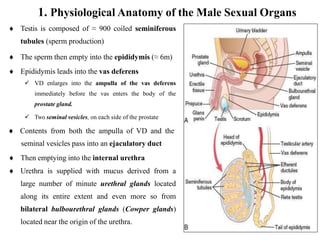
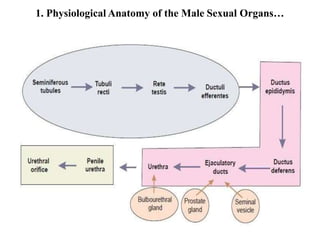
 Testis is composed of ≈ 900 coiled seminiferous
tubules (sperm production)
 The sperm then empty into the epididymis (≈ 6m)
 Epididymis leads into the vas deferens
 VD enlarges into the ampulla of the vas deferens
immediately before the vas enters the body of the
prostate gland.
 Two seminal vesicles, on each side of the prostate
 Contents from both the ampulla of VD and the
seminal vesicles pass into an ejaculatory duct
 Then emptying into the internal urethra
 Urethra is supplied with mucus derived from a
large number of minute urethral glands located
along its entire extent and even more so from
bilateral bulbourethral glands (Cowper glands)
located near the origin of the urethra.
1. Physiological Anatomy of the Male Sexual Organs…
Testis
Testis has 2 tubular Cells
1. Germinal cells: spermatogonia
2. Non-germinal cells:
a. Sertoli cells
 Non-motile + non-proliferating tubular cells.
 Divide the seminiferous tubule epithelium into two functional pools
 Basement → lumen.
b. Leydig cells
between the seminiferous tubules
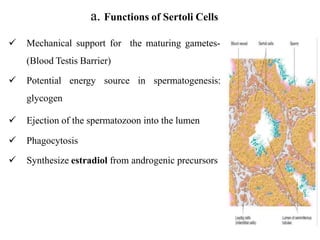
a. Functions of Sertoli Cells
 Mechanical support for the maturing gametes-
(Blood Testis Barrier)
 Potential energy source in spermatogenesis:
glycogen
 Ejection of the spermatozoon into the lumen
 Phagocytosis
 Synthesize estradiol from androgenic precursors
b. Leydig Cells (Interstitial Cells)
Functions
 Steroidogenic stromal cells (secrete androgens)
 Regulation: paracrine/autocrine (+ LH)
 are almost nonexistent in the testes during childhood when the testes
secrete almost no testosterone
 Produce testosterone
 Stimulated by LH from the anterior pituitary gland
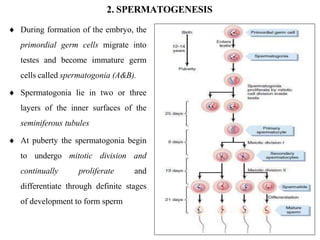
2. SPERMATOGENESIS
 During formation of the embryo, the
primordial germ cells migrate into
testes and become immature germ
cells called spermatogonia (A&B).
 Spermatogonia lie in two or three
layers of the inner surfaces of the
seminiferous tubules
 At puberty the spermatogonia begin
to undergo mitotic division and
continually proliferate and
differentiate through definite stages
of development to form sperm
2. SPERMATOGENESIS…
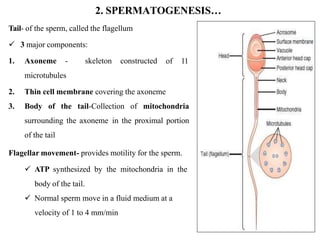
Tail- of the sperm, called the flagellum
 3 major components:
1. Axoneme - skeleton constructed
microtubules
of 11
2. Thin cell membrane covering the axoneme
3. Body of the tail-Collection of mitochondria
surrounding the axoneme in the proximal portion
of the tail
Flagellar movement- provides motility for the sperm.
 ATP synthesized by the mitochondria in the
body of the tail.
 Normal sperm move in a fluid medium at a
velocity of 1 to 4 mm/min
2. Factors affecting spermatogenesis
to secrete
process of
A. Hormonal Factors
1. Luteinizing hormone
 stimulates the Leydig cells
testosterone.
2. FSH
 stimulates the Sertoli cells
without this stimulation (the
spermiogenesis) will not occur.
3. Testosterone
secreted by the Leydig cells is essential for
division of the testicular
growth and
germinal cells
4. Estrogens
 formed from testosterone by the
Sertoli cells when they are stimulated
by FSH probably also essential for
spermiogenesis.
5. Growth hormone
 is necessary for metabolic functions
of the testes
 Promotes early division of the
spermatogonia themselves
 In its absence- spermatogenesis is
severely deficient or absent, thus
causing infertility.
B. Temperature
 an optimum testicular temperature is
34-35oC.
 In case of undescended testis
(cryptorchidism),nospermatogenesis
occurs, infertility b/c BT Arrests
sperm
2. SPERMATOGENESIS…
Maturation of Sperm in the Epididymis
 After the sperm have been in the epididymis for 18 to 24 hours,
they develop the capability of motility, even though several
inhibitory proteins in the epididymal fluid still prevent final motility
until after ejaculation.
 Maturation:-
 Acromosomal development
 Cytoplasmic reduction
 Flagellar growth
 Discharge of organelles
 Condensation of nucleus
2. SPERMATOGENESIS…
Storage of Sperm in the Testes
 The two testes form up to 120 million sperm each day.
 Most of these sperm are stored in the epididymis & small quantity is stored in
the VD
 They can remain stored, while maintaining their fertility, for at least a month.
 They are kept in a deeply inactive state by multiple inhibitory substances in the
secretions of the ducts.
 But, with a high level of sexual activity and ejaculations, they may be stored no
longer than a few days.
 After ejaculation, the sperm become motile and capable of fertilizing the ovum, a
process called maturation.
2. SPERMATOGENESIS…
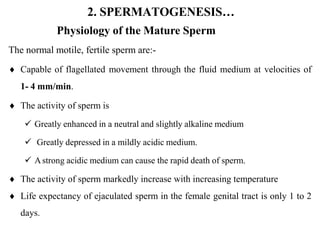
Physiology of the Mature Sperm
The normal motile, fertile sperm are:-
 Capable of flagellated movement through the fluid medium at velocities of
1- 4 mm/min.
 The activity of sperm is
 Greatly enhanced in a neutral and slightly alkaline medium
 Greatly depressed in a mildly acidic medium.
 Astrong acidic medium can cause the rapid death of sperm.
 The activity of sperm markedly increase with increasing temperature
 Life expectancy of ejaculated sperm in the female genital tract is only 1 to 2
days.
2. SPERMATOGENESIS…
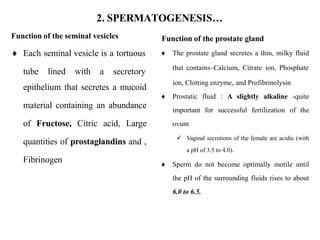
Function of the seminal vesicles
 Each seminal vesicle is a tortuous
tube lined with a secretory
epithelium that secretes a mucoid
material containing an abundance
of Fructose, Citric acid, Large
quantities of prostaglandins and ,
Fibrinogen
Function of the prostate gland
 The prostate gland secretes a thin, milky fluid
that contains–Calcium, Citrate ion, Phosphate
ion, Clotting enzyme, and Profibrinolysin
 Prostatic fluid : A slightly alkaline -quite
important for successful fertilization of the
ovum
 Vaginal secretions of the female are acidic (with
a pH of 3.5 to 4.0).
 Sperm do not become optimally motile until
the pH of the surrounding fluids rises to about
6.0 to 6.5.
2. SPERMATOGENESIS…
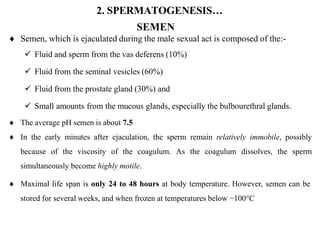
SEMEN
 Semen, which is ejaculated during the male sexual act is composed of the:-
 Fluid and sperm from the vas deferens (10%)
 Fluid from the seminal vesicles (60%)
 Fluid from the prostate gland (30%) and
 Small amounts from the mucous glands, especially the bulbourethral glands.
 The average pH semen is about 7.5
 In the early minutes after ejaculation, the sperm remain relatively immobile, possibly
because of the viscosity of the coagulum. As the coagulum dissolves, the sperm
simultaneously become highly motile.
 Maximal life span is only 24 to 48 hours at body temperature. However, semen can be
stored for several weeks, and when frozen at temperatures below −100°C
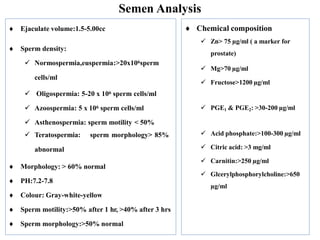
Semen Analysis
 Ejaculate volume:1.5-5.00cc
 Sperm density:
 Normospermia,euspermia:>20x106sperm
cells/ml
 Oligospermia: 5-20 x 106 sperm cells/ml
 Azoospermia: 5 x 10⁶ sperm cells/ml
 Asthenospermia: sperm motility < 50%
 Teratospermia: sperm morphology> 85%
abnormal
 Morphology: > 60% normal
 PH:7.2-7.8
 Colour: Gray-white-yellow
 Sperm motility:>50% after 1 hr, >40% after 3 hrs
 Sperm morphology:>50% normal
 Chemical composition
 Zn> 75 µg/ml ( a marker for
prostate)
 Mg>70 µg/ml
 Fructose>1200 µg/ml
 PGE1 & PGE2: >30-200 µg/ml
 Acid phosphate:>100-300 µg/ml
 Citric acid: >3 mg/ml
 Carnitin:>250 µg/ml
 Glcerylphosphorylcholine:>650
µg/ml
3. Male sexual act
i. Sensory Element
 Glans penis- most important source of
sensory nerve signals for initiating the male
sexual act.
 Glans penis has sensory end-organ system
that transmit sexual sensation  CNS
 Anal epithelium, scrotum, and perineal
structures-stimulation
 Urethra, bladder, prostate, seminal vesicles,
testes, and vas deferens- Inflammation &
congestion
Neuronal stimulus for male sexual act ii. Psychic Element
 Appropriate psychic stimuli can
greatly enhance the ability of a person
to perform the sexual act.
 Thinking sexual thoughts or even
dreaming the act of intercourse is
being performed can initiate the male
act, culminating in ejaculation.
 Indeed, nocturnal emissions during
dreams, often called “wet dreams,”
occur in many males during some
stages of sexual life, especially during
the teens.
Stages of the male sexual act
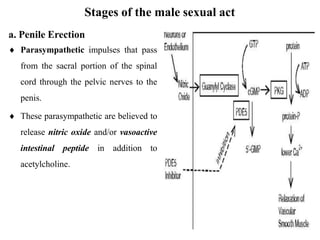
a. Penile Erection
 Parasympathetic impulses that pass
from the sacral portion of the spinal
cord through the pelvic nerves to the
penis.
 These parasympathetic are believed to
release nitric oxide and/or vasoactive
intestinal peptide in addition to
acetylcholine.
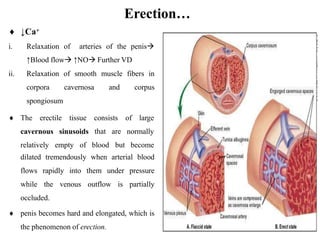
Erection…
 ↓Ca+
i. Relaxation of arteries of the penis
↑Blood flow ↑NO Further VD
ii. Relaxation of smooth muscle fibers in
corpora cavernosa and corpus
spongiosum
 The erectile tissue consists of large
that are
cavernous sinusoids
relatively empty of blood but
normally
become
dilated tremendously when arterial blood
flows rapidly into them under pressure
while the venous outflow is partially
occluded.
 penis becomes hard and elongated, which is
the phenomenon of erection.
Stages of the male sexual act…
b. Lubrication
 Parasympathetic impulses, in addition to promoting erection, cause the
urethral glands and the bulbourethral glands to secrete mucus.
 This mucus flows through the urethra during intercourse to aid in the
lubrication during coitus.
 However, most of the lubrication of coitus is provided by the female
sexual organs rather than by the male organs.
Stages of the male sexual act…
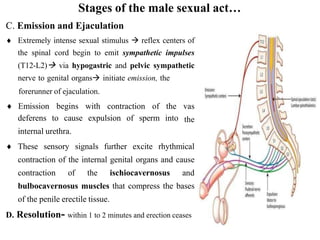
C. Emission and Ejaculation
 Extremely intense sexual stimulus  reflex centers of
the spinal cord begin to emit sympathetic impulses
(T12-L2) via hypogastric and pelvic sympathetic
nerve to genital organs initiate emission, the
forerunner of ejaculation.
 Emission begins with contraction of the vas
the
deferens to cause expulsion of sperm into
internal urethra.
 These sensory signals further excite rhythmical
contraction of the internal genital organs and cause
contraction of the ischiocavernosus and
bulbocavernosus muscles that compress the bases
of the penile erectile tissue.
D. Resolution- within 1 to 2 minutes and erection ceases
Physiological changes during male sexual act
• ↑HR ↑BF ↑MR
• ↑CO ↑ABP ↑Energy out put
• Stimulation of the CNS
• Hyperventilation
• Sympathetic stimulation
• Emotional excitement
• Sensation of pleasure
Sexual flash
Causes of male sterility
 Congenital absence of testis
 Cryptorchidism
 Infection with STD
 Destruction of the seminiferous
tubules
 Irradiation
 Oligospermia, azoospermia,
asthenospermia, amotile sperm
 Drugs, alcohol, smoking
 Impotence
 Hypogonadism
 Genetic defects
 Functional disorders of prostate
and seminal vesicles
 Genital tract obstruction
 Spermatogenesis arrest due to
hypovitaminosis
23
ReadingAssignment
1. Retrograde ejaculation
2. Impotence /erectile dysfunction
3. Priapism
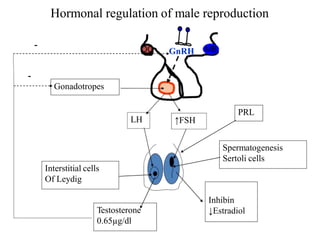
Hormonal regulation of male reproduction
OC MB
GnRH
↑FSH
LH
Interstitial cells
Of Leydig
Spermatogenesis
Sertoli cells
Testosterone
0.65µg/dl
Inhibin
↓Estradiol
-
Gonadotropes
-
PRL
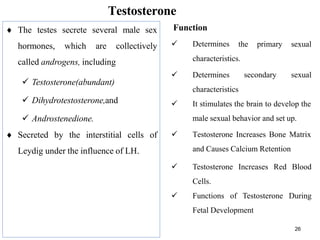
Testosterone
 The testes secrete several male sex
hormones, which are collectively
called androgens, including
 Testosterone(abundant)
 Dihydrotestosterone,and
 Androstenedione.
 Secreted by the interstitial cells of
Leydig under the influence of LH.
26
Function
 Determines the primary sexual
characteristics.
 Determines
characteristics
secondary sexual
 It stimulates the brain to develop the
male sexual behavior and set up.
 Testosterone Increases Bone Matrix
and Causes Calcium Retention
 Testosterone Increases Red Blood
Cells.
 Functions of Testosterone During
Fetal Development
Thank you!

3-230120115935-e50a16d7.pptx

  • 1.
    Wollega university School ofmedicine Department of Medicine Physiology of Male Reproductive system Zelalembanjaw9@gmail.com 1
  • 2.
    Outlines  FunctionalAnatomy ofthe reproductive organs of males  Spermatogenesis  Male sexual act  Male sex hormones
  • 3.
    1. Physiological Anatomyof the Male Sexual Organs  Testis is composed of ≈ 900 coiled seminiferous tubules (sperm production)  The sperm then empty into the epididymis (≈ 6m)  Epididymis leads into the vas deferens  VD enlarges into the ampulla of the vas deferens immediately before the vas enters the body of the prostate gland.  Two seminal vesicles, on each side of the prostate  Contents from both the ampulla of VD and the seminal vesicles pass into an ejaculatory duct  Then emptying into the internal urethra  Urethra is supplied with mucus derived from a large number of minute urethral glands located along its entire extent and even more so from bilateral bulbourethral glands (Cowper glands) located near the origin of the urethra.
  • 4.
    1. Physiological Anatomyof the Male Sexual Organs…
  • 5.
    Testis Testis has 2tubular Cells 1. Germinal cells: spermatogonia 2. Non-germinal cells: a. Sertoli cells  Non-motile + non-proliferating tubular cells.  Divide the seminiferous tubule epithelium into two functional pools  Basement → lumen. b. Leydig cells between the seminiferous tubules
  • 6.
    a. Functions ofSertoli Cells  Mechanical support for the maturing gametes- (Blood Testis Barrier)  Potential energy source in spermatogenesis: glycogen  Ejection of the spermatozoon into the lumen  Phagocytosis  Synthesize estradiol from androgenic precursors
  • 7.
    b. Leydig Cells(Interstitial Cells) Functions  Steroidogenic stromal cells (secrete androgens)  Regulation: paracrine/autocrine (+ LH)  are almost nonexistent in the testes during childhood when the testes secrete almost no testosterone  Produce testosterone  Stimulated by LH from the anterior pituitary gland
  • 8.
    2. SPERMATOGENESIS  Duringformation of the embryo, the primordial germ cells migrate into testes and become immature germ cells called spermatogonia (A&B).  Spermatogonia lie in two or three layers of the inner surfaces of the seminiferous tubules  At puberty the spermatogonia begin to undergo mitotic division and continually proliferate and differentiate through definite stages of development to form sperm
  • 9.
    2. SPERMATOGENESIS… Tail- ofthe sperm, called the flagellum  3 major components: 1. Axoneme - skeleton constructed microtubules of 11 2. Thin cell membrane covering the axoneme 3. Body of the tail-Collection of mitochondria surrounding the axoneme in the proximal portion of the tail Flagellar movement- provides motility for the sperm.  ATP synthesized by the mitochondria in the body of the tail.  Normal sperm move in a fluid medium at a velocity of 1 to 4 mm/min
  • 10.
    2. Factors affectingspermatogenesis to secrete process of A. Hormonal Factors 1. Luteinizing hormone  stimulates the Leydig cells testosterone. 2. FSH  stimulates the Sertoli cells without this stimulation (the spermiogenesis) will not occur. 3. Testosterone secreted by the Leydig cells is essential for division of the testicular growth and germinal cells 4. Estrogens  formed from testosterone by the Sertoli cells when they are stimulated by FSH probably also essential for spermiogenesis. 5. Growth hormone  is necessary for metabolic functions of the testes  Promotes early division of the spermatogonia themselves  In its absence- spermatogenesis is severely deficient or absent, thus causing infertility. B. Temperature  an optimum testicular temperature is 34-35oC.  In case of undescended testis (cryptorchidism),nospermatogenesis occurs, infertility b/c BT Arrests sperm
  • 11.
    2. SPERMATOGENESIS… Maturation ofSperm in the Epididymis  After the sperm have been in the epididymis for 18 to 24 hours, they develop the capability of motility, even though several inhibitory proteins in the epididymal fluid still prevent final motility until after ejaculation.  Maturation:-  Acromosomal development  Cytoplasmic reduction  Flagellar growth  Discharge of organelles  Condensation of nucleus
  • 12.
    2. SPERMATOGENESIS… Storage ofSperm in the Testes  The two testes form up to 120 million sperm each day.  Most of these sperm are stored in the epididymis & small quantity is stored in the VD  They can remain stored, while maintaining their fertility, for at least a month.  They are kept in a deeply inactive state by multiple inhibitory substances in the secretions of the ducts.  But, with a high level of sexual activity and ejaculations, they may be stored no longer than a few days.  After ejaculation, the sperm become motile and capable of fertilizing the ovum, a process called maturation.
  • 13.
    2. SPERMATOGENESIS… Physiology ofthe Mature Sperm The normal motile, fertile sperm are:-  Capable of flagellated movement through the fluid medium at velocities of 1- 4 mm/min.  The activity of sperm is  Greatly enhanced in a neutral and slightly alkaline medium  Greatly depressed in a mildly acidic medium.  Astrong acidic medium can cause the rapid death of sperm.  The activity of sperm markedly increase with increasing temperature  Life expectancy of ejaculated sperm in the female genital tract is only 1 to 2 days.
  • 14.
    2. SPERMATOGENESIS… Function ofthe seminal vesicles  Each seminal vesicle is a tortuous tube lined with a secretory epithelium that secretes a mucoid material containing an abundance of Fructose, Citric acid, Large quantities of prostaglandins and , Fibrinogen Function of the prostate gland  The prostate gland secretes a thin, milky fluid that contains–Calcium, Citrate ion, Phosphate ion, Clotting enzyme, and Profibrinolysin  Prostatic fluid : A slightly alkaline -quite important for successful fertilization of the ovum  Vaginal secretions of the female are acidic (with a pH of 3.5 to 4.0).  Sperm do not become optimally motile until the pH of the surrounding fluids rises to about 6.0 to 6.5.
  • 15.
    2. SPERMATOGENESIS… SEMEN  Semen,which is ejaculated during the male sexual act is composed of the:-  Fluid and sperm from the vas deferens (10%)  Fluid from the seminal vesicles (60%)  Fluid from the prostate gland (30%) and  Small amounts from the mucous glands, especially the bulbourethral glands.  The average pH semen is about 7.5  In the early minutes after ejaculation, the sperm remain relatively immobile, possibly because of the viscosity of the coagulum. As the coagulum dissolves, the sperm simultaneously become highly motile.  Maximal life span is only 24 to 48 hours at body temperature. However, semen can be stored for several weeks, and when frozen at temperatures below −100°C
  • 16.
    Semen Analysis  Ejaculatevolume:1.5-5.00cc  Sperm density:  Normospermia,euspermia:>20x106sperm cells/ml  Oligospermia: 5-20 x 106 sperm cells/ml  Azoospermia: 5 x 10⁶ sperm cells/ml  Asthenospermia: sperm motility < 50%  Teratospermia: sperm morphology> 85% abnormal  Morphology: > 60% normal  PH:7.2-7.8  Colour: Gray-white-yellow  Sperm motility:>50% after 1 hr, >40% after 3 hrs  Sperm morphology:>50% normal  Chemical composition  Zn> 75 µg/ml ( a marker for prostate)  Mg>70 µg/ml  Fructose>1200 µg/ml  PGE1 & PGE2: >30-200 µg/ml  Acid phosphate:>100-300 µg/ml  Citric acid: >3 mg/ml  Carnitin:>250 µg/ml  Glcerylphosphorylcholine:>650 µg/ml
  • 17.
    3. Male sexualact i. Sensory Element  Glans penis- most important source of sensory nerve signals for initiating the male sexual act.  Glans penis has sensory end-organ system that transmit sexual sensation  CNS  Anal epithelium, scrotum, and perineal structures-stimulation  Urethra, bladder, prostate, seminal vesicles, testes, and vas deferens- Inflammation & congestion Neuronal stimulus for male sexual act ii. Psychic Element  Appropriate psychic stimuli can greatly enhance the ability of a person to perform the sexual act.  Thinking sexual thoughts or even dreaming the act of intercourse is being performed can initiate the male act, culminating in ejaculation.  Indeed, nocturnal emissions during dreams, often called “wet dreams,” occur in many males during some stages of sexual life, especially during the teens.
  • 18.
    Stages of themale sexual act a. Penile Erection  Parasympathetic impulses that pass from the sacral portion of the spinal cord through the pelvic nerves to the penis.  These parasympathetic are believed to release nitric oxide and/or vasoactive intestinal peptide in addition to acetylcholine.
  • 19.
    Erection…  ↓Ca+ i. Relaxationof arteries of the penis ↑Blood flow ↑NO Further VD ii. Relaxation of smooth muscle fibers in corpora cavernosa and corpus spongiosum  The erectile tissue consists of large that are cavernous sinusoids relatively empty of blood but normally become dilated tremendously when arterial blood flows rapidly into them under pressure while the venous outflow is partially occluded.  penis becomes hard and elongated, which is the phenomenon of erection.
  • 20.
    Stages of themale sexual act… b. Lubrication  Parasympathetic impulses, in addition to promoting erection, cause the urethral glands and the bulbourethral glands to secrete mucus.  This mucus flows through the urethra during intercourse to aid in the lubrication during coitus.  However, most of the lubrication of coitus is provided by the female sexual organs rather than by the male organs.
  • 21.
    Stages of themale sexual act… C. Emission and Ejaculation  Extremely intense sexual stimulus  reflex centers of the spinal cord begin to emit sympathetic impulses (T12-L2) via hypogastric and pelvic sympathetic nerve to genital organs initiate emission, the forerunner of ejaculation.  Emission begins with contraction of the vas the deferens to cause expulsion of sperm into internal urethra.  These sensory signals further excite rhythmical contraction of the internal genital organs and cause contraction of the ischiocavernosus and bulbocavernosus muscles that compress the bases of the penile erectile tissue. D. Resolution- within 1 to 2 minutes and erection ceases
  • 22.
    Physiological changes duringmale sexual act • ↑HR ↑BF ↑MR • ↑CO ↑ABP ↑Energy out put • Stimulation of the CNS • Hyperventilation • Sympathetic stimulation • Emotional excitement • Sensation of pleasure Sexual flash
  • 23.
    Causes of malesterility  Congenital absence of testis  Cryptorchidism  Infection with STD  Destruction of the seminiferous tubules  Irradiation  Oligospermia, azoospermia, asthenospermia, amotile sperm  Drugs, alcohol, smoking  Impotence  Hypogonadism  Genetic defects  Functional disorders of prostate and seminal vesicles  Genital tract obstruction  Spermatogenesis arrest due to hypovitaminosis 23
  • 24.
    ReadingAssignment 1. Retrograde ejaculation 2.Impotence /erectile dysfunction 3. Priapism
  • 25.
    Hormonal regulation ofmale reproduction OC MB GnRH ↑FSH LH Interstitial cells Of Leydig Spermatogenesis Sertoli cells Testosterone 0.65µg/dl Inhibin ↓Estradiol - Gonadotropes - PRL
  • 26.
    Testosterone  The testessecrete several male sex hormones, which are collectively called androgens, including  Testosterone(abundant)  Dihydrotestosterone,and  Androstenedione.  Secreted by the interstitial cells of Leydig under the influence of LH. 26 Function  Determines the primary sexual characteristics.  Determines characteristics secondary sexual  It stimulates the brain to develop the male sexual behavior and set up.  Testosterone Increases Bone Matrix and Causes Calcium Retention  Testosterone Increases Red Blood Cells.  Functions of Testosterone During Fetal Development
  • 27.