Blood Bank
Management System
Objective:
• The project blood bank management system is designed for the blood bank
to gather blood from various sources and distribute it to the hospital and
needy people who have high requirements for it.
• It is a application to simulate the database management for blood bank
having daily transaction.
• It consists of four main modules: Administration, Donor, Receiver and
activities.
Overview of Presentation
• Donor Details
• Blood Collection
• Screening
• Component preparation
• Blood storage
• Blood request
• Compatibility
• Blood issue
• Monthly statistics
Donor Details
Types of donor:
• In-house Donor (Volunteer)
• Mobile Blood Donor (Camping)
Donor DetailsInterface
Donor Details
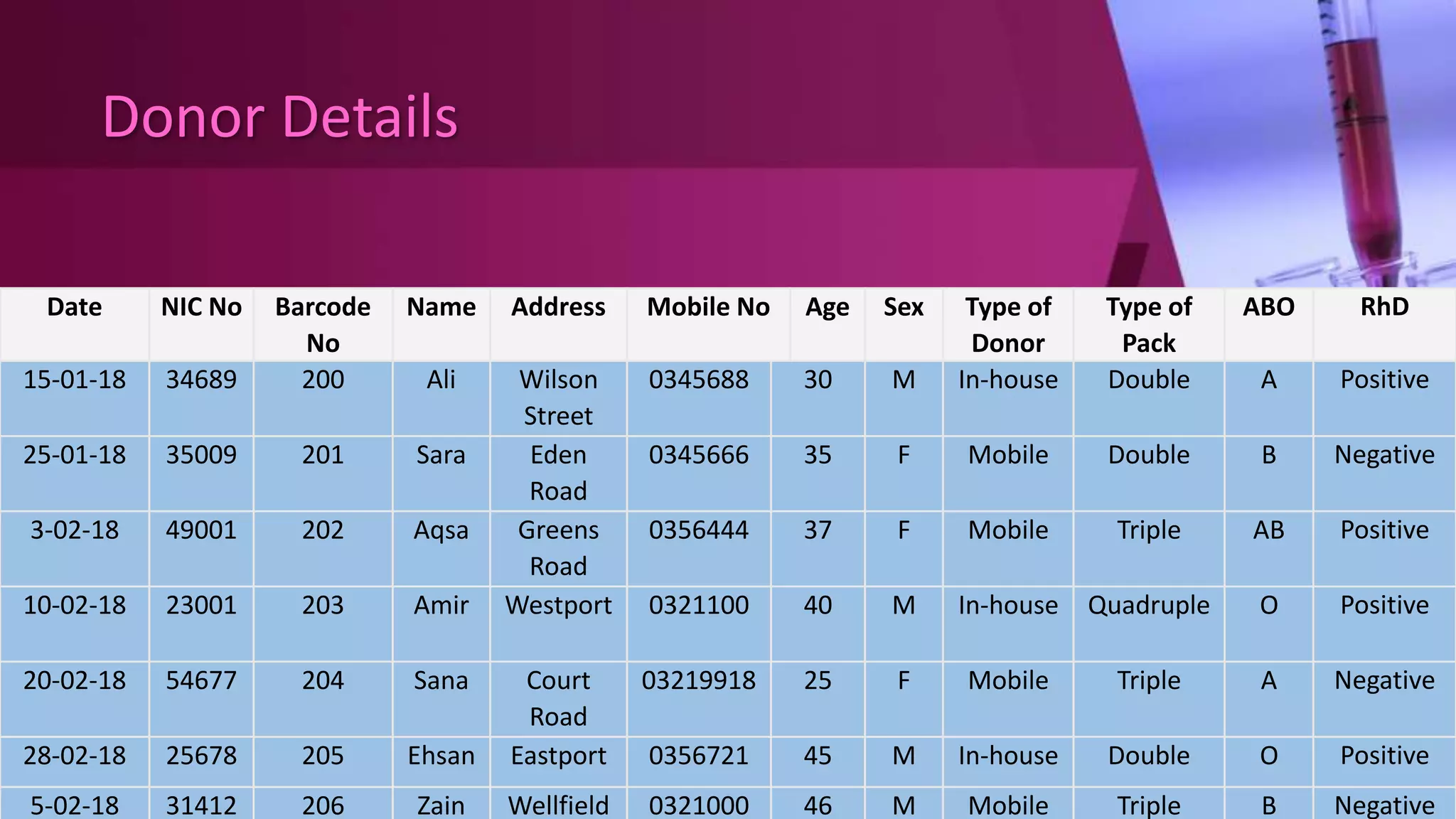
Date NIC No Barcode
No
Name Address Mobile No Age Sex Type of
Donor
Type of
Pack
ABO RhD
15-01-18 34689 200 Ali Wilson
Street
0345688 30 M In-house Double A Positive
25-01-18 35009 201 Sara Eden
Road
0345666 35 F Mobile Double B Negative
3-02-18 49001 202 Aqsa Greens
Road
0356444 37 F Mobile Triple AB Positive
10-02-18 23001 203 Amir Westport 0321100 40 M In-house Quadruple O Positive
20-02-18 54677 204 Sana Court
Road
03219918 25 F Mobile Triple A Negative
28-02-18 25678 205 Ehsan Eastport 0356721 45 M In-house Double O Positive
5-02-18 31412 206 Zain Wellfield 0321000 46 M Mobile Triple B Negative
Donor Details
• Every donor has a barcode number in each
donations.
• A barcode number is assigned to a blood pack
uniquely.
Donor Details
• In This Section hasfollowing facilities.
– Insert to new donordetails.
– Update to donordetails.
– Search the donor details, given Barcode No or
Type of donor andDate.
– Delete donor details by given the Barcode No.
Screening
• Identification of the donor’s blood
type is A, B, AB, O, or O negative
• Identification of Rhd positive or
negative.
• All blood are tested for infections
Such as HIV, HepB , HepC, MP,
VDRL. The blood is usually
discarded if any of these tests are
positive.
Screening Interface
ScreeningTestTable
No Barcode No ABO RhD HIV Hep B Hep C MP VDRL
1 200 A Positive Negative Negative Negative Negative Negative
2 201 B Negative Negative Negative Negative Negative Negative
3 202 AB Positive Negative Negative Negative Negative Negative
4 203 O Positive Negative Negative Negative Negative Negative
5 204 A Negative Negative Positive Negative Negative Negative
6 205 O Positive Negative Negative Positive Negative Negative
7 206 B Negative Negative Negative Negative Negative Negative
Test wise Donor List Report
Component preparation
• The blood is separated into parts RBC,
FFP, and Platelets after the screening.
• Platelets are separated from triple(AS)
and quadruple packs only.
• The components CPP and Cryo
separated from FFP when theyneed.
Component preparation interface
Component preparation
• This Section has followingfacilities.
• Insert the cpp details and cryodetails
• Search the cpp details and cryo details by
given Date andeveryday details
maintains.
• Delete component(cpp,cryo)details.
Blood storage
If the pack is double or triple, RBC
component will be expired within
35 days from date of collection. If the
pack is quadruple, RBC component will be expired
with in 42 days from date of collection.
Platelets will be expired within 5 days and FFP,
CPP, Cryo will be expired within one year from the
date of collection.
Blood Storage Interface
Blood bag expiry status report
Blood Storage Interface
• This Section hasfacilities.
– Insert the discardeddetails
– Search, edit anddelete discarded components .
– Search the RBC ,Platelets stock details and recently
expire details by given Noof days,ABC and Rhd.
– Search the FFPstock details(CPP,CRYO) and recently
expired details by given Noof days and ABC.
 Requests for the blood components are
received from patients. With the request
they bring the blood sample of the patient.
 Requests can be received from other
hospital for their stock requirements.
Blood request
Blood request interface
• This Section hasfacilities.
– Insert the other hospital blood detailsand
request patient details.
– Search the otherhospital blood details by given
hospital name ,patient details by given BHTNo.
– Delete and Edit the other hospital blood details by
given hospital name and date. And patient details
BHI No.
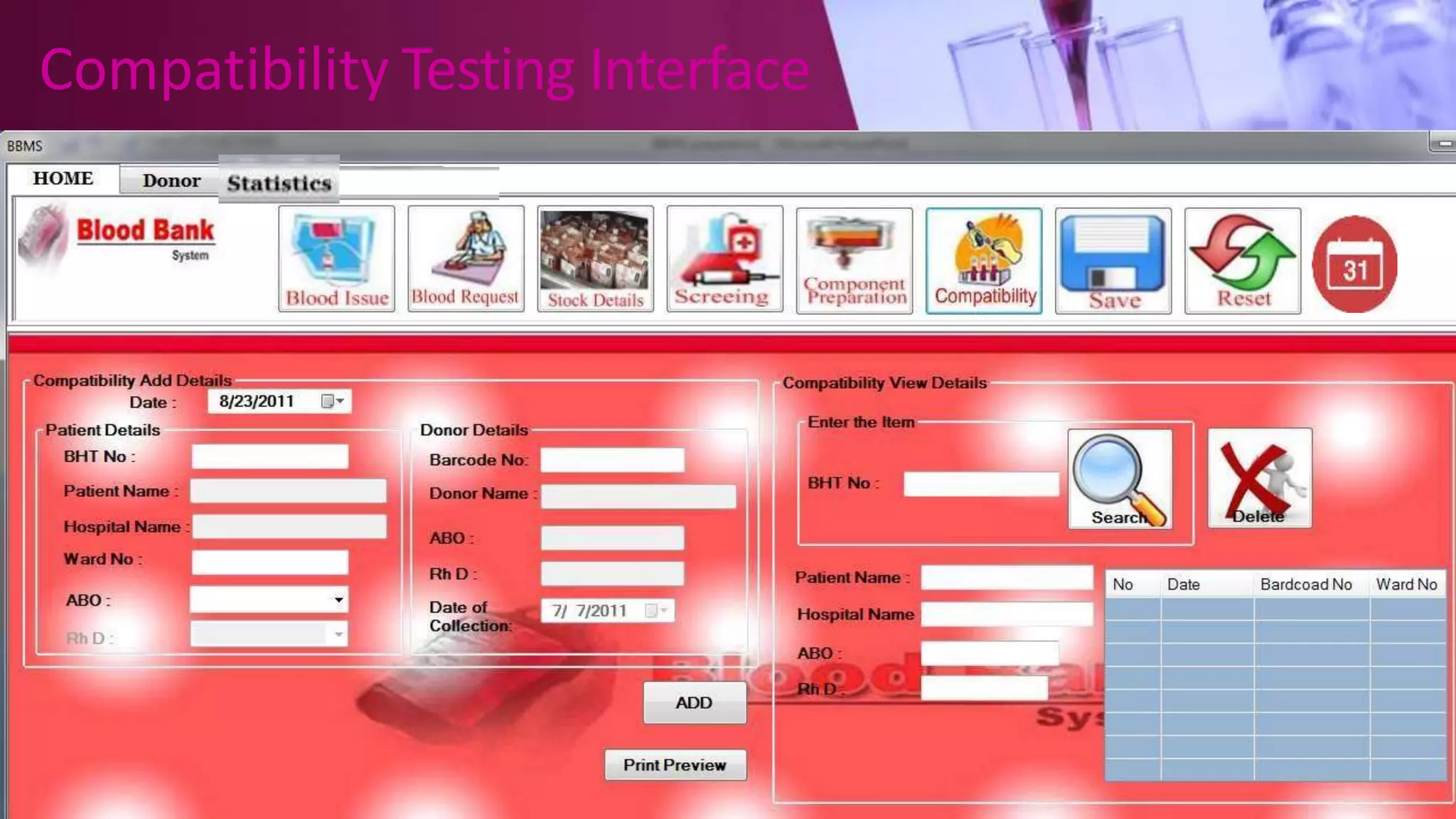
 Before a transfusion, compatibility testing
between donor’s and patient’s blood must
be done. Firstly they perform testing to
determine the blood type of patients and
perform cross matching test to identify
compatible blood components for blood
transfusions.
Compatibility Testing
Compatibility Testing Interface
Red blood cell compatibility table
Compatibility report against Patient request
• This Section hasfacilities.
– Insert the compatibility details and printpreview.
– Search the compatibility details given BHTNo.
– Delete compatibility details given BHI No.
Compatibility Testing Interface
 They issue the components to the patient
according the compatibility report.
 To other hospitals they issue RBC only.
Blood issued
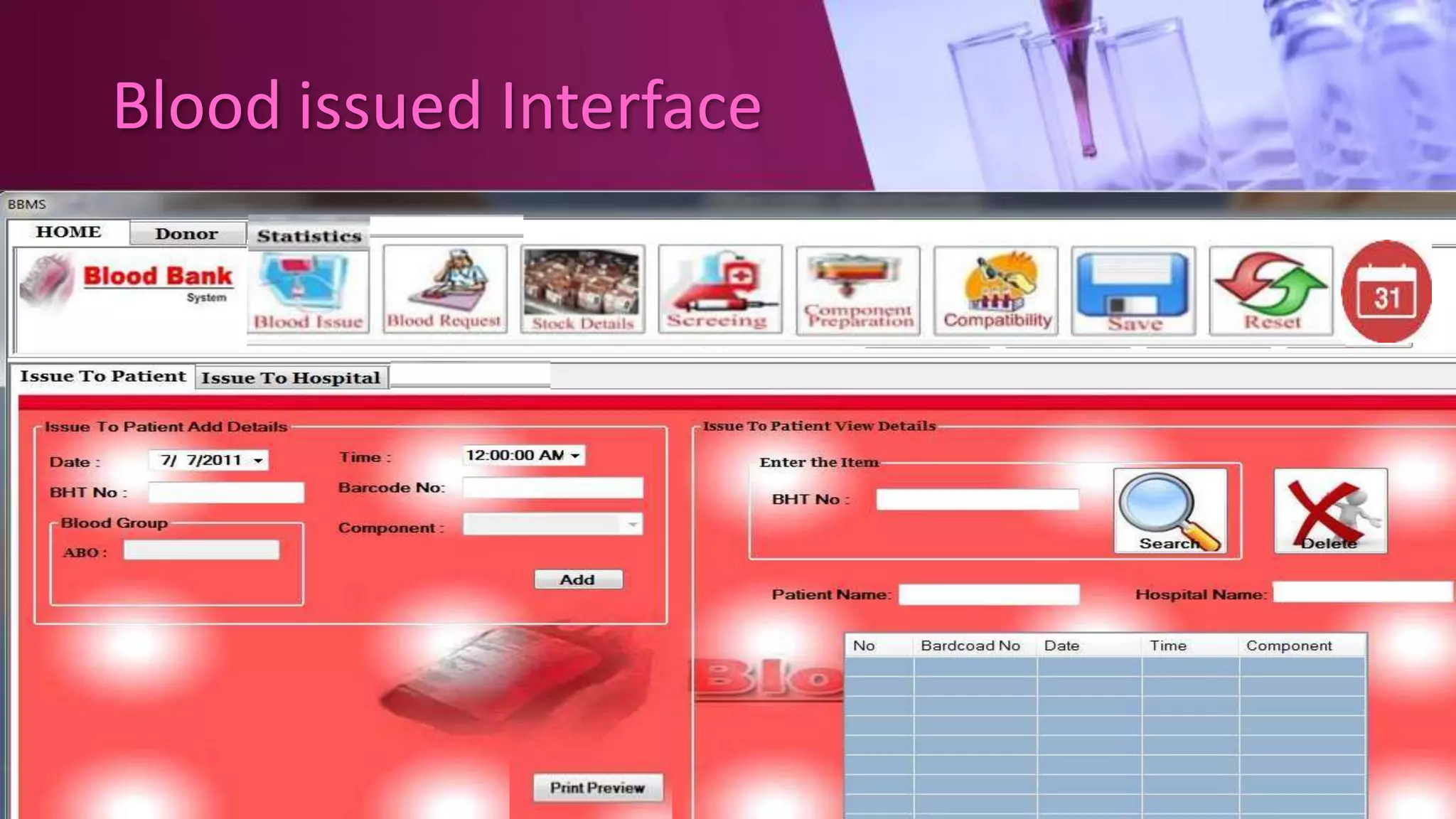
Blood issued Interface
Hospital Report
Blood issued Interface
• This Section hasfacilities.
– Insert the issue to patient,other hospital and return
blood details.
– Search the patient details by given BHT No ,other
hospitals details given hospital name and date, and return
details by givendate.
– Delete the other hospital blood details by given hospital
name and date, patient details by given BHI No, And
return details given date.
Blood Requisition Report
 The following Statistical Analysis are
maintained by the Hospital Blood Bank.
a. Blood Collection
b. Blood Collection Of
Summary
c. Collection Of Blood Group
d. Analysis Of RCC
Monthly StatisticsAnalysis
Monthly statistics analysis interface
• This Section has followingfacilities.
– Search the blood collection donors agesgroup
details given Yearandmonth.
– Search the blood collection summery donors
details given Yearandmonth.
– Search the collection of bloodgroups details
given Yearandmonth.
– Search the analysisof RCC details given Yearand
month.
Monthly statistics analysis interface
Analysis of RCC(Red Cell Count)
Meta-analysis association results in unconditional and conditional
analyses for hemoglobin (Hb), hematocrit (Hct) and red blood cell count
(RCC).
Analysis of RCC
Statistics of blood components
 As the donor’s data is saved in the system we
can reject those who have HIV or any other
infections.
 As we have the contact number of the donor
we can contact donor whenever necessary
comes.
 Since we have the expiry date of the packs we
can have a proper storage management system.
Conclusion
Blood Bank Management System

Blood Bank Management System

  • 1.
  • 2.
    Objective: • The projectblood bank management system is designed for the blood bank to gather blood from various sources and distribute it to the hospital and needy people who have high requirements for it. • It is a application to simulate the database management for blood bank having daily transaction. • It consists of four main modules: Administration, Donor, Receiver and activities.
  • 3.
    Overview of Presentation •Donor Details • Blood Collection • Screening • Component preparation • Blood storage • Blood request • Compatibility • Blood issue • Monthly statistics
  • 4.
    Donor Details Types ofdonor: • In-house Donor (Volunteer) • Mobile Blood Donor (Camping)
  • 5.
  • 6.
    Donor Details Date NICNo Barcode No Name Address Mobile No Age Sex Type of Donor Type of Pack ABO RhD 15-01-18 34689 200 Ali Wilson Street 0345688 30 M In-house Double A Positive 25-01-18 35009 201 Sara Eden Road 0345666 35 F Mobile Double B Negative 3-02-18 49001 202 Aqsa Greens Road 0356444 37 F Mobile Triple AB Positive 10-02-18 23001 203 Amir Westport 0321100 40 M In-house Quadruple O Positive 20-02-18 54677 204 Sana Court Road 03219918 25 F Mobile Triple A Negative 28-02-18 25678 205 Ehsan Eastport 0356721 45 M In-house Double O Positive 5-02-18 31412 206 Zain Wellfield 0321000 46 M Mobile Triple B Negative
  • 7.
    Donor Details • Everydonor has a barcode number in each donations. • A barcode number is assigned to a blood pack uniquely.
  • 8.
    Donor Details • InThis Section hasfollowing facilities. – Insert to new donordetails. – Update to donordetails. – Search the donor details, given Barcode No or Type of donor andDate. – Delete donor details by given the Barcode No.
  • 9.
    Screening • Identification ofthe donor’s blood type is A, B, AB, O, or O negative • Identification of Rhd positive or negative. • All blood are tested for infections Such as HIV, HepB , HepC, MP, VDRL. The blood is usually discarded if any of these tests are positive.
  • 10.
  • 11.
    ScreeningTestTable No Barcode NoABO RhD HIV Hep B Hep C MP VDRL 1 200 A Positive Negative Negative Negative Negative Negative 2 201 B Negative Negative Negative Negative Negative Negative 3 202 AB Positive Negative Negative Negative Negative Negative 4 203 O Positive Negative Negative Negative Negative Negative 5 204 A Negative Negative Positive Negative Negative Negative 6 205 O Positive Negative Negative Positive Negative Negative 7 206 B Negative Negative Negative Negative Negative Negative
  • 12.
    Test wise DonorList Report
  • 13.
    Component preparation • Theblood is separated into parts RBC, FFP, and Platelets after the screening. • Platelets are separated from triple(AS) and quadruple packs only. • The components CPP and Cryo separated from FFP when theyneed.
  • 14.
  • 15.
    Component preparation • ThisSection has followingfacilities. • Insert the cpp details and cryodetails • Search the cpp details and cryo details by given Date andeveryday details maintains. • Delete component(cpp,cryo)details.
  • 16.
    Blood storage If thepack is double or triple, RBC component will be expired within 35 days from date of collection. If the pack is quadruple, RBC component will be expired with in 42 days from date of collection. Platelets will be expired within 5 days and FFP, CPP, Cryo will be expired within one year from the date of collection.
  • 17.
  • 18.
    Blood bag expirystatus report
  • 19.
    Blood Storage Interface •This Section hasfacilities. – Insert the discardeddetails – Search, edit anddelete discarded components . – Search the RBC ,Platelets stock details and recently expire details by given Noof days,ABC and Rhd. – Search the FFPstock details(CPP,CRYO) and recently expired details by given Noof days and ABC.
  • 20.
     Requests forthe blood components are received from patients. With the request they bring the blood sample of the patient.  Requests can be received from other hospital for their stock requirements. Blood request
  • 21.
  • 23.
    Blood request interface •This Section hasfacilities. – Insert the other hospital blood detailsand request patient details. – Search the otherhospital blood details by given hospital name ,patient details by given BHTNo. – Delete and Edit the other hospital blood details by given hospital name and date. And patient details BHI No.
  • 24.
     Before atransfusion, compatibility testing between donor’s and patient’s blood must be done. Firstly they perform testing to determine the blood type of patients and perform cross matching test to identify compatible blood components for blood transfusions. Compatibility Testing
  • 25.
  • 26.
    Red blood cellcompatibility table
  • 27.
  • 28.
    • This Sectionhasfacilities. – Insert the compatibility details and printpreview. – Search the compatibility details given BHTNo. – Delete compatibility details given BHI No. Compatibility Testing Interface
  • 29.
     They issuethe components to the patient according the compatibility report.  To other hospitals they issue RBC only. Blood issued
  • 30.
  • 31.
  • 32.
    Blood issued Interface •This Section hasfacilities. – Insert the issue to patient,other hospital and return blood details. – Search the patient details by given BHT No ,other hospitals details given hospital name and date, and return details by givendate. – Delete the other hospital blood details by given hospital name and date, patient details by given BHI No, And return details given date.
  • 33.
  • 34.
     The followingStatistical Analysis are maintained by the Hospital Blood Bank. a. Blood Collection b. Blood Collection Of Summary c. Collection Of Blood Group d. Analysis Of RCC Monthly StatisticsAnalysis
  • 35.
  • 36.
    • This Sectionhas followingfacilities. – Search the blood collection donors agesgroup details given Yearandmonth. – Search the blood collection summery donors details given Yearandmonth. – Search the collection of bloodgroups details given Yearandmonth. – Search the analysisof RCC details given Yearand month. Monthly statistics analysis interface
  • 37.
    Analysis of RCC(RedCell Count) Meta-analysis association results in unconditional and conditional analyses for hemoglobin (Hb), hematocrit (Hct) and red blood cell count (RCC).
  • 38.
  • 39.
  • 40.
     As thedonor’s data is saved in the system we can reject those who have HIV or any other infections.  As we have the contact number of the donor we can contact donor whenever necessary comes.  Since we have the expiry date of the packs we can have a proper storage management system. Conclusion