{
Occlusion
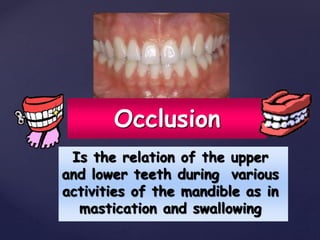
Is the relation of the upper
and lower teeth during various
activities of the mandible as in
mastication and swallowing
Contact of teeth in opposing
dental arches:
When the jaws are closed=
"static occlusal relationships“
During various jaw movements=
"dynamic occlusal relationships".
Occlusion
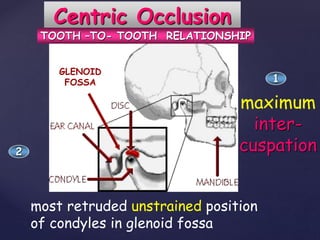
Centric occlusion
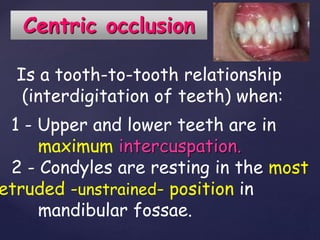
Is a tooth-to-tooth relationship
(interdigitation of teeth) when:
1 - Upper and lower teeth are in
maximum intercuspation.
2 - Condyles are resting in the most
etruded -unstrained- position in
mandibular fossae.
Centric Occlusion
maximum
inter-
cuspation
most retruded unstrained position
of condyles in glenoid fossa
GLENOID
FOSSA
TOOTH –TO- TOOTH RELATIONSHIP
1
2
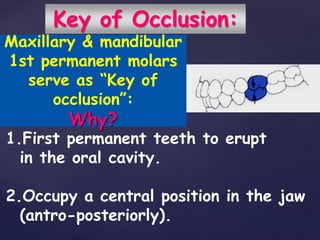
1.First permanent teeth to erupt
in the oral cavity.
2.Occupy a central position in the jaw
(antro-posteriorly).
Key of Occlusion:
Maxillary & mandibular
1st permanent molars
serve as “Key of
occlusion”:
Why?
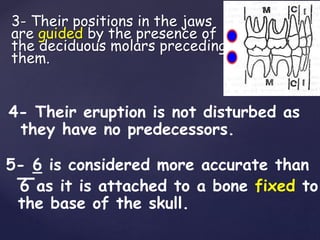
3- Their positions in the jaws
are guided by the presence of
the deciduous molars preceding
them.
4- Their eruption is not disturbed as
they have no predecessors.
5- 6 is considered more accurate than
6 as it is attached to a bone fixed to
the base of the skull.
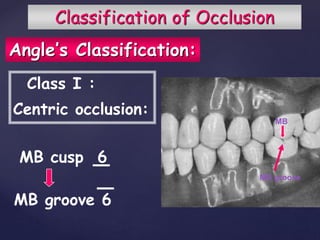
MB cusp 6
MB groove 6
Classification of Occlusion
Class I :
Centric occlusion:
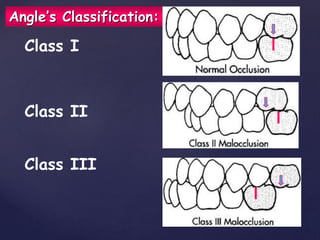
Angle’s Classification:
MB
MB groove
MB cusp 6 MB groove 6
Class I : centric occlusion
Orthognathic profile
Classification of Occlusion
Class I
Class II
Class III
Angle’s Classification:
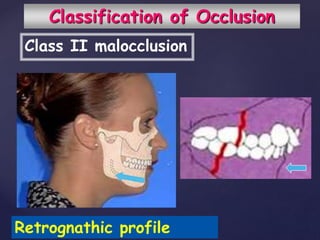
Class II malocclusion
Retrognathic profile
Classification of Occlusion
Class III malocclusion
Anterior cross bite
6
6
6
6
Malocclusion
6
6
Malocclusion
Centric occlusion
1- Opposing teeth:
I) Centric Occlusion of Permanent Teeth
Each tooth in a dental arch
occludes with two teeth in
the opposing arch ,
except:
the mandibular central incisor
the maxillary third molar.
General Concepts:
1
1 2
5
5
4
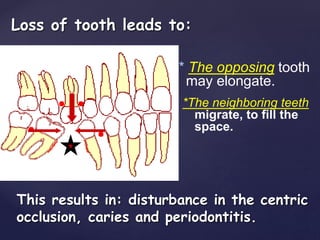
*The neighboring teeth
migrate, to fill the
space.
Loss of tooth leads to:
* The opposing tooth
may elongate.
This results in: disturbance in the centric
occlusion, caries and periodontitis.
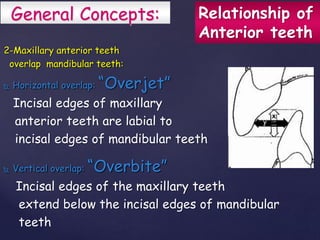
2-Maxillary anterior teeth
overlap mandibular teeth:
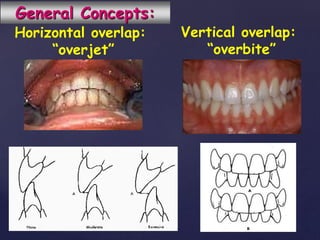
 Horizontal overlap: “Overjet”
Incisal edges of maxillary
anterior teeth are labial to
incisal edges of mandibular teeth
 Vertical overlap: “Overbite”
Incisal edges of the maxillary teeth
extend below the incisal edges of mandibular
teeth
Relationship of
Anterior teeth
General Concepts:
Overbite
Overjet
Vertical overlap:
“overbite”
Horizontal overlap:
“overjet”
General Concepts:
Relationship of
Individual Teeth
in
Centric Occlusion
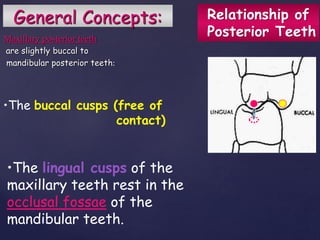
Maxillary posterior teeth
are slightly buccal to
mandibular posterior teeth:
Relationship of
Posterior Teeth
•The lingual cusps of the
maxillary teeth rest in the
occlusal fossae of the
mandibular teeth.
General Concepts:
•The buccal cusps (free of
contact)
• Buccal cusps of mandibular teeth
rest in occlusal fossae
of maxillary teeth.
• Lingual cusps
(free of contact)
.
Relationship of
Posterior Teeth
The mandibular posterior teeth:
General Concepts:
The buccal cusps (free of contact)
MBC Free, in the opposing B groove
DBC Free in the opposing embrassure between their
antagonistic teeth and the distal one
8……. DB slope of DBC of 8
MBC DBC
Maxillary molars
MLC Opposing central fossa
DLC 6…….. MMR 7
7 ……..DMR of 7
8 (if present) ……... DMR of 8
Lingual relation of maxillary molars
Forms of Malocclusion
Anterior
open bite
Crowding
Cross bite
Occlusion

Occlusion

  • 1.
  • 2.
    Occlusion Is the relationof the upper and lower teeth during various activities of the mandible as in mastication and swallowing
  • 3.
    Contact of teethin opposing dental arches: When the jaws are closed= "static occlusal relationships“ During various jaw movements= "dynamic occlusal relationships". Occlusion
  • 4.
    Centric occlusion Is atooth-to-tooth relationship (interdigitation of teeth) when: 1 - Upper and lower teeth are in maximum intercuspation. 2 - Condyles are resting in the most etruded -unstrained- position in mandibular fossae.
  • 5.
    Centric Occlusion maximum inter- cuspation most retrudedunstrained position of condyles in glenoid fossa GLENOID FOSSA TOOTH –TO- TOOTH RELATIONSHIP 1 2
  • 6.
    1.First permanent teethto erupt in the oral cavity. 2.Occupy a central position in the jaw (antro-posteriorly). Key of Occlusion: Maxillary & mandibular 1st permanent molars serve as “Key of occlusion”: Why?
  • 7.
    3- Their positionsin the jaws are guided by the presence of the deciduous molars preceding them. 4- Their eruption is not disturbed as they have no predecessors. 5- 6 is considered more accurate than 6 as it is attached to a bone fixed to the base of the skull.
  • 8.
    MB cusp 6 MBgroove 6 Classification of Occlusion Class I : Centric occlusion: Angle’s Classification: MB MB groove
  • 9.
    MB cusp 6MB groove 6 Class I : centric occlusion Orthognathic profile Classification of Occlusion
  • 10.
    Class I Class II ClassIII Angle’s Classification:
  • 11.
    Class II malocclusion Retrognathicprofile Classification of Occlusion
  • 12.
  • 13.
  • 14.
    1- Opposing teeth: I)Centric Occlusion of Permanent Teeth Each tooth in a dental arch occludes with two teeth in the opposing arch , except: the mandibular central incisor the maxillary third molar. General Concepts: 1 1 2 5 5 4
  • 15.
    *The neighboring teeth migrate,to fill the space. Loss of tooth leads to: * The opposing tooth may elongate. This results in: disturbance in the centric occlusion, caries and periodontitis.
  • 16.
    2-Maxillary anterior teeth overlapmandibular teeth:  Horizontal overlap: “Overjet” Incisal edges of maxillary anterior teeth are labial to incisal edges of mandibular teeth  Vertical overlap: “Overbite” Incisal edges of the maxillary teeth extend below the incisal edges of mandibular teeth Relationship of Anterior teeth General Concepts:
  • 17.
  • 18.
  • 20.
  • 21.
  • 22.
    Maxillary posterior teeth areslightly buccal to mandibular posterior teeth: Relationship of Posterior Teeth •The lingual cusps of the maxillary teeth rest in the occlusal fossae of the mandibular teeth. General Concepts: •The buccal cusps (free of contact)
  • 23.
    • Buccal cuspsof mandibular teeth rest in occlusal fossae of maxillary teeth. • Lingual cusps (free of contact) . Relationship of Posterior Teeth The mandibular posterior teeth: General Concepts:
  • 24.
    The buccal cusps(free of contact) MBC Free, in the opposing B groove DBC Free in the opposing embrassure between their antagonistic teeth and the distal one 8……. DB slope of DBC of 8 MBC DBC Maxillary molars
  • 25.
    MLC Opposing centralfossa DLC 6…….. MMR 7 7 ……..DMR of 7 8 (if present) ……... DMR of 8 Lingual relation of maxillary molars
  • 26.
    Forms of Malocclusion Anterior openbite Crowding Cross bite