Cancer CellsAbout UsTopicsHome Reference
Content:
What are cancer cells?
How cancer cells are different?
Grade and Cancer Cells
How Cancer Starts?
Treatment of Cancer
Cancer CellsAbout UsTopicsHome Reference
Cancer Cells are
• are cells gone wrong — in other words, they no
longer respond to many of the signals that
control cellular growth and death.
• appear to the body’s immune system to be
normal cells, therefore the body’s defenses will
not attack them.
• cell that has achieved a sort of immortality.
Cancer CellsAbout UsTopicsHome Reference
Cancer Cells
Vs. Normal
Cells
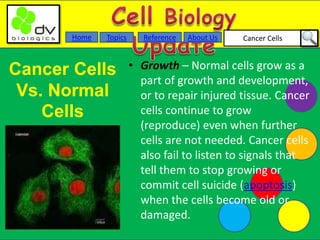
• Growth – Normal cells grow as a
part of growth and development,
or to repair injured tissue. Cancer
cells continue to grow
(reproduce) even when further
cells are not needed. Cancer cells
also fail to listen to signals that
tell them to stop growing or
commit cell suicide (apoptosis)
when the cells become old or
damaged.
Cancer CellsAbout UsTopicsHome Reference
• Ability to invade nearby tissues – Normal cells
respond to signals from other cells which tell them
they have reached a boundary. Cancer cells do not
respond to these signals, and extend into nearby
tissues often with finger-like projections.
• Ability to spread (metastasize) to other regions of
the body – Normal cells make substances called
adhesion molecules that cause them to stick to
nearby cells. Cancer cells, lacking the stickiness
caused by these adhesion molecules can break free
and float to other regions of the body.
Cancer CellsAbout UsTopicsHome Reference
• Immortality – Normal cells, like humans, have a
lifespan. When they reach a certain age, they die.
Cancer cells, in contrast, have developed a way to
“defy” death. On the end of our chromosomes is a
structure known as a telomere. Every time a cell
divides, its telomeres becomes shorter. When the
telomeres become short enough, the cells dies.
Cancer cells have figured out a way to restore their
telomeres so that they don’t continue to shorten as
the cell divides, thus, in a way, making them
immortal.
Cancer CellsAbout UsTopicsHome Reference
Grade and
Cancer
Cells
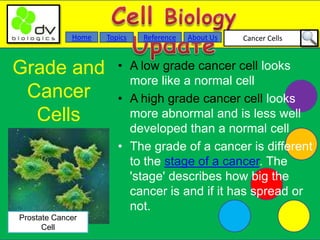
• A low grade cancer cell looks
more like a normal cell
• A high grade cancer cell looks
more abnormal and is less well
developed than a normal cell
• The grade of a cancer is different
to the stage of a cancer. The
'stage' describes how big the
cancer is and if it has spread or
not.
Prostate Cancer
Cell
Cancer CellsAbout UsTopicsHome Reference
• Doctors and scientists now know that each
cancer starts with changes in one cell or a
small group of cells. Usually, many years
before you can feel a lump, or a doctor can
see it on a scan, the cells have started to
divide and reproduce uncontrollably.
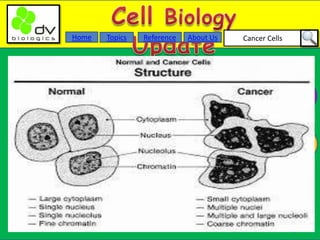
• You can see from the differences between
normal cells and cancer cells that the
cancer cell seems to lose a number of vital
control systems. This happens because
some of the genes in the cell have been
damaged or lost. Scientists call this
'mutation'.
How
cancer
starts
Cancer CellsAbout UsTopicsHome Reference
The organs in our body are made up of cells. Cells
divide and multiply as the body needs them. When these
cells continue multiplying when the body doesn't need them,
the result is a mass or growth, also called a tumor.
These growths are considered either benign or
malignant. Benign is considered non-cancerous and
malignant is cancerous. Benign tumors rarely are life
threatening and do not spread to other parts of the body.
They can often be removed. Malignant tumors, however,
often invade nearby tissue and organs, spreading the
disease.
Cancer CellsAbout UsTopicsHome Reference
Treatment of Cancer
There are four standard methods of treatment
for cancer: surgery, chemotherapy, radiation therapy,
and immunotherapy/biologic therapy. When initially
diagnosed with cancer, a cancer specialist (called an
oncologist) will provide the patient with cancer
treatment options. He or she will recommend the best
treatment plan based on the type of cancer, how far it
has spread, and other important factors like age and
general health.
Cancer CellsAbout UsTopicsHome Reference
References
• http://www.cancerresearchuk.org/cancer-
help/about-cancer/what-is-cancer/cells/how-
cancer-starts
• http://cancer.about.com/od/newlydiagnosed/
a/whatcancer.htm
• http://lungcancer.about.com/od/Biology-of-
Cancer/a/Cancer-Cells.htm
Cancer CellsAbout UsTopicsHome Reference
Prepared by:
Den Mark B. Galapir
Melbourne Padirayon

Cancer cells

  • 1.
  • 2.
    Cancer CellsAbout UsTopicsHomeReference Content: What are cancer cells? How cancer cells are different? Grade and Cancer Cells How Cancer Starts? Treatment of Cancer
  • 3.
    Cancer CellsAbout UsTopicsHomeReference Cancer Cells are • are cells gone wrong — in other words, they no longer respond to many of the signals that control cellular growth and death. • appear to the body’s immune system to be normal cells, therefore the body’s defenses will not attack them. • cell that has achieved a sort of immortality.
  • 4.
    Cancer CellsAbout UsTopicsHomeReference Cancer Cells Vs. Normal Cells • Growth – Normal cells grow as a part of growth and development, or to repair injured tissue. Cancer cells continue to grow (reproduce) even when further cells are not needed. Cancer cells also fail to listen to signals that tell them to stop growing or commit cell suicide (apoptosis) when the cells become old or damaged.
  • 5.
    Cancer CellsAbout UsTopicsHomeReference • Ability to invade nearby tissues – Normal cells respond to signals from other cells which tell them they have reached a boundary. Cancer cells do not respond to these signals, and extend into nearby tissues often with finger-like projections. • Ability to spread (metastasize) to other regions of the body – Normal cells make substances called adhesion molecules that cause them to stick to nearby cells. Cancer cells, lacking the stickiness caused by these adhesion molecules can break free and float to other regions of the body.
  • 6.
    Cancer CellsAbout UsTopicsHomeReference • Immortality – Normal cells, like humans, have a lifespan. When they reach a certain age, they die. Cancer cells, in contrast, have developed a way to “defy” death. On the end of our chromosomes is a structure known as a telomere. Every time a cell divides, its telomeres becomes shorter. When the telomeres become short enough, the cells dies. Cancer cells have figured out a way to restore their telomeres so that they don’t continue to shorten as the cell divides, thus, in a way, making them immortal.
  • 7.
  • 8.
    Cancer CellsAbout UsTopicsHomeReference Grade and Cancer Cells • A low grade cancer cell looks more like a normal cell • A high grade cancer cell looks more abnormal and is less well developed than a normal cell • The grade of a cancer is different to the stage of a cancer. The 'stage' describes how big the cancer is and if it has spread or not. Prostate Cancer Cell
  • 9.
    Cancer CellsAbout UsTopicsHomeReference • Doctors and scientists now know that each cancer starts with changes in one cell or a small group of cells. Usually, many years before you can feel a lump, or a doctor can see it on a scan, the cells have started to divide and reproduce uncontrollably. • You can see from the differences between normal cells and cancer cells that the cancer cell seems to lose a number of vital control systems. This happens because some of the genes in the cell have been damaged or lost. Scientists call this 'mutation'. How cancer starts
  • 10.
    Cancer CellsAbout UsTopicsHomeReference The organs in our body are made up of cells. Cells divide and multiply as the body needs them. When these cells continue multiplying when the body doesn't need them, the result is a mass or growth, also called a tumor. These growths are considered either benign or malignant. Benign is considered non-cancerous and malignant is cancerous. Benign tumors rarely are life threatening and do not spread to other parts of the body. They can often be removed. Malignant tumors, however, often invade nearby tissue and organs, spreading the disease.
  • 11.
    Cancer CellsAbout UsTopicsHomeReference Treatment of Cancer There are four standard methods of treatment for cancer: surgery, chemotherapy, radiation therapy, and immunotherapy/biologic therapy. When initially diagnosed with cancer, a cancer specialist (called an oncologist) will provide the patient with cancer treatment options. He or she will recommend the best treatment plan based on the type of cancer, how far it has spread, and other important factors like age and general health.
  • 12.
    Cancer CellsAbout UsTopicsHomeReference References • http://www.cancerresearchuk.org/cancer- help/about-cancer/what-is-cancer/cells/how- cancer-starts • http://cancer.about.com/od/newlydiagnosed/ a/whatcancer.htm • http://lungcancer.about.com/od/Biology-of- Cancer/a/Cancer-Cells.htm
  • 13.
    Cancer CellsAbout UsTopicsHomeReference Prepared by: Den Mark B. Galapir Melbourne Padirayon