ALKYLATING AGENTS
AND ANTIMETABOLITES
OBJECTIVE
 TO UNDERSTAND THE TYPE AND ROLE OF
ALKYLATING AGENTS
 TO UNDERSTAND THE TYPE AND ROLE OF
ANTIMETABOLITES
Alkylating Agent
 alkylating agent, any highly reactive drug that binds
to certain chemical groups (phosphate, amino,
sulfhydryl, hydroxyl, and imidazole groups) commonly
found in nucleic acids and other macromolecules,
bringing about changes in the DNA and RNA of cells.
 Alkylating agents were the first anticancer drugs used
 The types of molecular changes induced by alkylating
agents include cross-linking between strands of DNA
and the loss of a basic component (purine) from or the
breaking of the nucleic acid.
Con’t
 The result is that the nucleic acid will not be
replicated. Either the altered DNA will be unable to
carry out the functions of the cell, resulting in cell
death (cytotoxicity), or the altered DNA will change
the cell characteristics, resulting in an altered cell
(mutagenic change).
 This change may result in the ability or tendency to
produce cancerous cells (carcinogenicity).
 Normal cells may also be affected and become
cancer cells.
cont
 These molecules may either
 bind twice to one strand of DNA (intrastrand crosslink) or
 may bind once to both strands (interstrand crosslink).
 If the cell tries to replicate crosslinked DNA during cell
division, or tries to repair it, the DNA strands can break.
This leads to a form of programmed cell death called
apoptosis.
classes
 The alkylating agents are the largest group of
anticancer agents.
 Five main sub-groups.
1. Nitrogen mustards
2. Alkyl sulphonates
3. Nitrosoureas
4. Ethyleneimine
5. Thiazines
Nitrogen mustards
 Mechlorethamine: first nitrogen mustard.
 Used for Hodgkin and non-Hodgkin lymphomas
 It is also used topically for treatment of cutaneous T-
cell lymphoma .
 Toxicity: Block reproductive functions, First trimester
of pregnancy and later stage of pregnancy it should
not be used.
 Methclorethamine ,Cyclophosphamide,
Melphalan,Chlorambucil and Ifosfamide.
Alkyl sulphonates
 Busulfan – Highly specific for myeloid elements
and granulocyte .it is not curative.
 Toxicity: hyperuricaemia is common; pulmonary
fibrosis and skin pigmentation are specific
adverse effects.
 Drug of choice for chronic myeloid leukaemia .
 Dose: 2-6 mg/ day, orally
Nitrosoureas
 It is lipid soluble alkylating agents with a wide range of
antitumor activity
. Nitrosoureas: interfere with enzymes needed for DNA
repair.
 They are able to cross the blood-brain barrier.
 used to treat:
1. brain tumors
2. non-Hodgkin’s lymphoma,
3. multiple myeloma, and
4. malignant melanoma.
 Major toxicities occur in the hematopoietic and
gastrointestinal systems.
 Carmustine, lumustine, and streptozocin are examples
of nitrosoureas.
Thiazines
 Have primary inhibitory action on RNA and
protein synthesis (others mainly affect DNA).
 Ideal for malignant melanoma; also used in
Hodgkin's disease.
 Nausea and vomiting are prominent side effects.
 Alkylating agents can cause:
 severe nausea and vomiting
 as well as decreases in the number of red blood
cells and white blood cells.
 The decrease in the number of white cells results
in susceptibility to infection.
 Alkylating agents have found use in the
treatment of lymphoma, leukemia, testicular
cancer, melanoma, brain cancer, and breast
cancer. They are most often used in combination
with other anticancer drugs.
Antimetabolite
 similar in structure to a metabolite, or enzymatic
substrate, so competes with or inhibits the
metabolite.
 Their maximal cytotoxic effects are in S-phase
specific.
 readily become incorporated into either DNA or RNA
 cause toxicity In cells that are rapidly dividing
o Skin disorder, hair loss, anemia, mucositis,
myelosuppression and thrombocytopenia are common.
Antimetabolite as chemotherapeutic
1. Folate antagonist
2. Pyrimidine antagonist
3. Purine antagonist
4. Thymidylate synthase inhibitors
5. Multitargeted antifolate
6. Glycinamide ribonucleotide formyltransferase
and aminoimadazole carboxamide
ribonucleotide formyl transferase
Folate antagonist
 Methotrexate
 DHFR - conversion of dihydrofolate to
tetrahydrofolate and ultimately to 10-formyl
tetrahydrofolate which
 provides the formyl group for glycinamide
ribonucleotide formyl- transferase (GARFT) and
aminoimidazole carboxamide ribo- nucleotide
formyl transferase (AICARFT).
 Thus, the inhibition of DHFR results in depletion of
intracellular pools of reduced folates and ultimately
in reduced synthesis of purines and pyrimidines.
Mechanism
HN
N N
N
O
H2N
N
H
O
N
H
CO2H
CO2H
Folic acid
DHFR
HN
N N
H
N
O
H2N
N
H
R
Dihydrofolate
DHFR
HN
N N
H
H
N
O
H2N
N
H
R
Tetrahydrofolate
PABA
Microorganisms
HN
N N
H
N
O
H2N
N
R
Thymine synth
predominant mechanism of action of methotrexate is uncertain, as
polyglutamated forms of the drug also inhibit TS and AICARFT
Resistance
 Nonproliferating cells are resistant to MTX,
 probably because of a relative lack of DHFR.
 Decreased levels of the MTX polyglutamate due to
its decreased formation or increased breakdown.
 Resistance in neoplastic cells can be due to:
 amplification (production of additional copies) of the
gene that codes for DHFR, resulting in increased
levels of this enzyme.
 The enzyme affinity for MTX may also be
diminished.
 Resistance can also occur from a reduced influx of
MTX,
Indications
 MTX, effective against:
 acute lymphocytic leukemia,
 choriocarcinoma,
 Burkitt's lymphoma in children,
 breast cancer, and
 head and neck carcinomas.
Toxicity
 Renal damage: is a complication of high-dose MTX by
precipitating in the tubules.
 Hepatic function: Long-term use of MTX may lead to
cirrhosis.
 Pulmonary toxicity: This is a rare complication.
 Neurologic toxicities: associated with intrathecal
administration and include subacute meningeal
irritation, stiff neck, headache, and fever.
 Long-lasting effects, disabilities, have been seen in
children.
 Another DHFR inhibitor that has shown activity in
humans is piritrexim. This is compound does not
rely on the RFC, but enters the cell by means of
passive diffusion. It has oral bioavailability of 75%
 Trimetrexate is more lipophilic than methotrexate
and is not dependent on the RFC for entry into
the cell.
 This leads to higher concentrations of trimetrexate within
the cell, although the drug does not undergo
polyglutamylation.
Pyrimidine analogs
 It is widely used in colon cancer
 They include:-
 Fluorouracil
 CAPECITABINE
 CYTARABINE
 GEMCITABINE
5-fluorouracil (5-FU)
 replacing nucleosides in one or more normal cell
functions because of their similarity
 Main use is in leukaemias, lymphomas,
colorectal cancer and solid tumors
 They may fall into one of two main classes
 either being incorporated into DNA and RNA
synthesis or
 being responsible for inhibition of one of the
enzymes essential to cell metabolism.
5- FU prodrug capecitabine
 cytidine analogue is administered as an oral
formulation
 passes unchanged through the intestinal mucosa.
 activated through a series of enzymatic steps in
the liver and in tumour cells
 conversion to 5-FU in a potentially tumour-selective manner
by the enzyme thymidine phosphorylase
 Dose-limiting toxicities (DLT) included nausea,
mucositis, diarrhoea and neutropenia.
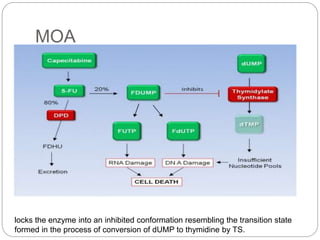
MOA
HN
N
O
O
O
HO
OP
O
OH
HO
5-FU metabolite
Thymidylate
Synthetase
HS
NHN
N
HN
N
O
NH2
R
B
H
HN
N
O
O
O
HO
OP
O
OH
HO
H
F
Thymidylate
Synthetase
S
B
NHN
N
HN
NH
O
NH2
R
F
Enzyme inhibition
HN
N
H
O
O
F
in vivo
HN
N
O
O
F
O
HO
OP
O
OH
HO
Inhibitor
Thymidylate synthetase
locks the enzyme into an inhibited conformation resembling the transition state
formed in the process of conversion of dUMP to thymidine by TS.
Resistance and adverse effects
 Resistance is encountered when the cells have
lost their ability to convert 5-FU into its active form
(5-FdUMP) or when they have altered or
increased thymidylate synthase levels.
 Adverse effects: anorexia, oral toxicity. A
dermopathy (erythematous desquamation of the
palms and soles) called the hand-foot syndrome
seen after extended infusions.
purines analogs
 6-THIOPURINES
 6-Mercaptopurine
 6-Thioguanine
 FLUDARABINE
 CLADRIBINE
6-Mercaptopurine
is the thiol analog of hypoxanthine
Primarly serves in the treatment of childhood
acute leukemia
Mode of action is:-
Inhibition of purine synthesis:
 Incorporation into nucleic acids:
Nucleotide formation
6-Mercaptopurine
Resistance:
1. an inability to biotransform 6-MP to the
corresponding nucleotide because of decreased
levels of HGPRT
2. increased dephosphorylation
3. increased metabolism of the drug to thiouric acid
or other metabolites.
4. Increased thiopurine methyltransferase (TMPT)
activity
Adverse effects:
 Bone marrow depression- principal toxicity. Side
effects (anorexia, nausea, vomiting, and diarrhea)
REFERENCE
 LIPPINCOAT’S PHARMACOLOGY
 LANG’S PHARMACOLOGY
 JOURNAL ON ANTIMETABOLITES
 WIKIPEDIA
 Cancer Research Campaign Department of
Medical Oncology, Beatson Oncology Centre,
Any queries????
QUERIES
Visit :www.bpharmstuf.com
THANK YOU!!!!!!!!!!!

Alkylating agents and antimetabolites

  • 1.
  • 2.
    OBJECTIVE  TO UNDERSTANDTHE TYPE AND ROLE OF ALKYLATING AGENTS  TO UNDERSTAND THE TYPE AND ROLE OF ANTIMETABOLITES
  • 3.
    Alkylating Agent  alkylatingagent, any highly reactive drug that binds to certain chemical groups (phosphate, amino, sulfhydryl, hydroxyl, and imidazole groups) commonly found in nucleic acids and other macromolecules, bringing about changes in the DNA and RNA of cells.  Alkylating agents were the first anticancer drugs used  The types of molecular changes induced by alkylating agents include cross-linking between strands of DNA and the loss of a basic component (purine) from or the breaking of the nucleic acid.
  • 5.
    Con’t  The resultis that the nucleic acid will not be replicated. Either the altered DNA will be unable to carry out the functions of the cell, resulting in cell death (cytotoxicity), or the altered DNA will change the cell characteristics, resulting in an altered cell (mutagenic change).  This change may result in the ability or tendency to produce cancerous cells (carcinogenicity).  Normal cells may also be affected and become cancer cells.
  • 6.
    cont  These moleculesmay either  bind twice to one strand of DNA (intrastrand crosslink) or  may bind once to both strands (interstrand crosslink).  If the cell tries to replicate crosslinked DNA during cell division, or tries to repair it, the DNA strands can break. This leads to a form of programmed cell death called apoptosis.
  • 8.
    classes  The alkylatingagents are the largest group of anticancer agents.  Five main sub-groups. 1. Nitrogen mustards 2. Alkyl sulphonates 3. Nitrosoureas 4. Ethyleneimine 5. Thiazines
  • 9.
    Nitrogen mustards  Mechlorethamine:first nitrogen mustard.  Used for Hodgkin and non-Hodgkin lymphomas  It is also used topically for treatment of cutaneous T- cell lymphoma .  Toxicity: Block reproductive functions, First trimester of pregnancy and later stage of pregnancy it should not be used.  Methclorethamine ,Cyclophosphamide, Melphalan,Chlorambucil and Ifosfamide.
  • 10.
    Alkyl sulphonates  Busulfan– Highly specific for myeloid elements and granulocyte .it is not curative.  Toxicity: hyperuricaemia is common; pulmonary fibrosis and skin pigmentation are specific adverse effects.  Drug of choice for chronic myeloid leukaemia .  Dose: 2-6 mg/ day, orally
  • 11.
    Nitrosoureas  It islipid soluble alkylating agents with a wide range of antitumor activity . Nitrosoureas: interfere with enzymes needed for DNA repair.  They are able to cross the blood-brain barrier.  used to treat: 1. brain tumors 2. non-Hodgkin’s lymphoma, 3. multiple myeloma, and 4. malignant melanoma.  Major toxicities occur in the hematopoietic and gastrointestinal systems.  Carmustine, lumustine, and streptozocin are examples of nitrosoureas.
  • 12.
    Thiazines  Have primaryinhibitory action on RNA and protein synthesis (others mainly affect DNA).  Ideal for malignant melanoma; also used in Hodgkin's disease.  Nausea and vomiting are prominent side effects.
  • 13.
     Alkylating agentscan cause:  severe nausea and vomiting  as well as decreases in the number of red blood cells and white blood cells.  The decrease in the number of white cells results in susceptibility to infection.  Alkylating agents have found use in the treatment of lymphoma, leukemia, testicular cancer, melanoma, brain cancer, and breast cancer. They are most often used in combination with other anticancer drugs.
  • 14.
    Antimetabolite  similar instructure to a metabolite, or enzymatic substrate, so competes with or inhibits the metabolite.  Their maximal cytotoxic effects are in S-phase specific.  readily become incorporated into either DNA or RNA  cause toxicity In cells that are rapidly dividing o Skin disorder, hair loss, anemia, mucositis, myelosuppression and thrombocytopenia are common.
  • 15.
    Antimetabolite as chemotherapeutic 1.Folate antagonist 2. Pyrimidine antagonist 3. Purine antagonist 4. Thymidylate synthase inhibitors 5. Multitargeted antifolate 6. Glycinamide ribonucleotide formyltransferase and aminoimadazole carboxamide ribonucleotide formyl transferase
  • 16.
    Folate antagonist  Methotrexate DHFR - conversion of dihydrofolate to tetrahydrofolate and ultimately to 10-formyl tetrahydrofolate which  provides the formyl group for glycinamide ribonucleotide formyl- transferase (GARFT) and aminoimidazole carboxamide ribo- nucleotide formyl transferase (AICARFT).  Thus, the inhibition of DHFR results in depletion of intracellular pools of reduced folates and ultimately in reduced synthesis of purines and pyrimidines.
  • 17.
    Mechanism HN N N N O H2N N H O N H CO2H CO2H Folic acid DHFR HN NN H N O H2N N H R Dihydrofolate DHFR HN N N H H N O H2N N H R Tetrahydrofolate PABA Microorganisms HN N N H N O H2N N R Thymine synth predominant mechanism of action of methotrexate is uncertain, as polyglutamated forms of the drug also inhibit TS and AICARFT
  • 18.
    Resistance  Nonproliferating cellsare resistant to MTX,  probably because of a relative lack of DHFR.  Decreased levels of the MTX polyglutamate due to its decreased formation or increased breakdown.  Resistance in neoplastic cells can be due to:  amplification (production of additional copies) of the gene that codes for DHFR, resulting in increased levels of this enzyme.  The enzyme affinity for MTX may also be diminished.  Resistance can also occur from a reduced influx of MTX,
  • 19.
    Indications  MTX, effectiveagainst:  acute lymphocytic leukemia,  choriocarcinoma,  Burkitt's lymphoma in children,  breast cancer, and  head and neck carcinomas.
  • 20.
    Toxicity  Renal damage:is a complication of high-dose MTX by precipitating in the tubules.  Hepatic function: Long-term use of MTX may lead to cirrhosis.  Pulmonary toxicity: This is a rare complication.  Neurologic toxicities: associated with intrathecal administration and include subacute meningeal irritation, stiff neck, headache, and fever.  Long-lasting effects, disabilities, have been seen in children.
  • 21.
     Another DHFRinhibitor that has shown activity in humans is piritrexim. This is compound does not rely on the RFC, but enters the cell by means of passive diffusion. It has oral bioavailability of 75%  Trimetrexate is more lipophilic than methotrexate and is not dependent on the RFC for entry into the cell.  This leads to higher concentrations of trimetrexate within the cell, although the drug does not undergo polyglutamylation.
  • 22.
    Pyrimidine analogs  Itis widely used in colon cancer  They include:-  Fluorouracil  CAPECITABINE  CYTARABINE  GEMCITABINE
  • 23.
    5-fluorouracil (5-FU)  replacingnucleosides in one or more normal cell functions because of their similarity  Main use is in leukaemias, lymphomas, colorectal cancer and solid tumors  They may fall into one of two main classes  either being incorporated into DNA and RNA synthesis or  being responsible for inhibition of one of the enzymes essential to cell metabolism.
  • 24.
    5- FU prodrugcapecitabine  cytidine analogue is administered as an oral formulation  passes unchanged through the intestinal mucosa.  activated through a series of enzymatic steps in the liver and in tumour cells  conversion to 5-FU in a potentially tumour-selective manner by the enzyme thymidine phosphorylase  Dose-limiting toxicities (DLT) included nausea, mucositis, diarrhoea and neutropenia.
  • 25.
    MOA HN N O O O HO OP O OH HO 5-FU metabolite Thymidylate Synthetase HS NHN N HN N O NH2 R B H HN N O O O HO OP O OH HO H F Thymidylate Synthetase S B NHN N HN NH O NH2 R F Enzyme inhibition HN N H O O F invivo HN N O O F O HO OP O OH HO Inhibitor Thymidylate synthetase locks the enzyme into an inhibited conformation resembling the transition state formed in the process of conversion of dUMP to thymidine by TS.
  • 26.
    Resistance and adverseeffects  Resistance is encountered when the cells have lost their ability to convert 5-FU into its active form (5-FdUMP) or when they have altered or increased thymidylate synthase levels.  Adverse effects: anorexia, oral toxicity. A dermopathy (erythematous desquamation of the palms and soles) called the hand-foot syndrome seen after extended infusions.
  • 27.
    purines analogs  6-THIOPURINES 6-Mercaptopurine  6-Thioguanine  FLUDARABINE  CLADRIBINE
  • 28.
    6-Mercaptopurine is the thiolanalog of hypoxanthine Primarly serves in the treatment of childhood acute leukemia Mode of action is:- Inhibition of purine synthesis:  Incorporation into nucleic acids: Nucleotide formation
  • 29.
    6-Mercaptopurine Resistance: 1. an inabilityto biotransform 6-MP to the corresponding nucleotide because of decreased levels of HGPRT 2. increased dephosphorylation 3. increased metabolism of the drug to thiouric acid or other metabolites. 4. Increased thiopurine methyltransferase (TMPT) activity Adverse effects:  Bone marrow depression- principal toxicity. Side effects (anorexia, nausea, vomiting, and diarrhea)
  • 30.
    REFERENCE  LIPPINCOAT’S PHARMACOLOGY LANG’S PHARMACOLOGY  JOURNAL ON ANTIMETABOLITES  WIKIPEDIA  Cancer Research Campaign Department of Medical Oncology, Beatson Oncology Centre,
  • 31.
  • 32.

Editor's Notes

  • #4  Many types of alkylating agents in use today Some examples of alkylating agents are nitrogen mustards (chlorambucil and cyclophosphamide), cisplatin, nitrosoureas (carmustine, lomustine, and semustine), alkylsulfonates (busulfan), ethyleneimines (thiotepa), and triazines (dacarbazine).
  • #6 Normal cells may also be affected and become cancer cells.
  • #8 Two DNA bases that are cross-linked by a nitrogen mustard. Different nitrogen mustards will have different chemical groups (R). The nitrogen mustards most commonly alkylate the N7 nitrogen of guanine (as shown here) but other atoms can be alkylated.[17]
  • #10 produce menstrual irregularities or premature ovarian failure in women and oligospermia in men.
  • #21 In addition to nausea, vomiting, and diarrhea, the most frequent toxicities occur in tissues that are constantly renewing. Some of these adverse effects can be prevented or reversed by administering leucovorin which is taken up more readily by normal cells than by tumor cells. Doses of leucovorin must be kept minimal to avoid possible interference with the antitumor action of MTX. Alkalinization of the urine and hydration help to prevent this problem.
  • #23 Capecitabine-like fluorouracil but taken orally useful in mtasttic cancer Cytaraine-ara-cytosine disruts chain elongation, act on hematologic malignancies not on solid tumor Gemcitabine-like cytosine 2 mechanisms effective on solid tumors
  • #26  thymidylate synthase is the main target for the nucleoside of 5-FU, which binds to the active site of the enzyme in a similar manner to dUMP. This is followed by incorporation of the folate co-factor 5, 1 0-methylenetetrahydrofolate that, combined with the fluorinated pyrimidine,
  • #27 In addition to nausea, vomiting, diarrhea, and alopecia, severe ulceration of the oral and GI mucosa, bone marrow depression (with bolus injection), and
  • #28 Fludarabine- adenosine analogue 3 effects inhibit rnrs,dna polymerase, apoptosis in cll and adult leukemia Cladarabine- adenosine analogue mainly effective on lymphocytes- hairy cell leukemia and cll
  • #30 [Note: The latter reaction is catalyzed by xanthine oxidase.5] the xanthine oxidase inhibitor,allopurinol, is frequently used to reduce hyperuricemia in cancer patients receiving chemotherapy The parent drug and its metabolites are excreted by the kidney. (for example, in Lesch-Nyhan syndrome, in which patients lack this enzyme),