CANCER
A GENETIC MISHAP
Dr. H.K.GARG
PROFESSOR
Sarojini Naidu Govt. Girls P.G. College
Shivaji Nagar, Bhopal
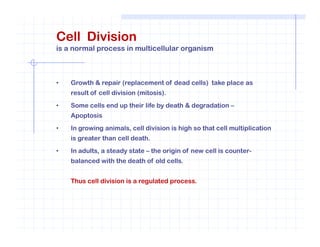
Cell Division
is a normal process in multicellular organism
• Growth & repair (replacement of dead cells) take place as
result of cell division (mitosis).
• Some cells end up their life by death & degradation –
Apoptosis
• In growing animals, cell division is high so that cell multiplication
is greater than cell death.
• In adults, a steady state – the origin of new cell is counter-
balanced with the death of old cells.
Thus cell division is a regulated process.
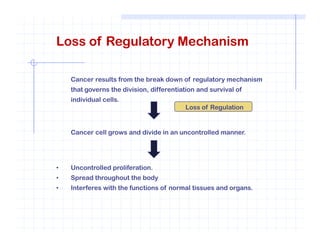
Loss of Regulatory Mechanism
Cancer results from the break down of regulatory mechanism
that governs the division, differentiation and survival of
individual cells.
Loss of Regulation
Cancer cell grows and divide in an uncontrolled manner.
• Uncontrolled proliferation.
• Spread throughout the body
• Interferes with the functions of normal tissues and organs.
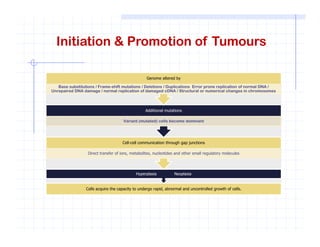
Initiation & Promotion of Tumours
Additional mutations
Variant (mutated) cells become dominant
Genome altered by
Base substitutions / Frame-shift mutations / Deletions / Duplications Error prone replication of normal DNA /
Unrepaired DNA damage / normal replication of damaged cDNA / Structural or numerical changes in chromosomes
Cells acquire the capacity to undergo rapid, abnormal and uncontrolled growth of cells.
Hyperplasia Neoplasia
Cell-cell communication through gap junctions
Direct transfer of ions, metabolites, nucleotides and other small regulatory molecules
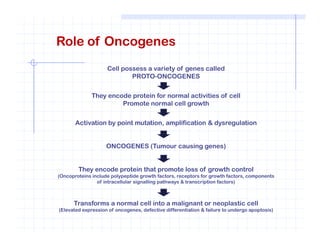
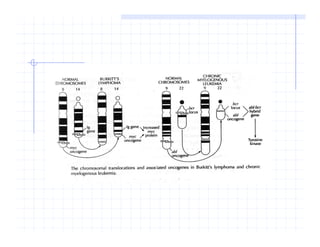
Role of Oncogenes
Cell possess a variety of genes called
PROTO-ONCOGENES
They encode protein for normal activities of cell
Promote normal cell growth
Activation by point mutation, amplification & dysregulationActivation by point mutation, amplification & dysregulation
ONCOGENES (Tumour causing genes)
They encode protein that promote loss of growth control
(Oncoproteins include polypeptide growth factors, receptors for growth factors, components
of intracellular signalling pathways & transcription factors)
Transforms a normal cell into a malignant or neoplastic cell
(Elevated expression of oncogenes, defective differentiation & failure to undergo apoptosis)
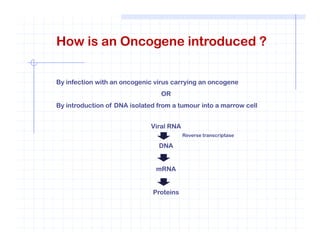
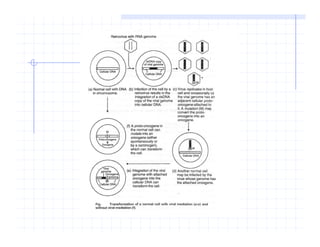
How is an Oncogene introduced ?
By infection with an oncogenic virus carrying an oncogene
OR
By introduction of DNA isolated from a tumour into a marrow cell
Viral RNAViral RNA
DNA
mRNA
Proteins
Reverse transcriptase
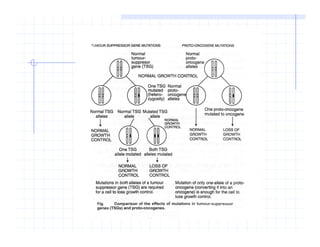
Tumour Supressor Gene
Normal cells contain genes on their chromosomes that supress
unregulated cell growth. These are called Tumour Supressor Gene.
• They encode protein that restraints cell growth and prevents cells
from becoming mutant.
• TSG products have an inhibitory role in cell growth and division.
• TSG is a recessive gene. It is necessary to have mutations in both the
alleles to result in tumour.
• Even a single normal allele is able to code for sufficient gene product
for normal function.
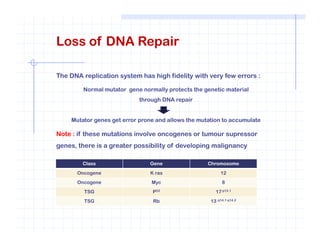
Loss of DNA Repair
The DNA replication system has high fidelity with very few errors :
Normal mutator gene normally protects the genetic material
through DNA repair
Mutator genes get error prone and allows the mutation to accumulate
Note : if these mutations involve oncogenes or tumour supressor
genes, there is a greater possibility of developing malignancy
Class Gene Chromosome
Oncogene K ras 12
Oncogene Myc 8
TSG P53 17 p13.1
TSG Rb 13 q14.1 q14.2
Check points during Cell Cycle
Cell cycle : G1 First Gap Phase
S Synthesis Phase
G2 Second Gap Phase
G0 Optional
• A series of protein complexes of 2 sub units :Cyclin dependent protein
kinase (Cdks) and Cyclin . These determine the progression of cell cycle
from one phase to the next.
• Cdks catalyzes the phosphorylation of specific serine / threonine residues
of specific target proteins
• Cyclins hold the target proteins so that Cdks can phosphorylate it.
Proteins encoded by TSG that regulate the cell cycle include :
• Rb – responsible for a rare childhood tumour of eye called retinoblastoma
• P53- ensures apoptosis.
Check points …………… p53
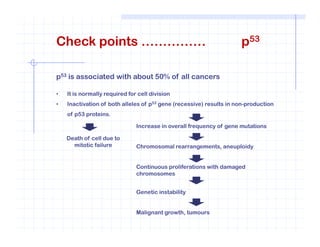
p53 is associated with about 50% of all cancers
• It is normally required for cell division
• Inactivation of both alleles of p53 gene (recessive) results in non-production
of p53 proteins.
Increase in overall frequency of gene mutations
Death of cell due to
mitotic failure
Increase in overall frequency of gene mutations
Chromosomal rearrangements, aneuploidy
Continuous proliferations with damaged
chromosomes
Genetic instability
Malignant growth, tumours
Thank You

Cancer : A Genetic Mishap - Dr HK Garg

  • 1.
    CANCER A GENETIC MISHAP Dr.H.K.GARG PROFESSOR Sarojini Naidu Govt. Girls P.G. College Shivaji Nagar, Bhopal
  • 2.
    Cell Division is anormal process in multicellular organism • Growth & repair (replacement of dead cells) take place as result of cell division (mitosis). • Some cells end up their life by death & degradation – Apoptosis • In growing animals, cell division is high so that cell multiplication is greater than cell death. • In adults, a steady state – the origin of new cell is counter- balanced with the death of old cells. Thus cell division is a regulated process.
  • 3.
    Loss of RegulatoryMechanism Cancer results from the break down of regulatory mechanism that governs the division, differentiation and survival of individual cells. Loss of Regulation Cancer cell grows and divide in an uncontrolled manner. • Uncontrolled proliferation. • Spread throughout the body • Interferes with the functions of normal tissues and organs.
  • 4.
    Initiation & Promotionof Tumours Additional mutations Variant (mutated) cells become dominant Genome altered by Base substitutions / Frame-shift mutations / Deletions / Duplications Error prone replication of normal DNA / Unrepaired DNA damage / normal replication of damaged cDNA / Structural or numerical changes in chromosomes Cells acquire the capacity to undergo rapid, abnormal and uncontrolled growth of cells. Hyperplasia Neoplasia Cell-cell communication through gap junctions Direct transfer of ions, metabolites, nucleotides and other small regulatory molecules
  • 5.
    Role of Oncogenes Cellpossess a variety of genes called PROTO-ONCOGENES They encode protein for normal activities of cell Promote normal cell growth Activation by point mutation, amplification & dysregulationActivation by point mutation, amplification & dysregulation ONCOGENES (Tumour causing genes) They encode protein that promote loss of growth control (Oncoproteins include polypeptide growth factors, receptors for growth factors, components of intracellular signalling pathways & transcription factors) Transforms a normal cell into a malignant or neoplastic cell (Elevated expression of oncogenes, defective differentiation & failure to undergo apoptosis)
  • 7.
    How is anOncogene introduced ? By infection with an oncogenic virus carrying an oncogene OR By introduction of DNA isolated from a tumour into a marrow cell Viral RNAViral RNA DNA mRNA Proteins Reverse transcriptase
  • 8.
    Tumour Supressor Gene Normalcells contain genes on their chromosomes that supress unregulated cell growth. These are called Tumour Supressor Gene. • They encode protein that restraints cell growth and prevents cells from becoming mutant. • TSG products have an inhibitory role in cell growth and division. • TSG is a recessive gene. It is necessary to have mutations in both the alleles to result in tumour. • Even a single normal allele is able to code for sufficient gene product for normal function.
  • 10.
    Loss of DNARepair The DNA replication system has high fidelity with very few errors : Normal mutator gene normally protects the genetic material through DNA repair Mutator genes get error prone and allows the mutation to accumulate Note : if these mutations involve oncogenes or tumour supressor genes, there is a greater possibility of developing malignancy Class Gene Chromosome Oncogene K ras 12 Oncogene Myc 8 TSG P53 17 p13.1 TSG Rb 13 q14.1 q14.2
  • 12.
    Check points duringCell Cycle Cell cycle : G1 First Gap Phase S Synthesis Phase G2 Second Gap Phase G0 Optional • A series of protein complexes of 2 sub units :Cyclin dependent protein kinase (Cdks) and Cyclin . These determine the progression of cell cycle from one phase to the next. • Cdks catalyzes the phosphorylation of specific serine / threonine residues of specific target proteins • Cyclins hold the target proteins so that Cdks can phosphorylate it. Proteins encoded by TSG that regulate the cell cycle include : • Rb – responsible for a rare childhood tumour of eye called retinoblastoma • P53- ensures apoptosis.
  • 14.
    Check points ……………p53 p53 is associated with about 50% of all cancers • It is normally required for cell division • Inactivation of both alleles of p53 gene (recessive) results in non-production of p53 proteins. Increase in overall frequency of gene mutations Death of cell due to mitotic failure Increase in overall frequency of gene mutations Chromosomal rearrangements, aneuploidy Continuous proliferations with damaged chromosomes Genetic instability Malignant growth, tumours
  • 15.