













MARIJUANA
OUTLINE
 What is Marijuana
 Types Of Marijuana
 Sources
 Street names Of Marijuana
 Production and How it is Used
 Mechanism Of action
 Indications
 Side Effects
 Management Of Addiction
 References
What is Marijuana?
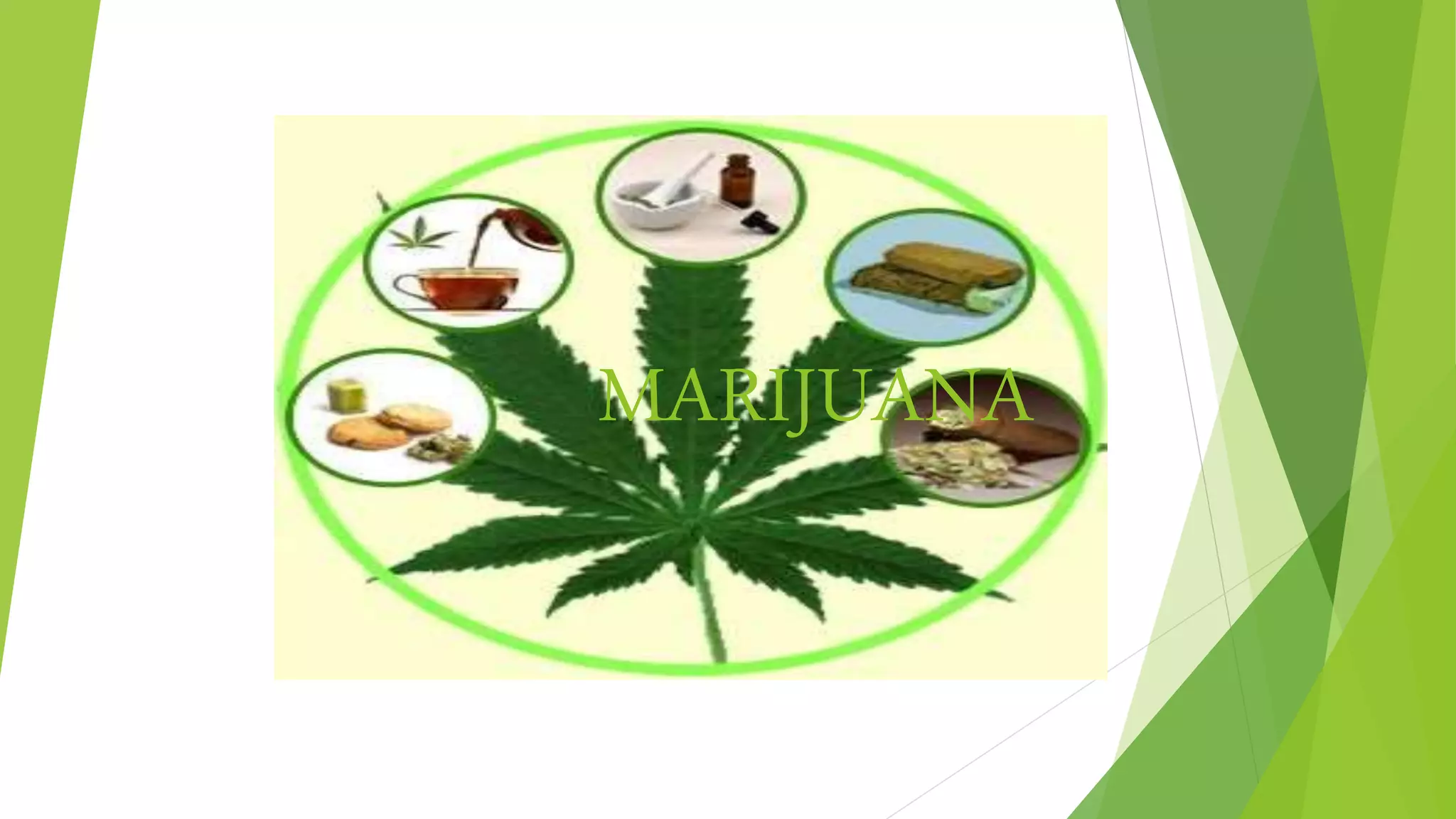
 Marijuana is one of the most abused drugs in the world obtained from Cannabis, the Indian
Hemp plant with the part that contains the ‘drug’ found mainly in flowers and much less in
the seeds, leaves and stem of the plant however they are sold as a mixture.
 It is usually green, brown or grey in color and the most popular form is the joint which is
when marijuana is dried and rolled paper, then smoked. In its more concentrated resinous
form it is called ‘hashish’ and as a sticky black liquid hash oil. The final method that
marijuana is commonly taken through is tea that it is it has been brewed.
 The marijuana plant has its active ingredient as Delta-9-tetrahydrocannabinol (THC) and
other compound such as Cannabinol, Cannabidol and tetrahydrocannabivarin.
TYPES OF MARIJUANA
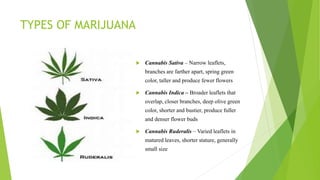
 Cannabis Sativa – Narrow leaflets,
branches are farther apart, spring green
color, taller and produce fewer flowers
 Cannabis Indica – Broader leaflets that
overlap, closer branches, deep olive green
color, shorter and bustier, produce fuller
and denser flower buds
 Cannabis Ruderalis – Varied leaflets in
matured leaves, shorter stature, generally
small size
SOURCES
Marijuana is an illegal drug in most countries however it is legal in some countries and countries
known mainly for the production of marijuana include:
 United States of America
 Afghanistan
 Jamaica
 India
 Mexico
 Columbia
 Pakistan
STREET NAMES OF MARIJUANA
 Because of their effects
 Airplane
 Amnesia
 Houdini
 Because people like it
 Ace
 Baby
 Because it is a green plant
 Grass
 Herb
 Because of their language
 Ganja
 Pot (Potiguaya)
REASONS FOR THE STREET NAMES
 Illegality issues
 Familiarization
 Because of the feeling they get
 To prevent attention in public
PRODUCTION
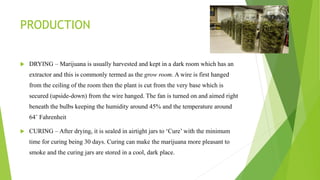
 DRYING – Marijuana is usually harvested and kept in a dark room which has an
extractor and this is commonly termed as the grow room. A wire is first hanged
from the ceiling of the room then the plant is cut from the very base which is
secured (upside-down) from the wire hanged. The fan is turned on and aimed right
beneath the bulbs keeping the humidity around 45% and the temperature around
64˚ Fahrenheit
 CURING – After drying, it is sealed in airtight jars to ‘Cure’ with the minimum
time for curing being 30 days. Curing can make the marijuana more pleasant to
smoke and the curing jars are stored in a cool, dark place.
HOW IT IS USED
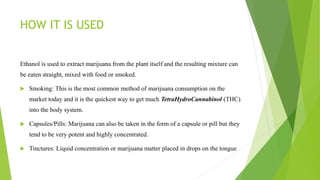
Ethanol is used to extract marijuana from the plant itself and the resulting mixture can
be eaten straight, mixed with food or smoked.
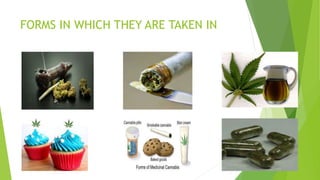
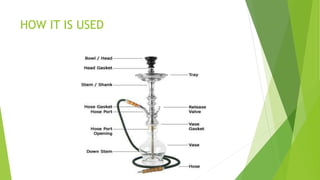
 Smoking: This is the most common method of marijuana consumption on the
market today and it is the quickest way to get much TetraHydroCannabinol (THC)
into the body system.
 Capsules/Pills: Marijuana can also be taken in the form of a capsule or pill but they
tend to be very potent and highly concentrated.
 Tinctures: Liquid concentration or marijuana matter placed in drops on the tongue
FORMS IN WHICH THEY ARE TAKEN IN
HOW IT IS USED
HOW “POT” WORKS
 Works through a unique system known as Endocannabinoid System
 Endocannabinoid system consists of
 Endocannabinoid receptors
 Cannabinoid neurotransmitters
 Physiological effects made of communication existing within the system
Endocannabinoid receptors include:
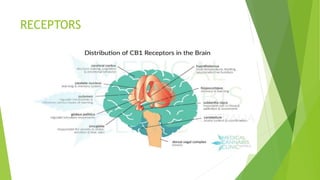
 CB1 Receptors: Greatly exposed in the CNS
 CB2 Receptors: Greatly Exposed in the immune system
HOW “POT” WORKS
Cannabinoid transmission include:
 Anandamide: The body’s own cannabinoid neurotransmitter
 2 – AG (Arachidolic Glycerol) neurotransmitter
 THC: Delta 9 Tetrahydrocannabinol – Cannabidiol
Physiological function includes:
 Pain modulation
 Stress Management
 Mood regulation
HOW IS THIS DIFFERENT FROM
ANANDAMIDE
 Rate of Degradation
 Physiological regulation
 Target and location specific
 Potency
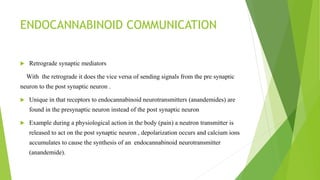
ENDOCANNABINOID COMMUNICATION
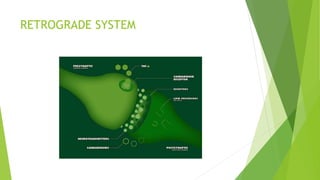
 Retrograde synaptic mediators
With the retrograde it does the vice versa of sending signals from the pre synaptic
neuron to the post synaptic neuron .
 Unique in that receptors to endocannabinoid neurotransmitters (anandemides) are
found in the presynaptic neuron instead of the post synaptic neuron
 Example during a physiological action in the body (pain) a neutron transmitter is
released to act on the post synaptic neuron , depolarization occurs and calcium ions
accumulates to cause the synthesis of an endocannabinoid neurotransmitter
(anandemide).
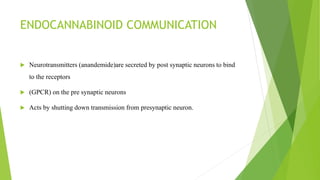
ENDOCANNABINOID COMMUNICATION
 Neurotransmitters (anandemide)are secreted by post synaptic neurons to bind
to the receptors
 (GPCR) on the pre synaptic neurons
 Acts by shutting down transmission from presynaptic neuron.
RETROGRADE SYSTEM
GABA
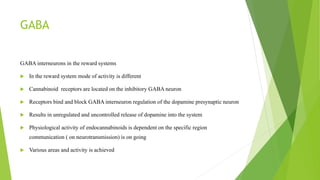
GABA interneurons in the reward systems
 In the reward system mode of activity is different
 Cannabinoid receptors are located on the inhibitory GABA neuron
 Receptors bind and block GABA interneuron regulation of the dopamine presynaptic neuron
 Results in unregulated and uncontrolled release of dopamine into the system
 Physiological activity of endocannabinoids is dependent on the specific region
communication ( on neurotransmission) is on going
 Various areas and activity is achieved
RECEPTORS
INDICATIONS
Marijuana plant components have some medicinal properties but that is not the same as medicine
including:
 Acts as a pain reliever
 Acts as anti-depressant
 People smoke it for its psychoactive properties thus to make them feel ‘high’
 It takes out stress and replaces it with joy and comfort
 Causes calming and inducing sleep
 Acts as an appetite stimulant.
 Lowers blood pressure in hypertensive patients
SIDE EFFECT – Short term effects
 Psychosis / Psychotic symptoms – Psychotic symptoms include:
 Hallucination
 Paranoia / Severe anxiety
 Loss of sense of personal identity
 Delusion
 Amnesia
 Lowered sense of self identity
Side Effects – Long Term
 Lowers life satisfaction
 Poor school performance and higher chance of dropping out
 Relationship problems especially intimate partner violence
 Effects on lungs
 Effect on fetus and babies
 Financial difficulties
 Greater chance of being unemployed or not getting good jobs
Management Of Marijuana Addiction
The treatment for marijuana abuse and dependence has many similarities to treatment for
addictions to other drugs although the long term clinical outcomes may be less severe. A lot of
people with marijuana use disorder especially adolescents suffer from other psychiatric disorder.
Treatment of this addiction effectively is done with standard treatment involving medications and
behavioral therapies. The most promising behavioral treatment includes:
 Motivational Enhancement Therapy
 Lifestyle Balance
 Contingency Management
 Cognitive Behavioral Therapy (CBT)
MOTIVATIONAL ENHANCEMENT THERAPY
AND LIFESTYLE BALANCE
 Designed to produce rapid, internally motivated change. Helps you identify
and keep up reasons to quit.
 When you are addicted to Marijuana your life falls out of balance. You rather
find yourself smoking a pot instead of working or going to school.
Contingency Management
A therapeutic management approach based on frequent monitoring of the target
behavior and provision of tangible positive rewards when the target behavior
occurs or does not occur.
Drugs used to manage marijuana dependence
1. Sleep aids e.g. Zolpidem
2. Anti-anxiety drugs e.g. Buspirone
3. Anti-epileptics e.g. Cabapentin
COGNITIVE BEHAVIORAL THERAPY
Cognitive behavioral therapy is a psychotherapy that deals with the
management of problematic behavior and they change how people think
and behave.
It is mostly used to treat anxiety and depression and can also be used to
treat mental disorder, psychological problems and stop of drug abuse.
ADVANTAGES OF MANAGEMENT
 More time for recovery
 More effective phasing
 A longer break in the substance abuse
 Increased wellbeing
 Form healthy new habit
REFERENCES
 Mehmedic Z et al Potency Trends of Delta-9-THC and Other Cannabinoids in
Confiscated Cannabis Preparations (From 1993 – 2008)
 National Academics Of Sciences, Engineering and Medicine; The Health Effects
Of Cannabis And Cannabinoids; The National Academies Press; 2017
 Zwerling C, Ryan J et al, The Efficacy of Pre-Employment Drug Screening for
Marijuana and Cocaine in Predicting Employment Outcome JAMA, 1990, 264 (20)
 http://www.drugabuse.gov/Publications/12/10/17; 13:45GMT

Marijuana

  • 1.
  • 2.
    OUTLINE  What isMarijuana  Types Of Marijuana  Sources  Street names Of Marijuana  Production and How it is Used  Mechanism Of action  Indications  Side Effects  Management Of Addiction  References
  • 3.
    What is Marijuana? Marijuana is one of the most abused drugs in the world obtained from Cannabis, the Indian Hemp plant with the part that contains the ‘drug’ found mainly in flowers and much less in the seeds, leaves and stem of the plant however they are sold as a mixture.  It is usually green, brown or grey in color and the most popular form is the joint which is when marijuana is dried and rolled paper, then smoked. In its more concentrated resinous form it is called ‘hashish’ and as a sticky black liquid hash oil. The final method that marijuana is commonly taken through is tea that it is it has been brewed.  The marijuana plant has its active ingredient as Delta-9-tetrahydrocannabinol (THC) and other compound such as Cannabinol, Cannabidol and tetrahydrocannabivarin.
  • 4.
    TYPES OF MARIJUANA Cannabis Sativa – Narrow leaflets, branches are farther apart, spring green color, taller and produce fewer flowers  Cannabis Indica – Broader leaflets that overlap, closer branches, deep olive green color, shorter and bustier, produce fuller and denser flower buds  Cannabis Ruderalis – Varied leaflets in matured leaves, shorter stature, generally small size
  • 5.
    SOURCES Marijuana is anillegal drug in most countries however it is legal in some countries and countries known mainly for the production of marijuana include:  United States of America  Afghanistan  Jamaica  India  Mexico  Columbia  Pakistan
  • 6.
    STREET NAMES OFMARIJUANA  Because of their effects  Airplane  Amnesia  Houdini  Because people like it  Ace  Baby  Because it is a green plant  Grass  Herb  Because of their language  Ganja  Pot (Potiguaya)
  • 7.
    REASONS FOR THESTREET NAMES  Illegality issues  Familiarization  Because of the feeling they get  To prevent attention in public
  • 8.
    PRODUCTION  DRYING –Marijuana is usually harvested and kept in a dark room which has an extractor and this is commonly termed as the grow room. A wire is first hanged from the ceiling of the room then the plant is cut from the very base which is secured (upside-down) from the wire hanged. The fan is turned on and aimed right beneath the bulbs keeping the humidity around 45% and the temperature around 64˚ Fahrenheit  CURING – After drying, it is sealed in airtight jars to ‘Cure’ with the minimum time for curing being 30 days. Curing can make the marijuana more pleasant to smoke and the curing jars are stored in a cool, dark place.
  • 9.
    HOW IT ISUSED Ethanol is used to extract marijuana from the plant itself and the resulting mixture can be eaten straight, mixed with food or smoked.  Smoking: This is the most common method of marijuana consumption on the market today and it is the quickest way to get much TetraHydroCannabinol (THC) into the body system.  Capsules/Pills: Marijuana can also be taken in the form of a capsule or pill but they tend to be very potent and highly concentrated.  Tinctures: Liquid concentration or marijuana matter placed in drops on the tongue
  • 10.
    FORMS IN WHICHTHEY ARE TAKEN IN
  • 11.
  • 12.
    HOW “POT” WORKS Works through a unique system known as Endocannabinoid System  Endocannabinoid system consists of  Endocannabinoid receptors  Cannabinoid neurotransmitters  Physiological effects made of communication existing within the system Endocannabinoid receptors include:  CB1 Receptors: Greatly exposed in the CNS  CB2 Receptors: Greatly Exposed in the immune system
  • 13.
    HOW “POT” WORKS Cannabinoidtransmission include:  Anandamide: The body’s own cannabinoid neurotransmitter  2 – AG (Arachidolic Glycerol) neurotransmitter  THC: Delta 9 Tetrahydrocannabinol – Cannabidiol Physiological function includes:  Pain modulation  Stress Management  Mood regulation
  • 14.
    HOW IS THISDIFFERENT FROM ANANDAMIDE  Rate of Degradation  Physiological regulation  Target and location specific  Potency
  • 15.
    ENDOCANNABINOID COMMUNICATION  Retrogradesynaptic mediators With the retrograde it does the vice versa of sending signals from the pre synaptic neuron to the post synaptic neuron .  Unique in that receptors to endocannabinoid neurotransmitters (anandemides) are found in the presynaptic neuron instead of the post synaptic neuron  Example during a physiological action in the body (pain) a neutron transmitter is released to act on the post synaptic neuron , depolarization occurs and calcium ions accumulates to cause the synthesis of an endocannabinoid neurotransmitter (anandemide).
  • 16.
    ENDOCANNABINOID COMMUNICATION  Neurotransmitters(anandemide)are secreted by post synaptic neurons to bind to the receptors  (GPCR) on the pre synaptic neurons  Acts by shutting down transmission from presynaptic neuron.
  • 17.
  • 18.
    GABA GABA interneurons inthe reward systems  In the reward system mode of activity is different  Cannabinoid receptors are located on the inhibitory GABA neuron  Receptors bind and block GABA interneuron regulation of the dopamine presynaptic neuron  Results in unregulated and uncontrolled release of dopamine into the system  Physiological activity of endocannabinoids is dependent on the specific region communication ( on neurotransmission) is on going  Various areas and activity is achieved
  • 19.
  • 20.
    INDICATIONS Marijuana plant componentshave some medicinal properties but that is not the same as medicine including:  Acts as a pain reliever  Acts as anti-depressant  People smoke it for its psychoactive properties thus to make them feel ‘high’  It takes out stress and replaces it with joy and comfort  Causes calming and inducing sleep  Acts as an appetite stimulant.  Lowers blood pressure in hypertensive patients
  • 21.
    SIDE EFFECT –Short term effects  Psychosis / Psychotic symptoms – Psychotic symptoms include:  Hallucination  Paranoia / Severe anxiety  Loss of sense of personal identity  Delusion  Amnesia  Lowered sense of self identity
  • 22.
    Side Effects –Long Term  Lowers life satisfaction  Poor school performance and higher chance of dropping out  Relationship problems especially intimate partner violence  Effects on lungs  Effect on fetus and babies  Financial difficulties  Greater chance of being unemployed or not getting good jobs
  • 23.
    Management Of MarijuanaAddiction The treatment for marijuana abuse and dependence has many similarities to treatment for addictions to other drugs although the long term clinical outcomes may be less severe. A lot of people with marijuana use disorder especially adolescents suffer from other psychiatric disorder. Treatment of this addiction effectively is done with standard treatment involving medications and behavioral therapies. The most promising behavioral treatment includes:  Motivational Enhancement Therapy  Lifestyle Balance  Contingency Management  Cognitive Behavioral Therapy (CBT)
  • 24.
    MOTIVATIONAL ENHANCEMENT THERAPY ANDLIFESTYLE BALANCE  Designed to produce rapid, internally motivated change. Helps you identify and keep up reasons to quit.  When you are addicted to Marijuana your life falls out of balance. You rather find yourself smoking a pot instead of working or going to school.
  • 25.
    Contingency Management A therapeuticmanagement approach based on frequent monitoring of the target behavior and provision of tangible positive rewards when the target behavior occurs or does not occur. Drugs used to manage marijuana dependence 1. Sleep aids e.g. Zolpidem 2. Anti-anxiety drugs e.g. Buspirone 3. Anti-epileptics e.g. Cabapentin
  • 26.
    COGNITIVE BEHAVIORAL THERAPY Cognitivebehavioral therapy is a psychotherapy that deals with the management of problematic behavior and they change how people think and behave. It is mostly used to treat anxiety and depression and can also be used to treat mental disorder, psychological problems and stop of drug abuse.
  • 27.
    ADVANTAGES OF MANAGEMENT More time for recovery  More effective phasing  A longer break in the substance abuse  Increased wellbeing  Form healthy new habit
  • 28.
    REFERENCES  Mehmedic Zet al Potency Trends of Delta-9-THC and Other Cannabinoids in Confiscated Cannabis Preparations (From 1993 – 2008)  National Academics Of Sciences, Engineering and Medicine; The Health Effects Of Cannabis And Cannabinoids; The National Academies Press; 2017  Zwerling C, Ryan J et al, The Efficacy of Pre-Employment Drug Screening for Marijuana and Cocaine in Predicting Employment Outcome JAMA, 1990, 264 (20)  http://www.drugabuse.gov/Publications/12/10/17; 13:45GMT