Campaign
Types of Campaign
Advocacy
Functions of Advocacy
Reasons for using Advocacy
Stages of building Advocacy
Campaign
Several related operations aimed at achieving a particular goal
(usually within geographical constraints)
A series of actions advancing a principle or tending toward a
particular end.
Advertising campaign
An advertising campaign is a series of advertisement messages that
share a single idea and theme which make up an integrated marketing
communication (IMC).
Civil society campaign
A civil society campaign is one that is intended to mobilize public
support and use democratic tools in order to instigate social change.
Military campaign
In the military sciences, the term military campaign applies to large scale,
long duration, significant military strategy plan incorporating a series of
inter-related military operations or battles forming a distinct part of a larger
conflict often called a war.
Political campaign
A political campaign is an organized effort which seeks to influence the
decision making process within a specific group. In democracies,
political campaigns often refer to electoral campaigns, by which
representatives are chosen or referendums are decided
Advocacy or Advocacy group
Advocacy is the attempt to influence the political climate, policy and
program decisions, public perceptions of social norms, funding
determinations, and community support and involvement for a specified
cause or issue, through a set of well planned and organized actions that
are undertaken by a group of committed individuals or organizations
working in concert.
Advocacy or Advocacy group
Advocacy is the attempt to influence the political climate, policy and
program decisions, public perceptions of social norms, funding
determinations, and community support and involvement for a specified
cause or issue, through a set of well planned and organized actions that
are undertaken by a group of committed individuals or organizations
working in concert.
There are a number of communication methods that are used to affect
social change within a given society.
Social Mobilization
Community Mobilization
Social Marketing
Education
Health Promotion
Behavioral Change Communication (BCC)
Four key environmental factors affect the individual’s ability to enact
the desired changes:
Socio-Culture Factors: the behaviors and attitudes considered
acceptable in given context.
Political Factors: the interplay of political forces such as pressure
groups and political parties; the relations between government and civil
society including the systems of governance.
Institutional Factors: Policies, laws and program that determine the roles
the government plays and the actions permitted ; activities to encourage
implementation of policies or programs and observance of laws.
Resource Factors: Human, financial and material resources that affect
what is required to make things happen; people’s health, economic and
education status; community knowledge, skills and solidarity networks.
UNFPA supports three types of advocacy work:
Program Advocacyaims at fostering a notional favorable environment
and the implementation of the (International Conference on Population and
Development) ICPD goals according to country-specific situation and
political circumstances and priority program issues.
Universal Issues Advocacy aims at global awareness of a wide range of
issues emanating from the ICPD Program of Action and agreements reached
in other global conferences.
Organizational Advocacy has two aims:
1. to enhance the UNFPA image and publicizing and promoting its
mandate.
2. to mobilize the resources needed by the Fund to support the
implementation of the ICPD Program of Action.
Advocacy targets individuals and groups to enlist their support for the
benefit of other members of their community or the wider public,
whereas BCC targets individuals and groups to enlist them to change
their behavior for their own benefit.
Advocacy aims for social transformation through changes in policies,
legislation, programs and social norms whereas BCC seeks to change
individual attitudes and behavior of clients or users of services, as well
as individual belief and norms.
Once you have mastered the necessary skills of how to plan and
implement advocacy interventions, you can work wonders.
 In developing countries , development issues and priorities are
competing against limited national resources, and decreasing
international aid. With that in mind, advocacy efforts become a
prerequisite to ensure that programs addressing population, Health
issues and gender issues get their fare share of resource allocation.
Advocacy efforts would provide decision-makers with information on
the priority population and health issues challenges and would
influence the way they think or act on them.
Advocacy strategies involve identifying partners, forming alliances, and
building coalitions. Working through such networks of support is more
effective.
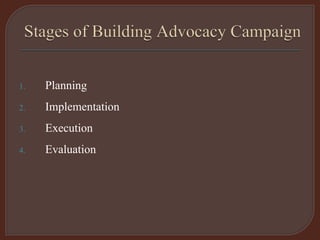
1. Planning
2. Implementation
3. Execution
4. Evaluation
Planning includes:
Message construction
A good message should be simple and clear.
It has clearly defined goal.
It must have the intrinsic value to target audience
State the problem clearly
Propose a solution
Invite the audience to take specific action.
Targeting the population
 Primary targets are those who have the power to effect the changes the
campaign calls for. They need to be influenced in order to reach the
campaign goal.
 If the primary target cannot be reached directly, or if communicating
with the primary target alone is not sufficient to bring about change,
people with influence on the primary target need to be mobilized, i.e.
the secondary target audience.
Strategizing
A campaign strategy should answer the following questions:
Problem, Vision, Change
 What problem are you confronting?
 What is your vision of how the world will be, once the problem is resolved?
 What change/s would bring about this vision?
Stakeholders, Relationships, Targets
 Who is affected, positively or negatively, by the problem?
 How are these people or groups related to the problem and to each other?
 Who are you trying to reach?
 If your campaign is successful, who will be affected?
Strategizing
Answering key questions repeatedly, at each stage of your campaign,
about the problem, solution, stakeholders and targets as well as the
tactics, message and tools you will use, will help develop your
campaign strategy.
Content writing
 Find popular content ideas via social media
 Keyword research tools lack the creativity you need for great content
Talk to your team/clients
Find the content that resonates
 Don’t struggle to make everyone happy. It’s impossible
 Set clear time scales and goals on brainstorming
Selecting the channels
List your different target audiences
 Where, in which types of places
Where does your message have the best chance of catching their
attention?
Which of the communication channels identified you can afford, or gain
external support for.
Selecting the channels
Questions to be asked may include:
 Who, in your organization or alliance, has experience working with
which types of media?
 Is free air-time available from TV or radio stations, including
community radio?
 What community organizations could pass on the message?
 What additional resources can be mobilized, e.g. by enlarging the
alliance, hiring specialists or contracting out parts of the
communication work?
Budget Allocation
Budgetary allocations are integral components to an annual financial
plan, or budget. They indicate the level of resources an organization is
committing to a department or program.
Budget Allocation
Before drawing up the budget, it is necessary to get an overview of the
type of inputs needed to achieve the objectives of the campaign.
Typical categories may be, for example
people (such as researchers, consultants, other partners’ staff-time)
travel costs (such as bus tickets, meal allowance)
vehicles (such as rental, petrol, driver’s time)
equipment (such as machinery, measuring instruments and other tools)
consumables and supplies (such as material, pumps, bricks or
containers)
Subcontracts (services and construction work)
Budget Allocation
A budget format has usually three parts:
(I) Personnel costs are defined as the total remuneration, in cash or in
kind, payable by an employer to an employee in return for work done
by the latter during the reference period.
(II) Non-Personnel costs are the costs you might include in your
proposal budget that are not related to salaries and wages. For
example equipment, travel, supplies, participants cost, utility costs,
communication costs and some types of telephone service.
Budget Allocation
(I) Indirect Costs are Facilities and Administrative Costs that includes
building use, operation and maintenance of facilities, student
services, departmental administration, or administrative support
offices.
Time frame
A specified period of time in which something occurs or is
planned to take place.
Do it 2-3 months before launch.
Capture and articulate qualitative and quantitative performance goals
Produce project plans that meet campaign objectives, identify
dependencies and tasks, and assign ownership.
Ensure team and partners understand what is expected of them
Identify the required resources/partners to the campaign/project.
Time frame
Create the “event horizon”
Estimate the time for each process, plus any other relevant release
dates. This gives us the event horizon and overall campaign window.
Visiting the Location/ Geo-Targeting
 When you are making a campaign to influence a small area you have
to physically visit the location to make further arrangements.
But for Digital Campaign we have to use Geo-Targeting
Geo-targeting refers to the practice of delivering different content to a
electronic media user based on his or her geographic location.
Geo targeting Users Online
 In online environments, ad servers look at a user’s IP address to figure
out their location.
 Behind the scenes, the ad server maintains a large database that
has every IP address already mapped to its country, state, and postal
code.
So, when a request comes in, the ad server strips the IP address from
the header of the request, queries this table, finds the necessary location
data, and then picks an ad that matches that criteria.
Meeting/Interacting with audience
 Campaign team should visit the targeted area if the purpose of the
campaign is to launch only in a small area i.e. village, town , a small
communtiy or any minority group or any ethnic community.
 Meeting with targeted audience and pre-discussion will also be fruitful in a
large extent to formulate the problem and its solution during planning
 Interactions at gross root level will also keep update to the level of
resistance i.e. cultural, educational, religious, ethnic, linguistic and other
prevailing practices in a community.
Practicality
Execution of campaign is required to follow all practical aspects
through a well organized process of monitoring as well as participation.
During execution process campaigner of any idea will realize that how
much his/her idea is applicable in a given context or circumstances.
During the phase of practicality executed plan may face deficiency of
resources, lack of man power, lack of will of the targeted people to
accept the idea to bring required change etc.
In the process of execution practicality of data collection must be in
accordance i.e. in the form of quantitative or qualitative and all applied
scales of data collection should be in coherence with the content of
campaign.
Analysis
Executed campaign should be analyzed on day to day basis.
Collected data must be analyzed by keeping into consideration of all
ethical perspectives of the campaign.
Analyzing team of the campaign may be consist of specialized
consultant and professional experts.
Time frame of campaign, execution plan, timings of delivery of
message may be reorganized on the basis of the analyzed data and
suggestion on daily basis/weekly basis/ or monthly basis depends on
the nature of campaign.
Repetition
Repeat the analysis again and again to see whether desired goals are
achieved by following previous steps.
Modification
If majority of the requirement is fulfilled only few goals are not
achieved the modify the respective content or stage/stages to complete
the remaining goals.
Alteration
Sometimes just modifying does not do the job alteration of content or
idea is necessary to build campaign for desired objectives.
Rejection
Even after alteration desired results are not gained then, rejection is the
only solution. Reject the whole idea. Start thinking a new one and work
on it from the very first step.
What’s our short-term goal that will contribute to our long-term goal?
How will we know when we’ve reached this goal successfully?
How can we target and segment our audiences to reach this goal?
What inspiring message can we send to each audience?
What channels will best communicate this message to each audience?

Campaign

  • 1.
    Campaign Types of Campaign Advocacy Functionsof Advocacy Reasons for using Advocacy Stages of building Advocacy Campaign
  • 2.
    Several related operationsaimed at achieving a particular goal (usually within geographical constraints) A series of actions advancing a principle or tending toward a particular end.
  • 3.
    Advertising campaign An advertisingcampaign is a series of advertisement messages that share a single idea and theme which make up an integrated marketing communication (IMC). Civil society campaign A civil society campaign is one that is intended to mobilize public support and use democratic tools in order to instigate social change.
  • 4.
    Military campaign In themilitary sciences, the term military campaign applies to large scale, long duration, significant military strategy plan incorporating a series of inter-related military operations or battles forming a distinct part of a larger conflict often called a war. Political campaign A political campaign is an organized effort which seeks to influence the decision making process within a specific group. In democracies, political campaigns often refer to electoral campaigns, by which representatives are chosen or referendums are decided
  • 5.
    Advocacy or Advocacygroup Advocacy is the attempt to influence the political climate, policy and program decisions, public perceptions of social norms, funding determinations, and community support and involvement for a specified cause or issue, through a set of well planned and organized actions that are undertaken by a group of committed individuals or organizations working in concert.
  • 6.
    Advocacy or Advocacygroup Advocacy is the attempt to influence the political climate, policy and program decisions, public perceptions of social norms, funding determinations, and community support and involvement for a specified cause or issue, through a set of well planned and organized actions that are undertaken by a group of committed individuals or organizations working in concert.
  • 7.
    There are anumber of communication methods that are used to affect social change within a given society. Social Mobilization Community Mobilization Social Marketing Education Health Promotion Behavioral Change Communication (BCC)
  • 8.
    Four key environmentalfactors affect the individual’s ability to enact the desired changes: Socio-Culture Factors: the behaviors and attitudes considered acceptable in given context. Political Factors: the interplay of political forces such as pressure groups and political parties; the relations between government and civil society including the systems of governance.
  • 9.
    Institutional Factors: Policies,laws and program that determine the roles the government plays and the actions permitted ; activities to encourage implementation of policies or programs and observance of laws. Resource Factors: Human, financial and material resources that affect what is required to make things happen; people’s health, economic and education status; community knowledge, skills and solidarity networks.
  • 10.
    UNFPA supports threetypes of advocacy work: Program Advocacyaims at fostering a notional favorable environment and the implementation of the (International Conference on Population and Development) ICPD goals according to country-specific situation and political circumstances and priority program issues. Universal Issues Advocacy aims at global awareness of a wide range of issues emanating from the ICPD Program of Action and agreements reached in other global conferences.
  • 11.
    Organizational Advocacy hastwo aims: 1. to enhance the UNFPA image and publicizing and promoting its mandate. 2. to mobilize the resources needed by the Fund to support the implementation of the ICPD Program of Action.
  • 12.
    Advocacy targets individualsand groups to enlist their support for the benefit of other members of their community or the wider public, whereas BCC targets individuals and groups to enlist them to change their behavior for their own benefit. Advocacy aims for social transformation through changes in policies, legislation, programs and social norms whereas BCC seeks to change individual attitudes and behavior of clients or users of services, as well as individual belief and norms.
  • 13.
    Once you havemastered the necessary skills of how to plan and implement advocacy interventions, you can work wonders.  In developing countries , development issues and priorities are competing against limited national resources, and decreasing international aid. With that in mind, advocacy efforts become a prerequisite to ensure that programs addressing population, Health issues and gender issues get their fare share of resource allocation.
  • 14.
    Advocacy efforts wouldprovide decision-makers with information on the priority population and health issues challenges and would influence the way they think or act on them. Advocacy strategies involve identifying partners, forming alliances, and building coalitions. Working through such networks of support is more effective.
  • 15.
    1. Planning 2. Implementation 3.Execution 4. Evaluation
  • 16.
    Planning includes: Message construction Agood message should be simple and clear. It has clearly defined goal. It must have the intrinsic value to target audience State the problem clearly Propose a solution Invite the audience to take specific action.
  • 17.
    Targeting the population Primary targets are those who have the power to effect the changes the campaign calls for. They need to be influenced in order to reach the campaign goal.  If the primary target cannot be reached directly, or if communicating with the primary target alone is not sufficient to bring about change, people with influence on the primary target need to be mobilized, i.e. the secondary target audience.
  • 18.
    Strategizing A campaign strategyshould answer the following questions: Problem, Vision, Change  What problem are you confronting?  What is your vision of how the world will be, once the problem is resolved?  What change/s would bring about this vision? Stakeholders, Relationships, Targets  Who is affected, positively or negatively, by the problem?  How are these people or groups related to the problem and to each other?  Who are you trying to reach?  If your campaign is successful, who will be affected?
  • 19.
    Strategizing Answering key questionsrepeatedly, at each stage of your campaign, about the problem, solution, stakeholders and targets as well as the tactics, message and tools you will use, will help develop your campaign strategy.
  • 20.
    Content writing  Findpopular content ideas via social media  Keyword research tools lack the creativity you need for great content Talk to your team/clients Find the content that resonates  Don’t struggle to make everyone happy. It’s impossible  Set clear time scales and goals on brainstorming
  • 21.
    Selecting the channels Listyour different target audiences  Where, in which types of places Where does your message have the best chance of catching their attention? Which of the communication channels identified you can afford, or gain external support for.
  • 22.
    Selecting the channels Questionsto be asked may include:  Who, in your organization or alliance, has experience working with which types of media?  Is free air-time available from TV or radio stations, including community radio?  What community organizations could pass on the message?  What additional resources can be mobilized, e.g. by enlarging the alliance, hiring specialists or contracting out parts of the communication work?
  • 23.
    Budget Allocation Budgetary allocationsare integral components to an annual financial plan, or budget. They indicate the level of resources an organization is committing to a department or program.
  • 24.
    Budget Allocation Before drawingup the budget, it is necessary to get an overview of the type of inputs needed to achieve the objectives of the campaign. Typical categories may be, for example people (such as researchers, consultants, other partners’ staff-time) travel costs (such as bus tickets, meal allowance) vehicles (such as rental, petrol, driver’s time) equipment (such as machinery, measuring instruments and other tools) consumables and supplies (such as material, pumps, bricks or containers) Subcontracts (services and construction work)
  • 25.
    Budget Allocation A budgetformat has usually three parts: (I) Personnel costs are defined as the total remuneration, in cash or in kind, payable by an employer to an employee in return for work done by the latter during the reference period. (II) Non-Personnel costs are the costs you might include in your proposal budget that are not related to salaries and wages. For example equipment, travel, supplies, participants cost, utility costs, communication costs and some types of telephone service.
  • 26.
    Budget Allocation (I) IndirectCosts are Facilities and Administrative Costs that includes building use, operation and maintenance of facilities, student services, departmental administration, or administrative support offices.
  • 27.
    Time frame A specifiedperiod of time in which something occurs or is planned to take place. Do it 2-3 months before launch. Capture and articulate qualitative and quantitative performance goals Produce project plans that meet campaign objectives, identify dependencies and tasks, and assign ownership. Ensure team and partners understand what is expected of them Identify the required resources/partners to the campaign/project.
  • 28.
    Time frame Create the“event horizon” Estimate the time for each process, plus any other relevant release dates. This gives us the event horizon and overall campaign window.
  • 29.
    Visiting the Location/Geo-Targeting  When you are making a campaign to influence a small area you have to physically visit the location to make further arrangements. But for Digital Campaign we have to use Geo-Targeting Geo-targeting refers to the practice of delivering different content to a electronic media user based on his or her geographic location.
  • 30.
    Geo targeting UsersOnline  In online environments, ad servers look at a user’s IP address to figure out their location.  Behind the scenes, the ad server maintains a large database that has every IP address already mapped to its country, state, and postal code. So, when a request comes in, the ad server strips the IP address from the header of the request, queries this table, finds the necessary location data, and then picks an ad that matches that criteria.
  • 31.
    Meeting/Interacting with audience Campaign team should visit the targeted area if the purpose of the campaign is to launch only in a small area i.e. village, town , a small communtiy or any minority group or any ethnic community.  Meeting with targeted audience and pre-discussion will also be fruitful in a large extent to formulate the problem and its solution during planning  Interactions at gross root level will also keep update to the level of resistance i.e. cultural, educational, religious, ethnic, linguistic and other prevailing practices in a community.
  • 32.
    Practicality Execution of campaignis required to follow all practical aspects through a well organized process of monitoring as well as participation. During execution process campaigner of any idea will realize that how much his/her idea is applicable in a given context or circumstances. During the phase of practicality executed plan may face deficiency of resources, lack of man power, lack of will of the targeted people to accept the idea to bring required change etc.
  • 33.
    In the processof execution practicality of data collection must be in accordance i.e. in the form of quantitative or qualitative and all applied scales of data collection should be in coherence with the content of campaign.
  • 34.
    Analysis Executed campaign shouldbe analyzed on day to day basis. Collected data must be analyzed by keeping into consideration of all ethical perspectives of the campaign. Analyzing team of the campaign may be consist of specialized consultant and professional experts. Time frame of campaign, execution plan, timings of delivery of message may be reorganized on the basis of the analyzed data and suggestion on daily basis/weekly basis/ or monthly basis depends on the nature of campaign.
  • 35.
    Repetition Repeat the analysisagain and again to see whether desired goals are achieved by following previous steps. Modification If majority of the requirement is fulfilled only few goals are not achieved the modify the respective content or stage/stages to complete the remaining goals.
  • 36.
    Alteration Sometimes just modifyingdoes not do the job alteration of content or idea is necessary to build campaign for desired objectives. Rejection Even after alteration desired results are not gained then, rejection is the only solution. Reject the whole idea. Start thinking a new one and work on it from the very first step.
  • 37.
    What’s our short-termgoal that will contribute to our long-term goal? How will we know when we’ve reached this goal successfully? How can we target and segment our audiences to reach this goal? What inspiring message can we send to each audience? What channels will best communicate this message to each audience?