camera
• Johann Zahn designed the first camera in 1685. But the first
photograph was clicked by Joseph Nicephore Niepce in the
year 1814.
• What is a camera?
• A device that consists of a lightproof chamber with an
aperture fitted with a lens and a shutter through which the
image of an object is projected onto a surface for recording
(as on film) or for translation into electrical impulses (as for
television broadcast)
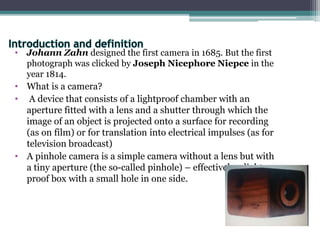
• A pinhole camera is a simple camera without a lens but with
a tiny aperture (the so-called pinhole) – effectively a light-
proof box with a small hole in one side.
• Light from a scene passes through the aperture and projects an
inverted image on the opposite side of the box, which is known as
the camera abscure .
• Advantages of pinhole camera:
• depth of the field camera is unlimited
• Disadvantage:
• Not useful in freezing the action of moving object.
• Components:
• Shutter
• The length of time a camera is open to expose light into the camera sensor
• Shutter speeds are typically measured in fractions of a second like 1/4
means a quarter of a secondsecond
• Sharp effect--fast shutter speed
• Blurr effact--slow shutter
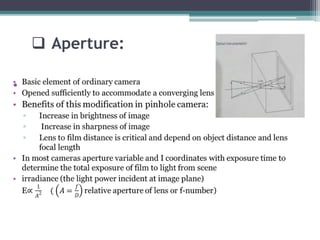
 Aperture:
•
• International Standards Organization(ISO):
▫ Measures the sensitivity of the sensor ISO is the level of sensitivity of your camera to available light.
Higher ISO increases light sensitivity.
• To flash or not to flash
• Depth of field
▫ Area of the image that appears in focus from foreground to background
▫ Affected by relative aperture
▫ 3 factors control depth of field
• Distance from the lens to the object
• f/stop being used
• Focal length of the lens
 ISO and depth of field

Camera

  • 1.
  • 2.
    • Johann Zahndesigned the first camera in 1685. But the first photograph was clicked by Joseph Nicephore Niepce in the year 1814. • What is a camera? • A device that consists of a lightproof chamber with an aperture fitted with a lens and a shutter through which the image of an object is projected onto a surface for recording (as on film) or for translation into electrical impulses (as for television broadcast) • A pinhole camera is a simple camera without a lens but with a tiny aperture (the so-called pinhole) – effectively a light- proof box with a small hole in one side.
  • 3.
    • Light froma scene passes through the aperture and projects an inverted image on the opposite side of the box, which is known as the camera abscure . • Advantages of pinhole camera: • depth of the field camera is unlimited • Disadvantage: • Not useful in freezing the action of moving object. • Components: • Shutter • The length of time a camera is open to expose light into the camera sensor • Shutter speeds are typically measured in fractions of a second like 1/4 means a quarter of a secondsecond • Sharp effect--fast shutter speed • Blurr effact--slow shutter
  • 4.
  • 5.
    • International StandardsOrganization(ISO): ▫ Measures the sensitivity of the sensor ISO is the level of sensitivity of your camera to available light. Higher ISO increases light sensitivity. • To flash or not to flash • Depth of field ▫ Area of the image that appears in focus from foreground to background ▫ Affected by relative aperture ▫ 3 factors control depth of field • Distance from the lens to the object • f/stop being used • Focal length of the lens  ISO and depth of field