 
“Make the world, see through your eyes”
Name – Aveek Gupta
Year – 1st Semester – 1st
Section – C
Roll Number - 04
Introduction
History
How a camera works?
Types of Camera, Lenses and Filters
Photography Techniques
Photo editing
Some of my work

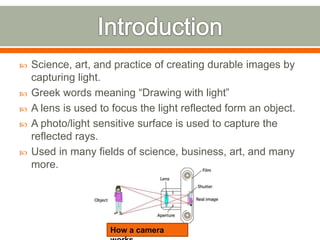
 Science, art, and practice of creating durable images by
capturing light.
 Greek words meaning “Drawing with light”
 A lens is used to focus the light reflected form an object.
 A photo/light sensitive surface is used to capture the
reflected rays.
 Used in many fields of science, business, art, and many
more.
How a camera

Precursor technologies
Invention of photography
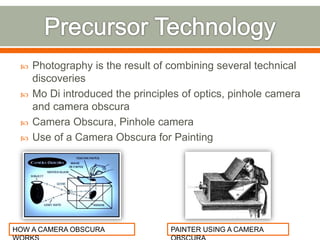
 Photography is the result of combining several technical
discoveries
 Mo Di introduced the principles of optics, pinhole camera
and camera obscura
 Camera Obscura, Pinhole camera
 Use of a Camera Obscura for Painting
HOW A CAMERA OBSCURA PAINTER USING A CAMERA
 British inventor Thomas Wedgwood used SILVER
NITRATE to capture the very first photograph.
 The picture faded with time and was able to not capture
shadows
 French inventor Joseph Nicéphore Niépce was the first
man to make permanent photoetching.
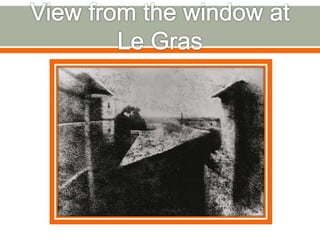
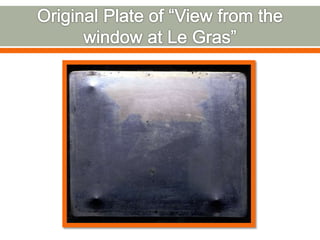
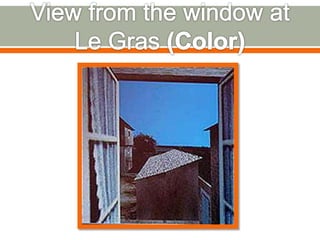
 “View from the window at Le Gras” was the first
permanent photograph by Niépce
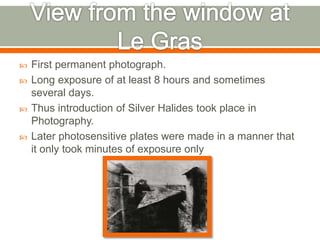
 First permanent photograph.
 Long exposure of at least 8 hours and sometimes
several days.
 Thus introduction of Silver Halides took place in
Photography.
 Later photosensitive plates were made in a manner that
it only took minutes of exposure only

 A digital camera uses an array of millions of tiny light
cavities or "photosites" to record an image.
 Upon clicking the shutter button the photosites open and
collect as much light as possible and upon releasing the
photosites closes.
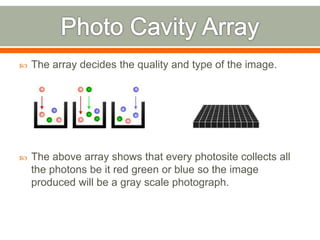
 The array decides the quality and type of the image.
 The above array shows that every photosite collects all
the photons be it red green or blue so the image
produced will be a gray scale photograph.
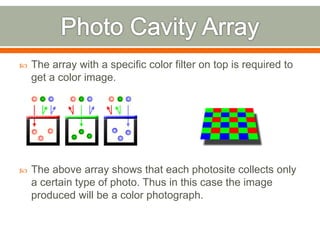
 The array with a specific color filter on top is required to
get a color image.
 The above array shows that each photosite collects only
a certain type of photo. Thus in this case the image
produced will be a color photograph.

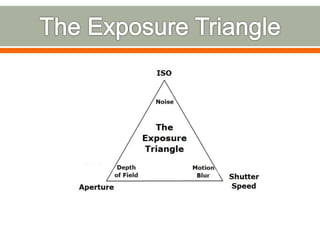
Exposure Triangle
Composition – Rule of Thirds
Image Stacking and Multiple Exposures
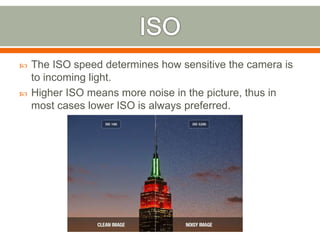
 The ISO speed determines how sensitive the camera is
to incoming light.
 Higher ISO means more noise in the picture, thus in
most cases lower ISO is always preferred.
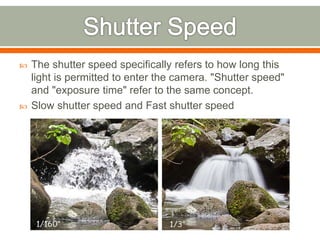
 The shutter speed specifically refers to how long this
light is permitted to enter the camera. "Shutter speed"
and "exposure time" refer to the same concept.
 Slow shutter speed and Fast shutter speed
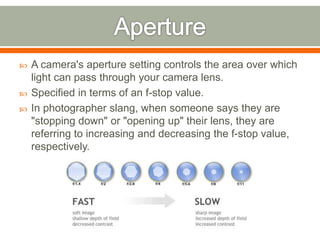
 A camera's aperture setting controls the area over which
light can pass through your camera lens.
 Specified in terms of an f-stop value.
 In photographer slang, when someone says they are
"stopping down" or "opening up" their lens, they are
referring to increasing and decreasing the f-stop value,
respectively.
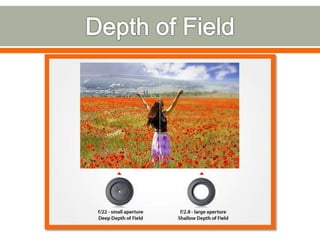
 The range of distance over which objects appear in
sharp focus is known as the DEPTH OF FIELD
 A camera's aperture setting is what determines a photo's
depth of field.
 Lower f-stop values correlate with a shallower depth of
field.
 The rule of thirds is a powerful compositional
technique for making photos more interesting
and dynamic.
 It's also perhaps one of the most well known.
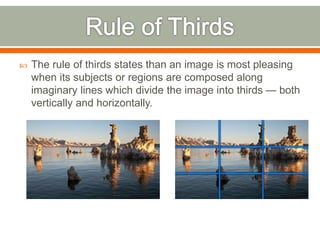
 The rule of thirds states than an image is most pleasing
when its subjects or regions are composed along
imaginary lines which divide the image into thirds — both
vertically and horizontally.
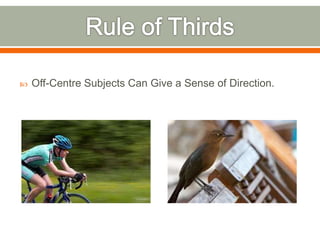
 Off-Centre Subjects Can Give a Sense of Direction.

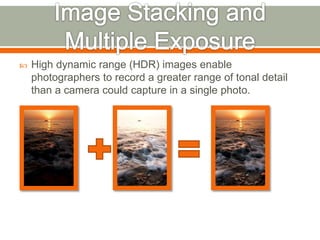
 High dynamic range (HDR) images enable
photographers to record a greater range of tonal detail
than a camera could capture in a single photo.
 Image compression –JPEG
 The RAW file format is digital photography's equivalent
of a negative in film photography.
 It contains untouched, "raw" pixel information straight
from the digital camera's sensor.
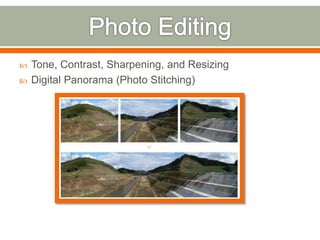
 Tone, Contrast, Sharpening, and Resizing
 Digital Panorama (Photo Stitching)

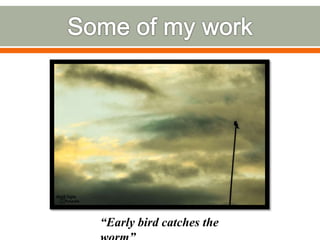
“Early bird catches the
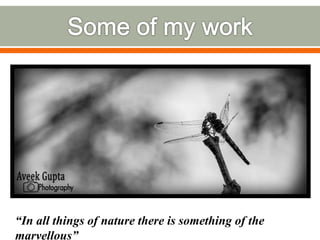
“In all things of nature there is something of the
marvellous”
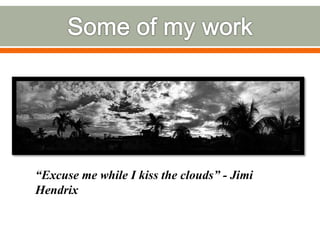
“Excuse me while I kiss the clouds” - Jimi
Hendrix
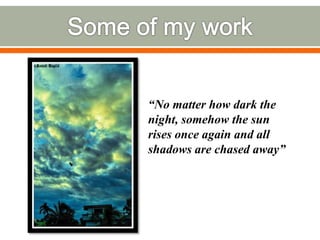
“No matter how dark the
night, somehow the sun
rises once again and all
shadows are chased away”
“Train your mind to see the
good in every situation”
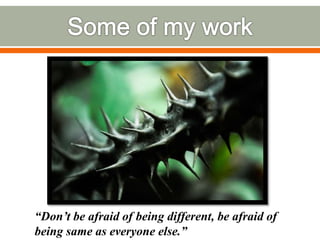
“Don’t be afraid of being different, be afraid of
being same as everyone else.”
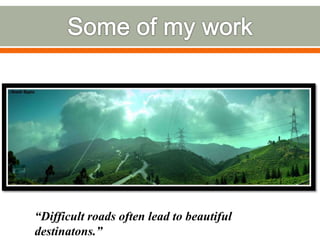
“Difficult roads often lead to beautiful
destinatons.”


Photography

  • 1.
      “Make theworld, see through your eyes” Name – Aveek Gupta Year – 1st Semester – 1st Section – C Roll Number - 04
  • 2.
    Introduction History How a cameraworks? Types of Camera, Lenses and Filters Photography Techniques Photo editing Some of my work
  • 3.
  • 4.
     Science, art,and practice of creating durable images by capturing light.  Greek words meaning “Drawing with light”  A lens is used to focus the light reflected form an object.  A photo/light sensitive surface is used to capture the reflected rays.  Used in many fields of science, business, art, and many more. How a camera

  • 5.
  • 6.
  • 7.
     Photography isthe result of combining several technical discoveries  Mo Di introduced the principles of optics, pinhole camera and camera obscura  Camera Obscura, Pinhole camera  Use of a Camera Obscura for Painting HOW A CAMERA OBSCURA PAINTER USING A CAMERA
  • 8.
     British inventorThomas Wedgwood used SILVER NITRATE to capture the very first photograph.  The picture faded with time and was able to not capture shadows  French inventor Joseph Nicéphore Niépce was the first man to make permanent photoetching.  “View from the window at Le Gras” was the first permanent photograph by Niépce
  • 10.
     First permanentphotograph.  Long exposure of at least 8 hours and sometimes several days.  Thus introduction of Silver Halides took place in Photography.  Later photosensitive plates were made in a manner that it only took minutes of exposure only
  • 13.
  • 14.
     A digitalcamera uses an array of millions of tiny light cavities or "photosites" to record an image.  Upon clicking the shutter button the photosites open and collect as much light as possible and upon releasing the photosites closes.
  • 15.
     The arraydecides the quality and type of the image.  The above array shows that every photosite collects all the photons be it red green or blue so the image produced will be a gray scale photograph.
  • 16.
     The arraywith a specific color filter on top is required to get a color image.  The above array shows that each photosite collects only a certain type of photo. Thus in this case the image produced will be a color photograph.
  • 17.
  • 18.
    Exposure Triangle Composition –Rule of Thirds Image Stacking and Multiple Exposures
  • 20.
     The ISOspeed determines how sensitive the camera is to incoming light.  Higher ISO means more noise in the picture, thus in most cases lower ISO is always preferred.
  • 21.
     The shutterspeed specifically refers to how long this light is permitted to enter the camera. "Shutter speed" and "exposure time" refer to the same concept.  Slow shutter speed and Fast shutter speed
  • 22.
     A camera'saperture setting controls the area over which light can pass through your camera lens.  Specified in terms of an f-stop value.  In photographer slang, when someone says they are "stopping down" or "opening up" their lens, they are referring to increasing and decreasing the f-stop value, respectively.
  • 23.
     The rangeof distance over which objects appear in sharp focus is known as the DEPTH OF FIELD  A camera's aperture setting is what determines a photo's depth of field.  Lower f-stop values correlate with a shallower depth of field.
  • 25.
     The ruleof thirds is a powerful compositional technique for making photos more interesting and dynamic.  It's also perhaps one of the most well known.
  • 26.
     The ruleof thirds states than an image is most pleasing when its subjects or regions are composed along imaginary lines which divide the image into thirds — both vertically and horizontally.
  • 27.
     Off-Centre SubjectsCan Give a Sense of Direction.
  • 28.
  • 29.
     High dynamicrange (HDR) images enable photographers to record a greater range of tonal detail than a camera could capture in a single photo.
  • 30.
     Image compression–JPEG  The RAW file format is digital photography's equivalent of a negative in film photography.  It contains untouched, "raw" pixel information straight from the digital camera's sensor.
  • 31.
     Tone, Contrast,Sharpening, and Resizing  Digital Panorama (Photo Stitching)
  • 32.
  • 33.
  • 34.
    “In all thingsof nature there is something of the marvellous”
  • 35.
    “Excuse me whileI kiss the clouds” - Jimi Hendrix
  • 36.
    “No matter howdark the night, somehow the sun rises once again and all shadows are chased away”
  • 37.
    “Train your mindto see the good in every situation”
  • 38.
    “Don’t be afraidof being different, be afraid of being same as everyone else.”
  • 39.
    “Difficult roads oftenlead to beautiful destinatons.”
  • 40.