RahatTufail
Roll# SSO12-13
University of the punjab
What is a camera
A device that consists of a lightproof
chamber with an aperture fitted with a lens
and a shutter through which the image of an
object is projected onto a surface for
recording (as on film) or for translation into
electrical impulses (as for television
broadcast)
Components of a camera
All cameras have included five crucial
components:
(1)The camera box
(2) Film
(3) The light control
(4) The lens
(5) The viewing system
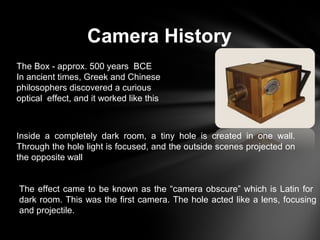
Camera History
The Box - approx. 500 years BCE
In ancient times, Greek and Chinese
philosophers discovered a curious
optical effect, and it worked like this
Inside a completely dark room, a tiny hole is created in one wall.
Through the hole light is focused, and the outside scenes projected on
the opposite wall
The effect came to be known as the “camera obscure” which is Latin for
dark room. This was the first camera. The hole acted like a lens, focusing
and projectile.
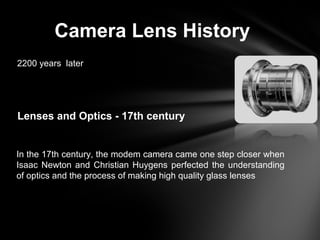
Camera Lens History
2200 years later
Lenses and Optics - 17th century
In the 17th century, the modem camera came one step closer when
Isaac Newton and Christian Huygens perfected the understanding
of optics and the process of making high quality glass lenses
Camera Film History
200 years later
Film - 19th century
Soon there were small. portable camera obscures. but an important
piece was missing. . ....FILM
Then in 1827 Joseph Nicéphore Niépce added the final touch. He
added ‘film‘ to create the first successful photograph, and the modern
camera was born: A glass lens, a dark box, and film.
Modern film and digital cameras
New digital cameras are very easy to use
just point and shoot. The camera's built-in
computer handles focus and exposure.
It's comforting to know that even the latest digital cameras work
the same way as their ancestors.
Digital Film
So what has changed ????
The most recent revolution in photography
is the invention of digital film.
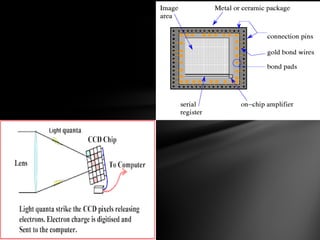
Replacing old-fashioned plastic film, digital cameras
capture the images with an electronic sensor called a
CCD. Photographs are stored on reusable computer
memory cards
The result is that modern photography is cheaper (and more
environmentally friendly) than it has ever been before.
Camera Working
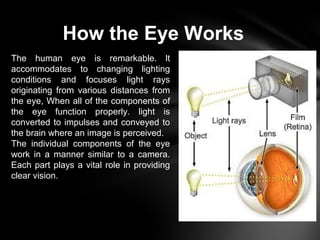
How the Eye Works
The human eye is remarkable. lt
accommodates to changing lighting
conditions and focuses light rays
originating from various distances from
the eye, When all of the components of
the eye function properly. light is
converted to impulses and conveyed to
the brain where an image is perceived.
The individual components of the eye
work in a manner similar to a camera.
Each part plays a vital role in providing
clear vision.
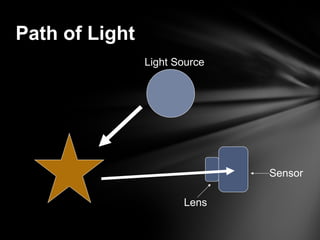
Path of Light
Light Source
Lens
Sensor
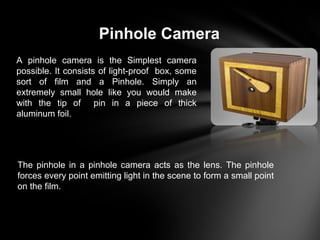
Pinhole Camera
A pinhole camera is the Simplest camera
possible. It consists of light-proof box, some
sort of film and a Pinhole. Simply an
extremely small hole like you would make
with the tip of pin in a piece of thick
aluminum foil.
The pinhole in a pinhole camera acts as the lens. The pinhole
forces every point emitting light in the scene to form a small point
on the film.
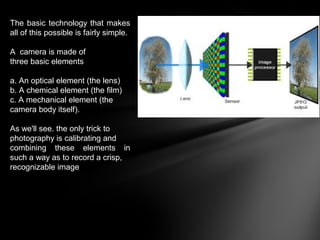
The basic technology that makes
all of this possible is fairly simple.
A camera is made of
three basic elements
a. An optical element (the lens)
b. A chemical element (the film)
c. A mechanical element (the
camera body itself).
As we'll see. the only trick to
photography is calibrating and
combining these elements in
such a way as to record a crisp,
recognizable image
Types of cameras
 BOX camera
 PANORAMIC camera
 Strip camera
 SPY camera
 TWIN lens camera
 SINGLE lens camera
 DIGITAL SLR camera
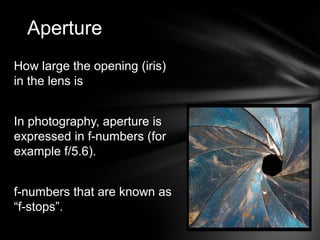
How large the opening (iris)
in the lens is
In photography, aperture is
expressed in f-numbers (for
example f/5.6).
f-numbers that are known as
“f-stops”.
Aperture
Area of the image that appears in focus from
foreground to background
Affected by aperture
Depth of Field
The length of time a camera shutter is open to expose
light into the camera sensor
Shutter speeds are typically measured in fractions of a
second
1/4 means a quarter of a second, while 1/250 means
one two-hundred-and-fiftieth
Shutter Speed
1/1600 sec
Collects light data
The Digital Sensor
International Standards Organization
Measures the sensitivity of the sensor
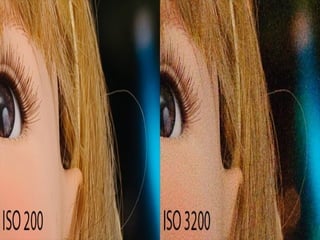
ISO is the level of sensitivity of your camera to
available light.
Higher ISO increases light sensitivity, but also
increases noise
ISO
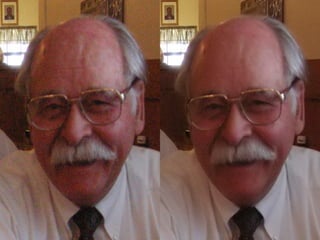
Created by electronic errors
Often described as the camera filling in the
blanks
Noise
JPEG-widely popular
TIFF-no compression
RAW-raw data
File Formats
To flash or not to flash
Flash
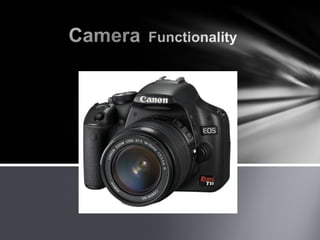
camera,types,working and functionality

camera,types,working and functionality

  • 1.
  • 2.
    What is acamera A device that consists of a lightproof chamber with an aperture fitted with a lens and a shutter through which the image of an object is projected onto a surface for recording (as on film) or for translation into electrical impulses (as for television broadcast)
  • 3.
    Components of acamera All cameras have included five crucial components: (1)The camera box (2) Film (3) The light control (4) The lens (5) The viewing system
  • 4.
    Camera History The Box- approx. 500 years BCE In ancient times, Greek and Chinese philosophers discovered a curious optical effect, and it worked like this Inside a completely dark room, a tiny hole is created in one wall. Through the hole light is focused, and the outside scenes projected on the opposite wall The effect came to be known as the “camera obscure” which is Latin for dark room. This was the first camera. The hole acted like a lens, focusing and projectile.
  • 5.
    Camera Lens History 2200years later Lenses and Optics - 17th century In the 17th century, the modem camera came one step closer when Isaac Newton and Christian Huygens perfected the understanding of optics and the process of making high quality glass lenses
  • 6.
    Camera Film History 200years later Film - 19th century Soon there were small. portable camera obscures. but an important piece was missing. . ....FILM Then in 1827 Joseph Nicéphore Niépce added the final touch. He added ‘film‘ to create the first successful photograph, and the modern camera was born: A glass lens, a dark box, and film.
  • 7.
    Modern film anddigital cameras New digital cameras are very easy to use just point and shoot. The camera's built-in computer handles focus and exposure. It's comforting to know that even the latest digital cameras work the same way as their ancestors.
  • 8.
    Digital Film So whathas changed ???? The most recent revolution in photography is the invention of digital film. Replacing old-fashioned plastic film, digital cameras capture the images with an electronic sensor called a CCD. Photographs are stored on reusable computer memory cards The result is that modern photography is cheaper (and more environmentally friendly) than it has ever been before.
  • 10.
  • 11.
    How the EyeWorks The human eye is remarkable. lt accommodates to changing lighting conditions and focuses light rays originating from various distances from the eye, When all of the components of the eye function properly. light is converted to impulses and conveyed to the brain where an image is perceived. The individual components of the eye work in a manner similar to a camera. Each part plays a vital role in providing clear vision.
  • 12.
    Path of Light LightSource Lens Sensor
  • 13.
    Pinhole Camera A pinholecamera is the Simplest camera possible. It consists of light-proof box, some sort of film and a Pinhole. Simply an extremely small hole like you would make with the tip of pin in a piece of thick aluminum foil. The pinhole in a pinhole camera acts as the lens. The pinhole forces every point emitting light in the scene to form a small point on the film.
  • 14.
    The basic technologythat makes all of this possible is fairly simple. A camera is made of three basic elements a. An optical element (the lens) b. A chemical element (the film) c. A mechanical element (the camera body itself). As we'll see. the only trick to photography is calibrating and combining these elements in such a way as to record a crisp, recognizable image
  • 15.
    Types of cameras BOX camera  PANORAMIC camera  Strip camera  SPY camera  TWIN lens camera  SINGLE lens camera  DIGITAL SLR camera
  • 17.
    How large theopening (iris) in the lens is In photography, aperture is expressed in f-numbers (for example f/5.6). f-numbers that are known as “f-stops”. Aperture
  • 18.
    Area of theimage that appears in focus from foreground to background Affected by aperture Depth of Field
  • 20.
    The length oftime a camera shutter is open to expose light into the camera sensor Shutter speeds are typically measured in fractions of a second 1/4 means a quarter of a second, while 1/250 means one two-hundred-and-fiftieth Shutter Speed
  • 21.
  • 22.
  • 23.
    International Standards Organization Measuresthe sensitivity of the sensor ISO is the level of sensitivity of your camera to available light. Higher ISO increases light sensitivity, but also increases noise ISO
  • 25.
    Created by electronicerrors Often described as the camera filling in the blanks Noise
  • 27.
  • 28.
    To flash ornot to flash Flash

Editor's Notes

  • #2 I’m rahat tufail and going to present Camera its types functionnality and working ,,,,, before I’m going to present my topic I’m going to tell you about outline of my presentation first I’m discuss what is a camera ,camera history,camera film history and digital camera and its film .secondly its types and then its working hain functionality . Ther are difrnt types of cameras and every camera has a variety of functions but some basic and common function which have every camera so im discuss only these basic functions . Lets began with
  • #5 In a dark room a tiny hole is created in one wall. Through the hole light is focused, and the outside scenes projected on the opposite wall This effect known as camera abscure which is latin for dark room this hole acted like lenz
  • #6 In the 17th century isaac newton and chris huygens made the quality glass lenses.
  • #7 In 19th century camera abscures were made but their product storage was missing then in 1827 joseph nicephore added the final touch he adder a film to create the first successful photograph so the modern cameras was born consisted upon a glass lenz a dark box and a film
  • #9 So what has changed the most important changed is replacing the old plastic film ..now digital cameras capture the images with an electronic senser called CCD. A Charge Coupled Device (CCD) is a highly sensitive photon detector. The CCD is divided up into a large number of light-sensitive small areas (known as pixels) When an image is 'captured' the electrical charge from each pixel is measured and converted to a number (digitised) by the electronic circuits within the camera. These numbers are transmitted to a computer (immediately or at some later time) where they are used to control the brightness of points on the computer screen (screen pixels), thus reproducing the original image projected onto the CCD
  • #16 Panoramic camera provide 360 field of view Strip cameras used to blur motion in background
  • #18 Aperture is a hole in lens or opening in the lens which allow to how much light entered into the camera body .. f-numbers that are known as “f-stops”… A smaller f-stop means a larger aperture, while a larger f-stop means a smaller aperture. 
  • #19 he size of the aperture has a direct impact on the depth of field, which is the area of the image that appears sharp. A large f-number such as f/32, (which means a smaller aperture) will bring all foreground and background objects in focus, while a small f-number such as f/1.4 will isolate the foreground from the background by making the foreground objects sharp and the background blurry
  • #21 If the shutter speed is fast, it can help to freeze action completely, as seen in the above photo of the dolphin. If the shutter speed is slow, it can create an effect called “motion blur”, where moving objects appear blurred along the direction of the motion.  high shutter speeds freeze action, while low shutter speeds create an effect of motion.
  • #24 The lower the ISO number, the less sensitive it is to the light, while a higher ISO number increases the sensitivity of your camera. The component within your camera that can change sensitivity is called “image sensor” or simply “sensor”. It is the most important (and most expensive) part of a camera and it is responsible for gathering light and transforming it into an image
  • #25 very camera has something called “Base ISO“, which is typically the lowest ISO number of the sensor that can produce the highest image quality, without adding noise to the picture.