Color as language

Color theory + Design + Language = New forms of communication
http://coloraslanguage.blogspot.com/

1. Weekly Posts: Homework

2. Class documents: syllabus, readings

3. Weekly Photos
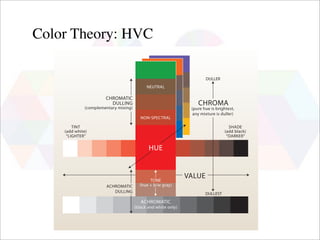
Color Theory: HVC

                                                                        DULLER
                                             NEUTRAL

                       CHROMATIC
                         DULLING                                    CHROMA
              (complementary mixing)                             (pure hue is brightest,
                                                                  any mixture is duller)
                                          NON SPECTRAL

        TINT                                                                        SHADE
    (add white)                                                                   (add black)
     “LIGHTER”                                                                     “DARKER”

                                              HUE


                                              TONE
                                                                VALUE
                       ACHROMATIC        (hue + b/w gray)
                          DULLING                                       DULLEST
                                          ACHROMATIC
                                       (black and white only)
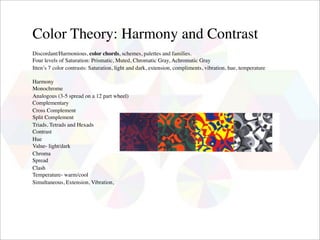
Color Theory: Harmony and Contrast
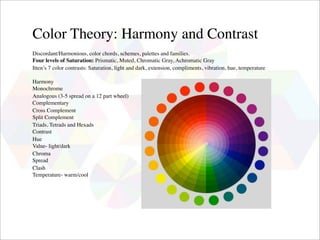
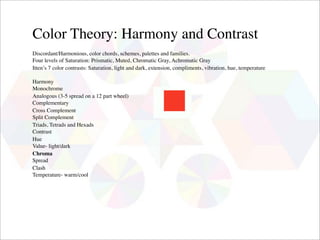
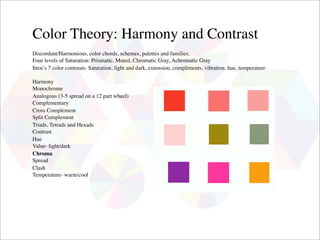
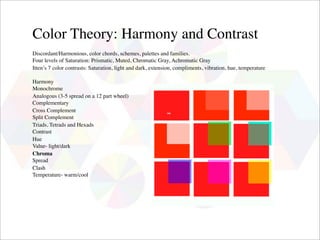
Discordant/Harmonious, color chords, schemes, palettes and families.
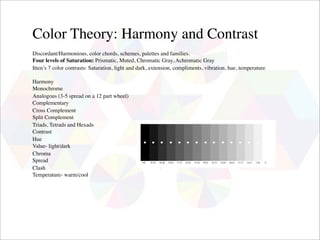
Four levels of Saturation: Prismatic, Muted, Chromatic Gray, Achromatic Gray
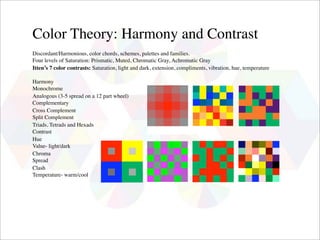
Itten’s 7 color contrasts: Saturation, light and dark, extension, compliments, vibration, hue, temperature

Harmony
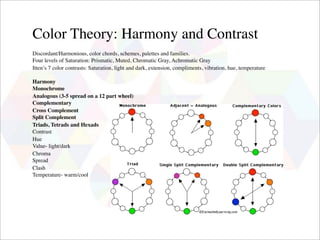
Monochrome
Analogous (3-5 spread on a 12 part wheel)
Complementary
Cross Complement
Split Complement
Triads, Tetrads and Hexads
Contrast
Hue
Value- light/dark
Chroma
Spread
Clash
Temperature- warm/cool
Simultaneous, Extension, Vibration,
Color Theory: Harmony and Contrast
Discordant/Harmonious, color chords, schemes, palettes and families.
Four levels of Saturation: Prismatic, Muted, Chromatic Gray, Achromatic Gray
Itten’s 7 color contrasts: Saturation, light and dark, extension, compliments, vibration, hue, temperature

Harmony
Monochrome
Analogous (3-5 spread on a 12 part wheel)
Complementary
Cross Complement
Split Complement
Triads, Tetrads and Hexads
Contrast
Hue
Value- light/dark
Chroma
Spread
Clash
Temperature- warm/cool
Color Theory: Harmony and Contrast
Discordant/Harmonious, color chords, schemes, palettes and families.
Four levels of Saturation: Prismatic, Muted, Chromatic Gray, Achromatic Gray
Itten’s 7 color contrasts: Saturation, light and dark, extension, compliments, vibration, hue, temperature

Harmony
Monochrome
Analogous (3-5 spread on a 12 part wheel)
Complementary
Cross Complement
Split Complement
Triads, Tetrads and Hexads
Contrast
Hue
Value- light/dark
Chroma
Spread
Clash
Temperature- warm/cool
Color Theory: Harmony and Contrast
Discordant/Harmonious, color chords, schemes, palettes and families.
Four levels of Saturation: Prismatic, Muted, Chromatic Gray, Achromatic Gray
Itten’s 7 color contrasts: Saturation, light and dark, extension, compliments, vibration, hue, temperature

Harmony
Monochrome
Analogous (3-5 spread on a 12 part wheel)
Complementary
Cross Complement
Split Complement
Triads, Tetrads and Hexads
Contrast
Hue
Value- light/dark
Chroma
Spread
Clash
Temperature- warm/cool
Color Theory: Harmony and Contrast
Discordant/Harmonious, color chords, schemes, palettes and families.
Four levels of Saturation: Prismatic, Muted, Chromatic Gray, Achromatic Gray
Itten’s 7 color contrasts: Saturation, light and dark, extension, compliments, vibration, hue, temperature

Harmony
Monochrome
Analogous (3-5 spread on a 12 part wheel)
Complementary
Cross Complement
Split Complement
Triads, Tetrads and Hexads
Contrast
Hue
Value- light/dark
Chroma
Spread
Clash
Temperature- warm/cool
Color Theory: Harmony and Contrast
Discordant/Harmonious, color chords, schemes, palettes and families.
Four levels of Saturation: Prismatic, Muted, Chromatic Gray, Achromatic Gray
Itten’s 7 color contrasts: Saturation, light and dark, extension, compliments, vibration, hue, temperature

Harmony
Monochrome
Analogous (3-5 spread on a 12 part wheel)
Complementary
Cross Complement
Split Complement
Triads, Tetrads and Hexads
Contrast
Hue
Value- light/dark
Chroma
Spread
Clash
Temperature- warm/cool
Color Theory: Harmony and Contrast
Discordant/Harmonious, color chords, schemes, palettes and families.
Four levels of Saturation: Prismatic, Muted, Chromatic Gray, Achromatic Gray
Itten’s 7 color contrasts: Saturation, light and dark, extension, compliments, vibration, hue, temperature

Harmony
Monochrome
Analogous (3-5 spread on a 12 part wheel)
Complementary
Cross Complement
Split Complement
Triads, Tetrads and Hexads
Contrast
Hue
Value- light/dark
Chroma
Spread
Clash
Temperature- warm/cool
Color Theory: Harmony and Contrast
Discordant/Harmonious, color chords, schemes, palettes and families.
Four levels of Saturation: Prismatic, Muted, Chromatic Gray, Achromatic Gray
Itten’s 7 color contrasts: Saturation, light and dark, extension, compliments, vibration, hue, temperature

Harmony
Monochrome
Analogous (3-5 spread on a 12 part wheel)
Complementary
Cross Complement
Split Complement
Triads, Tetrads and Hexads
Contrast
Hue
Value- light/dark
Chroma
Spread
Clash
Temperature- warm/cool
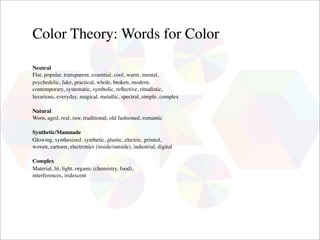
Color Theory: Words for Color

Neutral
Flat, popular, transparent, essential, cool, warm, mental,
psychedelic, fake, practical, whole, broken, modern,
contemporary, systematic, symbolic, reflective, ritualistic,
luxurious, everyday, magical, metallic, spectral, simple, complex

Natural
Worn, aged, real, raw, traditional, old fashioned, romantic

Synthetic/Manmade
Glowing, synthesized, synthetic, plastic, electric, printed,
woven, cartoon, electronics (inside/outside), industrial, digital

Complex
Material, lit, light, organic (chemistry, food),
interferences, iridescent
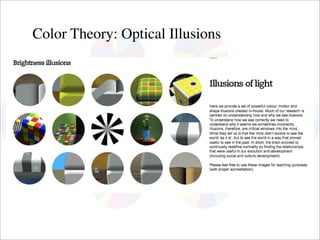
Color Theory: Optical Illusions
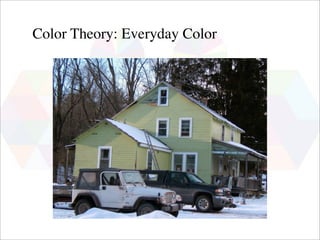
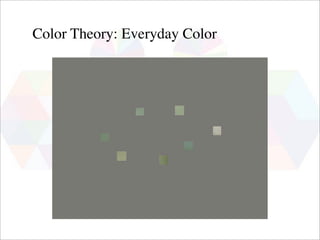
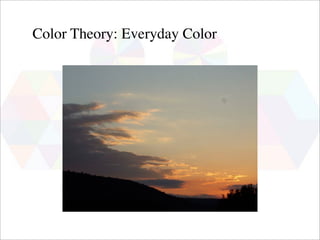
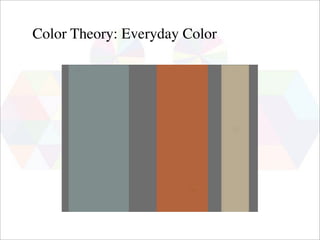
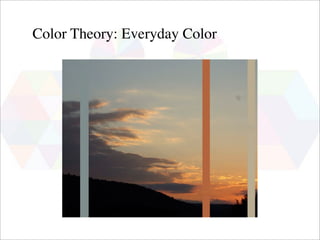
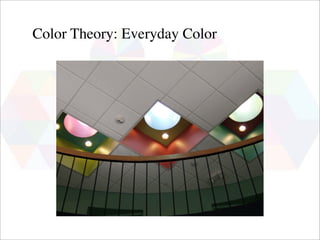
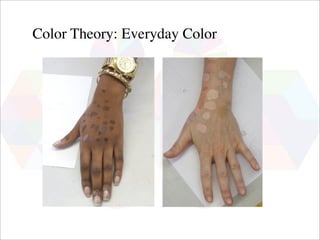
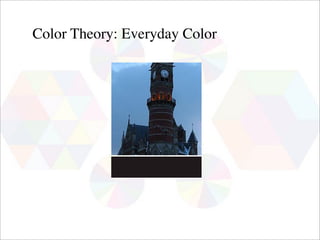
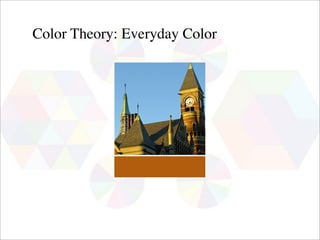
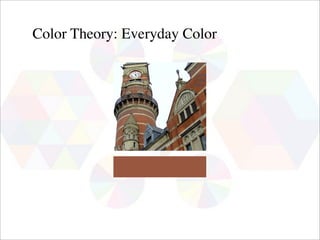
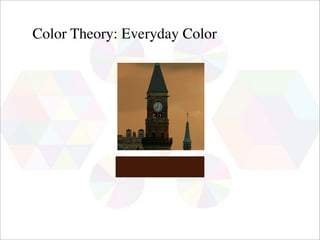
Color Theory: Everyday Color
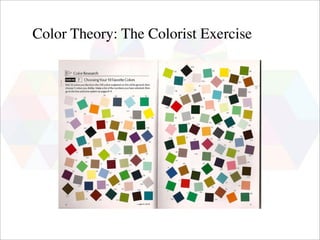
Color Theory: The Colorist Exercise
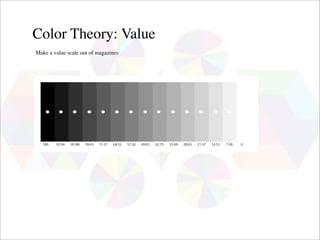
Color Theory: Value
Make a value scale out of magazines
Design:
1. Point
2. Form
3. Space
4. Size
5. Plane
6. Proportion
7. Balance
8. Rhythm
9. Emphasis
10. Unity
11. Texture
12. Shape
13. Line
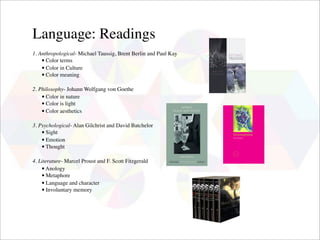
Language: Readings
1. Anthropological- Michael Taussig, Brent Berlin and Paul Kay
    • Color terms
    • Color in Culture
    • Color meaning
2. Philosophy- Johann Wolfgang von Goethe
    • Color in nature
    • Color is light
    • Color aesthetics
3. Psychological- Alan Gilchrist and David Batchelor
    • Sight
    • Emotion
    • Thought
4. Literature- Marcel Proust and F. Scott Fitzgerald
    • Anology
    • Metaphore
    • Language and character
    • Involuntary memory
Quotes
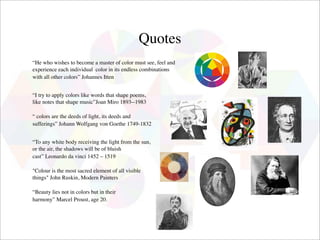
“He who wishes to become a master of color must see, feel and
experience each individual  color in its endless combinations
with all other colors” Johannes Itten
 

“I try to apply colors like words that shape poems,
like notes that shape music”Joan Miro 1893­-1983
 
“ colors are the deeds of light, its deeds and
sufferings” Johann Wolfgang von Goethe 1749-1832
 

“To any white body receiving the light from the sun,
or the air, the shadows will be of bluish
cast” Leonardo da vinci 1452 – 1519

"Colour is the most sacred element of all visible
things" John Ruskin, Modern Painters

“Beauty lies not in colors but in their
harmony” Marcel Proust, age 20.
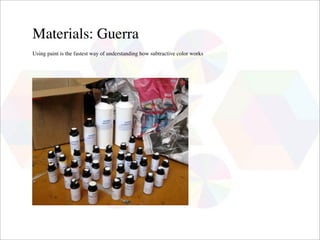
Materials: Guerra
Using paint is the fastest way of understanding how subtractive color works
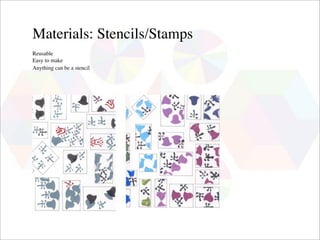
Materials: Stencils/Stamps
Reusable
Easy to make
Anything can be a stencil
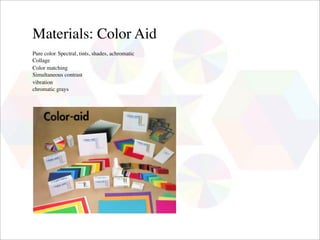
Materials: Color Aid
Pure color: Spectral, tints, shades, achromatic
Collage
Color matching
Simultaneous contrast
vibration
chromatic grays
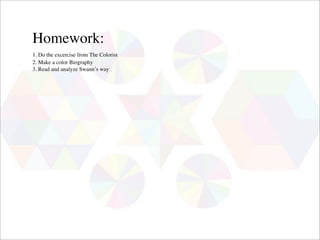
Homework:
1. Do the excercise from The Colorist
2. Make a color Biography
3. Read and analyze Swann’s way

C.A.L_Week1

  • 1.
    Color as language Colortheory + Design + Language = New forms of communication
  • 2.
    http://coloraslanguage.blogspot.com/ 1. Weekly Posts:Homework 2. Class documents: syllabus, readings 3. Weekly Photos
  • 3.
    Color Theory: HVC DULLER NEUTRAL CHROMATIC DULLING CHROMA (complementary mixing) (pure hue is brightest, any mixture is duller) NON SPECTRAL TINT SHADE (add white) (add black) “LIGHTER” “DARKER” HUE TONE VALUE ACHROMATIC (hue + b/w gray) DULLING DULLEST ACHROMATIC (black and white only)
  • 4.
    Color Theory: Harmonyand Contrast Discordant/Harmonious, color chords, schemes, palettes and families. Four levels of Saturation: Prismatic, Muted, Chromatic Gray, Achromatic Gray Itten’s 7 color contrasts: Saturation, light and dark, extension, compliments, vibration, hue, temperature Harmony Monochrome Analogous (3-5 spread on a 12 part wheel) Complementary Cross Complement Split Complement Triads, Tetrads and Hexads Contrast Hue Value- light/dark Chroma Spread Clash Temperature- warm/cool Simultaneous, Extension, Vibration,
  • 5.
    Color Theory: Harmonyand Contrast Discordant/Harmonious, color chords, schemes, palettes and families. Four levels of Saturation: Prismatic, Muted, Chromatic Gray, Achromatic Gray Itten’s 7 color contrasts: Saturation, light and dark, extension, compliments, vibration, hue, temperature Harmony Monochrome Analogous (3-5 spread on a 12 part wheel) Complementary Cross Complement Split Complement Triads, Tetrads and Hexads Contrast Hue Value- light/dark Chroma Spread Clash Temperature- warm/cool
  • 6.
    Color Theory: Harmonyand Contrast Discordant/Harmonious, color chords, schemes, palettes and families. Four levels of Saturation: Prismatic, Muted, Chromatic Gray, Achromatic Gray Itten’s 7 color contrasts: Saturation, light and dark, extension, compliments, vibration, hue, temperature Harmony Monochrome Analogous (3-5 spread on a 12 part wheel) Complementary Cross Complement Split Complement Triads, Tetrads and Hexads Contrast Hue Value- light/dark Chroma Spread Clash Temperature- warm/cool
  • 7.
    Color Theory: Harmonyand Contrast Discordant/Harmonious, color chords, schemes, palettes and families. Four levels of Saturation: Prismatic, Muted, Chromatic Gray, Achromatic Gray Itten’s 7 color contrasts: Saturation, light and dark, extension, compliments, vibration, hue, temperature Harmony Monochrome Analogous (3-5 spread on a 12 part wheel) Complementary Cross Complement Split Complement Triads, Tetrads and Hexads Contrast Hue Value- light/dark Chroma Spread Clash Temperature- warm/cool
  • 8.
    Color Theory: Harmonyand Contrast Discordant/Harmonious, color chords, schemes, palettes and families. Four levels of Saturation: Prismatic, Muted, Chromatic Gray, Achromatic Gray Itten’s 7 color contrasts: Saturation, light and dark, extension, compliments, vibration, hue, temperature Harmony Monochrome Analogous (3-5 spread on a 12 part wheel) Complementary Cross Complement Split Complement Triads, Tetrads and Hexads Contrast Hue Value- light/dark Chroma Spread Clash Temperature- warm/cool
  • 9.
    Color Theory: Harmonyand Contrast Discordant/Harmonious, color chords, schemes, palettes and families. Four levels of Saturation: Prismatic, Muted, Chromatic Gray, Achromatic Gray Itten’s 7 color contrasts: Saturation, light and dark, extension, compliments, vibration, hue, temperature Harmony Monochrome Analogous (3-5 spread on a 12 part wheel) Complementary Cross Complement Split Complement Triads, Tetrads and Hexads Contrast Hue Value- light/dark Chroma Spread Clash Temperature- warm/cool
  • 10.
    Color Theory: Harmonyand Contrast Discordant/Harmonious, color chords, schemes, palettes and families. Four levels of Saturation: Prismatic, Muted, Chromatic Gray, Achromatic Gray Itten’s 7 color contrasts: Saturation, light and dark, extension, compliments, vibration, hue, temperature Harmony Monochrome Analogous (3-5 spread on a 12 part wheel) Complementary Cross Complement Split Complement Triads, Tetrads and Hexads Contrast Hue Value- light/dark Chroma Spread Clash Temperature- warm/cool
  • 11.
    Color Theory: Harmonyand Contrast Discordant/Harmonious, color chords, schemes, palettes and families. Four levels of Saturation: Prismatic, Muted, Chromatic Gray, Achromatic Gray Itten’s 7 color contrasts: Saturation, light and dark, extension, compliments, vibration, hue, temperature Harmony Monochrome Analogous (3-5 spread on a 12 part wheel) Complementary Cross Complement Split Complement Triads, Tetrads and Hexads Contrast Hue Value- light/dark Chroma Spread Clash Temperature- warm/cool
  • 12.
    Color Theory: Wordsfor Color Neutral Flat, popular, transparent, essential, cool, warm, mental, psychedelic, fake, practical, whole, broken, modern, contemporary, systematic, symbolic, reflective, ritualistic, luxurious, everyday, magical, metallic, spectral, simple, complex Natural Worn, aged, real, raw, traditional, old fashioned, romantic Synthetic/Manmade Glowing, synthesized, synthetic, plastic, electric, printed, woven, cartoon, electronics (inside/outside), industrial, digital Complex Material, lit, light, organic (chemistry, food), interferences, iridescent
  • 13.
  • 14.
  • 15.
  • 16.
  • 17.
  • 18.
  • 19.
  • 20.
  • 21.
  • 22.
  • 23.
  • 24.
  • 25.
    Color Theory: TheColorist Exercise
  • 26.
    Color Theory: Value Makea value scale out of magazines
  • 27.
    Design: 1. Point 2. Form 3.Space 4. Size 5. Plane 6. Proportion 7. Balance 8. Rhythm 9. Emphasis 10. Unity 11. Texture 12. Shape 13. Line
  • 28.
    Language: Readings 1. Anthropological-Michael Taussig, Brent Berlin and Paul Kay • Color terms • Color in Culture • Color meaning 2. Philosophy- Johann Wolfgang von Goethe • Color in nature • Color is light • Color aesthetics 3. Psychological- Alan Gilchrist and David Batchelor • Sight • Emotion • Thought 4. Literature- Marcel Proust and F. Scott Fitzgerald • Anology • Metaphore • Language and character • Involuntary memory
  • 29.
    Quotes “He who wishesto become a master of color must see, feel and experience each individual  color in its endless combinations with all other colors” Johannes Itten   “I try to apply colors like words that shape poems, like notes that shape music”Joan Miro 1893­-1983   “ colors are the deeds of light, its deeds and sufferings” Johann Wolfgang von Goethe 1749-1832   “To any white body receiving the light from the sun, or the air, the shadows will be of bluish cast” Leonardo da vinci 1452 – 1519 "Colour is the most sacred element of all visible things" John Ruskin, Modern Painters “Beauty lies not in colors but in their harmony” Marcel Proust, age 20.
  • 30.
    Materials: Guerra Using paintis the fastest way of understanding how subtractive color works
  • 31.
    Materials: Stencils/Stamps Reusable Easy tomake Anything can be a stencil
  • 32.
    Materials: Color Aid Purecolor: Spectral, tints, shades, achromatic Collage Color matching Simultaneous contrast vibration chromatic grays
  • 33.
    Homework: 1. Do theexcercise from The Colorist 2. Make a color Biography 3. Read and analyze Swann’s way