Eat More, Weigh Less,
and Live Healthy
PURIFYING OUR EATING HABITS
S.M.A.R.T. Plans
How did we do?
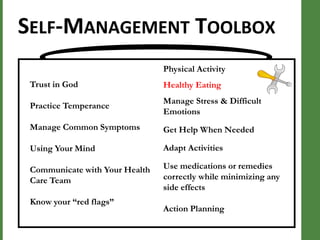
SELF-MANAGEMENT TOOLBOX
Physical Activity

Trust in God

Healthy Eating

Practice Temperance

Manage Stress & Difficult
Emotions

Manage Common Symptoms

Get Help When Needed

Using Your Mind

Adapt Activities

Communicate with Your Health
Care Team

Use medications or remedies
correctly while minimizing any
side effects

Know your “red flags”

Action Planning
COMM

ON

NUTRITI

ON

EDUCAT

ION

MESSA

GES

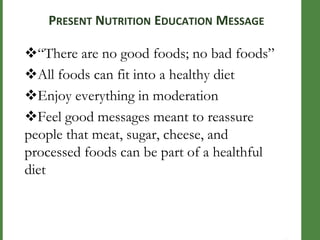
PRESENT NUTRITION EDUCATION MESSAGE

―There are no good foods; no bad foods‖
All foods can fit into a healthy diet
Enjoy everything in moderation
Feel good messages meant to reassure
people that meat, sugar, cheese, and
processed foods can be part of a healthful
diet
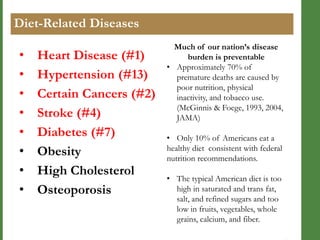
Diet-Related Diseases
•
•
•
•
•
•
•
•

Heart Disease (#1)
Hypertension (#13)
Certain Cancers (#2)
Stroke (#4)
Diabetes (#7)
Obesity
High Cholesterol
Osteoporosis

Much of our nation’s disease
burden is preventable
• Approximately 70% of
premature deaths are caused by
poor nutrition, physical
inactivity, and tobacco use.
(McGinnis & Foege, 1993, 2004,
JAMA)

• Only 10% of Americans eat a
healthy diet consistent with federal
nutrition recommendations.
• The typical American diet is too
high in saturated and trans fat,
salt, and refined sugars and too
low in fruits, vegetables, whole
grains, calcium, and fiber.
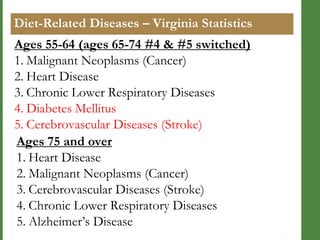
Diet-Related Diseases – Virginia Statistics
Ages 55-64 (ages 65-74 #4 & #5 switched)
1. Malignant Neoplasms (Cancer)
2. Heart Disease
3. Chronic Lower Respiratory Diseases
4. Diabetes Mellitus
5. Cerebrovascular Diseases (Stroke)
Ages 75 and over
1. Heart Disease
2. Malignant Neoplasms (Cancer)
3. Cerebrovascular Diseases (Stroke)
4. Chronic Lower Respiratory Diseases
5. Alzheimer‘s Disease
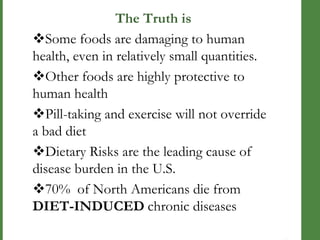
The Truth is
Some foods are damaging to human
health, even in relatively small quantities.
Other foods are highly protective to
human health
Pill-taking and exercise will not override
a bad diet
Dietary Risks are the leading cause of
disease burden in the U.S.
70% of North Americans die from
DIET-INDUCED chronic diseases
The Truth is
―We often hear that ‗An ounce of prevention
is worth a pound of cure.‘ A plant-based diet
may be one of our best and most practical
ways to prevent chronic disease. Thus, to
boost your health, it is sound strategy to
move toward a plant-based diet.‖ Taken
from (USDA Agricultural Research Service,
2006,
http://www.ars.usda.gov/News/docs.htm?do
cid=9246 )
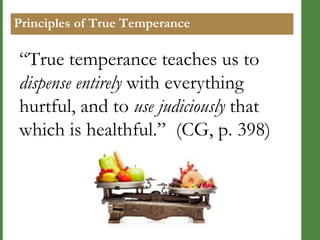
Principles of True Temperance

―True temperance teaches us to
dispense entirely with everything
hurtful, and to use judiciously that
which is healthful.‖ (CG, p. 398)
Principles of True Temperance

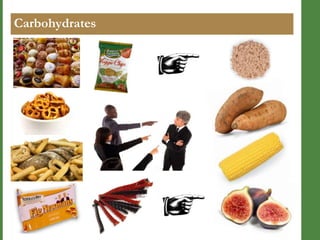
• Carbohydrates
• Calorie Density
• Satiety
Carbohydrates
3 Main Types: sugar, starch, fiber
Richest Sources of:
•Energy/Calories
Vitamins C & E
•Carotnoids
•Phytochemicals

•Magnesium
•B-Vitamins
•Trace Minerals

―The healthiest sources of carbohydrates—
unprocessed or minimally processed whole grains,
vegetables, fruits and beans—promote good health
by delivering vitamins, minerals, fiber, and a host of
important phytonutrients.‖ ~ Harvard School of
Public Health
Carbohydrates

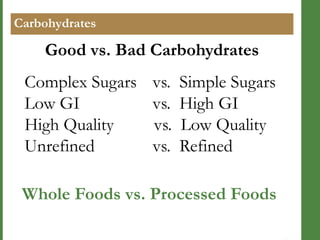
Good vs. Bad Carbohydrates

Complex Sugars
Low GI
High Quality
Unrefined

vs.
vs.
vs.
vs.

Simple Sugars
High GI
Low Quality
Refined

Whole Foods vs. Processed Foods
Carbohydrates

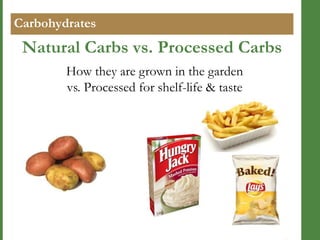
Natural Carbs vs. Processed Carbs
How they are grown in the garden
vs. Processed for shelf-life & taste
Carbohydrates
The Issue with Processed Carbs
• High in Calories & Calorie Density
• Little to no Fiber, Vitamins, & Nutrients
―Unhealthier sources of carbohydrates include white
bread, pastries, sodas, and other highly processed or
refined foods. These items contain easily digested
carbohydrates that may contribute to weight gain,
interfere with weight loss, and promote diabetes and
heart disease.‖ ~ Harvard School of Public Health
Carbohydrates
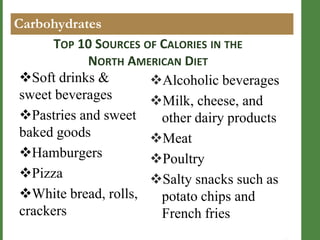
TOP 10 SOURCES OF CALORIES IN THE
NORTH AMERICAN DIET
Soft drinks &
Alcoholic beverages
sweet beverages
Milk, cheese, and
Pastries and sweet
other dairy products
baked goods
Meat
Hamburgers
Poultry
Pizza
Salty snacks such as
White bread, rolls,
potato chips and
crackers
French fries
Carbohydrates
Carbohydrates

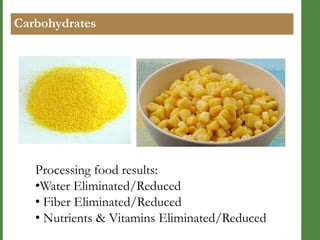
Processing food results:
•Water Eliminated/Reduced
• Fiber Eliminated/Reduced
• Nutrients & Vitamins Eliminated/Reduced
Calorie Density

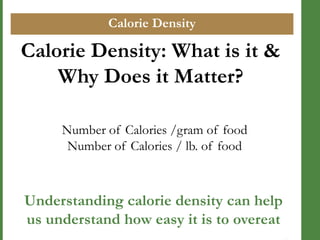
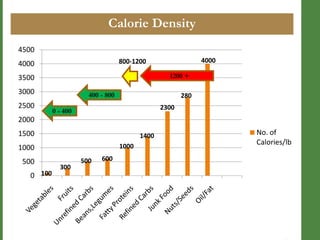
Calorie Density: What is it &
Why Does it Matter?
Number of Calories /gram of food
Number of Calories / lb. of food

Understanding calorie density can help
us understand how easy it is to overeat
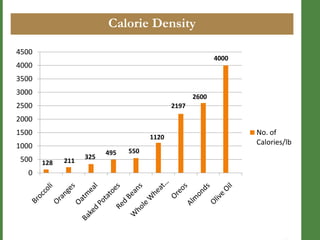
Calorie Density
4500

4000

4000

3500
3000

2600

2500

2197

2000
1500

1120

1000
500
0

128

211

325

495

550

No. of
Calories/lb
Calorie Density

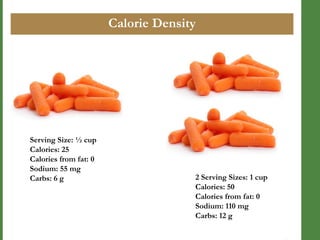
Serving Size: ½ cup
Calories: 25
Calories from fat: 0
Sodium: 55 mg
Carbs: 6 g

2 Serving Sizes: 1 cup
Calories: 50
Calories from fat: 0
Sodium: 110 mg
Carbs: 12 g
Calorie Density
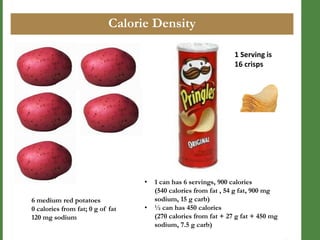
1 Serving is
16 crisps

•

6 medium red potatoes
0 calories from fat; 0 g of fat
120 mg sodium

•

1 can has 6 servings, 900 calories
(540 calories from fat , 54 g fat, 900 mg
sodium, 15 g carb)
½ can has 450 calories
(270 calories from fat + 27 g fat + 450 mg
sodium, 7.5 g carb)
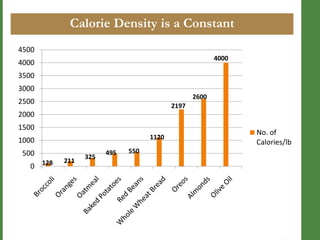
Calorie Density is a Constant
4500
4000

4000
3500
3000
2600

2500

2197

2000
1500
1120

1000
500
0 128

211

325

495

550

No. of
Calories/lb
Calorie Density
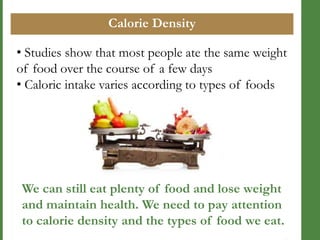
• Studies show that most people ate the same weight
of food over the course of a few days
• Caloric intake varies according to types of foods

We can still eat plenty of food and lose weight
and maintain health. We need to pay attention
to calorie density and the types of food we eat.
Satiety
What is it?
Satiety

• Opposite of Hunger
• Hunger is a built in survival
mechanism, it‘s not a bad
thing
• It‘s difficult to defeat
hunger purely on will-power
Satiety

What’s wrong with a “diet”?
1. We have to come off of it
2. Typically restricts foods
3. Often accompanied by pills or
supplements that are supposed to
help us fight hunger
Satiety

• Hunger is not the problem
• The problem is that our food
supply has changed and what we’re
eating to satisfy our hunger

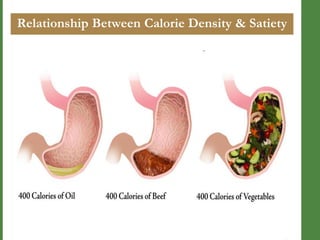
• Calories of the foods eaten =
Satiety
Relationship Between Calorie Density & Satiety
Satiety

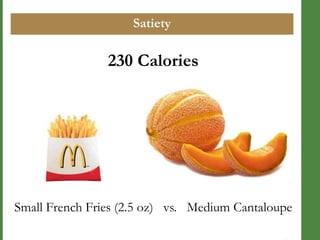
230 Calories

Small French Fries (2.5 oz) vs. Medium Cantaloupe
Satiety

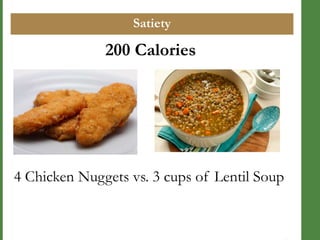
200 Calories

4 Chicken Nuggets vs. 3 cups of Lentil Soup
Satiety

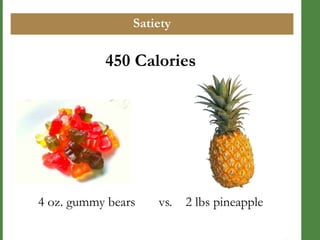
450 Calories

4 oz. gummy bears

vs.

2 lbs pineapple
Satiety

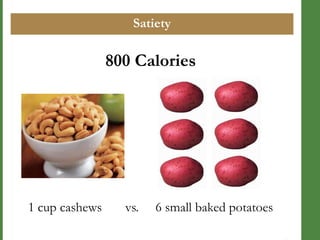
800 Calories

1 cup cashews

vs.

6 small baked potatoes
Calorie Density
4500
1200 +

3500
3000
2500

4000

800-1200

4000

400 - 800

280
2300

0 - 400

2000
1500

1400
1000

1000
500
0 100

300

500

600

No. of
Calories/lb
Satiety

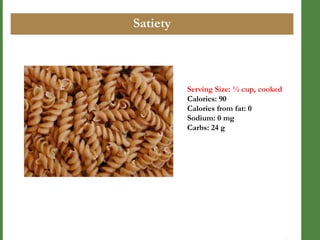
Serving Size: ½ cup, cooked
Calories: 90
Calories from fat: 0
Sodium: 0 mg
Carbs: 24 g
Satiety

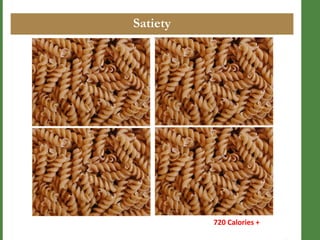
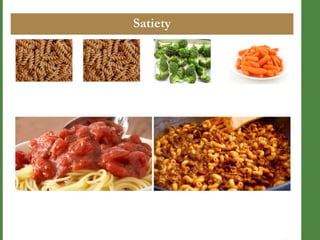
720 Calories +
Satiety

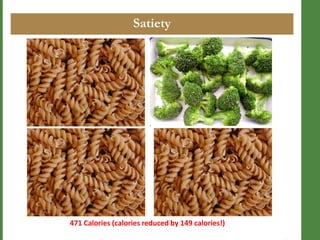
471 Calories (calories reduced by 149 calories!)
Satiety

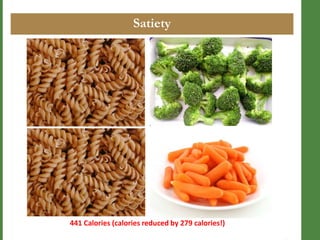
441 Calories (calories reduced by 279 calories!)
Satiety
Healthy Eating Guidelines

• Plant-Centered
• Minimally Processed
• Calorie Dilute (pair lower calorie
vegetables or fruits with higher calorie
starches)
• Low S-O-S (Salt-Oil-Sugars)
• Variety – Consume a variety of foods
from plant-based food groups
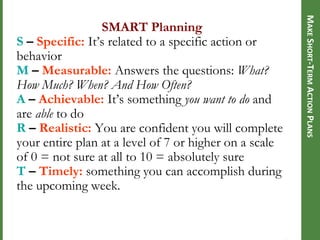
MAKE SHORT-TERM ACTION PLANS

SMART Planning
S – Specific: It‘s related to a specific action or
behavior
M – Measurable: Answers the questions: What?
How Much? When? And How Often?
A – Achievable: It‘s something you want to do and
are able to do
R – Realistic: You are confident you will complete
your entire plan at a level of 7 or higher on a scale
of 0 = not sure at all to 10 = absolutely sure
T – Timely: something you can accomplish during
the upcoming week.

Calorie Density - HEAL Workshop, Session 2

  • 1.
    Eat More, WeighLess, and Live Healthy PURIFYING OUR EATING HABITS
  • 2.
  • 3.
    SELF-MANAGEMENT TOOLBOX Physical Activity Trustin God Healthy Eating Practice Temperance Manage Stress & Difficult Emotions Manage Common Symptoms Get Help When Needed Using Your Mind Adapt Activities Communicate with Your Health Care Team Use medications or remedies correctly while minimizing any side effects Know your “red flags” Action Planning
  • 4.
    COMM ON NUTRITI ON EDUCAT ION MESSA GES PRESENT NUTRITION EDUCATIONMESSAGE ―There are no good foods; no bad foods‖ All foods can fit into a healthy diet Enjoy everything in moderation Feel good messages meant to reassure people that meat, sugar, cheese, and processed foods can be part of a healthful diet
  • 5.
    Diet-Related Diseases • • • • • • • • Heart Disease(#1) Hypertension (#13) Certain Cancers (#2) Stroke (#4) Diabetes (#7) Obesity High Cholesterol Osteoporosis Much of our nation’s disease burden is preventable • Approximately 70% of premature deaths are caused by poor nutrition, physical inactivity, and tobacco use. (McGinnis & Foege, 1993, 2004, JAMA) • Only 10% of Americans eat a healthy diet consistent with federal nutrition recommendations. • The typical American diet is too high in saturated and trans fat, salt, and refined sugars and too low in fruits, vegetables, whole grains, calcium, and fiber.
  • 6.
    Diet-Related Diseases –Virginia Statistics Ages 55-64 (ages 65-74 #4 & #5 switched) 1. Malignant Neoplasms (Cancer) 2. Heart Disease 3. Chronic Lower Respiratory Diseases 4. Diabetes Mellitus 5. Cerebrovascular Diseases (Stroke) Ages 75 and over 1. Heart Disease 2. Malignant Neoplasms (Cancer) 3. Cerebrovascular Diseases (Stroke) 4. Chronic Lower Respiratory Diseases 5. Alzheimer‘s Disease
  • 7.
    The Truth is Somefoods are damaging to human health, even in relatively small quantities. Other foods are highly protective to human health Pill-taking and exercise will not override a bad diet Dietary Risks are the leading cause of disease burden in the U.S. 70% of North Americans die from DIET-INDUCED chronic diseases
  • 8.
    The Truth is ―Weoften hear that ‗An ounce of prevention is worth a pound of cure.‘ A plant-based diet may be one of our best and most practical ways to prevent chronic disease. Thus, to boost your health, it is sound strategy to move toward a plant-based diet.‖ Taken from (USDA Agricultural Research Service, 2006, http://www.ars.usda.gov/News/docs.htm?do cid=9246 )
  • 9.
    Principles of TrueTemperance ―True temperance teaches us to dispense entirely with everything hurtful, and to use judiciously that which is healthful.‖ (CG, p. 398)
  • 10.
    Principles of TrueTemperance • Carbohydrates • Calorie Density • Satiety
  • 11.
    Carbohydrates 3 Main Types:sugar, starch, fiber Richest Sources of: •Energy/Calories Vitamins C & E •Carotnoids •Phytochemicals •Magnesium •B-Vitamins •Trace Minerals ―The healthiest sources of carbohydrates— unprocessed or minimally processed whole grains, vegetables, fruits and beans—promote good health by delivering vitamins, minerals, fiber, and a host of important phytonutrients.‖ ~ Harvard School of Public Health
  • 12.
    Carbohydrates Good vs. BadCarbohydrates Complex Sugars Low GI High Quality Unrefined vs. vs. vs. vs. Simple Sugars High GI Low Quality Refined Whole Foods vs. Processed Foods
  • 13.
    Carbohydrates Natural Carbs vs.Processed Carbs How they are grown in the garden vs. Processed for shelf-life & taste
  • 14.
    Carbohydrates The Issue withProcessed Carbs • High in Calories & Calorie Density • Little to no Fiber, Vitamins, & Nutrients ―Unhealthier sources of carbohydrates include white bread, pastries, sodas, and other highly processed or refined foods. These items contain easily digested carbohydrates that may contribute to weight gain, interfere with weight loss, and promote diabetes and heart disease.‖ ~ Harvard School of Public Health
  • 15.
    Carbohydrates TOP 10 SOURCESOF CALORIES IN THE NORTH AMERICAN DIET Soft drinks & Alcoholic beverages sweet beverages Milk, cheese, and Pastries and sweet other dairy products baked goods Meat Hamburgers Poultry Pizza Salty snacks such as White bread, rolls, potato chips and crackers French fries
  • 16.
  • 17.
    Carbohydrates Processing food results: •WaterEliminated/Reduced • Fiber Eliminated/Reduced • Nutrients & Vitamins Eliminated/Reduced
  • 18.
    Calorie Density Calorie Density:What is it & Why Does it Matter? Number of Calories /gram of food Number of Calories / lb. of food Understanding calorie density can help us understand how easy it is to overeat
  • 19.
  • 20.
    Calorie Density Serving Size:½ cup Calories: 25 Calories from fat: 0 Sodium: 55 mg Carbs: 6 g 2 Serving Sizes: 1 cup Calories: 50 Calories from fat: 0 Sodium: 110 mg Carbs: 12 g
  • 21.
    Calorie Density 1 Servingis 16 crisps • 6 medium red potatoes 0 calories from fat; 0 g of fat 120 mg sodium • 1 can has 6 servings, 900 calories (540 calories from fat , 54 g fat, 900 mg sodium, 15 g carb) ½ can has 450 calories (270 calories from fat + 27 g fat + 450 mg sodium, 7.5 g carb)
  • 22.
    Calorie Density isa Constant 4500 4000 4000 3500 3000 2600 2500 2197 2000 1500 1120 1000 500 0 128 211 325 495 550 No. of Calories/lb
  • 23.
    Calorie Density • Studiesshow that most people ate the same weight of food over the course of a few days • Caloric intake varies according to types of foods We can still eat plenty of food and lose weight and maintain health. We need to pay attention to calorie density and the types of food we eat.
  • 24.
  • 25.
    Satiety • Opposite ofHunger • Hunger is a built in survival mechanism, it‘s not a bad thing • It‘s difficult to defeat hunger purely on will-power
  • 26.
    Satiety What’s wrong witha “diet”? 1. We have to come off of it 2. Typically restricts foods 3. Often accompanied by pills or supplements that are supposed to help us fight hunger
  • 27.
    Satiety • Hunger isnot the problem • The problem is that our food supply has changed and what we’re eating to satisfy our hunger • Calories of the foods eaten = Satiety
  • 28.
  • 29.
    Satiety 230 Calories Small FrenchFries (2.5 oz) vs. Medium Cantaloupe
  • 30.
    Satiety 200 Calories 4 ChickenNuggets vs. 3 cups of Lentil Soup
  • 31.
    Satiety 450 Calories 4 oz.gummy bears vs. 2 lbs pineapple
  • 32.
    Satiety 800 Calories 1 cupcashews vs. 6 small baked potatoes
  • 33.
    Calorie Density 4500 1200 + 3500 3000 2500 4000 800-1200 4000 400- 800 280 2300 0 - 400 2000 1500 1400 1000 1000 500 0 100 300 500 600 No. of Calories/lb
  • 34.
    Satiety Serving Size: ½cup, cooked Calories: 90 Calories from fat: 0 Sodium: 0 mg Carbs: 24 g
  • 35.
  • 36.
    Satiety 471 Calories (caloriesreduced by 149 calories!)
  • 37.
    Satiety 441 Calories (caloriesreduced by 279 calories!)
  • 38.
  • 39.
    Healthy Eating Guidelines •Plant-Centered • Minimally Processed • Calorie Dilute (pair lower calorie vegetables or fruits with higher calorie starches) • Low S-O-S (Salt-Oil-Sugars) • Variety – Consume a variety of foods from plant-based food groups
  • 40.
    MAKE SHORT-TERM ACTIONPLANS SMART Planning S – Specific: It‘s related to a specific action or behavior M – Measurable: Answers the questions: What? How Much? When? And How Often? A – Achievable: It‘s something you want to do and are able to do R – Realistic: You are confident you will complete your entire plan at a level of 7 or higher on a scale of 0 = not sure at all to 10 = absolutely sure T – Timely: something you can accomplish during the upcoming week.

Editor's Notes

  • #4 Say in your own words: This workshop is designed to give us some of the self-management tools needed to take on these tasks: GO TO SLIDE 7 (read each tool, elaborate if needed)Say in your own words: During this workshop, we’ll have a chance to learn and practice these different tools. Understand that like a toolbox, you will not use every tool in every instance. A plumber may need a wrench instead of a hammer to fix a sink. But if we take on these tasks and use our tools we can improve our lives and reverse disease.
  • #9 Protective elements are concentrated in plant-products, damaging elements concentrated in animal foods
  • #41 Say in your own words: Sometimes we can get overwhelmed when we think about the changes that we need or want to make. And when our problems or challenges seem too big, this makes it hard for us to get started.So to help…we’re going to do some short-term action plans, which we will call SMART Plans. Over the next two weeks are going to be SMART and then in a couple of weeks when we meet again, we will share our results with the group.Our SMART plans will help us achieve our goals by breaking down our activities into smaller, more doable tasks. For example if you want to improve your fitness, maybe you can have a plan to research what types of exercises are safe for you to do with your health limitations. Another action plan could be that you will start an exercise program by walking for five minutes 2 or three times a week. Or, if you were a person who wants to improve their diet, maybe you will eat more vegetables during your lunch hour 3 or 4 times this week…or perhaps you will curb your diet soda habit to only 1 can a day instead of 2. Or maybe you’d like to relax by taking the time to read a book for one hour twice this week….something like that…..In your H.E.A.L. folder, you have an ACTION PLAN FORM. I want you to pull this out, in a second I will ask you to get in pairs so that you can help each other make a SMART PLAN. What we are going to do is get started with meeting our goals. We’re going to focus on what we are going to to THIS WEEK and write down exactly how we are going to do it. In order for our action plans to be effective, they need to have the following elements. (REACH THE SMART PLANNING CHART and elaborate)S – Specific:It’s related to a specific action or behavior (for example, losing weight is not an action or behavior, but reducing snacks between meals or eating fruit instead of candy are behaviors and actions that lead to losing weight)M – Measurable:Answers the questions: What? How Much? When? And How Often? (what = walking, how much = around the block; when = in the morning; how often = 3 times this week or Monday, Wednesday, FridayA – Achievable:It’s something you want to do and are able to do (not something someone else thinks you should do or even what you think you should do)R – Realistic: You are confident you will complete your entire plan at a level of 7 or higher on a scale of 0 = not sure at all to 10 = absolutely sure (if your confidence level is less than a 7, then readjust your plan; as you will be more likely to be successful)T – Timely: something you can accomplish during the upcoming week.I have my SMART plan example on the next slide