Nutrition for
Performance and Weight Control
Adam Pennell MS, CSCS, SNS
Energy
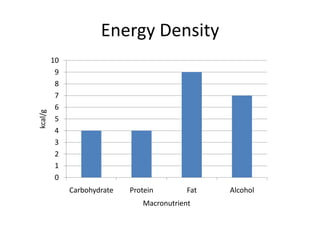
Energy Density
0
1
2
3
4
5
6
7
8
9
10
Carbohydrate Protein Fat Alcohol
kcal/g
Macronutrient
Estimating Energy Expenditure
• Revised Harris-Benedict Formula1
– Basal metabolic rate (BMR)
– Activity factor (AF)
– Total daily energy expenditure (TDEE)
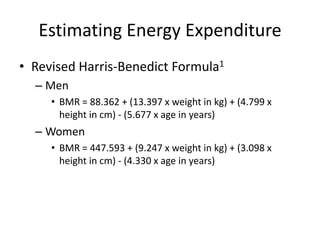
Estimating Energy Expenditure
• Revised Harris-Benedict Formula1
– Men
• BMR = 88.362 + (13.397 x weight in kg) + (4.799 x
height in cm) - (5.677 x age in years)
– Women
• BMR = 447.593 + (9.247 x weight in kg) + (3.098 x
height in cm) - (4.330 x age in years)
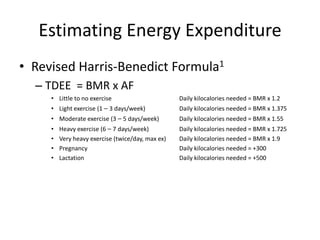
Estimating Energy Expenditure
• Revised Harris-Benedict Formula1
– TDEE = BMR x AF
• Little to no exercise Daily kilocalories needed = BMR x 1.2
• Light exercise (1 – 3 days/week) Daily kilocalories needed = BMR x 1.375
• Moderate exercise (3 – 5 days/week) Daily kilocalories needed = BMR x 1.55
• Heavy exercise (6 – 7 days/week) Daily kilocalories needed = BMR x 1.725
• Very heavy exercise (twice/day, max ex) Daily kilocalories needed = BMR x 1.9
• Pregnancy Daily kilocalories needed = +300
• Lactation Daily kilocalories needed = +500
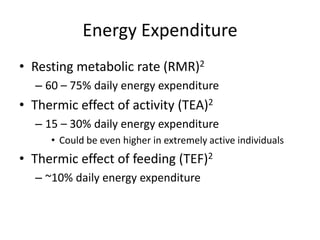
Energy Expenditure
• Resting metabolic rate (RMR)2
– 60 – 75% daily energy expenditure
• Thermic effect of activity (TEA)2
– 15 – 30% daily energy expenditure
• Could be even higher in extremely active individuals
• Thermic effect of feeding (TEF)2
– ~10% daily energy expenditure
Nutrition Strategies
Macronutrient Contributions
• A well balanced diet should consist of the
following macronutrient percentages
– Ranges vary for individual demands/goals
• CHO 55 – 65%
• PRO 15 – 25%
• FAT 15 – 25%
*Per day, not per meal necessarily
Diet Analysis
• Female, 22 years old, 120 lbs, 5’3”
– BMR = 1,352.4
– AF = 1.375 (light exercise; 1 – 3 days/week)
– TDEE = 1,352.4 x 1.375 = 1, 860 kcal
60% CHO
1,116 kcal
279 g
20% PRO
372 kcal
93 g
20% FAT
372 kcal
41 g
Low CHO Diet
• Glycogen
– Stored CHO
– Extremely important energy substrate
– Requires water retention
• 2 – 4 g of water/1 g CHO3-5
– Low CHO diet = ↑ water loss
Low CHO Diet
• Insufficient CHO intake leads to depleted
glycogen, blood glucose
– Brain, nerves, blood, are fueled by CHO
• Fat cannot be converted directly to glucose
• Glucose is then created via non-ideal
pathways
– Glycerol from triglycerides
– Muscle degraded to create CHO
Low CHO Diet
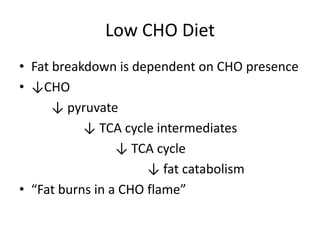
• Fat breakdown is dependent on CHO presence
• ↓CHO
↓ pyruvate
↓ TCA cycle intermediates
↓ TCA cycle
↓ fat catabolism
• “Fat burns in a CHO flame”
Low CHO Diet
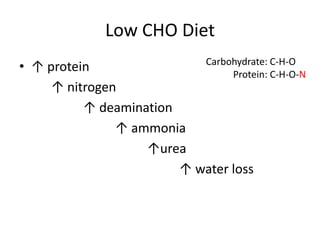
• ↑ protein
↑ nitrogen
↑ deamination
↑ ammonia
↑urea
↑ water loss
Carbohydrate: C-H-O
Protein: C-H-O-N
Low CHO Diet
• Protein is a horrible energy source
• Only a small contribution (~2%) to total
energy production during exercise6
– May increase to 5 – 15% late in prolonged-
duration exercise
Low CHO Diet
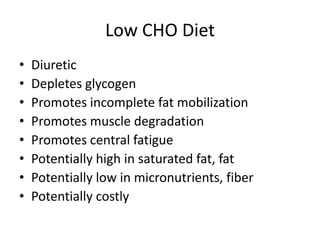
• Diuretic
• Depletes glycogen
• Promotes incomplete fat mobilization
• Promotes muscle degradation
• Promotes central fatigue
• Potentially high in saturated fat, fat
• Potentially low in micronutrients, fiber
• Potentially costly
Low CHO Diet
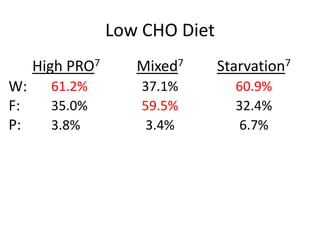
High PRO7
61.2%
35.0%
3.8%
Mixed7
37.1%
59.5%
3.4%
Starvation7
60.9%
32.4%
6.7%
W:
F:
P:
Energy Expenditure
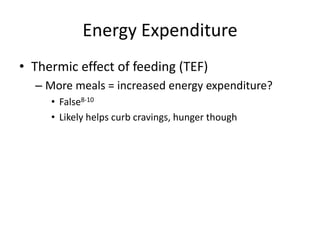
• Thermic effect of feeding (TEF)
– More meals = increased energy expenditure?
• False8-10
• Likely helps curb cravings, hunger though
Calorie Shifting
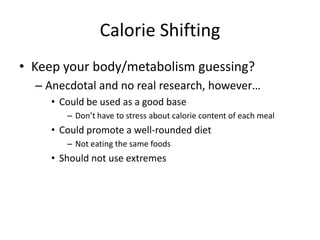
• Keep your body/metabolism guessing?
– Anecdotal and no real research, however…
• Could be used as a good base
– Don’t have to stress about calorie content of each meal
• Could promote a well-rounded diet
– Not eating the same foods
• Should not use extremes
Nutrition for Weight Loss
Underfeeding
• Caloric decrease should be modest to
maximize weight loss, minimize hunger, and
maintain physiological functioning
– ~500 kcal/day is generally suggested
• Equates to 1 lb/week
– Women should consume at least 1,200 kcal/day11
– Men should consume at least 1,800 kcal/day11
Exercise
• Easiest way to provide a negative energy
balance
– Cutting calories in the diet is not always an option
– Typically cardiovascular exercise
– Also weight training, interval training, etc.
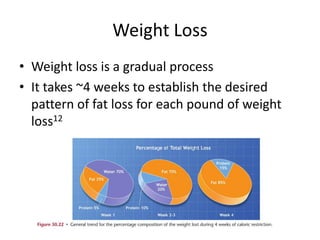
Weight Loss
• Weight loss is a gradual process
• It takes ~4 weeks to establish the desired
pattern of fat loss for each pound of weight
loss12
Fat Storage
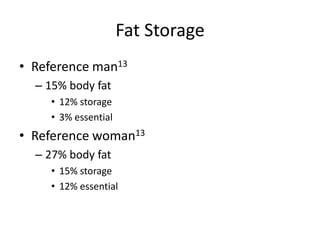
• Reference man13
– 15% body fat
• 12% storage
• 3% essential
• Reference woman13
– 27% body fat
• 15% storage
• 12% essential
Nutrition for Weight Gain
Resistance Training
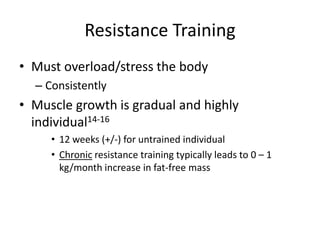
• Must overload/stress the body
– Consistently
• Muscle growth is gradual and highly
individual14-16
• 12 weeks (+/-) for untrained individual
• Chronic resistance training typically leads to 0 – 1
kg/month increase in fat-free mass
Overfeeding
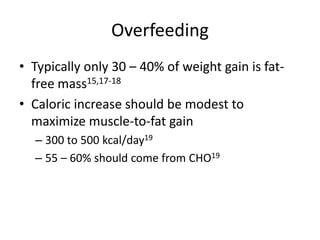
• Typically only 30 – 40% of weight gain is fat-
free mass15,17-18
• Caloric increase should be modest to
maximize muscle-to-fat gain
– 300 to 500 kcal/day19
– 55 – 60% should come from CHO19
Practical Performance
Recommendations
Pre-Exercise
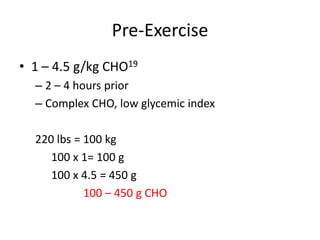
• 1 – 4.5 g/kg CHO19
– 2 – 4 hours prior
– Complex CHO, low glycemic index
220 lbs = 100 kg
100 x 1= 100 g
100 x 4.5 = 450 g
100 – 450 g CHO
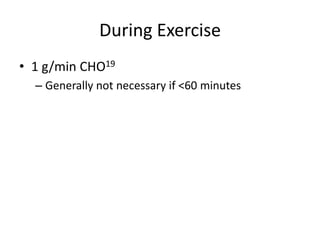
During Exercise
• 1 g/min CHO19
– Generally not necessary if <60 minutes
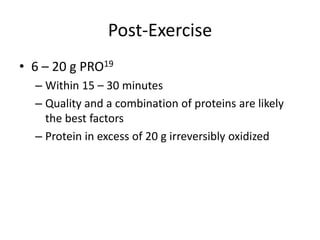
Post-Exercise
• 6 – 20 g PRO19
– Within 15 – 30 minutes
– Quality and a combination of proteins are likely
the best factors
– Protein in excess of 20 g irreversibly oxidized
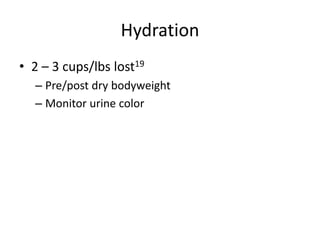
Hydration
• 2 – 3 cups/lbs lost19
– Pre/post dry bodyweight
– Monitor urine color
Chocolate Milk
• Nature’s engineered recovery beverage
• Provides fluid
• Cheap
– ~$5/gallon (CA prices in 2013)
• Serving
– 1-2 cups depending on needs
– ~$0.32/cup
• CHO:PRO ratio
– 3:1 – 4:1
• For lower ratio (anaerobic) you can “cut” with plain milk or use less chocolate
• For higher ratio (aerobic) you can add chocolate
• Casein, whey protein 8-11 g/cup
• High glycemic index 25-30 g/cup
• Fat-free 0 g/cup
• Low-fat 2.5 g/cup
– Not ideal but a small amount of fat will likely not delay gastric emptying too significantly
• Vitamins/minerals
– Calcium, vitamin D, sodium, potassium, etc.
Supplements
• Completely unregulated industry
– Too much?
– Too little?
– Safe?
– Purity?
– Cost?
– Adverse effects?
– Spiked?
– Tainted?
– Contamination?
– No research?
– Bad research?
– Research sponsor?
– Marketing?
Lifestyle Nutrition
Basic Nutrition Strategies
• Moderation
• Variety
– “Colorful” plate
• High in fiber
• High in nutrient-dense foods
• Not stressful/restricting or overindulging
• Consistency
• Physical activity*
Questions/Comments
apennell@csub.edu
Sources
1. Roza, A., et al. (1984). The Harris Benedict equation reevaluated. American Journal of Clinical Nutrition, 40(1), 168-182. 19
2. Poehlman, E. (1989). A review: Exercise and its influence on resting energy metabolism in man. Medicine and Science in Sports
and Exercise, 21(5), 515-525.
3. Greenleaf, J., et al. (1969). Muscle glycogen and its significance for the water content of the body. Acta Physiologica
Scandinavica Supplementum.
4. Kreitzman, S., et al. (1992). Glycogen storage: Illutions of easy weight loss, excessive weight regain, and distortions in
estimations of body composition. The American Journal of Clinical Nutrition, 56, 292S-293S.
5. Tymoczko, J., et al. (2009). Biochemistry: A short course.
6. Powers, S., et al. (2011). Exercise physiology: Theory and application to fitness and performance.
7. Yang, M. & Van Itallie, T. (1976). Composition of weight lost during short-term weight reduction. Metabolic responses of obese
subjects to starvation and low-calorie ketogenic and nonketogenic diets. The Journal of Clinical Investigation, 58(3), 722-730.
8. Hill, J., et al. (1988). Effects of meal frequency on energy utilization in rats. American Journal of Physiology, 255, R616-R621.
9. Wolfram, G., et al. (1987). Thermogenesis in humans after varying meal time frequency. Annals of Nutrition and
Metabolism, 31(2), 88-97.
10. Bellisle, F., et al. (1997). Meal frequency and energy balance. British Journal of Nutrition, 77, S57-S70.
11. American College of Sports Medicine. (2005). Resource Manual for Guidelines for Exercise Testing and Prescription.
12. McArdle, W., et al. (2010). Exercise physiology: Nutrition, energy, and human performance.
13. Behnke, A., & Wilmore, J. (1974). Evaluation and regulation of body build and composition.
14. Kraemer WJ. General adaptations to resistance and endurance training. In: Baechle T, editor. Essentials of strength training and
conditioning. Champaign (IL): Human Kinetics, 1994: 127-50
15. Forbes, G. (1991). Exercise and body composition. Journal of Applied Physiology, 70, 994-997.
16. Wilmore, J. (1974. Alterations in strength, body composition, and anthropometric measurements consequent to a 10 week
weight training program. Medicine and Science in Sport and Exercise, 6, 133-138.
17. Welle, S., et al. (1989). Stimulation of protein turnover by carbohydrate overfeeding in men. American Journal of
Physiology, 257, E413-E417.
18. Forbes, G., et al. (1986). Deliberate overfeeding in women and men: Energy cost and composition of weight gain. British
Journal of Nutrition, 56, 1-9.
19. Fink, H., et al. (2009). Practical Applications in Sports Nutrition.

Winter 2013 - NEW-trition - Adam Pennell

  • 1.
    Nutrition for Performance andWeight Control Adam Pennell MS, CSCS, SNS
  • 2.
  • 3.
  • 4.
    Estimating Energy Expenditure •Revised Harris-Benedict Formula1 – Basal metabolic rate (BMR) – Activity factor (AF) – Total daily energy expenditure (TDEE)
  • 5.
    Estimating Energy Expenditure •Revised Harris-Benedict Formula1 – Men • BMR = 88.362 + (13.397 x weight in kg) + (4.799 x height in cm) - (5.677 x age in years) – Women • BMR = 447.593 + (9.247 x weight in kg) + (3.098 x height in cm) - (4.330 x age in years)
  • 6.
    Estimating Energy Expenditure •Revised Harris-Benedict Formula1 – TDEE = BMR x AF • Little to no exercise Daily kilocalories needed = BMR x 1.2 • Light exercise (1 – 3 days/week) Daily kilocalories needed = BMR x 1.375 • Moderate exercise (3 – 5 days/week) Daily kilocalories needed = BMR x 1.55 • Heavy exercise (6 – 7 days/week) Daily kilocalories needed = BMR x 1.725 • Very heavy exercise (twice/day, max ex) Daily kilocalories needed = BMR x 1.9 • Pregnancy Daily kilocalories needed = +300 • Lactation Daily kilocalories needed = +500
  • 7.
    Energy Expenditure • Restingmetabolic rate (RMR)2 – 60 – 75% daily energy expenditure • Thermic effect of activity (TEA)2 – 15 – 30% daily energy expenditure • Could be even higher in extremely active individuals • Thermic effect of feeding (TEF)2 – ~10% daily energy expenditure
  • 8.
  • 9.
    Macronutrient Contributions • Awell balanced diet should consist of the following macronutrient percentages – Ranges vary for individual demands/goals • CHO 55 – 65% • PRO 15 – 25% • FAT 15 – 25% *Per day, not per meal necessarily
  • 10.
    Diet Analysis • Female,22 years old, 120 lbs, 5’3” – BMR = 1,352.4 – AF = 1.375 (light exercise; 1 – 3 days/week) – TDEE = 1,352.4 x 1.375 = 1, 860 kcal 60% CHO 1,116 kcal 279 g 20% PRO 372 kcal 93 g 20% FAT 372 kcal 41 g
  • 11.
    Low CHO Diet •Glycogen – Stored CHO – Extremely important energy substrate – Requires water retention • 2 – 4 g of water/1 g CHO3-5 – Low CHO diet = ↑ water loss
  • 12.
    Low CHO Diet •Insufficient CHO intake leads to depleted glycogen, blood glucose – Brain, nerves, blood, are fueled by CHO • Fat cannot be converted directly to glucose • Glucose is then created via non-ideal pathways – Glycerol from triglycerides – Muscle degraded to create CHO
  • 13.
    Low CHO Diet •Fat breakdown is dependent on CHO presence • ↓CHO ↓ pyruvate ↓ TCA cycle intermediates ↓ TCA cycle ↓ fat catabolism • “Fat burns in a CHO flame”
  • 14.
    Low CHO Diet •↑ protein ↑ nitrogen ↑ deamination ↑ ammonia ↑urea ↑ water loss Carbohydrate: C-H-O Protein: C-H-O-N
  • 15.
    Low CHO Diet •Protein is a horrible energy source • Only a small contribution (~2%) to total energy production during exercise6 – May increase to 5 – 15% late in prolonged- duration exercise
  • 16.
    Low CHO Diet •Diuretic • Depletes glycogen • Promotes incomplete fat mobilization • Promotes muscle degradation • Promotes central fatigue • Potentially high in saturated fat, fat • Potentially low in micronutrients, fiber • Potentially costly
  • 17.
    Low CHO Diet HighPRO7 61.2% 35.0% 3.8% Mixed7 37.1% 59.5% 3.4% Starvation7 60.9% 32.4% 6.7% W: F: P:
  • 18.
    Energy Expenditure • Thermiceffect of feeding (TEF) – More meals = increased energy expenditure? • False8-10 • Likely helps curb cravings, hunger though
  • 19.
    Calorie Shifting • Keepyour body/metabolism guessing? – Anecdotal and no real research, however… • Could be used as a good base – Don’t have to stress about calorie content of each meal • Could promote a well-rounded diet – Not eating the same foods • Should not use extremes
  • 20.
  • 21.
    Underfeeding • Caloric decreaseshould be modest to maximize weight loss, minimize hunger, and maintain physiological functioning – ~500 kcal/day is generally suggested • Equates to 1 lb/week – Women should consume at least 1,200 kcal/day11 – Men should consume at least 1,800 kcal/day11
  • 22.
    Exercise • Easiest wayto provide a negative energy balance – Cutting calories in the diet is not always an option – Typically cardiovascular exercise – Also weight training, interval training, etc.
  • 23.
    Weight Loss • Weightloss is a gradual process • It takes ~4 weeks to establish the desired pattern of fat loss for each pound of weight loss12
  • 24.
    Fat Storage • Referenceman13 – 15% body fat • 12% storage • 3% essential • Reference woman13 – 27% body fat • 15% storage • 12% essential
  • 25.
  • 26.
    Resistance Training • Mustoverload/stress the body – Consistently • Muscle growth is gradual and highly individual14-16 • 12 weeks (+/-) for untrained individual • Chronic resistance training typically leads to 0 – 1 kg/month increase in fat-free mass
  • 27.
    Overfeeding • Typically only30 – 40% of weight gain is fat- free mass15,17-18 • Caloric increase should be modest to maximize muscle-to-fat gain – 300 to 500 kcal/day19 – 55 – 60% should come from CHO19
  • 28.
  • 29.
    Pre-Exercise • 1 –4.5 g/kg CHO19 – 2 – 4 hours prior – Complex CHO, low glycemic index 220 lbs = 100 kg 100 x 1= 100 g 100 x 4.5 = 450 g 100 – 450 g CHO
  • 30.
    During Exercise • 1g/min CHO19 – Generally not necessary if <60 minutes
  • 31.
    Post-Exercise • 6 –20 g PRO19 – Within 15 – 30 minutes – Quality and a combination of proteins are likely the best factors – Protein in excess of 20 g irreversibly oxidized
  • 32.
    Hydration • 2 –3 cups/lbs lost19 – Pre/post dry bodyweight – Monitor urine color
  • 33.
    Chocolate Milk • Nature’sengineered recovery beverage • Provides fluid • Cheap – ~$5/gallon (CA prices in 2013) • Serving – 1-2 cups depending on needs – ~$0.32/cup • CHO:PRO ratio – 3:1 – 4:1 • For lower ratio (anaerobic) you can “cut” with plain milk or use less chocolate • For higher ratio (aerobic) you can add chocolate • Casein, whey protein 8-11 g/cup • High glycemic index 25-30 g/cup • Fat-free 0 g/cup • Low-fat 2.5 g/cup – Not ideal but a small amount of fat will likely not delay gastric emptying too significantly • Vitamins/minerals – Calcium, vitamin D, sodium, potassium, etc.
  • 34.
    Supplements • Completely unregulatedindustry – Too much? – Too little? – Safe? – Purity? – Cost? – Adverse effects? – Spiked? – Tainted? – Contamination? – No research? – Bad research? – Research sponsor? – Marketing?
  • 35.
  • 36.
    Basic Nutrition Strategies •Moderation • Variety – “Colorful” plate • High in fiber • High in nutrient-dense foods • Not stressful/restricting or overindulging • Consistency • Physical activity*
  • 39.
  • 40.
    Sources 1. Roza, A.,et al. (1984). The Harris Benedict equation reevaluated. American Journal of Clinical Nutrition, 40(1), 168-182. 19 2. Poehlman, E. (1989). A review: Exercise and its influence on resting energy metabolism in man. Medicine and Science in Sports and Exercise, 21(5), 515-525. 3. Greenleaf, J., et al. (1969). Muscle glycogen and its significance for the water content of the body. Acta Physiologica Scandinavica Supplementum. 4. Kreitzman, S., et al. (1992). Glycogen storage: Illutions of easy weight loss, excessive weight regain, and distortions in estimations of body composition. The American Journal of Clinical Nutrition, 56, 292S-293S. 5. Tymoczko, J., et al. (2009). Biochemistry: A short course. 6. Powers, S., et al. (2011). Exercise physiology: Theory and application to fitness and performance. 7. Yang, M. & Van Itallie, T. (1976). Composition of weight lost during short-term weight reduction. Metabolic responses of obese subjects to starvation and low-calorie ketogenic and nonketogenic diets. The Journal of Clinical Investigation, 58(3), 722-730. 8. Hill, J., et al. (1988). Effects of meal frequency on energy utilization in rats. American Journal of Physiology, 255, R616-R621. 9. Wolfram, G., et al. (1987). Thermogenesis in humans after varying meal time frequency. Annals of Nutrition and Metabolism, 31(2), 88-97. 10. Bellisle, F., et al. (1997). Meal frequency and energy balance. British Journal of Nutrition, 77, S57-S70. 11. American College of Sports Medicine. (2005). Resource Manual for Guidelines for Exercise Testing and Prescription. 12. McArdle, W., et al. (2010). Exercise physiology: Nutrition, energy, and human performance. 13. Behnke, A., & Wilmore, J. (1974). Evaluation and regulation of body build and composition. 14. Kraemer WJ. General adaptations to resistance and endurance training. In: Baechle T, editor. Essentials of strength training and conditioning. Champaign (IL): Human Kinetics, 1994: 127-50 15. Forbes, G. (1991). Exercise and body composition. Journal of Applied Physiology, 70, 994-997. 16. Wilmore, J. (1974. Alterations in strength, body composition, and anthropometric measurements consequent to a 10 week weight training program. Medicine and Science in Sport and Exercise, 6, 133-138. 17. Welle, S., et al. (1989). Stimulation of protein turnover by carbohydrate overfeeding in men. American Journal of Physiology, 257, E413-E417. 18. Forbes, G., et al. (1986). Deliberate overfeeding in women and men: Energy cost and composition of weight gain. British Journal of Nutrition, 56, 1-9. 19. Fink, H., et al. (2009). Practical Applications in Sports Nutrition.