Clean Eating
Learn how to live well with Heart Problems
By Raul Ortega
Healthy Eating Lifestyle
You don’t have to eat less, you just have to eat right. When you begin to eat healthy,
you are simply taking a better step to reduce multiple risk factors that are linked to
heart disease. Eating healthy plays a big role in everyone's life by helping us improve
our blood pressure, cholesterol levels, lose those extra pounds, and overall maintain
a healthy weight. Patients that are diabetic are highly recommended to eat healthy
to help manage their blood sugar.
This lesson will guide you through new ways you can improve your diet without
having to cut-off all those delicious foods or flavors you desire.
Healthy vs Unhealthy
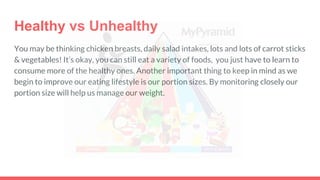
You may be thinking chicken breasts, daily salad intakes, lots and lots of carrot sticks
& vegetables! It’s okay, you can still eat a variety of foods, you just have to learn to
consume more of the healthy ones. Another important thing to keep in mind as we
begin to improve our eating lifestyle is our portion sizes. By monitoring closely our
portion size will help us manage our weight.
Eat More
You should be adding more of
these types of foods in your diet
Fresh fruits & vegetables
Whole grains
-Whole wheat bread
-Brown rice
Foods high in unsaturated fat
-Nuts
-Olive oil
-Fish
Non-meat sources of protein
-Beans
+
Have Less
By cutting these type of foods, it
will help you improve your health
High-fat animal products
-fatty cuts of meat
-butter
-whole-fat milk
-dairy products
-cream sauces
Snack foods and fast food
Foods high in sodium
Alcohol
-
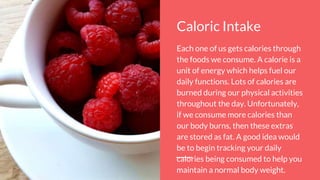
Caloric Intake
Each one of us gets calories through
the foods we consume. A calorie is a
unit of energy which helps fuel our
daily functions. Lots of calories are
burned during our physical activities
throughout the day. Unfortunately,
if we consume more calories than
our body burns, then these extras
are stored as fat. A good idea would
be to begin tracking your daily
calories being consumed to help you
maintain a normal body weight.
Obesity Crisis in America
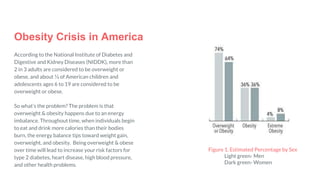
According to the National Institute of Diabetes and
Digestive and Kidney Diseases (NIDDK), more than
2 in 3 adults are considered to be overweight or
obese, and about ⅓ of American children and
adolescents ages 6 to 19 are considered to be
overweight or obese.
So what’s the problem? The problem is that
overweight & obesity happens due to an energy
imbalance. Throughout time, when individuals begin
to eat and drink more calories than their bodies
burn, the energy balance tips toward weight gain,
overweight, and obesity. Being overweight & obese
over time will lead to increase your risk factors for
type 2 diabetes, heart disease, high blood pressure,
and other health problems.
Figure 1. Estimated Percentage by Sex
Light green- Men
Dark green- Women
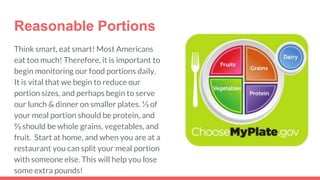
Reasonable Portions
Think smart, eat smart! Most Americans
eat too much! Therefore, it is important to
begin monitoring our food portions daily.
It is vital that we begin to reduce our
portion sizes, and perhaps begin to serve
our lunch & dinner on smaller plates. ⅓ of
your meal portion should be protein, and
⅔ should be whole grains, vegetables, and
fruit. Start at home, and when you are at a
restaurant you can split your meal portion
with someone else. This will help you lose
some extra pounds!
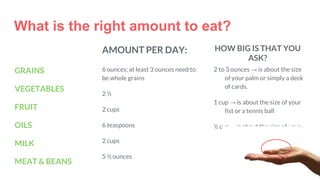
What is the right amount to eat?
GRAINS
VEGETABLES
FRUIT
OILS
MILK
MEAT & BEANS
AMOUNT PER DAY:
6 ounces; at least 3 ounces need to
be whole grains
2 ½
2 cups
6 teaspoons
2 cups
5 ½ ounces
2 to 3 ounces → is about the size
of your palm or simply a deck
of cards.
1 cup → is about the size of your
fist or a tennis ball
½ cup→ is about the size of your
cupped hand or golf ball
HOW BIG IS THAT YOU
ASK?
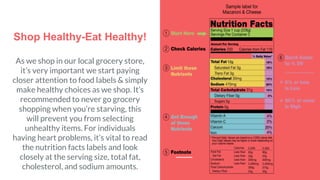
Shop Healthy-Eat Healthy!
As we shop in our local grocery store,
it’s very important we start paying
closer attention to food labels & simply
make healthy choices as we shop. It’s
recommended to never go grocery
shopping when you’re starving, this
will prevent you from selecting
unhealthy items. For individuals
having heart problems, it’s vital to read
the nutrition facts labels and look
closely at the serving size, total fat,
cholesterol, and sodium amounts.
Shop Healthy!
It’s recommended to make
shopping list before walking into
the grocery store. Once you’ve
created your list, stick to it! This
will help you avoid any impulse
buys. The following grocery
sections should be the sections
you should be shopping at to
make heart-healthy choices:
● MEAT COUNTER → Begin buying fish or chicken, and
reduce your read meats. If you would like to replace
meats on certain days, begin buying beans, tofu, or
nuts. A great tip is to avoid meats that have been
smoked or cured; these meats are high in sodium.
● PRODUCE SECTION→ You can reduce fat intake by
consuming meals around produce instead. Remember
that fresh fruits & vegetables contain almost no
sodium.
● DAIRY SECTION→ Begin buying lower-fat dairy
products. A great tip would be that if you buy whole
milk, you should try getting reduced fat or 2% milk.
● SNACK SECTION→ Shop for low-fat & low sodium!
Several snacks contain trans fat.
● FROZEN FOOD SECTION→ Frozen dinners are often
high in sodium! You should begin shopping for plain
frozen foods without any sauces.
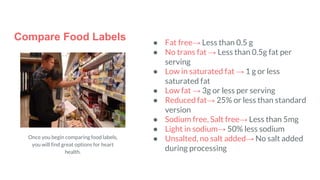
Compare Food Labels
Once you begin comparing food labels,
you will find great options for heart
health.
● Fat free→ Less than 0.5 g
● No trans fat → Less than 0.5g fat per
serving
● Low in saturated fat → 1 g or less
saturated fat
● Low fat → 3g or less per serving
● Reduced fat→ 25% or less than standard
version
● Sodium free, Salt free→ Less than 5mg
● Light in sodium→ 50% less sodium
● Unsalted, no salt added→ No salt added
during processing
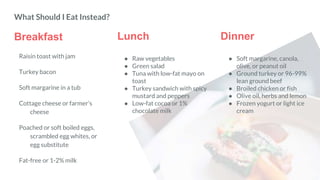
Breakfast
Raisin toast with jam
Turkey bacon
Soft margarine in a tub
Cottage cheese or farmer’s
cheese
Poached or soft boiled eggs,
scrambled egg whites, or
egg substitute
Fat-free or 1-2% milk
Lunch Dinner
● Soft margarine, canola,
olive, or peanut oil
● Ground turkey or 96-99%
lean ground beef
● Broiled chicken or fish
● Olive oil, herbs and lemon
● Frozen yogurt or light ice
cream
What Should I Eat Instead?
● Raw vegetables
● Green salad
● Tuna with low-fat mayo on
toast
● Turkey sandwich with spicy
mustard and peppers
● Low-fat cocoa or 1%
chocolate milk
How To Cook At Home?
Healthy eating starts at home! You can
begin by cutting down the fat and salt
you add to your foods. You don’t have
to cut or sacrifice your favorite flavors.
You can simply begin cooking without
using fat and salt. A great tip is to
purchase a recipe book that includes
delicious recipes with low-fat and low-
sodium ingredients. Follow these
cooking tips at home:
● Replace whole milk with low fat milk
● Replace half of the fat with applesauce
● Replace common spreads like margarine
and mayo with plant stanol and sterol
esters.
● Remove skin from your chicken & turkey
● Steam or microwave vegetables without
adding fat or salt
● Try adding herb blends, lemon juice pepper,
or flavored vinegar on vegetables
● Add chopped onions, garlic, and peppers to
your favorite beans and rice
● Spoon natural cooking juices over your
meats instead of gravy or cream sauce.
New Healthy Eating Goals to Follow:
GOAL: Cut sodium intake
Start by leaving salt out of your food
Cut back on high sodium foods
Begin tracking your progress
Reward yourself when you reach below 2,300 mg per day!
Consume one vegetable each day with your lunch
Try new vegetables every week
Consume 2 ½ vegetables per day
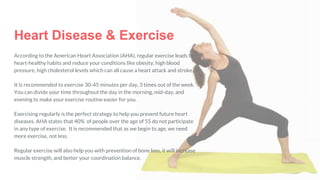
According to the American Heart Association (AHA), regular exercise leads to
heart-healthy habits and reduce your conditions like obesity, high blood
pressure, high cholesterol levels which can all cause a heart attack and stroke.
It is recommended to exercise 30-45 minutes per day, 3 times out of the week.
You can divide your time throughout the day in the morning, mid-day, and
evening to make your exercise routine easier for you.
Exercising regularly is the perfect strategy to help you prevent future heart
diseases. AHA states that 40% of people over the age of 55 do not participate
in any type of exercise. It is recommended that as we begin to age, we need
more exercise, not less.
Regular exercise will also help you with prevention of bone loss, it will increase
muscle strength, and better your coordination balance.
Heart Disease & Exercise
References
1. https://www.goredforwomen.org/home/about-heart-disease-in-women/research/v
2. http://www.niddk.nih.gov/health-information/health-statistics/Pages/overweight-obesity-statistics.aspx
3. Miller, Nancy Miller, RN, BSN. Krames Patient Education: A Guide For Cardiac Rehabilitation.. Living Well With Heart
Disease. PP 1-64.

Clean Eating

  • 1.
    Clean Eating Learn howto live well with Heart Problems By Raul Ortega
  • 2.
    Healthy Eating Lifestyle Youdon’t have to eat less, you just have to eat right. When you begin to eat healthy, you are simply taking a better step to reduce multiple risk factors that are linked to heart disease. Eating healthy plays a big role in everyone's life by helping us improve our blood pressure, cholesterol levels, lose those extra pounds, and overall maintain a healthy weight. Patients that are diabetic are highly recommended to eat healthy to help manage their blood sugar. This lesson will guide you through new ways you can improve your diet without having to cut-off all those delicious foods or flavors you desire.
  • 3.
  • 4.
    Healthy vs Unhealthy Youmay be thinking chicken breasts, daily salad intakes, lots and lots of carrot sticks & vegetables! It’s okay, you can still eat a variety of foods, you just have to learn to consume more of the healthy ones. Another important thing to keep in mind as we begin to improve our eating lifestyle is our portion sizes. By monitoring closely our portion size will help us manage our weight.
  • 6.
    Eat More You shouldbe adding more of these types of foods in your diet Fresh fruits & vegetables Whole grains -Whole wheat bread -Brown rice Foods high in unsaturated fat -Nuts -Olive oil -Fish Non-meat sources of protein -Beans +
  • 7.
    Have Less By cuttingthese type of foods, it will help you improve your health High-fat animal products -fatty cuts of meat -butter -whole-fat milk -dairy products -cream sauces Snack foods and fast food Foods high in sodium Alcohol -
  • 8.
    Caloric Intake Each oneof us gets calories through the foods we consume. A calorie is a unit of energy which helps fuel our daily functions. Lots of calories are burned during our physical activities throughout the day. Unfortunately, if we consume more calories than our body burns, then these extras are stored as fat. A good idea would be to begin tracking your daily calories being consumed to help you maintain a normal body weight.
  • 9.
    Obesity Crisis inAmerica According to the National Institute of Diabetes and Digestive and Kidney Diseases (NIDDK), more than 2 in 3 adults are considered to be overweight or obese, and about ⅓ of American children and adolescents ages 6 to 19 are considered to be overweight or obese. So what’s the problem? The problem is that overweight & obesity happens due to an energy imbalance. Throughout time, when individuals begin to eat and drink more calories than their bodies burn, the energy balance tips toward weight gain, overweight, and obesity. Being overweight & obese over time will lead to increase your risk factors for type 2 diabetes, heart disease, high blood pressure, and other health problems. Figure 1. Estimated Percentage by Sex Light green- Men Dark green- Women
  • 10.
    Reasonable Portions Think smart,eat smart! Most Americans eat too much! Therefore, it is important to begin monitoring our food portions daily. It is vital that we begin to reduce our portion sizes, and perhaps begin to serve our lunch & dinner on smaller plates. ⅓ of your meal portion should be protein, and ⅔ should be whole grains, vegetables, and fruit. Start at home, and when you are at a restaurant you can split your meal portion with someone else. This will help you lose some extra pounds!
  • 11.
    What is theright amount to eat? GRAINS VEGETABLES FRUIT OILS MILK MEAT & BEANS AMOUNT PER DAY: 6 ounces; at least 3 ounces need to be whole grains 2 ½ 2 cups 6 teaspoons 2 cups 5 ½ ounces 2 to 3 ounces → is about the size of your palm or simply a deck of cards. 1 cup → is about the size of your fist or a tennis ball ½ cup→ is about the size of your cupped hand or golf ball HOW BIG IS THAT YOU ASK?
  • 12.
    Shop Healthy-Eat Healthy! Aswe shop in our local grocery store, it’s very important we start paying closer attention to food labels & simply make healthy choices as we shop. It’s recommended to never go grocery shopping when you’re starving, this will prevent you from selecting unhealthy items. For individuals having heart problems, it’s vital to read the nutrition facts labels and look closely at the serving size, total fat, cholesterol, and sodium amounts.
  • 13.
    Shop Healthy! It’s recommendedto make shopping list before walking into the grocery store. Once you’ve created your list, stick to it! This will help you avoid any impulse buys. The following grocery sections should be the sections you should be shopping at to make heart-healthy choices: ● MEAT COUNTER → Begin buying fish or chicken, and reduce your read meats. If you would like to replace meats on certain days, begin buying beans, tofu, or nuts. A great tip is to avoid meats that have been smoked or cured; these meats are high in sodium. ● PRODUCE SECTION→ You can reduce fat intake by consuming meals around produce instead. Remember that fresh fruits & vegetables contain almost no sodium. ● DAIRY SECTION→ Begin buying lower-fat dairy products. A great tip would be that if you buy whole milk, you should try getting reduced fat or 2% milk. ● SNACK SECTION→ Shop for low-fat & low sodium! Several snacks contain trans fat. ● FROZEN FOOD SECTION→ Frozen dinners are often high in sodium! You should begin shopping for plain frozen foods without any sauces.
  • 14.
    Compare Food Labels Onceyou begin comparing food labels, you will find great options for heart health. ● Fat free→ Less than 0.5 g ● No trans fat → Less than 0.5g fat per serving ● Low in saturated fat → 1 g or less saturated fat ● Low fat → 3g or less per serving ● Reduced fat→ 25% or less than standard version ● Sodium free, Salt free→ Less than 5mg ● Light in sodium→ 50% less sodium ● Unsalted, no salt added→ No salt added during processing
  • 15.
    Breakfast Raisin toast withjam Turkey bacon Soft margarine in a tub Cottage cheese or farmer’s cheese Poached or soft boiled eggs, scrambled egg whites, or egg substitute Fat-free or 1-2% milk Lunch Dinner ● Soft margarine, canola, olive, or peanut oil ● Ground turkey or 96-99% lean ground beef ● Broiled chicken or fish ● Olive oil, herbs and lemon ● Frozen yogurt or light ice cream What Should I Eat Instead? ● Raw vegetables ● Green salad ● Tuna with low-fat mayo on toast ● Turkey sandwich with spicy mustard and peppers ● Low-fat cocoa or 1% chocolate milk
  • 16.
    How To CookAt Home? Healthy eating starts at home! You can begin by cutting down the fat and salt you add to your foods. You don’t have to cut or sacrifice your favorite flavors. You can simply begin cooking without using fat and salt. A great tip is to purchase a recipe book that includes delicious recipes with low-fat and low- sodium ingredients. Follow these cooking tips at home: ● Replace whole milk with low fat milk ● Replace half of the fat with applesauce ● Replace common spreads like margarine and mayo with plant stanol and sterol esters. ● Remove skin from your chicken & turkey ● Steam or microwave vegetables without adding fat or salt ● Try adding herb blends, lemon juice pepper, or flavored vinegar on vegetables ● Add chopped onions, garlic, and peppers to your favorite beans and rice ● Spoon natural cooking juices over your meats instead of gravy or cream sauce.
  • 17.
    New Healthy EatingGoals to Follow: GOAL: Cut sodium intake Start by leaving salt out of your food Cut back on high sodium foods Begin tracking your progress Reward yourself when you reach below 2,300 mg per day! Consume one vegetable each day with your lunch Try new vegetables every week Consume 2 ½ vegetables per day
  • 18.
    According to theAmerican Heart Association (AHA), regular exercise leads to heart-healthy habits and reduce your conditions like obesity, high blood pressure, high cholesterol levels which can all cause a heart attack and stroke. It is recommended to exercise 30-45 minutes per day, 3 times out of the week. You can divide your time throughout the day in the morning, mid-day, and evening to make your exercise routine easier for you. Exercising regularly is the perfect strategy to help you prevent future heart diseases. AHA states that 40% of people over the age of 55 do not participate in any type of exercise. It is recommended that as we begin to age, we need more exercise, not less. Regular exercise will also help you with prevention of bone loss, it will increase muscle strength, and better your coordination balance. Heart Disease & Exercise
  • 19.
    References 1. https://www.goredforwomen.org/home/about-heart-disease-in-women/research/v 2. http://www.niddk.nih.gov/health-information/health-statistics/Pages/overweight-obesity-statistics.aspx 3.Miller, Nancy Miller, RN, BSN. Krames Patient Education: A Guide For Cardiac Rehabilitation.. Living Well With Heart Disease. PP 1-64.