How do you figure out how much 
a company is worth? 
By Cameron Fen
Table of Contents 
• Present Value 
• Discounted Cash flow 
• Discounted Cash flow with growth 
• Cash flow and WACC 
• P/E and other metrics
What is Free Cash Flow 
• Free cash flow is the cash that the company 
has that is available to give back to 
shareholders 
• Companies don’t need free cash flow to 
maintain the operations of the company 
• The can pay dividends, buyback stock, make 
acquisitions, invest in growth with free cash 
flow
Stocks are cash flows 
• The value of a stock is in the value of its 
earnings 
• The owner of a share owns the rights to 
proportional share of a company’s cash flow 
– If a company earns 100 million dollars and there 
are 50 million shares outstanding each share owns 
the rights to 2 dollars in earnings 
• The company is going earn you a profit $2 or 
more every year for the foreseeable future
Present Value of a stream of cash 
• One share of Google is going to pay you $2.25 
a share in dividends every year for perpetuity, 
how much is the stock worth?
Present Value of a stream of cash 
• One share of Google is going to pay you $2.25 
a share in dividends every year for perpetuity, 
how much is the stock worth? 
• First we need to talk about interest rates 
• If you put $100 in the bank and the interest 
rate is 5% you get $105 at the end of the year
Discounting Future Value 
• The Present Value of $105 a year from now is 
$100 because you are indifferent from 
receiving $100 now and $105 a year from now 
• This makes sense because everyone would 
rather have money now then money a year 
from now so people have to pay us more if we 
had to give up money now to receive money 
in the future
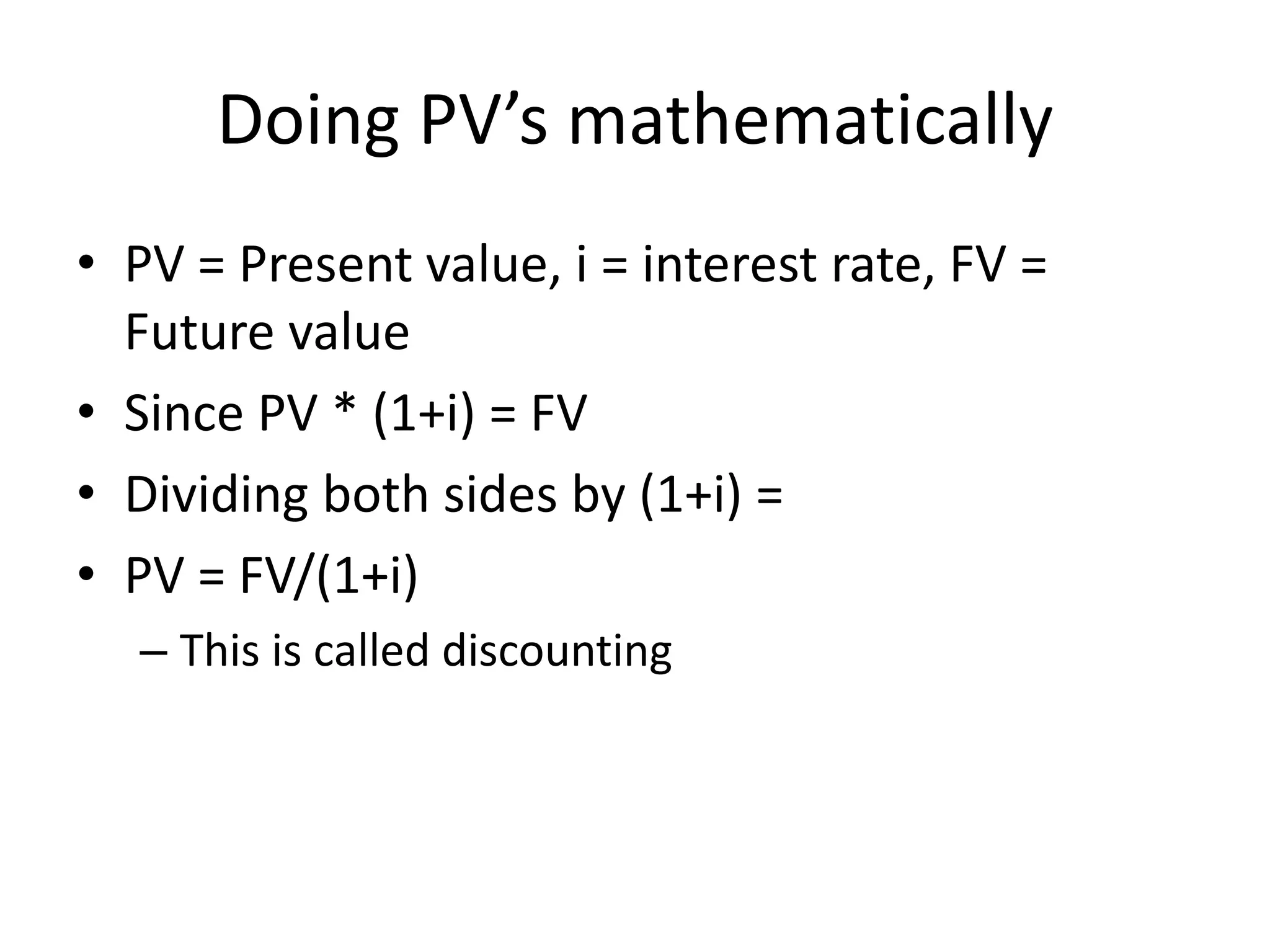
Doing PV’s mathematically 
• PV = Present value, i = interest rate, FV = 
Future value 
• Since PV * (1+i) = FV 
• Dividing both sides by (1+i)…
Doing PV’s mathematically 
• PV = Present value, i = interest rate, FV = 
Future value 
• Since PV * (1+i) = FV 
• Dividing both sides by (1+i) = 
• PV = FV/(1+i) 
– This is called discounting
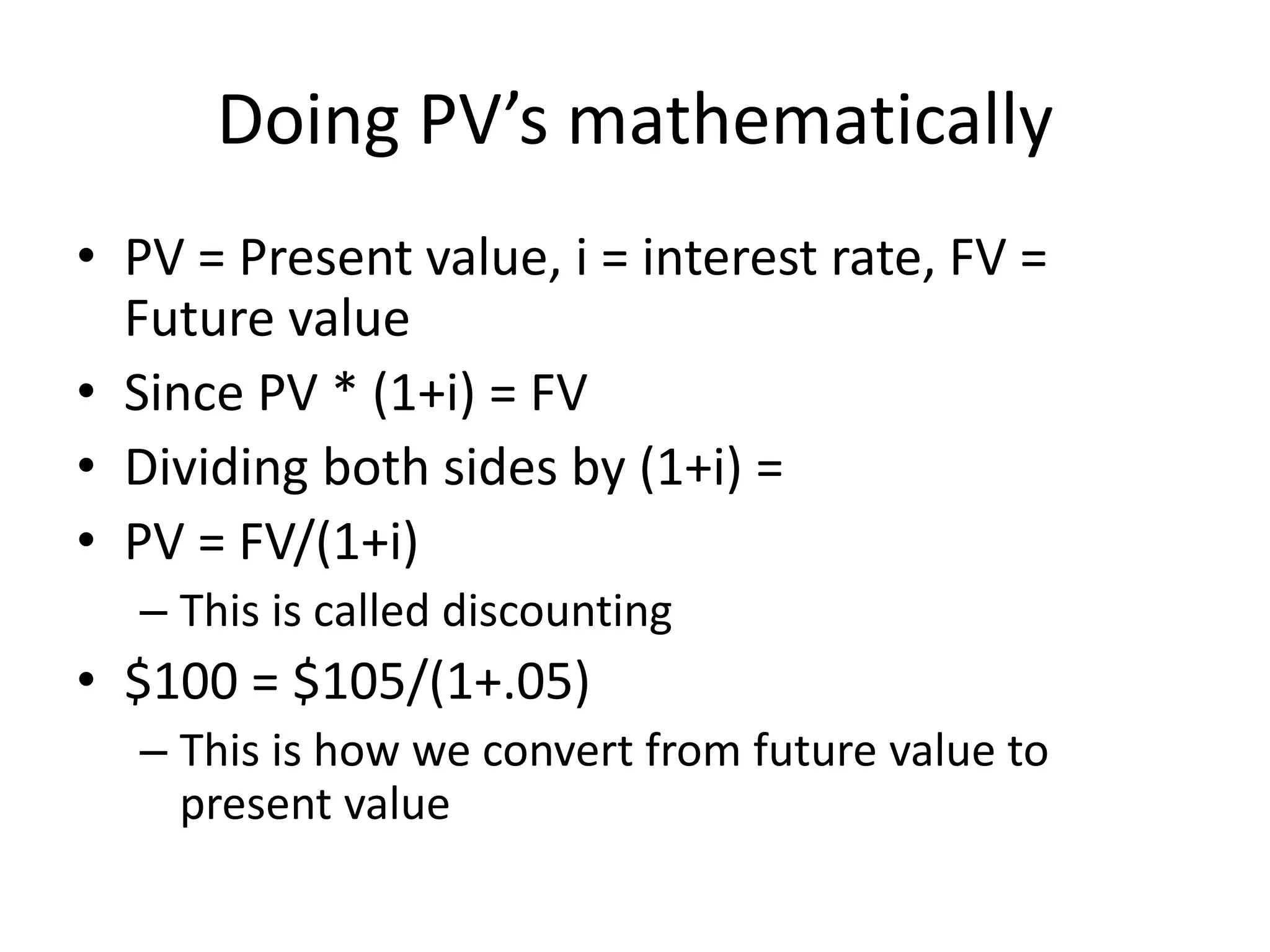
Doing PV’s mathematically 
• PV = Present value, i = interest rate, FV = 
Future value 
• Since PV * (1+i) = FV 
• Dividing both sides by (1+i) = 
• PV = FV/(1+i) 
– This is called discounting 
• $100 = $105/(1+.05) 
– This is how we convert from future value to 
present value
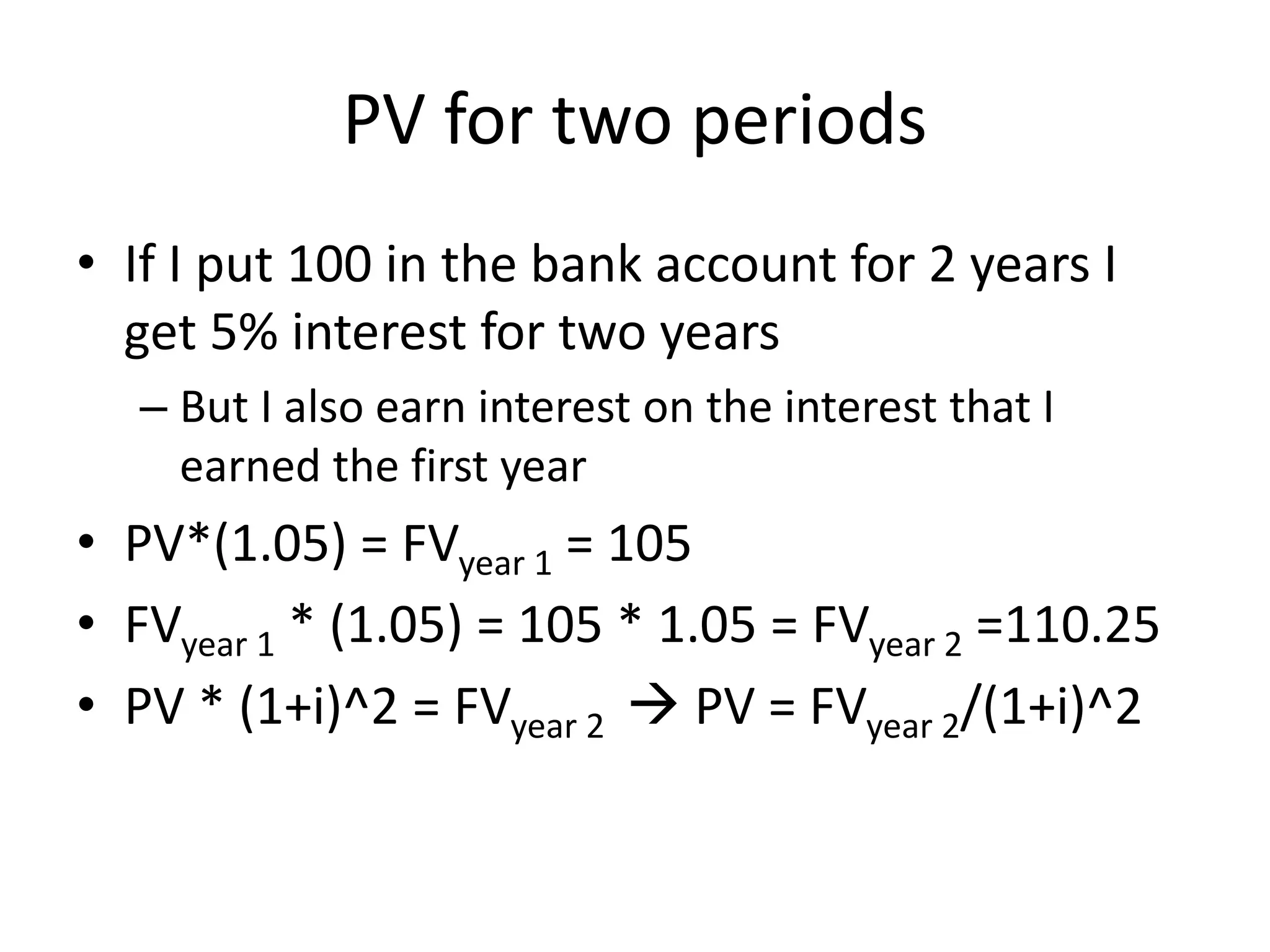
PV for two periods 
• If I put 100 in the bank account for 2 years I 
get 5% interest for two years 
– But I also earn interest on the interest that I 
earned the first year 
• PV*(1.05) = FVyear 1 = 105 
• FVyear 1 * (1.05) = 105 * 1.05 = FVyear 2 =110.25 
• PV * (1+i)^2 = FVyear  2 
PV = FVyear 2/(1+i)^2
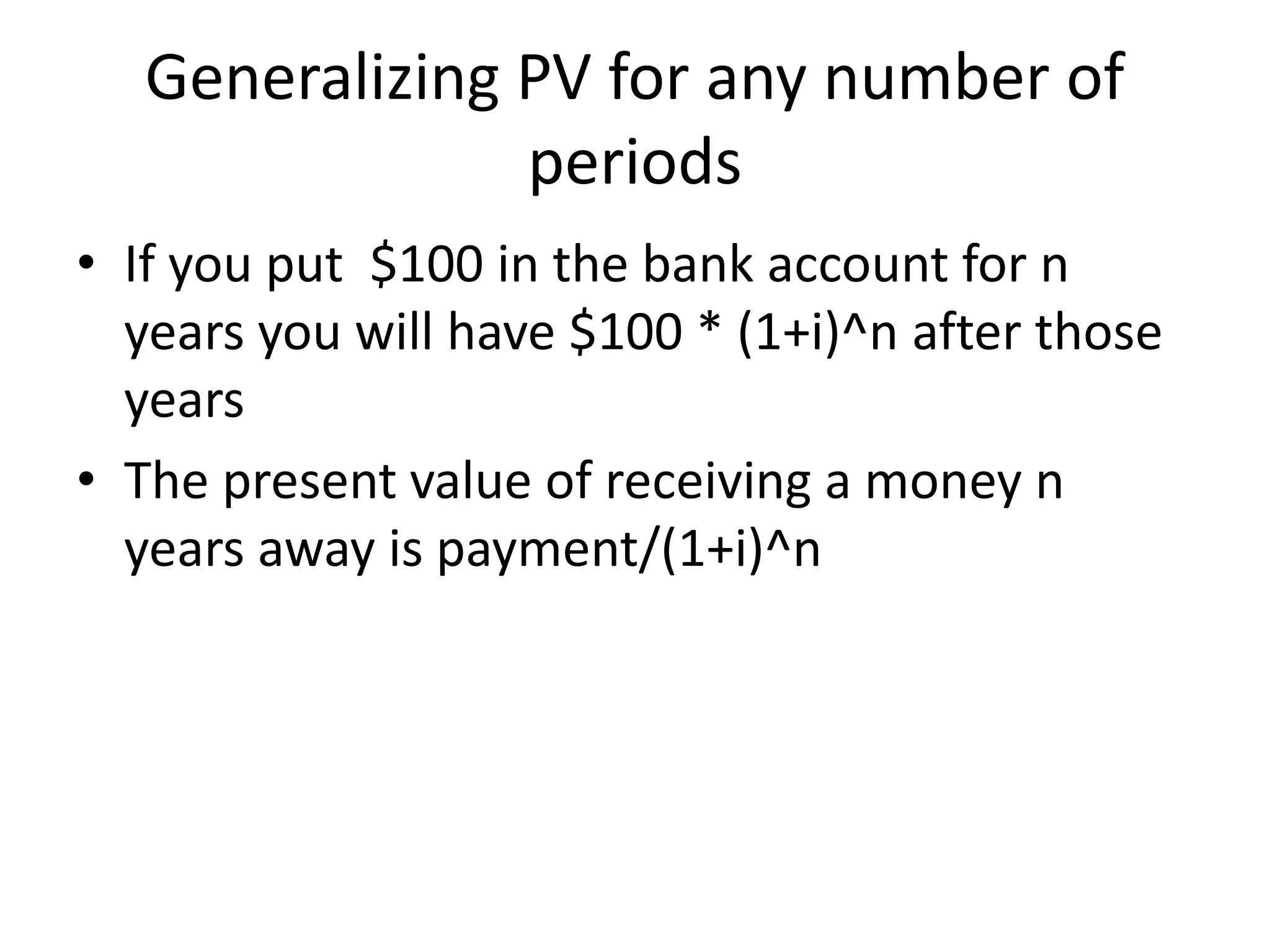
Generalizing PV for any number of 
periods 
• If you put $100 in the bank account for n 
years you will have $100 * (1+i)^n after those 
years 
• The present value of receiving a money n 
years away is payment/(1+i)^n
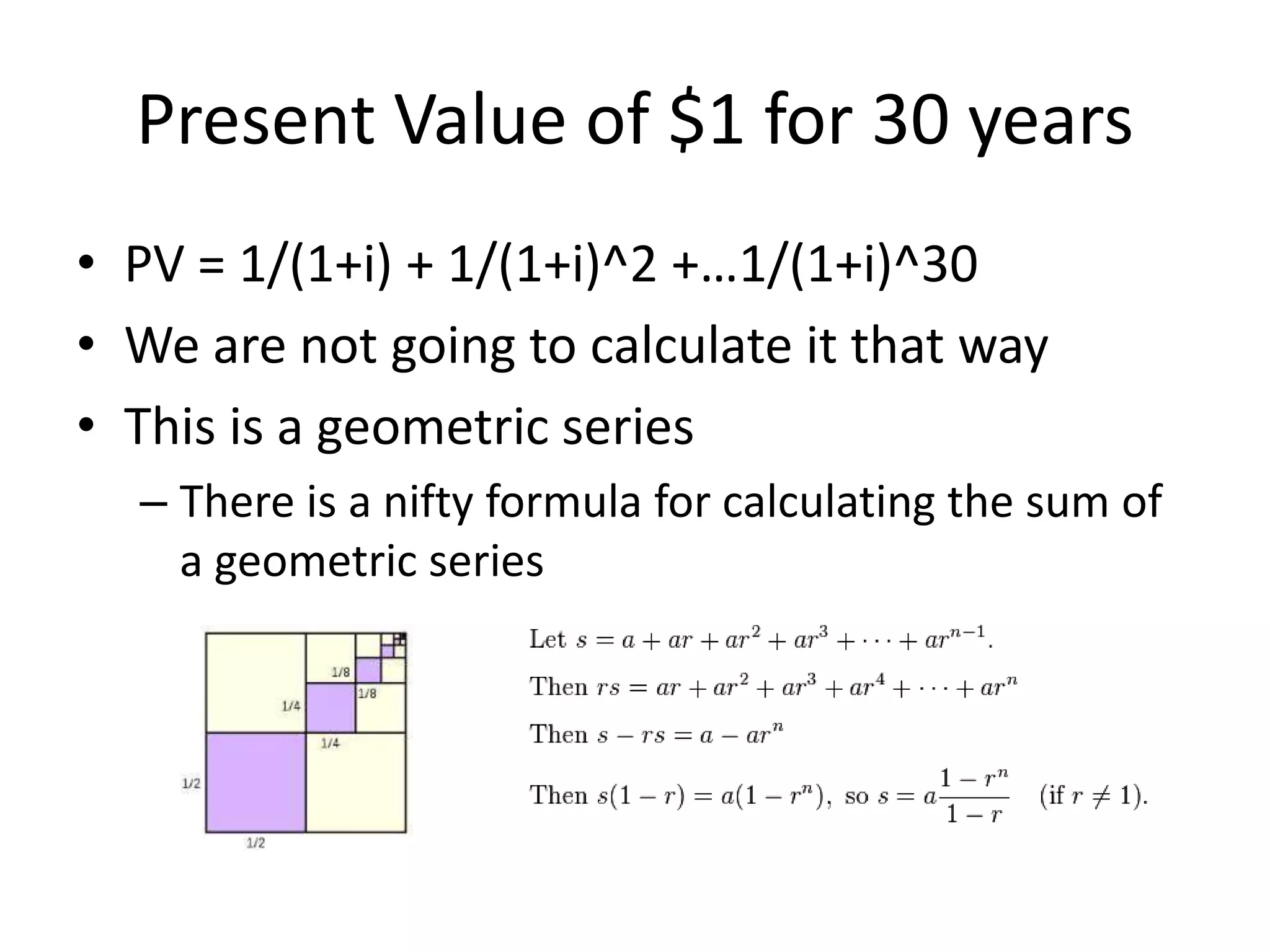
Present Value of $1 for 30 years 
• PV = 1/(1+i) + 1/(1+i)^2 +…1/(1+i)^30 
• We are not going to calculate it that way 
• This is a geometric series 
– There is a nifty formula for calculating the sum of 
a geometric series
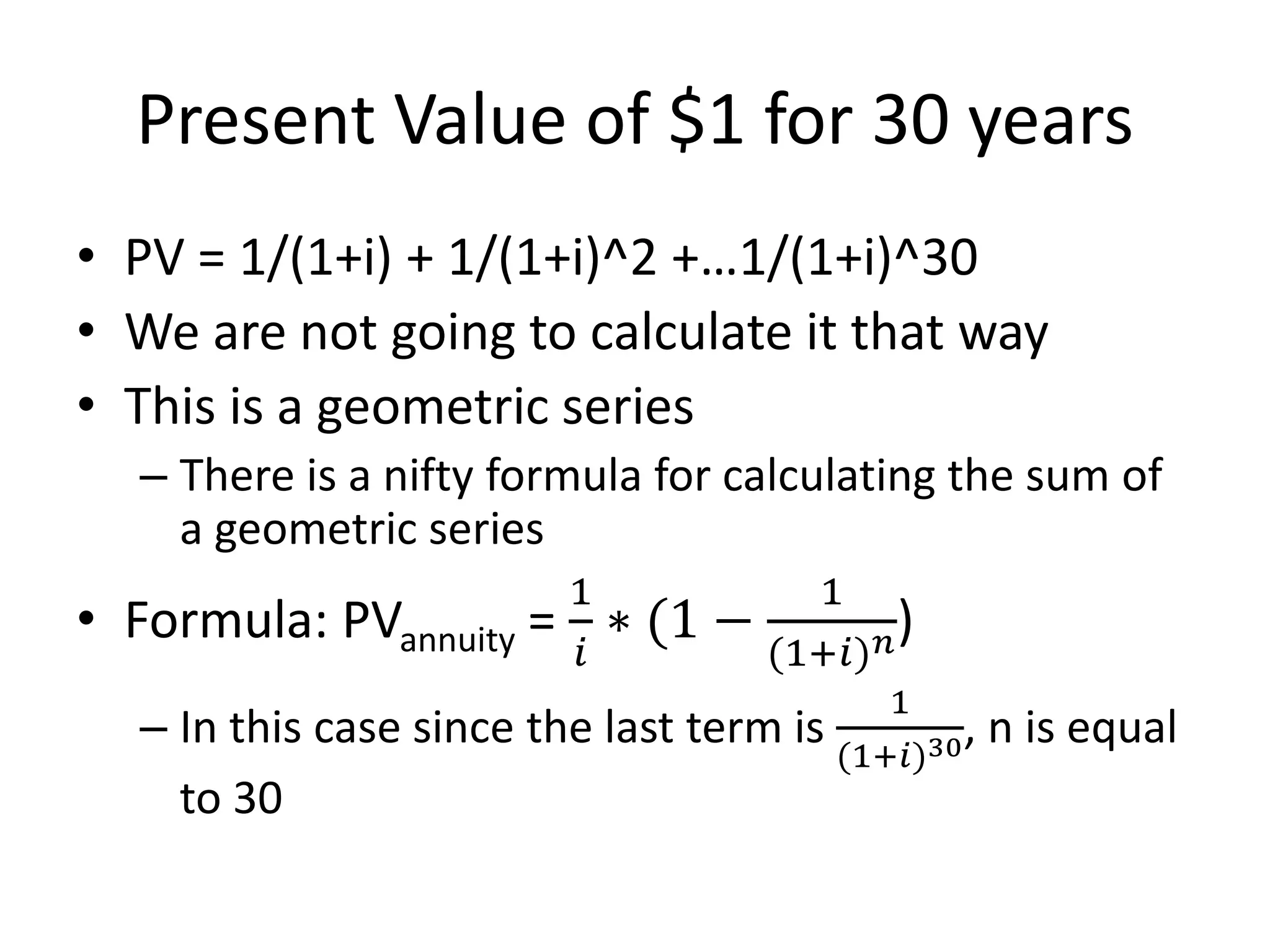
Present Value of $1 for 30 years 
• PV = 1/(1+i) + 1/(1+i)^2 +…1/(1+i)^30 
• We are not going to calculate it that way 
• This is a geometric series 
– There is a nifty formula for calculating the sum of 
a geometric series 
• Formula: PVannuity = 
1 
푖 
∗ (1 − 
1 
(1+푖)푛) 
– In this case since the last term is 
1 
(1+푖)30, n is equal 
to 30
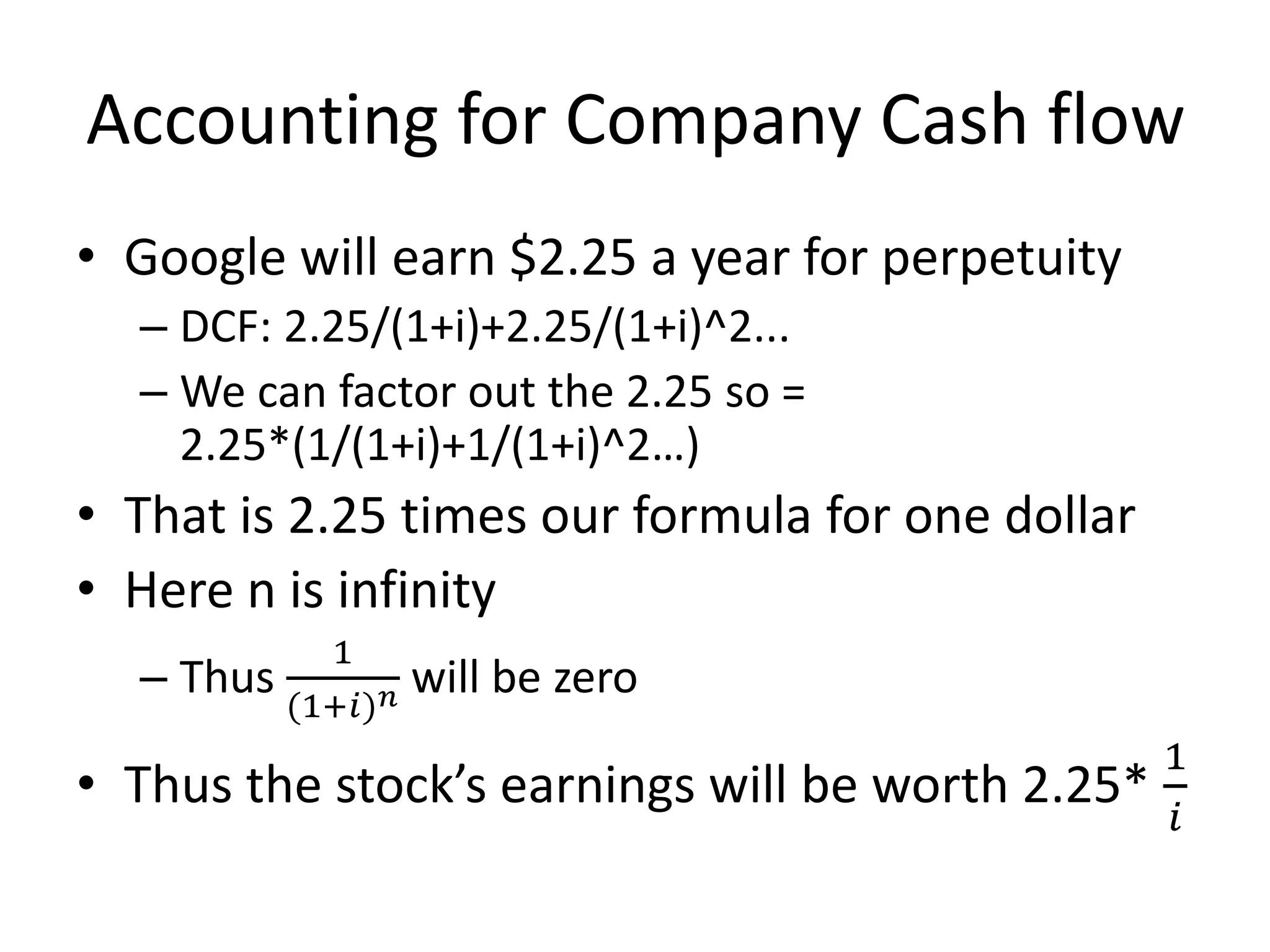
Accounting for Company Cash flow 
• Google will earn $2.25 a year for perpetuity 
– DCF: 2.25/(1+i)+2.25/(1+i)^2... 
– We can factor out the 2.25 so = 
2.25*(1/(1+i)+1/(1+i)^2…) 
• That is 2.25 times our formula for one dollar 
• Here n is infinity 
– Thus 
1 
(1+푖)푛 will be zero 
• Thus the stock’s earnings will be worth 2.25* 
1 
푖
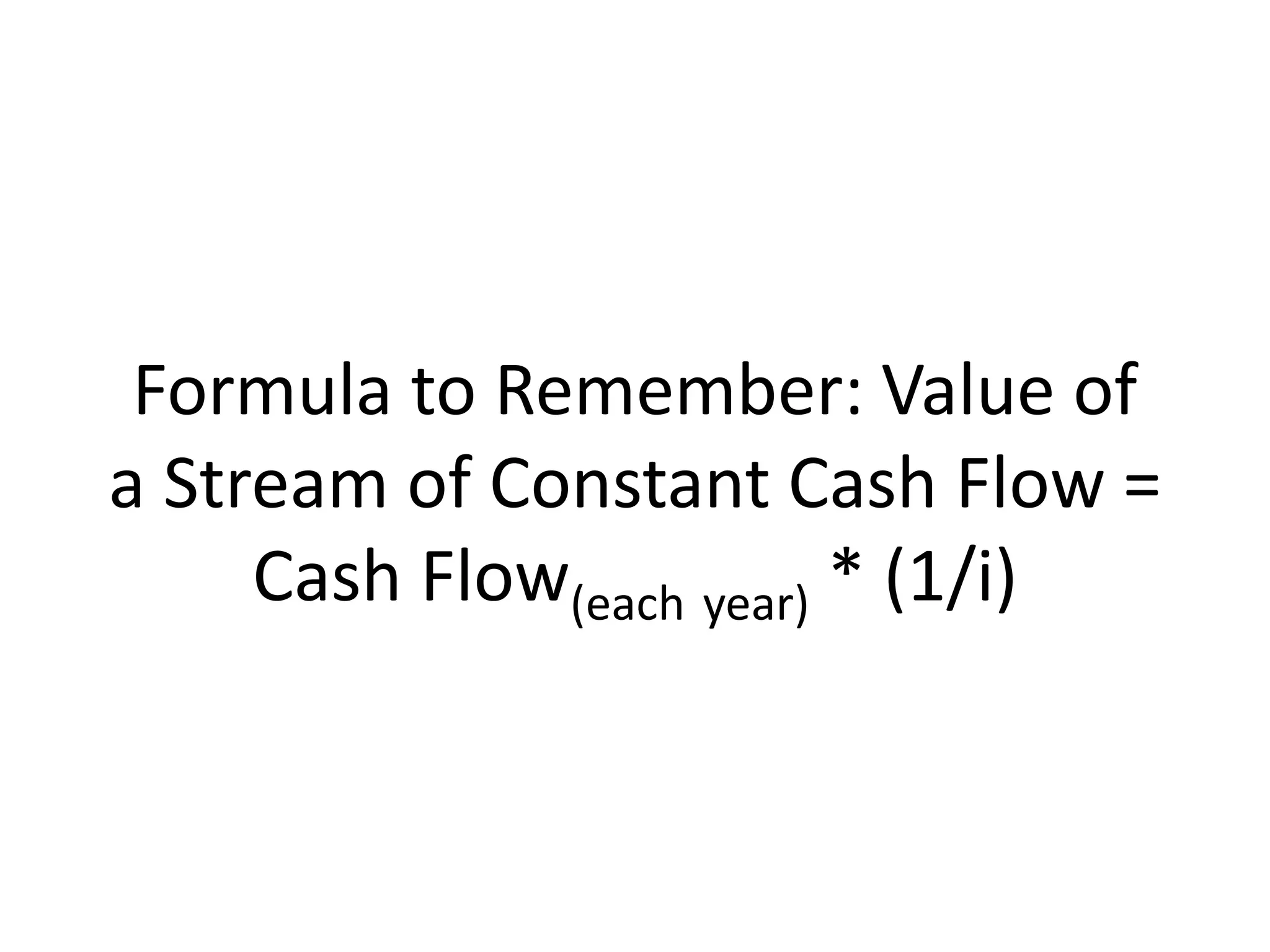
Formula to Remember: Value of 
a Stream of Constant Cash Flow = 
Cash Flow(each year) * (1/i)
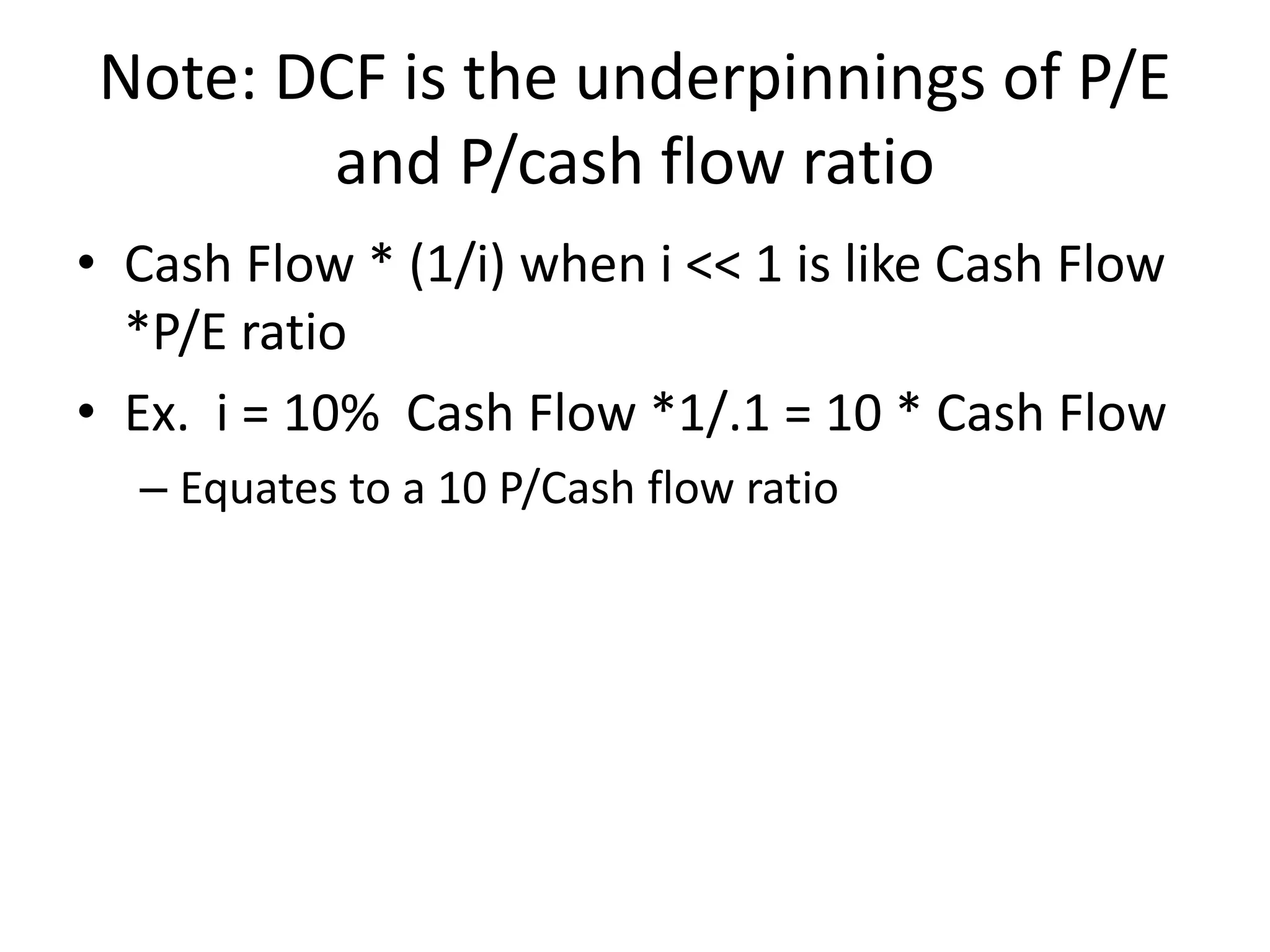
Note: DCF is the underpinnings of P/E 
and P/cash flow ratio 
• Cash Flow * (1/i) when i << 1 is like Cash Flow 
*P/E ratio 
• Ex. i = 10% Cash Flow *1/.1 = 10 * Cash Flow 
– Equates to a 10 P/Cash flow ratio
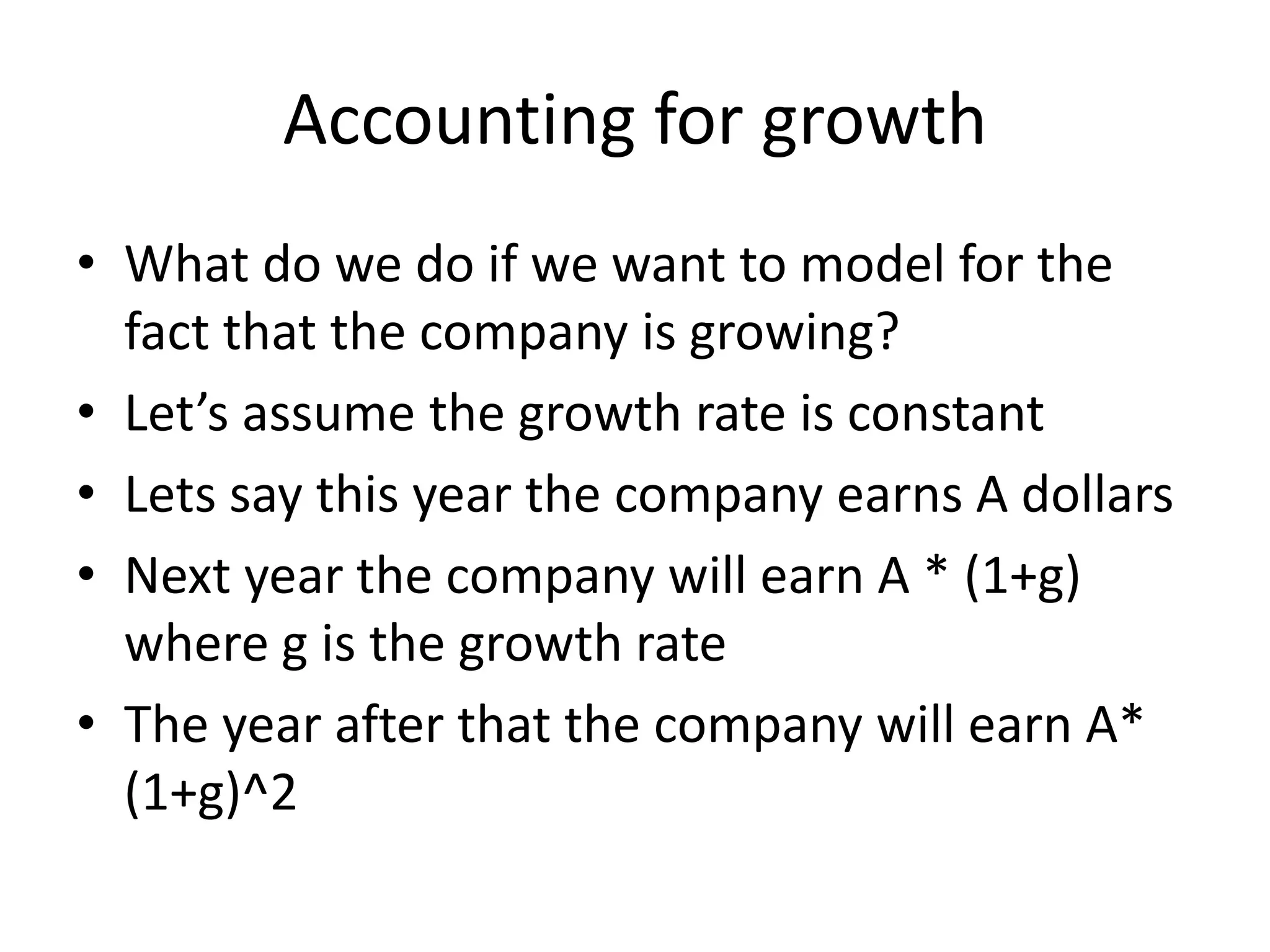
Accounting for growth 
• What do we do if we want to model for the 
fact that the company is growing? 
• Let’s assume the growth rate is constant 
• Lets say this year the company earns A dollars 
• Next year the company will earn A * (1+g) 
where g is the growth rate 
• The year after that the company will earn A* 
(1+g)^2
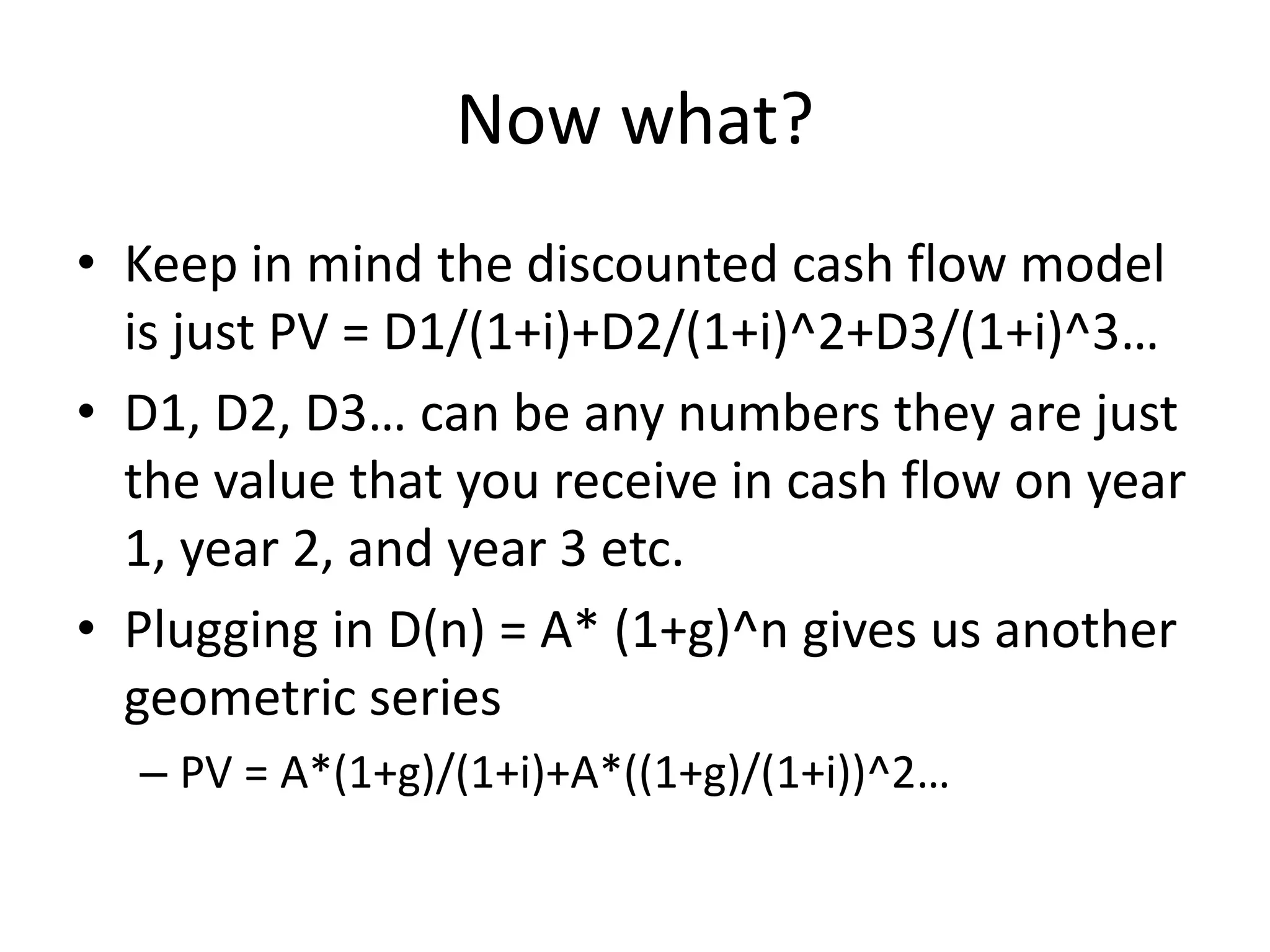
Now what? 
• Keep in mind the discounted cash flow model 
is just PV = D1/(1+i)+D2/(1+i)^2+D3/(1+i)^3… 
• D1, D2, D3… can be any numbers they are just 
the value that you receive in cash flow on year 
1, year 2, and year 3 etc. 
• Plugging in D(n) = A* (1+g)^n gives us another 
geometric series 
– PV = A*(1+g)/(1+i)+A*((1+g)/(1+i))^2…
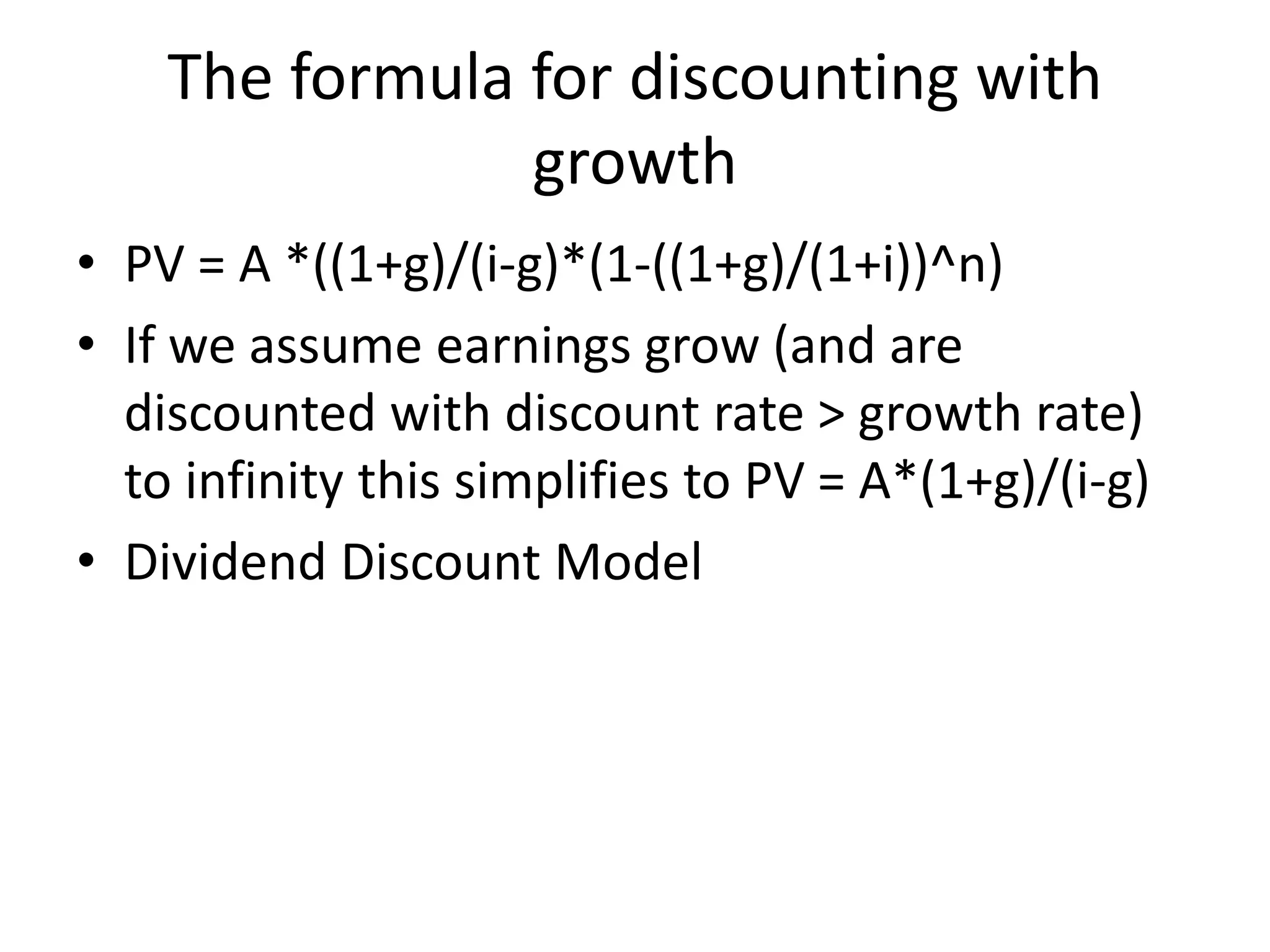
The formula for discounting with 
growth 
• PV = A *((1+g)/(i-g)*(1-((1+g)/(1+i))^n) 
• If we assume earnings grow (and are 
discounted with discount rate > growth rate) 
to infinity this simplifies to PV = A*(1+g)/(i-g) 
• Dividend Discount Model
Now what? 
• Now that you have the present value of the 
companies cash flow you have to subtract the 
value of the companies debt 
– Debt holders are senior to equity holders when it 
comes to getting back there money so theoretically 
the cash flow first goes to paying them back 
• The present value of discounted free cash flows – 
the value of the debt + total cash on balance 
sheets should be approximately equal to the 
market cap of your equity for a fairly valued 
company
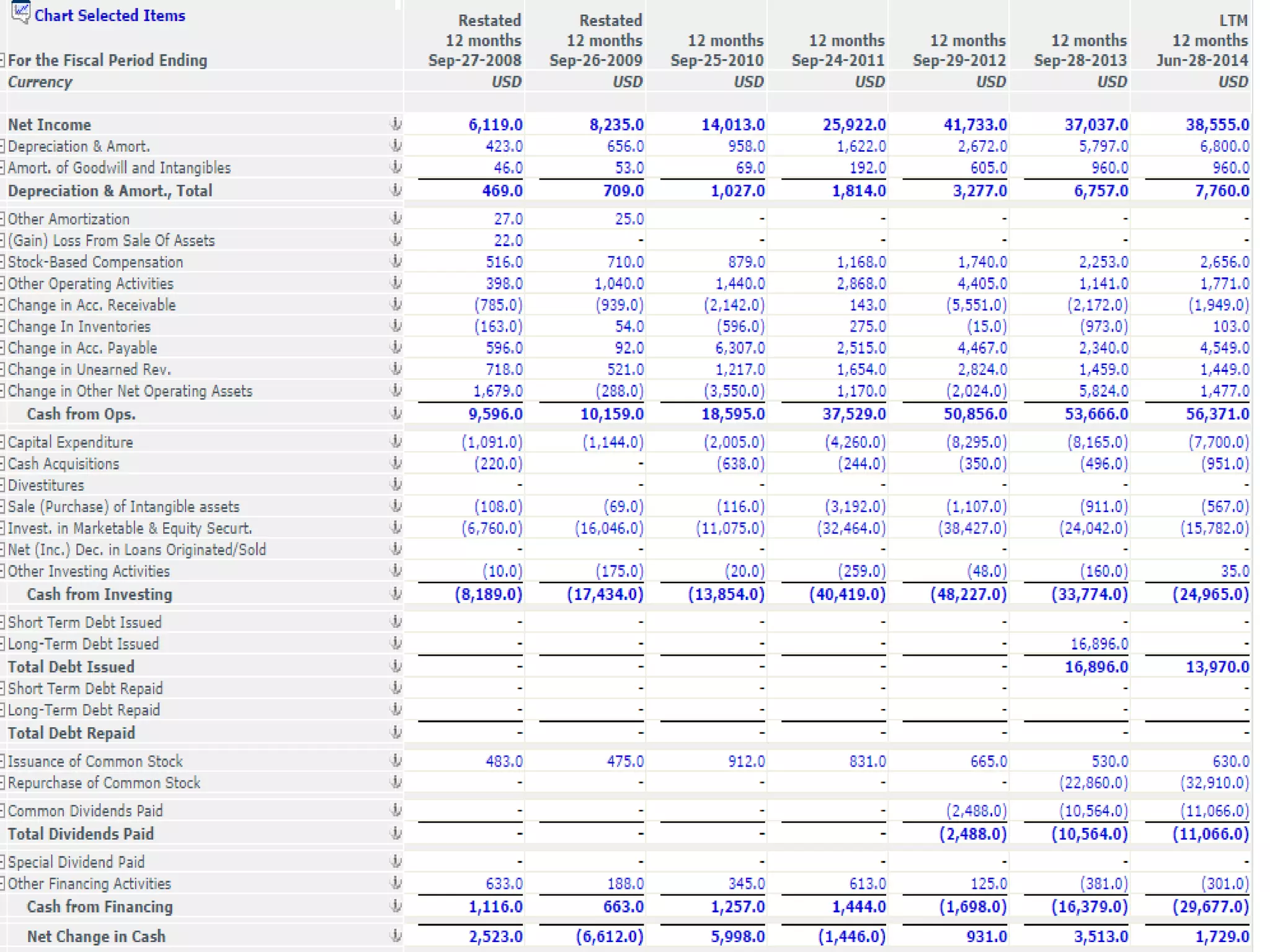
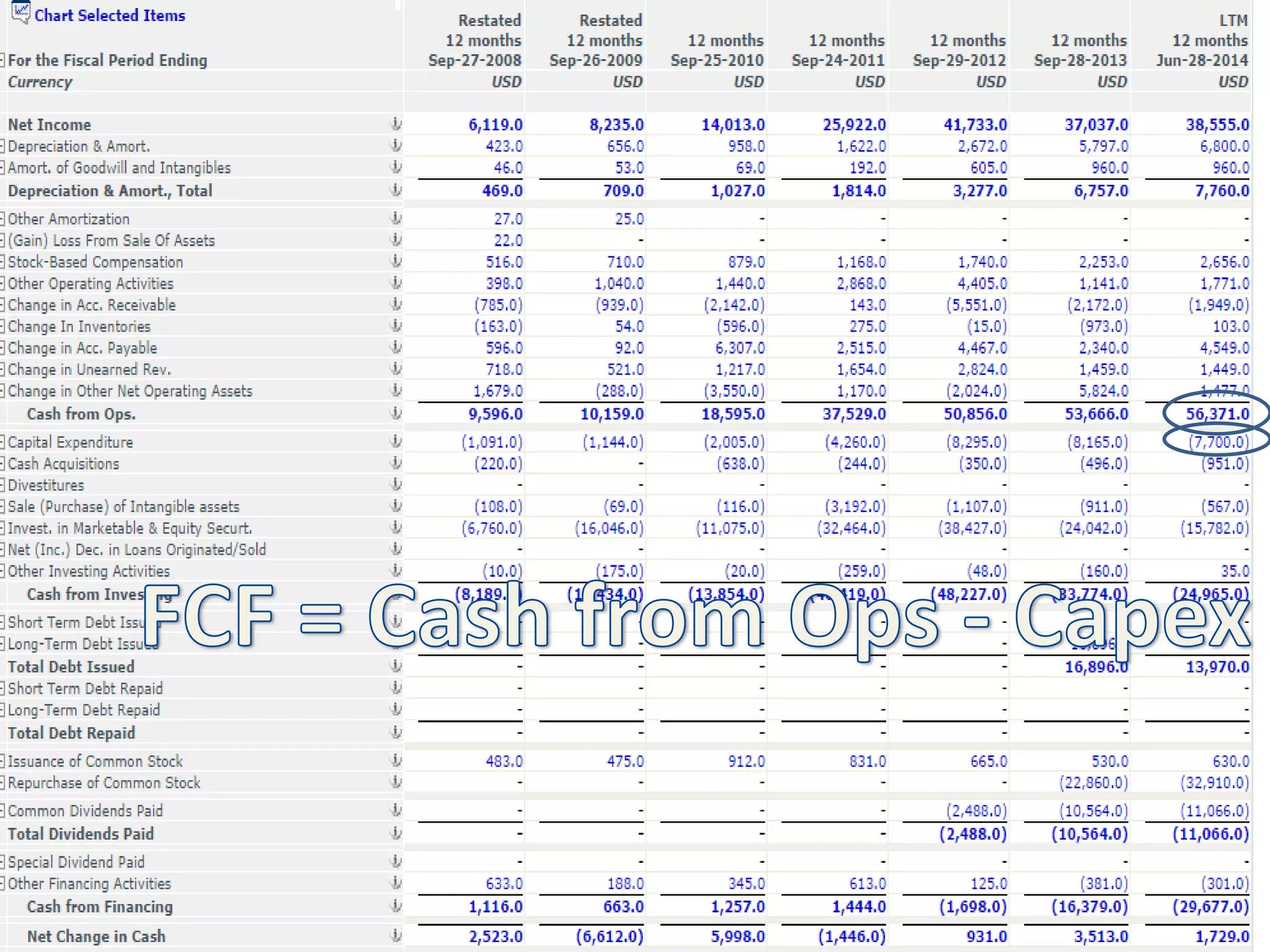
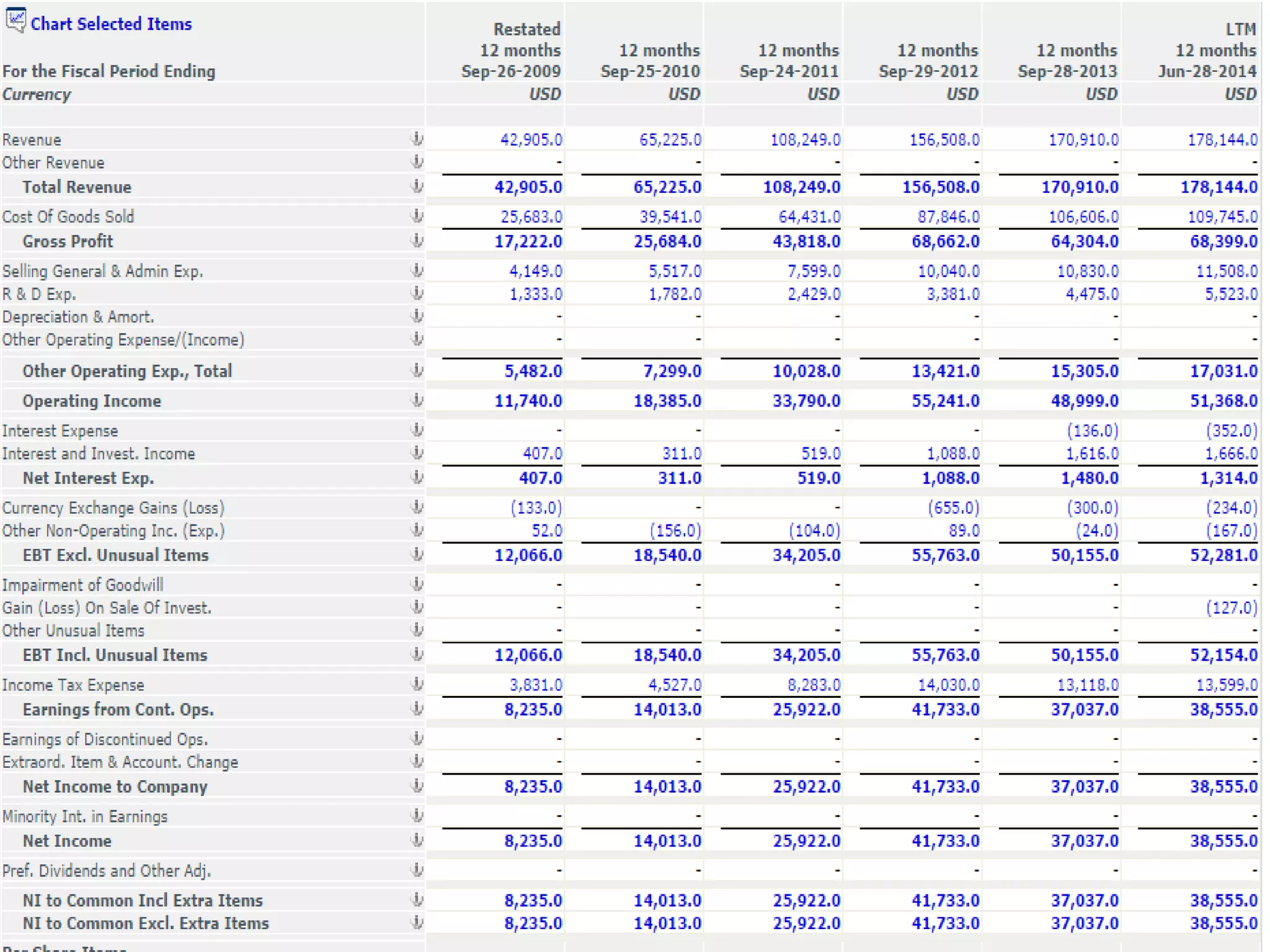
Exercise: Do a DCF model for 
AAPL
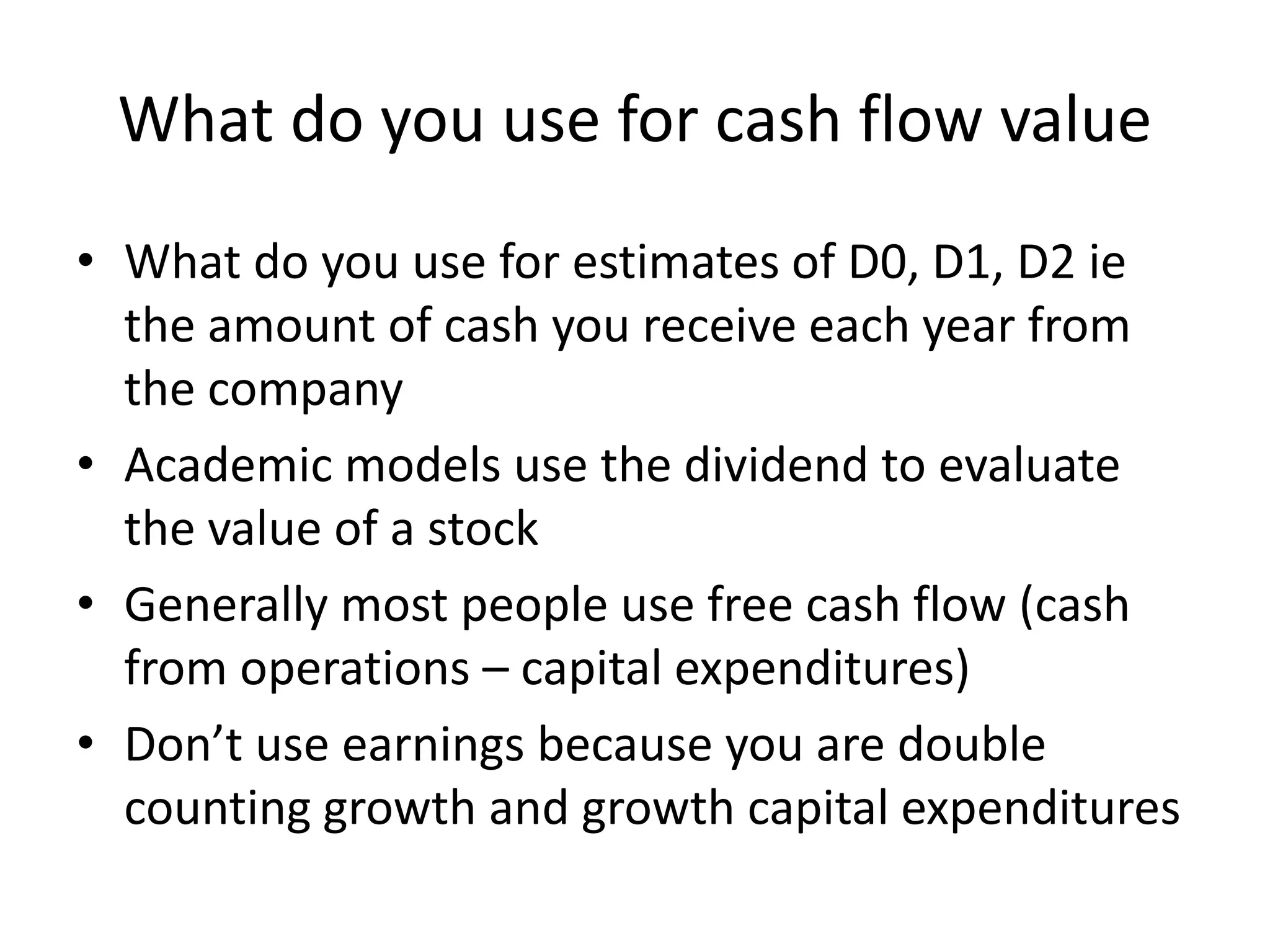
What do you use for cash flow value 
• What do you use for estimates of D0, D1, D2 ie 
the amount of cash you receive each year from 
the company 
• Academic models use the dividend to evaluate 
the value of a stock 
• Generally most people use free cash flow (cash 
from operations – capital expenditures) 
• Don’t use earnings because you are double 
counting growth and growth capital expenditures
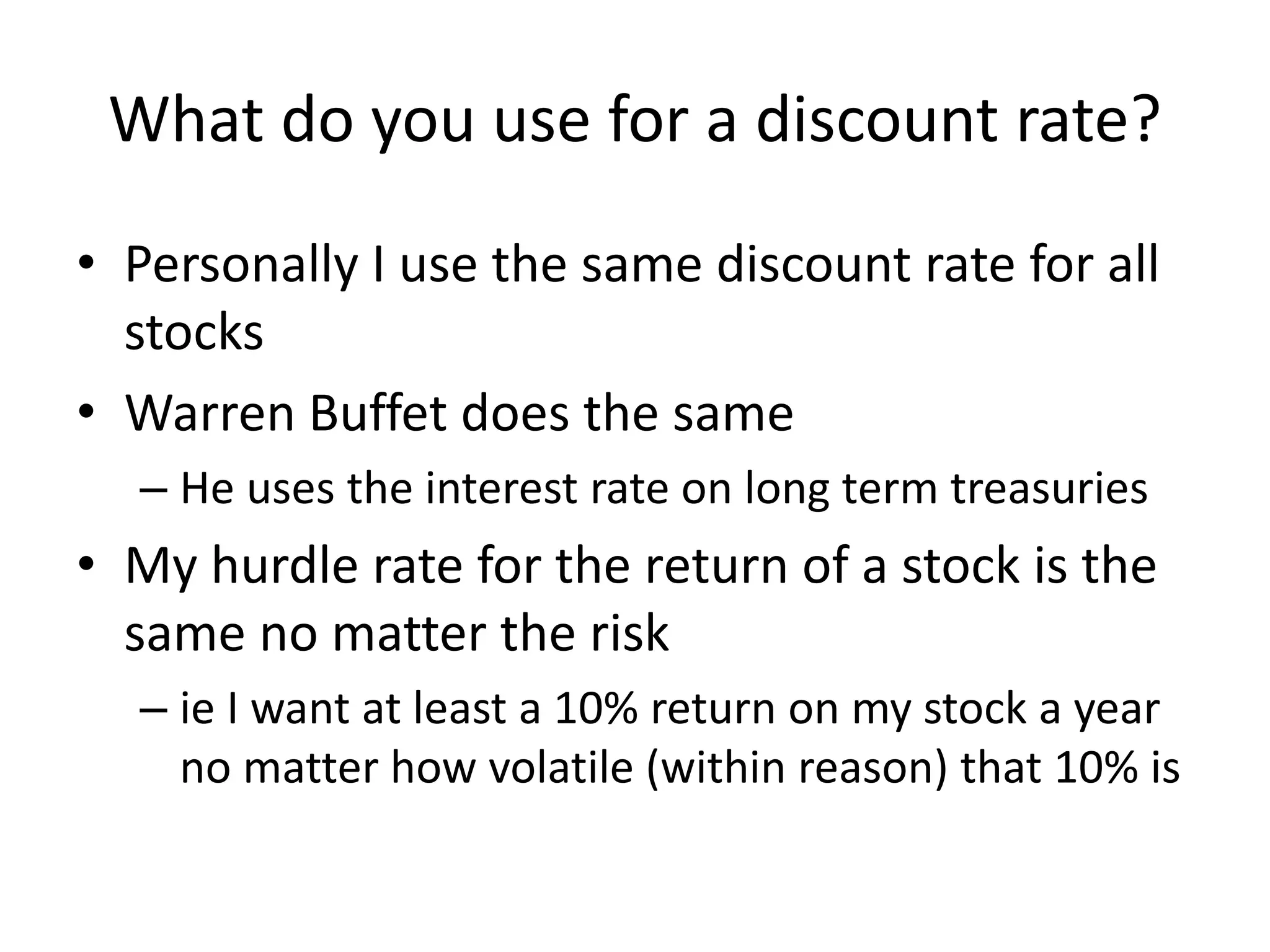
What do you use for a discount rate? 
• Personally I use the same discount rate for all 
stocks 
• Warren Buffet does the same 
– He uses the interest rate on long term treasuries 
• My hurdle rate for the return of a stock is the 
same no matter the risk 
– ie I want at least a 10% return on my stock a year 
no matter how volatile (within reason) that 10% is
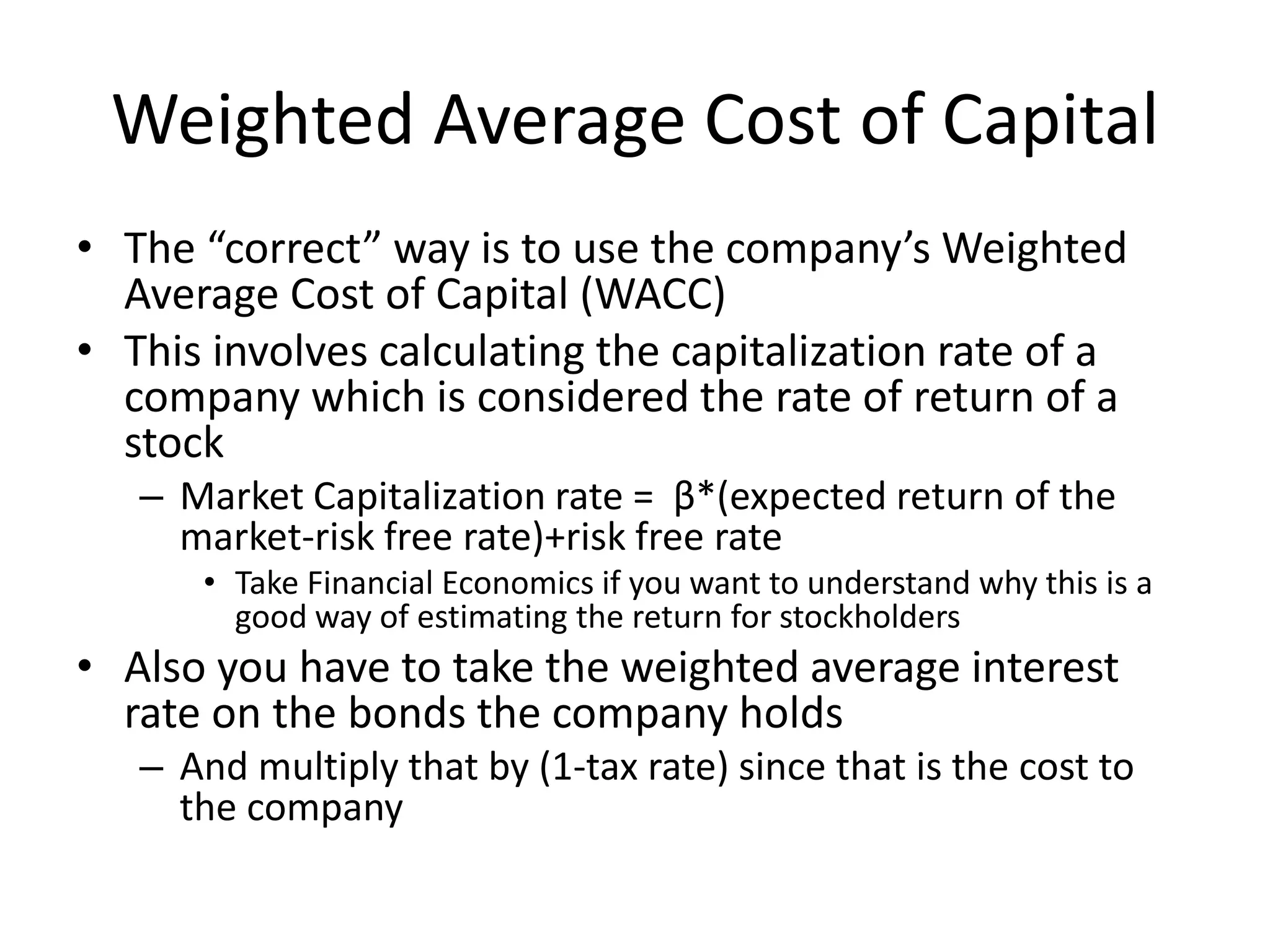
Weighted Average Cost of Capital 
• The “correct” way is to use the company’s Weighted 
Average Cost of Capital (WACC) 
• This involves calculating the capitalization rate of a 
company which is considered the rate of return of a 
stock 
– Market Capitalization rate = β*(expected return of the 
market-risk free rate)+risk free rate 
• Take Financial Economics if you want to understand why this is a 
good way of estimating the return for stockholders 
• Also you have to take the weighted average interest 
rate on the bonds the company holds 
– And multiply that by (1-tax rate) since that is the cost to 
the company
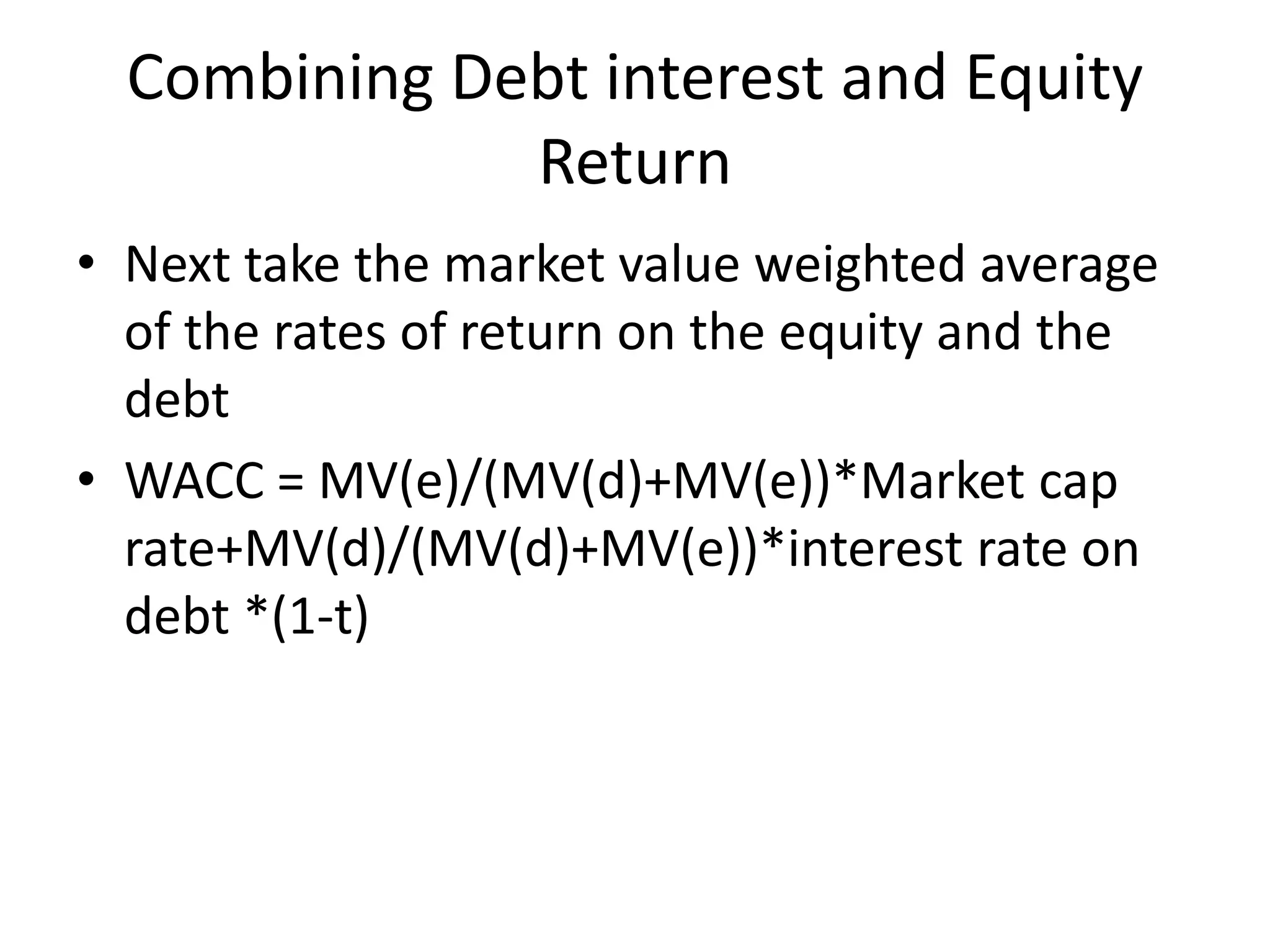
Combining Debt interest and Equity 
Return 
• Next take the market value weighted average 
of the rates of return on the equity and the 
debt 
• WACC = MV(e)/(MV(d)+MV(e))*Market cap 
rate+MV(d)/(MV(d)+MV(e))*interest rate on 
debt *(1-t)
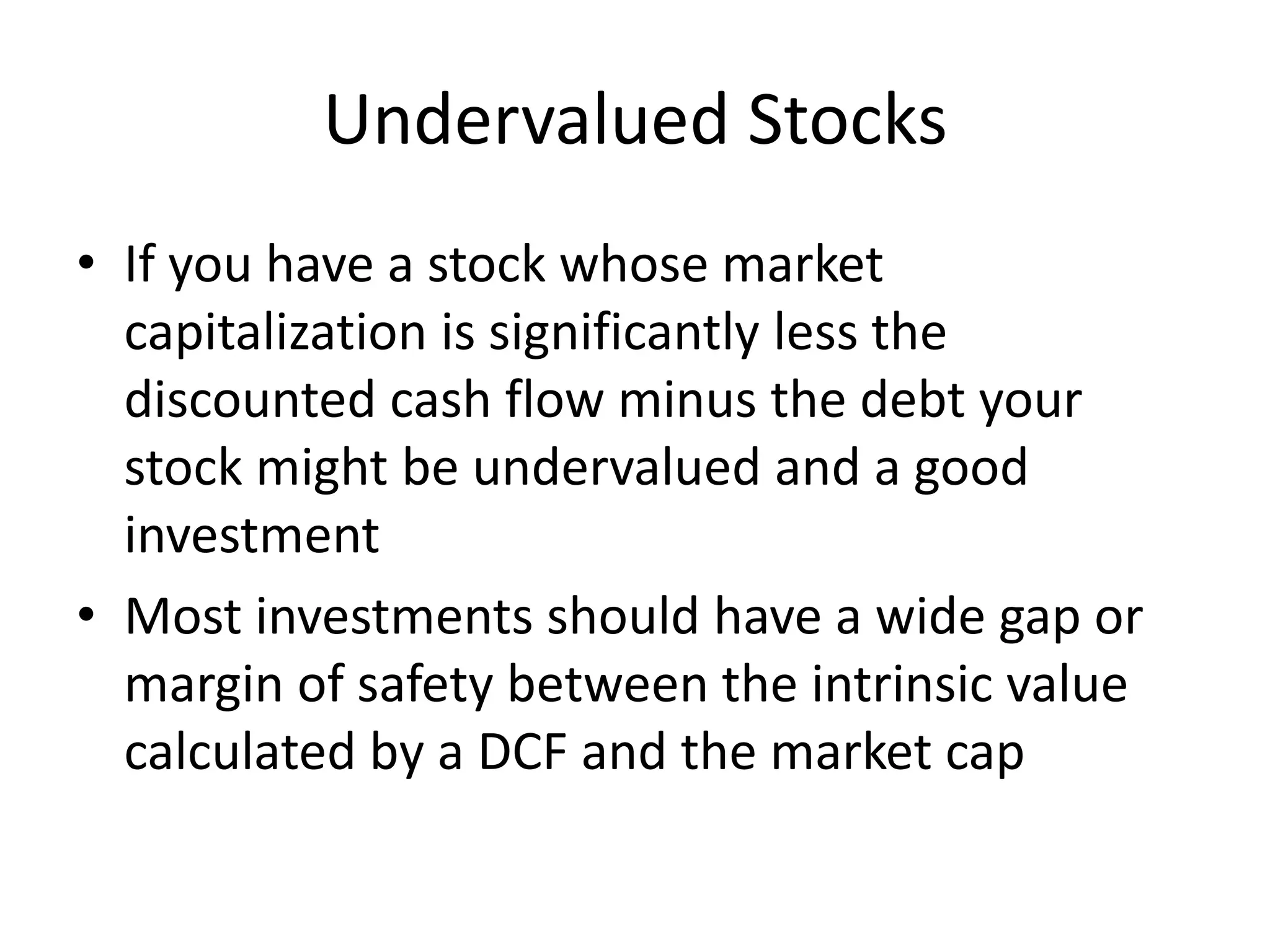
Undervalued Stocks 
• If you have a stock whose market 
capitalization is significantly less the 
discounted cash flow minus the debt your 
stock might be undervalued and a good 
investment 
• Most investments should have a wide gap or 
margin of safety between the intrinsic value 
calculated by a DCF and the market cap
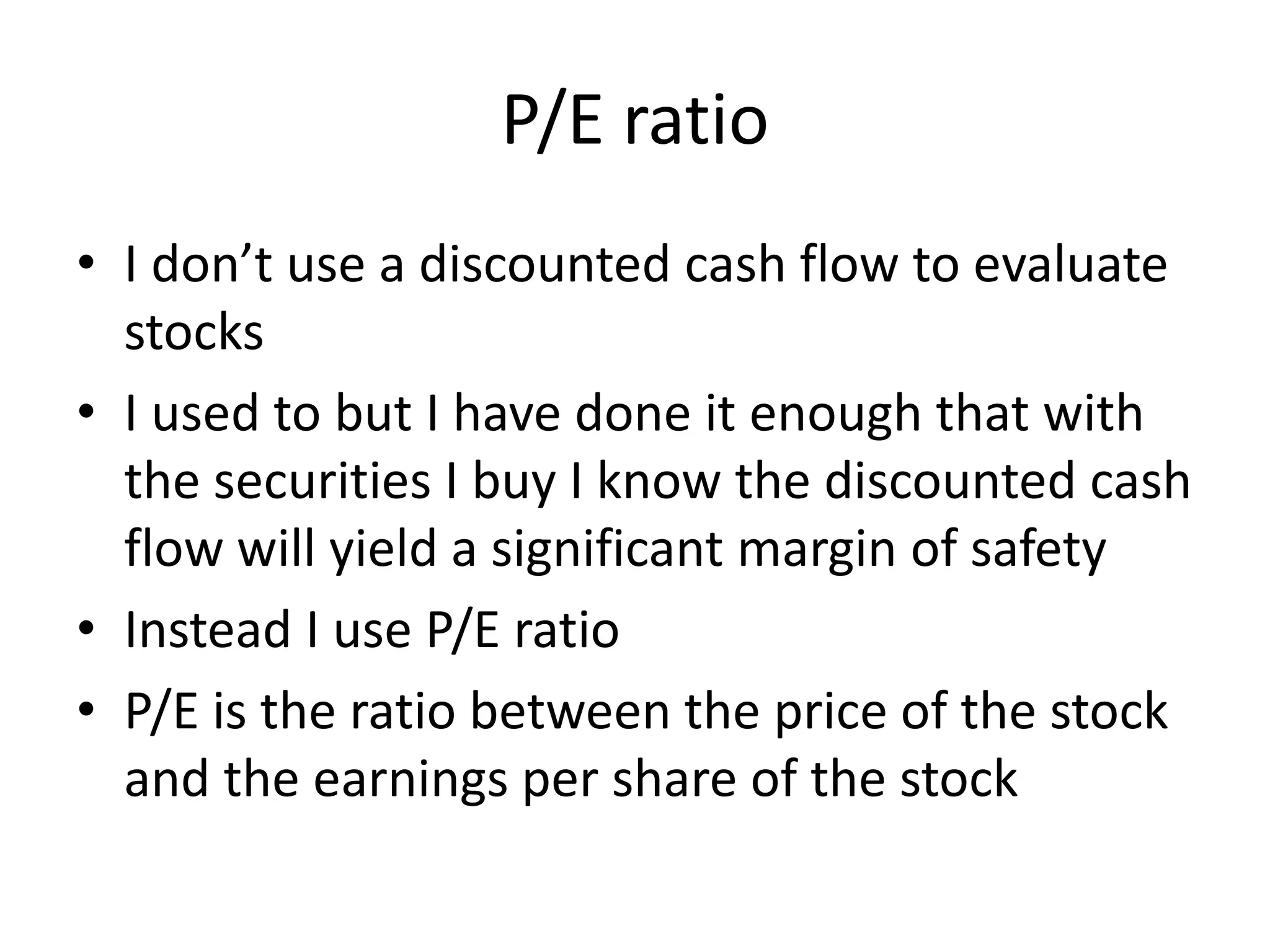
P/E ratio 
• I don’t use a discounted cash flow to evaluate 
stocks 
• I used to but I have done it enough that with 
the securities I buy I know the discounted cash 
flow will yield a significant margin of safety 
• Instead I use P/E ratio 
• P/E is the ratio between the price of the stock 
and the earnings per share of the stock
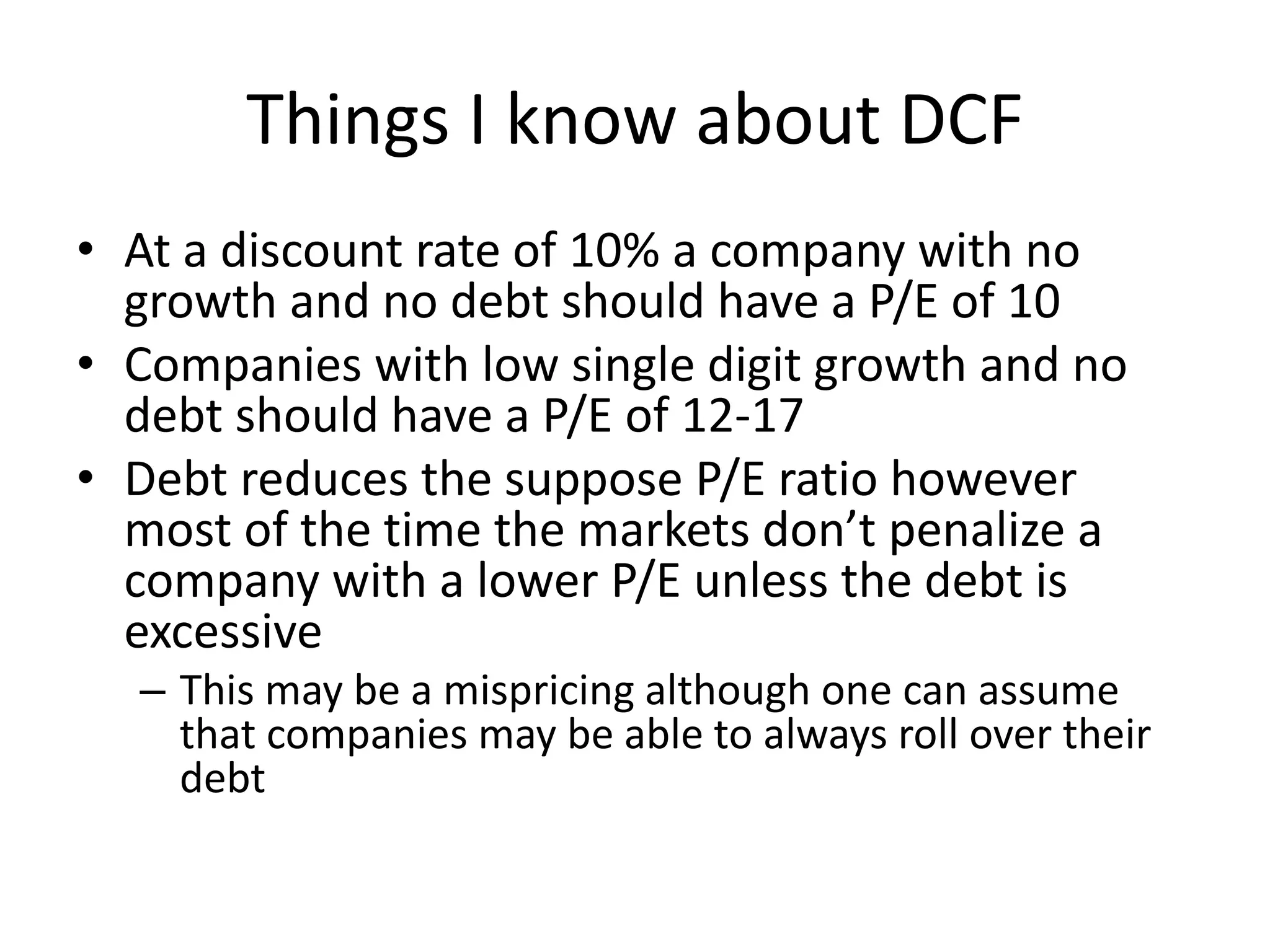
Things I know about DCF 
• At a discount rate of 10% a company with no 
growth and no debt should have a P/E of 10 
• Companies with low single digit growth and no 
debt should have a P/E of 12-17 
• Debt reduces the suppose P/E ratio however 
most of the time the markets don’t penalize a 
company with a lower P/E unless the debt is 
excessive 
– This may be a mispricing although one can assume 
that companies may be able to always roll over their 
debt
Other Metrics 
• Enterprise Value(EV), Earnings before interest 
and taxes (EBIT), Earnings before interest taxes 
depreciation and amortization (EBITDA), Price 
to earnings divided by growth (PEG), Free 
Cash Flow 
• All these metrics are discussed in the 
Accounting presentation
Company Valuation 
• Another way to value a company is to look at 
how comparable companies in the same 
industry are being valued 
• Also can look at recent acquisitions 
• Compare using P/E or EV/EBIT or EV/EBITDA or 
P/FCF or even more in depth look at the 
company
Dangers of using industry comparables 
• The whole sector maybe overvalued and you 
are buying perhaps at best the least 
overvalued (but still overvalued) 
• Companies often overpay for acquisitions 
– Goodwill write downs
Liquidation Value 
• We can also valuate a company based on how 
much all it’s assets will sell for if it closed 
down the business and sold all it’s assets 
• We can use tangible book value as one proxy 
for liquidation value 
• Tangible book value is Assets minus liabilities 
minus intangible assets 
– Goodwill etc.
Problems with Tangible Book Value 
• Many companies own lots of specialized 
equipment and machinery 
• These things are hard to sell 
• We need a margin of safety 
– We need a value where we know if we liquidated 
the company we would earn at least that much
Net Current Asset Value 
• Net Current Asset Value was coined by 
Benjamin Graham the father of value 
investments 
• Net Current Asset Value = Current Assets – 
Total Liabilities

Valuation Techniques

  • 1.
    How do youfigure out how much a company is worth? By Cameron Fen
  • 2.
    Table of Contents • Present Value • Discounted Cash flow • Discounted Cash flow with growth • Cash flow and WACC • P/E and other metrics
  • 3.
    What is FreeCash Flow • Free cash flow is the cash that the company has that is available to give back to shareholders • Companies don’t need free cash flow to maintain the operations of the company • The can pay dividends, buyback stock, make acquisitions, invest in growth with free cash flow
  • 4.
    Stocks are cashflows • The value of a stock is in the value of its earnings • The owner of a share owns the rights to proportional share of a company’s cash flow – If a company earns 100 million dollars and there are 50 million shares outstanding each share owns the rights to 2 dollars in earnings • The company is going earn you a profit $2 or more every year for the foreseeable future
  • 5.
    Present Value ofa stream of cash • One share of Google is going to pay you $2.25 a share in dividends every year for perpetuity, how much is the stock worth?
  • 6.
    Present Value ofa stream of cash • One share of Google is going to pay you $2.25 a share in dividends every year for perpetuity, how much is the stock worth? • First we need to talk about interest rates • If you put $100 in the bank and the interest rate is 5% you get $105 at the end of the year
  • 7.
    Discounting Future Value • The Present Value of $105 a year from now is $100 because you are indifferent from receiving $100 now and $105 a year from now • This makes sense because everyone would rather have money now then money a year from now so people have to pay us more if we had to give up money now to receive money in the future
  • 8.
    Doing PV’s mathematically • PV = Present value, i = interest rate, FV = Future value • Since PV * (1+i) = FV • Dividing both sides by (1+i)…
  • 9.
    Doing PV’s mathematically • PV = Present value, i = interest rate, FV = Future value • Since PV * (1+i) = FV • Dividing both sides by (1+i) = • PV = FV/(1+i) – This is called discounting
  • 10.
    Doing PV’s mathematically • PV = Present value, i = interest rate, FV = Future value • Since PV * (1+i) = FV • Dividing both sides by (1+i) = • PV = FV/(1+i) – This is called discounting • $100 = $105/(1+.05) – This is how we convert from future value to present value
  • 11.
    PV for twoperiods • If I put 100 in the bank account for 2 years I get 5% interest for two years – But I also earn interest on the interest that I earned the first year • PV*(1.05) = FVyear 1 = 105 • FVyear 1 * (1.05) = 105 * 1.05 = FVyear 2 =110.25 • PV * (1+i)^2 = FVyear  2 PV = FVyear 2/(1+i)^2
  • 12.
    Generalizing PV forany number of periods • If you put $100 in the bank account for n years you will have $100 * (1+i)^n after those years • The present value of receiving a money n years away is payment/(1+i)^n
  • 13.
    Present Value of$1 for 30 years • PV = 1/(1+i) + 1/(1+i)^2 +…1/(1+i)^30 • We are not going to calculate it that way • This is a geometric series – There is a nifty formula for calculating the sum of a geometric series
  • 14.
    Present Value of$1 for 30 years • PV = 1/(1+i) + 1/(1+i)^2 +…1/(1+i)^30 • We are not going to calculate it that way • This is a geometric series – There is a nifty formula for calculating the sum of a geometric series • Formula: PVannuity = 1 푖 ∗ (1 − 1 (1+푖)푛) – In this case since the last term is 1 (1+푖)30, n is equal to 30
  • 15.
    Accounting for CompanyCash flow • Google will earn $2.25 a year for perpetuity – DCF: 2.25/(1+i)+2.25/(1+i)^2... – We can factor out the 2.25 so = 2.25*(1/(1+i)+1/(1+i)^2…) • That is 2.25 times our formula for one dollar • Here n is infinity – Thus 1 (1+푖)푛 will be zero • Thus the stock’s earnings will be worth 2.25* 1 푖
  • 16.
    Formula to Remember:Value of a Stream of Constant Cash Flow = Cash Flow(each year) * (1/i)
  • 17.
    Note: DCF isthe underpinnings of P/E and P/cash flow ratio • Cash Flow * (1/i) when i << 1 is like Cash Flow *P/E ratio • Ex. i = 10% Cash Flow *1/.1 = 10 * Cash Flow – Equates to a 10 P/Cash flow ratio
  • 18.
    Accounting for growth • What do we do if we want to model for the fact that the company is growing? • Let’s assume the growth rate is constant • Lets say this year the company earns A dollars • Next year the company will earn A * (1+g) where g is the growth rate • The year after that the company will earn A* (1+g)^2
  • 19.
    Now what? •Keep in mind the discounted cash flow model is just PV = D1/(1+i)+D2/(1+i)^2+D3/(1+i)^3… • D1, D2, D3… can be any numbers they are just the value that you receive in cash flow on year 1, year 2, and year 3 etc. • Plugging in D(n) = A* (1+g)^n gives us another geometric series – PV = A*(1+g)/(1+i)+A*((1+g)/(1+i))^2…
  • 20.
    The formula fordiscounting with growth • PV = A *((1+g)/(i-g)*(1-((1+g)/(1+i))^n) • If we assume earnings grow (and are discounted with discount rate > growth rate) to infinity this simplifies to PV = A*(1+g)/(i-g) • Dividend Discount Model
  • 21.
    Now what? •Now that you have the present value of the companies cash flow you have to subtract the value of the companies debt – Debt holders are senior to equity holders when it comes to getting back there money so theoretically the cash flow first goes to paying them back • The present value of discounted free cash flows – the value of the debt + total cash on balance sheets should be approximately equal to the market cap of your equity for a fairly valued company
  • 22.
    Exercise: Do aDCF model for AAPL
  • 26.
    What do youuse for cash flow value • What do you use for estimates of D0, D1, D2 ie the amount of cash you receive each year from the company • Academic models use the dividend to evaluate the value of a stock • Generally most people use free cash flow (cash from operations – capital expenditures) • Don’t use earnings because you are double counting growth and growth capital expenditures
  • 27.
    What do youuse for a discount rate? • Personally I use the same discount rate for all stocks • Warren Buffet does the same – He uses the interest rate on long term treasuries • My hurdle rate for the return of a stock is the same no matter the risk – ie I want at least a 10% return on my stock a year no matter how volatile (within reason) that 10% is
  • 28.
    Weighted Average Costof Capital • The “correct” way is to use the company’s Weighted Average Cost of Capital (WACC) • This involves calculating the capitalization rate of a company which is considered the rate of return of a stock – Market Capitalization rate = β*(expected return of the market-risk free rate)+risk free rate • Take Financial Economics if you want to understand why this is a good way of estimating the return for stockholders • Also you have to take the weighted average interest rate on the bonds the company holds – And multiply that by (1-tax rate) since that is the cost to the company
  • 29.
    Combining Debt interestand Equity Return • Next take the market value weighted average of the rates of return on the equity and the debt • WACC = MV(e)/(MV(d)+MV(e))*Market cap rate+MV(d)/(MV(d)+MV(e))*interest rate on debt *(1-t)
  • 30.
    Undervalued Stocks •If you have a stock whose market capitalization is significantly less the discounted cash flow minus the debt your stock might be undervalued and a good investment • Most investments should have a wide gap or margin of safety between the intrinsic value calculated by a DCF and the market cap
  • 31.
    P/E ratio •I don’t use a discounted cash flow to evaluate stocks • I used to but I have done it enough that with the securities I buy I know the discounted cash flow will yield a significant margin of safety • Instead I use P/E ratio • P/E is the ratio between the price of the stock and the earnings per share of the stock
  • 32.
    Things I knowabout DCF • At a discount rate of 10% a company with no growth and no debt should have a P/E of 10 • Companies with low single digit growth and no debt should have a P/E of 12-17 • Debt reduces the suppose P/E ratio however most of the time the markets don’t penalize a company with a lower P/E unless the debt is excessive – This may be a mispricing although one can assume that companies may be able to always roll over their debt
  • 33.
    Other Metrics •Enterprise Value(EV), Earnings before interest and taxes (EBIT), Earnings before interest taxes depreciation and amortization (EBITDA), Price to earnings divided by growth (PEG), Free Cash Flow • All these metrics are discussed in the Accounting presentation
  • 34.
    Company Valuation •Another way to value a company is to look at how comparable companies in the same industry are being valued • Also can look at recent acquisitions • Compare using P/E or EV/EBIT or EV/EBITDA or P/FCF or even more in depth look at the company
  • 35.
    Dangers of usingindustry comparables • The whole sector maybe overvalued and you are buying perhaps at best the least overvalued (but still overvalued) • Companies often overpay for acquisitions – Goodwill write downs
  • 36.
    Liquidation Value •We can also valuate a company based on how much all it’s assets will sell for if it closed down the business and sold all it’s assets • We can use tangible book value as one proxy for liquidation value • Tangible book value is Assets minus liabilities minus intangible assets – Goodwill etc.
  • 37.
    Problems with TangibleBook Value • Many companies own lots of specialized equipment and machinery • These things are hard to sell • We need a margin of safety – We need a value where we know if we liquidated the company we would earn at least that much
  • 38.
    Net Current AssetValue • Net Current Asset Value was coined by Benjamin Graham the father of value investments • Net Current Asset Value = Current Assets – Total Liabilities