Dr. Kumbhare Manoj R.
Professor
S.M.B.T. College of Pharmacy
Dhamangaon Nashik (M.S.).
Calcium channel blockers
After successful completion of topic, a learner
should be able to-
Understand History of Calcium channel
blockers
Know examples of Calcium channel blockers
Explain applications of Calcium channel
blockers
Mechanism of action of Calcium channel
blockers
Learning Outcome
2
Introduction
 History of Calcium channel blockers
 Know examples of Calcium channel blockers
 Explain applications of Calcium channel blockers
 Mechanism of action of Calcium channel blockers
Content
3
Calcium channel blockers were first identified in the
lab of German pharmacologist Albrecht Fleckenstein
beginning in 1964. In 1025, Avicenna introduced the
medicinal use of Taxus baccata for phytotherapy in
The Canon of Medicine. He named this herbal drug
"Zarnab" and used it as a cardiac remedy. This was
the first known use of a calcium channel blocker
drug, which were not in wide use in the Western
world until the 1960s.
Introduction
4
Calcium channel blockers (CCB), calcium
channel antagonists or calcium antagonists are
a group of medications that disrupt the movement
of calcium (Ca2+ ) through calcium channels
5
Mechanism
In the body's tissues, the concentration of calcium ions (Ca2+ )
outside cells is normally about 10000-fold higher than the
concentration inside cells. Embedded in the membrane of some
cells are calcium channels. When these cells receive a certain
signal, the channels open, letting calcium rush into the cell. The
resulting increase in intracellular calcium has different effects in
different types of cells. Calcium channel blockers prevent or
reduce the opening of these channels and thereby reduce these
effects.
6
 Classes
 1.1 Dihydropyridine
 1.2 Non-dihydropyridine
 1.2.1 Phenylalkylamine
 1.2.2 Benzothiazepine
 1.2.3 Nonselective
 1.2.4 Others
7
Dihydropyridine (DHP)
 Dihydropyridine (DHP) calcium channel blockers
are derived from the molecule dihydropyridine
and often used to reduce systemic vascular
resistance and arterial pressure.
 Manidipine Nicardipine , Nifedipine , Nilvadipine,
 Nimodipine This substance can pass the blood-
brain barrier and is used to prevent cerebral
vasospasm.
8
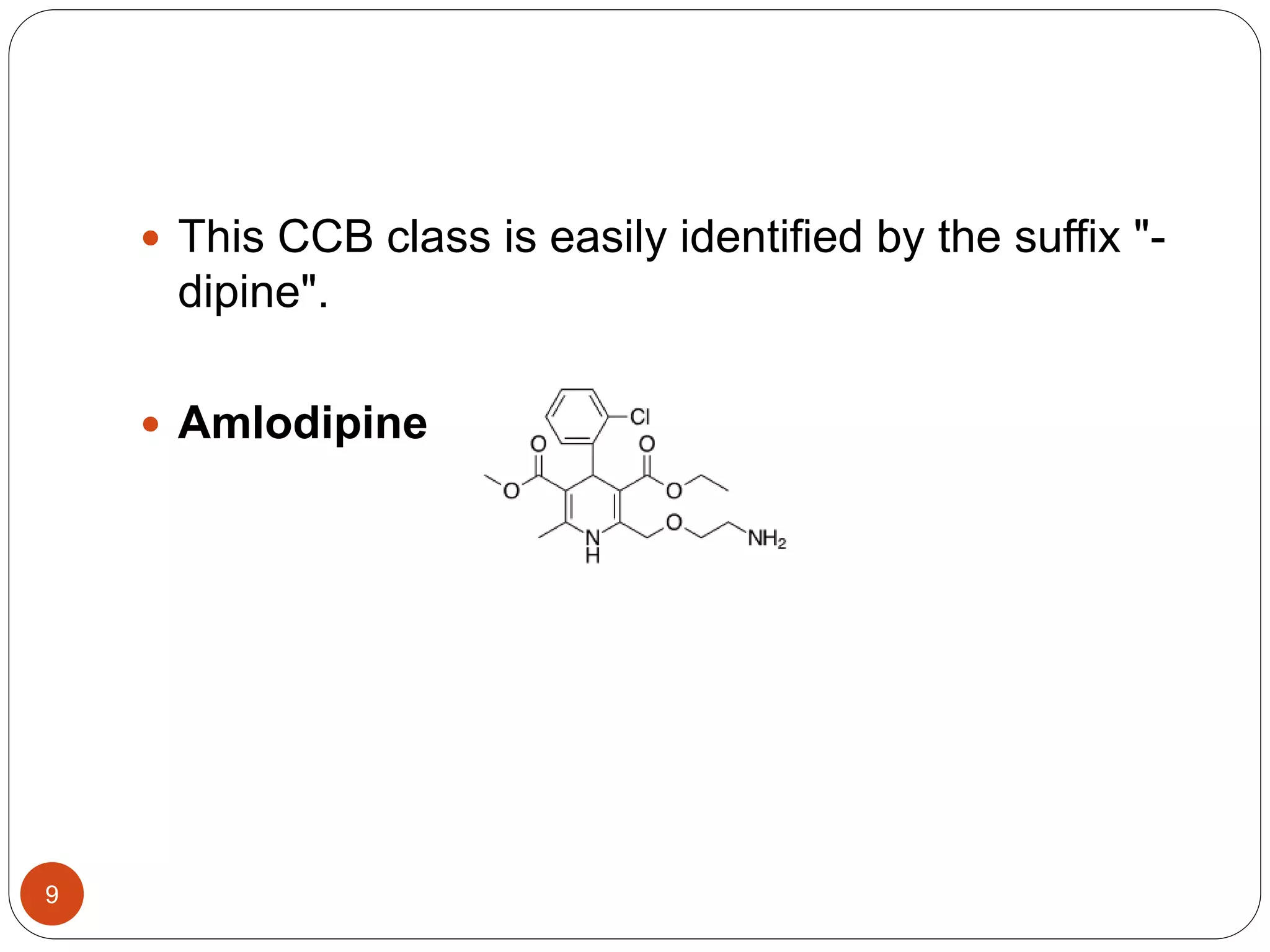
 This CCB class is easily identified by the suffix "-
dipine".
 Amlodipine
9
Nifedipine
10
 1.2 Non-dihydropyridine
 1.2.1 Phenylalkylamine
 Verapamil
11
Summary
Introduction
Mechanism of action
 Examples
Applications
12
13

Calcium channel blockers

  • 1.
    Dr. Kumbhare ManojR. Professor S.M.B.T. College of Pharmacy Dhamangaon Nashik (M.S.). Calcium channel blockers
  • 2.
    After successful completionof topic, a learner should be able to- Understand History of Calcium channel blockers Know examples of Calcium channel blockers Explain applications of Calcium channel blockers Mechanism of action of Calcium channel blockers Learning Outcome 2
  • 3.
    Introduction  History ofCalcium channel blockers  Know examples of Calcium channel blockers  Explain applications of Calcium channel blockers  Mechanism of action of Calcium channel blockers Content 3
  • 4.
    Calcium channel blockerswere first identified in the lab of German pharmacologist Albrecht Fleckenstein beginning in 1964. In 1025, Avicenna introduced the medicinal use of Taxus baccata for phytotherapy in The Canon of Medicine. He named this herbal drug "Zarnab" and used it as a cardiac remedy. This was the first known use of a calcium channel blocker drug, which were not in wide use in the Western world until the 1960s. Introduction 4
  • 5.
    Calcium channel blockers(CCB), calcium channel antagonists or calcium antagonists are a group of medications that disrupt the movement of calcium (Ca2+ ) through calcium channels 5
  • 6.
    Mechanism In the body'stissues, the concentration of calcium ions (Ca2+ ) outside cells is normally about 10000-fold higher than the concentration inside cells. Embedded in the membrane of some cells are calcium channels. When these cells receive a certain signal, the channels open, letting calcium rush into the cell. The resulting increase in intracellular calcium has different effects in different types of cells. Calcium channel blockers prevent or reduce the opening of these channels and thereby reduce these effects. 6
  • 7.
     Classes  1.1Dihydropyridine  1.2 Non-dihydropyridine  1.2.1 Phenylalkylamine  1.2.2 Benzothiazepine  1.2.3 Nonselective  1.2.4 Others 7
  • 8.
    Dihydropyridine (DHP)  Dihydropyridine(DHP) calcium channel blockers are derived from the molecule dihydropyridine and often used to reduce systemic vascular resistance and arterial pressure.  Manidipine Nicardipine , Nifedipine , Nilvadipine,  Nimodipine This substance can pass the blood- brain barrier and is used to prevent cerebral vasospasm. 8
  • 9.
     This CCBclass is easily identified by the suffix "- dipine".  Amlodipine 9
  • 10.
  • 11.
     1.2 Non-dihydropyridine 1.2.1 Phenylalkylamine  Verapamil 11
  • 12.
  • 13.