

More Related Content
What's hot
What's hot (19)
Recently uploaded
Recently uploaded (20)
Calcium Channel Blocking Drugs
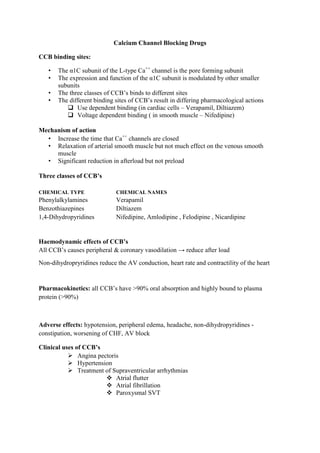
- 1. Calcium Channel Blocking Drugs<br />CCB binding sites:<br />The α1C subunit of the L-type Ca++ channel is the pore forming subunit<br />The expression and function of the α1C subunit is modulated by other smaller subunits<br />The three classes of CCB’s binds to different sites<br />The different binding sites of CCB’s result in differing pharmacological actions<br />Use dependent binding (in cardiac cells – Verapamil, Diltiazem)<br />Voltage dependent binding ( in smooth muscle – Nifedipine)<br />Mechanism of action<br />Increase the time that Ca++ channels are closed<br />Relaxation of arterial smooth muscle but not much effect on the venous smooth muscle<br />Significant reduction in afterload but not preload <br />Three classes of CCB’s<br />CHEMICAL TYPE CHEMICAL NAMES <br />Phenylalkylamines Verapamil <br />Benzothiazepines Diltiazem<br />1,4-Dihydropyridines Nifedipine, Amlodipine , Felodipine , Nicardipine <br />Haemodynamic effects of CCB’s<br />All CCB’s causes peripheral & coronary vasodilation -> reduce after load<br />Non-dihydropryridines reduce the AV conduction, heart rate and contractility of the heart<br />Pharmacokinetics: all CCB’s have >90% oral absorption and highly bound to plasma protein (>90%)<br />Adverse effects: hypotension, peripheral edema, headache, non-dihydropyridines - constipation, worsening of CHF, AV block<br />Clinical uses of CCB’s<br />Angina pectoris<br />Hypertension<br />Treatment of Supraventricular arrhythmias<br />Atrial flutter<br />Atrial fibrillation<br />Paroxysmal SVT<br />CCB’s improve cardiac function by<br />reducing cardiac after load <br />increasing O2 supply<br />decreasing cardiac preload<br />normalizing heart rate in patients with supraventricular tachycardia <br />increasing total peripheral resistance<br />Correct : A, B, D<br />