Drugs acting
on
the Autonomic Nervous System
Dr. Manoj R. Kumbhare
SMBT College of Pharmacy,
Nandi Hills, Dhamangaon, Nasik
422403
Learning outcomes
• After watching this presentation student able
to explain-
• Neurotransmitter release
• Differentiate sympathetic and parasympathetic
nervous system.
• Describe the cholinergic drug effects on major
body systems.
• Classify cholinergic drugs
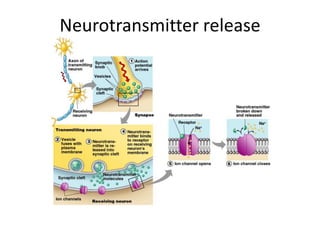
Neurotransmitter release
Parasympathetic and Smpathetic System
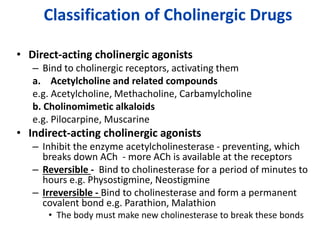
Classification of Cholinergic Drugs
• Direct-acting cholinergic agonists
– Bind to cholinergic receptors, activating them
a. Acetylcholine and related compounds
e.g. Acetylcholine, Methacholine, Carbamylcholine
b. Cholinomimetic alkaloids
e.g. Pilocarpine, Muscarine
• Indirect-acting cholinergic agonists
– Inhibit the enzyme acetylcholinesterase - preventing, which
breaks down ACh - more ACh is available at the receptors
– Reversible - Bind to cholinesterase for a period of minutes to
hours e.g. Physostigmine, Neostigmine
– Irreversible - Bind to cholinesterase and form a permanent
covalent bond e.g. Parathion, Malathion
• The body must make new cholinesterase to break these bonds

Drugs acting on ANS.ppt

  • 1.
    Drugs acting on the AutonomicNervous System Dr. Manoj R. Kumbhare SMBT College of Pharmacy, Nandi Hills, Dhamangaon, Nasik 422403
  • 2.
    Learning outcomes • Afterwatching this presentation student able to explain- • Neurotransmitter release • Differentiate sympathetic and parasympathetic nervous system. • Describe the cholinergic drug effects on major body systems. • Classify cholinergic drugs
  • 3.
  • 4.
  • 5.
  • 7.
    Classification of CholinergicDrugs • Direct-acting cholinergic agonists – Bind to cholinergic receptors, activating them a. Acetylcholine and related compounds e.g. Acetylcholine, Methacholine, Carbamylcholine b. Cholinomimetic alkaloids e.g. Pilocarpine, Muscarine • Indirect-acting cholinergic agonists – Inhibit the enzyme acetylcholinesterase - preventing, which breaks down ACh - more ACh is available at the receptors – Reversible - Bind to cholinesterase for a period of minutes to hours e.g. Physostigmine, Neostigmine – Irreversible - Bind to cholinesterase and form a permanent covalent bond e.g. Parathion, Malathion • The body must make new cholinesterase to break these bonds