 Each morning millions of individuals
around the world wake up and begin their
day with a cup of coffee.
 Young people often find the taste of
coffee and tea unpalatable.
 However children and adolescents drink
some unsubstantial quantities of soft
drinks both at home and away.
 While coffee, tea, and soft drinks differ
widely in taste and nutrient composition,
they share an important characteristic.
 They all contain chemicals called
methylxanthines.
 Only three methyxanthines are found in
food; caffeine, theophyline and
theobromine.
 In the metabolism of caffeine, it easily
crosses the placental barrier to enter featal
tissue and passes from the mother to
infant thorough the breast milk.
 Once consumed its effects are seen within
15min to 2 hours.
 Caffeine, theophylline and theobromine
have similar physiological effects
throughout the body.
 However potency of these drugs varies
according to the physiological system
under consideration.
 For example ;theophylline is a more
potent stimulator of the cardiovascular
system than caffeine or theobromine
 Caffeine leads to more profound
stimulation of the nervous system than
either of the other two compounds.
Cardiovascular system
 The action of caffeine and other
methylxanthines on the cardiovascular
system is complex.
 Studies show that caffeine is associated
with a rise in blood pressure and an
increase in the heart rate.
Cardiovascular system
 The effect of caffeine in blood pressure is
more pronounced in the elderly.
 Moderate caffeine intake does not
produce adverse effects on the
cardiovascular system.
Smooth muscle
 The methylxanthines relax a variety of
smooth muscles including those found in
the bronchi of the lungs.
 In deed as a result of theophylines ability
to dilate the bronchi, the drug is used in
the management of asthma.
Smooth muscle
 Theophylline and related compounds are
prescribed as prophylactic therapy for
asthma and are used as adjuncts in the
treatment of prolonged asthma attacks.
Smooth muscle
 As a result of their ability to stimulate the
respiratory system ,both theophilline and
caffeine have been prescribed to prevent
episodes of loss of effective breathing in
preterm infants.
Gastrointestinal system
 Caffeine stimulates the secretion of
gastric acid and pepsin,
 Pepsin is the enzymes that begins the
breakdown of proteins In the stomach .
 As a result coffee intake is considered
detrimental to individuals sufferings
from gastric ulcers.
Gastrointestinal system
 However both caffeinated and
decaffeinated coffee increase gastric
secretions hence coffee alone is not the
only compound and that additional
compound contribute to beverage actions
on the gastrointestinal system.
Renal system
 The diuretic action of caffeine and other
methylxanthines has long been
recognized
 Acute ingestion of 250-300mg of caffeine
results in the short term stimunlation of
urine output and sodium excretion in
individuals deprived of caffeine for days
or weeks.
Renal system
 Regular intake of caffeine however is
associated with the development of
tolerance to the diuretic effects of the drug
 The actions of the drug on the renal system
are reduced in individuals who regularly
consume coffee or tea.
 Caffeine as an energy producing aid has
become popular.
 Many professional athletes have
committed to using caffeine to improve
their physical performance during both
training and competition.
1. Caffeine increases heart rate, respiration,
blood pressure and blood glucose levels
which together contribute to the positive
effect of the drug on physical
performance.
2. Additionally, following caffeine
consumption, energy derived from fats is
increased while that from CHO is
reduced allowing individuals to sustain
physical activity for longer periods of
time.
3. Another factor that contributes to
caffeine positive effects on physical
activity is that the drug may reduce the
perception of the pain resulting from the
vigorous activity.
 Caffeine pain relieving properties stem
from the drug ability to stimulate the
release of beta –endorphin -the body’s
natural pain killer.
 While caffeine can boost performance of
endurance activities, it has minimal
effects of enhancing maximal abilities on
tasks that require power outputs
e.g. in lifting and carrying.
 However caffeine may prolong the time
until fatigue occurs.
 A cup of coffee with dinner can led to a
night with little sleep.
 Caffeine can delay sleep onset, shorten
sleep time, reduce the average depth of
sleep and worsen the quality of sleep.
 High doses can led to insomnia.
 While caffeine induced sleep disturbances
do not appear to be a major concern for
adults, caffeine induced alterations in
sleep may be problematic in children.
 This is due to the subsequent behavioral
issues.
 Although all the physiological
consequences of the methylxanthines are
important, it is the action of these drugs
on the CNS and behavior that contributes
most significantly to their use.
 Caffeine , theophylline and theobromine
stimulate the activity of the CNS with
caffeine having the most potent effects.
 Consumption of as little as a one medium
cup of coffee stimulates the cortex, the
area of the brain involved in higher metal
functioning.
 Higher doses stimulate the medulla too
which is important for the control of
respiration, cardiovascular functioning
and muscular activity.
 Levels of over 1000mg may result to
restlessness, insomnia, sensory
disturbance including ringing in the ears.
 High doses of caffeine intake can led to
intoxification and worsen the symptoms
of withdrawal when one abstains.
 Moderate consumption of caffeine rich
foods and beverages is key to caffeine
intake.
 Over the years, concern has been
expressed about the potentially harmful
effects of caffeine intake during
pregnancy.
 Caffeine intake has been blamed for
infertility,miscarriage,low birth weight
and birth defects.
 Some studies have shown that caffeine
serve as teratogen (an agent that can
cause malformation to an embro or lead
to birth defects) in laboratory animals.
 In these studies providing caffeine to
pregnant animals resulted in abnormal
organ development in a small % of the
offspring.
 The most frequently observed defects
were facial defects and limbs defects.
 However higher doses of caffeine were
required to produce such defects
particularly when the drug was
incorporated in the animals’ food.
 Lower doses had negligible effects on
fetal development.
 Epidemeological studies have assessed
the relationship between coffee
consumption during pregnancy and the
risks of preterm delivery, low birth
weights and congenital malformations in
human populations.
 Results suggests that heavy caffeine use
greater than 700 mg per day may be
associate with a decreased probability of
pregnancy
 It is also associated with an increased
probability of a woman suffering
miscarriage or having a preterm delivery.
 Additionally ,extensive caffeine
consumption by a mother may increase
the risks of the infant suffering from sleep
apnea or the sudden death syndrome
 Smaller amounts of coffee consumed in a
day-less than 300mg /day have fewer
negative effects reported in pregnancy and
infant health.
 Hence a limit of a maximum of caffeine
intake being 300mg/day or approximately
3 8oz cup s of coffee in a day is
recommended.
 moderate intake of caffeine has relatively
mild effects in most individuals
 intake of large quantities of the drug can
have negative consequences.
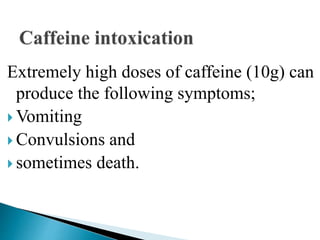
Extremely high doses of caffeine (10g) can
produce the following symptoms;
 Vomiting
 Convulsions and
 sometimes death.
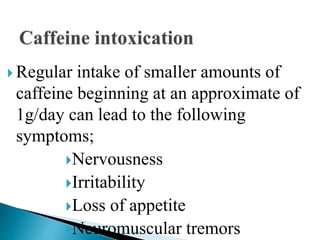
 Regular intake of smaller amounts of
caffeine beginning at an approximate of
1g/day can lead to the following
symptoms;
Nervousness
Irritability
Loss of appetite
Neuromuscular tremors
 Caffeine is a drug that produces
physiological ,psychological and
behavioral effects .
 Of our concern is whether this makes it a
drug of abuse.
 Many people feel that they depend on
caffeine
 At least everyone knows at least one
person who cannot seem to face the day
without a cup of tea or coffee.
 However, addiction and dependence are
terms that are usually used to describe
behaviours relating to drugs such as herion
, nicotine, alcohol and cocaine.
Should caffeine be described as an
addictive drug?
 According to psychopharmacologists and
clinicians, for a drug to be considered
addictive it must met a set of primary
criteria and may meet a set of secondary
criteria.
 Example ; a feature /hallmark of drug
addiction is rising / escalating use of a drug
and loss of control over drug taking
behavior.
 Typically people who are addicted to a
drug need more and more of the drug to
achieve the same effect. This phenomena is
called tolerance.
 Although originally taking the drug may
have produced presurable effects, addicts
maintain drug taking behavior to avoid the
ill feelings / withdrawal symptoms when
ceasing to take the drug.
 Thus drug addiction is indicative of a cycle
of behaviours that include the pursuit of
pleasurable effects and avoidance of
negative effects.
 The first thing to consider about a alleged
addictive substance is whether or not it
produces pleasurable effects.
 These pleasurable effects promote drug
taking behavior for the obvious reasons
that people take pleasurable things.
 Caffeine reinforcing properties are
presumed to be related to the drugs ability
to produce physiological arousal including
increased alertness enhanced mood and
increased concentration.
 Some argue that the reinforcing effects of
caffeine are similar in character but not in
magnitude to psychostimullant drugs such
as cocaine.
 Others argue that although caffeine does
not produce positive effects such as mood
elevation; the reinforcing effects are
relatively weak.
 More importantly unlike typical drugs of
abuse ,individuals do not need to consume
an increasing amounts of caffeine (drug
abuse) but rather use the drug at consistent
and moderate levels (drug use)
Caffeine tolerance
 In animals, tolerance to the locomotor
enhancing effects of caffeine is well
demonstrated.
 However in many animal studies ,the doses
of caffeine used are significantly greater
than those generally consumed by humans.
Caffeine tolerance
 Humans develop tolerance to some of the
physiological effects of caffeine such as
elevated heart rate and blood pressure , but
typically do not show tolerance to the
mood elevating and sleep delaying effects
of the drug.
Caffeine tolerance
 The general consensus is that little
tolerance develops to the positive effects of
caffeine .
 This explains why caffeine users do not
significantly escalate drug use over time.
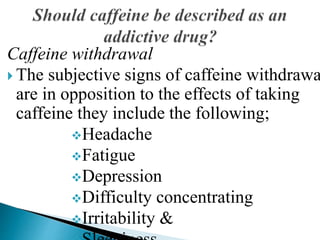
Caffeine withdrawal
 The subjective signs of caffeine withdrawa
are in opposition to the effects of taking
caffeine they include the following;
Headache
Fatigue
Depression
Difficulty concentrating
Irritability &
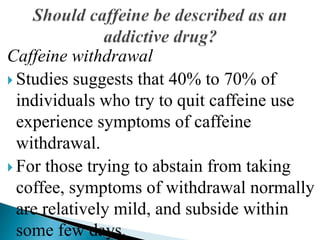
Caffeine withdrawal
 Studies suggests that 40% to 70% of
individuals who try to quit caffeine use
experience symptoms of caffeine
withdrawal.
 For those trying to abstain from taking
coffee, symptoms of withdrawal normally
are relatively mild, and subside within
some few days.
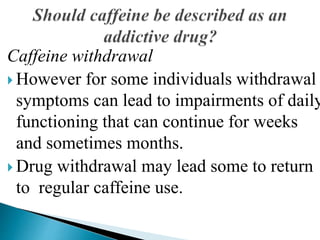
Caffeine withdrawal
 However for some individuals withdrawal
symptoms can lead to impairments of daily
functioning that can continue for weeks
and sometimes months.
 Drug withdrawal may lead some to return
to regular caffeine use.
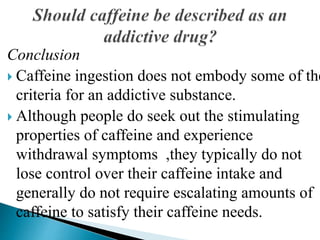
Conclusion
 Caffeine ingestion does not embody some of the
criteria for an addictive substance.
 Although people do seek out the stimulating
properties of caffeine and experience
withdrawal symptoms ,they typically do not
lose control over their caffeine intake and
generally do not require escalating amounts of
caffeine to satisfy their caffeine needs.

CAFFEINE, THE METHYLXANTHINES AND BEHAVIOUR.pptx

  • 2.
     Each morningmillions of individuals around the world wake up and begin their day with a cup of coffee.  Young people often find the taste of coffee and tea unpalatable.  However children and adolescents drink some unsubstantial quantities of soft drinks both at home and away.
  • 3.
     While coffee,tea, and soft drinks differ widely in taste and nutrient composition, they share an important characteristic.  They all contain chemicals called methylxanthines.  Only three methyxanthines are found in food; caffeine, theophyline and theobromine.
  • 4.
     In themetabolism of caffeine, it easily crosses the placental barrier to enter featal tissue and passes from the mother to infant thorough the breast milk.  Once consumed its effects are seen within 15min to 2 hours.
  • 5.
     Caffeine, theophyllineand theobromine have similar physiological effects throughout the body.  However potency of these drugs varies according to the physiological system under consideration.
  • 6.
     For example;theophylline is a more potent stimulator of the cardiovascular system than caffeine or theobromine  Caffeine leads to more profound stimulation of the nervous system than either of the other two compounds.
  • 7.
    Cardiovascular system  Theaction of caffeine and other methylxanthines on the cardiovascular system is complex.  Studies show that caffeine is associated with a rise in blood pressure and an increase in the heart rate.
  • 8.
    Cardiovascular system  Theeffect of caffeine in blood pressure is more pronounced in the elderly.  Moderate caffeine intake does not produce adverse effects on the cardiovascular system.
  • 9.
    Smooth muscle  Themethylxanthines relax a variety of smooth muscles including those found in the bronchi of the lungs.  In deed as a result of theophylines ability to dilate the bronchi, the drug is used in the management of asthma.
  • 10.
    Smooth muscle  Theophyllineand related compounds are prescribed as prophylactic therapy for asthma and are used as adjuncts in the treatment of prolonged asthma attacks.
  • 11.
    Smooth muscle  Asa result of their ability to stimulate the respiratory system ,both theophilline and caffeine have been prescribed to prevent episodes of loss of effective breathing in preterm infants.
  • 12.
    Gastrointestinal system  Caffeinestimulates the secretion of gastric acid and pepsin,  Pepsin is the enzymes that begins the breakdown of proteins In the stomach .  As a result coffee intake is considered detrimental to individuals sufferings from gastric ulcers.
  • 13.
    Gastrointestinal system  Howeverboth caffeinated and decaffeinated coffee increase gastric secretions hence coffee alone is not the only compound and that additional compound contribute to beverage actions on the gastrointestinal system.
  • 14.
    Renal system  Thediuretic action of caffeine and other methylxanthines has long been recognized  Acute ingestion of 250-300mg of caffeine results in the short term stimunlation of urine output and sodium excretion in individuals deprived of caffeine for days or weeks.
  • 15.
    Renal system  Regularintake of caffeine however is associated with the development of tolerance to the diuretic effects of the drug  The actions of the drug on the renal system are reduced in individuals who regularly consume coffee or tea.
  • 16.
     Caffeine asan energy producing aid has become popular.  Many professional athletes have committed to using caffeine to improve their physical performance during both training and competition.
  • 17.
    1. Caffeine increasesheart rate, respiration, blood pressure and blood glucose levels which together contribute to the positive effect of the drug on physical performance.
  • 18.
    2. Additionally, followingcaffeine consumption, energy derived from fats is increased while that from CHO is reduced allowing individuals to sustain physical activity for longer periods of time.
  • 19.
    3. Another factorthat contributes to caffeine positive effects on physical activity is that the drug may reduce the perception of the pain resulting from the vigorous activity.  Caffeine pain relieving properties stem from the drug ability to stimulate the release of beta –endorphin -the body’s natural pain killer.
  • 20.
     While caffeinecan boost performance of endurance activities, it has minimal effects of enhancing maximal abilities on tasks that require power outputs e.g. in lifting and carrying.  However caffeine may prolong the time until fatigue occurs.
  • 21.
     A cupof coffee with dinner can led to a night with little sleep.  Caffeine can delay sleep onset, shorten sleep time, reduce the average depth of sleep and worsen the quality of sleep.  High doses can led to insomnia.
  • 22.
     While caffeineinduced sleep disturbances do not appear to be a major concern for adults, caffeine induced alterations in sleep may be problematic in children.  This is due to the subsequent behavioral issues.
  • 23.
     Although allthe physiological consequences of the methylxanthines are important, it is the action of these drugs on the CNS and behavior that contributes most significantly to their use.  Caffeine , theophylline and theobromine stimulate the activity of the CNS with caffeine having the most potent effects.
  • 24.
     Consumption ofas little as a one medium cup of coffee stimulates the cortex, the area of the brain involved in higher metal functioning.  Higher doses stimulate the medulla too which is important for the control of respiration, cardiovascular functioning and muscular activity.
  • 25.
     Levels ofover 1000mg may result to restlessness, insomnia, sensory disturbance including ringing in the ears.  High doses of caffeine intake can led to intoxification and worsen the symptoms of withdrawal when one abstains.
  • 26.
     Moderate consumptionof caffeine rich foods and beverages is key to caffeine intake.
  • 27.
     Over theyears, concern has been expressed about the potentially harmful effects of caffeine intake during pregnancy.  Caffeine intake has been blamed for infertility,miscarriage,low birth weight and birth defects.
  • 28.
     Some studieshave shown that caffeine serve as teratogen (an agent that can cause malformation to an embro or lead to birth defects) in laboratory animals.  In these studies providing caffeine to pregnant animals resulted in abnormal organ development in a small % of the offspring.
  • 29.
     The mostfrequently observed defects were facial defects and limbs defects.  However higher doses of caffeine were required to produce such defects particularly when the drug was incorporated in the animals’ food.  Lower doses had negligible effects on fetal development.
  • 30.
     Epidemeological studieshave assessed the relationship between coffee consumption during pregnancy and the risks of preterm delivery, low birth weights and congenital malformations in human populations.
  • 31.
     Results suggeststhat heavy caffeine use greater than 700 mg per day may be associate with a decreased probability of pregnancy  It is also associated with an increased probability of a woman suffering miscarriage or having a preterm delivery.
  • 32.
     Additionally ,extensivecaffeine consumption by a mother may increase the risks of the infant suffering from sleep apnea or the sudden death syndrome
  • 33.
     Smaller amountsof coffee consumed in a day-less than 300mg /day have fewer negative effects reported in pregnancy and infant health.  Hence a limit of a maximum of caffeine intake being 300mg/day or approximately 3 8oz cup s of coffee in a day is recommended.
  • 34.
     moderate intakeof caffeine has relatively mild effects in most individuals  intake of large quantities of the drug can have negative consequences.
  • 35.
    Extremely high dosesof caffeine (10g) can produce the following symptoms;  Vomiting  Convulsions and  sometimes death.
  • 36.
     Regular intakeof smaller amounts of caffeine beginning at an approximate of 1g/day can lead to the following symptoms; Nervousness Irritability Loss of appetite Neuromuscular tremors
  • 37.
     Caffeine isa drug that produces physiological ,psychological and behavioral effects .  Of our concern is whether this makes it a drug of abuse.  Many people feel that they depend on caffeine
  • 38.
     At leasteveryone knows at least one person who cannot seem to face the day without a cup of tea or coffee.  However, addiction and dependence are terms that are usually used to describe behaviours relating to drugs such as herion , nicotine, alcohol and cocaine.
  • 39.
    Should caffeine bedescribed as an addictive drug?  According to psychopharmacologists and clinicians, for a drug to be considered addictive it must met a set of primary criteria and may meet a set of secondary criteria.
  • 40.
     Example ;a feature /hallmark of drug addiction is rising / escalating use of a drug and loss of control over drug taking behavior.  Typically people who are addicted to a drug need more and more of the drug to achieve the same effect. This phenomena is called tolerance.
  • 41.
     Although originallytaking the drug may have produced presurable effects, addicts maintain drug taking behavior to avoid the ill feelings / withdrawal symptoms when ceasing to take the drug.  Thus drug addiction is indicative of a cycle of behaviours that include the pursuit of pleasurable effects and avoidance of negative effects.
  • 42.
     The firstthing to consider about a alleged addictive substance is whether or not it produces pleasurable effects.  These pleasurable effects promote drug taking behavior for the obvious reasons that people take pleasurable things.
  • 43.
     Caffeine reinforcingproperties are presumed to be related to the drugs ability to produce physiological arousal including increased alertness enhanced mood and increased concentration.  Some argue that the reinforcing effects of caffeine are similar in character but not in magnitude to psychostimullant drugs such as cocaine.
  • 44.
     Others arguethat although caffeine does not produce positive effects such as mood elevation; the reinforcing effects are relatively weak.
  • 45.
     More importantlyunlike typical drugs of abuse ,individuals do not need to consume an increasing amounts of caffeine (drug abuse) but rather use the drug at consistent and moderate levels (drug use)
  • 46.
    Caffeine tolerance  Inanimals, tolerance to the locomotor enhancing effects of caffeine is well demonstrated.  However in many animal studies ,the doses of caffeine used are significantly greater than those generally consumed by humans.
  • 47.
    Caffeine tolerance  Humansdevelop tolerance to some of the physiological effects of caffeine such as elevated heart rate and blood pressure , but typically do not show tolerance to the mood elevating and sleep delaying effects of the drug.
  • 48.
    Caffeine tolerance  Thegeneral consensus is that little tolerance develops to the positive effects of caffeine .  This explains why caffeine users do not significantly escalate drug use over time.
  • 49.
    Caffeine withdrawal  Thesubjective signs of caffeine withdrawa are in opposition to the effects of taking caffeine they include the following; Headache Fatigue Depression Difficulty concentrating Irritability &
  • 50.
    Caffeine withdrawal  Studiessuggests that 40% to 70% of individuals who try to quit caffeine use experience symptoms of caffeine withdrawal.  For those trying to abstain from taking coffee, symptoms of withdrawal normally are relatively mild, and subside within some few days.
  • 51.
    Caffeine withdrawal  Howeverfor some individuals withdrawal symptoms can lead to impairments of daily functioning that can continue for weeks and sometimes months.  Drug withdrawal may lead some to return to regular caffeine use.
  • 52.
    Conclusion  Caffeine ingestiondoes not embody some of the criteria for an addictive substance.  Although people do seek out the stimulating properties of caffeine and experience withdrawal symptoms ,they typically do not lose control over their caffeine intake and generally do not require escalating amounts of caffeine to satisfy their caffeine needs.