Caco-2 cell permeability assay
Ms. Priyansha Singh
B. Pharm,
M.S. (Pharm.)- Pharmacology & Toxicology
4/24/2024 2
Drug absorption by the human intestine
Factors influencing intestinal absorption of drugs
 Dissolution rate
 Solubility
 Intestinal permeability
The dissolution rate and solubility determine how fast the drug
achieves its maximum concentration in the luminal intestinal
Routes of drug absorption at the intestinal brush border
1. Passive diffusion
a) Paracellular b)Transcellular
2. Carrier mediated or Active transport
3. Vesicular transport
Passive Diffusion:
Factors that govern extracellular diffusion
a) Differences in drug concentration
b) electrical potential and hydrostatic pressure between the luminal
and blood sides of the intestinal epithelium
Tight junctions between the cells are the major barriers to passive
diffusion
There are three types of vesicular transport pathways:
a) Fluid-phase endocytosis
b) Receptor mediated endocytosis
c) Transcytosis
As the surface of a cell membrane is much larger than the surface of tight junctions (99.9 versus 0.01%), compounds using the transcellular pathway tend
to have higher absorption rates than compounds that cross the epithelium via the paracellular pathway
4/24/2024 3
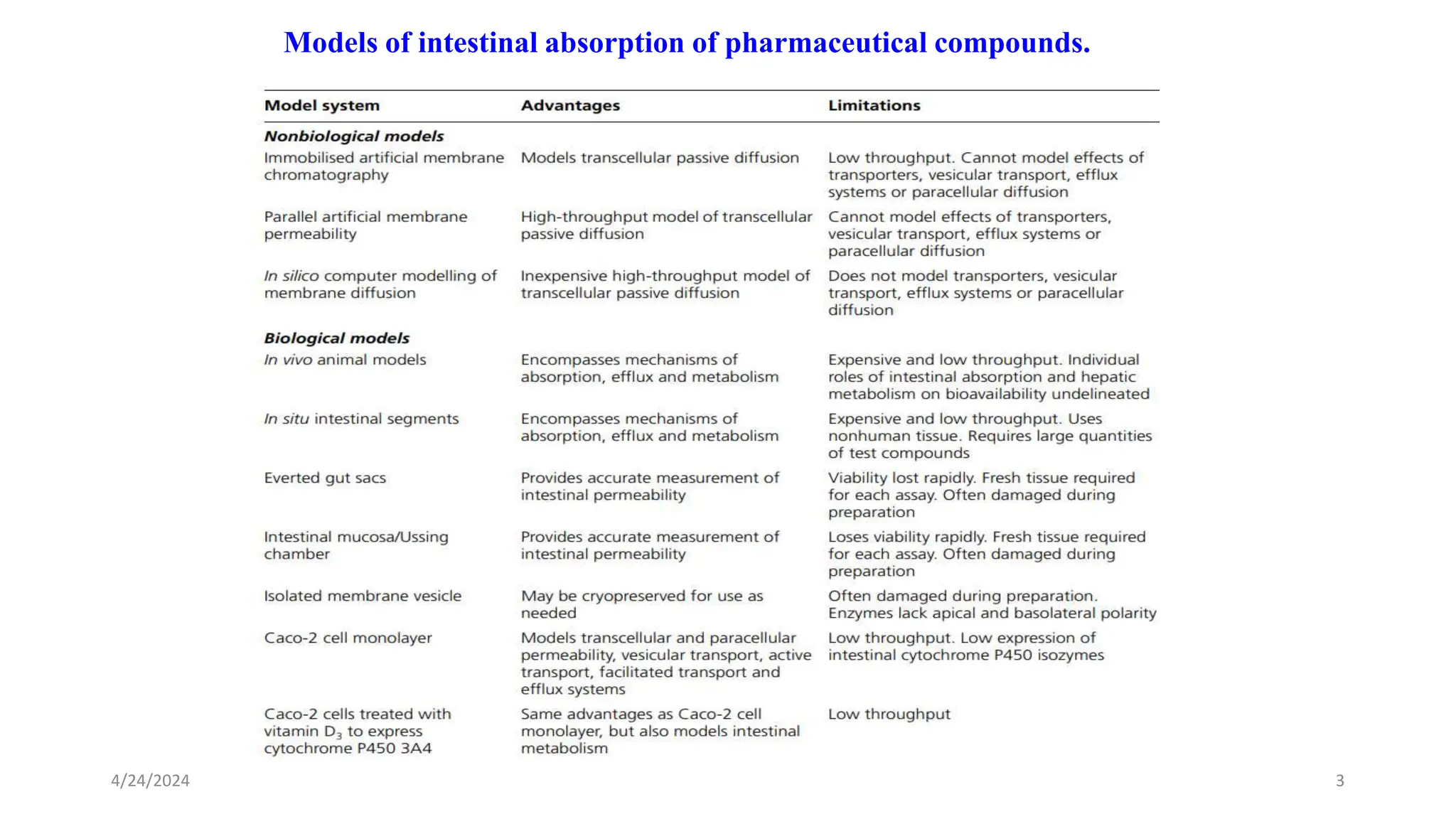
Models of intestinal absorption of pharmaceutical compounds.
Characteristics of Caco-2 cells
Origin:
Human colon carcinoma
Growth in culture:
Monolayer epithelial cells to measure drug absorption
Form a tight monolayer to serve as a model of the paracellular movement
of compounds across the monolayer
Why Caco2 cell
• Caco-2 cells undergo spontaneous enterocytic differentiation in culture
to resemble epithelial cells of the small intestine
• Differentiate to form tight junctions between cells
• 21 days after confluence in standard culture medium
• Express transporter proteins, efflux proteins, and Phase II conjugation
enzymes to model a variety of transcellular pathways as well as
metabolic transformation of test substances.
• The apparent permeability coefficients measured for reference
compounds across Caco-2 cell monolayers have shown good
correlation with in vivo absorption
Limitation
One of the functional differences between normal cells and Caco-2 cells
is the lack of expression of the cytochrome P450 isozymes and in
particular, CYP3A4, which is normally expressed at high levels in the
intestine.
It can be induced by exposing with Vit D3
1
2
3
4
5
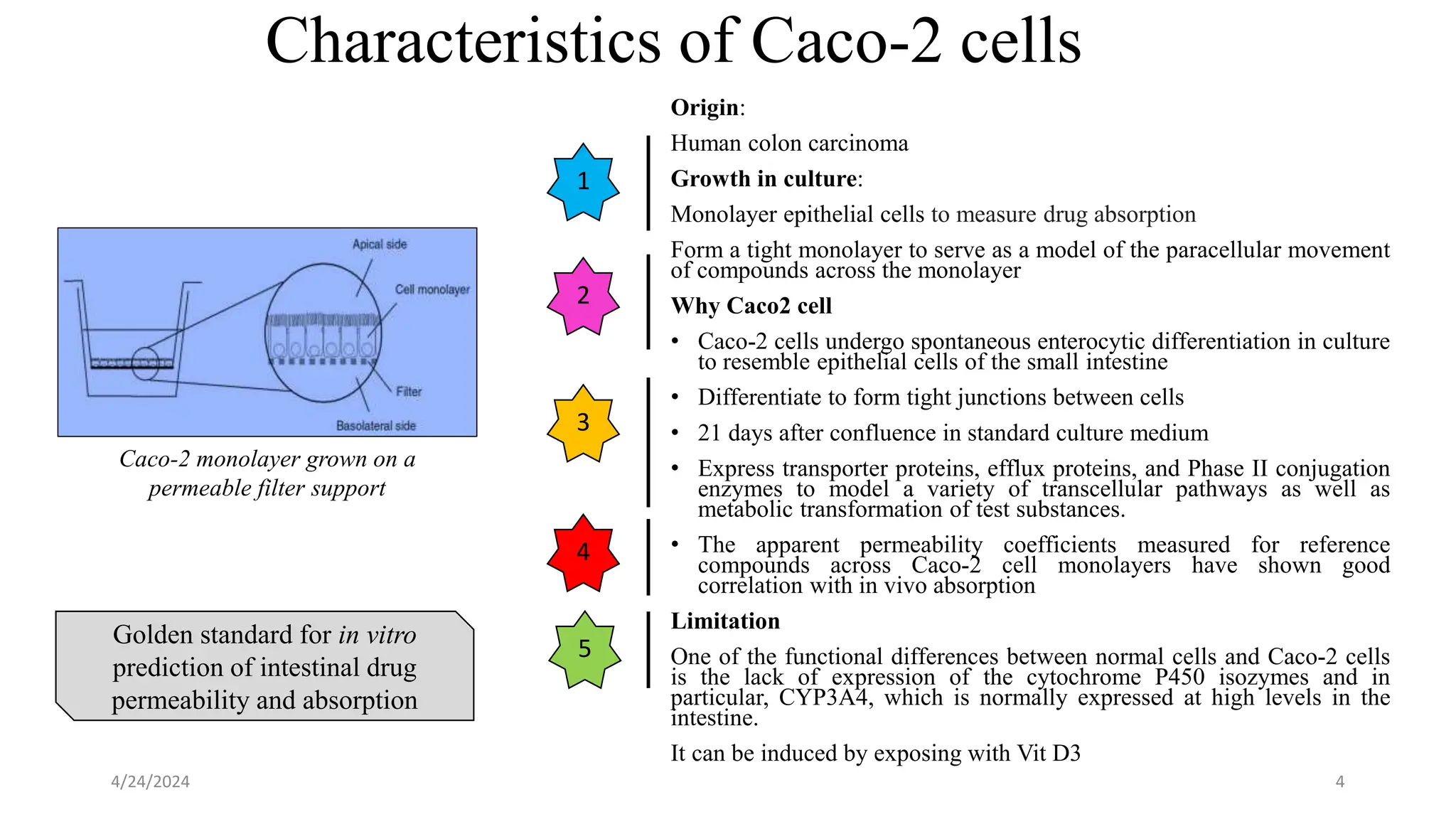
Caco-2 monolayer grown on a
permeable filter support
Golden standard for in vitro
prediction of intestinal drug
permeability and absorption
4/24/2024 4
Permeability assessment
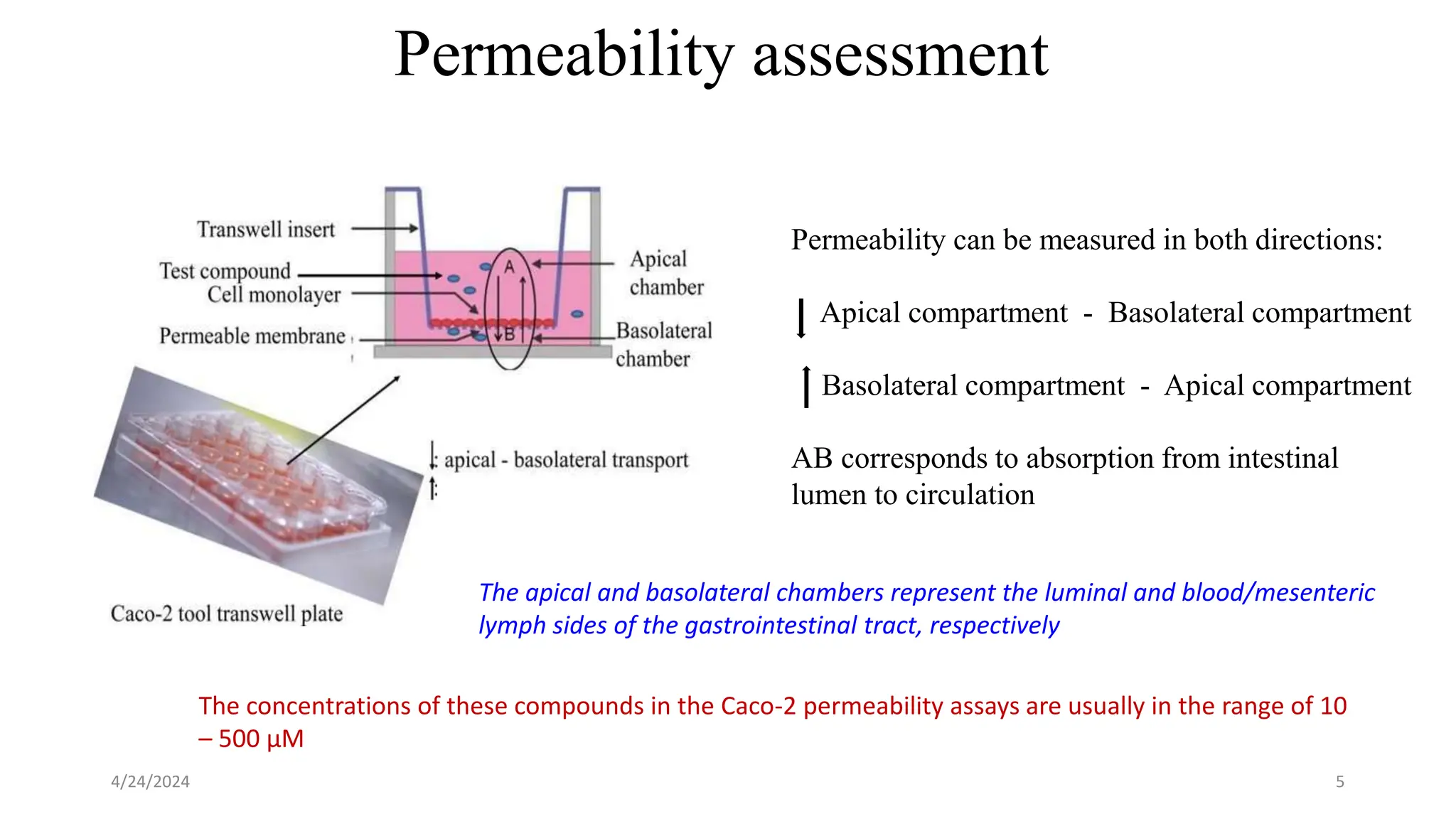
Permeability can be measured in both directions:
Apical compartment - Basolateral compartment
Basolateral compartment - Apical compartment
AB corresponds to absorption from intestinal
lumen to circulation
4/24/2024 5
The apical and basolateral chambers represent the luminal and blood/mesenteric
lymph sides of the gastrointestinal tract, respectively
The concentrations of these compounds in the Caco-2 permeability assays are usually in the range of 10
– 500 µM
Cultivation of Caco-2 cell monolayers
• Caco-2 cells are cultured to confluency
• Trypsin/EDTA solution is added
• Cells are then incubated at 37℃ for 6-15 min
• Knock the sides of the flask to detach still adherent cells
• Complete growth medium is added to neutralize the trypsin/EDTA solution
• Pipette up and down gently to separate the cells
• 1 ml of cell suspension is removed for cell counting and viability measurement
Trypsinization of Caco2 cells
Seeding onto filter transwell insert
4/24/2024 6
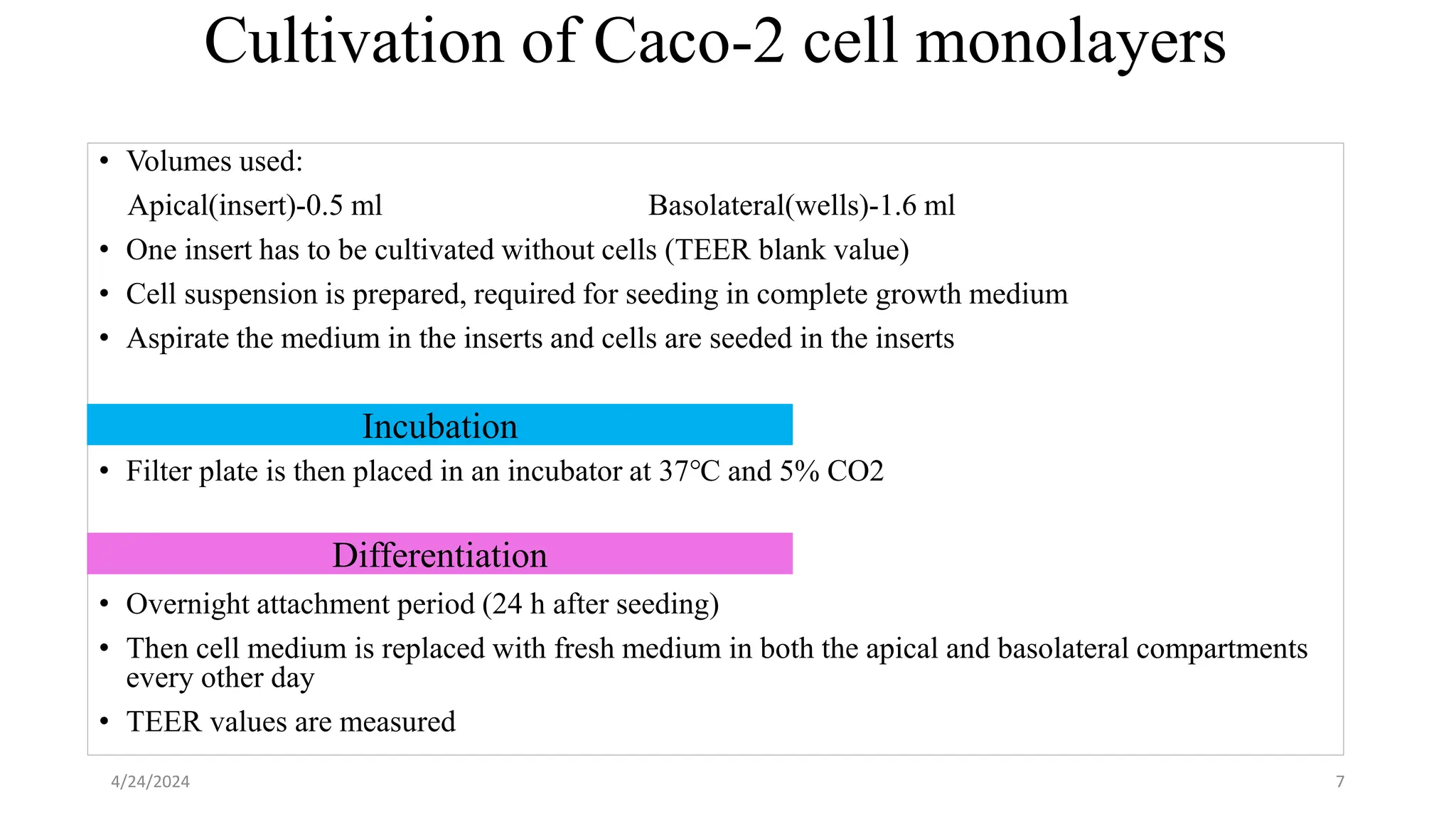
• Volumes used:
Apical(insert)-0.5 ml Basolateral(wells)-1.6 ml
• One insert has to be cultivated without cells (TEER blank value)
• Cell suspension is prepared, required for seeding in complete growth medium
• Aspirate the medium in the inserts and cells are seeded in the inserts
• Filter plate is then placed in an incubator at 37℃ and 5% CO2
• Overnight attachment period (24 h after seeding)
• Then cell medium is replaced with fresh medium in both the apical and basolateral compartments
every other day
• TEER values are measured
Incubation
Differentiation
Cultivation of Caco-2 cell monolayers
4/24/2024 7
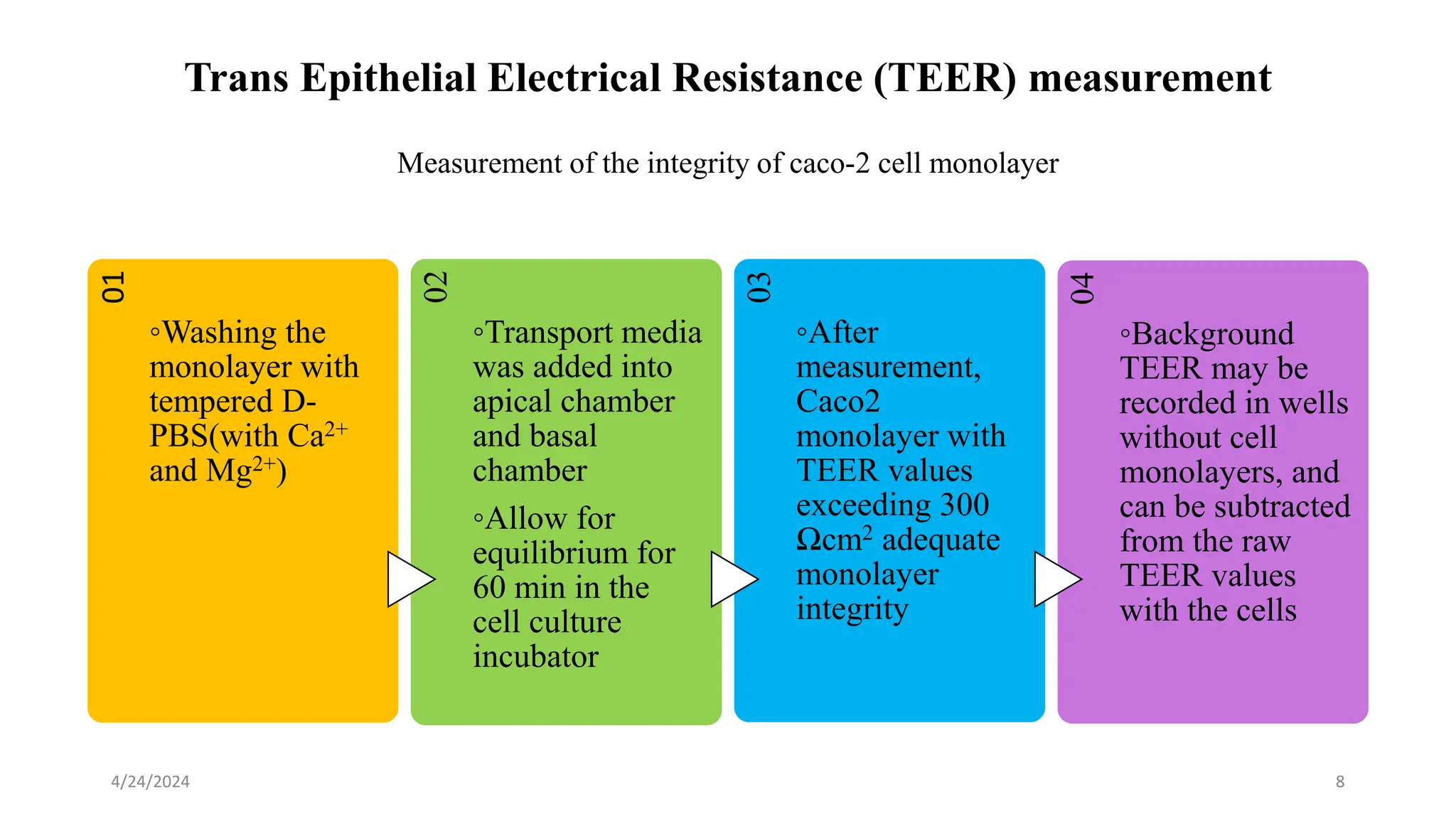
Trans Epithelial Electrical Resistance (TEER) measurement
Measurement of the integrity of caco-2 cell monolayer
01
⸰Washing the
monolayer with
tempered D-
PBS(with Ca2+
and Mg2+)
02
⸰Transport media
was added into
apical chamber
and basal
chamber
⸰Allow for
equilibrium for
60 min in the
cell culture
incubator
03
⸰After
measurement,
Caco2
monolayer with
TEER values
exceeding 300
Ωcm2 adequate
monolayer
integrity
04
⸰Background
TEER may be
recorded in wells
without cell
monolayers, and
can be subtracted
from the raw
TEER values
with the cells
4/24/2024 8
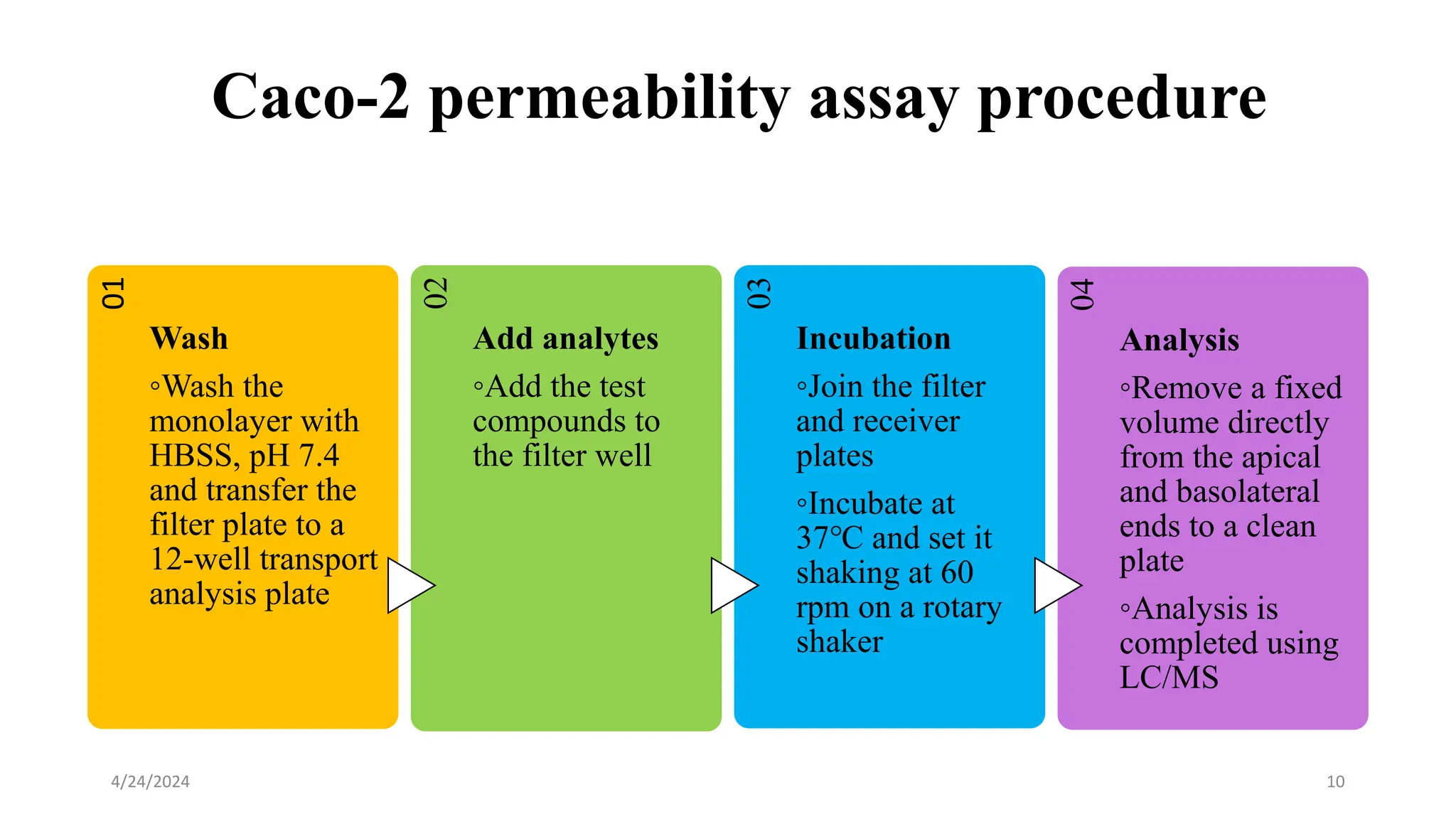
Caco-2 permeability assay procedure
01
Wash
⸰Wash the
monolayer with
HBSS, pH 7.4
and transfer the
filter plate to a
12-well transport
analysis plate
02
Add analytes
⸰Add the test
compounds to
the filter well
03
Incubation
⸰Join the filter
and receiver
plates
⸰Incubate at
37℃ and set it
shaking at 60
rpm on a rotary
shaker
04
Analysis
⸰Remove a fixed
volume directly
from the apical
and basolateral
ends to a clean
plate
⸰Analysis is
completed using
LC/MS
4/24/2024 10
Apparent permeability, Papp(cm/s) & Efflux Ratio
Papp =
𝒅𝑸
𝒅𝒕
×
𝟏
A.C0
Permeability
rate over time
Area of caco-2
covered filter
Initial concentration in
donor compartment
Efflux ratio =
Papp [B → A]
Papp [A → B]
4/24/2024 11
Papp values of < 1-2 × 10⁻⁶ cm/ s : low
permeability (0−20% human fraction
absorbed.
Papp values of 2−10 × 10−6 cm/s:
moderate permeability (20−80% Fa)
Papp > 10 × 10−6 cm/ s : high
permeability (80−100% Fa)
4/24/2024 12
Although it is acknowledged that the actual permeability values may vary in Caco-2 monolayer permeability
assays, the assay results are most reliably interpreted in comparison to compounds evaluated in the same
assay, relative to standard compounds representing upper (Propanolol) and lower bounds (fluorescein or
mannitol)
Ctd…
Tegan P. Stockdale, Victoria L. Challinor, Reginald P. Lehmann, James
J. De Voss, and Joanne T. Blanchfield
ACS Omega 2019 4 (4), 7658-7666
DOI: 10.1021/acsomega.9b00496
Papp values decrease with increasing test compound concentration, suggests the involvement of
transporter pathways.
For example, the measurement of Papp values for a test compound may be repeated in the presence of
verapamil (100 µM) [42] or MK-571 (50 µM) [37], which are inhibitors of P-glycoprotein and MRP,
respectively
When a compound has an efflux ratio of greater than 2, it suggests that the compound may be subject to
active efflux.

Caco-2 cell permeability assay for drug absorption

  • 1.
    Caco-2 cell permeabilityassay Ms. Priyansha Singh B. Pharm, M.S. (Pharm.)- Pharmacology & Toxicology
  • 2.
    4/24/2024 2 Drug absorptionby the human intestine Factors influencing intestinal absorption of drugs  Dissolution rate  Solubility  Intestinal permeability The dissolution rate and solubility determine how fast the drug achieves its maximum concentration in the luminal intestinal Routes of drug absorption at the intestinal brush border 1. Passive diffusion a) Paracellular b)Transcellular 2. Carrier mediated or Active transport 3. Vesicular transport Passive Diffusion: Factors that govern extracellular diffusion a) Differences in drug concentration b) electrical potential and hydrostatic pressure between the luminal and blood sides of the intestinal epithelium Tight junctions between the cells are the major barriers to passive diffusion There are three types of vesicular transport pathways: a) Fluid-phase endocytosis b) Receptor mediated endocytosis c) Transcytosis As the surface of a cell membrane is much larger than the surface of tight junctions (99.9 versus 0.01%), compounds using the transcellular pathway tend to have higher absorption rates than compounds that cross the epithelium via the paracellular pathway
  • 3.
    4/24/2024 3 Models ofintestinal absorption of pharmaceutical compounds.
  • 4.
    Characteristics of Caco-2cells Origin: Human colon carcinoma Growth in culture: Monolayer epithelial cells to measure drug absorption Form a tight monolayer to serve as a model of the paracellular movement of compounds across the monolayer Why Caco2 cell • Caco-2 cells undergo spontaneous enterocytic differentiation in culture to resemble epithelial cells of the small intestine • Differentiate to form tight junctions between cells • 21 days after confluence in standard culture medium • Express transporter proteins, efflux proteins, and Phase II conjugation enzymes to model a variety of transcellular pathways as well as metabolic transformation of test substances. • The apparent permeability coefficients measured for reference compounds across Caco-2 cell monolayers have shown good correlation with in vivo absorption Limitation One of the functional differences between normal cells and Caco-2 cells is the lack of expression of the cytochrome P450 isozymes and in particular, CYP3A4, which is normally expressed at high levels in the intestine. It can be induced by exposing with Vit D3 1 2 3 4 5 Caco-2 monolayer grown on a permeable filter support Golden standard for in vitro prediction of intestinal drug permeability and absorption 4/24/2024 4
  • 5.
    Permeability assessment Permeability canbe measured in both directions: Apical compartment - Basolateral compartment Basolateral compartment - Apical compartment AB corresponds to absorption from intestinal lumen to circulation 4/24/2024 5 The apical and basolateral chambers represent the luminal and blood/mesenteric lymph sides of the gastrointestinal tract, respectively The concentrations of these compounds in the Caco-2 permeability assays are usually in the range of 10 – 500 µM
  • 6.
    Cultivation of Caco-2cell monolayers • Caco-2 cells are cultured to confluency • Trypsin/EDTA solution is added • Cells are then incubated at 37℃ for 6-15 min • Knock the sides of the flask to detach still adherent cells • Complete growth medium is added to neutralize the trypsin/EDTA solution • Pipette up and down gently to separate the cells • 1 ml of cell suspension is removed for cell counting and viability measurement Trypsinization of Caco2 cells Seeding onto filter transwell insert 4/24/2024 6
  • 7.
    • Volumes used: Apical(insert)-0.5ml Basolateral(wells)-1.6 ml • One insert has to be cultivated without cells (TEER blank value) • Cell suspension is prepared, required for seeding in complete growth medium • Aspirate the medium in the inserts and cells are seeded in the inserts • Filter plate is then placed in an incubator at 37℃ and 5% CO2 • Overnight attachment period (24 h after seeding) • Then cell medium is replaced with fresh medium in both the apical and basolateral compartments every other day • TEER values are measured Incubation Differentiation Cultivation of Caco-2 cell monolayers 4/24/2024 7
  • 8.
    Trans Epithelial ElectricalResistance (TEER) measurement Measurement of the integrity of caco-2 cell monolayer 01 ⸰Washing the monolayer with tempered D- PBS(with Ca2+ and Mg2+) 02 ⸰Transport media was added into apical chamber and basal chamber ⸰Allow for equilibrium for 60 min in the cell culture incubator 03 ⸰After measurement, Caco2 monolayer with TEER values exceeding 300 Ωcm2 adequate monolayer integrity 04 ⸰Background TEER may be recorded in wells without cell monolayers, and can be subtracted from the raw TEER values with the cells 4/24/2024 8
  • 10.
    Caco-2 permeability assayprocedure 01 Wash ⸰Wash the monolayer with HBSS, pH 7.4 and transfer the filter plate to a 12-well transport analysis plate 02 Add analytes ⸰Add the test compounds to the filter well 03 Incubation ⸰Join the filter and receiver plates ⸰Incubate at 37℃ and set it shaking at 60 rpm on a rotary shaker 04 Analysis ⸰Remove a fixed volume directly from the apical and basolateral ends to a clean plate ⸰Analysis is completed using LC/MS 4/24/2024 10
  • 11.
    Apparent permeability, Papp(cm/s)& Efflux Ratio Papp = 𝒅𝑸 𝒅𝒕 × 𝟏 A.C0 Permeability rate over time Area of caco-2 covered filter Initial concentration in donor compartment Efflux ratio = Papp [B → A] Papp [A → B] 4/24/2024 11 Papp values of < 1-2 × 10⁻⁶ cm/ s : low permeability (0−20% human fraction absorbed. Papp values of 2−10 × 10−6 cm/s: moderate permeability (20−80% Fa) Papp > 10 × 10−6 cm/ s : high permeability (80−100% Fa)
  • 12.
    4/24/2024 12 Although itis acknowledged that the actual permeability values may vary in Caco-2 monolayer permeability assays, the assay results are most reliably interpreted in comparison to compounds evaluated in the same assay, relative to standard compounds representing upper (Propanolol) and lower bounds (fluorescein or mannitol) Ctd… Tegan P. Stockdale, Victoria L. Challinor, Reginald P. Lehmann, James J. De Voss, and Joanne T. Blanchfield ACS Omega 2019 4 (4), 7658-7666 DOI: 10.1021/acsomega.9b00496 Papp values decrease with increasing test compound concentration, suggests the involvement of transporter pathways. For example, the measurement of Papp values for a test compound may be repeated in the presence of verapamil (100 µM) [42] or MK-571 (50 µM) [37], which are inhibitors of P-glycoprotein and MRP, respectively When a compound has an efflux ratio of greater than 2, it suggests that the compound may be subject to active efflux.