Microsomal Stability Assay
(mouse, rat, dog, monkey, human)
• Microsomes are vesicle-like artifacts re-formed from
pieces of the endoplasmic reticulum (ER) when
eukaryotic cells are broken-up in the laboratory;
microsomes are not present in healthy, living cells.
 Microsomes are necessary to analyze the
metabolic activity of CYPs.
Measurement of in vitro intrinsic
clearance using microsomes



The liver is the most important site of drug
metabolism in the body. Approximately 60 % of
marketed compounds are cleared by hepatic CYP-
mediated metabolism.
Liver microsomes are subcellular fractions which
contain membrane bound drug metabolising
enzymes.
Microsomes can be used to determine the in vitro
intrinsic clearance of a compound.
•
•
Microsomes can be concentrated and separated from
other cellular debris by differential centrifugation.
Unbroken cells, nuclei, and mitochondria sediment out
whereas soluble enzymes and fragmented ER, which
contains cytochrome P450 (CYP), remain in solution.
Isolation of microsomes
ASSAY


Metabolic stability, as defined as the percentage
of parent compound lost over time, is assessed
in the presence of liver microsomes.
The microsomal stability assay is primarily used
to investigate Phase I metabolism using
NADPH as an enzyme co-factor.
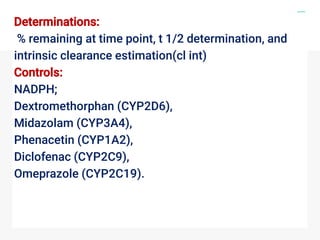
Determinations:
% remaining at time point, t 1/2 determination, and
intrinsic clearance estimation(cl int)
Controls:
NADPH;
Dextromethorphan (CYP2D6),
Midazolam (CYP3A4),
Phenacetin (CYP1A2),
Diclofenac (CYP2C9),
Omeprazole (CYP2C19).
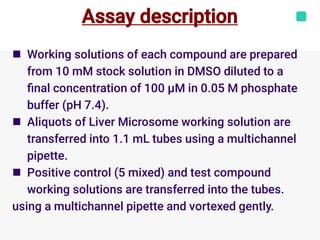
Assay description



Working solutions of each compound are prepared
from 10 mM stock solution in DMSO diluted to a
final concentration of 100 μM in 0.05 M phosphate
buffer (pH 7.4).
Aliquots of Liver Microsome working solution are
transferred into 1.1 mL tubes using a multichannel
pipette.
Positive control (5 mixed) and test compound
working solutions are transferred into the tubes.
using a multichannel pipette and vortexed gently.
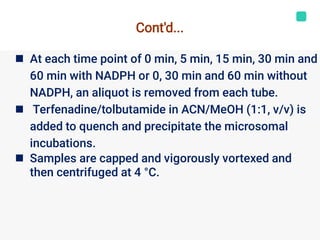
Cont'd...



At each time point of 0 min, 5 min, 15 min, 30 min and
60 min with NADPH or 0, 30 min and 60 min without
NADPH, an aliquot is removed from each tube.
Terfenadine/tolbutamide in ACN/MeOH (1:1, v/v) is
added to quench and precipitate the microsomal
incubations.
Samples are capped and vigorously vortexed and
then centrifuged at 4 °C.


•
•

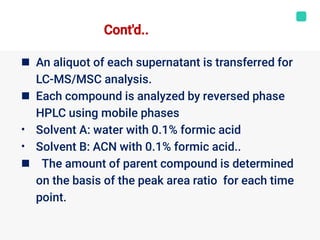
An aliquot of each supernatant is transferred for
LC-MS/MSC analysis.
Each compound is analyzed by reversed phase
HPLC using mobile phases
Solvent A: water with 0.1% formic acid
Solvent B: ACN with 0.1% formic acid..
The amount of parent compound is determined
on the basis of the peak area ratio for each time
point.
Cont'd..
Data analysis
•
•
Calculations.
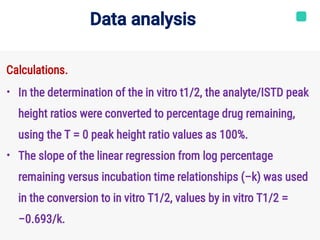
In the determination of the in vitro t1/2, the analyte/ISTD peak
height ratios were converted to percentage drug remaining,
using the T = 0 peak height ratio values as 100%.
The slope of the linear regression from log percentage
remaining versus incubation time relationships (−k) was used
in the conversion to in vitro T1/2, values by in vitro T1/2 =
−0.693/k.
Cont'd
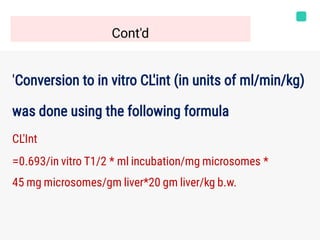
′Conversion to in vitro CL′int (in units of ml/min/kg)
was done using the following formula
CL'Int
=0.693/in vitro T1/2 * ml incubation/mg microsomes *
45 mg microsomes/gm liver*20 gm liver/kg b.w.
Cont'd
•
•
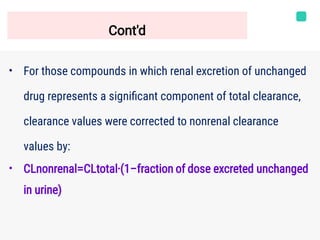
For those compounds in which renal excretion of unchanged
drug represents a significant component of total clearance,
clearance values were corrected to nonrenal clearance
values by:
CLnonrenal=CLtotal⋅(1−fraction of dose excreted unchanged
in urine)
Abbreviations
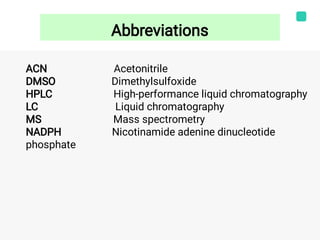
ACN Acetonitrile
DMSO Dimethylsulfoxide
HPLC High-performance liquid chromatography
LC Liquid chromatography
MS Mass spectrometry
NADPH Nicotinamide adenine dinucleotide
phosphate
Advantages of microsomal assays
•
•
•
•
The use of species-specific microsomes can be used
to enable an understanding of interspecies
differences in drug metabolism.
Easy to prepare, use and store enabling cost
efficiencies over whole cell models.
Microsomes are pooled from multiple donors to
minimise the effect of interindividual variability.
Microsomes are fully characterised using probe
substrates to ensure activity is maintained between
batches.
Thank you...

Microsomal stability assay

  • 1.
    Microsomal Stability Assay (mouse,rat, dog, monkey, human)
  • 2.
    • Microsomes arevesicle-like artifacts re-formed from pieces of the endoplasmic reticulum (ER) when eukaryotic cells are broken-up in the laboratory; microsomes are not present in healthy, living cells.  Microsomes are necessary to analyze the metabolic activity of CYPs.
  • 3.
    Measurement of invitro intrinsic clearance using microsomes    The liver is the most important site of drug metabolism in the body. Approximately 60 % of marketed compounds are cleared by hepatic CYP- mediated metabolism. Liver microsomes are subcellular fractions which contain membrane bound drug metabolising enzymes. Microsomes can be used to determine the in vitro intrinsic clearance of a compound.
  • 4.
    • • Microsomes can beconcentrated and separated from other cellular debris by differential centrifugation. Unbroken cells, nuclei, and mitochondria sediment out whereas soluble enzymes and fragmented ER, which contains cytochrome P450 (CYP), remain in solution. Isolation of microsomes
  • 5.
    ASSAY   Metabolic stability, asdefined as the percentage of parent compound lost over time, is assessed in the presence of liver microsomes. The microsomal stability assay is primarily used to investigate Phase I metabolism using NADPH as an enzyme co-factor.
  • 6.
    Determinations: % remaining attime point, t 1/2 determination, and intrinsic clearance estimation(cl int) Controls: NADPH; Dextromethorphan (CYP2D6), Midazolam (CYP3A4), Phenacetin (CYP1A2), Diclofenac (CYP2C9), Omeprazole (CYP2C19).
  • 7.
    Assay description    Working solutionsof each compound are prepared from 10 mM stock solution in DMSO diluted to a final concentration of 100 μM in 0.05 M phosphate buffer (pH 7.4). Aliquots of Liver Microsome working solution are transferred into 1.1 mL tubes using a multichannel pipette. Positive control (5 mixed) and test compound working solutions are transferred into the tubes. using a multichannel pipette and vortexed gently.
  • 8.
    Cont'd...    At each timepoint of 0 min, 5 min, 15 min, 30 min and 60 min with NADPH or 0, 30 min and 60 min without NADPH, an aliquot is removed from each tube. Terfenadine/tolbutamide in ACN/MeOH (1:1, v/v) is added to quench and precipitate the microsomal incubations. Samples are capped and vigorously vortexed and then centrifuged at 4 °C.
  • 9.
      • •  An aliquot ofeach supernatant is transferred for LC-MS/MSC analysis. Each compound is analyzed by reversed phase HPLC using mobile phases Solvent A: water with 0.1% formic acid Solvent B: ACN with 0.1% formic acid.. The amount of parent compound is determined on the basis of the peak area ratio for each time point. Cont'd..
  • 10.
    Data analysis • • Calculations. In thedetermination of the in vitro t1/2, the analyte/ISTD peak height ratios were converted to percentage drug remaining, using the T = 0 peak height ratio values as 100%. The slope of the linear regression from log percentage remaining versus incubation time relationships (−k) was used in the conversion to in vitro T1/2, values by in vitro T1/2 = −0.693/k.
  • 11.
    Cont'd ′Conversion to invitro CL′int (in units of ml/min/kg) was done using the following formula CL'Int =0.693/in vitro T1/2 * ml incubation/mg microsomes * 45 mg microsomes/gm liver*20 gm liver/kg b.w.
  • 12.
    Cont'd • • For those compoundsin which renal excretion of unchanged drug represents a significant component of total clearance, clearance values were corrected to nonrenal clearance values by: CLnonrenal=CLtotal⋅(1−fraction of dose excreted unchanged in urine)
  • 13.
    Abbreviations ACN Acetonitrile DMSO Dimethylsulfoxide HPLCHigh-performance liquid chromatography LC Liquid chromatography MS Mass spectrometry NADPH Nicotinamide adenine dinucleotide phosphate
  • 14.
    Advantages of microsomalassays • • • • The use of species-specific microsomes can be used to enable an understanding of interspecies differences in drug metabolism. Easy to prepare, use and store enabling cost efficiencies over whole cell models. Microsomes are pooled from multiple donors to minimise the effect of interindividual variability. Microsomes are fully characterised using probe substrates to ensure activity is maintained between batches.
  • 15.