By
Dr. ABDALLAH HAMED
Lecturer of General Surgery
Ain Shams University
 Diagnosing axillary disease is the most
important prognostic facctor in breast cancer
 Definition:
It is the first draining lymph node on the direct
lymphatic pathway from the primary tumor site
and so it is the first node to harbour cancer
cells detached from the primary tumour.
 Studies validating the use of SLNB restricted
its use to T1 or T2 tumors with no clinically
palpable lymph nodes
 Large or locally advanced tumors (T3 or T4)
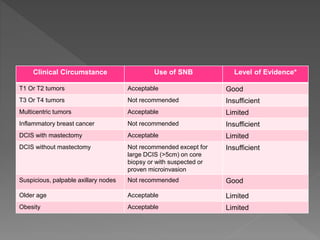
Clinical Circumstance Use of SNB Level of Evidence*
T1 Or T2 tumors Acceptable Good
T3 Or T4 tumors Not recommended Insufficient
Multicentric tumors Acceptable Limited
Inflammatory breast cancer Not recommended Insufficient
DCIS with mastectomy Acceptable Limited
DCIS without mastectomy Not recommended except for
large DCIS (>5cm) on core
biopsy or with suspected or
proven microinvasion
Insufficient
Suspicious, palpable axillary nodes Not recommended Good
Older age Acceptable Limited
Obesity Acceptable Limited
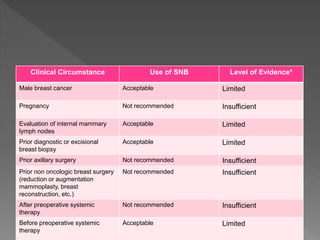
Clinical Circumstance Use of SNB Level of Evidence*
Male breast cancer Acceptable Limited
Pregnancy Not recommended Insufficient
Evaluation of internal mammary
lymph nodes
Acceptable Limited
Prior diagnostic or excisional
breast biopsy
Acceptable Limited
Prior axillary surgery Not recommended Insufficient
Prior non oncologic breast surgery
(reduction or augmentation
mammoplasty, breast
reconstruction, etc.)
Not recommended Insufficient
After preoperative systemic
therapy
Not recommended Insufficient
Before preoperative systemic
therapy
Acceptable Limited
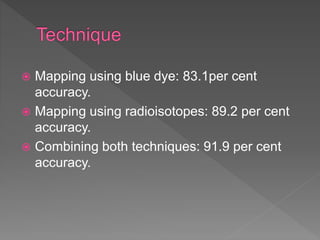
 Mapping using blue dye: 83.1per cent
accuracy.
 Mapping using radioisotopes: 89.2 per cent
accuracy.
 Combining both techniques: 91.9 per cent
accuracy.
 Peri-tumoral injection ( which has limited
application in clinically impalpable tumors).
 Intra and sub-dermal.
 Peri or sub-areolar.
 Prognostic value of SLNB
Negative SLNB
Positive SLNB
 NEGATIVE:
SLNB spares many patients the potential
side effects of axillary lymph node dissection
(ALND) such as lymphoedema,
and studies concluded that with a negative
SLNB, SLN surgery alone without ALND is
safe and effective
 Positive:
Isolated tumor lesions ….<0.2 mm
Micrometastases….0.2 2mm
Macrometastases… >2mm
 Positive: current
guidelines recommend ALND in breast
cancer patients with positive SLNB.
However recent trials as ACOSOG 0011
which was published recently which provided
convincing evidence that completion (ALND)
was unnecessary in patients with 1 to 2
positive sentinel lymph nodes (SLNs).
 Although the findings of ACOSOG Z0011 are
impressive, in clinical practice they are
applicable to limited number of cases and
that was because of the limited study
population, old age group, receptor status of
the tumor, and length of follow up.
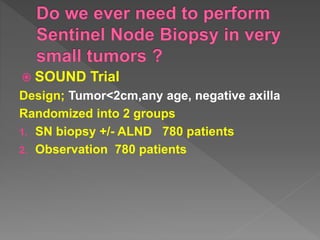
 SOUND Trial
Design; Tumor<2cm,any age, negative axilla
Randomized into 2 groups
1. SN biopsy +/- ALND 780 patients
2. Observation 780 patients
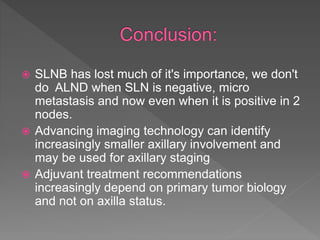
 SLNB has lost much of it's importance, we don't
do ALND when SLN is negative, micro
metastasis and now even when it is positive in 2
nodes.
 Advancing imaging technology can identify
increasingly smaller axillary involvement and
may be used for axillary staging
 Adjuvant treatment recommendations
increasingly depend on primary tumor biology
and not on axilla status.
Sentinel lymph node biopsy (slnb)

Sentinel lymph node biopsy (slnb)

  • 1.
    By Dr. ABDALLAH HAMED Lecturerof General Surgery Ain Shams University
  • 2.
     Diagnosing axillarydisease is the most important prognostic facctor in breast cancer
  • 3.
     Definition: It isthe first draining lymph node on the direct lymphatic pathway from the primary tumor site and so it is the first node to harbour cancer cells detached from the primary tumour.
  • 5.
     Studies validatingthe use of SLNB restricted its use to T1 or T2 tumors with no clinically palpable lymph nodes
  • 6.
     Large orlocally advanced tumors (T3 or T4)
  • 7.
    Clinical Circumstance Useof SNB Level of Evidence* T1 Or T2 tumors Acceptable Good T3 Or T4 tumors Not recommended Insufficient Multicentric tumors Acceptable Limited Inflammatory breast cancer Not recommended Insufficient DCIS with mastectomy Acceptable Limited DCIS without mastectomy Not recommended except for large DCIS (>5cm) on core biopsy or with suspected or proven microinvasion Insufficient Suspicious, palpable axillary nodes Not recommended Good Older age Acceptable Limited Obesity Acceptable Limited
  • 8.
    Clinical Circumstance Useof SNB Level of Evidence* Male breast cancer Acceptable Limited Pregnancy Not recommended Insufficient Evaluation of internal mammary lymph nodes Acceptable Limited Prior diagnostic or excisional breast biopsy Acceptable Limited Prior axillary surgery Not recommended Insufficient Prior non oncologic breast surgery (reduction or augmentation mammoplasty, breast reconstruction, etc.) Not recommended Insufficient After preoperative systemic therapy Not recommended Insufficient Before preoperative systemic therapy Acceptable Limited
  • 9.
     Mapping usingblue dye: 83.1per cent accuracy.  Mapping using radioisotopes: 89.2 per cent accuracy.  Combining both techniques: 91.9 per cent accuracy.
  • 10.
     Peri-tumoral injection( which has limited application in clinically impalpable tumors).  Intra and sub-dermal.  Peri or sub-areolar.
  • 14.
     Prognostic valueof SLNB Negative SLNB Positive SLNB
  • 15.
     NEGATIVE: SLNB sparesmany patients the potential side effects of axillary lymph node dissection (ALND) such as lymphoedema, and studies concluded that with a negative SLNB, SLN surgery alone without ALND is safe and effective
  • 16.
     Positive: Isolated tumorlesions ….<0.2 mm Micrometastases….0.2 2mm Macrometastases… >2mm
  • 17.
     Positive: current guidelinesrecommend ALND in breast cancer patients with positive SLNB. However recent trials as ACOSOG 0011 which was published recently which provided convincing evidence that completion (ALND) was unnecessary in patients with 1 to 2 positive sentinel lymph nodes (SLNs).
  • 18.
     Although thefindings of ACOSOG Z0011 are impressive, in clinical practice they are applicable to limited number of cases and that was because of the limited study population, old age group, receptor status of the tumor, and length of follow up.
  • 19.
     SOUND Trial Design;Tumor<2cm,any age, negative axilla Randomized into 2 groups 1. SN biopsy +/- ALND 780 patients 2. Observation 780 patients
  • 21.
     SLNB haslost much of it's importance, we don't do ALND when SLN is negative, micro metastasis and now even when it is positive in 2 nodes.  Advancing imaging technology can identify increasingly smaller axillary involvement and may be used for axillary staging  Adjuvant treatment recommendations increasingly depend on primary tumor biology and not on axilla status.