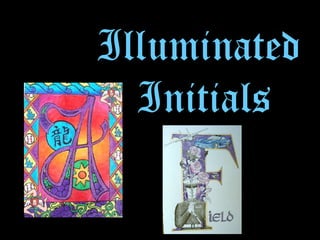
Illuminated  Initials
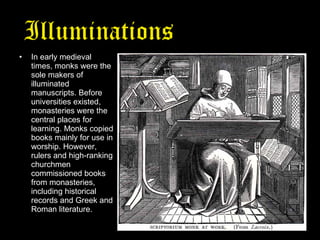
Illuminations   from the Middle Ages In early medieval times, monks were the sole makers of illuminated manuscripts. Before universities existed, monasteries were the central places for learning. Monks copied books mainly for use in worship. However, rulers and high-ranking churchmen commissioned books from monasteries, including historical records and Greek and Roman literature.
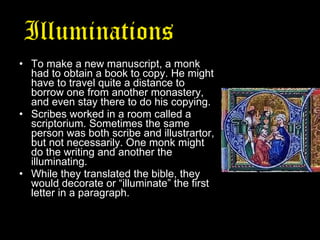
Illuminations   from the Middle Ages To make a new manuscript, a monk had to obtain a book to copy. He might have to travel quite a distance to borrow one from another monastery, and even stay there to do his copying.  Scribes worked in a room called a scriptorium. Sometimes the same person was both scribe and illustrartor, but not necessarily. One monk might do the writing and another the illuminating. While they translated the bible, they would decorate or “illuminate” the first letter in a paragraph.
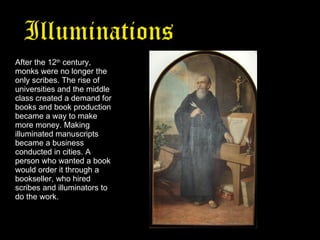
Illuminations   from the Middle Ages After the 12 th  century, monks were no longer the only scribes. The rise of universities and the middle class created a demand for books and book production became a way to make more money. Making illuminated manuscripts became a business conducted in cities. A person who wanted a book would order it through a bookseller, who hired scribes and illuminators to do the work.
 
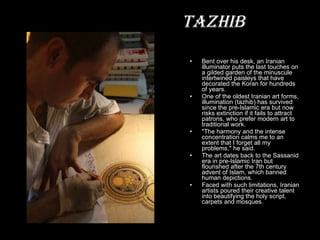
Bent over his desk, an Iranian illuminator puts the last touches on a gilded garden of the minuscule intertwined paisleys that have decorated the Koran for hundreds of years. One of the oldest Iranian art forms, illumination (tazhib) has survived since the pre-Islamic era but now risks extinction if it fails to attract patrons, who prefer modern art to traditional work. "The harmony and the intense concentration calms me to an extent that I forget all my problems," he said. The art dates back to the Sassanid era in pre-Islamic Iran but flourished after the 7th century advent of Islam, which banned human depictions. Faced with such limitations, Iranian artists poured their creative talent into beautifying the holy script, carpets and mosques. Tazhib
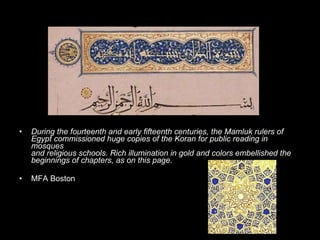
During the fourteenth and early fifteenth centuries, the Mamluk rulers of  Egypt commissioned huge copies of the Koran for public reading in mosques  and religious schools. Rich illumination in gold and colors embellished the  beginnings of chapters, as on this page.   MFA Boston
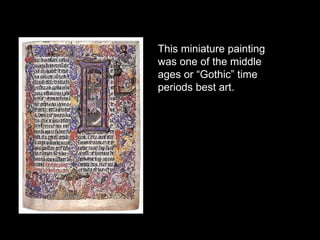
This miniature painting was one of the middle ages or “Gothic” time periods best art.
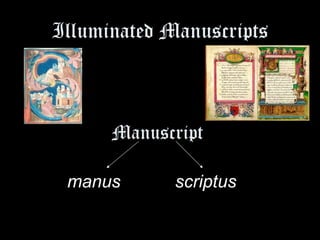
Manuscript manus   scriptus Illuminated Manuscripts
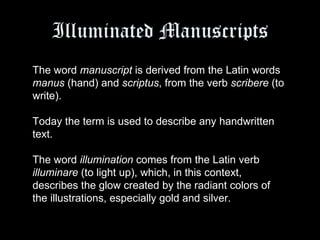
Illuminated Manuscripts The word  manuscript  is derived from the Latin words  manus  (hand) and  scriptus , from the verb  scribere  (to write).  Today the term is used to describe any handwritten text.  The word  illumination  comes from the Latin verb  illuminare  (to light up), which, in this context, describes the glow created by the radiant colors of the illustrations, especially gold and silver.
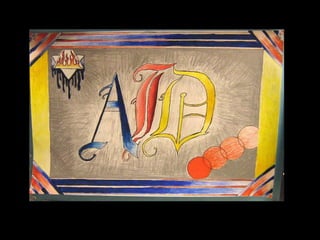
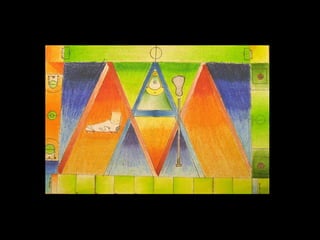
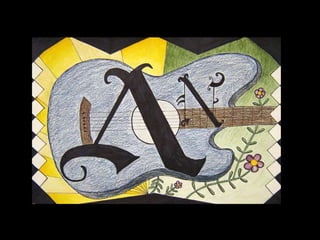
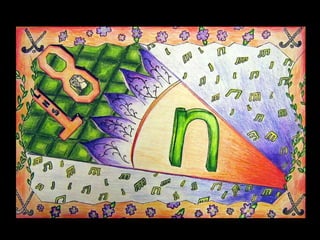
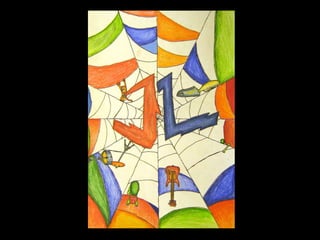
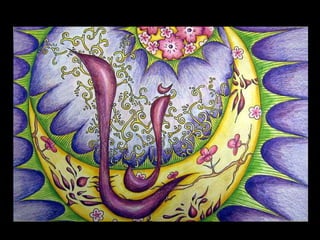
1. Your Name Initial  –  one or all 2. Three Symbols  – Things that represent you 3. Border  - border should relate to the rest of your illumination. 4. A Color Harmony and expert shading skills Illuminated Initials Project Requirements:


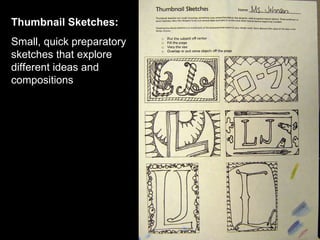
Thumbnail Sketches: Small, quick preparatory sketches that explore different ideas and compositions
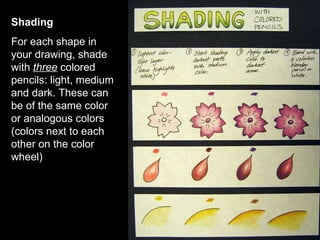
Shading For each shape in your drawing, shade with  three  colored pencils: light, medium and dark. These can be of the same color or analogous colors (colors next to each other on the color wheel)
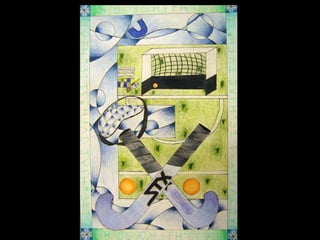
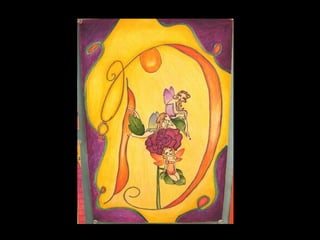
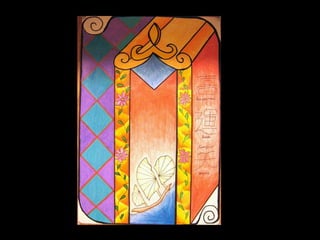
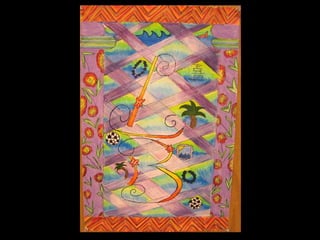
Invent a creative illumination of your own initials   You will need to do a minimum of six thumbnail sketches and a large rough draft before starting the final ! Your final illumination should include: Your Name Initial  –  one or all Three Symbols  – Things that represent you 3.  Border  - border should relate to the rest of your illumination. 4.  A Color Harmony and  expert  shading skills Your grade will be based on Creativity, Design, Craftsmanship, Effort and Attitude.

Illuminated initials powerpoint

  • 1.
  • 2.
    Illuminations from the Middle Ages In early medieval times, monks were the sole makers of illuminated manuscripts. Before universities existed, monasteries were the central places for learning. Monks copied books mainly for use in worship. However, rulers and high-ranking churchmen commissioned books from monasteries, including historical records and Greek and Roman literature.
  • 3.
    Illuminations from the Middle Ages To make a new manuscript, a monk had to obtain a book to copy. He might have to travel quite a distance to borrow one from another monastery, and even stay there to do his copying. Scribes worked in a room called a scriptorium. Sometimes the same person was both scribe and illustrartor, but not necessarily. One monk might do the writing and another the illuminating. While they translated the bible, they would decorate or “illuminate” the first letter in a paragraph.
  • 4.
    Illuminations from the Middle Ages After the 12 th century, monks were no longer the only scribes. The rise of universities and the middle class created a demand for books and book production became a way to make more money. Making illuminated manuscripts became a business conducted in cities. A person who wanted a book would order it through a bookseller, who hired scribes and illuminators to do the work.
  • 5.
  • 6.
    Bent over hisdesk, an Iranian illuminator puts the last touches on a gilded garden of the minuscule intertwined paisleys that have decorated the Koran for hundreds of years. One of the oldest Iranian art forms, illumination (tazhib) has survived since the pre-Islamic era but now risks extinction if it fails to attract patrons, who prefer modern art to traditional work. "The harmony and the intense concentration calms me to an extent that I forget all my problems," he said. The art dates back to the Sassanid era in pre-Islamic Iran but flourished after the 7th century advent of Islam, which banned human depictions. Faced with such limitations, Iranian artists poured their creative talent into beautifying the holy script, carpets and mosques. Tazhib
  • 7.
    During the fourteenthand early fifteenth centuries, the Mamluk rulers of Egypt commissioned huge copies of the Koran for public reading in mosques and religious schools. Rich illumination in gold and colors embellished the beginnings of chapters, as on this page. MFA Boston
  • 8.
    This miniature paintingwas one of the middle ages or “Gothic” time periods best art.
  • 9.
    Manuscript manus scriptus Illuminated Manuscripts
  • 10.
    Illuminated Manuscripts Theword manuscript is derived from the Latin words manus (hand) and scriptus , from the verb scribere (to write). Today the term is used to describe any handwritten text. The word illumination comes from the Latin verb illuminare (to light up), which, in this context, describes the glow created by the radiant colors of the illustrations, especially gold and silver.
  • 11.
    1. Your NameInitial – one or all 2. Three Symbols – Things that represent you 3. Border - border should relate to the rest of your illumination. 4. A Color Harmony and expert shading skills Illuminated Initials Project Requirements:
  • 12.
  • 13.
  • 14.
  • 15.
  • 16.
  • 17.
  • 18.
  • 19.
  • 20.
  • 21.
  • 22.
    Thumbnail Sketches: Small,quick preparatory sketches that explore different ideas and compositions
  • 23.
    Shading For eachshape in your drawing, shade with three colored pencils: light, medium and dark. These can be of the same color or analogous colors (colors next to each other on the color wheel)
  • 24.
    Invent a creativeillumination of your own initials You will need to do a minimum of six thumbnail sketches and a large rough draft before starting the final ! Your final illumination should include: Your Name Initial – one or all Three Symbols – Things that represent you 3. Border - border should relate to the rest of your illumination. 4. A Color Harmony and expert shading skills Your grade will be based on Creativity, Design, Craftsmanship, Effort and Attitude.