Joe Clarke
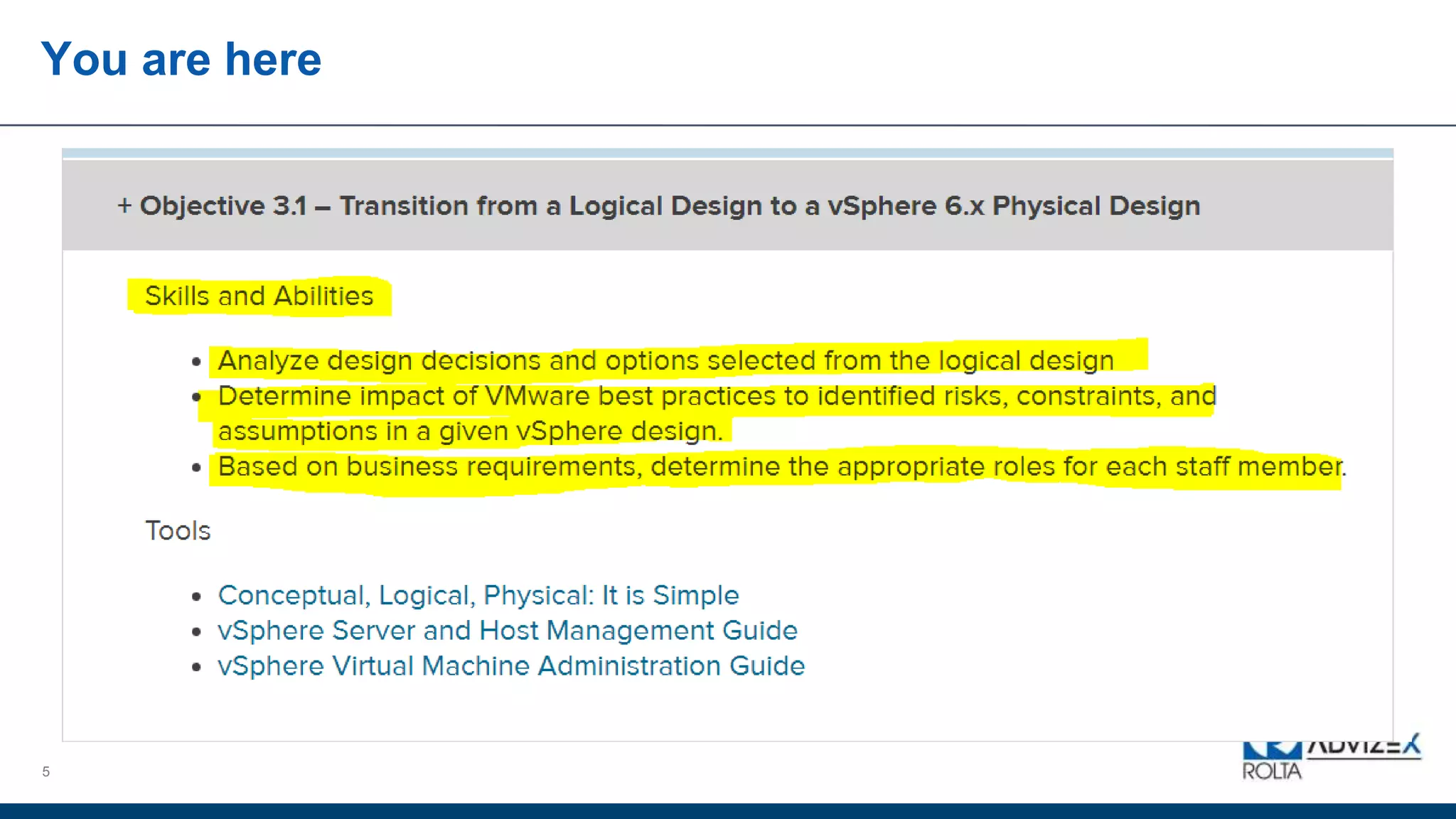
Principal ArchitectObjective 3.1 – Transition from a
Logical Design to a vSphere 6.x
Physical Design
Agenda
• Introduction
• 3V0-622 Objectives
• Conceptual / Logical / Physical Refresher
• Exam Topics
2
Quick Intro
• Joe Clarke from Cleveland, Ohio
• Principal Architect at Rolta AdvizeX
• VCDX5-DTM, VCIX6-DCV, Candidate for VCDX6-DCV
• @elgwhoppo
• www.elgwhoppo.com
• Thanks for having me!
3
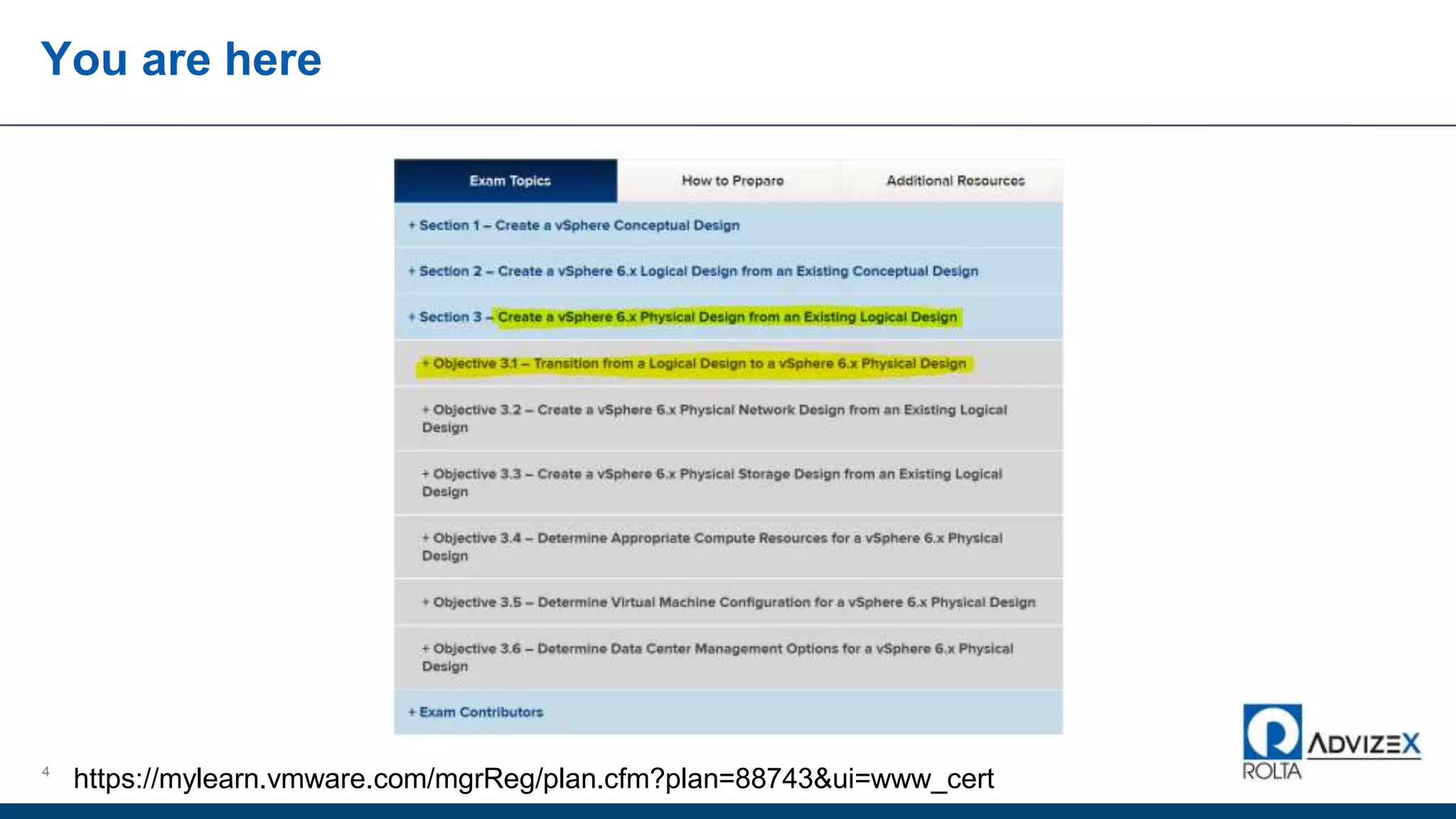
You are here
4
https://mylearn.vmware.com/mgrReg/plan.cfm?plan=88743&ui=www_cert
You are here
5
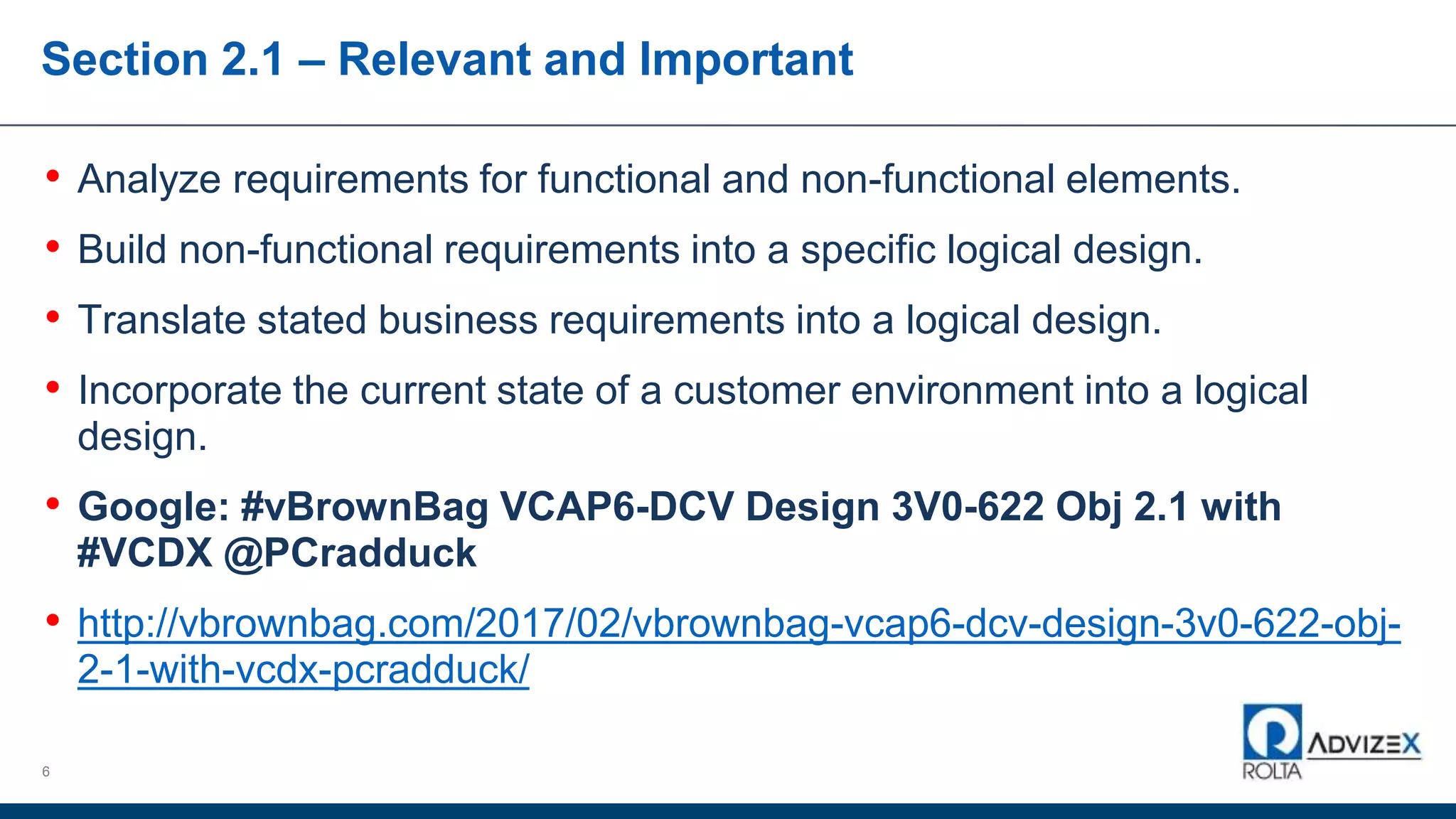
Section 2.1 – Relevant and Important
• Analyze requirements for functional and non-functional elements.
• Build non-functional requirements into a specific logical design.
• Translate stated business requirements into a logical design.
• Incorporate the current state of a customer environment into a logical
design.
• Google: #vBrownBag VCAP6-DCV Design 3V0-622 Obj 2.1 with
#VCDX @PCradduck
• http://vbrownbag.com/2017/02/vbrownbag-vcap6-dcv-design-3v0-622-obj-
2-1-with-vcdx-pcradduck/
6
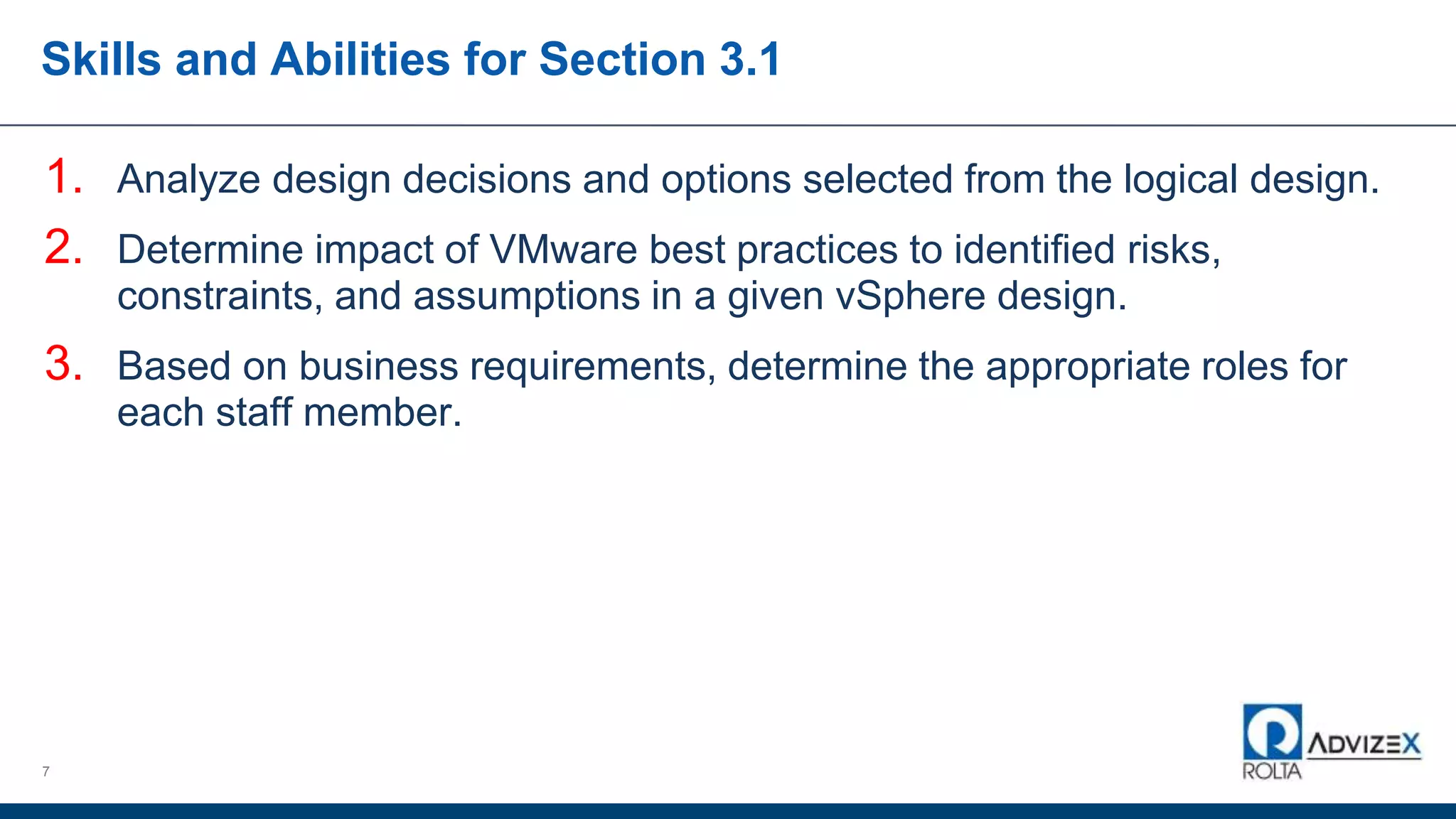
Skills and Abilities for Section 3.1
1. Analyze design decisions and options selected from the logical design.
2. Determine impact of VMware best practices to identified risks,
constraints, and assumptions in a given vSphere design.
3. Based on business requirements, determine the appropriate roles for
each staff member.
7
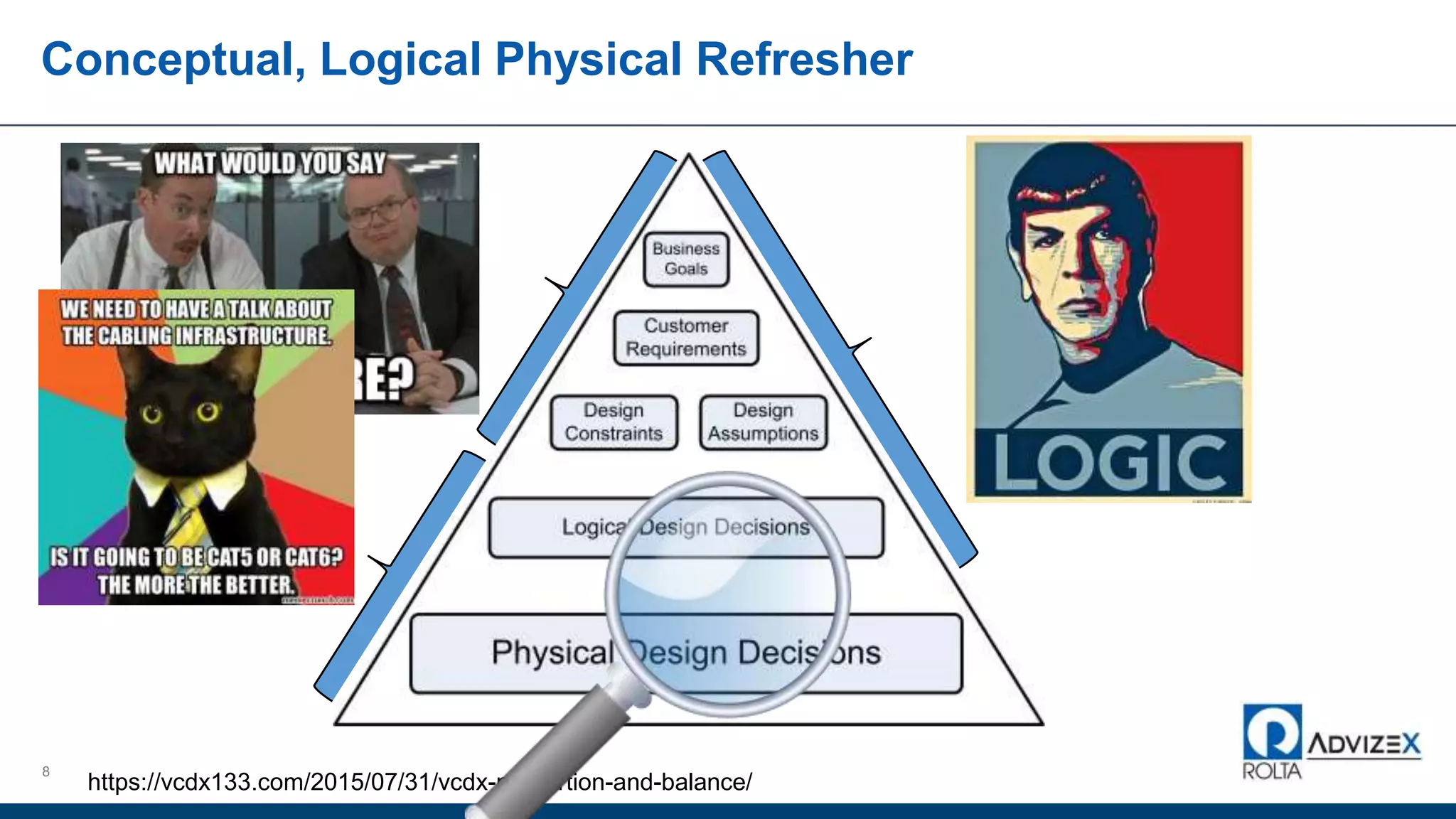
Conceptual, Logical Physical Refresher
8
https://vcdx133.com/2015/07/31/vcdx-proportion-and-balance/
Conceptual Design
9
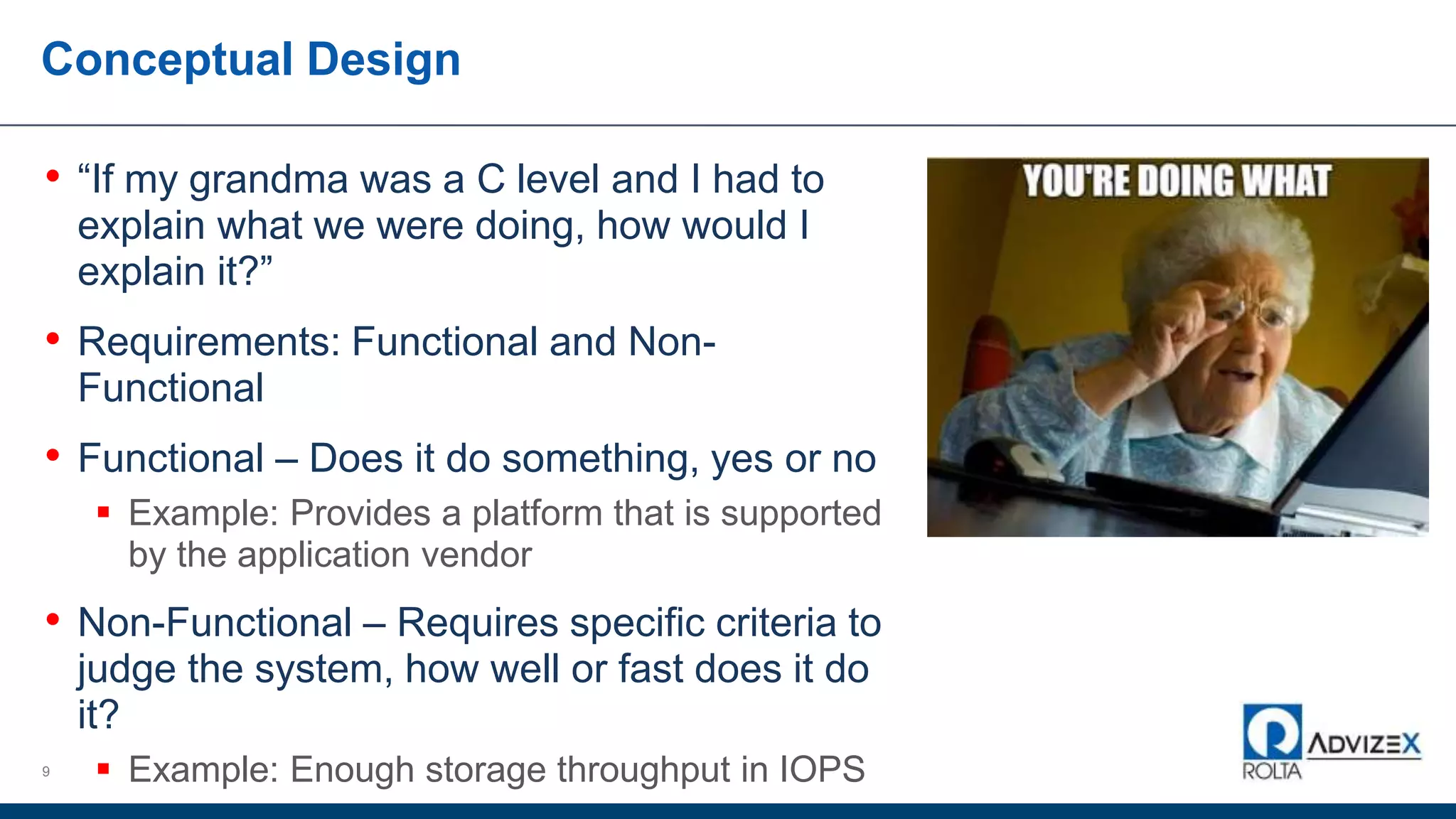
• “If my grandma was a C level and I had to
explain what we were doing, how would I
explain it?”
• Requirements: Functional and Non-
Functional
• Functional – Does it do something, yes or no
 Example: Provides a platform that is supported
by the application vendor
• Non-Functional – Requires specific criteria to
judge the system, how well or fast does it do
it?
 Example: Enough storage throughput in IOPS
Conceptual
10
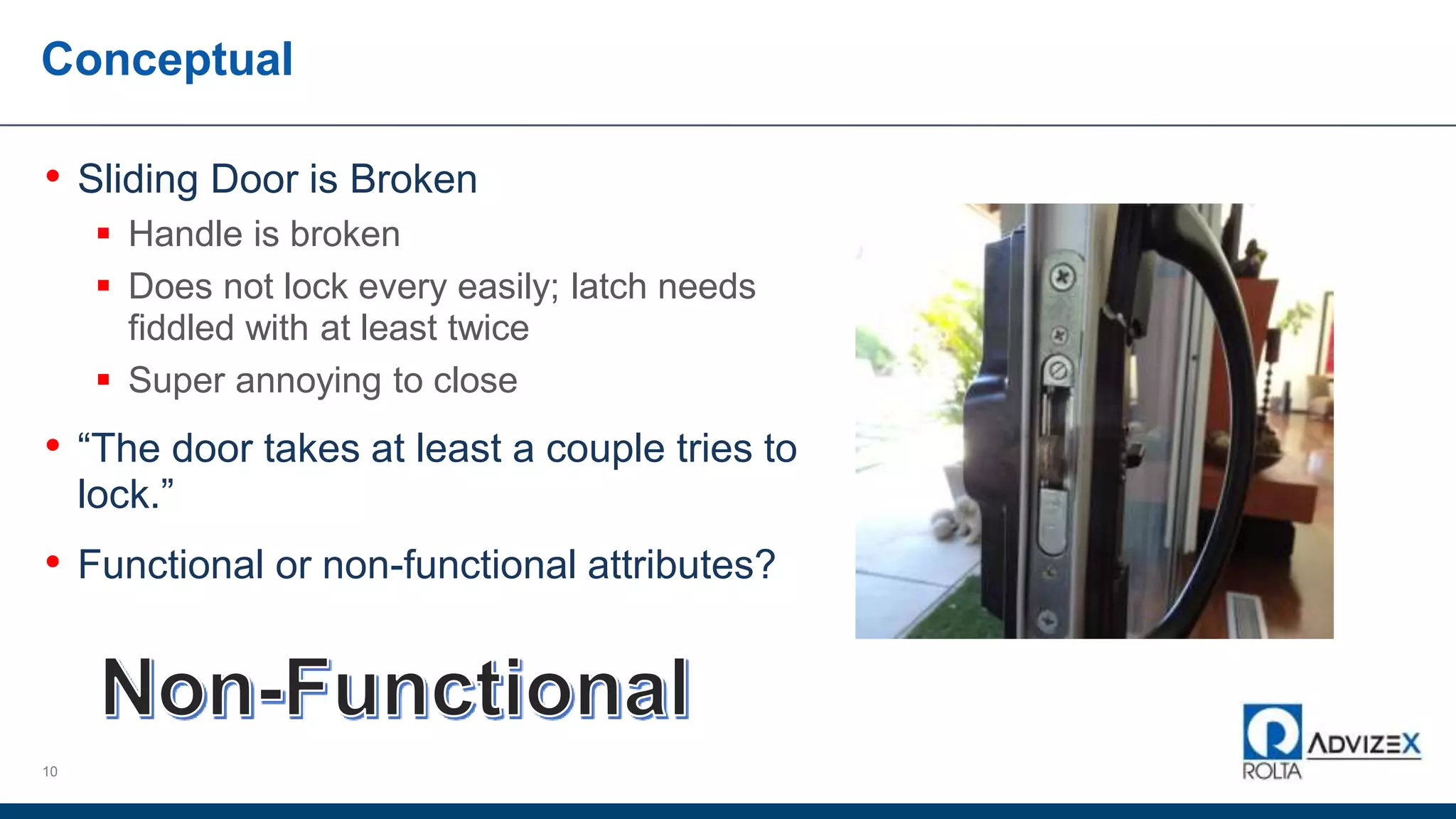
• Sliding Door is Broken
 Handle is broken
 Does not lock every easily; latch needs
fiddled with at least twice
 Super annoying to close
• “The door takes at least a couple tries to
lock.”
• Functional or non-functional attributes?
Conceptual
11
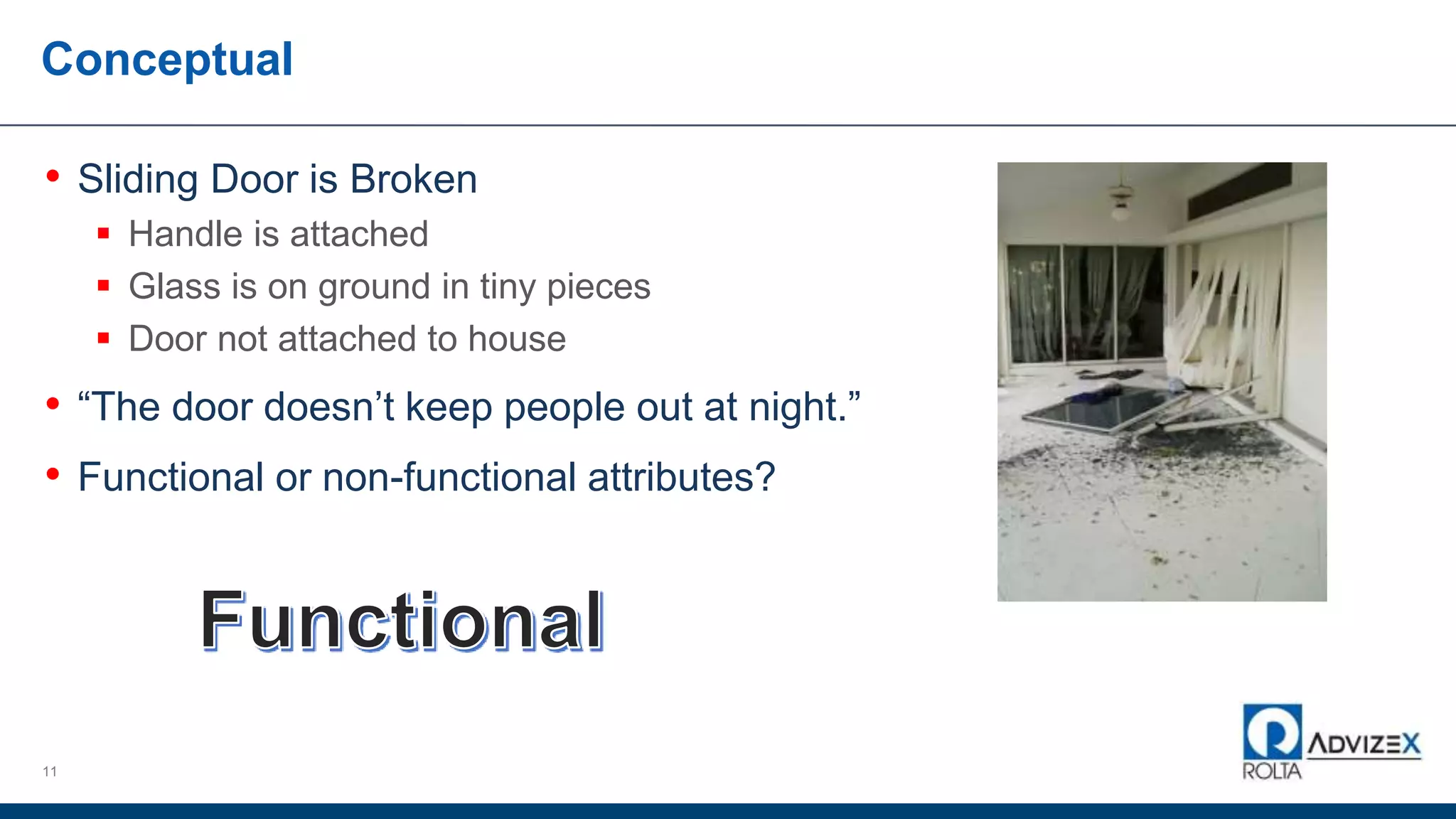
• Sliding Door is Broken
 Handle is attached
 Glass is on ground in tiny pieces
 Door not attached to house
• “The door doesn’t keep people out at night.”
• Functional or non-functional attributes?
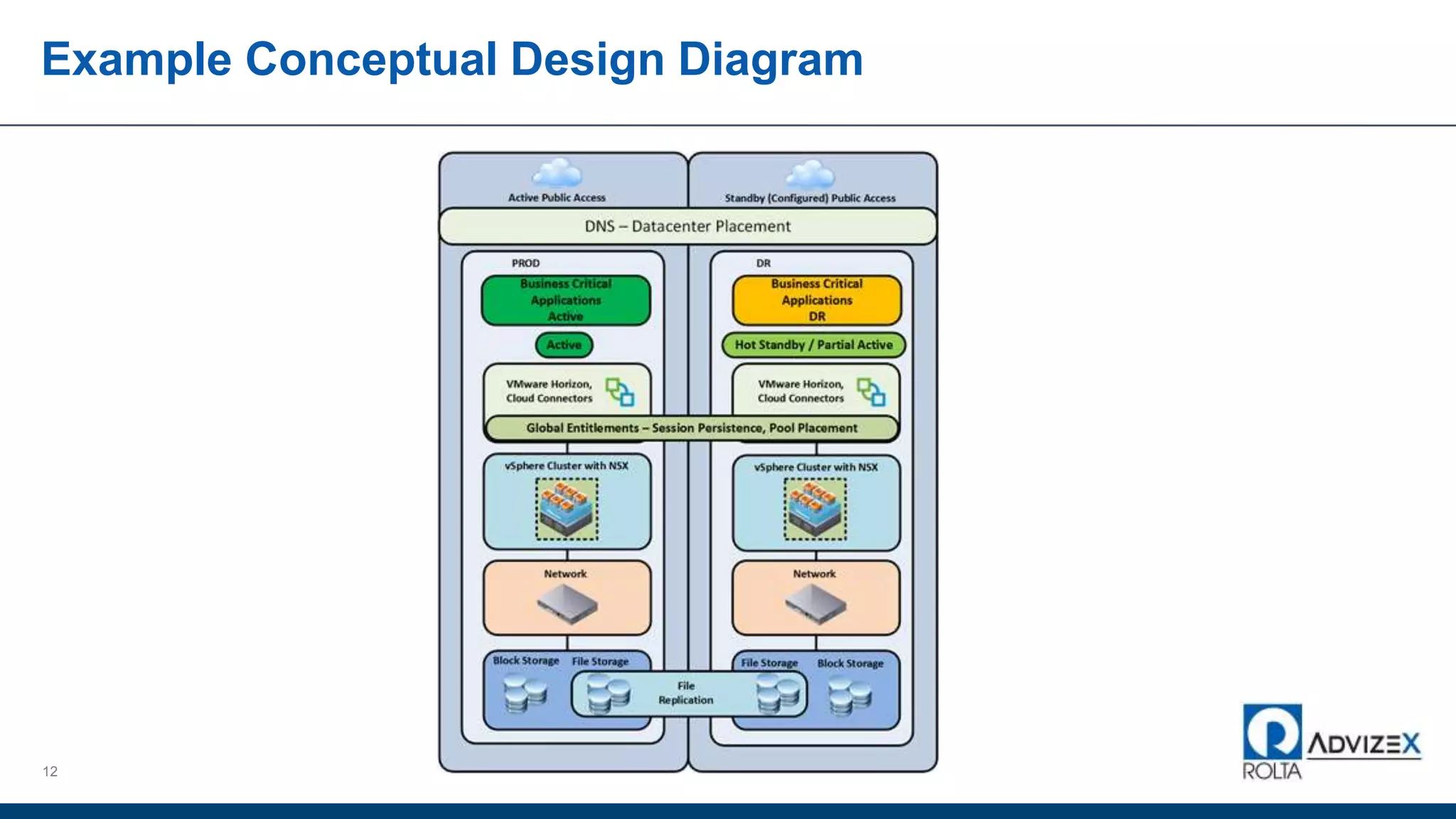
Example Conceptual Design Diagram
12
Logical Design
13
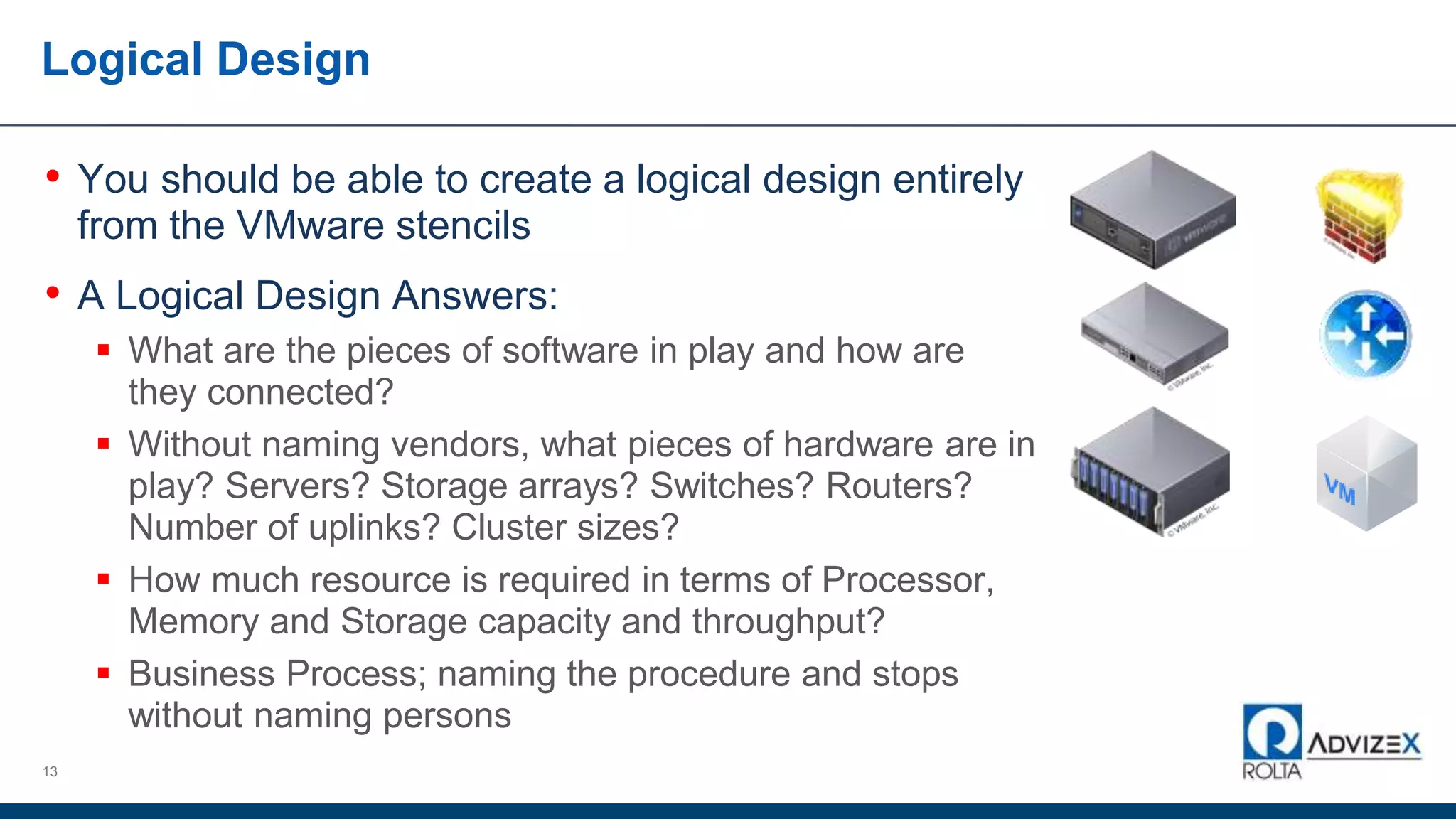
• You should be able to create a logical design entirely
from the VMware stencils
• A Logical Design Answers:
 What are the pieces of software in play and how are
they connected?
 Without naming vendors, what pieces of hardware are in
play? Servers? Storage arrays? Switches? Routers?
Number of uplinks? Cluster sizes?
 How much resource is required in terms of Processor,
Memory and Storage capacity and throughput?
 Business Process; naming the procedure and stops
without naming persons
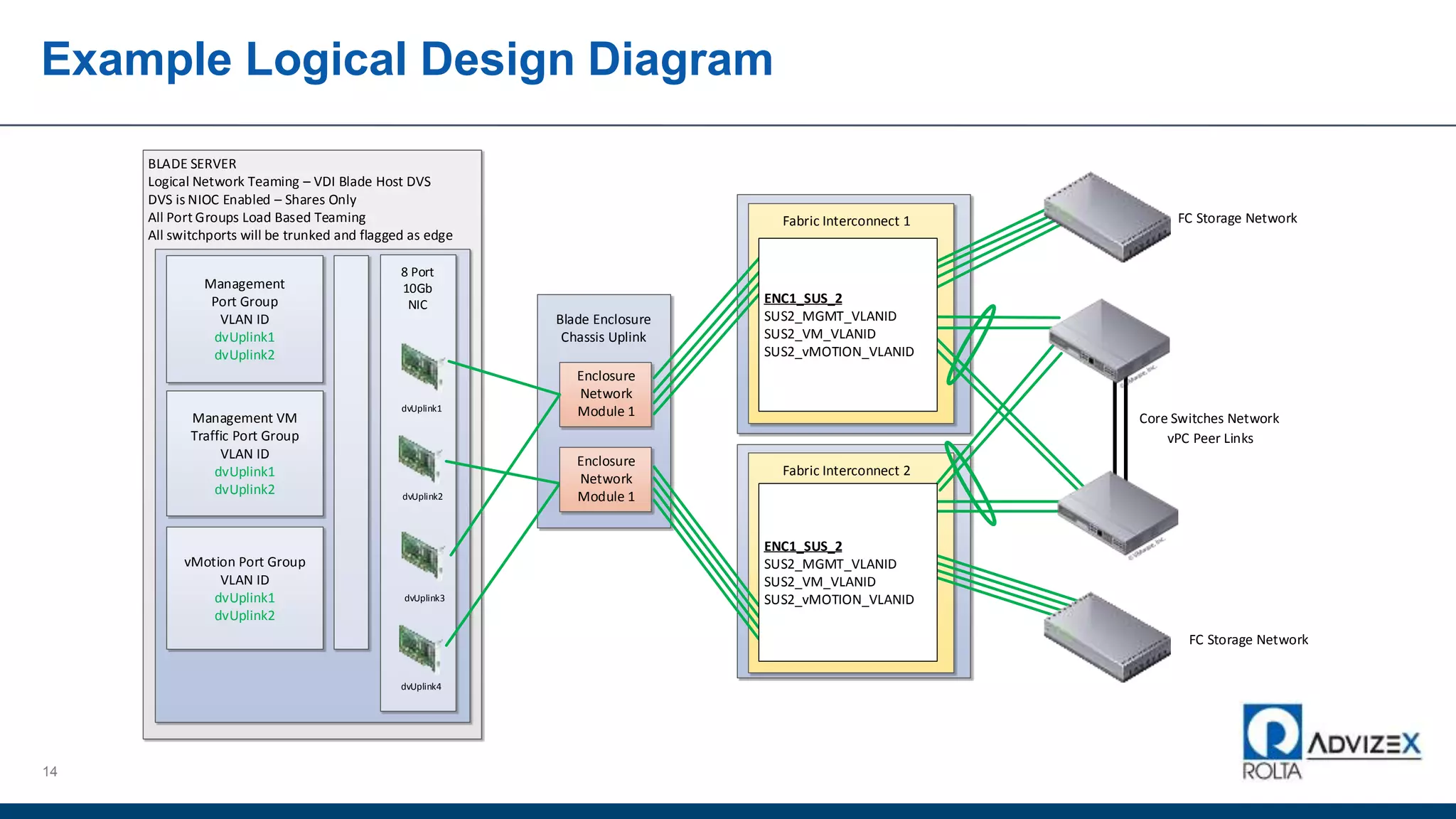
Example Logical Design Diagram
14
BLADE SERVER
Logical Network Teaming – VDI Blade Host DVS
DVS is NIOC Enabled – Shares Only
All Port Groups Load Based Teaming
All switchports will be trunked and flagged as edge
8 Port
10Gb
NIC
dvUplink1
Management
Port Group
VLAN ID
dvUplink1
dvUplink2
dvUplink4
dvUplink2
dvUplink3
Management VM
Traffic Port Group
VLAN ID
dvUplink1
dvUplink2
vMotion Port Group
VLAN ID
dvUplink1
dvUplink2
Blade Enclosure
Chassis Uplink
Enclosure
Network
Module 1
Fabric Interconnect 1
Enclosure
Network
Module 1
Fabric Interconnect 2
vPC Peer Links
Core Switches Network
ENC1_SUS_2
SUS2_MGMT_VLANID
SUS2_VM_VLANID
SUS2_vMOTION_VLANID
FC Storage Network
FC Storage Network
ENC1_SUS_2
SUS2_MGMT_VLANID
SUS2_VM_VLANID
SUS2_vMOTION_VLANID
Physical Design
15
• A physical design names OEM components and hookups and specifics
• A Physical Design provides:
 CPU Types and Named Models
 Storage type, disk speeds, quantity, capacity, RAID configuration
 Load Balancer Models
 Server Makes and Models
 IP Addresses for VMs
 Port map for cabling, connections
 Cable types, Rack Layout
 Estimated Power Consumption
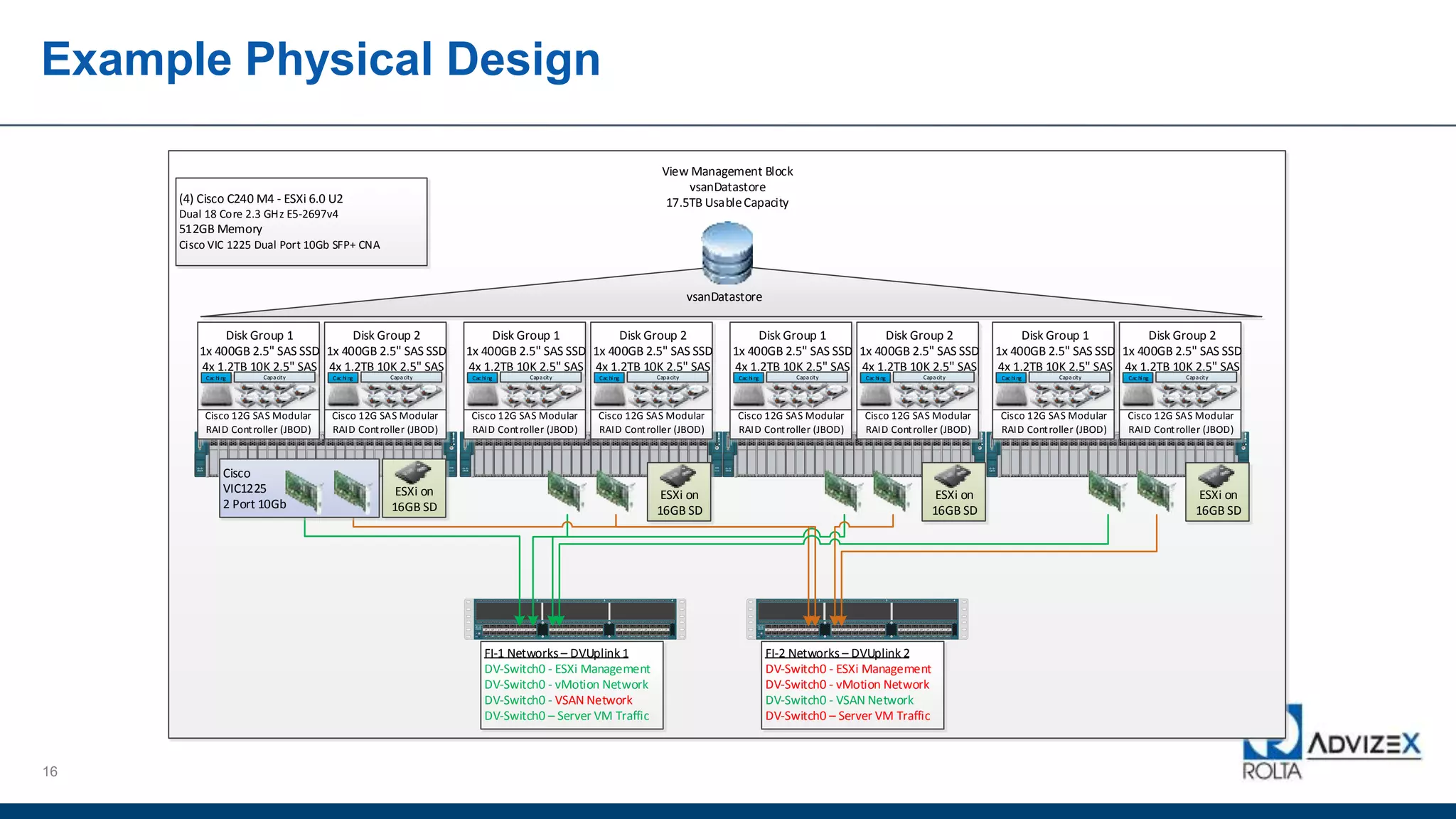
Example Physical Design
16
PWR
SYS
PWR
SYS
PWR
SYS
PWR
SYS
PWR
SYS
PWR
SYS
PWR
SYS
PWR
SYS
PWR
SYS
PWR
SYS
PWR
SYS
PWR
SYS
PWR
SYS
PWR
SYS
PWR
SYS
PWR
SYS
PWR
SYS
PWR
SYS
PWR
SYS
PWR
SYS
PWR
SYS
PWR
SYS
PWR
SYS
PWR
SYS
PWR
SYS
CONSOLE
UCS
C240 M3
!
PWR
SYS
PWR
SYS
PWR
SYS
PWR
SYS
PWR
SYS
PWR
SYS
PWR
SYS
PWR
SYS
PWR
SYS
PWR
SYS
PWR
SYS
PWR
SYS
PWR
SYS
PWR
SYS
PWR
SYS
PWR
SYS
PWR
SYS
PWR
SYS
PWR
SYS
PWR
SYS
PWR
SYS
PWR
SYS
PWR
SYS
PWR
SYS
PWR
SYS
CONSOLE UCS
C240 M3
!
PWR
SYS
PWR
SYS
PWR
SYS
PWR
SYS
PWR
SYS
PWR
SYS
PWR
SYS
PWR
SYS
PWR
SYS
PWR
SYS
PWR
SYS
PWR
SYS
PWR
SYS
PWR
SYS
PWR
SYS
PWR
SYS
PWR
SYS
PWR
SYS
PWR
SYS
PWR
SYS
PWR
SYS
PWR
SYS
PWR
SYS
PWR
SYS
PWR
SYS
CONSOLE
UCS
C240 M3
!
vsanDatastore
View Management Block
vsanDatastore
17.5TB UsableCapacity
2 3 4
1 2 3 4 5 6 7 8 9 10 11 12 13 14 15 16 17 18 19 20 21 22 23 24 25 26 27 28 29 30 31 32 33 34 35 36 37 38 39 40 41 42 43 44 45 46 47 48
CISCO UCS 6296UP
STAT
ID
2 3 4
1 2 3 4 5 6 7 8 9 10 11 12 13 14 15 16 17 18 19 20 21 22 23 24 25 26 27 28 29 30 31 32 33 34 35 36 37 38 39 40 41 42 43 44 45 46 47 48
CISCO UCS 6296UP
STAT
ID
Cisco
VIC1225
2 Port 10Gb
ESXi on
16GB SD
ESXi on
16GB SD
ESXi on
16GB SD
(4) Cisco C240 M4 - ESXi 6.0 U2
Dual 18 Core 2.3 GHz E5-2697v4
512GB Memory
Cisco VIC 1225 Dual Port 10Gb SFP+ CNA
PWR
SYS
PWR
SYS
PWR
SYS
PWR
SYS
PWR
SYS
PWR
SYS
PWR
SYS
PWR
SYS
PWR
SYS
PWR
SYS
PWR
SYS
PWR
SYS
PWR
SYS
PWR
SYS
PWR
SYS
PWR
SYS
PWR
SYS
PWR
SYS
PWR
SYS
PWR
SYS
PWR
SYS
PWR
SYS
PWR
SYS
PWR
SYS
PWR
SYS
CONSOLE
UCS
C240 M3
!
ESXi on
16GB SD
FI-1 Networks – DVUplink 1
DV-Switch0 - ESXi Management
DV-Switch0 - vMotion Network
DV-Switch0 - VSAN Network
DV-Switch0 – Server VM Traffic
FI-2 Networks – DVUplink 2
DV-Switch0 - ESXi Management
DV-Switch0 - vMotion Network
DV-Switch0 - VSAN Network
DV-Switch0 – Server VM Traffic
Disk Group 1
1x 400GB 2.5" SAS SSD
4x 1.2TB 10K 2.5" SAS
Cac hi ng Capacity
Cisco 12G SAS Modular
RAID Controller (JBOD)
Disk Group 2
1x 400GB 2.5" SAS SSD
4x 1.2TB 10K 2.5" SAS
Cac hi ng Capacity
Cisco 12G SAS Modular
RAID Controller (JBOD)
Disk Group 1
1x 400GB 2.5" SAS SSD
4x 1.2TB 10K 2.5" SAS
Cac hi ng Capacity
Cisco 12G SAS Modular
RAID Controller (JBOD)
Disk Group 2
1x 400GB 2.5" SAS SSD
4x 1.2TB 10K 2.5" SAS
Cac hi ng Capacity
Cisco 12G SAS Modular
RAID Controller (JBOD)
Disk Group 1
1x 400GB 2.5" SAS SSD
4x 1.2TB 10K 2.5" SAS
Cac hi ng Capacity
Cisco 12G SAS Modular
RAID Controller (JBOD)
Disk Group 2
1x 400GB 2.5" SAS SSD
4x 1.2TB 10K 2.5" SAS
Cac hi ng Capacity
Cisco 12G SAS Modular
RAID Controller (JBOD)
Disk Group 1
1x 400GB 2.5" SAS SSD
4x 1.2TB 10K 2.5" SAS
Cac hi ng Capacity
Cisco 12G SAS Modular
RAID Controller (JBOD)
Disk Group 2
1x 400GB 2.5" SAS SSD
4x 1.2TB 10K 2.5" SAS
Cac hi ng Capacity
Cisco 12G SAS Modular
RAID Controller (JBOD)
3.1 Objective 1
• Analyze design decisions and options selected from the logical design.
17
Analyze Design Decisions from Logical
• Example logical design decision:
 Cluster Sizes and Resource requirements
 Integration of software components “This talks to this”
 Why multiple clusters?
 Why or why not use a load balanced PSC?
18
Analyze Design Decisions from Logical to Physical
• How do each of my decisions impact:
• Availability – How does my server OEM choice impact availability?
• Manageability – How does my network choice impact availability?
• Performance – How does my processor clock speed impact performance?
• Recoverability – How does my secondary vendor storage impact RTOs?
• Security – How does re-using old gear bring risk?
• Cost – Why is one option more expensive than another?
19
VCDX Tip: Fuzz the design
• fuzzing is a software testing technique used to discover errors and
security loopholes in software, inputting massive amounts of data in an
attempt to make it crash.
• Go on the offensive like you didn’t design it. Remove yourself from it.
• Ask:
 Why?
 Why not?
 What if costs changed?
 Alternatives?
20
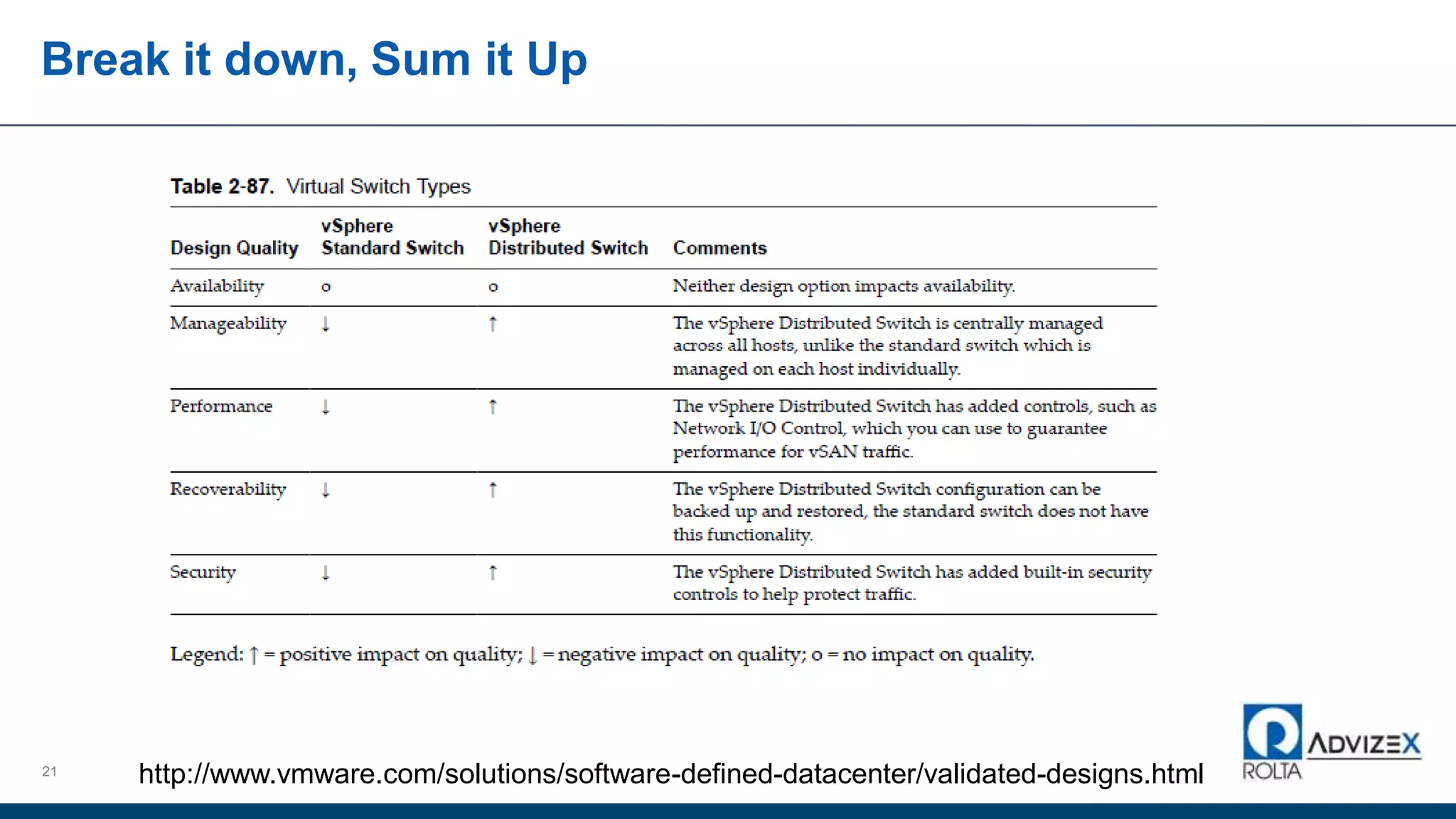
Break it down, Sum it Up
21 http://www.vmware.com/solutions/software-defined-datacenter/validated-designs.html
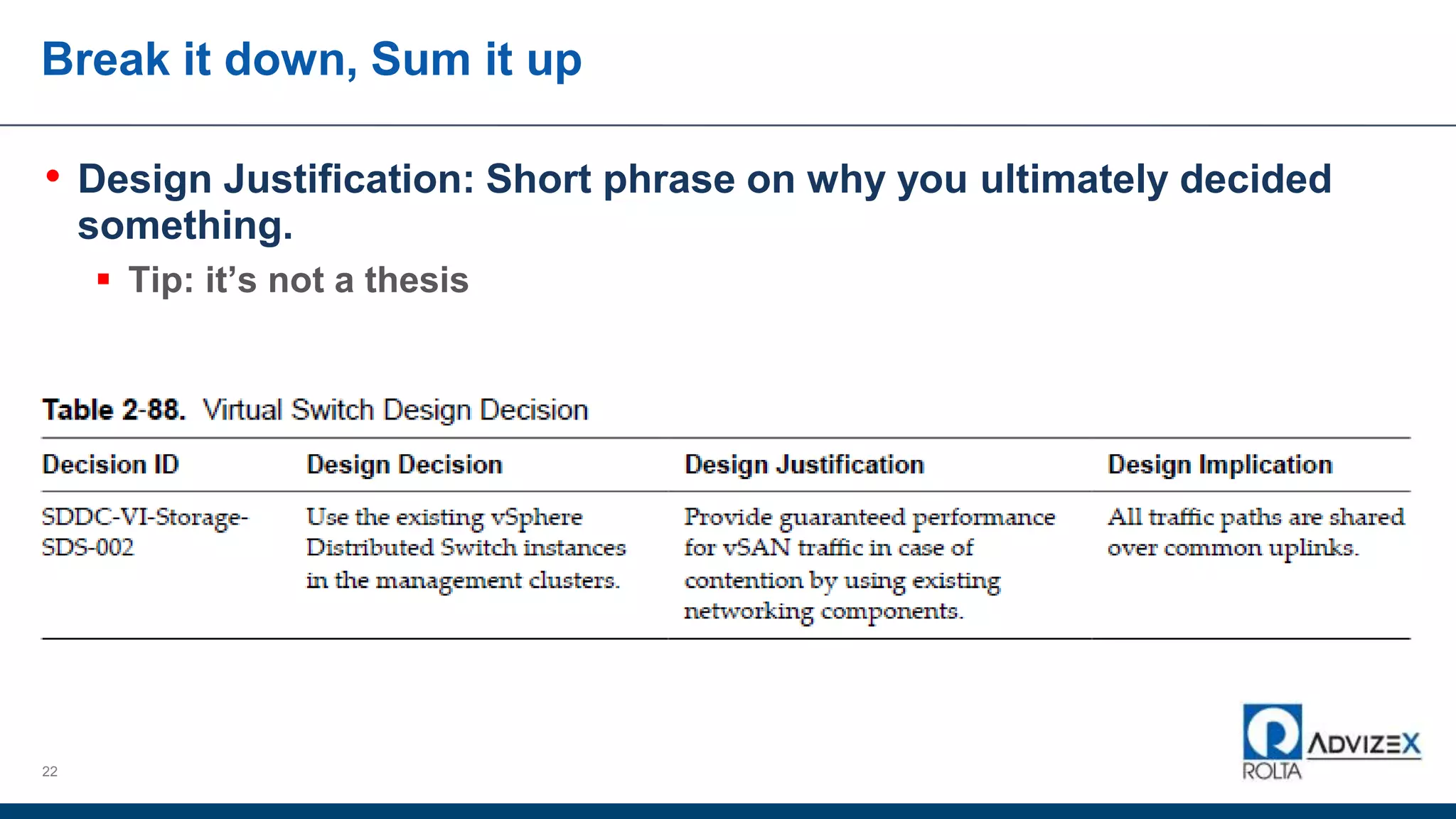
Break it down, Sum it up
• Design Justification: Short phrase on why you ultimately decided
something.
 Tip: it’s not a thesis
22
3.1 Objective 2
• Determine impact of VMware best practices to identified risks,
constraints, and assumptions in a given vSphere design.
23
Best Practice
• True best practices are almost always based on previous experience.
• There is no magic book of conclusive best practices.
• Be able to explain the characteristics of something you deem a best
practice and why it is.
• VCDX Defense Tip:
• Don’t ever answer with “Because it’s a VMware best practice”
24
Constraints, Risks and Assumptions
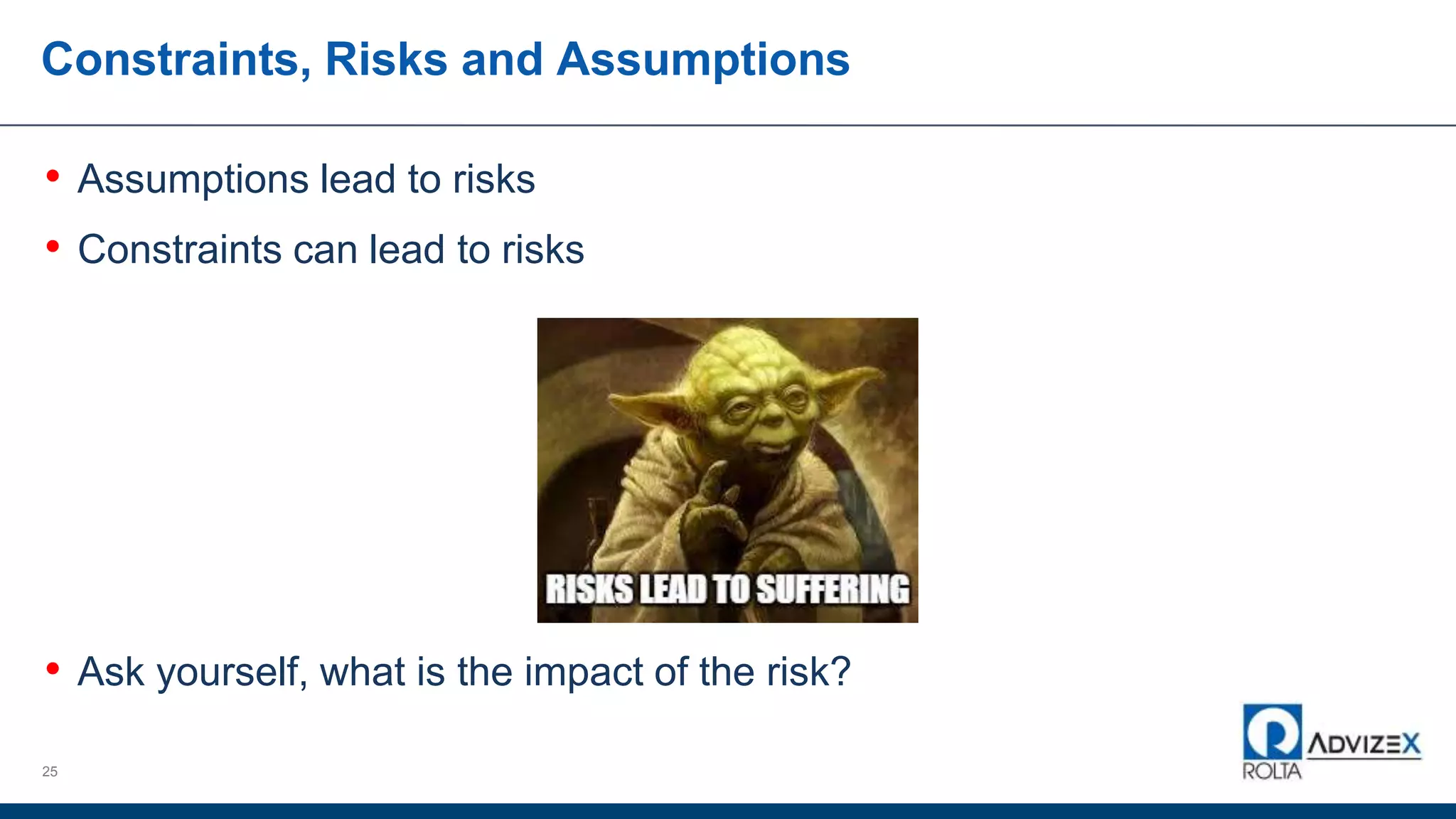
• Assumptions lead to risks
• Constraints can lead to risks
• Ask yourself, what is the impact of the risk?
25
Risk Example
• Forecasted bandwidth for storage replication will bring the DCI to 95%
utilization up from 15%.
• Potential Downstream Impacts:
 RPO cannot be guaranteed if link saturation occurs
 Saturation of a DCI can result in diminished performance for non-storage
related traffic even with QoS in place
 Additional costs for DCI throughput increase
 RPO may need to be adjusted
• Mitigation: Important! Include one!
• Risks without mitigation plans are whiny at best.
26
The eternal struggle:
• Is it a constraint?
• Is it a requirement?
• Is it both?
 Constraint: a limitation or restriction.
 Requirement: must either perform a function, or be a specific measurement of a
function’s success
• Is it an assumption?
27
Constraint vs Requirement:
• Customer demands that all server based network integration must
interoperate with existing Cisco switches.
28
Constraint vs Requirement:
• Customer demands that all switching hardware acquired is Cisco in order
to capitalize on existing investment in management tools.
29
Constraint vs Requirement:
• Customer demands that all storage use only flash disks.
30
3.1 Objective 3
• Based on business requirements, determine the appropriate roles for each
staff member.
31
Different Roles care about Different Things
• Real world: An IT org will decide itself who is doing what in regards to
operations.
• Real world: You will need to make recommendations of who should own
what operational responsibilities of a design.
• Reading between the lines: Understand the different roles and what they
care about.
32
Business requirement focus for roles
• Roles:
 CEO
 CFO
 CIO
 CISO
 Development Manager
 Infrastructure Manager
 VMware Engineer
 Network Engineer
 Legal Counsel
• Requirements typically focus on:
 Company Execution
 Company Bottom Line
 IT’s level of service to the business
 Securing Assets, Brand reputation
 Availability of resources
 Infrastructure Cost, Reliability
 Ease of software installation
 Time to value of assets
 Not getting sued
33
CEO, ACME Retail Chain
• “We are expanding our online retail platform to meet the anticipated
demand during our peak seasons. It must not go down during the holiday
season and it must be able to transact business with the same speed and
experience we usually provide, no matter the load”.
• Underlying requirements and qualifying questions:
 Availability - Wants it functional especially during the holiday
 What is the maximum downtime permissible?
 What is the difference in lost revenue regarding availability between peak and off
seasons?
 KPI – Uptime in nines
 Performance – Transactions must be as if there’s no rush
 Are normal times and experiences well understood and documented?
 KPI – Transactions per second, QA engineer web checkout workflow.34
Infrastructure Manager, ACME Retail Chain
• “We are under tremendous pressure from the CFO to keep costs to a
minimum, while expanding our infrastructure footprint by several rows
worth. Also it seems like nobody understands that we need to protect all
the additional data this is going to generate”.
• Underlying requirements and qualifying questions:
 Recoverability – His job is potentially on the line if he loses production data
 What are the recovery requirements?
 KPI – RPO, RTO
 Cost – Must expand while keeping costs to a minimum
 What is the budget allotted for the expansion initiative?
 KPI - TCO
35
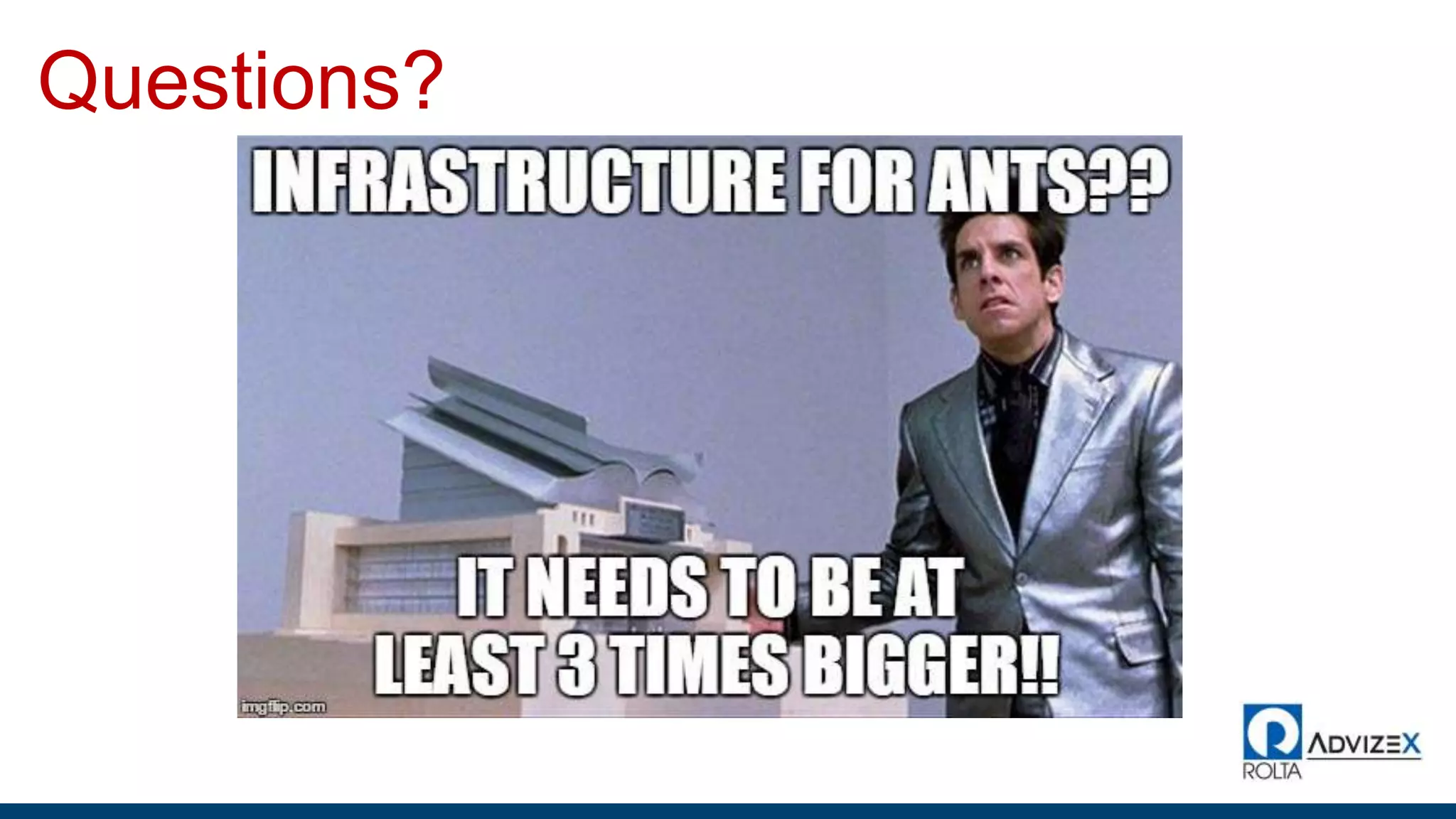
Questions?

3V0-622 objective-3.1-logical-physical with Joe Clarke @elgwhoppo

  • 1.
    Joe Clarke Principal ArchitectObjective3.1 – Transition from a Logical Design to a vSphere 6.x Physical Design
  • 2.
    Agenda • Introduction • 3V0-622Objectives • Conceptual / Logical / Physical Refresher • Exam Topics 2
  • 3.
    Quick Intro • JoeClarke from Cleveland, Ohio • Principal Architect at Rolta AdvizeX • VCDX5-DTM, VCIX6-DCV, Candidate for VCDX6-DCV • @elgwhoppo • www.elgwhoppo.com • Thanks for having me! 3
  • 4.
  • 5.
  • 6.
    Section 2.1 –Relevant and Important • Analyze requirements for functional and non-functional elements. • Build non-functional requirements into a specific logical design. • Translate stated business requirements into a logical design. • Incorporate the current state of a customer environment into a logical design. • Google: #vBrownBag VCAP6-DCV Design 3V0-622 Obj 2.1 with #VCDX @PCradduck • http://vbrownbag.com/2017/02/vbrownbag-vcap6-dcv-design-3v0-622-obj- 2-1-with-vcdx-pcradduck/ 6
  • 7.
    Skills and Abilitiesfor Section 3.1 1. Analyze design decisions and options selected from the logical design. 2. Determine impact of VMware best practices to identified risks, constraints, and assumptions in a given vSphere design. 3. Based on business requirements, determine the appropriate roles for each staff member. 7
  • 8.
    Conceptual, Logical PhysicalRefresher 8 https://vcdx133.com/2015/07/31/vcdx-proportion-and-balance/
  • 9.
    Conceptual Design 9 • “Ifmy grandma was a C level and I had to explain what we were doing, how would I explain it?” • Requirements: Functional and Non- Functional • Functional – Does it do something, yes or no  Example: Provides a platform that is supported by the application vendor • Non-Functional – Requires specific criteria to judge the system, how well or fast does it do it?  Example: Enough storage throughput in IOPS
  • 10.
    Conceptual 10 • Sliding Dooris Broken  Handle is broken  Does not lock every easily; latch needs fiddled with at least twice  Super annoying to close • “The door takes at least a couple tries to lock.” • Functional or non-functional attributes?
  • 11.
    Conceptual 11 • Sliding Dooris Broken  Handle is attached  Glass is on ground in tiny pieces  Door not attached to house • “The door doesn’t keep people out at night.” • Functional or non-functional attributes?
  • 12.
  • 13.
    Logical Design 13 • Youshould be able to create a logical design entirely from the VMware stencils • A Logical Design Answers:  What are the pieces of software in play and how are they connected?  Without naming vendors, what pieces of hardware are in play? Servers? Storage arrays? Switches? Routers? Number of uplinks? Cluster sizes?  How much resource is required in terms of Processor, Memory and Storage capacity and throughput?  Business Process; naming the procedure and stops without naming persons
  • 14.
    Example Logical DesignDiagram 14 BLADE SERVER Logical Network Teaming – VDI Blade Host DVS DVS is NIOC Enabled – Shares Only All Port Groups Load Based Teaming All switchports will be trunked and flagged as edge 8 Port 10Gb NIC dvUplink1 Management Port Group VLAN ID dvUplink1 dvUplink2 dvUplink4 dvUplink2 dvUplink3 Management VM Traffic Port Group VLAN ID dvUplink1 dvUplink2 vMotion Port Group VLAN ID dvUplink1 dvUplink2 Blade Enclosure Chassis Uplink Enclosure Network Module 1 Fabric Interconnect 1 Enclosure Network Module 1 Fabric Interconnect 2 vPC Peer Links Core Switches Network ENC1_SUS_2 SUS2_MGMT_VLANID SUS2_VM_VLANID SUS2_vMOTION_VLANID FC Storage Network FC Storage Network ENC1_SUS_2 SUS2_MGMT_VLANID SUS2_VM_VLANID SUS2_vMOTION_VLANID
  • 15.
    Physical Design 15 • Aphysical design names OEM components and hookups and specifics • A Physical Design provides:  CPU Types and Named Models  Storage type, disk speeds, quantity, capacity, RAID configuration  Load Balancer Models  Server Makes and Models  IP Addresses for VMs  Port map for cabling, connections  Cable types, Rack Layout  Estimated Power Consumption
  • 16.
    Example Physical Design 16 PWR SYS PWR SYS PWR SYS PWR SYS PWR SYS PWR SYS PWR SYS PWR SYS PWR SYS PWR SYS PWR SYS PWR SYS PWR SYS PWR SYS PWR SYS PWR SYS PWR SYS PWR SYS PWR SYS PWR SYS PWR SYS PWR SYS PWR SYS PWR SYS PWR SYS CONSOLE UCS C240M3 ! PWR SYS PWR SYS PWR SYS PWR SYS PWR SYS PWR SYS PWR SYS PWR SYS PWR SYS PWR SYS PWR SYS PWR SYS PWR SYS PWR SYS PWR SYS PWR SYS PWR SYS PWR SYS PWR SYS PWR SYS PWR SYS PWR SYS PWR SYS PWR SYS PWR SYS CONSOLE UCS C240 M3 ! PWR SYS PWR SYS PWR SYS PWR SYS PWR SYS PWR SYS PWR SYS PWR SYS PWR SYS PWR SYS PWR SYS PWR SYS PWR SYS PWR SYS PWR SYS PWR SYS PWR SYS PWR SYS PWR SYS PWR SYS PWR SYS PWR SYS PWR SYS PWR SYS PWR SYS CONSOLE UCS C240 M3 ! vsanDatastore View Management Block vsanDatastore 17.5TB UsableCapacity 2 3 4 1 2 3 4 5 6 7 8 9 10 11 12 13 14 15 16 17 18 19 20 21 22 23 24 25 26 27 28 29 30 31 32 33 34 35 36 37 38 39 40 41 42 43 44 45 46 47 48 CISCO UCS 6296UP STAT ID 2 3 4 1 2 3 4 5 6 7 8 9 10 11 12 13 14 15 16 17 18 19 20 21 22 23 24 25 26 27 28 29 30 31 32 33 34 35 36 37 38 39 40 41 42 43 44 45 46 47 48 CISCO UCS 6296UP STAT ID Cisco VIC1225 2 Port 10Gb ESXi on 16GB SD ESXi on 16GB SD ESXi on 16GB SD (4) Cisco C240 M4 - ESXi 6.0 U2 Dual 18 Core 2.3 GHz E5-2697v4 512GB Memory Cisco VIC 1225 Dual Port 10Gb SFP+ CNA PWR SYS PWR SYS PWR SYS PWR SYS PWR SYS PWR SYS PWR SYS PWR SYS PWR SYS PWR SYS PWR SYS PWR SYS PWR SYS PWR SYS PWR SYS PWR SYS PWR SYS PWR SYS PWR SYS PWR SYS PWR SYS PWR SYS PWR SYS PWR SYS PWR SYS CONSOLE UCS C240 M3 ! ESXi on 16GB SD FI-1 Networks – DVUplink 1 DV-Switch0 - ESXi Management DV-Switch0 - vMotion Network DV-Switch0 - VSAN Network DV-Switch0 – Server VM Traffic FI-2 Networks – DVUplink 2 DV-Switch0 - ESXi Management DV-Switch0 - vMotion Network DV-Switch0 - VSAN Network DV-Switch0 – Server VM Traffic Disk Group 1 1x 400GB 2.5" SAS SSD 4x 1.2TB 10K 2.5" SAS Cac hi ng Capacity Cisco 12G SAS Modular RAID Controller (JBOD) Disk Group 2 1x 400GB 2.5" SAS SSD 4x 1.2TB 10K 2.5" SAS Cac hi ng Capacity Cisco 12G SAS Modular RAID Controller (JBOD) Disk Group 1 1x 400GB 2.5" SAS SSD 4x 1.2TB 10K 2.5" SAS Cac hi ng Capacity Cisco 12G SAS Modular RAID Controller (JBOD) Disk Group 2 1x 400GB 2.5" SAS SSD 4x 1.2TB 10K 2.5" SAS Cac hi ng Capacity Cisco 12G SAS Modular RAID Controller (JBOD) Disk Group 1 1x 400GB 2.5" SAS SSD 4x 1.2TB 10K 2.5" SAS Cac hi ng Capacity Cisco 12G SAS Modular RAID Controller (JBOD) Disk Group 2 1x 400GB 2.5" SAS SSD 4x 1.2TB 10K 2.5" SAS Cac hi ng Capacity Cisco 12G SAS Modular RAID Controller (JBOD) Disk Group 1 1x 400GB 2.5" SAS SSD 4x 1.2TB 10K 2.5" SAS Cac hi ng Capacity Cisco 12G SAS Modular RAID Controller (JBOD) Disk Group 2 1x 400GB 2.5" SAS SSD 4x 1.2TB 10K 2.5" SAS Cac hi ng Capacity Cisco 12G SAS Modular RAID Controller (JBOD)
  • 17.
    3.1 Objective 1 •Analyze design decisions and options selected from the logical design. 17
  • 18.
    Analyze Design Decisionsfrom Logical • Example logical design decision:  Cluster Sizes and Resource requirements  Integration of software components “This talks to this”  Why multiple clusters?  Why or why not use a load balanced PSC? 18
  • 19.
    Analyze Design Decisionsfrom Logical to Physical • How do each of my decisions impact: • Availability – How does my server OEM choice impact availability? • Manageability – How does my network choice impact availability? • Performance – How does my processor clock speed impact performance? • Recoverability – How does my secondary vendor storage impact RTOs? • Security – How does re-using old gear bring risk? • Cost – Why is one option more expensive than another? 19
  • 20.
    VCDX Tip: Fuzzthe design • fuzzing is a software testing technique used to discover errors and security loopholes in software, inputting massive amounts of data in an attempt to make it crash. • Go on the offensive like you didn’t design it. Remove yourself from it. • Ask:  Why?  Why not?  What if costs changed?  Alternatives? 20
  • 21.
    Break it down,Sum it Up 21 http://www.vmware.com/solutions/software-defined-datacenter/validated-designs.html
  • 22.
    Break it down,Sum it up • Design Justification: Short phrase on why you ultimately decided something.  Tip: it’s not a thesis 22
  • 23.
    3.1 Objective 2 •Determine impact of VMware best practices to identified risks, constraints, and assumptions in a given vSphere design. 23
  • 24.
    Best Practice • Truebest practices are almost always based on previous experience. • There is no magic book of conclusive best practices. • Be able to explain the characteristics of something you deem a best practice and why it is. • VCDX Defense Tip: • Don’t ever answer with “Because it’s a VMware best practice” 24
  • 25.
    Constraints, Risks andAssumptions • Assumptions lead to risks • Constraints can lead to risks • Ask yourself, what is the impact of the risk? 25
  • 26.
    Risk Example • Forecastedbandwidth for storage replication will bring the DCI to 95% utilization up from 15%. • Potential Downstream Impacts:  RPO cannot be guaranteed if link saturation occurs  Saturation of a DCI can result in diminished performance for non-storage related traffic even with QoS in place  Additional costs for DCI throughput increase  RPO may need to be adjusted • Mitigation: Important! Include one! • Risks without mitigation plans are whiny at best. 26
  • 27.
    The eternal struggle: •Is it a constraint? • Is it a requirement? • Is it both?  Constraint: a limitation or restriction.  Requirement: must either perform a function, or be a specific measurement of a function’s success • Is it an assumption? 27
  • 28.
    Constraint vs Requirement: •Customer demands that all server based network integration must interoperate with existing Cisco switches. 28
  • 29.
    Constraint vs Requirement: •Customer demands that all switching hardware acquired is Cisco in order to capitalize on existing investment in management tools. 29
  • 30.
    Constraint vs Requirement: •Customer demands that all storage use only flash disks. 30
  • 31.
    3.1 Objective 3 •Based on business requirements, determine the appropriate roles for each staff member. 31
  • 32.
    Different Roles careabout Different Things • Real world: An IT org will decide itself who is doing what in regards to operations. • Real world: You will need to make recommendations of who should own what operational responsibilities of a design. • Reading between the lines: Understand the different roles and what they care about. 32
  • 33.
    Business requirement focusfor roles • Roles:  CEO  CFO  CIO  CISO  Development Manager  Infrastructure Manager  VMware Engineer  Network Engineer  Legal Counsel • Requirements typically focus on:  Company Execution  Company Bottom Line  IT’s level of service to the business  Securing Assets, Brand reputation  Availability of resources  Infrastructure Cost, Reliability  Ease of software installation  Time to value of assets  Not getting sued 33
  • 34.
    CEO, ACME RetailChain • “We are expanding our online retail platform to meet the anticipated demand during our peak seasons. It must not go down during the holiday season and it must be able to transact business with the same speed and experience we usually provide, no matter the load”. • Underlying requirements and qualifying questions:  Availability - Wants it functional especially during the holiday  What is the maximum downtime permissible?  What is the difference in lost revenue regarding availability between peak and off seasons?  KPI – Uptime in nines  Performance – Transactions must be as if there’s no rush  Are normal times and experiences well understood and documented?  KPI – Transactions per second, QA engineer web checkout workflow.34
  • 35.
    Infrastructure Manager, ACMERetail Chain • “We are under tremendous pressure from the CFO to keep costs to a minimum, while expanding our infrastructure footprint by several rows worth. Also it seems like nobody understands that we need to protect all the additional data this is going to generate”. • Underlying requirements and qualifying questions:  Recoverability – His job is potentially on the line if he loses production data  What are the recovery requirements?  KPI – RPO, RTO  Cost – Must expand while keeping costs to a minimum  What is the budget allotted for the expansion initiative?  KPI - TCO 35
  • 36.