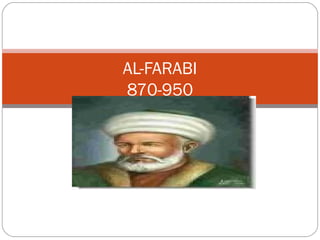
AL-FARABI
870-950
Education
Abu Nasr Muhammad ibn Muhammad ibn Ozlugh ibn
Tarkhan al-Farabi was a Turk by birth and was born at Wasij
in Farab, a district in Transoxania.
He studied philosophy, logic, politics, mathematics , physics
and music.
Education
“ the parent of all subsequent Arab philosophers.”
 the “Mu’allimu’thani”
Works on politics:
“A Summary of Plato’s Law”
Siyasatu’l Madaniyyah
Ara’u ahl- Madinatu’l-Fadilah
Jawami-u’s- siyasat
Ijtima’atu’l- madaniyah
Human Nature
Power of Reason
Ability to differentiate between good and bad, profit and loss
Power of Contention/ argument/ debate
When human wants something and to get away from something
else
The basis of love and hate, truth and untruth, anger.
Power of Thinking
Necessitates another power to retain traces of feeling after the
thing felt has passed away, resolved
Power of Feeling/ emotion
Human nature
Human Groupings: Two kinds:
Perfect : the completion of service of the imperfect groups.
Imperfect: village, of the wards of city, collection of roads and
halting places
“the greatest good and the highest culmination is attained
in the unit of perfect assemblages, i.e. the City or State.”
Theory of Mutual Renunciation of
Rights
“ They gather together, consider the state of affairs, and each of them
gives up in favour of the other a part of that by which he would have
over-powered him, each making it a condition that they would keep
perfect peace with each other and not take away from the other anything
except on certain conditions.”
Headship in a State
Workers of Leadership:
“There are some who have the intellect to draw conclusion better than
others, while some can convey their deduction to others with greater
facility.”
Those who can draw conclusions from given facts lead those who
cannot, while such as have not the capacity to convey to others what
they have themselves learnt have not got the true marks of leadership.
Ideal Ra’isul- Awwal
12 attributes: ( Not only the mind but also Body)
Perfection in physical organs
Great understanding
Visualisation of all that is said
A perfectly retentive(saving) memory
Power to get at the root of things with the least argument
Power to convey to others exactly according to his wish a deep
love of learning.
shunning (avoid) of playfulness
Ideal Ra’isul- Awwal…Attributes (cont..)
Control over desire, and moderation in eating, drinking and
sexual intercourse.
Love of truth and hatred of lying
Breadth of heart and love of justice and hatred of force and
tyranny
Power to distribute justice without any effort, fearlessness in
doing things as he thinks ought to be done
Possession of a sufficient amount of wealth.
Ideal Ra’isul- Awwal…attributes..(cont)
One with just five or six of these qualities would make a
fairly good leader.
Or one who has been brought up under a Leader of these
qualities.
Or a council of two or even five members possessing an
aggregate of these qualities provided at least one of them is a
Hakim.
Internal organization of state
“In a well organized commonwealth, the Supreme Head
collects, arranges and organises the different functionaries in
a proper manner, and their status increases or decreases
according to the distance between them and the Supreme
Head.”
Formation of State
Motives:
Force: those who have resources, physical or moral, at his
disposal, makes a whole body of the people subservient to him.
Patriarchal theory: birth entails cooperation between father and
children and those descendent.
Material relationship
Proper organization of the people by the Supreme Head
Varieties of states
other than model city
States: categories
States of Necessity
Primary object of the head is to arrange for the necessities of the
citizens.
State of Ease
Citizens are content if they are assured of a life of comfort and if their
desires would not go beyond moderate limits
State of Desires
Making life of the people luxurious with plenty of resources
State of Imperialist
A nation wants to have hegemony over other nations.
Varieties of states
other than model city
Empire: the people of an imperialistic state, excel in having
mastery over others either physically or spiritually in such a
way that the latter should be at their service in body and
mind
Colonies: they have been overtaken by an enemy or by an
epidemic or through economic necessity.
Cities
Four types:
Virtuous city
Purpose of the government and institution of society are organize on the basis
of attainment of true happiness.
Ignorance city
Government ignore the nature of true happiness and institution of the society
is organized on other basis.
Immoral City
Government is aware of the nature of true happiness but does not adhere
follow it and institution of society are organized for attainment of other hands
as can be found in ignorance city.
Erring City
Purpose of the government are displace from attainment true happiness and
the institution being corrupted.
Conclusion
His ideas aim to advance human societies and states.
He employed some of Plato’s approaches in his ideas.
He tried to balance between reason and revelation.

Topic 4 - Al-Farabi

  • 1.
  • 2.
    Education Abu Nasr Muhammadibn Muhammad ibn Ozlugh ibn Tarkhan al-Farabi was a Turk by birth and was born at Wasij in Farab, a district in Transoxania. He studied philosophy, logic, politics, mathematics , physics and music.
  • 3.
    Education “ the parentof all subsequent Arab philosophers.”  the “Mu’allimu’thani” Works on politics: “A Summary of Plato’s Law” Siyasatu’l Madaniyyah Ara’u ahl- Madinatu’l-Fadilah Jawami-u’s- siyasat Ijtima’atu’l- madaniyah
  • 4.
    Human Nature Power ofReason Ability to differentiate between good and bad, profit and loss Power of Contention/ argument/ debate When human wants something and to get away from something else The basis of love and hate, truth and untruth, anger. Power of Thinking Necessitates another power to retain traces of feeling after the thing felt has passed away, resolved Power of Feeling/ emotion
  • 5.
    Human nature Human Groupings:Two kinds: Perfect : the completion of service of the imperfect groups. Imperfect: village, of the wards of city, collection of roads and halting places “the greatest good and the highest culmination is attained in the unit of perfect assemblages, i.e. the City or State.”
  • 6.
    Theory of MutualRenunciation of Rights “ They gather together, consider the state of affairs, and each of them gives up in favour of the other a part of that by which he would have over-powered him, each making it a condition that they would keep perfect peace with each other and not take away from the other anything except on certain conditions.”
  • 7.
    Headship in aState Workers of Leadership: “There are some who have the intellect to draw conclusion better than others, while some can convey their deduction to others with greater facility.” Those who can draw conclusions from given facts lead those who cannot, while such as have not the capacity to convey to others what they have themselves learnt have not got the true marks of leadership.
  • 8.
    Ideal Ra’isul- Awwal 12attributes: ( Not only the mind but also Body) Perfection in physical organs Great understanding Visualisation of all that is said A perfectly retentive(saving) memory Power to get at the root of things with the least argument Power to convey to others exactly according to his wish a deep love of learning. shunning (avoid) of playfulness
  • 9.
    Ideal Ra’isul- Awwal…Attributes(cont..) Control over desire, and moderation in eating, drinking and sexual intercourse. Love of truth and hatred of lying Breadth of heart and love of justice and hatred of force and tyranny Power to distribute justice without any effort, fearlessness in doing things as he thinks ought to be done Possession of a sufficient amount of wealth.
  • 10.
    Ideal Ra’isul- Awwal…attributes..(cont) Onewith just five or six of these qualities would make a fairly good leader. Or one who has been brought up under a Leader of these qualities. Or a council of two or even five members possessing an aggregate of these qualities provided at least one of them is a Hakim.
  • 11.
    Internal organization ofstate “In a well organized commonwealth, the Supreme Head collects, arranges and organises the different functionaries in a proper manner, and their status increases or decreases according to the distance between them and the Supreme Head.”
  • 12.
    Formation of State Motives: Force:those who have resources, physical or moral, at his disposal, makes a whole body of the people subservient to him. Patriarchal theory: birth entails cooperation between father and children and those descendent. Material relationship Proper organization of the people by the Supreme Head
  • 13.
    Varieties of states otherthan model city States: categories States of Necessity Primary object of the head is to arrange for the necessities of the citizens. State of Ease Citizens are content if they are assured of a life of comfort and if their desires would not go beyond moderate limits State of Desires Making life of the people luxurious with plenty of resources State of Imperialist A nation wants to have hegemony over other nations.
  • 14.
    Varieties of states otherthan model city Empire: the people of an imperialistic state, excel in having mastery over others either physically or spiritually in such a way that the latter should be at their service in body and mind Colonies: they have been overtaken by an enemy or by an epidemic or through economic necessity.
  • 15.
    Cities Four types: Virtuous city Purposeof the government and institution of society are organize on the basis of attainment of true happiness. Ignorance city Government ignore the nature of true happiness and institution of the society is organized on other basis. Immoral City Government is aware of the nature of true happiness but does not adhere follow it and institution of society are organized for attainment of other hands as can be found in ignorance city. Erring City Purpose of the government are displace from attainment true happiness and the institution being corrupted.
  • 16.
    Conclusion His ideas aimto advance human societies and states. He employed some of Plato’s approaches in his ideas. He tried to balance between reason and revelation.