DifferingDiffering IdeologiesIdeologies
Where did Ideologies come from?Where did Ideologies come from?
Attributes of a goodAttributes of a good
GovernmentGovernment
 Wise rulers who rule on behalf of theWise rulers who rule on behalf of the
peoplepeople
 Place the needs of the community abovePlace the needs of the community above
their own selfish desires.their own selfish desires.
 Emphasizes individual rights and humanEmphasizes individual rights and human
equalityequality
Attributes of a bad governmentAttributes of a bad government
 Makes decisions in their best interestMakes decisions in their best interest
instead of the best interest of society.instead of the best interest of society.
 Violates the rights of its peopleViolates the rights of its people
 Is not law abidingIs not law abiding
 Make decisions that decrease the qualityMake decisions that decrease the quality
of life of the peopleof life of the people
The EnlightenmentThe Enlightenment
 In the 1700’s, many EuropeanIn the 1700’s, many European
philosophers wrote that people could usephilosophers wrote that people could use
reason to improve society.reason to improve society.
 The use of reason to guide people’sThe use of reason to guide people’s
thoughts defined a time period known asthoughts defined a time period known as
thethe Enlightenment.Enlightenment.
 The ideas of these thinkers contributed toThe ideas of these thinkers contributed to
the creation of modern democracy.the creation of modern democracy.
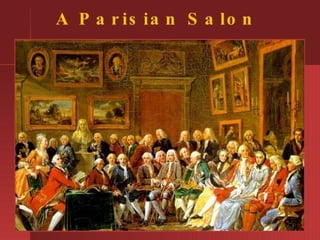
A perisian SalonA perisian Salon
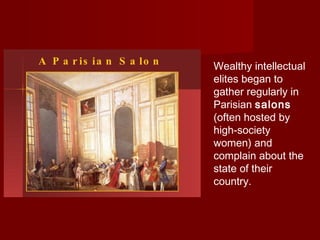
Wealthy intellectual
elites began to
gather regularly in
Parisian salons
(often hosted by
high-society
women) and
complain about the
state of their
country.
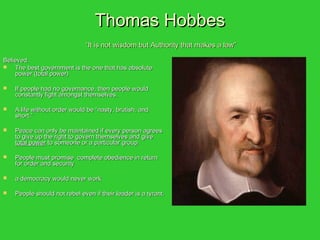
Thomas HobbesThomas Hobbes
  “It is not wisdom but Authority that makes a law”“It is not wisdom but Authority that makes a law”
Believed:Believed:
 The best government is the one that has absoluteThe best government is the one that has absolute
power (total power)power (total power)
 If people had no governance, then people wouldIf people had no governance, then people would
constantly fight amongst themselves.constantly fight amongst themselves.
 A life without order would be “nasty, brutish, andA life without order would be “nasty, brutish, and
short.”short.”
 Peace can only be maintained if every person agreesPeace can only be maintained if every person agrees
to give up the right to govern themselves and giveto give up the right to govern themselves and give
total powertotal power to someone or a particular group.to someone or a particular group.
 People must promise complete obedience in returnPeople must promise complete obedience in return
for order and securityfor order and security
 a democracy would never worka democracy would never work
 People should not rebel even if their leader is a tyrant.People should not rebel even if their leader is a tyrant.
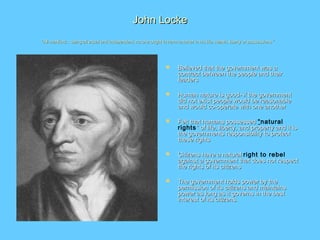
John LockeJohn Locke
“All mankind... being all equal and independent, no one ought to harm another in his life, health, liberty or possessions.”“All mankind... being all equal and independent, no one ought to harm another in his life, health, liberty or possessions.”
 Believed that the government was aBelieved that the government was a
contract between the people and theircontract between the people and their
leadersleaders
 Human nature is good- if the governmentHuman nature is good- if the government
did not exist people would be reasonabledid not exist people would be reasonable
and would co-operate with one anotherand would co-operate with one another
 Felt that humans possessedFelt that humans possessed “natural
rights” of life, liberty, and property and it is” of life, liberty, and property and it is
the governments responsibility to protectthe governments responsibility to protect
these rightsthese rights
 Citizens have a naturalCitizens have a natural right to rebel
against a government that does not respectagainst a government that does not respect
the rights of its citizensthe rights of its citizens
 The government holds power by theThe government holds power by the
permission of its citizens and maintainspermission of its citizens and maintains
power as long as it governs in the bestpower as long as it governs in the best
interest of its citizens.interest of its citizens.
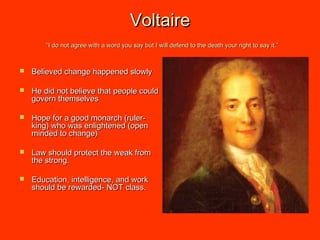
VoltaireVoltaire
“I do not agree with a word you say but I will defend to the death your right to say it.”“I do not agree with a word you say but I will defend to the death your right to say it.”
 Believed change happened slowlyBelieved change happened slowly
 He did not believe that people couldHe did not believe that people could
govern themselvesgovern themselves
 Hope for a good monarch (ruler-Hope for a good monarch (ruler-
king) who was enlightened (openking) who was enlightened (open
minded to change)minded to change)
 Law should protect the weak fromLaw should protect the weak from
the strong.the strong.
 Education, intelligence, and workEducation, intelligence, and work
should be rewarded- NOT class.should be rewarded- NOT class.
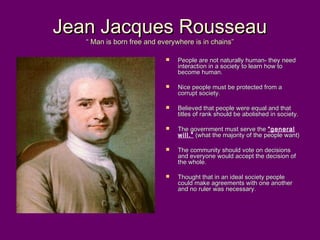
Jean Jacques RousseauJean Jacques Rousseau
“ Man is born free and everywhere is in chains”“ Man is born free and everywhere is in chains”
 People are not naturally human- they needPeople are not naturally human- they need
interaction in a society to learn how tointeraction in a society to learn how to
become human.become human.
 Nice people must be protected from aNice people must be protected from a
corrupt society.corrupt society.
 Believed that people were equal and thatBelieved that people were equal and that
titles of rank should be abolished in society.titles of rank should be abolished in society.
 The government must serve theThe government must serve the “general
will.” (what the majority of the people want)(what the majority of the people want)
 The community should vote on decisionsThe community should vote on decisions
and everyone would accept the decision ofand everyone would accept the decision of
the whole.the whole.
 Thought that in an ideal society peopleThought that in an ideal society people
could make agreements with one anothercould make agreements with one another
and no ruler was necessary.and no ruler was necessary.
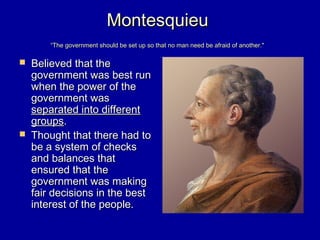
MontesquieuMontesquieu
“The government should be set up so that no man need be afraid of another."“The government should be set up so that no man need be afraid of another."
 Believed that theBelieved that the
government was best rungovernment was best run
when the power of thewhen the power of the
government wasgovernment was
separated into differentseparated into different
groupsgroups..
 Thought that there had toThought that there had to
be a system of checksbe a system of checks
and balances thatand balances that
ensured that theensured that the
government was makinggovernment was making
fair decisions in the bestfair decisions in the best
interest of the people.interest of the people.
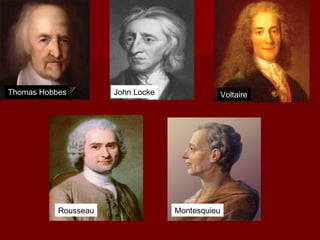
Thomas Hobbes John Locke Voltaire
Rousseau Montesquieu

Differing ideologies

  • 1.
    DifferingDiffering IdeologiesIdeologies Where didIdeologies come from?Where did Ideologies come from?
  • 2.
    Attributes of agoodAttributes of a good GovernmentGovernment  Wise rulers who rule on behalf of theWise rulers who rule on behalf of the peoplepeople  Place the needs of the community abovePlace the needs of the community above their own selfish desires.their own selfish desires.  Emphasizes individual rights and humanEmphasizes individual rights and human equalityequality
  • 3.
    Attributes of abad governmentAttributes of a bad government  Makes decisions in their best interestMakes decisions in their best interest instead of the best interest of society.instead of the best interest of society.  Violates the rights of its peopleViolates the rights of its people  Is not law abidingIs not law abiding  Make decisions that decrease the qualityMake decisions that decrease the quality of life of the peopleof life of the people
  • 4.
    The EnlightenmentThe Enlightenment In the 1700’s, many EuropeanIn the 1700’s, many European philosophers wrote that people could usephilosophers wrote that people could use reason to improve society.reason to improve society.  The use of reason to guide people’sThe use of reason to guide people’s thoughts defined a time period known asthoughts defined a time period known as thethe Enlightenment.Enlightenment.  The ideas of these thinkers contributed toThe ideas of these thinkers contributed to the creation of modern democracy.the creation of modern democracy.
  • 5.
    A perisian SalonAperisian Salon
  • 6.
    Wealthy intellectual elites beganto gather regularly in Parisian salons (often hosted by high-society women) and complain about the state of their country.
  • 7.
    Thomas HobbesThomas Hobbes   “Itis not wisdom but Authority that makes a law”“It is not wisdom but Authority that makes a law” Believed:Believed:  The best government is the one that has absoluteThe best government is the one that has absolute power (total power)power (total power)  If people had no governance, then people wouldIf people had no governance, then people would constantly fight amongst themselves.constantly fight amongst themselves.  A life without order would be “nasty, brutish, andA life without order would be “nasty, brutish, and short.”short.”  Peace can only be maintained if every person agreesPeace can only be maintained if every person agrees to give up the right to govern themselves and giveto give up the right to govern themselves and give total powertotal power to someone or a particular group.to someone or a particular group.  People must promise complete obedience in returnPeople must promise complete obedience in return for order and securityfor order and security  a democracy would never worka democracy would never work  People should not rebel even if their leader is a tyrant.People should not rebel even if their leader is a tyrant.
  • 8.
    John LockeJohn Locke “Allmankind... being all equal and independent, no one ought to harm another in his life, health, liberty or possessions.”“All mankind... being all equal and independent, no one ought to harm another in his life, health, liberty or possessions.”  Believed that the government was aBelieved that the government was a contract between the people and theircontract between the people and their leadersleaders  Human nature is good- if the governmentHuman nature is good- if the government did not exist people would be reasonabledid not exist people would be reasonable and would co-operate with one anotherand would co-operate with one another  Felt that humans possessedFelt that humans possessed “natural rights” of life, liberty, and property and it is” of life, liberty, and property and it is the governments responsibility to protectthe governments responsibility to protect these rightsthese rights  Citizens have a naturalCitizens have a natural right to rebel against a government that does not respectagainst a government that does not respect the rights of its citizensthe rights of its citizens  The government holds power by theThe government holds power by the permission of its citizens and maintainspermission of its citizens and maintains power as long as it governs in the bestpower as long as it governs in the best interest of its citizens.interest of its citizens.
  • 9.
    VoltaireVoltaire “I do notagree with a word you say but I will defend to the death your right to say it.”“I do not agree with a word you say but I will defend to the death your right to say it.”  Believed change happened slowlyBelieved change happened slowly  He did not believe that people couldHe did not believe that people could govern themselvesgovern themselves  Hope for a good monarch (ruler-Hope for a good monarch (ruler- king) who was enlightened (openking) who was enlightened (open minded to change)minded to change)  Law should protect the weak fromLaw should protect the weak from the strong.the strong.  Education, intelligence, and workEducation, intelligence, and work should be rewarded- NOT class.should be rewarded- NOT class.
  • 10.
    Jean Jacques RousseauJeanJacques Rousseau “ Man is born free and everywhere is in chains”“ Man is born free and everywhere is in chains”  People are not naturally human- they needPeople are not naturally human- they need interaction in a society to learn how tointeraction in a society to learn how to become human.become human.  Nice people must be protected from aNice people must be protected from a corrupt society.corrupt society.  Believed that people were equal and thatBelieved that people were equal and that titles of rank should be abolished in society.titles of rank should be abolished in society.  The government must serve theThe government must serve the “general will.” (what the majority of the people want)(what the majority of the people want)  The community should vote on decisionsThe community should vote on decisions and everyone would accept the decision ofand everyone would accept the decision of the whole.the whole.  Thought that in an ideal society peopleThought that in an ideal society people could make agreements with one anothercould make agreements with one another and no ruler was necessary.and no ruler was necessary.
  • 11.
    MontesquieuMontesquieu “The government shouldbe set up so that no man need be afraid of another."“The government should be set up so that no man need be afraid of another."  Believed that theBelieved that the government was best rungovernment was best run when the power of thewhen the power of the government wasgovernment was separated into differentseparated into different groupsgroups..  Thought that there had toThought that there had to be a system of checksbe a system of checks and balances thatand balances that ensured that theensured that the government was makinggovernment was making fair decisions in the bestfair decisions in the best interest of the people.interest of the people.
  • 12.
    Thomas Hobbes JohnLocke Voltaire Rousseau Montesquieu