THE CONSTITUTION COMMISSION AND ITS
REPORT
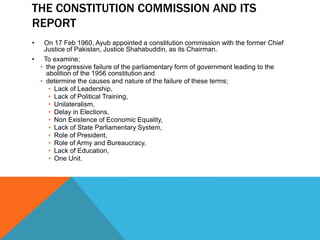
• On 17 Feb 1960, Ayub appointed a constitution commission with the former Chief
Justice of Pakistan, Justice Shahabuddin, as its Chairman.
• To examine;
• the progressive failure of the parliamentary form of government leading to the
abolition of the 1956 constitution and
• determine the causes and nature of the failure of these terms;
• Lack of Leadership,
• Lack of Political Training,
• Unilateralism,
• Delay in Elections,
• Non Existence of Economic Equality,
• Lack of State Parliamentary System,
• Role of President,
• Role of Army and Bureaucracy,
• Lack of Education,
• One Unit.
FAILURE OF THE PARLIAMENTARY SYSTEM
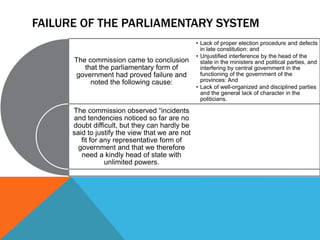
The commission came to conclusion
that the parliamentary form of
government had proved failure and
noted the following cause:
The commission observed “incidents
and tendencies noticed so far are no
doubt difficult, but they can hardly be
said to justify the view that we are not
fit for any representative form of
government and that we therefore
need a kindly head of state with
unlimited powers.
• Lack of proper election procedure and defects
in late constitution: and
• Unjustified interference by the head of the
state in the ministers and political parties, and
interfering by central government in the
functioning of the government of the
provinces: And
• Lack of well-organized and disciplined parties
and the general lack of character in the
politicians.
PRESIDENTIAL FORM OF GOVERNMENT
RECOMMENDED
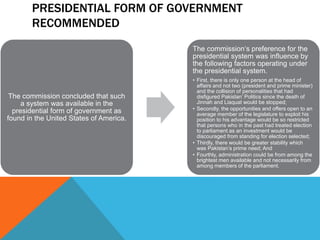
The commission concluded that such
a system was available in the
presidential form of government as
found in the United States of America.
The commission‘s preference for the
presidential system was influence by
the following factors operating under
the presidential system.
• First, there is only one person at the head of
affairs and not two (president and prime minister)
and the collision of personalities that had
disfigured Pakistan’ Politics since the death of
Jinnah and Liaquat would be stopped;
• Secondly, the opportunities and offers open to an
average member of the legislature to exploit his
position to his advantage would be so restricted
that persons who in the past had treated election
to parliament as an investment would be
discouraged from standing for election selected;
• Thirdly, there would be greater stability which
was Pakistan’s prime need; And
• Fourthly, administration could be from among the
brightest men available and not necessarily from
among members of the parliament.
LEGISLATURE; UNICAMERAL OR BICAMERAL
Turning to the details commission favored bi-cameral
legislature because commission emphasized need of
an upper chamber which could be able to check
harshness of the legislature by the lower house.
THE PRESIDENT AND HIS POWER
• Execution of laws,
• Appointment of governors,
• central ministers with consent of senate,
• removal of governors,
• central ministers according to rules,
• Appointment of judges of Supreme Court,
• Holding Supreme command of army, navy, air force.
• Also has right of emergency and issue of ordinance and giving or withholding
of assent in respect of bills passed by parliament, and
• President can nominate 8 members to the senate.
FEDERAL FORM OF GOVERNMENT
RECOMMENDED
• Unitary or Federal, also
commission,
• the commission stated to the
feeling at the time in East
Pakistan ‘of being treated as a
colony’.
The commission discussed
whether the form of
government should be
• ‘as a result of neglect by the
central government, their
province, in spite of its
superiority in numbers as well
as its capacity to earn more
foreign exchange, was far
behind the other part of the
country in the field of
development.
It recorded that the people
of east Pakistan who had
worked wholeheartedly for
the achievement of
Pakistan felt betrayed
• ‘it is our considered opinion
that if we impose unitary form,
• ignoring the state of feelings of
East and West Pakistan,
• we would be motivating the
average Muslims of the East
Pakistan into arms of
extremists and disruptive
elements which are active in
that province.
The commission
concluded:
RECOMMENDATIONS RELATING TO THE
ELECTORATES
Qualified franchise based on literacy and property,
• and commission also recommended that members of the
legislatures, both provincial and central,
• should be elected directly by the people and Restricted Franchise
• and commission favored separate electorate for all of Pakistan.
RECOMMENDATIONS REGARDING REVIVAL OF
POLITICAL PARTIES
Commission rightly pointed out that as long a representative form of
government had to be worked out
• “we fail to see how political parties can be avoided”. And the commission reached at
the conclusion, ‘if we want to a democratic form of government our try should be to
create conditions in which a party based on principle can appear’.
RECOMMENDATIONS RELATING TO ISLAMIC
PROVISIONS
The commission advice that we should follow
the instruction given by PROPHET (PBUH).
RECOMMENDATIONS REGARDING TO THE
JUDICIARY
• Independence Judiciary and commission preferred a system of impeachment
to remove the chief justice and other judges of the supreme court.
• The resolution for the impeachment were to be signed by
• not less than one-fourth of the total number of members of the house of the
people.
• Also the person impeached would then have removed his office should he be
found guilty
• by two-thirds of the total number of the members of the senate.
• The commission prescribed the same procedure for the impeachment of the
President, Vice President, governors, and ministers. As for the removal of
High court judges, the constitution favored the procedure adopted in the last
constitution under article 169.
FUNDAMENTAL RIGHTS AND DIRECTIVE
PRINCIPLES OF THE POLICY
Commission favored the Directive Principles of
the state policy as laid down in the last
constitution.
NOTE OF DISSENT
Sardar Habibullah,
gave a note of dissent
on certain points. He
opposed;
• The services from their role of weakening parliamentary
democracy in Pakistan
• Federal from of government and favored the unitary form.
• The recommendation of qualified franchise based on literacy
and property as it would withdraw a large number of important
sections of the population of their votes, particularly industrial
and agricultural labour.
• The recommendation of direct elections and favored indirect
elections by democrats elected on universal franchise.
CONTINUE..
Also
oppose:
• Bi-cameral legislature at the center and thought that the
upper house recommended by commission would be
unnecessary in a Presidential form of government.
• The office of the VICE PRESIDENT recommendations by
the commission because two people in power would soon
develop conflicts and try to pull one another down.
• The recommendations of separate electorate because,
according to him, its was the right of the minorities to ask it
not for the majority to force it upon them.

Shahbuddin commision its report

  • 2.
    THE CONSTITUTION COMMISSIONAND ITS REPORT • On 17 Feb 1960, Ayub appointed a constitution commission with the former Chief Justice of Pakistan, Justice Shahabuddin, as its Chairman. • To examine; • the progressive failure of the parliamentary form of government leading to the abolition of the 1956 constitution and • determine the causes and nature of the failure of these terms; • Lack of Leadership, • Lack of Political Training, • Unilateralism, • Delay in Elections, • Non Existence of Economic Equality, • Lack of State Parliamentary System, • Role of President, • Role of Army and Bureaucracy, • Lack of Education, • One Unit.
  • 3.
    FAILURE OF THEPARLIAMENTARY SYSTEM The commission came to conclusion that the parliamentary form of government had proved failure and noted the following cause: The commission observed “incidents and tendencies noticed so far are no doubt difficult, but they can hardly be said to justify the view that we are not fit for any representative form of government and that we therefore need a kindly head of state with unlimited powers. • Lack of proper election procedure and defects in late constitution: and • Unjustified interference by the head of the state in the ministers and political parties, and interfering by central government in the functioning of the government of the provinces: And • Lack of well-organized and disciplined parties and the general lack of character in the politicians.
  • 4.
    PRESIDENTIAL FORM OFGOVERNMENT RECOMMENDED The commission concluded that such a system was available in the presidential form of government as found in the United States of America. The commission‘s preference for the presidential system was influence by the following factors operating under the presidential system. • First, there is only one person at the head of affairs and not two (president and prime minister) and the collision of personalities that had disfigured Pakistan’ Politics since the death of Jinnah and Liaquat would be stopped; • Secondly, the opportunities and offers open to an average member of the legislature to exploit his position to his advantage would be so restricted that persons who in the past had treated election to parliament as an investment would be discouraged from standing for election selected; • Thirdly, there would be greater stability which was Pakistan’s prime need; And • Fourthly, administration could be from among the brightest men available and not necessarily from among members of the parliament.
  • 5.
    LEGISLATURE; UNICAMERAL ORBICAMERAL Turning to the details commission favored bi-cameral legislature because commission emphasized need of an upper chamber which could be able to check harshness of the legislature by the lower house.
  • 6.
    THE PRESIDENT ANDHIS POWER • Execution of laws, • Appointment of governors, • central ministers with consent of senate, • removal of governors, • central ministers according to rules, • Appointment of judges of Supreme Court, • Holding Supreme command of army, navy, air force. • Also has right of emergency and issue of ordinance and giving or withholding of assent in respect of bills passed by parliament, and • President can nominate 8 members to the senate.
  • 7.
    FEDERAL FORM OFGOVERNMENT RECOMMENDED • Unitary or Federal, also commission, • the commission stated to the feeling at the time in East Pakistan ‘of being treated as a colony’. The commission discussed whether the form of government should be • ‘as a result of neglect by the central government, their province, in spite of its superiority in numbers as well as its capacity to earn more foreign exchange, was far behind the other part of the country in the field of development. It recorded that the people of east Pakistan who had worked wholeheartedly for the achievement of Pakistan felt betrayed • ‘it is our considered opinion that if we impose unitary form, • ignoring the state of feelings of East and West Pakistan, • we would be motivating the average Muslims of the East Pakistan into arms of extremists and disruptive elements which are active in that province. The commission concluded:
  • 8.
    RECOMMENDATIONS RELATING TOTHE ELECTORATES Qualified franchise based on literacy and property, • and commission also recommended that members of the legislatures, both provincial and central, • should be elected directly by the people and Restricted Franchise • and commission favored separate electorate for all of Pakistan.
  • 9.
    RECOMMENDATIONS REGARDING REVIVALOF POLITICAL PARTIES Commission rightly pointed out that as long a representative form of government had to be worked out • “we fail to see how political parties can be avoided”. And the commission reached at the conclusion, ‘if we want to a democratic form of government our try should be to create conditions in which a party based on principle can appear’.
  • 10.
    RECOMMENDATIONS RELATING TOISLAMIC PROVISIONS The commission advice that we should follow the instruction given by PROPHET (PBUH).
  • 11.
    RECOMMENDATIONS REGARDING TOTHE JUDICIARY • Independence Judiciary and commission preferred a system of impeachment to remove the chief justice and other judges of the supreme court. • The resolution for the impeachment were to be signed by • not less than one-fourth of the total number of members of the house of the people. • Also the person impeached would then have removed his office should he be found guilty • by two-thirds of the total number of the members of the senate. • The commission prescribed the same procedure for the impeachment of the President, Vice President, governors, and ministers. As for the removal of High court judges, the constitution favored the procedure adopted in the last constitution under article 169.
  • 12.
    FUNDAMENTAL RIGHTS ANDDIRECTIVE PRINCIPLES OF THE POLICY Commission favored the Directive Principles of the state policy as laid down in the last constitution.
  • 13.
    NOTE OF DISSENT SardarHabibullah, gave a note of dissent on certain points. He opposed; • The services from their role of weakening parliamentary democracy in Pakistan • Federal from of government and favored the unitary form. • The recommendation of qualified franchise based on literacy and property as it would withdraw a large number of important sections of the population of their votes, particularly industrial and agricultural labour. • The recommendation of direct elections and favored indirect elections by democrats elected on universal franchise.
  • 14.
    CONTINUE.. Also oppose: • Bi-cameral legislatureat the center and thought that the upper house recommended by commission would be unnecessary in a Presidential form of government. • The office of the VICE PRESIDENT recommendations by the commission because two people in power would soon develop conflicts and try to pull one another down. • The recommendations of separate electorate because, according to him, its was the right of the minorities to ask it not for the majority to force it upon them.