 Triangles are congruent when they have
exactly the same three sides and exactly
the same three angles.
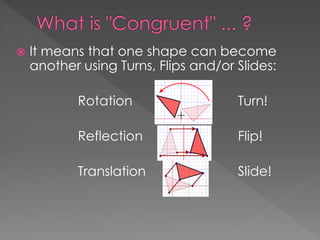
 It means that one shape can become
another using Turns, Flips and/or Slides:
Rotation Turn!
Reflection Flip!
Translation Slide!
 When two triangles are congruent they
will have exactly the same three
sides and exactly the same three angles.
 The equal sides and angles may not be
in the same position (if there is a turn or a
flip), but they are there.
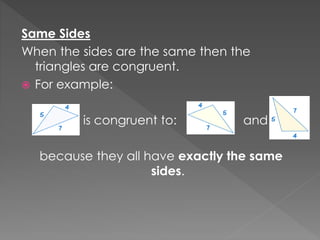
Same Sides
When the sides are the same then the
triangles are congruent.
 For example:
is congruent to: and
because they all have exactly the same
sides.
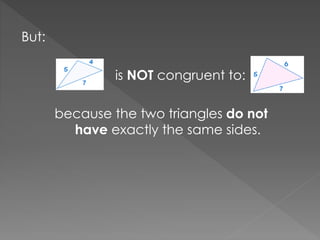
But:
is NOT congruent to:
because the two triangles do not
have exactly the same sides.
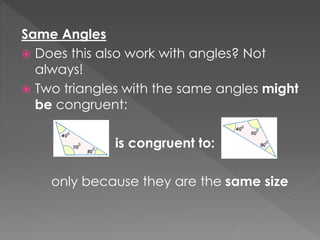
Same Angles
 Does this also work with angles? Not
always!
 Two triangles with the same angles might
be congruent:
is congruent to:
only because they are the same size
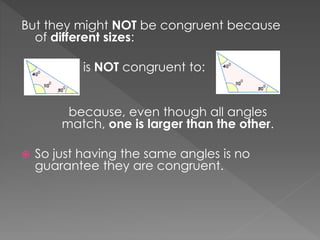
But they might NOT be congruent because
of different sizes:
is NOT congruent to:
because, even though all angles
match, one is larger than the other.
 So just having the same angles is no
guarantee they are congruent.
Two triangles are congruent if they have:
 exactly the same three sides and
 exactly the same three angles.
 But we don't have to know all three sides
and all three angles ...usually three out of
the six is enough.
 SAS(side-angle-side) congruence
› Two triangles are congruent if two
sides and the included angle of one
triangle are equal to the two sides
and the included angle of other
triangle.
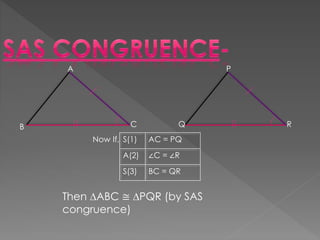
A
B C
P
Q R
S(1) AC = PQ
A(2) ∠C = ∠R
S(3) BC = QR
Now If,
Then ∆ABC ≅ ∆PQR (by SAS
congruence)
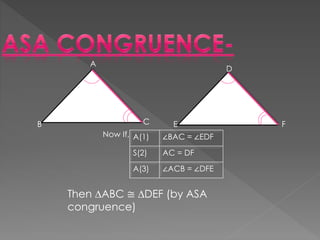
› Two triangles are congruent if
two angles and the included
side of one triangle are equal to
two angles and the included
side of other triangle.
A
B C
D
E F
Now If, A(1) ∠BAC = ∠EDF
S(2) AC = DF
A(3) ∠ACB = ∠DFE
Then ∆ABC ≅ ∆DEF (by ASA
congruence)
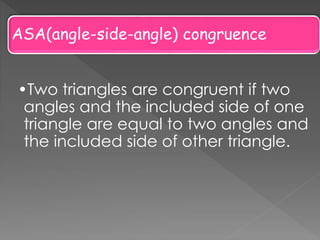
ASA(angle-side-angle) congruence
•Two triangles are congruent if two
angles and the included side of one
triangle are equal to two angles and
the included side of other triangle.
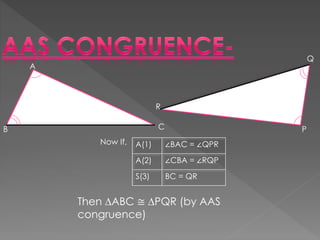
A
B C P
Q
R
Now If, A(1) ∠BAC = ∠QPR
A(2) ∠CBA = ∠RQP
S(3) BC = QR
Then ∆ABC ≅ ∆PQR (by AAS
congruence)
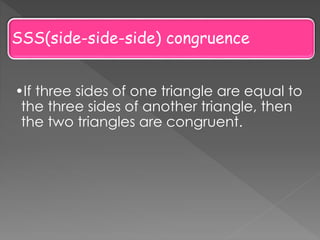
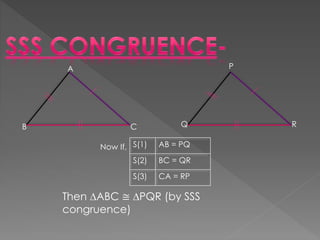
SSS(side-side-side) congruence
•If three sides of one triangle are equal to
the three sides of another triangle, then
the two triangles are congruent.
Now If, S(1) AB = PQ
S(2) BC = QR
S(3) CA = RP
A
B C
P
Q R
Then ∆ABC ≅ ∆PQR (by SSS
congruence)
RHS(right angle-hypotenuse-side) congruence
•If in two right-angled triangles the
hypotenuse and one side of one
triangle are equal to the
hypotenuse and one side of the
other triangle, then the two triangles
are congruent.
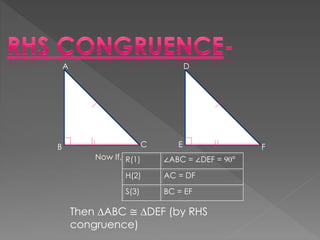
Now If, R(1) ∠ABC = ∠DEF = 90°
H(2) AC = DF
S(3) BC = EF
A
B C
D
E F
Then ∆ABC ≅ ∆DEF (by RHS
congruence)
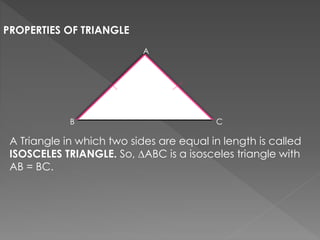
PROPERTIES OF TRIANGLE
A
B C
A Triangle in which two sides are equal in length is called
ISOSCELES TRIANGLE. So, ∆ABC is a isosceles triangle with
AB = BC.
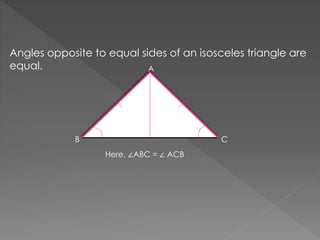
Angles opposite to equal sides of an isosceles triangle are
equal.
B C
A
Here, ∠ABC = ∠ ACB
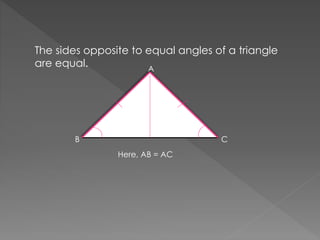
The sides opposite to equal angles of a triangle
are equal.
CB
A
Here, AB = AC
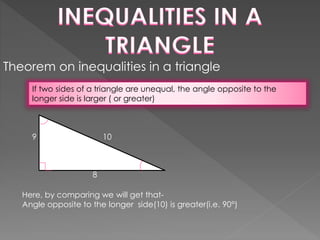
Theorem on inequalities in a triangle
If two sides of a triangle are unequal, the angle opposite to the
longer side is larger ( or greater)
10
8
9
Here, by comparing we will get that-
Angle opposite to the longer side(10) is greater(i.e. 90°)
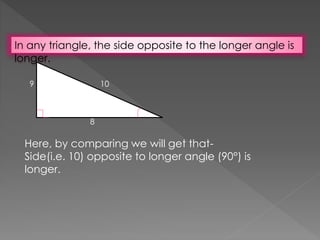
In any triangle, the side opposite to the longer angle is
longer.
10
8
9
Here, by comparing we will get that-
Side(i.e. 10) opposite to longer angle (90°) is
longer.
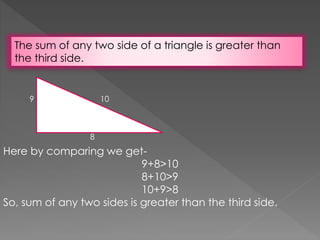
The sum of any two side of a triangle is greater than
the third side.
10
8
9
Here by comparing we get-
9+8>10
8+10>9
10+9>8
So, sum of any two sides is greater than the third side.

Congruents of Triangle

  • 2.
     Triangles arecongruent when they have exactly the same three sides and exactly the same three angles.
  • 3.
     It meansthat one shape can become another using Turns, Flips and/or Slides: Rotation Turn! Reflection Flip! Translation Slide!
  • 4.
     When twotriangles are congruent they will have exactly the same three sides and exactly the same three angles.  The equal sides and angles may not be in the same position (if there is a turn or a flip), but they are there.
  • 5.
    Same Sides When thesides are the same then the triangles are congruent.  For example: is congruent to: and because they all have exactly the same sides.
  • 6.
    But: is NOT congruentto: because the two triangles do not have exactly the same sides.
  • 7.
    Same Angles  Doesthis also work with angles? Not always!  Two triangles with the same angles might be congruent: is congruent to: only because they are the same size
  • 8.
    But they mightNOT be congruent because of different sizes: is NOT congruent to: because, even though all angles match, one is larger than the other.  So just having the same angles is no guarantee they are congruent.
  • 9.
    Two triangles arecongruent if they have:  exactly the same three sides and  exactly the same three angles.  But we don't have to know all three sides and all three angles ...usually three out of the six is enough.
  • 10.
     SAS(side-angle-side) congruence ›Two triangles are congruent if two sides and the included angle of one triangle are equal to the two sides and the included angle of other triangle.
  • 11.
    A B C P Q R S(1)AC = PQ A(2) ∠C = ∠R S(3) BC = QR Now If, Then ∆ABC ≅ ∆PQR (by SAS congruence)
  • 12.
    › Two trianglesare congruent if two angles and the included side of one triangle are equal to two angles and the included side of other triangle.
  • 13.
    A B C D E F NowIf, A(1) ∠BAC = ∠EDF S(2) AC = DF A(3) ∠ACB = ∠DFE Then ∆ABC ≅ ∆DEF (by ASA congruence)
  • 14.
    ASA(angle-side-angle) congruence •Two trianglesare congruent if two angles and the included side of one triangle are equal to two angles and the included side of other triangle.
  • 15.
    A B C P Q R NowIf, A(1) ∠BAC = ∠QPR A(2) ∠CBA = ∠RQP S(3) BC = QR Then ∆ABC ≅ ∆PQR (by AAS congruence)
  • 16.
    SSS(side-side-side) congruence •If threesides of one triangle are equal to the three sides of another triangle, then the two triangles are congruent.
  • 17.
    Now If, S(1)AB = PQ S(2) BC = QR S(3) CA = RP A B C P Q R Then ∆ABC ≅ ∆PQR (by SSS congruence)
  • 18.
    RHS(right angle-hypotenuse-side) congruence •Ifin two right-angled triangles the hypotenuse and one side of one triangle are equal to the hypotenuse and one side of the other triangle, then the two triangles are congruent.
  • 19.
    Now If, R(1)∠ABC = ∠DEF = 90° H(2) AC = DF S(3) BC = EF A B C D E F Then ∆ABC ≅ ∆DEF (by RHS congruence)
  • 20.
    PROPERTIES OF TRIANGLE A BC A Triangle in which two sides are equal in length is called ISOSCELES TRIANGLE. So, ∆ABC is a isosceles triangle with AB = BC.
  • 21.
    Angles opposite toequal sides of an isosceles triangle are equal. B C A Here, ∠ABC = ∠ ACB
  • 22.
    The sides oppositeto equal angles of a triangle are equal. CB A Here, AB = AC
  • 23.
    Theorem on inequalitiesin a triangle If two sides of a triangle are unequal, the angle opposite to the longer side is larger ( or greater) 10 8 9 Here, by comparing we will get that- Angle opposite to the longer side(10) is greater(i.e. 90°)
  • 24.
    In any triangle,the side opposite to the longer angle is longer. 10 8 9 Here, by comparing we will get that- Side(i.e. 10) opposite to longer angle (90°) is longer.
  • 25.
    The sum ofany two side of a triangle is greater than the third side. 10 8 9 Here by comparing we get- 9+8>10 8+10>9 10+9>8 So, sum of any two sides is greater than the third side.