International Journal of Engineering Research and Development
eISSN : 2278-067X, pISSN : 2278-800X, www.ijerd.com
Volume 2, Issue 4 (July 2012), PP. 19-28

    A Study on Strength Properties of Geopolymer Concrete with
                       Addition of G.G.B.S
    Ganapati Naidu. P1, A.S.S.N.Prasad2, S.Adiseshu3, P.V.V.Satayanarayana4
                                  1, 2
                                       M.E (2009-2011), 3Associate Professor, 4Professor,
                            Department of Civil Engineering, Andhra University, Visakhapatnam


Abstract––Flyash based geopolymer concrete is introduced in 1979 by Davidovits to reduce the use of OPC in concrete.
Geopolymer is an inorganic alumino-hydroxide polymer synthesized form predominantly silicon and aluminum materials
of geological origin and by product materials such as flyash (with low calcium). In this paper an attempt is made to study
strength properties of geopolymer concrete using low calcium flyash replacing with slag in 5 different percentages.
Sodium silicate (103 kg/m3) and sodium hydroxide of 8 molarity (41kg/m 3) solutions were used as alkalis in all 5 different
mixes. With maximum (28.57%) replacement of flyash with slag (Mix no5), achieved a maximum compressive strength of
57MPa for 28 days. The same mix (Mix no5) is shown 43.56 MPa after exposure of 500°C for 2 hours.

Keywords––Geopolymer concrete, sodium silicate, sodium hydroxide, flyash, slag, compressive strength, split tensile
strength, flexural strength, and temperature effect.

                                            I.          INTRODUCTION
          The geopolymer technology is proposed by Davidovits and gives considerable promise for application in concrete
industry as an alternative binder to the Portland cement. In terms of reducing the global warming, the geopolymer
technology could reduce the CO2 emission in to the atmosphere, caused by cement and aggregate industries about 80%. In
this technology, the source material that is rich in silicon (Si) and Aluminium (Al) is reacted with a highly alkaline soluti on
through the process of geopolymerisation to produce the binding material. The term „geopolymer‟ describes a family of
mineral binders that have a polymeric silicon-oxygen-aluminium framework structure, similar to that found in zeolites, but
without the crystal structure. The polymerisation process involves a substantially fast chemical reaction under highly alkaline
condition on Si-Al minerals that result in a three-dimensional polymeric chain and ring structure consisting of Si-O-Al-O
bonds. Geopolymer concrete is emerging as a new environmentally friendly construction material for sustainable
development, using flyash and alkali in place of OPC as the binding agent. This attempt results in two benefits. i.e. reducing
CO2 releases from production of OPC and effective utilisation of industrial waste by products such as flyash, slag etc by
decreasing the use of OPC.

                                     II.           OBJECTIVE AND SCOPE
          To evaluate the different strength properties of geopolymer concrete mixture with G.G.B.S replaced in percentage
to flyash. Making workable, high strength and durable geopolymer concrete containing G.G.B.S (Slag) without usage of
ordinary Portland cement

                                           III.          SIGNIFICANCE
         This paper aims to reduce the usage of ordinary Portland cement and to improve the usage of the other by product
G.G.B.S (Slag). This product helps in reducing the carbon emissions caused by the conventional concrete. This also
produces high strength concretes with the use of nominal mixes when compared to conventional concrete.

                                             IV.           MATERIALS
          Flyash used in this experimental work was obtained from National Thermal Power Corporation (NTPC),
Visakhapatnam. Flyash is finely grained residue resulting from the combustion of ground or powdered coal. Mean particle
size is about 0.1 to 0.2 µm and finer than cement and consist mainly of glassy spherical particles as well as residues of
hematite and magnetite. The specific gravity, fineness modulus, specific surface area and density of flyash are 2.82, 1.375,
310 m2/kg and 1.4 kg/m3 respectively. Ground granulated blast furnace slag of fineness modulus 0.16 was used in the work.

          Locally available river sand having fineness modulus 2.22, specific gravity 2.4 and conforming to grading zone-III
as per I.S: 383 - 1970. Coarse aggregate is of angular shaped crushed granite with maximum size 20mm and its fineness
modulus and specific gravity are 7.17 and 2.89 respectively. Potable water with pH value 7.15 was used for the geopolymer
concrete.


                                                              19
A Study on Strength Properties of Geopolymer Concrete with Addition of G.G.B.S

                                     V.           EXPERIMENTAL WORK
1.    Mix design of geopolymer concrete
           In the design of geopolymer concrete mix, total aggregates (fine and coarse) taken as 77% of entire concrete mix
by mass. This value is similar to that used in OPC concrete in which it will be in the range of 75 to 80% of the entire
concrete mix by mass. Fine aggregate was taken as 30% of the total aggregates. From the available literature, it is observed
that the average density of flyash-based geopolymer concrete is similar to that of OPC concrete (2400 kg/m3). Knowing the
density of concrete, the combined mass of alkaline liquid and flyash can be arrived at. By assuming the ratios of alkaline
liquid to flyash as 0.4, mass of flyash and mass of alkaline liquid was found out. To obtain mass of sodium hydroxide and
sodium silicate solutions, the ratio of sodium silicate solution to sodium hydroxide solution was fixed as 2.5. In the present
investigation, concentration of NaOH solution is taken as 8 M.

2.  Preparation of geopolymer concrete
         320 g (molarity x molecular weight) of sodium hydroxide flakes dissolved in one litre of water to prepare sodium
hydroxide solution of 8M. The mass of NaOH solids in a solution vary depending on the concentration of the solution
expressed in terms of molar, M. The mass of NaOH solids was measured as 248 g per kg of NaOH solution of 8 M
concentration. The sodium hydroxide solution is mixed with sodium silicate solution to get the desired alkaline solution one
day before making the geopolymer concrete. After solution is prepared the composition is weighed and mixed in concrete
mixture as conventional concrete and transferred into moulds as early as possible as the setting times are very low.

3.   Mixing and Casting
          It was found that the fresh geopolymer masonry mix was grey in colour and was cohesive. The amount of water in
the mix played an important role on the behaviour of fresh mix. Davidovits (2002) suggested that it is preferable to mix the
sodium silicate solution and the sodium hydroxide solution together at least one day before adding the liquid to the solid
constituents. The author suggested that the sodium silicate solution obtained from the market usually is in the form of a
dimmer or a trimmer, instead of a monomer, and mixing it together with the sodium hydroxide solution assists the
polymerization process.

          The effects of water content in the mix and the mixing time were identified as test parameters in the detailed st udy
.From the preliminary work; it was decided to observe the following standard process of mixing in all further studies. Mix
sodium hydroxide solution and sodium silicate solution together at least one day prior to adding the liquid to the dry
materials. Mix all dry materials in the pan mixer for about three minutes. Add the liquid component of the mixture at the end
of dry mixing, and continue the wet mixing for another four minutes. Compaction of fresh concrete in the cube moulds was
achieved by compacting on a vibration table for ten seconds. After casting, the specimens were left undisturbed for 24 hours.
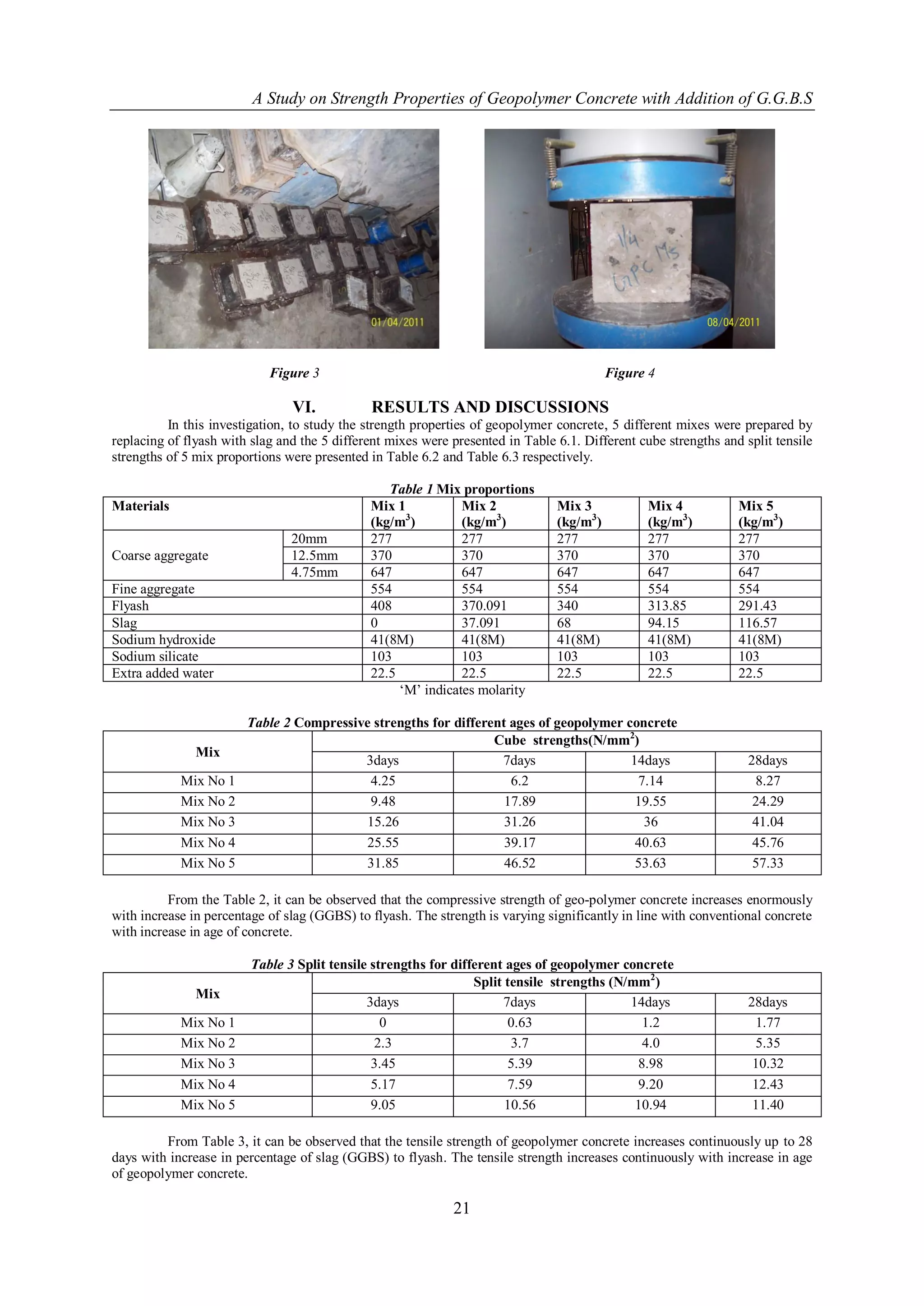
Five different mixes were developed in this study, for each mix 12 cubes of 150mm, 12 cylinders of diameter of 150mm x
height 300mm and 3 beams of 150mm x 150mm x 750mm were cast to study compressive, split and flexural strengths of
each mix.

4.  Curing
    Curing is not required for these geopolymer blocks. The heat gets liberated during the preparation of sodium hydroxide
which should be kept undisturbed for one day.

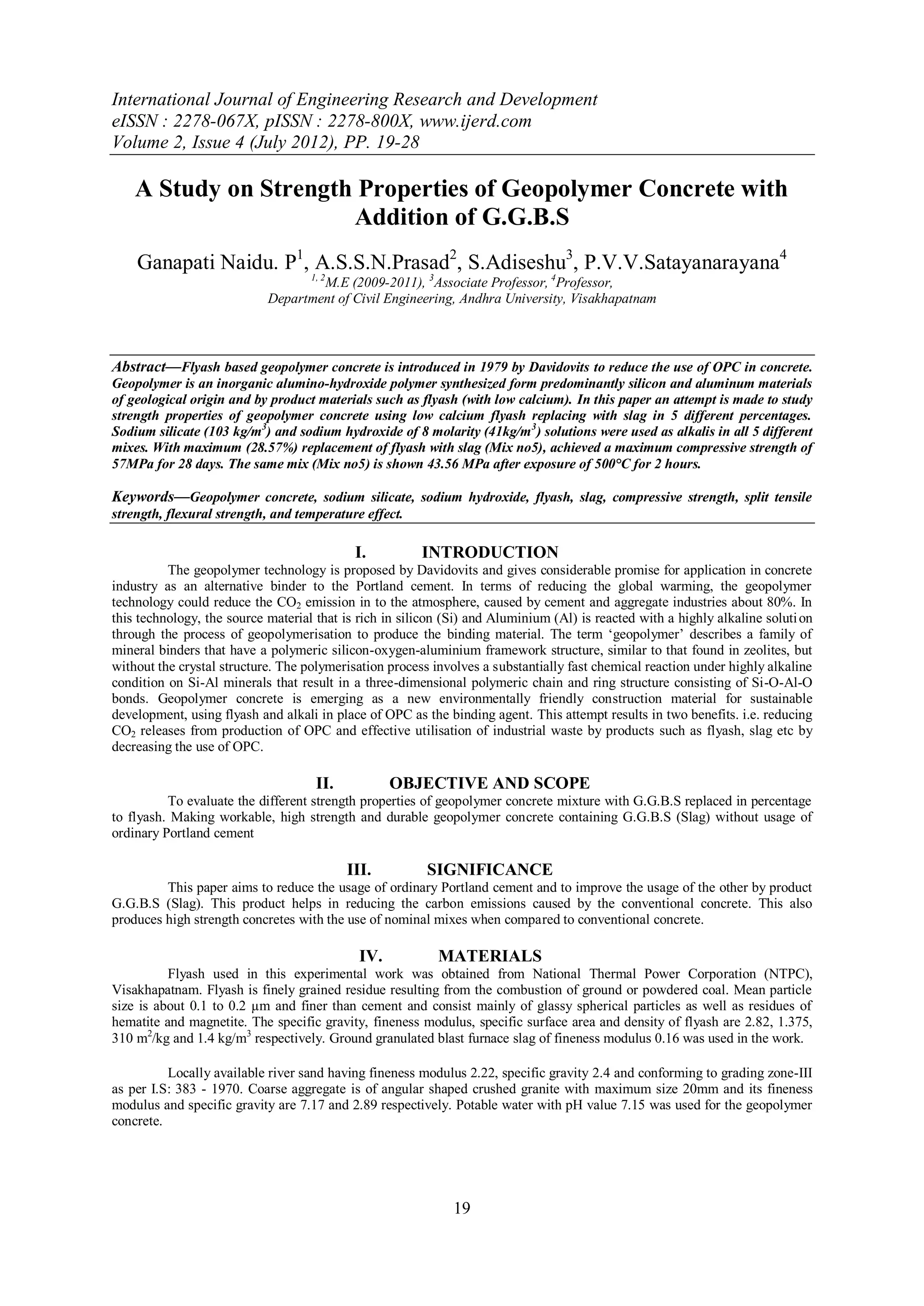
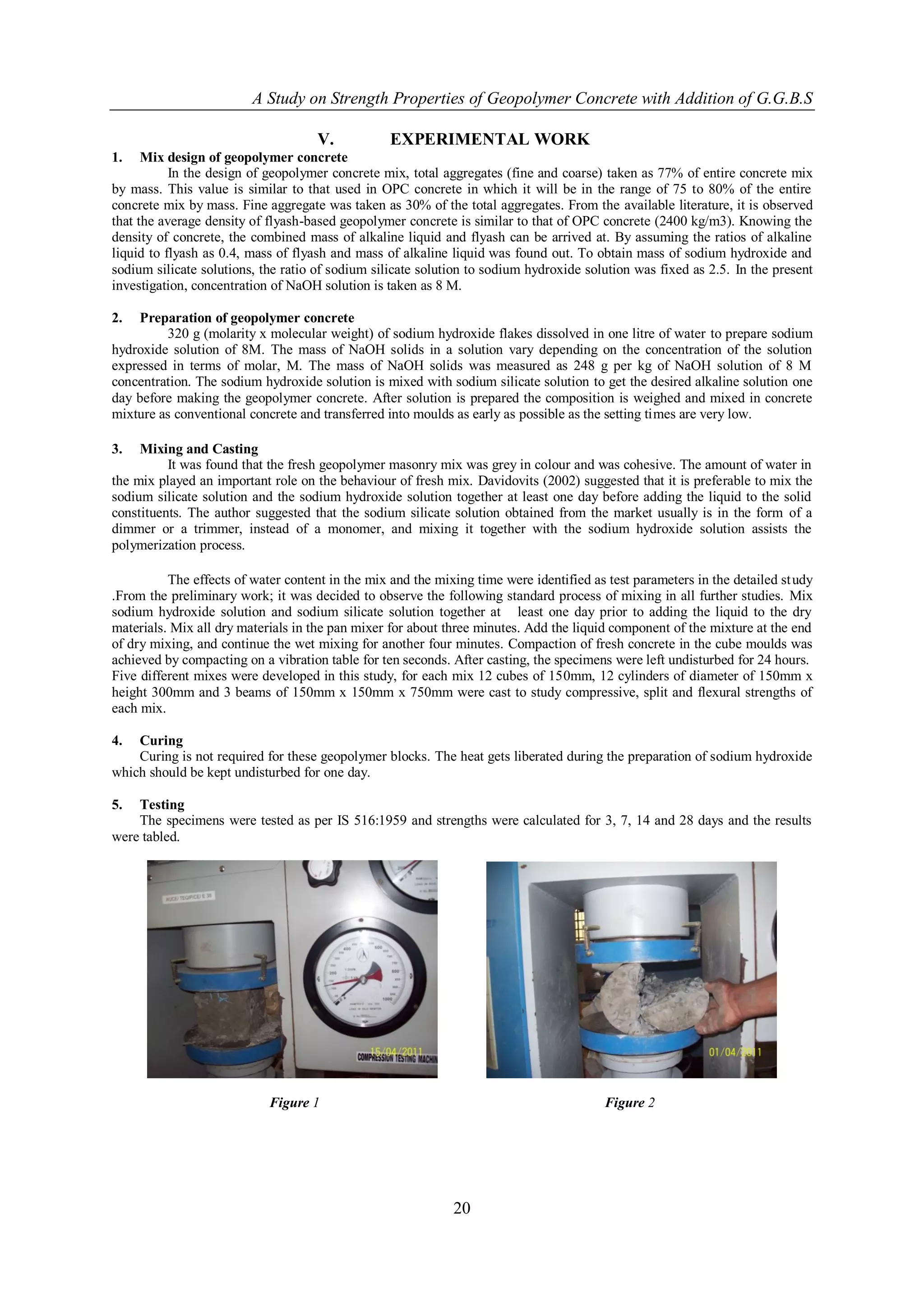
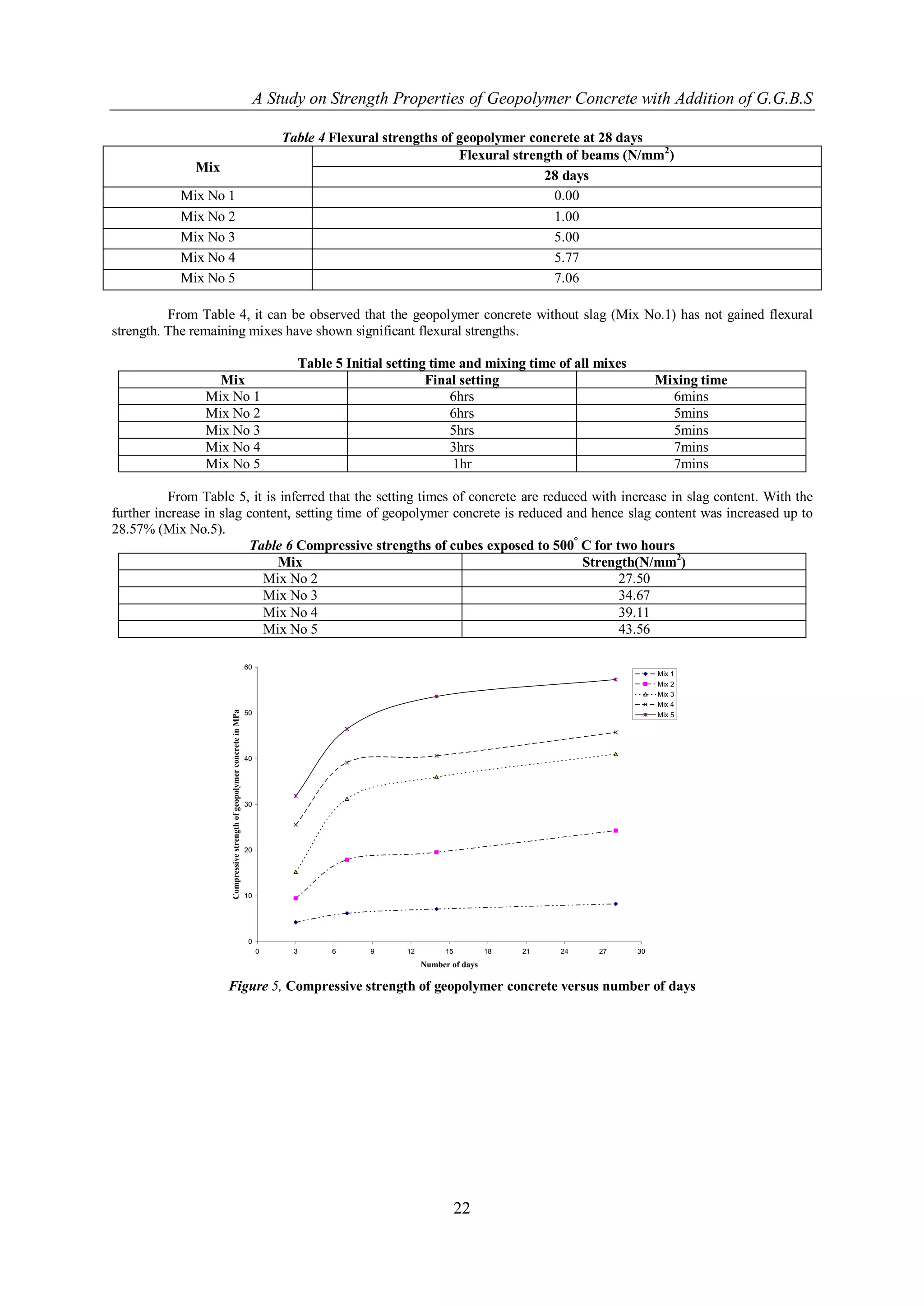
5.  Testing
    The specimens were tested as per IS 516:1959 and strengths were calculated for 3, 7, 14 and 28 days and the results
were tabled.


                            Figure 1                                                     Figure 2


                                                             20
A Study on Strength Properties of Geopolymer Concrete with Addition of G.G.B.S


                            Figure 3                                                      Figure 4

                                VI.            RESULTS AND DISCUSSIONS
          In this investigation, to study the strength properties of geopolymer concrete, 5 different mixes were prepared by
replacing of flyash with slag and the 5 different mixes were presented in Table 6.1. Different cube strengths and split tensile
strengths of 5 mix proportions were presented in Table 6.2 and Table 6.3 respectively.

                                                 Table 1 Mix proportions
Materials                                     Mix 1           Mix 2             Mix 3            Mix 4           Mix 5
                                              (kg/m3)         (kg/m3)           (kg/m3)          (kg/m3)         (kg/m3)
                                20mm          277             277               277              277             277
Coarse aggregate                12.5mm        370             370               370              370             370
                                4.75mm        647             647               647              647             647
Fine aggregate                                554             554               554              554             554
Flyash                                        408             370.091           340              313.85          291.43
Slag                                          0               37.091            68               94.15           116.57
Sodium hydroxide                              41(8M)          41(8M)            41(8M)           41(8M)          41(8M)
Sodium silicate                               103             103               103              103             103
Extra added water                             22.5            22.5              22.5             22.5            22.5
                                                   „M‟ indicates molarity

                        Table 2 Compressive strengths for different ages of geopolymer concrete
                                                                 Cube strengths(N/mm2)
               Mix
                                          3days                   7days                 14days                     28days
            Mix No 1                       4.25                     6.2                  7.14                       8.27
            Mix No 2                       9.48                    17.89                 19.55                      24.29
            Mix No 3                      15.26                    31.26                  36                        41.04
            Mix No 4                      25.55                    39.17                 40.63                      45.76
            Mix No 5                      31.85                    46.52                 53.63                      57.33

          From the Table 2, it can be observed that the compressive strength of geo-polymer concrete increases enormously
with increase in percentage of slag (GGBS) to flyash. The strength is varying significantly in line with conventional concrete
with increase in age of concrete.

                         Table 3 Split tensile strengths for different ages of geopolymer concrete
                                                                 Split tensile strengths (N/mm2)
               Mix
                                              3days                   7days                 14days                 28days
            Mix No 1                             0                     0.63                   1.2                   1.77
            Mix No 2                            2.3                     3.7                   4.0                   5.35
            Mix No 3                           3.45                    5.39                  8.98                   10.32
            Mix No 4                           5.17                    7.59                  9.20                   12.43
            Mix No 5                           9.05                    10.56                 10.94                  11.40

         From Table 3, it can be observed that the tensile strength of geopolymer concrete increases continuously up to 28
days with increase in percentage of slag (GGBS) to flyash. The tensile strength increases continuously with increase in age
of geopolymer concrete.

                                                             21
A Study on Strength Properties of Geopolymer Concrete with Addition of G.G.B.S

                                                                                   Table 4 Flexural strengths of geopolymer concrete at 28 days
                                                                                                                 Flexural strength of beams (N/mm2)
              Mix
                                                                                                                               28 days
            Mix No 1                                                                                                             0.00
            Mix No 2                                                                                                             1.00
            Mix No 3                                                                                                             5.00
            Mix No 4                                                                                                             5.77
            Mix No 5                                                                                                             7.06

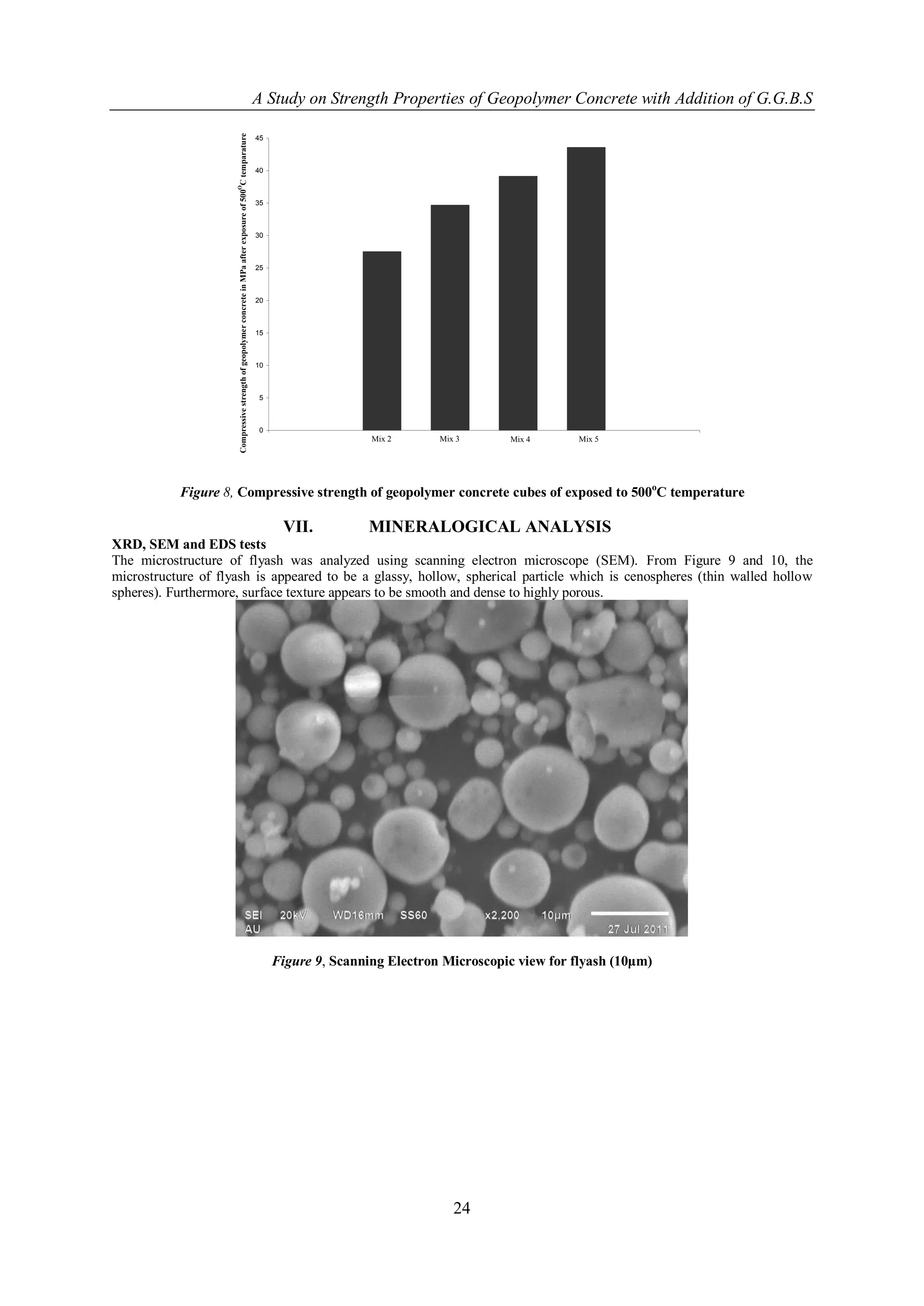
          From Table 4, it can be observed that the geopolymer concrete without slag (Mix No.1) has not gained flexural
strength. The remaining mixes have shown significant flexural strengths.

                                                                                        Table 5 Initial setting time and mixing time of all mixes
                  Mix                                                                                          Final setting                             Mixing time
                Mix No 1                                                                                           6hrs                                    6mins
                Mix No 2                                                                                           6hrs                                    5mins
                Mix No 3                                                                                           5hrs                                    5mins
                Mix No 4                                                                                           3hrs                                    7mins
                Mix No 5                                                                                            1hr                                    7mins

          From Table 5, it is inferred that the setting times of concrete are reduced with increase in slag content. With the
further increase in slag content, setting time of geopolymer concrete is reduced and hence slag content was increased up to
28.57% (Mix No.5).
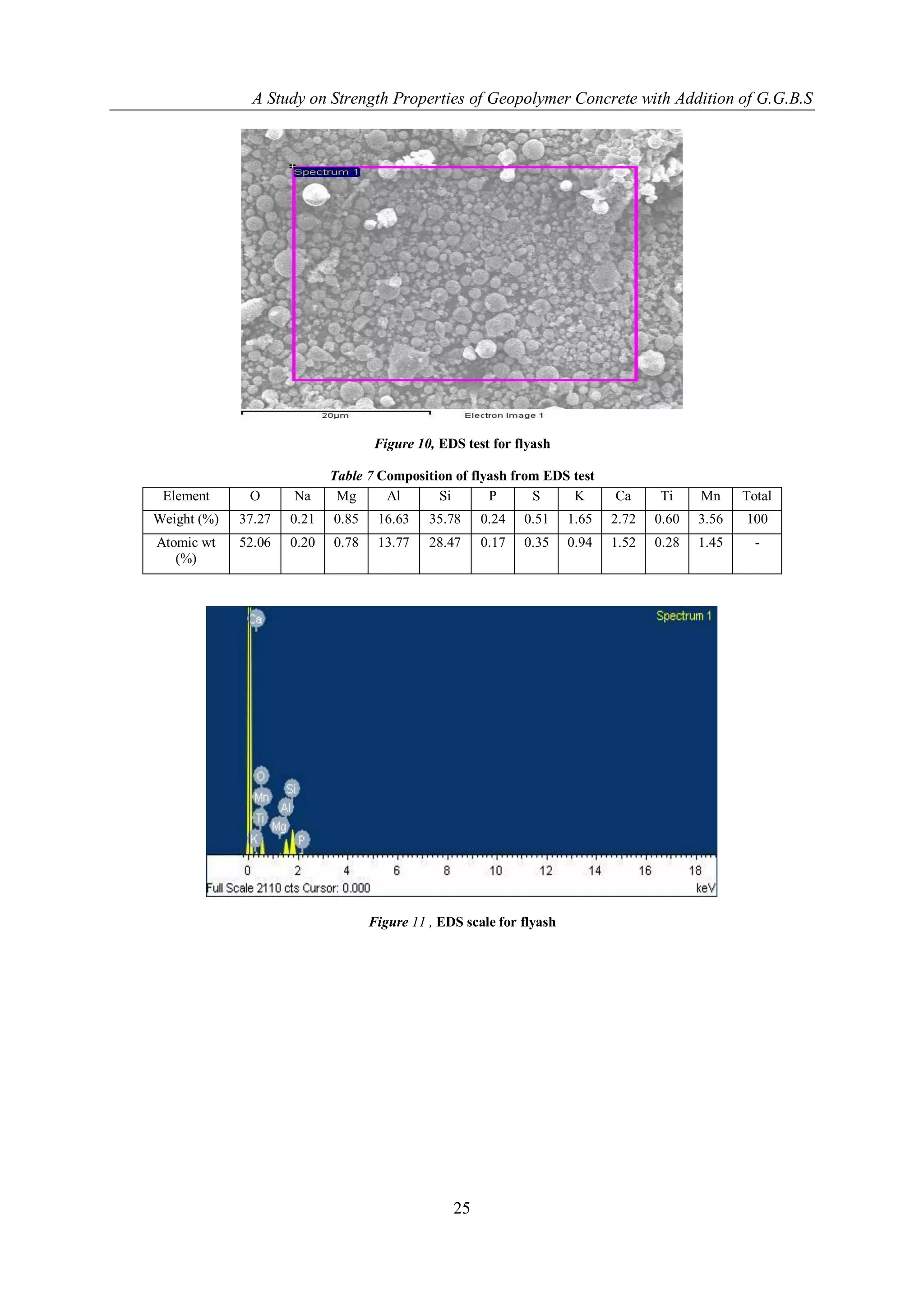
                          Table 6 Compressive strengths of cubes exposed to 500° C for two hours
                              Mix                                                   Strength(N/mm2)
                            Mix No 2                                                      27.50
                            Mix No 3                                                      34.67
                            Mix No 4                                                      39.11
                            Mix No 5                                                      43.56

                                                                          60
                                                                                                                                                         Mix 1
                                                                                                                                                         Mix 2
                                                                                                                                                         Mix 3
                                                                                                                                                         Mix 4
                     Compressive strength of geopolymer concrete in MPa


                                                                          50                                                                             Mix 5


                                                                          40


                                                                          30


                                                                          20


                                                                          10


                                                                          0
                                                                               0    3        6      9     12         15         18   21   24   27   30
                                                                                                               Number of days

                    Figure 5, Compressive strength of geopolymer concrete versus number of days


                                                                                                                          22
A Study on Strength Properties of Geopolymer Concrete with Addition of G.G.B.S

                                                                                                                                      14                                                                                     Mix 1
                                                                                                                                                                                                                             Mix 2
                                                                                                                                                                                                                             Mix 3
                                                                                                                                                                                                                             Mix 4
                                                                                                                                      12
                                                                                                                                                                                                                             Mix 5


                                                                               Split tensile strength of geopolymer concrete in MPa
                                                                                                                                      10


                                                                                                                                      8


                                                                                                                                      6


                                                                                                                                      4


                                                                                                                                      2


                                                                                                                                      0
                                                                                                                                           0    3    6           9    12         15           18   21      24     27    30
                                                                                                                                                                           Number of days


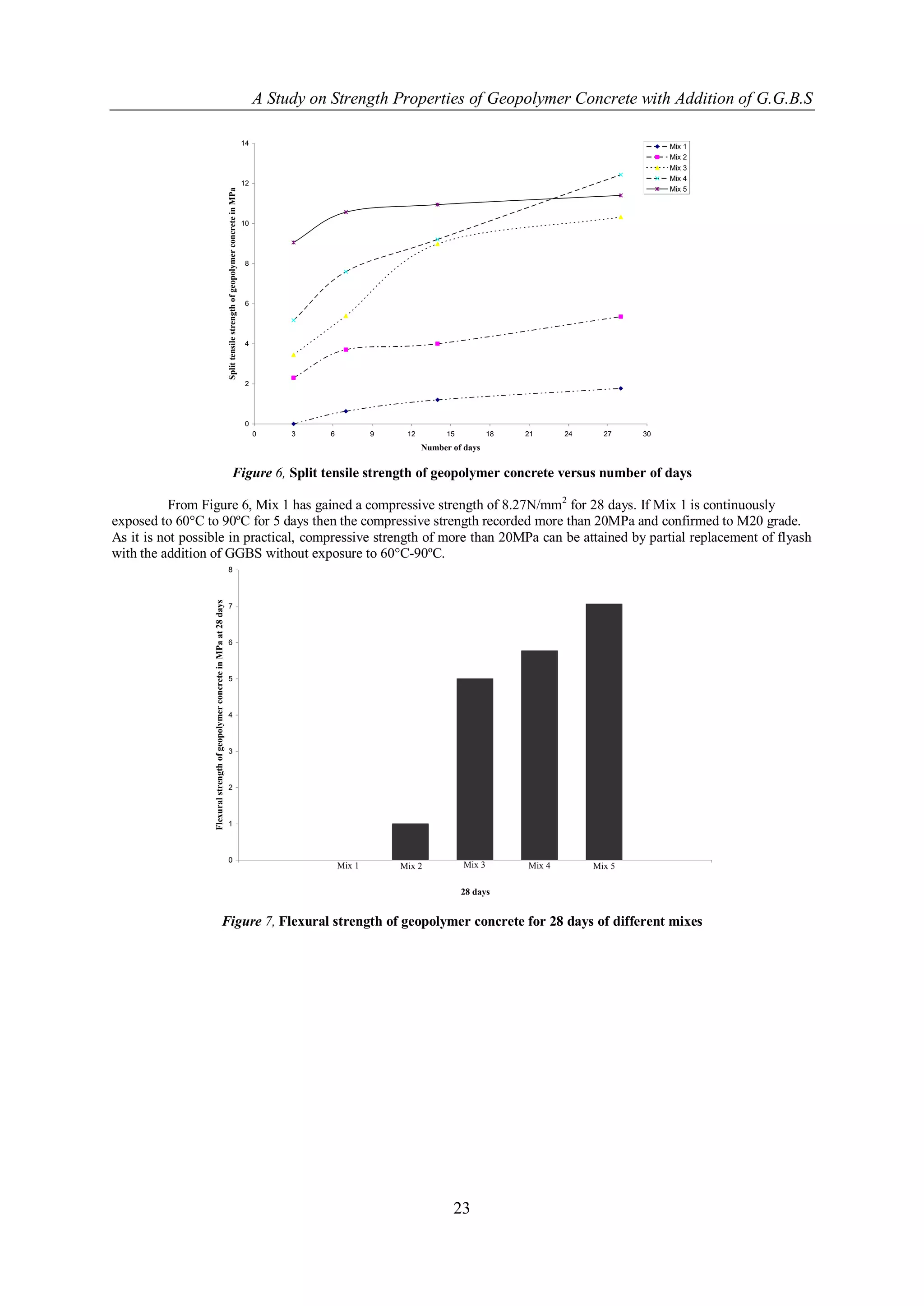
                                                                                                  Figure 6, Split tensile strength of geopolymer concrete versus number of days

           From Figure 6, Mix 1 has gained a compressive strength of 8.27N/mm2 for 28 days. If Mix 1 is continuously
exposed to 60°C to 90ºC for 5 days then the compressive strength recorded more than 20MPa and confirmed to M20 grade.
As it is not possible in practical, compressive strength of more than 20MPa can be attained by partial replacement of flyash
with the addition of GGBS without exposure to 60°C-90ºC.
                                                                               8
                  Flexural strength of geopolymer concrete in MPa at 28 days


                                                                               7


                                                                               6


                                                                               5


                                                                               4


                                                                               3


                                                                               2


                                                                               1


                                                                               0
                                                                                                                                                         Mix 1       Mix 2            Mix 3        Mix 4        Mix 5

                                                                                                                                                                                      28 days


                                                         Figure 7, Flexural strength of geopolymer concrete for 28 days of different mixes


                                                                                                                                                                                  23
A Study on Strength Properties of Geopolymer Concrete with Addition of G.G.B.S


                     Compressive strength of geopolymer concrete in MPa after exposure of 500OC temparature
                                                                                                              45


                                                                                                              40


                                                                                                              35


                                                                                                              30


                                                                                                              25


                                                                                                              20


                                                                                                              15


                                                                                                              10


                                                                                                               5


                                                                                                               0
                                                                                                                                   Mix 2      Mix 3      Mix 4       Mix 5


           Figure 8, Compressive strength of geopolymer concrete cubes of exposed to 500oC temperature

                                                                                                                    VII.          MINERALOGICAL ANALYSIS
XRD, SEM and EDS tests
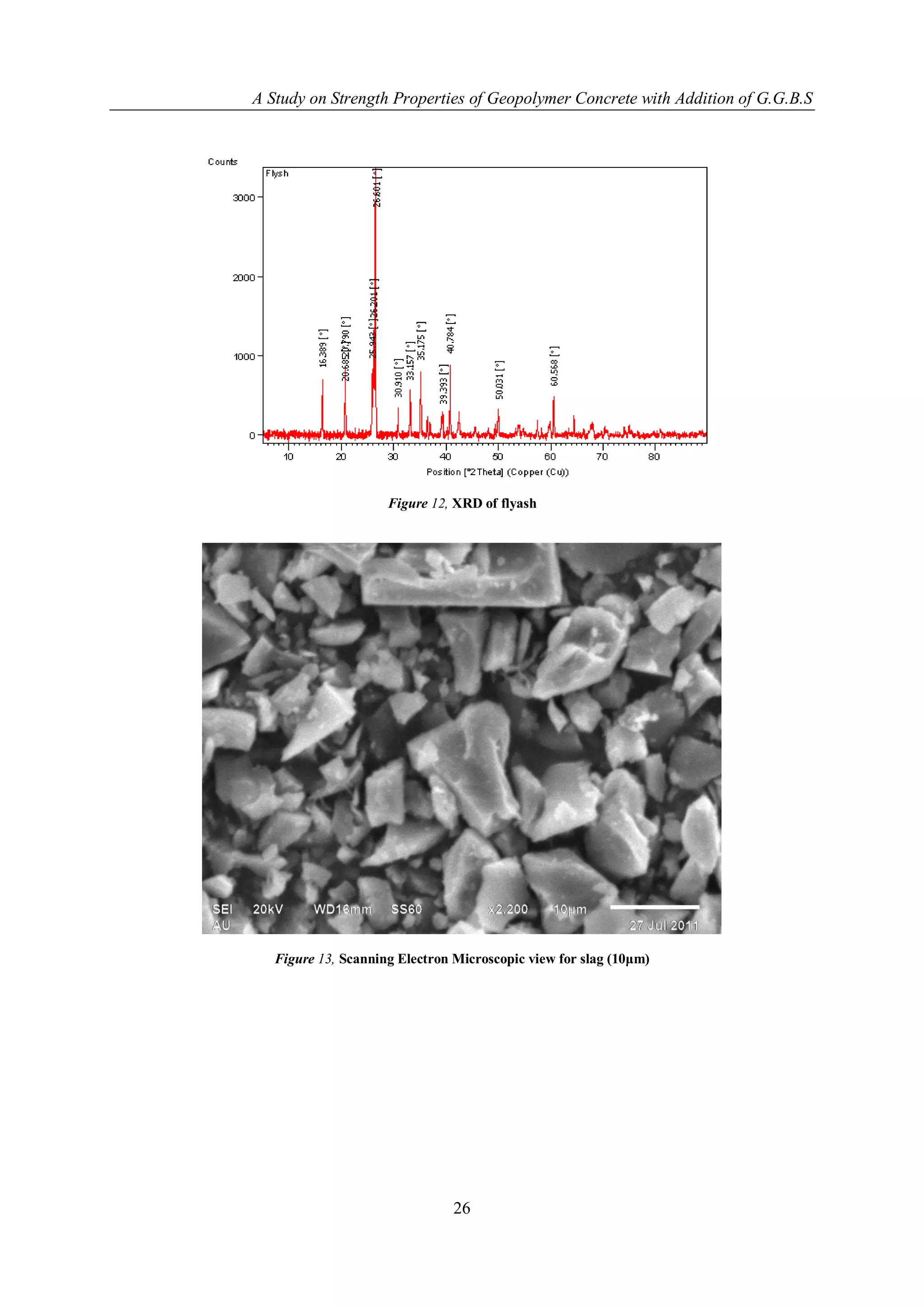
The microstructure of flyash was analyzed using scanning electron microscope (SEM). From Figure 9 and 10, the
microstructure of flyash is appeared to be a glassy, hollow, spherical particle which is cenospheres (thin walled hollow
spheres). Furthermore, surface texture appears to be smooth and dense to highly porous.


                                                                                                                   Figure 9, Scanning Electron Microscopic view for flyash (10μm)


                                                                                                                                                 24
A Study on Strength Properties of Geopolymer Concrete with Addition of G.G.B.S


                                   Figure 10, EDS test for flyash

                            Table 7 Composition of flyash from EDS test
 Element      O      Na      Mg      Al      Si       P      S     K         Ca     Ti     Mn     Total
Weight (%)   37.27   0.21   0.85    16.63    35.78    0.24   0.51     1.65   2.72   0.60   3.56   100
Atomic wt    52.06   0.20   0.78    13.77    28.47    0.17   0.35     0.94   1.52   0.28   1.45     -
   (%)


                                   Figure 11 , EDS scale for flyash


                                                 25
A Study on Strength Properties of Geopolymer Concrete with Addition of G.G.B.S


                     Figure 12, XRD of flyash


   Figure 13, Scanning Electron Microscopic view for slag (10μm)


                                26
A Study on Strength Properties of Geopolymer Concrete with Addition of G.G.B.S


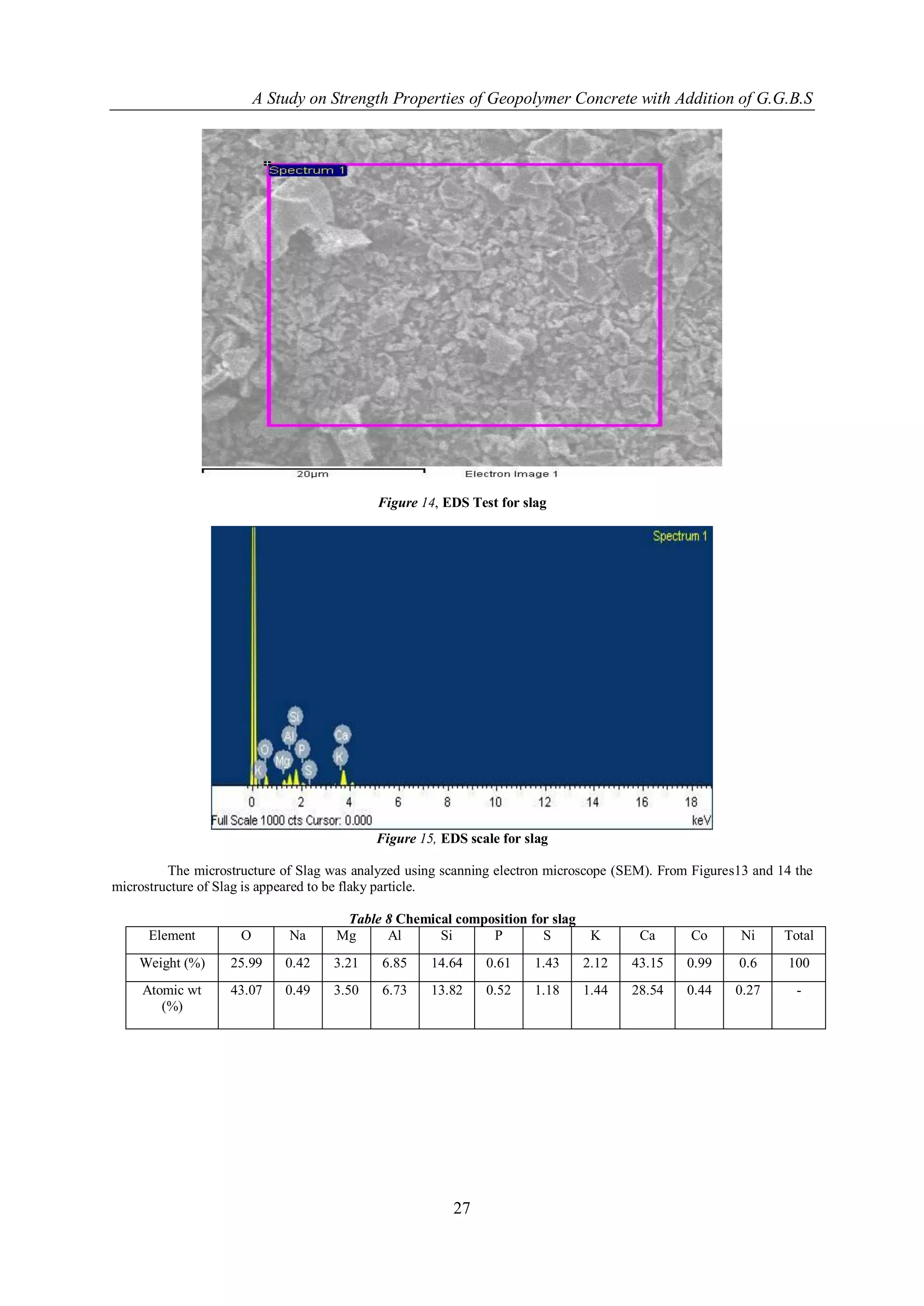
                                            Figure 14, EDS Test for slag


                                           Figure 15, EDS scale for slag

         The microstructure of Slag was analyzed using scanning electron microscope (SEM). From Figures13 and 14 the
microstructure of Slag is appeared to be flaky particle.

                                      Table 8 Chemical composition for slag
      Element        O        Na     Mg     Al      Si      P        S         K       Ca      Co       Ni     Total
    Weight (%)     25.99     0.42   3.21    6.85    14.64    0.61     1.43    2.12    43.15    0.99    0.6      100
     Atomic wt     43.07     0.49   3.50    6.73    13.82    0.52     1.18    1.44    28.54    0.44    0.27      -
        (%)


                                                        27
A Study on Strength Properties of Geopolymer Concrete with Addition of G.G.B.S


                                                   Figure 16, XRD of slag


                                        VIII.             CONCLUSIONS
Based on the experimental work the following conclusions are drawn:
        Higher concentrations of G.G.B.S (Slag) result in higher compressive strength of geopolymer concrete. Mixing of
         G.G.B.S was tested up to 28.57%, beyond that immediate setting was observed.
        There is no necessity of exposing geopolymer concrete to higher temperature to attain maximum strength if
         minimum 9% of flyash is replaced by GGBS.
        Compressive strength of geopolymer concrete increases with increase in percentage of replacement of flyash with
         GGBS. Flyash was replaced by GGBS up to 28.57%, beyond that fast setting was observed.
        A maximum of 25% loss in compressive strength was observed when geopolymer concrete exposed to a
         temperature of 500oC for two hours.
        90% of compressive strength was achieved in 14 days.
        The average density of geopolymer concrete was equal to that of OPC concrete.

                                                     REFERENCES
  [1].   THE PROCEEDINGS OF GEOPOLYMER 2005 WORLD CONGRESS, 4th Int. Conference on geopolymers, edited by J.
         Davidovits, Geopolymer Institute, France 2006.
  [2].   D. Bondar, C. J. Lynsdale, N. B. Milestone, N. Hassani, and A. A. Ramezanianpour. “ENGINEERING PROPERTIES OF
         ALKALI ACTIVATE NATURAL POZZOLAN CONCRETE”. Second International Conference on Sustainable Construction
         Materials and Technologies June 28-June 30, 2010.
  [3].   K. Dattatreya ,N.P. Rajamane ,D. Sabitha ,P.S. Ambily ,M.C. Nataraja “Flexural behaviour of reinforced Geopolymer concrete
         beams”. INTERNATIONAL JOURNAL OF CIVIL AND STRUCTURAL ENGINEERING. Volume 2, No 1, 2011.
  [4].   J. Provis, P. Duxson, R.M. Harrex, c-z. Yong, J.S.J. van deventer. “VALORISATION OF FLYASHES BY
         GEOPOLYMERISATION”. Global NEST Journal, Vol 11, No 2, pp 147-154, 2009.
  [5].   Kunal kupwade-patil and Erez Allouche “EFFECT OF ALKALI SILICA REACTION (ASR) IN GEOPOLYMER
         CONCRETE”. World of cold ash (woca) conference –May 9-12, 2011, in Denver, co, USA. http://www.flyash.info/
  [6].   S. Vaidya, E.I. Diaz, E.N. Allouche. “EXPERIMENTAL EVALUATION OF SELF-CURE GEOPOLYMER CONCRETE FOR
         MASS POUR APPLICATIONS”. World of coal ash (woca) conference –may 9-12, 2011, in Denver, co, USA
         http://www.flyash.info/.
  [7].   Susan, Bernal; Ruby, De Gutierrez; Silvio, Delvasto; Erich, Rodriguez. “PERFORMANCE OF GEOPOLYMERIC CONCRETE
         REINFORCED WITH STEEL FIBERS”. November 15-18, 2006 São Paulo – Brazil.
  [8].   SureshThokchom, Dr.Partha .Ghosh and Dr. Somnath Ghosh. “ACID RESISTANCE OF FLYASH BASED GEOPOLYMER
         MORTARS”. International Journal of Recent Trends in Engineering, Vol. 1, No. 6, May 2009.


                                                               28

IJERD (www.ijerd.com) International Journal of Engineering Research and Development

  • 1.
    International Journal ofEngineering Research and Development eISSN : 2278-067X, pISSN : 2278-800X, www.ijerd.com Volume 2, Issue 4 (July 2012), PP. 19-28 A Study on Strength Properties of Geopolymer Concrete with Addition of G.G.B.S Ganapati Naidu. P1, A.S.S.N.Prasad2, S.Adiseshu3, P.V.V.Satayanarayana4 1, 2 M.E (2009-2011), 3Associate Professor, 4Professor, Department of Civil Engineering, Andhra University, Visakhapatnam Abstract––Flyash based geopolymer concrete is introduced in 1979 by Davidovits to reduce the use of OPC in concrete. Geopolymer is an inorganic alumino-hydroxide polymer synthesized form predominantly silicon and aluminum materials of geological origin and by product materials such as flyash (with low calcium). In this paper an attempt is made to study strength properties of geopolymer concrete using low calcium flyash replacing with slag in 5 different percentages. Sodium silicate (103 kg/m3) and sodium hydroxide of 8 molarity (41kg/m 3) solutions were used as alkalis in all 5 different mixes. With maximum (28.57%) replacement of flyash with slag (Mix no5), achieved a maximum compressive strength of 57MPa for 28 days. The same mix (Mix no5) is shown 43.56 MPa after exposure of 500°C for 2 hours. Keywords––Geopolymer concrete, sodium silicate, sodium hydroxide, flyash, slag, compressive strength, split tensile strength, flexural strength, and temperature effect. I. INTRODUCTION The geopolymer technology is proposed by Davidovits and gives considerable promise for application in concrete industry as an alternative binder to the Portland cement. In terms of reducing the global warming, the geopolymer technology could reduce the CO2 emission in to the atmosphere, caused by cement and aggregate industries about 80%. In this technology, the source material that is rich in silicon (Si) and Aluminium (Al) is reacted with a highly alkaline soluti on through the process of geopolymerisation to produce the binding material. The term „geopolymer‟ describes a family of mineral binders that have a polymeric silicon-oxygen-aluminium framework structure, similar to that found in zeolites, but without the crystal structure. The polymerisation process involves a substantially fast chemical reaction under highly alkaline condition on Si-Al minerals that result in a three-dimensional polymeric chain and ring structure consisting of Si-O-Al-O bonds. Geopolymer concrete is emerging as a new environmentally friendly construction material for sustainable development, using flyash and alkali in place of OPC as the binding agent. This attempt results in two benefits. i.e. reducing CO2 releases from production of OPC and effective utilisation of industrial waste by products such as flyash, slag etc by decreasing the use of OPC. II. OBJECTIVE AND SCOPE To evaluate the different strength properties of geopolymer concrete mixture with G.G.B.S replaced in percentage to flyash. Making workable, high strength and durable geopolymer concrete containing G.G.B.S (Slag) without usage of ordinary Portland cement III. SIGNIFICANCE This paper aims to reduce the usage of ordinary Portland cement and to improve the usage of the other by product G.G.B.S (Slag). This product helps in reducing the carbon emissions caused by the conventional concrete. This also produces high strength concretes with the use of nominal mixes when compared to conventional concrete. IV. MATERIALS Flyash used in this experimental work was obtained from National Thermal Power Corporation (NTPC), Visakhapatnam. Flyash is finely grained residue resulting from the combustion of ground or powdered coal. Mean particle size is about 0.1 to 0.2 µm and finer than cement and consist mainly of glassy spherical particles as well as residues of hematite and magnetite. The specific gravity, fineness modulus, specific surface area and density of flyash are 2.82, 1.375, 310 m2/kg and 1.4 kg/m3 respectively. Ground granulated blast furnace slag of fineness modulus 0.16 was used in the work. Locally available river sand having fineness modulus 2.22, specific gravity 2.4 and conforming to grading zone-III as per I.S: 383 - 1970. Coarse aggregate is of angular shaped crushed granite with maximum size 20mm and its fineness modulus and specific gravity are 7.17 and 2.89 respectively. Potable water with pH value 7.15 was used for the geopolymer concrete. 19
  • 2.
    A Study onStrength Properties of Geopolymer Concrete with Addition of G.G.B.S V. EXPERIMENTAL WORK 1. Mix design of geopolymer concrete In the design of geopolymer concrete mix, total aggregates (fine and coarse) taken as 77% of entire concrete mix by mass. This value is similar to that used in OPC concrete in which it will be in the range of 75 to 80% of the entire concrete mix by mass. Fine aggregate was taken as 30% of the total aggregates. From the available literature, it is observed that the average density of flyash-based geopolymer concrete is similar to that of OPC concrete (2400 kg/m3). Knowing the density of concrete, the combined mass of alkaline liquid and flyash can be arrived at. By assuming the ratios of alkaline liquid to flyash as 0.4, mass of flyash and mass of alkaline liquid was found out. To obtain mass of sodium hydroxide and sodium silicate solutions, the ratio of sodium silicate solution to sodium hydroxide solution was fixed as 2.5. In the present investigation, concentration of NaOH solution is taken as 8 M. 2. Preparation of geopolymer concrete 320 g (molarity x molecular weight) of sodium hydroxide flakes dissolved in one litre of water to prepare sodium hydroxide solution of 8M. The mass of NaOH solids in a solution vary depending on the concentration of the solution expressed in terms of molar, M. The mass of NaOH solids was measured as 248 g per kg of NaOH solution of 8 M concentration. The sodium hydroxide solution is mixed with sodium silicate solution to get the desired alkaline solution one day before making the geopolymer concrete. After solution is prepared the composition is weighed and mixed in concrete mixture as conventional concrete and transferred into moulds as early as possible as the setting times are very low. 3. Mixing and Casting It was found that the fresh geopolymer masonry mix was grey in colour and was cohesive. The amount of water in the mix played an important role on the behaviour of fresh mix. Davidovits (2002) suggested that it is preferable to mix the sodium silicate solution and the sodium hydroxide solution together at least one day before adding the liquid to the solid constituents. The author suggested that the sodium silicate solution obtained from the market usually is in the form of a dimmer or a trimmer, instead of a monomer, and mixing it together with the sodium hydroxide solution assists the polymerization process. The effects of water content in the mix and the mixing time were identified as test parameters in the detailed st udy .From the preliminary work; it was decided to observe the following standard process of mixing in all further studies. Mix sodium hydroxide solution and sodium silicate solution together at least one day prior to adding the liquid to the dry materials. Mix all dry materials in the pan mixer for about three minutes. Add the liquid component of the mixture at the end of dry mixing, and continue the wet mixing for another four minutes. Compaction of fresh concrete in the cube moulds was achieved by compacting on a vibration table for ten seconds. After casting, the specimens were left undisturbed for 24 hours. Five different mixes were developed in this study, for each mix 12 cubes of 150mm, 12 cylinders of diameter of 150mm x height 300mm and 3 beams of 150mm x 150mm x 750mm were cast to study compressive, split and flexural strengths of each mix. 4. Curing Curing is not required for these geopolymer blocks. The heat gets liberated during the preparation of sodium hydroxide which should be kept undisturbed for one day. 5. Testing The specimens were tested as per IS 516:1959 and strengths were calculated for 3, 7, 14 and 28 days and the results were tabled. Figure 1 Figure 2 20
  • 3.
    A Study onStrength Properties of Geopolymer Concrete with Addition of G.G.B.S Figure 3 Figure 4 VI. RESULTS AND DISCUSSIONS In this investigation, to study the strength properties of geopolymer concrete, 5 different mixes were prepared by replacing of flyash with slag and the 5 different mixes were presented in Table 6.1. Different cube strengths and split tensile strengths of 5 mix proportions were presented in Table 6.2 and Table 6.3 respectively. Table 1 Mix proportions Materials Mix 1 Mix 2 Mix 3 Mix 4 Mix 5 (kg/m3) (kg/m3) (kg/m3) (kg/m3) (kg/m3) 20mm 277 277 277 277 277 Coarse aggregate 12.5mm 370 370 370 370 370 4.75mm 647 647 647 647 647 Fine aggregate 554 554 554 554 554 Flyash 408 370.091 340 313.85 291.43 Slag 0 37.091 68 94.15 116.57 Sodium hydroxide 41(8M) 41(8M) 41(8M) 41(8M) 41(8M) Sodium silicate 103 103 103 103 103 Extra added water 22.5 22.5 22.5 22.5 22.5 „M‟ indicates molarity Table 2 Compressive strengths for different ages of geopolymer concrete Cube strengths(N/mm2) Mix 3days 7days 14days 28days Mix No 1 4.25 6.2 7.14 8.27 Mix No 2 9.48 17.89 19.55 24.29 Mix No 3 15.26 31.26 36 41.04 Mix No 4 25.55 39.17 40.63 45.76 Mix No 5 31.85 46.52 53.63 57.33 From the Table 2, it can be observed that the compressive strength of geo-polymer concrete increases enormously with increase in percentage of slag (GGBS) to flyash. The strength is varying significantly in line with conventional concrete with increase in age of concrete. Table 3 Split tensile strengths for different ages of geopolymer concrete Split tensile strengths (N/mm2) Mix 3days 7days 14days 28days Mix No 1 0 0.63 1.2 1.77 Mix No 2 2.3 3.7 4.0 5.35 Mix No 3 3.45 5.39 8.98 10.32 Mix No 4 5.17 7.59 9.20 12.43 Mix No 5 9.05 10.56 10.94 11.40 From Table 3, it can be observed that the tensile strength of geopolymer concrete increases continuously up to 28 days with increase in percentage of slag (GGBS) to flyash. The tensile strength increases continuously with increase in age of geopolymer concrete. 21
  • 4.
    A Study onStrength Properties of Geopolymer Concrete with Addition of G.G.B.S Table 4 Flexural strengths of geopolymer concrete at 28 days Flexural strength of beams (N/mm2) Mix 28 days Mix No 1 0.00 Mix No 2 1.00 Mix No 3 5.00 Mix No 4 5.77 Mix No 5 7.06 From Table 4, it can be observed that the geopolymer concrete without slag (Mix No.1) has not gained flexural strength. The remaining mixes have shown significant flexural strengths. Table 5 Initial setting time and mixing time of all mixes Mix Final setting Mixing time Mix No 1 6hrs 6mins Mix No 2 6hrs 5mins Mix No 3 5hrs 5mins Mix No 4 3hrs 7mins Mix No 5 1hr 7mins From Table 5, it is inferred that the setting times of concrete are reduced with increase in slag content. With the further increase in slag content, setting time of geopolymer concrete is reduced and hence slag content was increased up to 28.57% (Mix No.5). Table 6 Compressive strengths of cubes exposed to 500° C for two hours Mix Strength(N/mm2) Mix No 2 27.50 Mix No 3 34.67 Mix No 4 39.11 Mix No 5 43.56 60 Mix 1 Mix 2 Mix 3 Mix 4 Compressive strength of geopolymer concrete in MPa 50 Mix 5 40 30 20 10 0 0 3 6 9 12 15 18 21 24 27 30 Number of days Figure 5, Compressive strength of geopolymer concrete versus number of days 22
  • 5.
    A Study onStrength Properties of Geopolymer Concrete with Addition of G.G.B.S 14 Mix 1 Mix 2 Mix 3 Mix 4 12 Mix 5 Split tensile strength of geopolymer concrete in MPa 10 8 6 4 2 0 0 3 6 9 12 15 18 21 24 27 30 Number of days Figure 6, Split tensile strength of geopolymer concrete versus number of days From Figure 6, Mix 1 has gained a compressive strength of 8.27N/mm2 for 28 days. If Mix 1 is continuously exposed to 60°C to 90ºC for 5 days then the compressive strength recorded more than 20MPa and confirmed to M20 grade. As it is not possible in practical, compressive strength of more than 20MPa can be attained by partial replacement of flyash with the addition of GGBS without exposure to 60°C-90ºC. 8 Flexural strength of geopolymer concrete in MPa at 28 days 7 6 5 4 3 2 1 0 Mix 1 Mix 2 Mix 3 Mix 4 Mix 5 28 days Figure 7, Flexural strength of geopolymer concrete for 28 days of different mixes 23
  • 6.
    A Study onStrength Properties of Geopolymer Concrete with Addition of G.G.B.S Compressive strength of geopolymer concrete in MPa after exposure of 500OC temparature 45 40 35 30 25 20 15 10 5 0 Mix 2 Mix 3 Mix 4 Mix 5 Figure 8, Compressive strength of geopolymer concrete cubes of exposed to 500oC temperature VII. MINERALOGICAL ANALYSIS XRD, SEM and EDS tests The microstructure of flyash was analyzed using scanning electron microscope (SEM). From Figure 9 and 10, the microstructure of flyash is appeared to be a glassy, hollow, spherical particle which is cenospheres (thin walled hollow spheres). Furthermore, surface texture appears to be smooth and dense to highly porous. Figure 9, Scanning Electron Microscopic view for flyash (10μm) 24
  • 7.
    A Study onStrength Properties of Geopolymer Concrete with Addition of G.G.B.S Figure 10, EDS test for flyash Table 7 Composition of flyash from EDS test Element O Na Mg Al Si P S K Ca Ti Mn Total Weight (%) 37.27 0.21 0.85 16.63 35.78 0.24 0.51 1.65 2.72 0.60 3.56 100 Atomic wt 52.06 0.20 0.78 13.77 28.47 0.17 0.35 0.94 1.52 0.28 1.45 - (%) Figure 11 , EDS scale for flyash 25
  • 8.
    A Study onStrength Properties of Geopolymer Concrete with Addition of G.G.B.S Figure 12, XRD of flyash Figure 13, Scanning Electron Microscopic view for slag (10μm) 26
  • 9.
    A Study onStrength Properties of Geopolymer Concrete with Addition of G.G.B.S Figure 14, EDS Test for slag Figure 15, EDS scale for slag The microstructure of Slag was analyzed using scanning electron microscope (SEM). From Figures13 and 14 the microstructure of Slag is appeared to be flaky particle. Table 8 Chemical composition for slag Element O Na Mg Al Si P S K Ca Co Ni Total Weight (%) 25.99 0.42 3.21 6.85 14.64 0.61 1.43 2.12 43.15 0.99 0.6 100 Atomic wt 43.07 0.49 3.50 6.73 13.82 0.52 1.18 1.44 28.54 0.44 0.27 - (%) 27
  • 10.
    A Study onStrength Properties of Geopolymer Concrete with Addition of G.G.B.S Figure 16, XRD of slag VIII. CONCLUSIONS Based on the experimental work the following conclusions are drawn:  Higher concentrations of G.G.B.S (Slag) result in higher compressive strength of geopolymer concrete. Mixing of G.G.B.S was tested up to 28.57%, beyond that immediate setting was observed.  There is no necessity of exposing geopolymer concrete to higher temperature to attain maximum strength if minimum 9% of flyash is replaced by GGBS.  Compressive strength of geopolymer concrete increases with increase in percentage of replacement of flyash with GGBS. Flyash was replaced by GGBS up to 28.57%, beyond that fast setting was observed.  A maximum of 25% loss in compressive strength was observed when geopolymer concrete exposed to a temperature of 500oC for two hours.  90% of compressive strength was achieved in 14 days.  The average density of geopolymer concrete was equal to that of OPC concrete. REFERENCES [1]. THE PROCEEDINGS OF GEOPOLYMER 2005 WORLD CONGRESS, 4th Int. Conference on geopolymers, edited by J. Davidovits, Geopolymer Institute, France 2006. [2]. D. Bondar, C. J. Lynsdale, N. B. Milestone, N. Hassani, and A. A. Ramezanianpour. “ENGINEERING PROPERTIES OF ALKALI ACTIVATE NATURAL POZZOLAN CONCRETE”. Second International Conference on Sustainable Construction Materials and Technologies June 28-June 30, 2010. [3]. K. Dattatreya ,N.P. Rajamane ,D. Sabitha ,P.S. Ambily ,M.C. Nataraja “Flexural behaviour of reinforced Geopolymer concrete beams”. INTERNATIONAL JOURNAL OF CIVIL AND STRUCTURAL ENGINEERING. Volume 2, No 1, 2011. [4]. J. Provis, P. Duxson, R.M. Harrex, c-z. Yong, J.S.J. van deventer. “VALORISATION OF FLYASHES BY GEOPOLYMERISATION”. Global NEST Journal, Vol 11, No 2, pp 147-154, 2009. [5]. Kunal kupwade-patil and Erez Allouche “EFFECT OF ALKALI SILICA REACTION (ASR) IN GEOPOLYMER CONCRETE”. World of cold ash (woca) conference –May 9-12, 2011, in Denver, co, USA. http://www.flyash.info/ [6]. S. Vaidya, E.I. Diaz, E.N. Allouche. “EXPERIMENTAL EVALUATION OF SELF-CURE GEOPOLYMER CONCRETE FOR MASS POUR APPLICATIONS”. World of coal ash (woca) conference –may 9-12, 2011, in Denver, co, USA http://www.flyash.info/. [7]. Susan, Bernal; Ruby, De Gutierrez; Silvio, Delvasto; Erich, Rodriguez. “PERFORMANCE OF GEOPOLYMERIC CONCRETE REINFORCED WITH STEEL FIBERS”. November 15-18, 2006 São Paulo – Brazil. [8]. SureshThokchom, Dr.Partha .Ghosh and Dr. Somnath Ghosh. “ACID RESISTANCE OF FLYASH BASED GEOPOLYMER MORTARS”. International Journal of Recent Trends in Engineering, Vol. 1, No. 6, May 2009. 28