Downloaded 43 times
![International Journal of Modern Engineering Research (IJMER)
www.ijmer.com Vol. 3, Issue. 4, Jul - Aug. 2013 pp-2007-2010 ISSN: 2249-6645
www.ijmer.com 2007 | Page
Dr. Mrs. S. A. Bhalchandra1
, Mrs. A. Y. Bhosle2
Department of Applied Mechanics Government College of Engineering, Aurangabad Maharashtra
ABSTRACT: This paper presents results of an experimental program to determine mechanical properties of Glass fibre
reinforced Geopolymer Concrete which contains fly ash, alkaline liquids, fine & course aggregates & glass fibres. The
effects of inclusion of glass fibers on density, compressive strength & flexural strength of hardened geopolymer concrete
composite (GPCC) was studied. Alkaline liquids to fly ash ratio were fixed as 0.35 with 100% replacement of ordinary
Portland cement by fly ash. For alkaline liquid combination ratio of Sodium hydroxide solution to Sodium silicate solution
was fixed as 1.00. Glass fibers were added to the mix in 0.01%, 0.02%, 0.03% & 0.04% by volume of concrete. Based on the
test results it was observed that the glass fibers reinforced geopolymer concrete have relatively higher strength in short
curing time (3 days) than geopolymer concrete & Ordinary Portland cement concrete.
Keywords: alkaline liquids, compressive strength, density, flexural strength, fly ash, glass fibers.
I. INTRODUCTION
With infrastructure development growing, demand for concrete as construction material is on increase worldwide,
which ultimately increase the demand for cement. Production of Ordinary Portland cement is highly energy intensive,
consume significant amount of non renewable natural resources such as lime stone deposition, coal etc. & about 1.0 ton of
carbon dioxide (Co2) is liberated during production of one ton of Portland cement [4 -11]. The environmental effects
associated with production of Portland cement, created an urgent need to develop alternative binder to make concrete. The
development of fly ash based geopolymer concrete is in response for the need of greener concrete. The abundant availability
of fly ash worldwide create an opportunity to utilize this byproduct of burnt coal as substitute for Portland cement to
manufacture concrete.[5]
Davidovits (1988) proposed that an alkaline liquids could be used to react with the Silicon (Si) & Aluminium (Al)
in source material of geological origin or in byproduct material such as Fly ash, Metacolin, Ground granulated blast furnace
slag (GGBS) Rice husk ash (RHA) etc. to produce binders. [2]
Geopolymer concrete does not utilize any Portland cement in it, however the binder is produced by the reaction of
an alkaline liquids with a source material which is rich in Silica & Alumina.[3]. The geopolymer paste binds the loose course
& fine aggregates & other un reacted materials together to form geopolymer concrete.The manufacture of geopolymer
concrete is carried out using the usual concrete technology methods [1].
High early strength, low shrinkage, freeze thaw resistance, sulphate resistance, & corrosion resistance are the
properties of geopolymer concrete.[3] Geopolymer concrete composites are good candidate material of construction from
strength & durability considerations. Also bond strength of Geopolymer concrete with rebars is higher than cement
concrete.[5]
The water absorption of fly ash geopolymer is less than 5% which is low & Apparent Volume of Permeable Voids
is less than 12% ( which is classified as good ). [10] Water to geopolymer solid ratio is the most influential parameter to
increase strength, & to decrease the water absorption / Apparent Volume of Permeable Voids & water permeability.[10]
Fibre reinforced concrete is relatively new composite material in which fibres are introduced in matrics as micro
reinforcement so as to improve the tensile cracking & other properties of concrete.[7] Some type of fibres produce greater
impact abrasion & shatter resistance in concrete .Addition of glass & polypropylene fibres to concrete increase the splitting
tensile strength & compressive strength of concrete by approximately 20-50% [6]. The compressive, split tensile, flexural &
bond strength of geopolymer concrete with 100% replacement of cement by fly ash have increase as the fibre content
increased. The maximum value of all these strengths obtained at 0.03% of fibre content.
II. EXPERIMENTAL INVESTIGATIONS
2.1 Materials
The materials used for making glass fibres reinforced geopolymer concrete are Low calcium dry fly ash as source
material, alkaline liquids, course & fine aggregates, glass fibres & water.
Fly ash
Fly ash is a residue from the combustion of pulverized coal collected by mechanical or electrostatic separators from
the flue gases of thermal power plants. The spherical form of fly ash particles improves the flow ability & reduces the water
demand. In this experimental work low calcium dry fly ash ( Pozzocrete-83) procured from Dirk India limited Nashik
obtained from Ekalahare ( Nashik) thermal power station was used as source material Fineness of fly ash particles in terms
of Specific surface was 430 m2
/Kg .
Properties of Glass Fibre Reinforced Geopolymer Concrete](https://image.slidesharecdn.com/aw3420072010-130912024059-phpapp01/85/Properties-of-Glass-Fibre-Reinforced-Geopolymer-Concrete-1-320.jpg)
![International Journal of Modern Engineering Research (IJMER)
www.ijmer.com Vol. 3, Issue. 4, Jul - Aug. 2013 pp-2007-2010 ISSN: 2249-6645
www.ijmer.com 2007 | Page
Dr. Mrs. S. A. Bhalchandra1
, Mrs. A. Y. Bhosle2
Department of Applied Mechanics Government College of Engineering, Aurangabad Maharashtra
ABSTRACT: This paper presents results of an experimental program to determine mechanical properties of Glass fibre
reinforced Geopolymer Concrete which contains fly ash, alkaline liquids, fine & course aggregates & glass fibres. The
effects of inclusion of glass fibers on density, compressive strength & flexural strength of hardened geopolymer concrete
composite (GPCC) was studied. Alkaline liquids to fly ash ratio were fixed as 0.35 with 100% replacement of ordinary
Portland cement by fly ash. For alkaline liquid combination ratio of Sodium hydroxide solution to Sodium silicate solution
was fixed as 1.00. Glass fibers were added to the mix in 0.01%, 0.02%, 0.03% & 0.04% by volume of concrete. Based on the
test results it was observed that the glass fibers reinforced geopolymer concrete have relatively higher strength in short
curing time (3 days) than geopolymer concrete & Ordinary Portland cement concrete.
Keywords: alkaline liquids, compressive strength, density, flexural strength, fly ash, glass fibers.
I. INTRODUCTION
With infrastructure development growing, demand for concrete as construction material is on increase worldwide,
which ultimately increase the demand for cement. Production of Ordinary Portland cement is highly energy intensive,
consume significant amount of non renewable natural resources such as lime stone deposition, coal etc. & about 1.0 ton of
carbon dioxide (Co2) is liberated during production of one ton of Portland cement [4 -11]. The environmental effects
associated with production of Portland cement, created an urgent need to develop alternative binder to make concrete. The
development of fly ash based geopolymer concrete is in response for the need of greener concrete. The abundant availability
of fly ash worldwide create an opportunity to utilize this byproduct of burnt coal as substitute for Portland cement to
manufacture concrete.[5]
Davidovits (1988) proposed that an alkaline liquids could be used to react with the Silicon (Si) & Aluminium (Al)
in source material of geological origin or in byproduct material such as Fly ash, Metacolin, Ground granulated blast furnace
slag (GGBS) Rice husk ash (RHA) etc. to produce binders. [2]
Geopolymer concrete does not utilize any Portland cement in it, however the binder is produced by the reaction of
an alkaline liquids with a source material which is rich in Silica & Alumina.[3]. The geopolymer paste binds the loose course
& fine aggregates & other un reacted materials together to form geopolymer concrete.The manufacture of geopolymer
concrete is carried out using the usual concrete technology methods [1].
High early strength, low shrinkage, freeze thaw resistance, sulphate resistance, & corrosion resistance are the
properties of geopolymer concrete.[3] Geopolymer concrete composites are good candidate material of construction from
strength & durability considerations. Also bond strength of Geopolymer concrete with rebars is higher than cement
concrete.[5]
The water absorption of fly ash geopolymer is less than 5% which is low & Apparent Volume of Permeable Voids
is less than 12% ( which is classified as good ). [10] Water to geopolymer solid ratio is the most influential parameter to
increase strength, & to decrease the water absorption / Apparent Volume of Permeable Voids & water permeability.[10]
Fibre reinforced concrete is relatively new composite material in which fibres are introduced in matrics as micro
reinforcement so as to improve the tensile cracking & other properties of concrete.[7] Some type of fibres produce greater
impact abrasion & shatter resistance in concrete .Addition of glass & polypropylene fibres to concrete increase the splitting
tensile strength & compressive strength of concrete by approximately 20-50% [6]. The compressive, split tensile, flexural &
bond strength of geopolymer concrete with 100% replacement of cement by fly ash have increase as the fibre content
increased. The maximum value of all these strengths obtained at 0.03% of fibre content.
II. EXPERIMENTAL INVESTIGATIONS
2.1 Materials
The materials used for making glass fibres reinforced geopolymer concrete are Low calcium dry fly ash as source
material, alkaline liquids, course & fine aggregates, glass fibres & water.
Fly ash
Fly ash is a residue from the combustion of pulverized coal collected by mechanical or electrostatic separators from
the flue gases of thermal power plants. The spherical form of fly ash particles improves the flow ability & reduces the water
demand. In this experimental work low calcium dry fly ash ( Pozzocrete-83) procured from Dirk India limited Nashik
obtained from Ekalahare ( Nashik) thermal power station was used as source material Fineness of fly ash particles in terms
of Specific surface was 430 m2
/Kg .
Properties of Glass Fibre Reinforced Geopolymer Concrete](https://image.slidesharecdn.com/aw3420072010-130912024059-phpapp01/75/Properties-of-Glass-Fibre-Reinforced-Geopolymer-Concrete-1-2048.jpg)
![International Journal of Modern Engineering Research (IJMER)
www.ijmer.com Vol. 3, Issue. 4, Jul - Aug. 2013 pp-2007-2010 ISSN: 2249-6645
www.ijmer.com 2008 | Page
Alkaline liquids
A combination of Sodium hydroxide solution & Sodium silicate solution was used as alkaline activators for
geopolymerization. Sodium hydroxide is available commercially in falkes & pellets form. For this experimental program
Sodium hydroxide flakes with 98% purity were dissolved in distilled water to make NaOH solution.
Sodium silicate is available commercially in solution form which was used as such. The chemical composition of Sodium
silicate is Na2O=16.37%, SiO2=34.35% (total solids=50.72%. ), water=49.28%
Aggregates
Course aggregates comprising of max size 20mm having fineness modulus of 6.60, bulk density of 1603 Kg/m3
, &
specific gravity of 2.603 were used.
Fine aggregates (sand) is clean dry river sand was sieved through 4.75mm sieve to remove pebbles, confirming to grading
zone I as per IS 383-1970 having specific gravity 2.576, bulk density of 1793 kg/m3, & fineness modulus of 3.35 was used.
Both aggregates were in saturated surface dry condition.
Glass Fibres
Glass fibres are made of silicon oxide with addition of small amount of other oxides Glass fibres are characteristic
for their high strength, good temperature resistance, corrosion resistance & available at low price. In this investigation alkali
resistance glass fibres of 12mm length & 14 microns nominal diameter having density of 2680Kg/m3
were used.
2.2 Mix design for Glass fibre reinforced Geopolymer concrete
The basic mixtures proportions used for the trial mixtures was based upon previous research on geopolymer mixture
proportions [9,12]. In this investigation mix design procedure developed by Shri S. V. Patankar [8] for their PhD thesis
work was adopted. Alkaline liquids to fly ash ratio by mass was fixed as 0.35. For alkaline liquid combination ratio of
Sodium hydroxide solution to Sodium silicate solution was fixed as 1.00 . Mix proportions for characteristic strength of
30Mpa are described in table 1
Table1: Mix proportions for geopolymer concrete with & without glass fibres
Mix ID Fly Ash
in Kg/m3
Fine
aggregates
in Kg/m3
Course
aggregates in
Kg/m3
NaOH
Solution
inKg/m3
Na2SiO3
Solution in
Kg/m3
Extra water
in Kg/m3
Glass fibers
in gm/m3
GPC
0.00% fibres
360.00 692.53 1287.78 63.00 63.00 73.68 0.00
GPCC1
0.01% fibres
360.00 692.53 1287.78 63.00 63.00 73.68 268.00
GPCC2
0.02% fibres
360.00 692.53 1287.78 63.00 63.00 73.68 536.00
GPCC3
0.03% fibres
360.00 692.53 1287.78 63.00 63.00 73.68 804.00
GPCC4
0.04% fibres
360.00 692.53 1287.78 63.00 63.00 73.68 1072.00
2.3 Preparation of Geopolymer concrete composites
To prepare 13 molarity concentration of Sodium hydroxide solution 520gm of Sodium hydroxide flakes was
dissolved in distilled water & make up to one liter . The mass of NaOH solids was measured as 38.5%. The Sodium
hydroxide solution was prepared 24 hours prior to use, because after dissolving flakes of NaOH in water, temperature of
solution goes up to 700
to 800
C, hence it is necessary to cool it at room temperature & then it can be used. The Sodium
hydroxide solution thus prepared was mixed together with Sodium silicate solution to get desired alkaline solution. The solid
constituents of geopolymer concrete mix i.e. fly ash, fine & course aggragates, were dry mixed in drum mixer for about three
minutes. The extra water was added to alkaline solution prior to mixing of concrete. Then alkaline solution along with extra
water added to dry mix thoroughly for four minutes to get homogeneous mix. For glass fibres reinforced geopolymer
concrete mixes, fibres were added to dry mix in four different proportions such as 0.01%.0.02%, 0.03%, & 0.04%by volume
of concrete. In this experimental work, 100 X 100 X 100mm size cubes, & 100 X 100 X 500mm size prisms were cast for
testing of compressive & flexural strength. After 24 hours of casting all specimens were demoulded & then placed in an oven
for thermal curing (heating) at specified temperature of 900
C for eight hours duration. Then specimens were removed from
oven & kept at room temperature. After 3 days, weight of specimens was taken to determine density & tests for compressive
strength & Flexural strength were conducted
III. RESULTS & DISCUSSIONS
3.1 Density
Average density values of geopolymer concrete with & without glass fibers was 2650 kg/m3
which is nearly equal
to that of conventional concrete.](https://image.slidesharecdn.com/aw3420072010-130912024059-phpapp01/85/Properties-of-Glass-Fibre-Reinforced-Geopolymer-Concrete-2-320.jpg)
![International Journal of Modern Engineering Research (IJMER)
www.ijmer.com Vol. 3, Issue. 4, Jul - Aug. 2013 pp-2007-2010 ISSN: 2249-6645
www.ijmer.com 2010 | Page
3.81
5.17
5.81 5.96
5.1
4
5.41
5.96
6.28
5.49
0
1
2
3
4
5
6
7
0.00% 0.01% 0.02% 0.03% 0.04%
Volume of glass fibres
FlexuralStrength
3 days
28 days
Figure 2 : Flexural strength of GPCC
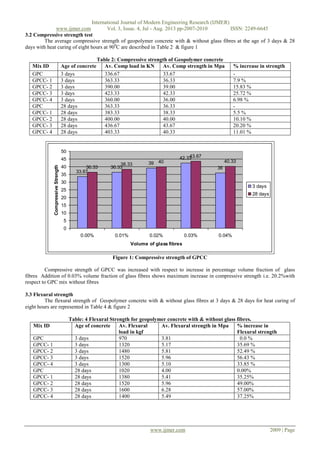
From test results it can be observed that flexural strength of geopolymer concrete was increased as the volume
fraction of glass fibre is increased. Addition of glass fibres increased flexural strength by 57 % with respect to GPC mix
without fibre. Flexural strength was highest at 0.03% of glass fibres.
IV. Conclusions
1) Geopolymer concrete is an excellent alternative to Portland cement concrete.
2) Density of Geopolymer concrete is similar to that of ordinary Portland cement concrete.
3) Low calcium fly ash based Geopolymer concrete has excellent compressive strength within short period (3 days) &
suitable for structural applications. Inclusion of glass fibres in Geopolymer concrete shows considerable increase in
compressive, & flexural strength of GPCC with respect to GPC without fibres.
4) Compressive strength & Flexural strength of glass fibre reinforced geopolymer concrete increases with respect to
increase in percentage volume fraction of glass fibres from 0.01%,0.02%,0.03% &0.04%.
5) Addition of 0.03% volume fraction of glass fibres shows maximum increase in Compressive strength & Flexural
strength by 20.2%, & 57% respectively with respect to GPC mix without fibres.
References
[1]. D.Hardjito,, S.E.Wallah, D.M.J. Sumajouw, B.V.Rangan, “Introducing fly ash based geopolymer concrete manufacturing &
engineering properties 3”, 30th
conference on OUR WORLD IN CONCRETE & STRUCTURES: 23-24 August 2005 Singapore pp
271 to 278
[2]. N. A. Lloyd & B. V. Rangan“ Geopolymer concrete with Fly ash”, Second International conference on Sustainable construction
materials & Technologies,28-30 June 2010
[3]. N. A. Lloyd & B. V. Rangan, “ Geopolymer concrete: A review of development &opportunities”, 35th
conference on OUR
WORLD IN CONCRETE & STRUCTURES: 25-27 August 2010 Singapore
[4]. K.Vijai, R.Kumutha & B.V.Rangan , “ Effect of types of curing on strength of geopolymer concrete”, International Journal of the
Physical Sciences, vol 5(9), 18 August 2010, pp 1419 to 1423.
[5]. N.P. rajmane, M.C. Nataraja & N. Lakshmanan “ An introduction to geopolymer concrete ”, The Indian Concrete Journal
November 11 vol 85, No 11, pp 25 to 28.
[6]. K.Vijai, R.Kumutha & B.G.Vishnuram , “Proporties of glass fiber reinforced geopolymer concrete composites”, ASIAN Journal of
Civil Engineering ( Building & Housing ) Vol.13, No.4 , 2012 pp 511 to 520.
[7]. Sathish Kumar.V. Blessen Skariah Thomas, Alex Christopher, “ An Experimental Study on Proporties of Glass Fibre Reinforced
Geopolumer Concrete”, International Journal of Engineering Research & Applications ( IJERA )Vol.2, Issue 6, November-
December 2012, pp.722-726
[8]. S. V.Patankar, “Mix proportioning of fly ash based geopolymer concrete”,Synopsis for PhD.
[9]. R.Anuradha, V.Shreevidya, R.Venkatasubramani, B.V.Rangan, “ Modified guidelines for Geopolymer concrete mix design using
Indian Standard”, ASIAN Journal of Civil Engineering ( Building & Housing ) Vol.13, No.3 , 2012 pp 353-364.
[10]. Monita Olivia & Hamid R. Nikraz, “ Strength & Water Penetrability of fly ash based geopolymer concrete”, ARPAN Journal of
Engineering & Applied Sciences, vol 6 ,No 7, July 2011,pp70 to 78.
[11]. Rajamane N. P., Nataraja M.C., Lakshmanan N, & Ambily P.S, “ Literature Survey on Geopolymer concrete & Research Plan in
Indian Context”, 148 The Masterbuilder- April 2012.www.masterbuilder.co.in
[12]. M.I. Abdul Aleem & P. D. Arumairaj, “Optimum mix for the geopolymer concrete”, Indian Journal of Science & Technology, vol
5, No3, March 2012.](https://image.slidesharecdn.com/aw3420072010-130912024059-phpapp01/85/Properties-of-Glass-Fibre-Reinforced-Geopolymer-Concrete-4-320.jpg)

This paper investigates the mechanical properties of glass fiber reinforced geopolymer concrete made with fly ash and alkaline liquids, focusing on the effects of varying fiber content on density and strength. Results show that the inclusion of glass fibers significantly enhances compressive and flexural strengths, with a peak improvement observed at a 0.03% fiber volume ratio. The study supports the viability of geopolymer concrete as an environmentally friendly alternative to traditional Portland cement concrete.


