Download to read offline
![IOSR Journal of Mechanical and Civil Engineering (IOSR-JMCE)
e-ISSN: 2278-1684,p-ISSN: 2320-334X, Volume 12, Issue 4 Ver. IV (Jul. - Aug. 2015), PP 12-16
www.iosrjournals.org
DOI: 10.9790/1684-12441216 www.iosrjournals.org 12 | Page
Performance Analysis of a Domestic Refrigerator using Al2O3
Nanoparticles
R.K Adyanshee Pattanayak 1
, Nilamani Sahoo 2
, Prasheet Mishra 3
1
( Mechanical Department, C V Raman College of Engineering/Biju Patnaik University of Technology, India )
2
( Mechanical Department, C V Raman College of Engineering/Biju Patnaik University of Technology, India )
3
( Marine Department, C V Raman College of Engineering/Biju Patnaik University of Technology, India )
Abstract: Nanofluid, a new concept in nanotechnology has already got the attention of the research
communities due to its unique property such as thermal conductivity. Therefore, the reliability and performance
of a domestic refrigerator using nanorefrigerant is experimentally investigated in the present study.
Experiments are performed using PAG (Polyalkylne Glycol) oil with Al2O3 nanoparticles to analyse the
performance characteristics of a domestic refrigerator using refrigerant HFC134a (tetrafluoroethane). With
different mass fraction of Al2O3 nanoparticles , the energy consumption test and freezing capacity test are
investigated. From the experimental observations it is found that the refrigerator works normally and safely
using HFC134a and PAG oil with Al2O3 nanoparticles. The coefficient of performance of the domestic
refrigerator is improved by 12.14%, 27.8% and 39.46% with 0.47%, 0.952% and 1.42% mass fractions of Al2O3
nanoparticles respectively. Also the power consumption is reduced by 10%, 20%, 26.6% and the freezing
capacity is also increased for above mass fraction of Al2O3 nanoparticles. This study helps to reduce energy
consumption of the society.
Keywords - Al2O3 nanoparticles , COP , mass fraction , nanofluid , polyalkyline Glycol oil
I. Introduction
In today’s world everyone is thinking of reducing energy consumption and saving it for more longer
period. A big amount of energy is consumed in our household devices like televisions, air conditioners and
refrigerator. First two devices consumption can be reduced by controlling its use like whenever you need you
use them or you switch them off. But refrigerator cannot be controlled by limiting its use, because it has to run
all the time. So the solution to this is to build an energy efficient model. Conventional thermo fluids are
responsible for poor thermal conductivity. So improving its thermal conductivity will enhance the heat transfer
characteristics of the conventional fluid. As we know that metal particles have larger thermal conductivity than
the base fluid, so suspension of the metal particles in the base fluid is expected to enhance the thermal
conductivity. Lot of work has been done in suspending metal particles in the size of millimeters or micrometers
but it has got very few practical applications as there always remain the problem of pressure drop due to
sedimentation. So researchers have developed a new standard of fluid called the nanofluid which has got high
surface area which prevents the particles being clogged. So we have replaced the conventional fluid with the
nanofluid which is made by the use of nanotechnology, engineered to possess unique thermal properties which
can improve the heat transfer and is energy efficient is thermal systems. The nanofliud are the mixtures of the
base fluid and the nanoparticles. The base fluid can be water,refrigerant, engine oil etc and nanoparticles can be
Al, Cu, Al2O3 , CNT etc. combined together to form a colloid called nanofluid. Lot of work has been done by
using nano particles. Specifically in refrigerator, on replacing the base fluid with nano fluid which has enhanced
the performance of the same. R Krishna Sabareesh et al[1]conducted experiment taking TiO2 nanoparticles with
mineral oil with R12 as refrigerant and found that the COP of the system increased after using the nanofluid.
Sheng-shan Bi et al[2]mixed the mineral oil with 0.1% mass fraction of TiO2 nano particles in place of POE oil
in the HFC134a refrigerant and got 26.1% less energy consumption which in result increased the COP of the
system. Sheng-shan Bi et al[3]did another experiment by mixing nano particles ( 0.5g/L TiO2) with the
refrigerant R600a and got the result of 9.6% less energy consumption in the domestic refrigerator. M Mahbubul
et al[4] took 0.5 to 2% volume concentration of Al2O3 nano particle with refrigerant R141b which resulted in
increased thermal conductivity and viscosity. Meibo Xing et al[5] proposed C60 nano oil as a promising
lubricant. It is a mixture of C60 nano particles and mineral oil. This work of his improved the COP of two
refrigerating system by 5.6% and 5.3% . F S Javadi et al[6] took a combination of R-134a refrigerant with TiO2
and Al2O3 nanoparticles in 0.1% mass fraction and found that there is more energy reduction when compared
with domestic refrigerator. My work consists of a model of domestic refrigerator working on vapour
compression cycle. Our work is based on comparison of COP, Compressor work and Refrigerating Effect of the
domestic refrigerator by replacing conventional base fluid (PAG oil as lubricant oil) with nanofluids (PAG oil +
different mass fractions of Al2O3 nano particles) with R-134a as refrigerant.](https://image.slidesharecdn.com/c012441216-160711061849/85/C012441216-1-320.jpg)
![IOSR Journal of Mechanical and Civil Engineering (IOSR-JMCE)
e-ISSN: 2278-1684,p-ISSN: 2320-334X, Volume 12, Issue 4 Ver. IV (Jul. - Aug. 2015), PP 12-16
www.iosrjournals.org
DOI: 10.9790/1684-12441216 www.iosrjournals.org 12 | Page
Performance Analysis of a Domestic Refrigerator using Al2O3
Nanoparticles
R.K Adyanshee Pattanayak 1
, Nilamani Sahoo 2
, Prasheet Mishra 3
1
( Mechanical Department, C V Raman College of Engineering/Biju Patnaik University of Technology, India )
2
( Mechanical Department, C V Raman College of Engineering/Biju Patnaik University of Technology, India )
3
( Marine Department, C V Raman College of Engineering/Biju Patnaik University of Technology, India )
Abstract: Nanofluid, a new concept in nanotechnology has already got the attention of the research
communities due to its unique property such as thermal conductivity. Therefore, the reliability and performance
of a domestic refrigerator using nanorefrigerant is experimentally investigated in the present study.
Experiments are performed using PAG (Polyalkylne Glycol) oil with Al2O3 nanoparticles to analyse the
performance characteristics of a domestic refrigerator using refrigerant HFC134a (tetrafluoroethane). With
different mass fraction of Al2O3 nanoparticles , the energy consumption test and freezing capacity test are
investigated. From the experimental observations it is found that the refrigerator works normally and safely
using HFC134a and PAG oil with Al2O3 nanoparticles. The coefficient of performance of the domestic
refrigerator is improved by 12.14%, 27.8% and 39.46% with 0.47%, 0.952% and 1.42% mass fractions of Al2O3
nanoparticles respectively. Also the power consumption is reduced by 10%, 20%, 26.6% and the freezing
capacity is also increased for above mass fraction of Al2O3 nanoparticles. This study helps to reduce energy
consumption of the society.
Keywords - Al2O3 nanoparticles , COP , mass fraction , nanofluid , polyalkyline Glycol oil
I. Introduction
In today’s world everyone is thinking of reducing energy consumption and saving it for more longer
period. A big amount of energy is consumed in our household devices like televisions, air conditioners and
refrigerator. First two devices consumption can be reduced by controlling its use like whenever you need you
use them or you switch them off. But refrigerator cannot be controlled by limiting its use, because it has to run
all the time. So the solution to this is to build an energy efficient model. Conventional thermo fluids are
responsible for poor thermal conductivity. So improving its thermal conductivity will enhance the heat transfer
characteristics of the conventional fluid. As we know that metal particles have larger thermal conductivity than
the base fluid, so suspension of the metal particles in the base fluid is expected to enhance the thermal
conductivity. Lot of work has been done in suspending metal particles in the size of millimeters or micrometers
but it has got very few practical applications as there always remain the problem of pressure drop due to
sedimentation. So researchers have developed a new standard of fluid called the nanofluid which has got high
surface area which prevents the particles being clogged. So we have replaced the conventional fluid with the
nanofluid which is made by the use of nanotechnology, engineered to possess unique thermal properties which
can improve the heat transfer and is energy efficient is thermal systems. The nanofliud are the mixtures of the
base fluid and the nanoparticles. The base fluid can be water,refrigerant, engine oil etc and nanoparticles can be
Al, Cu, Al2O3 , CNT etc. combined together to form a colloid called nanofluid. Lot of work has been done by
using nano particles. Specifically in refrigerator, on replacing the base fluid with nano fluid which has enhanced
the performance of the same. R Krishna Sabareesh et al[1]conducted experiment taking TiO2 nanoparticles with
mineral oil with R12 as refrigerant and found that the COP of the system increased after using the nanofluid.
Sheng-shan Bi et al[2]mixed the mineral oil with 0.1% mass fraction of TiO2 nano particles in place of POE oil
in the HFC134a refrigerant and got 26.1% less energy consumption which in result increased the COP of the
system. Sheng-shan Bi et al[3]did another experiment by mixing nano particles ( 0.5g/L TiO2) with the
refrigerant R600a and got the result of 9.6% less energy consumption in the domestic refrigerator. M Mahbubul
et al[4] took 0.5 to 2% volume concentration of Al2O3 nano particle with refrigerant R141b which resulted in
increased thermal conductivity and viscosity. Meibo Xing et al[5] proposed C60 nano oil as a promising
lubricant. It is a mixture of C60 nano particles and mineral oil. This work of his improved the COP of two
refrigerating system by 5.6% and 5.3% . F S Javadi et al[6] took a combination of R-134a refrigerant with TiO2
and Al2O3 nanoparticles in 0.1% mass fraction and found that there is more energy reduction when compared
with domestic refrigerator. My work consists of a model of domestic refrigerator working on vapour
compression cycle. Our work is based on comparison of COP, Compressor work and Refrigerating Effect of the
domestic refrigerator by replacing conventional base fluid (PAG oil as lubricant oil) with nanofluids (PAG oil +
different mass fractions of Al2O3 nano particles) with R-134a as refrigerant.](https://image.slidesharecdn.com/c012441216-160711061849/75/C012441216-1-2048.jpg)
![Performance Analysis of a Domestic Refrigerator using Al2O3 Nanoparticles
DOI: 10.9790/1684-12441216 www.iosrjournals.org 16 | Page
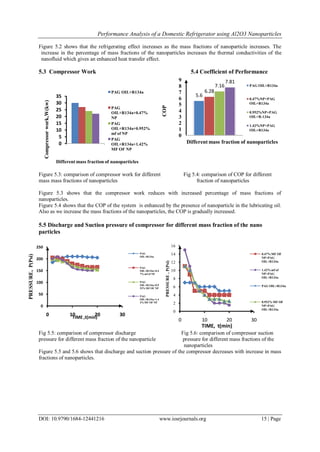
5.6 Temperature of Refrigerating Space
Fig 5.7: variation of temperature of the refrigerating space Using different mass fractions of
nanoparticles.
The temperature is reduced from150
c to -130
c , -16.30
c , -17.40
c , -18.50
c for the mixture of PAG oil and R134a
, PAG oil and 0.47% mass fraction of nanoparticles and R134a , PAG oil and 0.952% mass fraction of
nanoparticle and R134a , PAG oil and 1.42% mass fraction of nanoparticle an R134a respectively within 9
minutes (540Secs).
VI. Conclusion
The power consumption of the compressor was reduced by 10%, 20% and 26.6% for mass fractions of
o.47%, 0.952% and 1.42% of Al2O3 nanoparticles respectively. The refrigerating effect is also enhanced by the
use of the nanoparticles. The coefficient of performance of the refrigerating system was improved by 12.14% ,
27.8% and 39.46% for the mass fractions of 0.47%, 0.952% and 1.42 % of Al2O3 nanoparticles respectively.
There was also reduction of compressor’s suction and discharge pressures with addition of nanoparticles. So
from the above observations we can conclude that the present study can be helpful to the society in the reduction
of energy consumption by using a simple vapour compression refrigerating system in which Al2O3 nanoparticles
of different mass fractions are added in the lubricating oil.
References
[1]. R. Krishna Sabareesh, N. Gobinath, V. Sajith, Sumitesh Das, C.B. Sobhan, Application of TiO2 nanoparticles as a lubricant-
additive for vapor compression refrigeration systems – An experimental investigation ,International Journal of Refrigeration,
35(7), 2012,1989-1996.
[2]. Sheng-shan Bi, Lin Shi, Li-li Zhang, Application of nanoparticles in domestic refrigerators,Applied Thermal Engineering, 28( 14–
15), 2008,1834-1843.
[3]. Shengshan Bi, Kai Guo, Zhigang Liu, JiangtaoWu, Performance of a domestic refrigerator using TiO2–R600a nano-refrigerant
as working fluid, Energy Convers. Manag. 52 (1) ,2011,733–737.
[4]. I.M. Mahbubul, R. Saidur, M.A. Amalina, Thermal Conductivity, Viscosity and Density of R141b Refrigerant based Nanofluid,
Procedia Engineering, 56, 2013, 310-315
[5]. Meibo Xing, Ruixiang Wang, Jianlin Yu3, Application of fullerene C60 nano-oil for performance enhancement of domestic
refrigerator compressors, International Journal of Refrigeration, 40, 2014, 398-403.
[6]. F.S. Javadi,
, R. Saidur, Energetic, economic and environmental impacts of using nanorefrigerant in domestic refrigerators in
Malaysia, Energy Conversion and Management,73,2013,335-339.
[7]. I.M. Mahbubul, S.A. Fadhilah, R. Saidur, K.Y. Leong, M.A. Amalina, Thermophysical properties and heat transfer performance of
Al2O3/R-134a nanorefrigerants International Journal of Heat and Mass Transfer,57(1), 2013,100-108
[8]. I.M. Mahbubul, A. Saadah, R. Saidur, M.A. Khairul, A. Kamyar, Thermal performance analysis of Al2O3/R-134a nanorefrigerant,
International Journal of Heat and Mass Transfer,85,2015,1034-1040.
[9]. S. Zeinali Heris, M. Nasr Esfahany, S.G. Etemad, Experimental investigation of convective heat transfer of Al2O3/wate nanofluid
in circular tube, Inernational journal of Heat Fluid Flow 28 (2),2007,203–210.
-25
-20
-15
-10
-5
0
5
10
15
20
0 200 400 600
TEMPERATURET(0C)
TIME t(SEC)
PAG OIL+R134a
PAG OIL+0.47%
NP+R134a
PAG
OIL+0.952%NP+R134a
PAG
OIL+1.42%NP+R134a](https://image.slidesharecdn.com/c012441216-160711061849/85/C012441216-5-320.jpg)

1) The document analyzes the performance of a domestic refrigerator using nanofluids made of PAG oil and different mass fractions of Al2O3 nanoparticles, with R134a as the refrigerant. 2) Experiments show that using nanofluids reduces energy consumption by up to 26.6% and increases the freezing capacity of the refrigerator, compared to using PAG oil alone. 3) The coefficient of performance (COP) of the refrigerator is improved by up to 39.46% when using a 1.42% mass fraction of Al2O3 nanoparticles in the PAG oil. Higher nanoparticle concentrations lead to better thermal conductivity and heat transfer, enhancing refrigerator performance.


![Getting Started with Apache Spark: Big Data Made Simple [Free Meetup]](https://cdn.slidesharecdn.com/ss_thumbnails/apachesparkgettingstarted-260203175547-8361bcc3-thumbnail.jpg?width=640&height=640&fit=bounds)


