1	


Conceptual Plant Design for Styrene Production by
the Dehydrogenation of Ethylbenzene
Ramiro Ramirez
Russell Wong
Group 20
April 27, 2015
Executive Summary
This proposal will provide a technical and profitability assessment associated with the
construction and operation of a plant capable of producing styrene via the dehydrogenation of
ethylbenzene with a capacity of 100 million kilograms per year. Styrene remains a valuable
commodity chemical produced and distributed in large volumes. As the base component for the
production of polystyrene, acrylonitrile butadiene styrene (ABS) and other polymers, styrene is
an integral part of the global chemical market and shows appreciable growth within the United
States.
The proposed design will require a single packed-bed reactor and utilize a proprietary iron
catalyst in order to achieve optimal selectivity with respect to styrene and minimize the
production of side products. Three distillation columns will purify the heavy organic products to
selling quality. Integration of all associated costs and economic factors and on the basis of a two-
year construction period and ten year operating time yields a Total Capitalized Investment
required equal to $37.4 million dollars. The Net Present Value of the proposed project is
equivalent to $28.9 million dollars with a relative annual growth of this value normalized to the
total capital investment equal to 5.1% each year at an expected industry tax rate of 25%. This
project will also provide a return on investment before taxes equal to 25.1% each year and an
estimate of the Internal Rate of Return (IRR) equal to 9.8%.
Further analysis providing comprehensive technical and economical consideration is provided.
Additional modeling of the system as well as sensibility and safety analysis reflect will reflect
the feasibility of the proposed design. Given the conclusions of this base case conceptual design,
further analysis is recommended in order to increase the economic potential of the design.
2	


Table of Contents
Executive Summary 1
Introduction and Market Overview 3
Production Chemistry 4
Plant Structure and Operating Conditions 4
System Modeling and Design Specifications 6
Separation System
Recycle and Product Streams
Economic Analysis 9
Capital Investment
Operating Costs
Revenue
Discounted Cash Flow and Detailed Economic Analysis
Aspen HYSYS
Sensitivity Analysis
Risks and Safety Analysis 13
Process Decisions and Alternatives 14
Conclusion 15
References 16
Appendices
Appendix A: Production Chemistry and Design Equations 16
Appendix B: Design Conditions at Various Operating Conditions 18
Appendix C: Separation System Design Equations and Considerations 23
Appendix D: Economic Analysis 25
Appendix E: Sensitivity Analysis 35
Appendix F: Process Flow Diagrams/HYSYS 37
Appendix G: Matlab Code 41
Team Member Work Statements 56
3	


Introduction and Market Overview
Styrene is a valuable commodity chemical integral to the production of polystyrene and
other large-volume commodity polymers. In industrial production, styrene and various co-
products are formed through the dehydrogenation of ethylbenzene. Global production of styrene
in 2012 was upwards of 33 million metric tonnes with roughly 20 % of total production
occurring in the United States. The global styrene market grows at an approximate rate of 3.6%
per year with a slightly faster rate expected in the United States [1]. With superior engineering as
well and safety and environment considerations, investment in this commodity chemical shows
promise in the present and future global chemical market.
Large-volume demand for styrene is the result of its ability to polymerize. Approximately
60% of styrene is utilized in the production of polystyrene, a versatile low-cost polymer with
notable use in the manufacturing of containers, bottles, lids and packaging. In addition to this,
styrene is also the base components of many specialized materials involved in electronics, tires,
toys and performance automotive parts. Given the performance, low toxicity and affordability of
styrene-derived products, there lacks many alternatives to this chemical. Growth in the styrene
market is reflected by improved production methods and new uses and ensures stability,
prosperity and profitability in the global styrene market.
The proposed project is a plant producing styrene by the dehydrogenation of
ethylbenzene at a rate of 100,000 tonnes per year. Technical and economic analysis will be
conducted on the basis of a 2-year construction period and 10-year operating time. For the
purpose of economic analysis an enterprise rate of 12.0%, a tax rate of 25%, a construction rate
of 6.0% and a bond rate 4% will be observed with relevant costs for involved utilities, chemicals
and equipment made available in Appendix D. Further detailed analysis and modeling of the
overall plant design will provide technical specifications as well as risk and profitability
assessment associated with the construction and operation of the proposed plant.
4	


Production Chemistry
The overall reaction set that occurs by the dehydrogenation of ethylbenzene can be
shown by the following equations:
𝐸𝑡ℎ𝑦𝑙𝑏𝑒𝑛𝑧𝑒𝑛𝑒           ↔         𝑆𝑡𝑦𝑟𝑒𝑛𝑒 + 𝐻𝑦𝑑𝑟𝑜𝑔𝑒𝑛                                                                                              (1)
𝐸𝑡ℎ𝑦𝑙𝑏𝑒𝑛𝑧𝑒𝑛𝑒           →         𝑇𝑜𝑙𝑢𝑒𝑛𝑒   +     𝐸𝑡ℎ𝑦𝑙𝑒𝑛𝑒                                                                                              (2)
𝐸𝑡ℎ𝑦𝑙𝑏𝑒𝑛𝑧𝑒𝑛𝑒   +     𝐻𝑦𝑑𝑟𝑜𝑔𝑒𝑛           →           𝑀𝑒𝑡ℎ𝑎𝑛𝑒   +     𝐵𝑒𝑛𝑧𝑒𝑛𝑒                                                                              (3)
In order to make styrene production economically viable, special care must be taken in
order to reduce the formation of side products; maximize the first reaction and minimize the
reverse reaction, reaction 2, and reaction 3. In order to achieve maximum selectivity with respect
to styrene the reaction set is to be undergone in the vapor phase in a packed bed reactor under a
heterogeneous iron catalyst. The proprietary iron catalyst licensed for use in this reaction has a
bulk density of 1282 kg/m3
and a void fraction of 0.4 and will be required to achieve the desired
styrene productivity. Superheated steam must also be added to the system to both dilute the
reactants and products, shifting the reaction towards styrene, and to prevent catalyst coking. The
reaction set has an overall endothermic nature requiring heat exchange equipment in order to
maintain isothermal conditions within the reactor. The activity and composition of the various
species within the reactor can be determined using a set of design equations. Special design
considerations are to be observed in order to optimize styrene production. Further kinetic and
thermodynamic data for the reaction set is provided in Appendix A.
Plant Structure and Operating Conditions
Packed bed reactors provide the best and most cost effective conditions for this iron
catalyzed heterogeneous vapor phase dehydrogenation. Pure ethyl-benzene is in supply to the
plant at a temperature of 136°C and a pressure of 2.0 atm. Unconverted ethylbenzene in the
effluent stream is to be completely recycled and combined with this fresh feed. Upon application
of relevant design equations and observing equilibrium limitations to the system it can be
determined that optimal conditions are achieved at high temperatures and low pressures, (See
Appendix B). In order to maintain sufficient pressure in the reactor and prevent the deactivation
of the catalyst at high temperatures, the reactor is to be operated isothermally at a temperature of
5	


600°C and a pressure of 2 atm. Reactor effluent is to be introduced into a separation system
consisting of a three-phase separator and three distillation columns in order to achieve material
streams of the individual products at an acceptable purity, as shown in Figure 1.
Figure 1: Simplified process flow sheet for production of styrene form ethylbenzene.
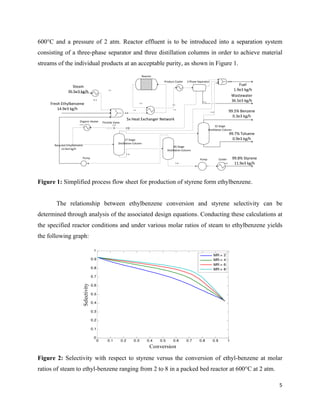
The relationship between ethylbenzene conversion and styrene selectivity can be
determined through analysis of the associated design equations. Conducting these calculations at
the specified reactor conditions and under various molar ratios of steam to ethylbenzene yields
the following graph:
Figure 2: Selectivity with respect to styrene versus the conversion of ethyl-benzene at molar
ratios of steam to ethyl-benzene ranging from 2 to 8 in a packed bed reactor at 600°C at 2 atm.
Steam
36.5e3 kg/h
E-1
P-2
Fresh Ethylbenzene
14.9e3 kg/h
5x Heat Exchanger Network
P-4
Reactor
P-5
P-6
P-7
Product Cooler
P-8
E-6
3 Phase Separator P-10
E-9
P-11
Organic Heater
Wastewater
36.5e3 kg/h
P-13
Throttle Valve
P-14
27 Stage
Distillation Column
P-15
32 Stage
Distillation Column
85 Stage
Distillation Column
P-16
99.7% Toluene
0.9e3 kg/h
99.5% Benzene
0.3e3 kg/h
Pump
Recycled Ethylbenzene
12.0e3 kg/h
P-22
P-23
Fuel
1.9e3 kg/h
P-25
Pump Cooler
P-26
99.8% Styrene
11.9e3 kg/h
0 0.1 0.2 0.3 0.4 0.5 0.6 0.7 0.8 0.9 1
0
0.1
0.2
0.3
0.4
0.5
0.6
0.7
0.8
0.9
1
Conversion
Selectivity
MR = 2
MR = 4
MR = 6
MR = 8
6	


From the resulting calculations, the optimal molar ratio of steam is found to be eight.
Although operating under this molar ratio increases the cost required associated with steam and
watsewater, being able to achieve higher conversion will increase overall the productivity and
lower the costs assoiated with high recycle rates. By plotting the expected profit and the return
on investent before taxes, an optimal conversion to operate at may be chosen.
Figure 3: Plot of return on investment before taxes as well the net present value of the project
with respect to ehtylbenzene conversion in a packed bed reactor operating with a molar ratio of
steam to ethylebenzene equal to 8 at 2 atm and 600°C at a 25% tax rate.
From these relationships, the maximum profitability for this plant occurs at a conversion
of ethylbenzene within the reactor equal to 56% and a selectivity of styrene equal to 81%. All
subsequent analysis will be conduceted using an ethylbenzene conversion of 56%, reactor
temperature of 600°C, reactor pressure of 2.0 atm and a molar ratio of steam to ethylbenzene
equal to eight.
System Modeling and Design Specifications
Both Matlab and Aspen HYSYS software have been utilized to model the activity of the
plant under the previously specified design conditions. It is important note that an ideal gas
0 0.2 0.4 0.6 0.8 1
0
5
10
15
20
25
30
35
40
45
50
Conversion
ROIBT
,[%/yr];NPVPROJ
,[$MM/yr]
ROIBT
NPVproj
Matlab - Optimal
HYSYS - Optimal
7	


assumption has been assumed and pressure drop negated in the Matlab simulation whereas the
HYSYS simulation takes pressure drop into account via the Ergun equation and incorporates
non-idealities within the system. Both have yielded comparable results and accurately model the
proposed system. Full Matlab code Aspen HYSYS model output are made available in
Appendices F and G.
The desired mass flowrate of styrene required to achieve target production is 3.31 kg/s on
the basis that the plant operates continuously for 8400 hours a year; this estimation provides
approximately 2 weeks of buffer time every year for plant maintenance, catalyst replacement or
any malfunctions encountered. At the specified conditions, the reactor specifications that will
accomplish this objective are as follows:
Table 1: Packed bed reactor specifications for conceptual design in Matlab and Aspen HYSYS.	


Reactor measurements and conditions are consistent with an operation of this magnitude
and will provide the desired styrene quantities. The inlet flowrate is in the vapor phase and has a
temperature of 600 °C and pressure of 2 atm with mole fraction compositions of steam and ethyl-
benzene equal to 0.89 and 0.11, respectively. Considering the reactor is being run isothermally
the effluent temperature remains 600 °C and taking the pressure drop into consideration, effluent
leaves the reactor at a pressure of 1.35 atm in the gas phase. Mass flowrates at the reactor inlet
and outlet for each individual species at steady-state are as follows:
Reactor	
  Properties HYSYS Matlab
Length,	
  [m] 0.25 0.25
Diameter,	
  [m] 2.80 2.68
Total	
  Area,	
  [m^3] 1.54 1.41
Catalyst	
  Weight,	
  	
  [kg] 786 720
Temperature,	
  	
  [°C] 600 600
Pressure,	
  	
  [atm] 2.00 2.00
Pressure	
  Drop,	
  [atm] 0.65 0.00
Heat	
  Load,	
  [kW] -­‐4096
8	


Table 2: Mass flowrates at reactor inlet and outlet of all species involved at steady state.	


The conversion of ethylbenzene in the Matlab and HYSYS models are 55% and 57%,
respectively; this is in accordance with the previously determined optimal conversion. Table 2
also shows the flowrates of all co-products made by the reaction. The most prevalent co-product
by mass for this system is toluene present in the effluent stream with a flowrate of 0.35 kg/s.
Although this is not an ideal case given the monetary value of toluene is less than that of both
styrene and ethylbenzene, toluene and the remaining co-products may be sold for their respective
chemical values upon purification by the separation system.
Separation System
Given that the products from the reaction include light organics, heavy organics, and
aqueous phases, many separations alternatives are available. In order to ensure significant
separations, an expander immediately brings the reactor products to a lower pressure of 1 atm
and a cooler brings them to 35°C. A three-phase separator separates the light vapor organics
(hydrogen, methane, and ethylene) from the rest of the products. These light organics are in low
enough concentrations and mass flows that a vapor separation is unprofitable, so they are vented
to become a fuel stream. The three-phase separator also separates the heavy organics (toluene,
benzene, ethylbenzene, and styrene) from the aqueous phase (wastewater) for approximately 15
minutes. After the separation at these conditions, the heavy organic stream is heated to 111°C to
be separated in the first distillation column.
The four heavy organics can then be separated in three different columns in order to
achieve a high purity of each of the individual components. This is required for the sale of
Matlab HYSYS Matlab HYSYS
Species Species
Steam 10.1 10.1 Steam 10.1 10.1
Fresh Ethylbenzene 4.13 4.22 Ethylbenzene 3.35 3.24
Recycled Ethylbenzene 3.35 3.24 Styrene 3.35 3.41
Total Ethylbenzene 7.47 7.46 Toluene 0.353 0.376
Benzene 0.224 0.231
Ethylene 0.081 0.083
Methane 0.061 0.066
Hydrogen 0.057 0.058
Total Flowrate, [kg/s] 17.62 17.61 Total Flowrate, [kg/s] 17.62 17.61
Flowrate, [kg/s] Flowrate, [kg/s]
Reactor Inlet Reactor Outlet
9	


styrene, toluene and benzene and the recycle of ethylbenzene. The distillation design heuristics
combined with the estimated distillation cost model outlined by Professor Doherty [4] lead to the
decision to split the significantly lighter benzene and toluene from the heavier ethylbenzene and
styrene products in the first column. This split is reasonable due to the low relative volatility
between styrene and ethyl-benzene.
In order to have high separation of benzene and toluene from ethylbenzene and styrene,
then benzene from toluene and ethylbenzene from styrene, three distinct columns are necessary,
as described in Appendix C. For 99.9% purity, the Matlab design requires the columns to have
17, 24, and 40 real stages, respectively, compared to the HYSYS calculations, which requires 27,
32, and 85 real 18-inch stages, respectively, to produce similar separations due to a wide variety
of assumptions. These stages are assigned to be 18 inches in height to ensure ~70% tray
efficiency and ensure moderate column heights. The Matlab calculations which account for
relative volatilities calculated from thermodynamic principles are described in Appendix B.	


Table 3: Column specifications for utilized separation system, where A, B, C, and D represent
Benzene, Toluene, Ethyl-benzene and Styrene, respectively.
	
  
Recycle and Product Streams
After the styrene and ethylbenzene split, the ethyl-benzene is pumped to 2 atm and mixed
with a fresh ethylbenzene feed stream to be recycled into a heat exchanger, which will be heat
the combined fresh and recycle ethylbenzene feed up to the desired temperature and pressure. An
additional pump and heat exchanger will be required to get a pure material stream of styrene
Matlab HYSYS Matlab HYSYS Matlab HYSYS
Separation Occuring *
Number of Stages 16 27 20 32 30 85
Reflux Ratio 12 14 10 4.0 11 8.0
Boilup Ratio
Column Pressure, [atm]
Condensor Temperature, [°C]
Reboiler Temperature, [°C]
Condensor Heat Load, [kW] 3,030 3,250 110 190 13,200 10,100
Reboiler Heat Load, [kW] 3,300 3,700 120 193 16,200 10,100
Diameter, [m]
Height, [m] 8.5 13.8 10.8 16.1 15.3 40.5
Column Specifications
1.0 1.0 1.0
94 71 136
1.3 0.78 2.9
AB ǁ‖ CD A ǁ‖ B C ǁ‖ D
140 110 145
Column 1 Column 2 Column 3
1.34 8.25 11.7
10	


exiting the plant at 125°C and 2.5 atm. A comprehensive flowsheet showing all flowrates and
prices for this proposed design is made available in Appendix F.
Economic Analysis
Capital Investment
The fixed capital investment can be calculated through install cost pricing of major
equipment pieces, including the reactor, heat exchangers, and separation system. The installed
costs are dominated by the separation system, multiplication of these costs by a factor of 2.28
will reflect the fixed capital cost of the design (See Appendix D).
Table 4. Installed costs of major equipment
Component Cost ($MM)
Reactor Heat Exchanger 0.025
Reactor Pressure Vessel 0.032
Steam Feed Heater 0.025
5x Heat Exchangers 0.13
Reactor Product Cooler 0.16
3 Phase Separator 0.36
Throttle Valve Negligible
First Column 0.61
Toluene Column 0.42
Styrene Column 3.32
Styrene Cooler Negligible
Recycle Pump Negligible
Total Installed Capital Cost 5.79
This 2.28-multiplier results in a total fixed capital investment of approximately $13.2 million. To
find the total capital investment the fixed capital investment must be added to the working
capital equal to two months’ worth of raw materials valued at $22.9 million dollars. The start-up
capital, equal to 10% of the fixed capital investment, results in a total capital investment equal to
$37.8 million dollars.
Table 5. Capital investment summary with the financing of the fixed capital
Cost ($MM)
Fixed Capital Investment 13.2
Working Capital 22.9
Start-Up Capital 1.3
Total Capital Investment 37.4
11	


Operating Costs
Yearly operating cost is dominated by the purchase of raw material, ethyl-benzene at
$137 million/year. The steam necessary for a molar ratio of 1:8 of the ethylbenzene to steam
results in a cost of $0.39 million/year, and the cost of utilities, including separation and
heating/cooling, result in a cost of $2.20 million/year. This effluent steam is considered
wastewater, with a yearly cost being negligible due to being many orders of magnitude lower
than the other costs. The costs associated with the replacement of the iron catalyst are also
considered to be negligible. This results in a total operating cost of $141 million/year, as shown
in Table 4.
Table 6. Yearly operating costs
Substance Yearly Cost, $ million
Ethyl-Benzene 138
Iron Catalyst Negligible
Steam 0.39
Utilities Yearly Cost, $ million
Reactor 0.20
Cooling Water 0.87
Wastewater Negligible
Heating Negligible
First Column 0.32
Toluene Column Negligible
Styrene Column 0.92
Yearly Net Cost 141
Revenue
Yearly revenue is dominated by the sale of the desired product, styrene, at $137
million/year, which is lower than the yearly net cost to run the plant. The sale of the byproducts
amounts to $12.5 million/year, as shown in Table 5.
Table 7. Yearly revenue.
Substance Cost Unit Yearly Value, $ million
Styrene $1.37/kg 137
Benzene $0.86/kg 2.43
Toluene $0.97/kg 6.70
Fuel $3/MMBtu 2.67
Yearly Net Revenue 150
With this yearly operating cost and revenue, the profit before taxes is calculated to be $9.4
million/year.
12	


Discounted Cash Flows and Detailed Economic Analysis
Discounted Cash Flows (DCF), a method described in Evaluating Plant Profitability in a
Risk-Return Context by Professor Mellichamp, determined the economic profitability of this
design. The parameters utilized to describe the economic viability of this design are: total capital
investment (TCI), net present value (NPV), return on investment before taxes (ROIBT), and
normalized net present value (NPV%). In order to calculate these parameters, key variables must
be defined, such as a tax rate of 25%, finance rate of 4%, enterprise rate of 12%, construction
rate of 6%, 2 years of construction, and 10 years of operation. Initial investment costs, the
calculations of these parameters, and a more detailed analysis is available in Appendix D.
The profitability of the design was optimized with regards to NPV% in particular.
Through repetition of the Matlab code at 25% tax rate, a conversion of 0.56 was chosen, which
resulted in a NPV% equal to 8.3%, as shown in figure 4. The corresponding NPV is $37.8
million, a minimum TCI of $30.5 million, and ROIBT of 36.5%/year.
Figure 4. Optimization of Matlab calculation for NPV% versus conversion at a 25% tax rate. The
dotted line indicates the operation conditions.
Aspen HYSYS
Aspen HYSYS modeling is ubiquitous in industry and generates acceptable models,
therefore, the HYSYS model parameters were used to cost this design. The values provided by
0 0.2 0.4 0.6 0.8 1
0
1
2
3
4
5
6
7
8
9
10
Conversion
NPV%
,[%/yr]
NPV%
Matlab - Optimal
HYSYS - Optimal
13	


the HYSYS model generally decrease the profitability of the plant, where the profit before taxes
is decreased by $1.6 million/year, as shown in Table 6. For example, the Matlab design’s total
capital investment and NPV% change from $30.5 million and 8.3% a year to the HYSYS
design’s $37.4 million and 5.1% a year. The simplified thermodynamic models assumed in
programming the Matlab code compared to the real fluid properties taken into account by the
HYSYS model account for this economic discrepancy.
Table 8. Economic parameters for Matlab and HYSYS designs
Economic Parameter Matlab HYSYS
Total Capital Investment 30.5 37.4
Profit Before Taxes ($/year) 11.0 9.4
Return on Investment Before Taxes (%/year) 36.5 25.1
Net Present Value ($MM at 25% Tax Rate) 37.8 28.7
Net Present Value Percent (25% Tax Rate) 8.3 5.1
Net Present Value ($MM at 48% Tax Rate) 26.7 21.2
Net Present Value Percent (48% Tax Rate) 5.9 3.7
Sensitivity Analysis
A sensitivity analysis of the process’ NPV% reveals sensitivity to fluctuations in the value
of the raw material, ethylbenzene, and primary product, styrene. This analysis reveals that the
process can withstand an approximately 7% decrease in styrene value to reach an NPV% of 0%,
or essentially the break-even point, and an approximately 7% increase in ethylbenzene price to
reach an NPV% of 0%.
There is a large risk in financing this process because of the large dependency on the
value of the only raw material and primary product, but this risk can be seen throughout every
single chemical commodity plant. The decision to invest in this process is dependent on how one
believes these prices will fluctuate. Plots for NPV% sensitivity versus enterprise rate, tax rate,
and finance rate can be found in Appendix E.
14	


Figure 5. Sensitivity of project profitability to fluctuations in feed and product costs.
Risks and Safety Precautions
Possible economic risks that could result in the diminishing profitability of the plant
include the possible fluctuations in the market. Any lowering of the cost in styrene or increase in
the ethyl-benzene can dramatically damage the profitability of the plant due to the $0.27 price
difference of the two chemicals per kilogram. Any increase in energy costs could possibly reduce
the profitability as well, considering that the separations are very energy intensive. In a failing
economy, the demand, and therefore price, of styrene would be reduced, leading to a negative
impact on the profitability of the plant. A different method of creating styrene, other than the
dehydrogenation of ethyl-benzene, could lead to a higher supply of chemical, and once again,
lower profits. These are not the only possible economic risks with the plant, and many unknown
variables could impact plant profitability.
The production of styrene from ethyl-benzene through dehydrogenation has a few safety
hazards. There are flammable byproducts, such as the hydrogen, benzene, ethylene and methane,
and toxic byproducts, such as toluene, ethyl-benzene, and styrene that should be marked
accordingly with a safety diamond rated two and four in the health and flammability sections.
Since the reaction occurs at very high temperatures and is endothermic, the reactor should be
fitted with a pressure release system as well as an emergency-cooling valve. These flammable
and toxic chemicals should be released from the pressure release a distance away from the
15	


populated regions of the plant and dealt with in a safety vent and blow down drum to collect the
chemicals or ignited in a flare stack. There is a large amount of steam within the reaction that is
utilized to prevent coking and add pressure, so the safety vent with blow-down drum is the more
reasonable option compared to letting the pressure dangerously increase, resulting in an
explosion.
Process Decisions and Alternatives
Time was a major factor in the optimization of this plant. The process could have been
run at different conditions to change the conversion and risks, but this particular set of conditions
were thought to optimize the normalized net present value. Although there is creation of
approximately 2% excess styrene, this was specifically chosen to ensure enough product to sell.
Operating at the maximum reactor temperature could be dangerous, especially with flammable
materials, but the excess of steam and low pressures should decrease the risk of explosions. The
process could also include multiple reactors in series, such as how it is in industry, but these
industrial plants produce much more product and have the ability to work with more equipment.
The separation system could have been designed with different splits, such as a direct
split with the lightest components first, but these separations lead to the large, more expensive
columns due to the recycle stream having to run through all the columns, or with the most
plentiful component first, but this separation of styrene from ethyl-benzene is difficult and
requires too many trays due to the low relative volatility between styrene and ethyl-benzene.
Conclusion
The final proposed plant design will provide 102 million kilograms of 99.9% pure styrene
per year. The system relies on a single packed bed reactor operating with an iron catalyst and
achieving an ethyl-benzene conversion of 56%. A comprehensive economic analysis has yielded
a Net Present Value for the project equal to $28.7 million dollars at an industry 25% tax rate and
has an annual growth on Net Present Value equal to 5.1%. The total capital investment required
to achieve the proposed plant is equal to $37.4 million dollars. Given the results of this technical
and economic analysis coupled with growth in the global styrene market, investment in this
proposal shows too much of a risk compared to the industry’s 12% enterprise rate, and different
options should be explored.
16	


References
[1] Styrene Information & Resource Center, “SIRC: Styrene.” www.styrene.org
March 1, 2015.
[2] Douglas, J. M. Conceptual Design of Chemical Processes. N.p.: McGraw-Hill, 1988. Print.
[3] Mellichamp, D. A. Evaluating Plant Profitability in a Risk-Return Context. N.p: Department
of Chemical Engineering, UCSB, 2012. Print.
[4] Doherty, Michael F., and Michael F. Malone. Conceptual Design of Distillation Systems.
Boston: McGraw-Hill, 2001. Print.
Appendix A: Reaction Set Chemistry and Design Equations
- Observed reaction set for dehydrogenation of ethyl-benzene:
𝐸𝑡ℎ𝑦𝑙𝑏𝑒𝑛𝑧𝑒𝑛𝑒           ↔         𝑆𝑡𝑦𝑟𝑒𝑛𝑒 + 𝐻𝑦𝑑𝑟𝑜𝑔𝑒𝑛                                                                                              (𝐴. 1)
𝐸𝑡ℎ𝑦𝑙𝑏𝑒𝑛𝑧𝑒𝑛𝑒           →         𝑇𝑜𝑙𝑢𝑒𝑛𝑒   +     𝐸𝑡ℎ𝑦𝑙𝑒𝑛𝑒                                                                                              (𝐴. 2)
𝐸𝑡ℎ𝑦𝑙𝑏𝑒𝑛𝑧𝑒𝑛𝑒   +     𝐻𝑦𝑑𝑟𝑜𝑔𝑒𝑛           →           𝑀𝑒𝑡ℎ𝑎𝑛𝑒   +     𝐵𝑒𝑛𝑧𝑒𝑛𝑒                                                                              (𝐴. 3)
- Respective reaction rates, [mol/m3
*s]
                  𝑟! = 1.177𝑥10!
exp −
21,708
𝑅𝑇
𝑝!"                                                                                    (𝐴. 4)
𝑟!! = 20.965  exp  (
!,!"#
!"
)𝑝!!" 𝑝!"# (A.5)
𝑟! = 9.206𝑥10!"
  exp  (−
!",!"#
!"
)𝑝!" (A.6)
𝑟! = 4.724𝑥10!
exp −
18,857
𝑅𝑇
𝑝!" 𝑝!!                                                                        (𝐴. 7)
Note: R = 1.987 cal/mol*K and ‘p ‘ is partial pressure in bar.
- Equilibrium relationship of Reaction 1
𝐾 =
𝑦!"# 𝑦!!" 𝑃
𝑦!"
                                        ln 𝐾 = 15.5408 −  
14,852.6
𝑇
Note: ‘T’ is temperature in Kelvin and ‘P’ is pressure in bar
- Heats of reaction:
Reaction (1): 1.2*105
kj/kmol
17	


Reaction (2): 1.1*105
kj/kmol
Reaction (3): -5.5*104
kj/kmol
- Iron Catalyst properties:
Bulk Density (pb) : 1282 kg/m3
Void Fraction (ɛ): 0.4
Max Allowable Temp: 600°C
- PBR design equations:
!"!"
!"
=  −𝑟!
!
+ 𝑟!!
!
− 𝑟!
!
− 𝑟!
!
                                                                                                  (𝐴. 8)
𝑑𝐹!"#
𝑑𝑊
=   𝑟!
!
  −     𝑟!!
!
                                                                                                            (𝐴. 9)  
𝑑𝐹!!"
𝑑𝑊
=     𝑟!
!
−   𝑟!!
!
− 𝑟!
!
                                                                                                            (𝐴. 10)
Note: ‘W’ represents catalyst weight in kg and ri = ri’ (pb)
- Total molar flowrates for all species determined by following Level 2 mole balances:
Fethylbenzene - Pstyrene - Ptoluene - Pbenzene = 0
-Phydrogen + Pstyrene - Ptoluene = 0
-Pethylene + Pbenzene = 0
-Pmethane + Ptoluene = 0
18	


Appendix B: Design Considerations at Varying Operating Conditions:
Figure B.1: Selectivity with respect to styrene versus the conversion of ethylbenzene at molar
ratios of steam to ethylbenzene ranging from 2 to 8 within a packed bed reactor at 600 °C.
Figure B.2: Total reactor size as a required for desired styrene production as a function of
conversion.
0 0.1 0.2 0.3 0.4 0.5 0.6 0.7 0.8 0.9 1
0
0.1
0.2
0.3
0.4
0.5
0.6
0.7
0.8
0.9
1
Conversion
Selectivity
MR = 2
MR = 4
MR = 6
MR = 8
0 0.2 0.4 0.6 0.8 1
0
10
20
30
40
50
60
Conversion
ReactorVolume,[m3
]
19	


Figure B.3: Fresh feed rate of ethylbenzene required to achieve required styrene production as a
function of reactor conversion
Figure B.4: Recycle feed rate of ethylbenzene required to achieve required styrene production
as a function of reactor conversion.
0 0.2 0.4 0.6 0.8 1
3
4
5
6
7
8
9
10
11
12
13
Conversion
FreshfeedrateEB,[kg/s]
0 0.2 0.4 0.6 0.8 1
0
10
20
30
40
50
60
70
80
Conversion
RecycleEB,[kg/s]
20	


Figure B.5: Total mass flowrate required into the reactor as a function of reactor conversion. By
the law of conservation of mass and assuming no accumulation the total mass flowrate going into
the reactor is equal to the total mass flowrate exiting the reactor.
Figure B.6: Mole fraction of all species entering the separation system at a given reactor
conversion. Note: Steam has an initial mole fraction of 0.89 and a final mole fraction of 0.83.
0 0.2 0.4 0.6 0.8 1
0
500
1000
1500
2000
2500
3000
Conversion
TotalFlowrateintotheReactor,[kg/s]
0 0.2 0.4 0.6 0.8 1
0
0.05
0.1
0.15
Conversion
MoleFraction
Ethylbenzene
Toluene
Benzene
Methane
Styrene
Ethylene
Hydrogen
Steam
21	


Figure B.7: Molar flowrates of species present within a packed bed reactor operating at 2 bar
and 600 °C as a function of catalyst weight.
Figure B.8: Total capital investment as a function of reactor conversion of a single PBR
operating at 600 °C and 2 atm.
0 2000 4000 6000 8000 10000
0
10
20
30
40
50
60
70
80
Catalyst Weight, [kg]
MolarFlowrate,[mol/s]
Ethylbenzene
Styrene
Hydrogen
Methane
Toluene
Ethylene
Benzene
0 0.2 0.4 0.6 0.8 1
25
30
35
40
45
50
55
60
65
70
Conversion
TotalCapitalInvestment,[$MM]
22	


Figure B.9: Measure of Net Present Value normalized to the Total Capital Investment measure
in percent per year as a function of reactor conversion at a 25% tax rate.
Figure B.10: Measure of the Return on Investment before taxes and the Net Present Value for
the project as a function of reaction conversion at a 25% tax rate.
0 0.2 0.4 0.6 0.8 1
0
1
2
3
4
5
6
7
8
9
10
Conversion
NPV%
,[%/yr]
NPV%
Matlab - Optimal
HYSYS - Optimal
0 0.2 0.4 0.6 0.8 1
0
5
10
15
20
25
30
35
40
45
50
Conversion
ROIBT
,[%/yr];NPVPROJ
,[$MM/yr]
ROIBT
NPVproj
Matlab - Optimal
HYSYS - Optimal
23	


Appendix C: Separation System Design Equations and Considerations
Columns Sequencing:
Relevant Assumptions:
- Constant Relative Volatility
- Constant Molar Overflow
- Uniform Pressure
- Ideal Mixture
For a binary mixture, the minimum reflux ratio, Rmin, may be determined the Underwood’s
Method:
𝑅!"# =  
1
(𝛼 − 1)𝑥!
                                                                                                                                  (𝐶. 1)
The expected observed reflux ratio, R, may be determined from the following correlation:
𝑅 = 1.5 ∗   𝑅!"#                                                                                                                                          (𝐶. 2)
Determination of corresponding boilup ratio, S:
𝑆 =
𝐷
𝐵
𝑅 + 𝑞 − 1 − 𝑞                                                                                                                       (𝐶. 3)
Where D is the distillate flowrate, B the bottoms flowrate and ‘q’ represents the feed quality.
Distillate and bottom flowrates are calculated assuming 100% recovery of heavy key component
in bottoms and 100% recovery of the light key in the distillate.
The Fenske Equation may be used to determine the minimum number of stages required achieve
the desired degree of separation:
𝑁!"# =  
ln  [(𝑓!,! 𝑓!,!)(𝑓!,! 𝑓!,!)]
𝑙𝑛𝛼!"
                                                                                                  (𝐶. 4)
Where ‘f’ represents the fractional recovery of the species.
24	


The theoretical number of stages required for desired separation may be determined using the
Fenske-Underwood-Gilliland method, as shown below:
𝑁 −   𝑁!"#
𝑁 + 1
  =     0.75   1 −
𝑟 −   𝑟!"#
𝑟 + 1
!.!"##
                                                                      (𝐶. 5)
Where ‘N’ is the resulting number of theoretical stages.
In order to determine the expected number of real stages in the column, the following correlation
may be used:
𝑁!"#$   =     2 ∗   𝑁!!!"#!$%&'(                                                                                                            (𝐶. 6)
Vapor flowrate within the column may be determined through the following equations:
𝑉! = 𝑅 + 1 ∗ 𝐷                                                                                                                                (𝐶. 7)
𝑉! = 𝑆𝐵                                                                                                                                                  (𝐶. 8)
Corresponding heat loads in the reactor and condenser may be determined by the following
equations:
𝑄! =   𝜆! 𝑉!                                                                                                                                      (𝐶. 9)
𝑄! =   𝜆! 𝑉!                                                                                                                                (𝐶. 10)
The cross sectional area of the column may be determined by the following equation:
𝐴 =  
𝑀!
𝑝! 𝑝!
1
𝜙!"##$
𝐴
𝐴!
𝑉                                                                                                  (𝐶. 11)
Where ‘A’ is the cross sectional area in square meters, ‘Mv’ is the molar weight of the vapor,
‘𝜙!"##$’ is the desired fraction of flooding velocity, ‘(A/An)’ is the fraction available for flow
and ‘V’ represents the vapor rate.
The corresponding height of the column can then be determined using the following equation:
𝐻 =   𝐻!"# +   𝐻! 𝑁                                                                                                                    (𝐶. 12)
Where ‘Hmin’ is equal to three times the tray spacing, ‘Ht’ and added to the over height of the
column, ‘H’.
25	


Appendix D: Economic Analysis
Raw Material Values
Substance Cost/Unit
Ethyl-Benzene $1.10/kg
Iron Catalyst $7.50/kg
Styrene $1.37/kg
Hydrogen $2.00/kg
Benzene $0.86/kg
Methane $3/MM BTU
Ethylene $1.20/kg
Toluene $0.97/kg
Cooling Water $0.08/kg
Wastewater $0.06/1000kg
Heating Fuel $3/MMBtu
Typical Steam Prices
Pressure (psia) Temperature (°C) Cost ($/1000kg) ΔHstm (kJ/kg)
30 121 2.38 2213
50 138 3.17 2159
100 165 4.25 2067
200 194 5.32 1960
500 242 6.74 1755
750 266 7.37 1634
Initial Equipment Costing
Relations found in Appendix E of Conceptua
l Design of Chemical Processes by James Douglas were used to find the installed equipment
costs for every piece of equipment.
Reactor
The shell and tube reactor was split into two different parts, a heat exchanger and pressure
vessel. In particular, this design can be broken down into the heat exchanger and 500 different
pressure vessels, which are each of the tubes.
Heat Exchanger
The heat exchanger’s installed cost can be modeled as:
Installed  Cost, $ =
𝑀&S
280
101.3𝐴!.!"
2.29 + 𝐹!                                           (𝐷. 1)
26	


where the M&S is the Marshall and Swift index, or 1600 in modern day, A is the heat exchanger
area, and 𝐹! is the correction factor, defined as:
𝐹! = 𝐹! + 𝐹! 𝐹!                                                                                                                  (𝐷. 2)
where 𝐹! is the factor that accounts for the design type, 𝐹! is the factor that accounts for
pressure, and 𝐹! is the factor that accounts for the shell and tube material. Here, the 𝐹! is 0.80
because of the fixed-tube sheet design,  𝐹! is 0.00 because of the pressure only being 2 bar or
approximately 30 psi, and 𝐹! is equal to 1.00 for carbon steel on carbon steel, resulting in a 𝐹! of
0.80. The areas, A, for the HYSYS heat exchangers were found through a correlation between
typical heat transfer coefficients, U, heat transferred, Q, and average change in temperature,
ΔTavg. This assumes cooling with cooling water with ΔT=20°C, and heating with steam.
𝑄 = 𝑈 ∗ 𝐴 ∗ ∆𝑇!"!                                                                                                          (𝐷. 3)
Pressure Vessel
The pressure vessel’s installed cost can be modeled as:
Installed  Cost, $ =
𝑀&S
280
101.9𝐷!.!""
𝐻!.!"
2.18 + 𝐹!                                 (𝐷. 4)
where the M&S is the Marshall and Swift index, or 1600 in modern day, D is the diameter of the
pressure vessel, H is the height or length of the pressure vessel, and 𝐹! is the correction factor,
defined as:
𝐹! = 𝐹! ∗ 𝐹!                                                                                                                                (𝐷. 5)
where 𝐹! is the factor that accounts for pressure and 𝐹! is the factor that accounts for material.
Specifically, 𝐹! is 1.00 for pressures up to 50 psi and 𝐹! is 1.00 for carbon steel.
Catalyst
The catalyst cost can be modeled as:
Installed  Cost, $ =
𝑀&S
280
𝜌!"# ∗ 𝜀 ∗ 𝑣𝑎𝑙𝑢𝑒!"# ∗ 𝑉                                                      (𝐷. 6)
where 𝜌!"# is the catalyst density, 𝜀 is the void fraction of the catalyst in reactor, 𝑣𝑎𝑙𝑢𝑒!"# is the
catalyst value, and V is the reactor volume. Here, 𝜌!"# = 1282
!"
!!
, 𝜀 = 0.4, 𝑣𝑎𝑙𝑢𝑒!"# = $7/𝑘𝑔,
and 𝑉 = 1.53  𝑚!
.
Pump
Pumps are assumed to have negligible costs due to its several orders of magnitude cheaper than
all of the other equipment.
27	


Separation System (Distillation Columns)
The distillation column initial cost can be modeled as the costs of two heat exchangers, which
are the reboiler and condenser, added the cost of the column shell and trays.
The column shell can be modeled as:
𝐶! = 𝐶!,!
𝑑
𝑑!
𝐻
𝐻!
∝!
                                                                                                              (𝐷. 7)
where 𝑑 is the column diameter, 𝐻 is the column height, 𝑑! = 1 and 𝐻! = 6.1 for a calculation
in meters, ∝!= 0.82 for a shell constant, and 𝐶!,! is calculated as:
𝐶!,! =
𝑀&S
280
𝐹! 𝐹! − 1 + 𝐹! 𝐹! 𝑐!,!                                                                                (𝐷. 8)
where  𝑀&𝑆 = 1600 for the Marshall and Swift index in modern day, 𝐹! = 1 for a carbon steel
tray material, 𝐹! = 1 for an operating pressure less than 4.5 bar, 𝐹! = 1.38 for indirect cost
factor, 𝐹! = 3.00 for direct cost factor, and 𝑐!,! = 5000 for the shell cost.
The tray cost can be modeled as:
𝐶! = 𝐶!,!
𝑑
𝑑!
∝!
𝐻
𝐻!
                                                                                                              (𝐷. 9)
where ∝!= 1.8 for a tray constant, and 𝐶!,! is calculated as:
𝐶!,! =
𝑀&S
280
𝐹! + 𝐹! + 𝐹! 𝑐!,!                                                                                          (𝐷. 10)
where 𝐹! = 0 for sieve tray types. The total installed capital cost of the column is then:
𝐶!"# = 𝐶! + 𝐶!                                                                                                                            (𝐷. 11)
Yearly Revenues and Costs
Revenues
Yearly revenues, or R, generated can be found by the sale value of all of the products.
𝑅 = 𝑃!"#$ ∗ 𝑣𝑎𝑙𝑢𝑒!"#$
!"#$%&'(
                                                                                        (𝐷. 12)
where the products are styrene, hydrogen, benzene, methane, ethylene, and toluene. Each
chemical is listed and priced as below with total yearly net revenue of $150 MM.
28	


Table D.1 Yearly revenue.
Substance Cost Unit Yearly Value, $ million
Styrene $1.37/kg 137
Benzene $0.86/kg 2.43
Toluene $0.97/kg 6.70
Fuel $3/MMBtu 2.67
Yearly Net Revenue 150
Costs
Yearly costs, or C, can be calculated by:
𝐶 = 𝐶!!"# + 𝐶!"#$%&"' + 𝐶!"#$%$&'()!                                                                          (𝐷. 13)
where, the material cost is the sum cost of steam and fresh ethyl-benzene and
𝐶!"# = 31 ln 𝑃 − 214 ∗ 𝑃! + 4.82𝑃!                                                                  (𝐷. 14)
𝐶!!"# = $1.14  𝑀𝑀 from all of the cooling water and heating fuel necessary, 𝐶!"#$%&"' =
$138  𝑀𝑀 from the steam and fresh ethyl-benzene, and 𝐶!"#$%$&'()! = $1.26  𝑀𝑀 where X is the
ethyl-benzene conversion in the reactor, resulting in total yearly net cost of $141 MM.
Table D.2 Yearly Costs.
Substance Yearly Cost, $ million
Ethyl-Benzene 137
Iron Catalyst negligible
Steam 0.39
Utilities Yearly Cost, $ million
Reactor 0.20
Cooling Water 0.87
Wastewater negligible
Heating Fuel 0.07
First Column 0.32
Toluene Column 0.02
Styrene Column 0.92
Yearly Net Cost 141
Profit Before Taxes
Profit  Before  Taxes = 𝑃𝐵𝑇 = 𝑅 − 𝐶                                                                      (𝐷. 15)
Fixed Capital
Fixed capital was calculated using the factored estimates approach, where
Fixed  Capital = 𝐹𝐶 = 2.28 ∗ 𝐼𝑆𝐵𝐿                                                                      (𝐷. 16)
29	


where ISBL is the sum of the installed costs of all the equipment, and the 2.28 comes from a
estimate of direct costs being the sum of the installed costs and offsite costs (~40% of the
installed costs), the indirect costs being ~30% of the direct costs, and there being a 25%
contingency on the direct costs.
Working Capital
For the purpose of this design, working capital was assumed to be worth approximately the cost
of two months of raw materials, or two months worth of ethyl-benzene.
Working  Capital = 𝑊𝐶 = 1400 ∗ 𝐶!"#$%&"'                                                      (𝐷. 17)
Start-up Capital
For the purpose of this design, start-up capital was assumed to be worth approximately 10% of
the fixed capital.
Start  Up  Capital = 𝑆𝑈 = 0.1 ∗ 𝐹𝐶                                                                        (𝐷. 18)
Total Capital Investment
The total capital investment can be calculated as:
Total  Capital  Investment = 𝑇𝐶𝐼 = 𝑎! ∗ 𝐹𝐶 1 + 𝐶𝑅 !
!
+ 𝑆𝑈 + 𝑊𝐶          (𝐷. 19)
where j is construction years relative to plant start up, where j=0 at the finishing year of
construction, CR is the construction rate, and 𝑎! is the fractional allocation of the fixed capital
during construction years.
Profitability Measurement
The plant profitability can be determined by metrics of profit before taxes (PBT), net present
value (NPV), net present value at plant start-up (NPV0), discounted net present value (NPVproj),
and normalized net present value (NPV%). Variables, such as tax rate (TR), enterprise rate (ER),
total capital invested (TCI), finance rate (FR), greatly affect these metrics.
𝑁𝑃𝑉! = 1 − TR ∗ 𝑃𝐵𝑇 ∗ 𝑏! 1 + ER !!
!
!!!
− 1 − TR FR ∗ 𝑇𝐶𝐼 ∗ 𝑏! 1 + ER !!
!
!!!
+ 0.1
∗ TR FC + 1.1 𝑏! 1 + ER !!
!
!!!
+ 1 − TR 𝑊𝐶 + 𝑆𝑈 − 𝑇𝐶𝐼 1 + ER !!
                                                                                                      (𝐷. 20)
30	


where 𝑏! represents the fraction of profit received each year and m is the lifetime of plant
operation.
𝑁𝑃𝑉!"#$ =
𝑁𝑃𝑉!
1 + 𝐸𝑅 !
                                                                                            (𝐷. 21)
where n is the number of construction years.
𝑁𝑃𝑉% =
𝑁𝑃𝑉!"#$
𝑚 + 𝑛 ∗ 𝑇𝐶𝐼
                                                                                          (𝐷. 22)
The return on investment before taxes is given by:
Return  on  Investment  Before  Taxes = 𝑅𝑂𝐼!" =
𝑃𝐵𝑇
𝐹𝐶 + 𝑊𝐶 + 𝑆𝑈
      (𝐷. 23)
In particular, this design has a 𝑁𝑃𝑉% = 5.0% and 𝑅𝑂𝐼!" = 25.1%.
Table D.3 Economic parameters for Matlab and HYSYS designs
Economic Parameter Matlab HYSYS
Total Capital Investment 30.5 37.4
Profit Before Taxes ($/year) 11.0 9.4
Return on Investment Before Taxes (%/year) 36.5 25.1
Net Present Value ($MM at 25% Tax Rate) 37.8 28.7
Net Present Value Percent (25% Tax Rate) 8.3 5.1
Net Present Value ($MM at 48% Tax Rate) 26.7 21.2
Net Present Value Percent (48% Tax Rate) 5.9 3.7
Internal Rate of Return
A root finding method on enterprise rate of the project calculates the internal rate of return when
there is no external financing. Excel spreadsheets allow for this value to be calculated. In
particular, the IRR is 9.8% at 25% tax rate, where it is 1.2% at 48% tax rate.
31	


Figure D.1: Finance sheet at tax rate 25%
All dollar amounts in table represent millions of dollars. Construction & operations period are in years.
Profit_BT = 9.4
Construction Rate 6.0% Tax Rate 25% Nconstruction 2
Finance Rate 4.0% Enterprise Rate 12.0% Noperations 10 Yields Tot.Cap.Inv. TI=FC+WC+SU
ROI_BT = 25.2%
Fixed Capital 13.2 a-3 0.00
alpha_Working Capital 20% a-2 0.00 b_1 0.80 TI=FC+WC+SU
alpha_Start-Up Capital 10% a-1 0.50 b_2 0.90
alpha_Salvage Value 3% a0 0.50 b_3 0.95
Capital In (+) Discount Discounted
Year DesignConstruction Period or Out (-) Factors Cash Flows
-3 Fixed Capital in Y-3 0.0 1.191 0.0
-2 Fixed Capital in Y-2 0.0 1.124 0.0
-1 Fixed Capital in Y-1 -6.6 1.060 -7.0
0 Fixed Capital in Y0 -6.6 1.000 -6.6
0 Working Capital -22.9 1.000 -22.9
0 Start-Up Capital -1.3 1.000 -1.3
0 Total of Capital Outlays -37.8
(=Sum of Constr. DCFs)
0 Total Capital Investment 37.8
(=Proceeds of Bond Issue)
Profit Bond Depreciation Profit Cash
Operations Period Before Taxes Financing Allowed After Taxes Flows
1 7.5 -1.5 -1.5 3.4 4.9 0.893 4.4
2 8.5 -1.5 -1.5 4.1 5.6 0.797 4.5
3 8.9 -1.5 -1.5 4.5 5.9 0.712 4.2
4 9.4 -1.5 -1.5 4.8 6.3 0.636 4.0
5 9.4 -1.5 -1.5 4.8 6.3 0.567 3.6
6 9.4 -1.5 -1.5 4.8 6.3 0.507 3.2
7 9.4 -1.5 -1.5 4.8 6.3 0.452 2.8
8 9.4 -1.5 -1.5 4.8 6.3 0.404 2.5
9 9.4 -1.5 -1.5 4.8 6.3 0.361 2.3
10 9.4 -1.5 -1.5 4.8 6.3 0.322 2.0
10 Working Capital 22.9 22.9 0.322 7.4
10 Salvage Value 0.4 0.2 0.2 0.322 0.1
10 Pay-Off TCI -37.8 -37.8 0.322 -12.2
WC & SV Total Profit Bond Interest Total Total Profit Total NPV(0) NPV-proj [NPV(0)
All Figures Represent Recovery Before Taxes Payments Depreciation After Taxes Cash Flow Discounted to EOY(-x)]
PV of Operations==> 7.4 50.5 -8.5 8.2 25.3 28.7 28.7 22.9
Bond Total Capital
Repayment Recovery
-12.2 15.6 Total Cash
Net Present Flow as Sum NPV(0) Avg. NPV_proj Avg.
Value of Bonds of NPVs Over y Years Over z Years
17.1 28.7 7.6% 5.1%
x = Nconstruction
y = Nooperations
z = Nconstruction + Noperations
NPV Increase per Year
normalized/annualized
CR and FR can be chosen independently. WC and SV are converted from inventory to Profit_BT in Year 10.
Table 3. Risk-Based Profitability Analysis: Net Present Value Via Discounted Cash Flow
Establishes the ROI_BT Based on TI (also TCI) and the Annual % Increase of NPV (Normalized by TCI)
Fixed Capital and Profit_BT are the two independent variables.
using Capitalization =
32	


Figure D.2: Finance sheet at tax rate 48%
All dollar amounts in table represent millions of dollars. Construction & operations period are in years.
Profit_BT = 9.4
Construction Rate 6.0% Tax Rate 48% Nconstruction 2
Finance Rate 4.0% Enterprise Rate 12.0% Noperations 10 Yields Tot.Cap.Inv. TI=FC+WC+SU
ROI_BT = 25.2%
Fixed Capital 13.2 a-3 0.00
alpha_Working Capital 20% a-2 0.00 b_1 0.80 TI=FC+WC+SU
alpha_Start-Up Capital 10% a-1 0.50 b_2 0.90
alpha_Salvage Value 3% a0 0.50 b_3 0.95
Capital In (+) Discount Discounted
Year DesignConstruction Period or Out (-) Factors Cash Flows
-3 Fixed Capital in Y-3 0.0 1.191 0.0
-2 Fixed Capital in Y-2 0.0 1.124 0.0
-1 Fixed Capital in Y-1 -6.6 1.060 -7.0
0 Fixed Capital in Y0 -6.6 1.000 -6.6
0 Working Capital -22.9 1.000 -22.9
0 Start-Up Capital -1.3 1.000 -1.3
0 Total of Capital Outlays -37.8
(=Sum of Constr. DCFs)
0 Total Capital Investment 37.8
(=Proceeds of Bond Issue)
Profit Bond Depreciation Profit Cash
Operations Period Before Taxes Financing Allowed After Taxes Flows
1 7.5 -1.5 -1.5 2.4 3.8 0.893 3.4
2 8.5 -1.5 -1.5 2.9 4.3 0.797 3.4
3 8.9 -1.5 -1.5 3.1 4.6 0.712 3.2
4 9.4 -1.5 -1.5 3.4 4.8 0.636 3.1
5 9.4 -1.5 -1.5 3.4 4.8 0.567 2.7
6 9.4 -1.5 -1.5 3.4 4.8 0.507 2.4
7 9.4 -1.5 -1.5 3.4 4.8 0.452 2.2
8 9.4 -1.5 -1.5 3.4 4.8 0.404 1.9
9 9.4 -1.5 -1.5 3.4 4.8 0.361 1.7
10 9.4 -1.5 -1.5 3.4 4.8 0.322 1.5
10 Working Capital 22.9 22.9 0.322 7.4
10 Salvage Value 0.4 0.2 0.2 0.322 0.1
10 Pay-Off TCI -37.8 -37.8 0.322 -12.2
WC & SV Total Profit Bond Interest Total Total Profit Total NPV(0) NPV-proj [NPV(0)
All Figures Represent Recovery Before Taxes Payments Depreciation After Taxes Cash Flow Discounted to EOY(-x)]
PV of Operations==> 7.4 50.5 -8.5 8.2 17.6 21.0 21.0 16.7
Bond Total Capital
Repayment Recovery
-12.2 15.6 Total Cash
Net Present Flow as Sum NPV(0) Avg. NPV_proj Avg.
Value of Bonds of NPVs Over y Years Over z Years
17.1 21.0 5.6% 3.7%
x = Nconstruction
y = Nooperations
z = Nconstruction + Noperations
NPV Increase per Year
normalized/annualized
CR and FR can be chosen independently. WC and SV are converted from inventory to Profit_BT in Year 10.
Table 3. Risk-Based Profitability Analysis: Net Present Value Via Discounted Cash Flow
Establishes the ROI_BT Based on TI (also TCI) and the Annual % Increase of NPV (Normalized by TCI)
Fixed Capital and Profit_BT are the two independent variables.
using Capitalization =
33	


Figure D.3: IRR calculation sheet at tax rate 25%
All dollar amounts in table represent millions of dollars. Construction & operations period are in years.
Profit_BT = 9.4
Construction Rate 6.0% Tax Rate 25% Nconstruction 2
Finance Rate 0.0% Enterprise Rate 9.8% Noperations 10 Yields Tot.Cap.Inv. TI=FC+WC+SU
ROI_BT = 25.1%
Fixed Capital 13.2 a-3 0.00
alpha_Working Capital 20% a-2 0.00 b_1 0.80 TI=FC+WC+SU
alpha_Start-Up Capital 10% a-1 0.50 b_2 0.90
alpha_Salvage Value 3% a0 0.50 b_3 0.95
Capital In (+) Discount Discounted
Year DesignConstruction Period or Out (-) Factors Cash Flows
-3 Fixed Capital in Y-3 0.0 1.191 0.0
-2 Fixed Capital in Y-2 0.0 1.124 0.0
-1 Fixed Capital in Y-1 -6.6 1.060 -7.0
0 Fixed Capital in Y0 -6.6 1.000 -6.6
0 Working Capital -22.9 1.000 -22.9
0 Start-Up Capital -1.3 1.000 -1.3
0 Total of Capital Outlays -37.8
(=Sum of Constr. DCFs)
0 Total Capital Investment 37.8
(=Proceeds of Bond Issue)
Profit Bond Depreciation Profit Cash
Operations Period Before Taxes Financing Allowed After Taxes Flows
1 7.5 0.0 -1.5 4.6 6.0 0.911 5.5
2 8.5 0.0 -1.5 5.3 6.7 0.829 5.6
3 8.9 0.0 -1.5 5.6 7.1 0.755 5.3
4 9.4 0.0 -1.5 6.0 7.4 0.688 5.1
5 9.4 0.0 -1.5 6.0 7.4 0.627 4.6
6 9.4 0.0 -1.5 6.0 7.4 0.571 4.2
7 9.4 0.0 -1.5 6.0 7.4 0.520 3.9
8 9.4 0.0 -1.5 6.0 7.4 0.473 3.5
9 9.4 0.0 -1.5 6.0 7.4 0.431 3.2
10 9.4 0.0 -1.5 6.0 7.4 0.393 2.9
10 Working Capital 22.9 22.9 0.393 9.0
10 Salvage Value 0.4 0.2 0.2 0.393 0.1
10 Pay-Off TCI 0.0 -37.8 0.393 -14.8
WC & SV Total Profit Bond Interest Total Total Profit Total NPV(0) NPV-proj [NPV(0)
All Figures Represent Recovery Before Taxes Payments Depreciation After Taxes Cash Flow Discounted to EOY(-x)]
PV of Operations==> 9.1 55.4 0.0 9.0 34.9 38.0 0.2 0.2
Bond Total Capital
Repayment Recovery
-14.8 18.0 Total Cash
IRR Calculation Net Present Flow as Sum NPV(0) Avg. NPV_proj Avg.
-16% Value of Bonds of NPVs Over y Years Over z Years
with the IRR function 23.0 38.0 0.1% 0.0%
x = Nconstruction
y = Nooperations
z = Nconstruction + Noperations
NPV Increase per Year
normalized/annualized
CR and FR can be chosen independently. WC and SV are converted from inventory to Profit_BT in Year 10.
Table 3. Risk-Based Profitability Analysis: Net Present Value Via Discounted Cash Flow
Establishes the ROI_BT Based on TI (also TCI) and the Annual % Increase of NPV (Normalized by TCI)
Fixed Capital and Profit_BT are the two independent variables.
using Capitalization =
34	


Figure D.4: IRR calculation sheet at tax rate 48%
All dollar amounts in table represent millions of dollars. Construction & operations period are in years.
Profit_BT = 9.4
Construction Rate 6.0% Tax Rate 48% Nconstruction 2
Finance Rate 0.0% Enterprise Rate 1.1% Noperations 10 Yields Tot.Cap.Inv. TI=FC+WC+SU
ROI_BT = 25.2%
Fixed Capital 13.2 a-3 0.00
alpha_Working Capital 20% a-2 0.00 b_1 0.80 TI=FC+WC+SU
alpha_Start-Up Capital 10% a-1 0.50 b_2 0.90
alpha_Salvage Value 3% a0 0.50 b_3 0.95
Capital In (+) Discount Discounted
Year DesignConstruction Period or Out (-) Factors Cash Flows
-3 Fixed Capital in Y-3 0.0 1.191 0.0
-2 Fixed Capital in Y-2 0.0 1.124 0.0
-1 Fixed Capital in Y-1 -6.6 1.060 -7.0
0 Fixed Capital in Y0 -6.6 1.000 -6.6
0 Working Capital -22.9 1.000 -22.9
0 Start-Up Capital -1.3 1.000 -1.3
0 Total of Capital Outlays -37.8
(=Sum of Constr. DCFs)
0 Total Capital Investment 37.8
(=Proceeds of Bond Issue)
Profit Bond Depreciation Profit Cash
Operations Period Before Taxes Financing Allowed After Taxes Flows
1 7.5 0.0 -1.5 3.2 4.6 0.989 4.6
2 8.5 0.0 -1.5 3.7 5.1 0.978 5.0
3 8.9 0.0 -1.5 3.9 5.4 0.968 5.2
4 9.4 0.0 -1.5 4.1 5.6 0.957 5.4
5 9.4 0.0 -1.5 4.1 5.6 0.947 5.3
6 9.4 0.0 -1.5 4.1 5.6 0.936 5.2
7 9.4 0.0 -1.5 4.1 5.6 0.926 5.2
8 9.4 0.0 -1.5 4.1 5.6 0.916 5.1
9 9.4 0.0 -1.5 4.1 5.6 0.906 5.1
10 9.4 0.0 -1.5 4.1 5.6 0.896 5.0
10 Working Capital 22.9 22.9 0.896 20.5
10 Salvage Value 0.4 0.2 0.2 0.896 0.2
10 Pay-Off TCI 0.0 -37.8 0.896 -33.9
WC & SV Total Profit Bond Interest Total Total Profit Total NPV(0) NPV-proj [NPV(0)
All Figures Represent Recovery Before Taxes Payments Depreciation After Taxes Cash Flow Discounted to EOY(-x)]
PV of Operations==> 20.7 85.5 0.0 13.7 37.5 37.8 0.0 0.0
Bond Total Capital
Repayment Recovery
-33.9 34.2 Total Cash
IRR Calculation Net Present Flow as Sum NPV(0) Avg. NPV_proj Avg.
-13% Value of Bonds of NPVs Over y Years Over z Years
with the IRR function 3.9 37.8 0.0% 0.0%
x = Nconstruction
y = Nooperations
z = Nconstruction + Noperations
NPV Increase per Year
normalized/annualized
CR and FR can be chosen independently. WC and SV are converted from inventory to Profit_BT in Year 10.
Table 3. Risk-Based Profitability Analysis: Net Present Value Via Discounted Cash Flow
Establishes the ROI_BT Based on TI (also TCI) and the Annual % Increase of NPV (Normalized by TCI)
Fixed Capital and Profit_BT are the two independent variables.
using Capitalization =
35	


Appendix E: Sensitivity Analysis
Normalized Net Present Value (NPV%) is a parameter or metric that is ubiquitous to
economics and financing. This is a value that reflects the earning potential of an investment, and
optimizations of this value maximize the annual rate of return and increase on the investment.
This key value determines the viability of a design against others.
Figure E.1. Sensitivity of NPV% compared to Enterprise Rate. The NPV% of the investment
decreases with increasing enterprise rate because this endeavor becomes less fruitful when the
enterprise is doing well.
36	


Figure E.2. Sensitivity of NPV% compared to Finance Rate. The NPV% of the investment
decreases with increasing finance rate because this endeavor becomes more expensive.
Figure E.3. Sensitivity of NPV% compared to Tax Rate. The NPV% of the investment decreases
with increasing tax rate because this endeavor becomes more expensive
37	


Appendix F: Process Flow Diagrams
Figure F.1: Mass flowsheet
Heater
Mixer
Steam
36.5e3kg/h
Reactor
Products
63.4e3kg/h
3PhaseSeparatorSeparatorVent
1.0e3kg/h
Mixer
Organics
25.9e3kg/h
Organics
25.9e3kg/h
27Stage
Distillation
Column
ReboilerReboiler
Reboiler
Condenser
FirstColumnVent
0.9e3kg/h
Ethyl-BenzeneandStyrene
23.9e3kg/h
32Stage
Distillation
Column
80Stage
Distillation
Column
BenzeneandToluene
1.2e3kg/h
CondenserBenzeneTolueneVent
Negligible
Condenser
99.5%Benzene
0.3e3kg/h
Wastewater
36.5e3kg/h
99.7%Toluene
0.9e3kg/h
RecycleStream
12.0e3kg/h
RecycleStream
12.0e3kg/h
FreshEthyl-Benzene
14.9e3kg/h
CoolerPump
99.8%Styrene
11.9e3kg/h
Pump
Fuel
1.9e3kg/h
5xHeat
Exchangers
ReactorFeed
63.4e3kg/h
Cooler
Throttle
Valve
Heater
Mixer
TraceTBC
38	


Figure F.2: Price flowsheet
Mixer
Steam
$0.39MM/yr
Reactor
$0.06MM
$0.20MM/yr
3PhaseSeparator
$0.36MM
Mixer
27Stage
Distillation
Column
$0.61MM
Reboiler
$0.23MM/yr
Condenser
$0.09MM/yr
32Stage
Distillation
Column
$0.42MM
Condenser
$0.29MM/yr
99.5%Benzene
$2.43MM/yr
Wastewater
Negligible
99.7%Toluene
$6.70MM/yr
FreshEthyl-Benzene
$138MM/yr
99.8%Styrene
$137MM/yr
Pump
Negligible
Fuel
$2.67MM/yr
5xHeat
Exchangers
$0.13MM
Throttle
Valve
Heater
$0.15
MM/yr
Mixer
TraceTBC
Reboiler
Negligible
Reboiler
$0.63MM/yr
Condenser
Negligible
85Stage
Distillation
Column
$3.32MM
Cooler
$0.16MM
$0.87MM/yr
Pump
Negligible
Cooler
Negligible
Heater
$0.06
MM/yr
39	


Figure F.3: Aspen HYSYS design
FFeed
EthylBenzene
Mixer
M1Out
SteamFeed
Reactor
Rout
Rheat
RCY-1
R
ReEBout
Pump1
Recycle
Pump
Pout
RoutCool
RCool
RoutC
Dvapor
Org
Wastewater
E-100
Col1In
V-100
QC-1
QR-1
D-1
B-1
V-1
T-101
Benzene
QR-2
QC-2
QR-3
QC-3
B-3
ReEB
T-100
Col1InEH
T-102
MIX-100
Fuel
Toluene
E-101
StyC
StyCE
P-100Styrene
StyPE
V-2
VLV-100
OrgP
E-102
M1Out1
E-103
M1Out2
E-104
M1Out3
E-105
M1Out4
Rout1Rout2Rout3
Rout4
E-107
SteamH
SteamE
E-106
Rout0
M1Out5
40	


Table F.1: Aspen HYSYS design data
MonApr2712:06:472015Case:X:che184bfinal4.hscFlowsheet:Case(Main)
Compositions
CompMoleFrac(Styrene)
CompMoleFrac(E-Benzene)
CompMoleFrac(Methane)
CompMoleFrac(Toluene)
CompMoleFrac(Benzene)
CompMoleFrac(Ethylene)
CompMoleFrac(Hydrogen)
CompMoleFrac(H2O)
FFeed
0.0000
1.0000
0.0000
0.0000
0.0000
0.0000
0.0000
0.0000
M1Out
0.0023
0.1082
0.0000
0.0003
0.0000
0.0000
0.0000
0.8891
SteamFeed
0.0000
0.0000
0.0000
0.0000
0.0000
0.0000
0.0000
1.0000
Rout
0.0498
0.0448
0.0058
0.0062
0.0043
0.0043
0.0418
0.8429
ReEBout
0.0468
0.9465
0.0000
0.0067
0.0000
0.0000
0.0000
0.0000
Pout
0.0468
0.9465
0.0000
0.0067
0.0000
0.0000
0.0000
0.0000
RoutC
0.0498
0.0448
0.0058
0.0062
0.0043
0.0043
0.0418
0.8429
Dvapor
0.0039
0.0052
0.1070
0.0019
0.0042
0.0764
0.7738
0.0277
Org
0.4738
0.4252
0.0007
0.0578
0.0392
0.0020
0.0006
0.0007
Wastewater
0.0000
0.0000
0.0000
0.0000
0.0000
0.0000
0.0000
1.0000
Col1In
0.4738
0.4252
0.0007
0.0578
0.0392
0.0020
0.0006
0.0007
D-1
0.0001
0.0016
0.0000
0.6733
0.3245
0.0003
0.0000
0.0001
B-1
0.5253
0.4714
0.0000
0.0033
0.0000
0.0000
0.0000
0.0000
V-1
0.0000
0.0005
0.0149
0.4264
0.4866
0.0442
0.0127
0.0146
Benzene
0.0000
0.0000
0.0001
0.0036
0.9950
0.0010
0.0000
0.0003
B-3
0.9980
0.0020
0.0000
0.0000
0.0000
0.0000
0.0000
0.0000
ReEB
0.0468
0.9466
0.0000
0.0067
0.0000
0.0000
0.0000
0.0000
CompMoleFrac(Styrene)
CompMoleFrac(E-Benzene)
CompMoleFrac(Methane)
CompMoleFrac(Toluene)
CompMoleFrac(Benzene)
CompMoleFrac(Ethylene)
CompMoleFrac(Hydrogen)
CompMoleFrac(H2O)
Fuel
0.0036
0.0048
0.0995
0.0364
0.0434
0.0738
0.7119
0.0266
Toluene
0.0001
0.0024
0.0000
0.9973
0.0002
0.0000
0.0000
0.0000
StyC
0.9980
0.0020
0.0000
0.0000
0.0000
0.0000
0.0000
0.0000
Styrene
0.9980
0.0020
0.0000
0.0000
0.0000
0.0000
0.0000
0.0000
V-2
0.0000
0.0000
0.0420
0.0011
0.7650
0.1193
0.0347
0.0380
OrgP
0.4738
0.4252
0.0007
0.0578
0.0392
0.0020
0.0006
0.0007
M1Out1
0.0023
0.1082
0.0000
0.0003
0.0000
0.0000
0.0000
0.8891
M1Out2
0.0023
0.1082
0.0000
0.0003
0.0000
0.0000
0.0000
0.8891
M1Out3
0.0023
0.1082
0.0000
0.0003
0.0000
0.0000
0.0000
0.8891
M1Out4
0.0023
0.1082
0.0000
0.0003
0.0000
0.0000
0.0000
0.8891
Rout1
0.0498
0.0448
0.0058
0.0062
0.0043
0.0043
0.0418
0.8429
Rout2
0.0498
0.0448
0.0058
0.0062
0.0043
0.0043
0.0418
0.8429
Rout3
0.0498
0.0448
0.0058
0.0062
0.0043
0.0043
0.0418
0.8429
Rout4
0.0498
0.0448
0.0058
0.0062
0.0043
0.0043
0.0418
0.8429
SteamH
0.0000
0.0000
0.0000
0.0000
0.0000
0.0000
0.0000
1.0000
Rout0
0.0498
0.0448
0.0058
0.0062
0.0043
0.0043
0.0418
0.8429
M1Out5
0.0023
0.1082
0.0000
0.0003
0.0000
0.0000
0.0000
0.8891
MaterialStreams
VapourFraction
Temperature
Pressure
MolarFlow
MassFlow
LiquidVolumeFlow
HeatFlow
C
kPa
kgmole/h
kg/h
m3/h
kJ/h
FFeed
0.0000
136.0
202.6
140.0
1.486e+004
17.08
1.504e+006
M1Out
1.0000
121.8
202.6
2280
6.335e+004
67.41
-4.721e+008
SteamFeed
1.0000
121.0
202.6
2028
3.653e+004
36.60
-4.840e+008
Rout
1.0000
600.0
202.6
2405
6.335e+004
70.40
-3.927e+008
ReEBout
0.0000
135.6
100.0
112.9
1.196e+004
13.72
1.826e+006
Pout
0.0000
135.7
202.6
112.9
1.196e+004
13.72
1.828e+006
RoutC
0.0539
35.00
202.6
2405
6.335e+004
70.40
-5.665e+008
Dvapor
1.0000
35.00
202.6
129.7
956.7
4.645
-1.197e+006
Org
0.0000
35.00
202.6
251.9
2.594e+004
29.22
1.242e+007
Wastewater
0.0000
35.00
202.6
2024
3.646e+004
36.53
-5.777e+008
Col1In
0.0046
111.0
100.0
251.9
2.594e+004
29.22
1.598e+007
D-1
0.0000
93.90
100.0
13.24
1159
1.328
4.676e+005
VapourFraction
Temperature
Pressure
MolarFlow
MassFlow
LiquidVolumeFlow
HeatFlow
C
kPa
kgmole/h
kg/h
m3/h
kJ/h
B-1
0.0000
140.1
100.0
227.2
2.387e+004
26.82
1.638e+007
V-1
1.0000
93.90
100.0
11.48
908.1
1.067
7.568e+005
Benzene
0.0000
71.12
100.0
4.316
337.0
0.3822
2.407e+005
B-3
0.0000
145.2
100.0
114.3
1.190e+004
13.10
1.457e+007
ReEB
0.0000
135.6
100.0
112.9
1.196e+004
13.72
1.826e+006
Fuel
1.0000
47.47
100.0
141.2
1865
5.712
-4.407e+005
Toluene
0.0000
109.9
100.0
8.923
822.4
0.9453
2.376e+005
StyC
0.0000
125.0
57.10
114.3
1.190e+004
13.10
1.409e+007
Styrene
0.0000
125.1
253.3
114.3
1.190e+004
13.10
1.409e+007
V-2
1.0000
71.12
100.0
7.793e-004
5.037e-002
6.275e-005
47.44
OrgP
0.0006
35.05
100.0
251.9
2.594e+004
29.22
1.242e+007
M1Out1
1.0000
200.0
202.6
2280
6.335e+004
67.41
-4.630e+008
VapourFraction
Temperature
Pressure
MolarFlow
MassFlow
LiquidVolumeFlow
HeatFlow
C
kPa
kgmole/h
kg/h
m3/h
kJ/h
M1Out2
1.0000
300.0
202.6
2280
6.335e+004
67.41
-4.503e+008
M1Out3
1.0000
400.0
202.6
2280
6.335e+004
67.41
-4.367e+008
M1Out4
1.0000
500.0
202.6
2280
6.335e+004
67.41
-4.223e+008
Rout1
1.0000
401.0
202.6
2405
6.335e+004
70.40
-4.223e+008
Rout2
1.0000
301.5
202.6
2405
6.335e+004
70.40
-4.359e+008
Rout3
1.0000
202.3
202.6
2405
6.335e+004
70.40
-4.486e+008
Rout4
1.0000
125.0
202.6
2405
6.335e+004
70.40
-4.578e+008
SteamH
1.0000
240.0
202.6
2028
3.653e+004
36.60
-4.755e+008
Rout0
1.0000
500.4
202.6
2405
6.335e+004
70.40
-4.079e+008
M1Out5
1.0000
600.0
202.6
2280
6.335e+004
67.41
-4.071e+008
EnergyStreams
HeatFlowkJ/h
Rheat
-1.437e+007
Pump1
2148
RCool
1.087e+008
QC-1
1.170e+007
QR-1
1.333e+007
QR-2
6.940e+005
QC-2
6.832e+005
QR-3
3.630e+007
QC-3
3.629e+007
Col1InEH
3.561e+006
StyCE
4.756e+005
StyPE
3847
SteamE
8.494e+006
41	


Appendix G: Matlab Code
% ChE 184B - Final Design Project
% Ramiro Ramirez
% Russell Wong
clear all;
close all;
clear;
clc;
% Desired Styrene Production
% 11905 kg/hr
Target = 3.307; %kg/s
% Styrene Equiilibrium const.
K = exp(15.5408 - (14852.6/(600+273.15)));
% Components Data
% Molar mass of components, [kg/mole]
MMsty = 0.10415; % Styrene
MMhy = 0.002016; % Hydrogen
MMeb = 0.10617; % Ethylbenzene
MMt = 0.09214; % Toluene
MMe = 0.02805; % Ethylene
MMm = 0.01604; % Methane
MMb = 0.07811; % Benzene
MMw = 0.018015; % Water
% Associated Costs
Val_eb = 1.10; % Ethylbenzene, [$/kg]
Cost_fuel = 3.00; % [$/MM BTU]
Cost_wastew = 0.06; % [$/1000 kg]
Cost_elec = 0.06; % [$/kWh]
Cost_coal = 1.62; % [$/MM BTU]
Cost_steam = ((31*log(29.39)-214)*Cost_elec + 4.82*Cost_coal)/1000; % [$/kg]
% Component Values, [$/kg]
Val_sty = 1.37; % Styrene
Val_hy = 2.00; % Hydrogen
Val_t = 0.97; % Toluene
Val_e = 1.20; % Ethylene
Val_m = 3.00; % Methane, [$/MM BTU]
Val_b = 0.86; % Benzene
% Catalyst Properties
VoidF = 0.4; % Void Fraction
pbulk = 1282; % Bulk denisty, [kg/m^3]
%Initial parameters
Temp = 600+273.15; % Kelvin
Pres = 2; % Bar
R = 1.987; %cal/molK
RR = 8.31446*10^-5; % (m^3*bar)/(K*mol)
%Design equations specifications
k1 = (1.177*10^8)*exp(-21708/(R*Temp));
k_1= (20.965)*exp(7804/(R*Temp));
k2 = (9.206*10^12)*exp(-45675/(R*Temp));
k3 = (4.724*10^7)*exp(-18857/(R*Temp));
k1 = k1/pbulk;
k_1 = k_1/pbulk;
k2 = k2/pbulk;
k3 = k3/pbulk;
% Initial Conditions
MR = 8; % Molar Ratio
V0 = 5; % m^3/s
Stytarget = 1;
while Stytarget <= Target;
42	


% Blank selec and conv matrices
SelectivityMR = zeros(93,7);
ConversionMR = zeros(93,7);
% Looping on Molar Ratio
%%%for MR = 2:8
FEB0 = (Pres*(V0*(1/(1+MR)))/(RR*Temp));
Steam = MR*FEB0;
% Solving the system of design equations for a PBR
% All calculations done with respect to catalyst weight: dF/dW
Eqsolve = @(W,y)( [(-k1*((y(1)*RR*Temp)/V0) + k_1*((y(2)*RR*Temp)/V0)*((y(3)*RR*Temp)/V0) -
k2*((y(1)*RR*Temp)/V0) - k3*((y(1)*RR*Temp)/V0)*((y(3)*RR*Temp)/V0)); (k1*((y(1)*RR*Temp)/V0)-
k_1*((y(2)*RR*Temp)/V0)*((y(3)*RR*Temp)/V0)); (k1*((y(1)*RR*Temp)/V0)-
k_1*((y(2)*RR*Temp)/V0)*((y(3)*RR*Temp)/V0)- k3*((y(1)*RR*Temp)/V0)*((y(3)*RR*Temp)/V0))]);
[W,y] = ode45(Eqsolve,[0 720],[FEB0;0;0]);
% Convert, [mol/s]
Feb = y(:,1);
Psty = y(:,2);
Phy = y(:,3);
% Level 2 Mole Balances [mol/s]
Pt = Psty-Phy;
Pb = (FEB0-Feb)- Psty - Pt;
Pm = Pt;
Pe = Pb;
% Outlet Flow
Vout = (V0*(Feb+Pt+Pb+Pm+Pe+Psty+Phy))./FEB0; % m^3/s
% Calculating Selectivity, Conversion and Yield
Conversion = (FEB0-Feb)./FEB0;
% Calculating Recycle
Reb = (FEB0).*(1-Conversion);
Febfed = FEB0-Reb; % What you have to buy
Selectivity = Psty./(FEB0-Feb);
Yield = Selectivity.*Conversion;
%%%Selectivity1 = zeros(109,1);
%%%Conversion1 = zeros(109,1);
%%%for i = 1:109
%%%Selectivity1(i,1) = Selectivity(i,1);
%%%Conversion1(i,1) = Conversion(i,1);
%%%end
%%%SelectivityM(:,MR-1) = Selectivity1;
%%%ConversionM(:,MR-1) = Conversion1;
%%%end
% Calculating Mass flowrates, [kg/s]
MReb = Reb * MMeb;
MPb = Pb * MMb;
MPm = Pm * MMm;
MPe = Pe * MMe;
MPt = Pt * MMt;
MPhy = Phy * MMhy;
MPsty = Psty * MMsty;
MFeb = Feb * MMeb;
MFebfed = Febfed * MMeb;
MSteam = Steam * MMw;
MFEB0 = FEB0 * MMeb;
% Checking to see if all adds up, mass
Min = MFeb(1)+ MSteam;
Mout = MPb(length(MPb))+MPm(length(MPb)) + MPe(length(MPb)) + MPt(length(MPb)) +
MPhy(length(MPb)) + MPsty(length(MPb)) + MReb(length(MPb));
Mout = Mout + MSteam;
Stytarget = MPsty(end);
V0 = V0 + 0.01;
end
43	


% Reactor Specifications
% Reactor Volume
RVol = (W./pbulk)./VoidF; % [m^3]
% Residence Time
tao = RVol./V0; % [sec]
% Calculating mole fractions leaving the reactor
Molesout = Feb + Pb + Phy + Psty + Pm + Pt + Pe + Steam;
Frac_eb = Feb./Molesout;
Frac_b = Pb./Molesout;
Frac_hy = Phy./Molesout;
Frac_sty = Psty./Molesout;
Frac_m = Pm./Molesout;
Frac_e = Pe./Molesout;
Frac_t = Pt./Molesout;
Frac_steam = Steam./Molesout;
% Calculating mass fractions leaving the reactor
MFrac_eb = MFeb./Mout;
MFrac_b = MPb./Mout;
MFrac_hy = MPhy./Mout;
MFrac_sty = MPsty./Mout;
MFrac_m = MPm./Mout;
MFrac_e = MPe./Mout;
MFrac_t = MPt./Mout;
MFrac_steam = MSteam./Mout;
%%% Economic Analysis - Reactor System
% Note: Factored Estimates
% Cooling relationship
Cost_refrig = @(Tref)(Cost_elec*(0.0747*(Tref^2) - 2.97*Tref + 105.88)); % [$/GJ] of heat removed
%Heat Exchanger Cost
HExArea = 57.45; %Area of Heat Exchanger in m^2
HExFC = (.8+0)*1.00;
HExPC=(1600/280)*(101.3*HExArea^(0.65)*HExFC);
HExIC=(1600/280)*(101.3*HExArea^(0.65)*(2.29+HExFC));
%Pressure Reactor Cost
PRD = .1463; %Pressure reactor diameter
PRH = .25; %Pressure reactor height
PRFC = 1;
PRPC=(1600/280)*(101.9*PRD^(1.066)*PRH^(0.82)*PRFC);
PRIC=(1600/280)*(101.9*PRD^(1.066)*PRH^(0.82)*(2.18+PRFC));
%Total Reactor Cost
TRC=HExIC+500*PRIC;
%Cost of Feed Heater $/yr
HHeat = 9066; %Heat in kW in heater with $3/mmBTU fuel cost
CHeat = HHeat*30240/293.07*3;
%Cost of Steam in $/yr given a coal-fired boiler (coal price from eia.gov)
%Electricity cost is in Texas $0.06/kWh but 0.12+ in CA
CSteam = (MSteam*(31*log(Pres*14.504)-214)*0.06+4.82*2.34)*30240;
%Cost of cooling water in $/yr
Cooling = 4088; %kW cooling req for reactor
CWater = (Cooling/(4.179*15))*30240*0.08;
%Cost of Wastewater treatment in $/yr
CWaste = (MSteam*0.06*30240);
% Cost of Raw Materials
44	


CostRaw = (MFebfed * Val_eb * 8400 * 3600) + (MSteam * Cost_steam*8400*3600) ; % Cost of raw
materials, [$/yr]
%CapCostSep = 5000000./Conversion; % Capital cost of Seperation System, [$]
%OpCostSep = 500000./Conversion; % Op. cost of sep Seperation System, [$/yr]
%CapCostReactor = TRC; % Capital cost of Reactor, [$]
%OpCostReactor = CWaste + CWater - CSteam;
CapCostReactor = 245000; % [$], from previous reports
OpCostReactor = 3.73*10^6; % [$], from previous reports
%%%%% Design and analysis of Separation System
% Antoine Equation Parameters, Table 2.1 (p.25)
% Styrene
Asty = 7.50233;
Bsty = 1819.81;
Csty = 248.662;
% Benzene
Aben = 6.87987;
Bben = 1196.76;
Cben = 219.161;
% Toluene
Atol = 6.95087;
Btol = 1342.31;
Ctol = 219.187;
% Ethylbenzene
Aeb = 6.95719;
Beb = 1424.255;
Ceb = 213.21;
% Required Thermodynamic Data required
% Heats of Vaporization
Hvap_b = 33900; % J/mol
Hvap_t = 38060; % J/mol
Hvap_eb = 35570; % J/mol
Hvap_s = 43500; % J/mol
% Saturated liquid densities
rho_b = 876.50; % g/L
rho_t = 866.90; % g/L
rho_eb = 866.50; % g/L
rho_s = 909.00; % g/L
AntEq_Psat = @(A,B,C,T)(10^(A - (B/(T+C))))/(750.06); % Returns Psat in bar, temp in Celcius
% Distillation Column #1 AB/CD (Ben,Tol/EB,Sty)
F1 = Pb(end) + Pt(end) + Reb(end) + Psty(end); % molar flowrate of A,B,C,D [mol/s]
q1 = 1; % Sat liquid
%Tcol1 = 167.39322; % Celcius, Bubble Point of mixture
Tcol1 = 140;
Pcol1 = 1; % bar
% Feed Composition, molar
z1_t = Pt(end)/F1;
z1_eb = Reb(end)/F1;
z1_b = Pb(end)/F1;
z1_s = Psty(end)/F1;
% Distillate and Bottoms flowrate assuming 100% recovery of light key in
% the distillate, Molar Flowrates
D1 = F1*z1_b + F1*z1_t; % mol/s
45	


B1 = F1*z1_eb + F1*z1_s; % mol/s
% K Values
K1_t = AntEq_Psat(Atol,Btol,Ctol,Tcol1)/Pcol1;
K1_eb = AntEq_Psat(Aeb,Beb,Ceb,Tcol1)/Pcol1;
K1_b = AntEq_Psat(Aben,Bben,Cben,Tcol1)/Pcol1;
K1_s = AntEq_Psat(Asty,Bsty,Csty,Tcol1)/Pcol1;
% Calculating Alpha Values, Styrene as reference component
alpha1_t = K1_t/K1_s;
alpha1_eb = K1_eb/K1_s;
alpha1_b = K1_b/K1_s;
alpha1_s = K1_s/K1_s;
% Calculating Rmin from Table 4.1 (AB/CD) (Ben,Tol/EB,Sty)
% A/BCD
%R1min = ( (alpha1_t*(z1_b + z1_t)) / (z1_b*(alpha1_b - alpha1_t)) ) + ( (alpha1_eb *
z1_eb)/(z1_b*(alpha1_b - alpha1_eb)) ) + (z1_s/(alpha1_b - 1));
% AB/CD
R1min = ( ( ((alpha1_eb*z1_b)/(alpha1_b-alpha1_eb)) + ((alpha1_eb*(z1_t + z1_eb))/(alpha1_t -
alpha1_eb)) ) / ( (z1_b + z1_t)*(1 + z1_b*(z1_eb + z1_s))) ) + (z1_s*( (
(z1_b/(alpha1_b-1)) + (z1_t/(alpha1_t-1))) / ((z1_b + z1_t)^2)));
%ABC/D
R1 = 1.5 * R1min;
% Calculating S, Eq 3.35
S1 = (D1/B1)*(R1+q1) - (1-q1);
% Calculating Nmin, Fenske Eq 4.16
N1min = log(999*2)/log(alpha1_b);
% Calculating N using FUG method, Eq 4.56
RHS1 = 0.75 * (( 1 - ((R1-R1min)/(R1+1))^0.5688));
N1_theo = (-N1min - RHS1)/(-1+RHS1);
% Calculating Real Stages using O'Connell's Coerrelation, p.260
N1_real = 2 * N1_theo;
% Calculating Vapor Rate inside column
VB1 = S1*B1;
VT1 = (R1 + 1) * D1;
% Calculating Heat Load
% Latent heats of vaporiztion, 100% Benzene in the distillate
% Saturated liquid products
% Using a weighted average for the bottoms
lambdaD1 = Hvap_b*(z1_b/(z1_b+z1_t)) + Hvap_t*(z1_t/(z1_t+z1_b));
lambdaB1 = (Hvap_eb*(z1_eb/(z1_eb+z1_s)) + Hvap_s*(z1_s/(z1_s+z1_eb)));
% Calculating the heat loads
Qc1 = lambdaD1*VT1; % Watts
Qr1 = lambdaB1*VB1; % Watts
% Column Sizing
Phi_flood = 0.6;
Frac_flow = 0.8;
c0 = 329; % Assuming 24 inch tray spacing, Table 6.1
Ht = 0.46; % Tray spacing in meters, (24 inches)
% Area of the column, Eq. 6.12
% Molecular weight of vapor, Mv
% Weighted average
Mv1 = ((z1_t*F1*MMt)/D1) + ((z1_b*F1*MMb)/D1); % kg/mol
Mv1 = Mv1 * 1000; % g/mol
% Calculating Weighted densities of liquid and vapor
46	


% Liquid Density
rho_l1 = ((z1_eb*F1*rho_eb)/B1) + ((z1_s*F1*rho_s)/B1); % g/L
% Vapor Density
%rho_v1 = ((z1_t*F1*rho_t)/D1) + ((z1_b*F1*rho_b)/D1); % g/L
rho_v1 = (2*Mv1)/(0.0821*120);
% Calculation of the area
Area_col1 = (Mv1/(sqrt(rho_l1*rho_v1)))*(1/(Phi_flood*c0))*(1/Frac_flow)*VT1*(1/1000)*3600;
% Defining minimum height
Ht_min = 3 * Ht;
% Calculating column diameter
Dia_col1 = 2*sqrt(Area_col1/pi); % Meters
% Calculating column height
Height_col1 = Ht_min + N1_real*Ht; % Meters
Height_col1_hys = Ht_min + 17*Ht;
% Calculating Heat Exchanger Areas
% Using Table 6.2 to determine heat xfer coefficients
U1_c = 800; % Condensor [W/m^2*K]
U1_r = 800; % Reboiler [w/m^2*K]
TwIN = 30; % Cooling Water inlet, [C]
TwOUT = 50; % Cooling Water outlet, [C]
LMtemp1_con =((Tcol1-TwOUT) - (Tcol1-TwIN)) / ((log(Tcol1-TwOUT)) - log(Tcol1-TwIN)); % Log mean
temperature
LMtemp1_reb = 165 - Tcol1;
% Calculating condensor and reboiler surface area
Area_reb1 = Qr1/(U1_r*LMtemp1_reb); % [m^2]
Area_con1 = Qc1/(U1_c*LMtemp1_con); % [m^2]
% HYSYS values
Qr1_hys = 3608*1000;
Qc1_hys = 3192*1000;
Area_reb1_hys = Qr1_hys/(U1_r*LMtemp1_reb); % [m^2]
Area_con1_hys = Qc1_hys/(U1_c*LMtemp1_con); % [m^2]
%Heat Exchanger Costs
HExFC = (.8+0)*1.00;
HExIC_reb1=(1600/280)*(101.3*Area_reb1^(0.65)*(2.29+HExFC));
HExIC_con1=(1600/280)*(101.3*Area_con1^(0.65)*(2.29+HExFC));
% Column Cost
COS1 = (1600/280)*(1*1 - 1 + 1.38*6)*5000;
COT1 = (1600/280)*(1.0+0+0)*500;
CS1 = COS1*(Dia_col1/1)*(Height_col1/6.1)^0.82;
CT1 = COT1*((Dia_col1/1)^1.8)*(Height_col1/6.1);
Col1_cost = CS1+CT1; % Total cost
% Column Operating Cost, (Cost of Utilities)
steamreb1 = ((Qr1/1000) * (1/2067)) * 8400 * 3600; % kg/yr steam
steamreb1_cost = (steamreb1/1000)*4.25; % Op. cost, [$/yr]
cwatercon1 = ((Qc1/1000) * (1/(4.18*20)))*8400*3600; % kg/yr cooling water
cwatercon1_cost = (cwatercon1/1000) * 0.08; % Op. cost, [$,yr]
ww1_cost = (steamreb1/1000)*0.06 + (cwatercon1/1000) * 0.06; % Waste Water Cost, [$/yr]
% Calculating total operating cost for column #1
col1_opcost = cwatercon1_cost + steamreb1_cost; % + ww1_cost; % [$/yr]
% Distillation Column #2 B/CD (Toluene/EB,Sty)
% Guesses this time
%F2 = 100;
%q2 = 1; % Sat liquid
%Tcol2 = 100; % Celcius
%Pcol2 = 1; % bar
% Feed Composition
%z2_t = 0.4;
%z2_eb = 0.3;
47	


%z2_s = 0.3;
%D2 = F2*z2_t; % Assume 100% recovery in dist
%B2 = F2*z2_eb + F2*z2_s;
% K Values
%K2_t = AntEq_Psat(Atol,Btol,Ctol,Tcol2)/Pcol2;
%K2_eb = AntEq_Psat(Aeb,Beb,Ceb,Tcol2)/Pcol2;
%K2_s = AntEq_Psat(Asty,Bsty,Csty,Tcol2)/Pcol2;
% Calculating Alpha Values, Styrene as reference component
%alpha2_t = K2_t/K2_s;
%alpha2_eb = K2_eb/K2_s;
%alpha2_s = K2_s/K2_s;
% Calculating Rmin
%f2 = 1 + 0.01*z1_eb;
%R2min = ( (alpha2_eb*(z2_t + z2_eb))/(f2*z2_t*(alpha2_t - alpha2_eb)) ) +
(z2_s/(f2*z2_t*(alpha2_t-1)));
%R2 = 1.5 * R2min;
% Calculating S, Eq 3.35
%S2 = (D2/B2)*(R2+q2) - (1-q2);
% Calculating Nmin, Fenske Eq 4.16
%N2min = log(999*2)/log(alpha2_t);
% Calculating N using FUG method, Eq 4.56
%RHS2 = 0.75 * (( 1 - ((R2-R2min)/(R2+1))^0.5688));
%N2_theo = (-N2min - RHS2)/(-1+RHS2);
% Calculating Real Stages using O'Connell's Coerrelation, p.260
%N2_real = 2 * N2_theo;
% Calculating Vapor Rate inside column
%VB2 = S2*B2;
%VT2 = (R2 + 1) * D2;
% Calculating Heat Load
% Calculating column diameter & height, Eq 6.12
%Phi_flood = 0.6;
%Frac_flow = 0.8;
%%%%% Distillation Column #2 A/B (Benzene/Toluene)
% Binary Distillation
%Col3Temp = 50:1:150;
%NumStages = zeros(1,length(Col3Temp))';
%for i = 1:length(Col3Temp)
F2 = D1; % [mol/s]
q2 = 1; % Sat liquid
%Tcol2 = 119.34; % Celcius, Bubble Point of the mixture
Tcol2 = 93.8;
Pcol2 = 1; % bar
% Feed Composition
z2_b = (z1_b*F1)/F2;
z2_t = (z1_t*F1)/F2;
% Defining distillate and bottoms molar flowrates
D2 = F2*z2_b; % Assume 100% recovery in dist.
B2 = F2 * z2_t;
% K Values
K2_b = AntEq_Psat(Aeb,Beb,Ceb,Tcol2)/Pcol2;
K2_t = AntEq_Psat(Asty,Bsty,Csty,Tcol2)/Pcol2;
% Calculating Alpha Values, Styrene as reference component
alpha2_b = K2_b/K2_t;
alpha2_t = K2_t/K2_t;
%%% Using Eq. 3.58, assuming sat liq and high purity distillate %%%%
%%% CHECK THIS
R2min = 1/((alpha2_b-1)*z2_b);
R2 = 1.5 * R2min;
% Calculating S, CHECK METHOD
S2 = (D2/B2)*(R2+q2) - (1-q2);
48	


% Calculating Nmin, using Fenske, Eq 3.48
N2min = (log(S2)/log(alpha2_b)) - 1;
% Calculating N using FUG method, Eq 4.56
RHS2 = 0.75 * (( 1 - ((R2-R2min)/(R2+1))^0.5688));
N2_theo = (-N2min - RHS2)/(-1+RHS2);
% Calculating Real Stages using O'Connell's Coerrelation, p.260
N2_real = 2 * N2_theo;
% Calculating Vapor Rate inside column
VB2 = S2*B2;
VT2 = (R2 + 1) * D2;
% Calculating Heat Load
% Latent heats of vaporiztion, 100% Benzene in the distillate
% Saturated liquid products
% Using a weighted average for the bottoms
lambdaD2 = Hvap_b;
lambdaB2 = Hvap_t;
% Calculating the heat loads
Qc2 = lambdaD2*VT2; % Watts
Qr2 = lambdaB2*VB2; % Watts
% Column Sizing
Phi_flood = 0.6;
Frac_flow = 0.8;
c0 = 329; % Assuming 24 inch tray spacing, Table 6.1
Ht = 0.46; % Tray spacing in meters, (24 inches)
% Area of the column, Eq. 6.12
% Molecular weight of vapor, Mv
% Only benzene in the distillate
Mv2 = MMb; % kg/mol
Mv2 = Mv2 * 1000; % g/mol
% Calculating Weighted densities of liquid and vapor
% Liquid Density
rho_l2 = rho_t; % g/L
% Vapor Density
%rho_v1 = ((z1_t*F1*rho_t)/D1) + ((z1_b*F1*rho_b)/D1); % g/L
rho_v2 = (2*Mv2)/(0.0821*120);
% Calculation of the area
Area_col2 = (Mv2/(sqrt(rho_l2*rho_v2)))*(1/(Phi_flood*c0))*(1/Frac_flow)*VT2*(1/1000)*3600; % m^2
% Defining minimum height
Ht_min = 3 * Ht;
% Calculating column diameter
Dia_col2 = 2*sqrt(Area_col2/pi); % Meters
% Calculating column height
Height_col2 = Ht_min + N2_real*Ht; % Meters
Height_col2_hys = Ht_min + 24*Ht;
% Calculating Heat Exchanger Areas
% Using Table 6.2 to determine heat xfer coefficients
U2_c = 800; % Condensor [W/m^2*K]
U2_r = 800; % Reboiler [w/m^2*K]
TwIN = 30; % Cooling Water inlet, [C]
TwOUT = 50; % Cooling Water outlet, [C]
LMtemp2_con =((Tcol2-TwOUT) - (Tcol2-TwIN)) / ((log(Tcol2-TwOUT)) - log(Tcol2-TwIN)); % Log mean
temperature
LMtemp2_reb = 121 - Tcol2;
49	


% Calculating condensor and reboiler surface area
Area_reb2 = Qr2/(U2_r*LMtemp2_reb); % [m^2]
Area_con2 = Qc2/(U2_c*LMtemp2_con); % [m^2]
% HYSYS values
Qr2_hys = 546*1000;
Qc2_hys = 491*1000;
Area_reb2_hys = Qr2_hys/(U1_r*LMtemp2_reb); % [m^2]
Area_con2_hys = Qc2_hys/(U1_c*LMtemp2_con); % [m^2]
%Heat Exchanger Costs
HExFC = (.8+0)*1.00;
HExIC_reb2=(1600/280)*(101.3*Area_reb2^(0.65)*(2.29+HExFC));
HExIC_con2=(1600/280)*(101.3*Area_con2^(0.65)*(2.29+HExFC));
% Column Cost
COS2 = (1600/280)*(1*1 - 1 + 1.38*6)*5000;
COT2 = (1600/280)*(1.0+0+0)*500;
CS2 = COS2*(Dia_col2/1)*(Height_col2/6.1)^0.82;
CT2 = COT2*((Dia_col2/1)^1.8)*(Height_col2/6.1);
Col2_cost = CS2+CT2; % Total cost
% Column Operating Cost, (Cost of Utilities)
steamreb2 = ((Qr2/1000) * (1/2213)) * 8400 * 3600; % kg/yr steam
steamreb2_cost = (steamreb2/1000)*2.38; % Op. cost, [$/yr]
cwatercon2 = ((Qc2/1000) * (1/(4.18*20)))*8400*3600; % kg/yr cooling water
cwatercon2_cost = (cwatercon2/1000) * 0.08; % Op. cost, [$,yr]
ww2_cost = (steamreb2/1000)*0.06 + (cwatercon2/1000)*0.06; % Waste Water Cost, [$/yr]
% Calculating total operating cost for column #1
col2_opcost = cwatercon2_cost + steamreb2_cost; %+ ww2_cost; % [$/yr]
% Distillation Column #3, C/D (Ethylbenzene/Styrene)
F3 = B1; % [mol/s]
q3 = 1; % Sat liquid
%Tcol3 = 167.64; % Celcius, Bubble Point for the mixture
Tcol3 = 140;
Pcol3 = 1; % bar
% Feed Composition
z3_eb = (z1_eb*F1)/F3;
z3_s= (z1_s*F1)/F3;
D3 = F3*z3_eb; % Assume 100% recovery in dist.
B3 = F3 * z3_s;
% K Values
K3_eb = AntEq_Psat(Aeb,Beb,Ceb,Tcol3)/Pcol3;
K3_s = AntEq_Psat(Asty,Bsty,Csty,Tcol3)/Pcol3;
% Calculating Alpha Values, Styrene as reference component
alpha3_eb = K3_eb/K3_s;
alpha3_s = K3_s/K3_s;
%%% Using Eq. 3.58, assuming sat liq and high purity distillate %%%%
%%% CHECK THIS
R3min = 1/((alpha3_eb-1)*z3_eb);
R3 = 1.5 * R3min;
% Calculating S, CHECK METHOD
S3 = (D3/B3)*(R3+q3) - (1-q3);
% Calculating Nmin, using Fenske, Eq 3.48
N3min = (log(S3)/log(alpha3_eb)) - 1;
50	


% Calculating N using FUG method, Eq 4.56
RHS3 = 0.75 * (( 1 - ((R3-R3min)/(R3+1))^0.5688));
N3_theo = (-N3min - RHS3)/(-1+RHS3);
% Calculating Real Stages using O'Connell's Coerrelation, p.260
N3_real = 2 * N3_theo;
% Calculating Vapor Rate inside column
VB3 = S3*B3;
VT3 = (R3 + 1) * D3;
% Calculating Heat Load
% Latent heats of vaporiztion, 100% Benzene in the distillate
% Saturated liquid products
% Using a weighted average for the bottoms
lambdaD3 = Hvap_eb;
lambdaB3 = Hvap_s;
% Calculating the heat loads
Qc3 = lambdaD3*VT3; % Watts
Qr3 = lambdaB3*VB3; % Watts
% Column Sizing
Phi_flood = 0.6;
Frac_flow = 0.8;
c0 = 329; % Assuming 24 inch tray spacing, Table 6.1
Ht = 0.46; % Tray spacing in meters, (24 inches)
% Area of the column, Eq. 6.12
% Molecular weight of vapor, Mv
% Only benzene in the distillate
Mv3 = MMeb; % kg/mol
Mv3 = Mv3 * 1000; % g/mol
% Calculating Weighted densities of liquid and vapor
% Liquid Density
rho_l3 = rho_s; % g/L
% Vapor Density
%rho_v1 = ((z1_t*F1*rho_t)/D1) + ((z1_b*F1*rho_b)/D1); % g/L
rho_v3 = (2*Mv3)/(0.0821*120);
% Calculation of the area
Area_col3 = (Mv3/(sqrt(rho_l3*rho_v3)))*(1/(Phi_flood*c0))*(1/Frac_flow)*VT3*(1/1000)*3600; % m^2
% Defining minimum height
Ht_min = 3 * Ht;
% Calculating column diameter
Dia_col3 = 2*sqrt(Area_col3/pi); % Meters
% Calculating column height
Height_col3 = Ht_min + N3_real*Ht; % Meters
Height_col3_hys = Ht_min + 66*Ht;
% Calculating Heat Exchanger Areas
% Using Table 6.2 to determine heat xfer coefficients
U3_c = 800; % Condensor [W/m^2*K]
U3_r = 800; % Reboiler [w/m^2*K]
TwIN = 30; % Cooling Water inlet, [C]
TwOUT = 50; % Cooling Water outlet, [C]
LMtemp3_con =((Tcol3-TwOUT) - (Tcol3-TwIN)) / ((log(Tcol3-TwOUT)) - log(Tcol3-TwIN)); % Log mean
temperature
LMtemp3_reb = 165-145; % Eq. 6.23, temp of steam - bubble temp
% Calculating condensor and reboiler surface area
Area_reb3 = Qr3/(U3_r*LMtemp3_reb); % [m^2]
Area_con3 = Qc3/(U3_c*LMtemp3_con); % [m^2]
51	


% HYSYS values
Qr3_hys = 16803*1000;
Qc3_hys = 15083*1000;
Area_reb3_hys = Qr3_hys/(U1_r*LMtemp3_reb); % [m^2]
Area_con3_hys = Qc3_hys/(U1_c*LMtemp3_con); % [m^2]
%Heat Exchanger Costs
HExFC = (.8+0)*1.00;
HExIC_reb3=(1600/280)*(101.3*Area_reb3^(0.65)*(2.29+HExFC));
HExIC_con3=(1600/280)*(101.3*Area_con3^(0.65)*(2.29+HExFC));
% Column Capital Cost
COS3 = (1600/280)*(1*1 - 1 + 1.38*6)*5000;
COT3 = (1600/280)*(1.0+0+0)*500;
CS3 = COS3*(Dia_col3/1)*(Height_col3/6.1)^0.82;
CT3 = COT3*((Dia_col3/1)^1.8)*(Height_col3/6.1);
Col3_cost = CS3+CT3;
% Column Operating Cost, (Cost of Utilities)
steamreb3 = ((Qr3/1000) * (1/2067)) * 8400 * 3600; % kg/yr steam
steamreb3_cost = (steamreb3/1000)*4.25; % Op. cost, [$/yr]
cwatercon3 = ((Qc3/1000) * (1/(4.18*20)))*8400*3600; % kg/yr cooling water
cwatercon3_cost = (cwatercon3/1000) * 0.08; % Op. cost, [$,yr]
ww3_cost = (steamreb3/1000)*0.06 + (cwatercon3/1000)*0.06; % Waste Water Cost, [$/yr]
% Calculating total operating cost for column #3
col3_opcost = cwatercon3_cost + steamreb3_cost; %+ ww3_cost; % [$/yr]
%%% Calculating Total Costs of the Separation System
% Cost of 3-phase separator
Vol_3sep = 17.61; % [m^3]
Dia_3sep = 1.41*2; % 1:1 ratio
COS4 = (1600/280)*(1*1 - 1 + 1.38*6)*5000;
COT4= (1600/280)*(1.0+0+0)*500;
CS4 = COS4*(Dia_3sep/1)*(Dia_3sep/6.1)^0.82;
CT4 = COT4*((Dia_3sep/1)^1.8)*(Dia_3sep/6.1);
sep3_cost = CS4+CT4;
% Cost of Cooler1 - Cools collective exit feed
Q_cooler1 = 4.575*10^7; %[Watts]
TwIN = 30; % Cooling Water inlet, [C]
TwOUT = 50; % Cooling Water outlet, [C]
LMtemp_cooler1 =((600-TwOUT) - (600-TwIN)) / ((log(600-TwOUT)) - log(600-TwIN)); % Log mean
temperature
% Calculating Initial Cooler surface area
Area_cooler1 = Q_cooler1/(U3_r*LMtemp_cooler1); % [m^2]
Cooler1_capcost =(1600/280)*(101.3*Area_cooler1^(0.65)*(2.29+HExFC)); % [$]
% Calculating operating cost of Initial Cooler
cwater_cooler1 = ((Q_cooler1/1000) * (1/(4.18*20)))*8400*3600; % kg/yr cooling water
cwatercon_cooler1_cost = (cwater_cooler1/1000) * 0.08; % Op. cost, [$,yr]
ww_cooler1_cost = (cwater_cooler1/1000)*0.06; % Waste Water Cost, [$/yr]
% Total operating cost of Initial cooler
Cooler1_opcost = cwatercon_cooler1_cost; % [$/yr]
% Calculating Total Condensor and Reboiler capital cost
% Sum from all three separation columns, total installed cost
reb_cost = HExIC_reb1 + HExIC_reb2 + HExIC_reb3; % [$]
con_cost = HExIC_con1 + HExIC_con2 + HExIC_con3; % [$]
% Calculating Capital Cost of Distillation Columns
52	


columns_cost = Col1_cost + Col2_cost + Col3_cost; % [$]
% Total Capital Cost of the Separation System
SepCostCap = columns_cost + reb_cost + con_cost + sep3_cost + Cooler1_capcost; % [$]
% Total Operating Cost of the Separation System
SepOpCost = col1_opcost + col2_opcost + col3_opcost + Cooler1_opcost; % [$/yr]
%%%%% Total Economics
ProfitRaw = (MPsty*Val_sty*8400*3600) + (MPb * Val_b * 8400*3600) + (MPt*Val_t*8400*3600); % (MPe
* Val_e*8400*3600)+(MPhy*Val_hy*8400*3600); % Profit from sale of raw materials,[$/yr]
Pbt = ProfitRaw - CostRaw - SepOpCost - CWaste - CWater - CHeat; % Profit
before taxes, [$/yr]
WC = (((MFebfed * Val_eb * 8400 * 3600)./12).*2); %((MPsty*Val_sty*8400*3600)./12.)*2; %
Working Cap, [$] Represents two months prod and feed
ISBL = (SepCostCap + TRC);
FCI= 2.28.*(ISBL); % Fixed capital Investment, [$]
SU = FCI.*0.1; % Start Up capital, [$]
TI = FCI + SU + WC; % Total Investment, [$]
TCI = (2.5.*ISBL) + WC; % Guthrie's Correlations
ROI_BT = (Pbt./TI).*100; % Return on Inv., [%/yr]
Dep = (FCI+SU).*(1/10); % Depreciation, [$]
POT = (TI - WC)./((1-0.48).*Pbt + 0.48.*Dep); % Pay out time, [yrs]
FR=0.04; %finance rate
TR=0.25; %Tax rate
ER=0.12; %Enterprise Rate
CashFlow=zeros(10,length(MPsty));
CashFlow(1,:)=(1-TR)*(Pbt.*0.8)+(1-TR)*(-TI.*FR)+TR*0.1*(1.1.*FCI);
CashFlow(2,:)=(1-TR)*(Pbt.*0.9)+(1-TR)*(-TI.*FR)+TR*0.1*(1.1.*FCI);
CashFlow(3,:)=(1-TR)*(Pbt.*0.95)+(1-TR)*(-TI.*FR)+TR*0.1*(1.1.*FCI);
for n=4:10
CashFlow(n,:)=(1-TR)*(Pbt)+(1-TR)*(-TI.*FR)+TR*0.1*(1.1.*FCI);
end
NCashFlow=CashFlow(:,length(MPsty));
NPVb=0;
for i=1:10
NPVa(i)=(1+ER)^(-i)*(NCashFlow(i));
NPVb=NPVb+NPVa(i);
end
%NPVa is before the WC, SV, and TCI and NPVb is the sum of the values
NPV=NPVb + (1+ER)^(-10)*(WC(end)+0.03.*FCI-TI(end));
NPVper=100*(NPV/(1+ER)^(2))/(12*TI(end));
% F vs W
figure(1)
plot(W,Feb,W,Psty,W,Phy,W,Pm,W,Pt,W,Pe,W,Pb,'LineWidth',1.3);
xlabel('Catalyst Weight, [kg]','FontSize',14,'FontName','Times New Roman'),
ylabel('Molar Flowrate, [mol/s]','FontSize',14,'FontName','Times New Roman');
legend('Ethylbenzene','Styrene','Hydrogen','Methane','Toluene','Ethylene','Benzene');
axis([0 10000 0 80]);
% F vs Conv
figure(2)
plot(Conversion,Feb,Conversion,Psty,'+',Conversion,Phy,Conversion,Pm,Conversion,Pt,Conversion,Pe,
Conversion,Pb);
xlabel('Conversion','FontSize',12,'FontName','Times New Roman'),
ylabel('F, [mol/s]','FontSize',12,'FontName','Times New Roman');
legend('Feb','Fsty','Fh','Pm','Pt','Pe','Pb');
% Plotting selectivity vs conv
figure(3)
plot(Conversion,Selectivity);
xlabel('Conversion','FontSize',12,'FontName','Times New Roman'),
ylabel('Selectivity','FontSize',12,'FontName','Times New Roman');
axis([0 1 0 1]);
53	


title('PBR at T = 600 C');
% Plotting Reactor Vol vs Conv.
figure(4)
plot(Conversion,RVol);
xlabel('Conversion','FontSize',12,'FontName','Times New Roman'),
ylabel('Reactor Volume, [m^3]','FontSize',12,'FontName','Times New Roman');
%Plotting Fresh Feed rate vs Conversion
figure(5)
plot(Conversion,MFebfed);
xlabel('Conversion','FontSize',12,'FontName','Times New Roman'),
ylabel('Fresh feed rate EB, [kg/s]','FontSize',12,'FontName','Times New Roman');
% Plotting recycle vs conv
figure(6)
plot(Conversion, MReb);
xlabel('Conversion','FontSize',12,'FontName','Times New Roman'),
ylabel('Recycle EB, [kg/s]','FontSize',12,'FontName','Times New Roman');
% Plotting Residence Time vs Conv
figure(7)
plot(Conversion,tao);
xlabel('Conversion','FontSize',12,'FontName','Times New Roman'),
ylabel('Residence Time, [s]','FontSize',12,'FontName','Times New Roman');
% Plotting economic potential
figure(8)
plot(Conversion, Pbt);
xlabel('Conversion','FontSize',12,'FontName','Times New Roman'),
ylabel('Economic Potential, [$/yr]','FontSize',12,'FontName','Times New Roman')
axis([0 1 -5000000 30000000]);
% Plotting Mole frac entering sep system
figure(9)
plot(Conversion,Frac_eb,Conversion,Frac_t,Conversion,Frac_b,Conversion,Frac_m,Conversion,Frac_sty
,Conversion,Frac_e,Conversion,Frac_hy,Conversion,Frac_steam,'LineWidth',1.3);
xlabel('Conversion','FontSize',14,'FontName','Times New Roman'),
ylabel('Mole Fraction','FontSize',14,'FontName','Times New Roman');
legend('Ethylbenzene','Toluene','Benzene','Methane','Styrene','Ethylene','Hydrogen','Steam');
axis([0 1 0 0.15]);
% Plotting total FR into the reactor vs Conv
figure(10)
plot(Conversion,Febfed);
xlabel('Conversion','FontSize',12,'FontName','Times New Roman'),
ylabel('FR - EB, [mol/s]','FontSize',12,'FontName','Times New Roman');
% Plotting FR into the sep system
figure(11)
plot(Conversion,(Feb+Pe+Pb+Pt+Pm+Psty+Phy));
xlabel('Conversion','FontSize',12,'FontName','Times New Roman'),
ylabel('FR into Sep System, [mol/s]','FontSize',12,'FontName','Times New Roman');
%%% Plotting the loop of MR
%%%figure(14)
%%%plot(ConversionM(:,1),SelectivityM(:,1),ConversionM(:,3),SelectivityM(:,3),ConversionM(:,5),Se
lectivityM(:,5),ConversionM(:,7),SelectivityM(:,7),'LineWidth',1.25);
%%%xlabel('Conversion','FontSize',15,'FontName','Times New Roman');
ylabel('Selectivity','FontSize',15,'FontName','Times New Roman');
%%%legend('MR = 2','MR = 4','MR = 6','MR = 8');
%%%axis([0 1 0 1]);
% Plotting Profit before taxes and Conversion
figure(12)
plot(Conversion, Pbt);
xlabel('Conversion','FontSize',12,'FontName','Times New Roman'),
ylabel('Profit Before Taxes, [$/yr]','FontSize',12,'FontName','Times New Roman')
axis([0 1 -5000000 30000000]);
% Plotting Return on Inverstemt vs Conversion
figure(13)
plot(Conversion, ROI_BT);
xlabel('Conversion','FontSize',12,'FontName','Times New Roman'),
ylabel('Return on Investment, Before Taxes, [%/yr]','FontSize',12,'FontName','Times New Roman');
% Plotting Pbt, ROI_BT, and TCI vs Conversion
figure(15)
PbtG = Pbt./1000000;
xx15 = 0.6673;
54	


yy15 = -2:1:30;
plot(Conversion,PbtG,Conversion,ROI_BT,xx15,yy15,'-');
axis([0 1 -2 30]);
xlabel('Conversion','FontSize',14,'FontName','Times New Roman','FontWeight','bold'),
ylabel('Profit_B_T [$MM/yr]; ROI_B_T [%/yr]','FontSize',14,'FontName','Times New
Roman','FontWeight','bold');
legend('Profit_B_T','ROI_B_T');
% Design Project Relevant Figures
W = [6000 4500 3500 3000 2200 1900 1400 1300 1200 1050 950 900 800
700 650 600 550 500 480 450];
Conversion = [0.8903 0.8683 0.8477 0.8348 0.8068 0.7922 0.7518 0.7423 0.7245 0.698
0.6716 0.6546 0.61 0.5453 0.5003 0.4425 0.3669 0.2683 0.2115 0.1161];
Selectivity = [0.5632 0.5967 0.6279 0.647 0.6868 0.7055 0.7458 0.7531 0.765 0.7792
0.7913 0.7979 0.8124 0.8295 0.8394 0.851 0.8647 0.8822 0.8909 0.9069];
Reb = [6.9357 8.0521 9.0925 9.6929 11.0578 11.7887 14.2479 14.6103 16.0228 17.5423 19.5807
20.9538 24.903 31.862 37.7074 46.9087 63.2381 100.2377 132.5755 265.9287];
RVol = [11.7005 8.7754 6.8253 5.8502 4.2902 3.7051 2.7301 2.5351 2.34 2.0476 1.8526
1.7551 1.5601 1.3651 1.2676 1.17 1.0725 0.975 0.936 0.8775];
Febfed = [56.2741 53.1068 50.5972 48.9866 46.1831 44.9318 43.146 42.0796 42.1363 40.6781
40.0477 39.7154 39.0108 38.2045 37.7465 37.2384 36.6426 35.9159 35.567 34.9379];
Steam = [505.6787 489.2716 477.5174 469.4363 457.9269 453.7639 459.1513
453.5191 465.2733 465.7631 477.0276 485.3536 511.3109 560.5319 603.6309
673.1771 799.0457 1089 1345 24047];
MFebfed = Febfed.* 0.10617;
MReb = Reb.*0.10617;
MSteam = Steam *0.01845;
FRin = MSteam + MReb + MFebfed;
ROI_BT = [7.6 13.2 18.2 21.2 27 29.5 35 35.4 37 37.8 38.6 38.8 39.1
38.4 37.4 35.5 32 25.1 20.5 9.7];
NPV_proj = [-9.2 -1.3 5.5 9.3 16.6 19.7 26.5 26.8 29.2 30.2 31.6 32.3
33.6 34.8 35.2 35.2 34.3 30.4 26.2 6.4];
NPV_perc = [-1.6 -0.2 1 1.7 3.2 3.8 5.2 5.3 5.7 5.9 6.2 6.3 6.4 6.3 6.1 5.8 5.1 3.7 2.7
0.4];
TCI = [47.793 46.283 45.157 44.436 43.305 42.855 42.652 42.237 42.684 42.463 42.813
43.1 44.07 46.041 47.833 50.793 56.269 69.155 80.658 128.84];
NPV_proj = NPV_proj + 11.1;
NPV_perc = NPV_perc + 2;
ROI_BT = ROI_BT + 3.5;
% Plotting Reactor Vol vs Conv.
figure(16)
xx1 = 0:0.01:1;
y1 = spline(Conversion,RVol,xx1);
plot(xx1,y1,'LineWidth',1.5);
xlabel('Conversion','FontSize',14,'FontName','Times New Roman'),
ylabel('Reactor Volume, [m^3]','FontSize',14,'FontName','Times New Roman');
%Plotting Fresh Feed rate vs Conversion
figure(17)
y2 = spline(Conversion,MFebfed,xx1);
plot(xx1,y2,'LineWidth',1.5);
xlabel('Conversion','FontSize',14,'FontName','Times New Roman'),
ylabel('Fresh feed rate EB, [kg/s]','FontSize',14,'FontName','Times New Roman');
% Plotting recycle vs conv
figure(18)
y3 = spline(Conversion,MReb,xx1);
plot(xx1,y3,'LineWidth',1.5);
xlabel('Conversion','FontSize',14,'FontName','Times New Roman'),
ylabel('Recycle EB, [kg/s]','FontSize',14,'FontName','Times New Roman');
% Plotting FR in and FR out of the reactor
figure(19)
y4 = spline(Conversion,FRin,xx1);
plot(xx1,y4,'LineWidth',1.5)
xlabel('Conversion','FontSize',14,'FontName','Times New Roman'),
ylabel('Total Flowrate into the Reactor, [kg/s]','FontSize',14,'FontName','Times New Roman');
% Plotting Prof BT vs NPV_proj
figure(20)
55	


y6 = spline(Conversion,TCI,xx1);
plot(xx1,y6,'LineWidth',1.5);
xlabel('Conversion','FontSize',14,'FontName','Times New Roman'),
ylabel('Total Capital Investment, [$MM]','FontSize',14,'FontName','Times New Roman');
% Plotting NPV_perc vs Conversion
figure(21)
y7 = spline(Conversion,NPV_perc,xx1);
xx15 = 0.5523;
yy15 = -2:0.5:10;
plot(xx1,y7,xx15,yy15,'k','LineWidth',1.5);
xlabel('Conversion','FontSize',14,'FontName','Times New Roman'),
ylabel('NPV_% , [%/yr]','FontSize',14,'FontName','Times New Roman');
axis([0 1 -2 10]);
%plot(Conversion,ROI_BT,Conversion1,NPV_proj)
figure(22)
xx1 = 0:0.01:1;
yy1 = spline(Conversion,ROI_BT,xx1);
yy2 = spline(Conversion,NPV_proj,xx1);
xx15 = 0.5523;
yy15 = -2:1:45;
plot(xx1,yy1,xx1,yy2,xx15,yy15,'k','LineWidth',1.25);
xlabel('Conversion','FontSize',12,'FontName','Times New Roman'),
ylabel('ROI_B_T, [%/yr]; NPV_P_R_O_J, [$MM/yr]','FontSize',12,'FontName','Times New Roman');
legend('ROI_B_T','NPV_p_r_o_j');
axis( [0 1 0 50]);
56	


Team	
  Member	
  Work	
  Statement	


My	
  Contributions	
  to	
  this	
  report	
  were:	


- Application	
  of	
  relevant	
  design	
  equations	
  and	
  balances.	
  
- Optimization	
  of	
  reactor	
  conditions.	
  
- Matlab	
  coding	
  for	
  optimizations.	
  	
  
- Executive	
  Summary,	
  Production	
  Chemistry,	
  Design	
  Specifications	


Print	
  Name	
  and	
  Sign:	
  	
  _________________________________	


  Date:	
  	
  _________	


Agreed:	


  _________________________________	


  Date:	
  	
  _________	
  
Print	
  Name	
  and	
  Sign	


Agreed:	


  _________________________________	


  Date:	
  	
  _________	
  
Print	
  Name	
  and	
  Sign	


57	


Rating	
  of	
  Team	
  Members	
  for	
  Design	
  Project	


Please	
  rate	
  each	
  group	
  member’s	
  contributions	
  in	
  the	
  categories	
  below:	
  	
  
1-­‐2	
  	
  -­‐	
  unsatisfactory,	
  3	
  -­‐	
  acceptable/adequate,	
  4	
  –	
  very	
  good,	
  5	
  -­‐	
  excellent	


Each	
  member	
  fills	
  out	
  one	
  form	
  and	
  signs	
  the	
  bottom.	


Name	
   :	
   	
  	
  1)	
  	
  Ramiro	
  Ramirez	


  2)	


  Russell	
  Wong	


  3)	
  ________________	


Quality	
  of	
  work	
  	
   __5__	
   	
   	
   __5__	
   	
   	
   _____	
  
presented	


Quantity	
  of	
  work	
   __5__	
   	
   	
   __5__	
   	
   	
   _____	
  
performed	


Effort	
   	
   	
   __5__	
   	
   	
   __5__	
   	
   	
   _____	


Punctuality	
  	
   	
   __5__	
   	
   	
   __5__	
   	
   	
   _____	
  
(meetings	
  and	
  	
  
deadlines)	


Knowledge	
  of	
  	
   	
   __5__	
   	
   	
   __5__	
   	
   	
   _____	
  
design	
  methods	


Class	
  attendance	
   __5__	
   	
   	
   __5__	
   	
   	
   _____	


Communication	
  	
   __5__	
   	
   	
   __5__	
   	
   	
   _____	


Do	
  you	
  feel	
  that	
  each	
  member	
  of	
  the	
  group	
  deserves	
  the	
  same	
  grade?	
  	
  If	
  not,	
  who	
  does	
  not	
  and	
  why?	


Yes,	
  an	
  equal	
  amount	
  of	
  work	
  of	
  equal	
  quality	
  was	
  contributes	
  by	
  all	
  team	
  members.	


It’s	
  important	
  to	
  note	
  that	
  differences	
  in	
  performance	
  will	
  not	
  necessarily	
  affect	
  individual	
  grades;	
  
however,	
  large	
  discrepancies	
  may	
  result	
  in	
  differences	
  in	
  grades.	


Additional	
  comments:	


Print	
  Name	
  and	
  Sign:	
  _____________________________________	
  	
  Date:	
  _______	


58	


Team	
  Member	
  Work	
  Statement	


My	
  Contributions	
  to	
  this	
  report	
  were:	


-­‐	
  Majority	
  of	
  Aspen	
  HYSYS	
  
-­‐	
  Majority	
  of	
  Economics	
  
-­‐	
  Safety	
  and	
  Risks	
  
-­‐	
  Process	
  Decisions	
  and	
  Alternatives	
  
-­‐	
  Sensitivity	
  Analysis	
  +	
  Matlab	
  
-­‐	
  Flow	
  sheets	
  
-­‐	
  Cost	
  diagram	


Print	
  Name	
  and	
  Sign:	
  	
  _________________________________	


  Date:	
  	
  _________	


Agreed:	


  _________________________________	


  Date:	
  	
  _________	
  
Print	
  Name	
  and	
  Sign	


Agreed:	


  _________________________________	


  Date:	
  	
  _________	
  
Print	
  Name	
  and	
  Sign	


59	


Rating	
  of	
  Team	
  Members	
  for	
  Design	
  Project	


Please	
  rate	
  each	
  group	
  member’s	
  contributions	
  in	
  the	
  categories	
  below:	
  	
  
1-­‐2	
  	
  -­‐	
  unsatisfactory,	
  3	
  -­‐	
  acceptable/adequate,	
  4	
  –	
  very	
  good,	
  5	
  -­‐	
  excellent	


Each	
  member	
  fills	
  out	
  one	
  form	
  and	
  signs	
  the	
  bottom.	


Name	
   :	
   	
  	
  1)	
  Ramiro	
  Ramirez	


  2)	
  Russell	
  Wong	


  3)	
  ________________	


Quality	
  of	
  work	
  	
   __5__	
   	
   	
   __5__	
   	
   	
   _____	
  
presented	


Quantity	
  of	
  work	
   __5__	
   	
   	
   __5__	
   	
   	
   _____	
  
performed	


Effort	
   	
   	
   __5__	
   	
   	
   __5__	
   	
   	
   _____	


Punctuality	
  	
   	
   __5__	
   	
   	
   __5__	
   	
   	
   _____	
  
(meetings	
  and	
  	
  
deadlines)	


Knowledge	
  of	
  	
   	
   __5__	
   	
   	
   __5__	
   	
   	
   _____	
  
design	
  methods	


Class	
  attendance	
   __5__	
   	
   	
   __5__	
   	
   	
   _____	


Communication	
  	
   __5__	
   	
   	
   __5__	
   	
   	
   _____	


Do	
  you	
  feel	
  that	
  each	
  member	
  of	
  the	
  group	
  deserves	
  the	
  same	
  grade?	
  	
  If	
  not,	
  who	
  does	
  not	
  and	
  why?	


I	
  feel	
  that	
  we	
  both	
  deserve	
  the	
  same	
  grade.	
  His	
  extensive	
  knowledge	
  and	
  understanding	
  of	
  Matlab	
  really	
  
help	
  us	
  power	
  through	
  the	
  initial	
  part.	
  We	
  both	
  came	
  up	
  with	
  the	
  theory	
  necessary	
  to	
  design	
  the	
  code,	
  
but	
  he	
  was	
  the	
  one	
  that	
  actually	
  worked	
  through	
  it.	
  I	
  worked	
  mainly	
  on	
  the	
  HYSYS	
  and	
  financials.	


It’s	
  important	
  to	
  note	
  that	
  differences	
  in	
  performance	
  will	
  not	
  necessarily	
  affect	
  individual	
  grades;	
  
however,	
  large	
  discrepancies	
  may	
  result	
  in	
  differences	
  in	
  grades.	


Additional	
  comments:	


Print	
  Name	
  and	
  Sign:	
  __Russell	
  Wong_________	
  	
  Date:	
  ________	
  

ChE184b Final Design

  • 1.
    1     ConceptualPlant Design for Styrene Production by the Dehydrogenation of Ethylbenzene Ramiro Ramirez Russell Wong Group 20 April 27, 2015 Executive Summary This proposal will provide a technical and profitability assessment associated with the construction and operation of a plant capable of producing styrene via the dehydrogenation of ethylbenzene with a capacity of 100 million kilograms per year. Styrene remains a valuable commodity chemical produced and distributed in large volumes. As the base component for the production of polystyrene, acrylonitrile butadiene styrene (ABS) and other polymers, styrene is an integral part of the global chemical market and shows appreciable growth within the United States. The proposed design will require a single packed-bed reactor and utilize a proprietary iron catalyst in order to achieve optimal selectivity with respect to styrene and minimize the production of side products. Three distillation columns will purify the heavy organic products to selling quality. Integration of all associated costs and economic factors and on the basis of a two- year construction period and ten year operating time yields a Total Capitalized Investment required equal to $37.4 million dollars. The Net Present Value of the proposed project is equivalent to $28.9 million dollars with a relative annual growth of this value normalized to the total capital investment equal to 5.1% each year at an expected industry tax rate of 25%. This project will also provide a return on investment before taxes equal to 25.1% each year and an estimate of the Internal Rate of Return (IRR) equal to 9.8%. Further analysis providing comprehensive technical and economical consideration is provided. Additional modeling of the system as well as sensibility and safety analysis reflect will reflect the feasibility of the proposed design. Given the conclusions of this base case conceptual design, further analysis is recommended in order to increase the economic potential of the design.
  • 2.
    2     Tableof Contents Executive Summary 1 Introduction and Market Overview 3 Production Chemistry 4 Plant Structure and Operating Conditions 4 System Modeling and Design Specifications 6 Separation System Recycle and Product Streams Economic Analysis 9 Capital Investment Operating Costs Revenue Discounted Cash Flow and Detailed Economic Analysis Aspen HYSYS Sensitivity Analysis Risks and Safety Analysis 13 Process Decisions and Alternatives 14 Conclusion 15 References 16 Appendices Appendix A: Production Chemistry and Design Equations 16 Appendix B: Design Conditions at Various Operating Conditions 18 Appendix C: Separation System Design Equations and Considerations 23 Appendix D: Economic Analysis 25 Appendix E: Sensitivity Analysis 35 Appendix F: Process Flow Diagrams/HYSYS 37 Appendix G: Matlab Code 41 Team Member Work Statements 56
  • 3.
    3     Introductionand Market Overview Styrene is a valuable commodity chemical integral to the production of polystyrene and other large-volume commodity polymers. In industrial production, styrene and various co- products are formed through the dehydrogenation of ethylbenzene. Global production of styrene in 2012 was upwards of 33 million metric tonnes with roughly 20 % of total production occurring in the United States. The global styrene market grows at an approximate rate of 3.6% per year with a slightly faster rate expected in the United States [1]. With superior engineering as well and safety and environment considerations, investment in this commodity chemical shows promise in the present and future global chemical market. Large-volume demand for styrene is the result of its ability to polymerize. Approximately 60% of styrene is utilized in the production of polystyrene, a versatile low-cost polymer with notable use in the manufacturing of containers, bottles, lids and packaging. In addition to this, styrene is also the base components of many specialized materials involved in electronics, tires, toys and performance automotive parts. Given the performance, low toxicity and affordability of styrene-derived products, there lacks many alternatives to this chemical. Growth in the styrene market is reflected by improved production methods and new uses and ensures stability, prosperity and profitability in the global styrene market. The proposed project is a plant producing styrene by the dehydrogenation of ethylbenzene at a rate of 100,000 tonnes per year. Technical and economic analysis will be conducted on the basis of a 2-year construction period and 10-year operating time. For the purpose of economic analysis an enterprise rate of 12.0%, a tax rate of 25%, a construction rate of 6.0% and a bond rate 4% will be observed with relevant costs for involved utilities, chemicals and equipment made available in Appendix D. Further detailed analysis and modeling of the overall plant design will provide technical specifications as well as risk and profitability assessment associated with the construction and operation of the proposed plant.
  • 4.
    4     ProductionChemistry The overall reaction set that occurs by the dehydrogenation of ethylbenzene can be shown by the following equations: 𝐸𝑡ℎ𝑦𝑙𝑏𝑒𝑛𝑧𝑒𝑛𝑒           ↔        𝑆𝑡𝑦𝑟𝑒𝑛𝑒 + 𝐻𝑦𝑑𝑟𝑜𝑔𝑒𝑛                                                                                              (1) 𝐸𝑡ℎ𝑦𝑙𝑏𝑒𝑛𝑧𝑒𝑛𝑒           →        𝑇𝑜𝑙𝑢𝑒𝑛𝑒   +    𝐸𝑡ℎ𝑦𝑙𝑒𝑛𝑒                                                                                              (2) 𝐸𝑡ℎ𝑦𝑙𝑏𝑒𝑛𝑧𝑒𝑛𝑒   +    𝐻𝑦𝑑𝑟𝑜𝑔𝑒𝑛           →          𝑀𝑒𝑡ℎ𝑎𝑛𝑒   +    𝐵𝑒𝑛𝑧𝑒𝑛𝑒                                                                              (3) In order to make styrene production economically viable, special care must be taken in order to reduce the formation of side products; maximize the first reaction and minimize the reverse reaction, reaction 2, and reaction 3. In order to achieve maximum selectivity with respect to styrene the reaction set is to be undergone in the vapor phase in a packed bed reactor under a heterogeneous iron catalyst. The proprietary iron catalyst licensed for use in this reaction has a bulk density of 1282 kg/m3 and a void fraction of 0.4 and will be required to achieve the desired styrene productivity. Superheated steam must also be added to the system to both dilute the reactants and products, shifting the reaction towards styrene, and to prevent catalyst coking. The reaction set has an overall endothermic nature requiring heat exchange equipment in order to maintain isothermal conditions within the reactor. The activity and composition of the various species within the reactor can be determined using a set of design equations. Special design considerations are to be observed in order to optimize styrene production. Further kinetic and thermodynamic data for the reaction set is provided in Appendix A. Plant Structure and Operating Conditions Packed bed reactors provide the best and most cost effective conditions for this iron catalyzed heterogeneous vapor phase dehydrogenation. Pure ethyl-benzene is in supply to the plant at a temperature of 136°C and a pressure of 2.0 atm. Unconverted ethylbenzene in the effluent stream is to be completely recycled and combined with this fresh feed. Upon application of relevant design equations and observing equilibrium limitations to the system it can be determined that optimal conditions are achieved at high temperatures and low pressures, (See Appendix B). In order to maintain sufficient pressure in the reactor and prevent the deactivation of the catalyst at high temperatures, the reactor is to be operated isothermally at a temperature of
  • 5.
    5     600°Cand a pressure of 2 atm. Reactor effluent is to be introduced into a separation system consisting of a three-phase separator and three distillation columns in order to achieve material streams of the individual products at an acceptable purity, as shown in Figure 1. Figure 1: Simplified process flow sheet for production of styrene form ethylbenzene. The relationship between ethylbenzene conversion and styrene selectivity can be determined through analysis of the associated design equations. Conducting these calculations at the specified reactor conditions and under various molar ratios of steam to ethylbenzene yields the following graph: Figure 2: Selectivity with respect to styrene versus the conversion of ethyl-benzene at molar ratios of steam to ethyl-benzene ranging from 2 to 8 in a packed bed reactor at 600°C at 2 atm. Steam 36.5e3 kg/h E-1 P-2 Fresh Ethylbenzene 14.9e3 kg/h 5x Heat Exchanger Network P-4 Reactor P-5 P-6 P-7 Product Cooler P-8 E-6 3 Phase Separator P-10 E-9 P-11 Organic Heater Wastewater 36.5e3 kg/h P-13 Throttle Valve P-14 27 Stage Distillation Column P-15 32 Stage Distillation Column 85 Stage Distillation Column P-16 99.7% Toluene 0.9e3 kg/h 99.5% Benzene 0.3e3 kg/h Pump Recycled Ethylbenzene 12.0e3 kg/h P-22 P-23 Fuel 1.9e3 kg/h P-25 Pump Cooler P-26 99.8% Styrene 11.9e3 kg/h 0 0.1 0.2 0.3 0.4 0.5 0.6 0.7 0.8 0.9 1 0 0.1 0.2 0.3 0.4 0.5 0.6 0.7 0.8 0.9 1 Conversion Selectivity MR = 2 MR = 4 MR = 6 MR = 8
  • 6.
    6     Fromthe resulting calculations, the optimal molar ratio of steam is found to be eight. Although operating under this molar ratio increases the cost required associated with steam and watsewater, being able to achieve higher conversion will increase overall the productivity and lower the costs assoiated with high recycle rates. By plotting the expected profit and the return on investent before taxes, an optimal conversion to operate at may be chosen. Figure 3: Plot of return on investment before taxes as well the net present value of the project with respect to ehtylbenzene conversion in a packed bed reactor operating with a molar ratio of steam to ethylebenzene equal to 8 at 2 atm and 600°C at a 25% tax rate. From these relationships, the maximum profitability for this plant occurs at a conversion of ethylbenzene within the reactor equal to 56% and a selectivity of styrene equal to 81%. All subsequent analysis will be conduceted using an ethylbenzene conversion of 56%, reactor temperature of 600°C, reactor pressure of 2.0 atm and a molar ratio of steam to ethylbenzene equal to eight. System Modeling and Design Specifications Both Matlab and Aspen HYSYS software have been utilized to model the activity of the plant under the previously specified design conditions. It is important note that an ideal gas 0 0.2 0.4 0.6 0.8 1 0 5 10 15 20 25 30 35 40 45 50 Conversion ROIBT ,[%/yr];NPVPROJ ,[$MM/yr] ROIBT NPVproj Matlab - Optimal HYSYS - Optimal
  • 7.
    7     assumptionhas been assumed and pressure drop negated in the Matlab simulation whereas the HYSYS simulation takes pressure drop into account via the Ergun equation and incorporates non-idealities within the system. Both have yielded comparable results and accurately model the proposed system. Full Matlab code Aspen HYSYS model output are made available in Appendices F and G. The desired mass flowrate of styrene required to achieve target production is 3.31 kg/s on the basis that the plant operates continuously for 8400 hours a year; this estimation provides approximately 2 weeks of buffer time every year for plant maintenance, catalyst replacement or any malfunctions encountered. At the specified conditions, the reactor specifications that will accomplish this objective are as follows: Table 1: Packed bed reactor specifications for conceptual design in Matlab and Aspen HYSYS.     Reactor measurements and conditions are consistent with an operation of this magnitude and will provide the desired styrene quantities. The inlet flowrate is in the vapor phase and has a temperature of 600 °C and pressure of 2 atm with mole fraction compositions of steam and ethyl- benzene equal to 0.89 and 0.11, respectively. Considering the reactor is being run isothermally the effluent temperature remains 600 °C and taking the pressure drop into consideration, effluent leaves the reactor at a pressure of 1.35 atm in the gas phase. Mass flowrates at the reactor inlet and outlet for each individual species at steady-state are as follows: Reactor  Properties HYSYS Matlab Length,  [m] 0.25 0.25 Diameter,  [m] 2.80 2.68 Total  Area,  [m^3] 1.54 1.41 Catalyst  Weight,    [kg] 786 720 Temperature,    [°C] 600 600 Pressure,    [atm] 2.00 2.00 Pressure  Drop,  [atm] 0.65 0.00 Heat  Load,  [kW] -­‐4096
  • 8.
    8     Table2: Mass flowrates at reactor inlet and outlet of all species involved at steady state.     The conversion of ethylbenzene in the Matlab and HYSYS models are 55% and 57%, respectively; this is in accordance with the previously determined optimal conversion. Table 2 also shows the flowrates of all co-products made by the reaction. The most prevalent co-product by mass for this system is toluene present in the effluent stream with a flowrate of 0.35 kg/s. Although this is not an ideal case given the monetary value of toluene is less than that of both styrene and ethylbenzene, toluene and the remaining co-products may be sold for their respective chemical values upon purification by the separation system. Separation System Given that the products from the reaction include light organics, heavy organics, and aqueous phases, many separations alternatives are available. In order to ensure significant separations, an expander immediately brings the reactor products to a lower pressure of 1 atm and a cooler brings them to 35°C. A three-phase separator separates the light vapor organics (hydrogen, methane, and ethylene) from the rest of the products. These light organics are in low enough concentrations and mass flows that a vapor separation is unprofitable, so they are vented to become a fuel stream. The three-phase separator also separates the heavy organics (toluene, benzene, ethylbenzene, and styrene) from the aqueous phase (wastewater) for approximately 15 minutes. After the separation at these conditions, the heavy organic stream is heated to 111°C to be separated in the first distillation column. The four heavy organics can then be separated in three different columns in order to achieve a high purity of each of the individual components. This is required for the sale of Matlab HYSYS Matlab HYSYS Species Species Steam 10.1 10.1 Steam 10.1 10.1 Fresh Ethylbenzene 4.13 4.22 Ethylbenzene 3.35 3.24 Recycled Ethylbenzene 3.35 3.24 Styrene 3.35 3.41 Total Ethylbenzene 7.47 7.46 Toluene 0.353 0.376 Benzene 0.224 0.231 Ethylene 0.081 0.083 Methane 0.061 0.066 Hydrogen 0.057 0.058 Total Flowrate, [kg/s] 17.62 17.61 Total Flowrate, [kg/s] 17.62 17.61 Flowrate, [kg/s] Flowrate, [kg/s] Reactor Inlet Reactor Outlet
  • 9.
    9     styrene,toluene and benzene and the recycle of ethylbenzene. The distillation design heuristics combined with the estimated distillation cost model outlined by Professor Doherty [4] lead to the decision to split the significantly lighter benzene and toluene from the heavier ethylbenzene and styrene products in the first column. This split is reasonable due to the low relative volatility between styrene and ethyl-benzene. In order to have high separation of benzene and toluene from ethylbenzene and styrene, then benzene from toluene and ethylbenzene from styrene, three distinct columns are necessary, as described in Appendix C. For 99.9% purity, the Matlab design requires the columns to have 17, 24, and 40 real stages, respectively, compared to the HYSYS calculations, which requires 27, 32, and 85 real 18-inch stages, respectively, to produce similar separations due to a wide variety of assumptions. These stages are assigned to be 18 inches in height to ensure ~70% tray efficiency and ensure moderate column heights. The Matlab calculations which account for relative volatilities calculated from thermodynamic principles are described in Appendix B.       Table 3: Column specifications for utilized separation system, where A, B, C, and D represent Benzene, Toluene, Ethyl-benzene and Styrene, respectively.   Recycle and Product Streams After the styrene and ethylbenzene split, the ethyl-benzene is pumped to 2 atm and mixed with a fresh ethylbenzene feed stream to be recycled into a heat exchanger, which will be heat the combined fresh and recycle ethylbenzene feed up to the desired temperature and pressure. An additional pump and heat exchanger will be required to get a pure material stream of styrene Matlab HYSYS Matlab HYSYS Matlab HYSYS Separation Occuring * Number of Stages 16 27 20 32 30 85 Reflux Ratio 12 14 10 4.0 11 8.0 Boilup Ratio Column Pressure, [atm] Condensor Temperature, [°C] Reboiler Temperature, [°C] Condensor Heat Load, [kW] 3,030 3,250 110 190 13,200 10,100 Reboiler Heat Load, [kW] 3,300 3,700 120 193 16,200 10,100 Diameter, [m] Height, [m] 8.5 13.8 10.8 16.1 15.3 40.5 Column Specifications 1.0 1.0 1.0 94 71 136 1.3 0.78 2.9 AB ǁ‖ CD A ǁ‖ B C ǁ‖ D 140 110 145 Column 1 Column 2 Column 3 1.34 8.25 11.7
  • 10.
    10     exitingthe plant at 125°C and 2.5 atm. A comprehensive flowsheet showing all flowrates and prices for this proposed design is made available in Appendix F. Economic Analysis Capital Investment The fixed capital investment can be calculated through install cost pricing of major equipment pieces, including the reactor, heat exchangers, and separation system. The installed costs are dominated by the separation system, multiplication of these costs by a factor of 2.28 will reflect the fixed capital cost of the design (See Appendix D). Table 4. Installed costs of major equipment Component Cost ($MM) Reactor Heat Exchanger 0.025 Reactor Pressure Vessel 0.032 Steam Feed Heater 0.025 5x Heat Exchangers 0.13 Reactor Product Cooler 0.16 3 Phase Separator 0.36 Throttle Valve Negligible First Column 0.61 Toluene Column 0.42 Styrene Column 3.32 Styrene Cooler Negligible Recycle Pump Negligible Total Installed Capital Cost 5.79 This 2.28-multiplier results in a total fixed capital investment of approximately $13.2 million. To find the total capital investment the fixed capital investment must be added to the working capital equal to two months’ worth of raw materials valued at $22.9 million dollars. The start-up capital, equal to 10% of the fixed capital investment, results in a total capital investment equal to $37.8 million dollars. Table 5. Capital investment summary with the financing of the fixed capital Cost ($MM) Fixed Capital Investment 13.2 Working Capital 22.9 Start-Up Capital 1.3 Total Capital Investment 37.4
  • 11.
    11     OperatingCosts Yearly operating cost is dominated by the purchase of raw material, ethyl-benzene at $137 million/year. The steam necessary for a molar ratio of 1:8 of the ethylbenzene to steam results in a cost of $0.39 million/year, and the cost of utilities, including separation and heating/cooling, result in a cost of $2.20 million/year. This effluent steam is considered wastewater, with a yearly cost being negligible due to being many orders of magnitude lower than the other costs. The costs associated with the replacement of the iron catalyst are also considered to be negligible. This results in a total operating cost of $141 million/year, as shown in Table 4. Table 6. Yearly operating costs Substance Yearly Cost, $ million Ethyl-Benzene 138 Iron Catalyst Negligible Steam 0.39 Utilities Yearly Cost, $ million Reactor 0.20 Cooling Water 0.87 Wastewater Negligible Heating Negligible First Column 0.32 Toluene Column Negligible Styrene Column 0.92 Yearly Net Cost 141 Revenue Yearly revenue is dominated by the sale of the desired product, styrene, at $137 million/year, which is lower than the yearly net cost to run the plant. The sale of the byproducts amounts to $12.5 million/year, as shown in Table 5. Table 7. Yearly revenue. Substance Cost Unit Yearly Value, $ million Styrene $1.37/kg 137 Benzene $0.86/kg 2.43 Toluene $0.97/kg 6.70 Fuel $3/MMBtu 2.67 Yearly Net Revenue 150 With this yearly operating cost and revenue, the profit before taxes is calculated to be $9.4 million/year.
  • 12.
    12     DiscountedCash Flows and Detailed Economic Analysis Discounted Cash Flows (DCF), a method described in Evaluating Plant Profitability in a Risk-Return Context by Professor Mellichamp, determined the economic profitability of this design. The parameters utilized to describe the economic viability of this design are: total capital investment (TCI), net present value (NPV), return on investment before taxes (ROIBT), and normalized net present value (NPV%). In order to calculate these parameters, key variables must be defined, such as a tax rate of 25%, finance rate of 4%, enterprise rate of 12%, construction rate of 6%, 2 years of construction, and 10 years of operation. Initial investment costs, the calculations of these parameters, and a more detailed analysis is available in Appendix D. The profitability of the design was optimized with regards to NPV% in particular. Through repetition of the Matlab code at 25% tax rate, a conversion of 0.56 was chosen, which resulted in a NPV% equal to 8.3%, as shown in figure 4. The corresponding NPV is $37.8 million, a minimum TCI of $30.5 million, and ROIBT of 36.5%/year. Figure 4. Optimization of Matlab calculation for NPV% versus conversion at a 25% tax rate. The dotted line indicates the operation conditions. Aspen HYSYS Aspen HYSYS modeling is ubiquitous in industry and generates acceptable models, therefore, the HYSYS model parameters were used to cost this design. The values provided by 0 0.2 0.4 0.6 0.8 1 0 1 2 3 4 5 6 7 8 9 10 Conversion NPV% ,[%/yr] NPV% Matlab - Optimal HYSYS - Optimal
  • 13.
    13     theHYSYS model generally decrease the profitability of the plant, where the profit before taxes is decreased by $1.6 million/year, as shown in Table 6. For example, the Matlab design’s total capital investment and NPV% change from $30.5 million and 8.3% a year to the HYSYS design’s $37.4 million and 5.1% a year. The simplified thermodynamic models assumed in programming the Matlab code compared to the real fluid properties taken into account by the HYSYS model account for this economic discrepancy. Table 8. Economic parameters for Matlab and HYSYS designs Economic Parameter Matlab HYSYS Total Capital Investment 30.5 37.4 Profit Before Taxes ($/year) 11.0 9.4 Return on Investment Before Taxes (%/year) 36.5 25.1 Net Present Value ($MM at 25% Tax Rate) 37.8 28.7 Net Present Value Percent (25% Tax Rate) 8.3 5.1 Net Present Value ($MM at 48% Tax Rate) 26.7 21.2 Net Present Value Percent (48% Tax Rate) 5.9 3.7 Sensitivity Analysis A sensitivity analysis of the process’ NPV% reveals sensitivity to fluctuations in the value of the raw material, ethylbenzene, and primary product, styrene. This analysis reveals that the process can withstand an approximately 7% decrease in styrene value to reach an NPV% of 0%, or essentially the break-even point, and an approximately 7% increase in ethylbenzene price to reach an NPV% of 0%. There is a large risk in financing this process because of the large dependency on the value of the only raw material and primary product, but this risk can be seen throughout every single chemical commodity plant. The decision to invest in this process is dependent on how one believes these prices will fluctuate. Plots for NPV% sensitivity versus enterprise rate, tax rate, and finance rate can be found in Appendix E.
  • 14.
    14     Figure5. Sensitivity of project profitability to fluctuations in feed and product costs. Risks and Safety Precautions Possible economic risks that could result in the diminishing profitability of the plant include the possible fluctuations in the market. Any lowering of the cost in styrene or increase in the ethyl-benzene can dramatically damage the profitability of the plant due to the $0.27 price difference of the two chemicals per kilogram. Any increase in energy costs could possibly reduce the profitability as well, considering that the separations are very energy intensive. In a failing economy, the demand, and therefore price, of styrene would be reduced, leading to a negative impact on the profitability of the plant. A different method of creating styrene, other than the dehydrogenation of ethyl-benzene, could lead to a higher supply of chemical, and once again, lower profits. These are not the only possible economic risks with the plant, and many unknown variables could impact plant profitability. The production of styrene from ethyl-benzene through dehydrogenation has a few safety hazards. There are flammable byproducts, such as the hydrogen, benzene, ethylene and methane, and toxic byproducts, such as toluene, ethyl-benzene, and styrene that should be marked accordingly with a safety diamond rated two and four in the health and flammability sections. Since the reaction occurs at very high temperatures and is endothermic, the reactor should be fitted with a pressure release system as well as an emergency-cooling valve. These flammable and toxic chemicals should be released from the pressure release a distance away from the
  • 15.
    15     populatedregions of the plant and dealt with in a safety vent and blow down drum to collect the chemicals or ignited in a flare stack. There is a large amount of steam within the reaction that is utilized to prevent coking and add pressure, so the safety vent with blow-down drum is the more reasonable option compared to letting the pressure dangerously increase, resulting in an explosion. Process Decisions and Alternatives Time was a major factor in the optimization of this plant. The process could have been run at different conditions to change the conversion and risks, but this particular set of conditions were thought to optimize the normalized net present value. Although there is creation of approximately 2% excess styrene, this was specifically chosen to ensure enough product to sell. Operating at the maximum reactor temperature could be dangerous, especially with flammable materials, but the excess of steam and low pressures should decrease the risk of explosions. The process could also include multiple reactors in series, such as how it is in industry, but these industrial plants produce much more product and have the ability to work with more equipment. The separation system could have been designed with different splits, such as a direct split with the lightest components first, but these separations lead to the large, more expensive columns due to the recycle stream having to run through all the columns, or with the most plentiful component first, but this separation of styrene from ethyl-benzene is difficult and requires too many trays due to the low relative volatility between styrene and ethyl-benzene. Conclusion The final proposed plant design will provide 102 million kilograms of 99.9% pure styrene per year. The system relies on a single packed bed reactor operating with an iron catalyst and achieving an ethyl-benzene conversion of 56%. A comprehensive economic analysis has yielded a Net Present Value for the project equal to $28.7 million dollars at an industry 25% tax rate and has an annual growth on Net Present Value equal to 5.1%. The total capital investment required to achieve the proposed plant is equal to $37.4 million dollars. Given the results of this technical and economic analysis coupled with growth in the global styrene market, investment in this proposal shows too much of a risk compared to the industry’s 12% enterprise rate, and different options should be explored.
  • 16.
    16     References [1]Styrene Information & Resource Center, “SIRC: Styrene.” www.styrene.org March 1, 2015. [2] Douglas, J. M. Conceptual Design of Chemical Processes. N.p.: McGraw-Hill, 1988. Print. [3] Mellichamp, D. A. Evaluating Plant Profitability in a Risk-Return Context. N.p: Department of Chemical Engineering, UCSB, 2012. Print. [4] Doherty, Michael F., and Michael F. Malone. Conceptual Design of Distillation Systems. Boston: McGraw-Hill, 2001. Print. Appendix A: Reaction Set Chemistry and Design Equations - Observed reaction set for dehydrogenation of ethyl-benzene: 𝐸𝑡ℎ𝑦𝑙𝑏𝑒𝑛𝑧𝑒𝑛𝑒           ↔        𝑆𝑡𝑦𝑟𝑒𝑛𝑒 + 𝐻𝑦𝑑𝑟𝑜𝑔𝑒𝑛                                                                                              (𝐴. 1) 𝐸𝑡ℎ𝑦𝑙𝑏𝑒𝑛𝑧𝑒𝑛𝑒           →        𝑇𝑜𝑙𝑢𝑒𝑛𝑒   +    𝐸𝑡ℎ𝑦𝑙𝑒𝑛𝑒                                                                                              (𝐴. 2) 𝐸𝑡ℎ𝑦𝑙𝑏𝑒𝑛𝑧𝑒𝑛𝑒   +    𝐻𝑦𝑑𝑟𝑜𝑔𝑒𝑛           →          𝑀𝑒𝑡ℎ𝑎𝑛𝑒   +    𝐵𝑒𝑛𝑧𝑒𝑛𝑒                                                                              (𝐴. 3) - Respective reaction rates, [mol/m3 *s]                  𝑟! = 1.177𝑥10! exp − 21,708 𝑅𝑇 𝑝!"                                                                                    (𝐴. 4) 𝑟!! = 20.965  exp  ( !,!"# !" )𝑝!!" 𝑝!"# (A.5) 𝑟! = 9.206𝑥10!"  exp  (− !",!"# !" )𝑝!" (A.6) 𝑟! = 4.724𝑥10! exp − 18,857 𝑅𝑇 𝑝!" 𝑝!!                                                                        (𝐴. 7) Note: R = 1.987 cal/mol*K and ‘p ‘ is partial pressure in bar. - Equilibrium relationship of Reaction 1 𝐾 = 𝑦!"# 𝑦!!" 𝑃 𝑦!"                                        ln 𝐾 = 15.5408 −   14,852.6 𝑇 Note: ‘T’ is temperature in Kelvin and ‘P’ is pressure in bar - Heats of reaction: Reaction (1): 1.2*105 kj/kmol
  • 17.
    17     Reaction(2): 1.1*105 kj/kmol Reaction (3): -5.5*104 kj/kmol - Iron Catalyst properties: Bulk Density (pb) : 1282 kg/m3 Void Fraction (ɛ): 0.4 Max Allowable Temp: 600°C - PBR design equations: !"!" !" =  −𝑟! ! + 𝑟!! ! − 𝑟! ! − 𝑟! !                                                                                                  (𝐴. 8) 𝑑𝐹!"# 𝑑𝑊 =   𝑟! !  −     𝑟!! !                                                                                                            (𝐴. 9)   𝑑𝐹!!" 𝑑𝑊 =     𝑟! ! −   𝑟!! ! − 𝑟! !                                                                                                            (𝐴. 10) Note: ‘W’ represents catalyst weight in kg and ri = ri’ (pb) - Total molar flowrates for all species determined by following Level 2 mole balances: Fethylbenzene - Pstyrene - Ptoluene - Pbenzene = 0 -Phydrogen + Pstyrene - Ptoluene = 0 -Pethylene + Pbenzene = 0 -Pmethane + Ptoluene = 0
  • 18.
    18     AppendixB: Design Considerations at Varying Operating Conditions: Figure B.1: Selectivity with respect to styrene versus the conversion of ethylbenzene at molar ratios of steam to ethylbenzene ranging from 2 to 8 within a packed bed reactor at 600 °C. Figure B.2: Total reactor size as a required for desired styrene production as a function of conversion. 0 0.1 0.2 0.3 0.4 0.5 0.6 0.7 0.8 0.9 1 0 0.1 0.2 0.3 0.4 0.5 0.6 0.7 0.8 0.9 1 Conversion Selectivity MR = 2 MR = 4 MR = 6 MR = 8 0 0.2 0.4 0.6 0.8 1 0 10 20 30 40 50 60 Conversion ReactorVolume,[m3 ]
  • 19.
    19     FigureB.3: Fresh feed rate of ethylbenzene required to achieve required styrene production as a function of reactor conversion Figure B.4: Recycle feed rate of ethylbenzene required to achieve required styrene production as a function of reactor conversion. 0 0.2 0.4 0.6 0.8 1 3 4 5 6 7 8 9 10 11 12 13 Conversion FreshfeedrateEB,[kg/s] 0 0.2 0.4 0.6 0.8 1 0 10 20 30 40 50 60 70 80 Conversion RecycleEB,[kg/s]
  • 20.
    20     FigureB.5: Total mass flowrate required into the reactor as a function of reactor conversion. By the law of conservation of mass and assuming no accumulation the total mass flowrate going into the reactor is equal to the total mass flowrate exiting the reactor. Figure B.6: Mole fraction of all species entering the separation system at a given reactor conversion. Note: Steam has an initial mole fraction of 0.89 and a final mole fraction of 0.83. 0 0.2 0.4 0.6 0.8 1 0 500 1000 1500 2000 2500 3000 Conversion TotalFlowrateintotheReactor,[kg/s] 0 0.2 0.4 0.6 0.8 1 0 0.05 0.1 0.15 Conversion MoleFraction Ethylbenzene Toluene Benzene Methane Styrene Ethylene Hydrogen Steam
  • 21.
    21     FigureB.7: Molar flowrates of species present within a packed bed reactor operating at 2 bar and 600 °C as a function of catalyst weight. Figure B.8: Total capital investment as a function of reactor conversion of a single PBR operating at 600 °C and 2 atm. 0 2000 4000 6000 8000 10000 0 10 20 30 40 50 60 70 80 Catalyst Weight, [kg] MolarFlowrate,[mol/s] Ethylbenzene Styrene Hydrogen Methane Toluene Ethylene Benzene 0 0.2 0.4 0.6 0.8 1 25 30 35 40 45 50 55 60 65 70 Conversion TotalCapitalInvestment,[$MM]
  • 22.
    22     FigureB.9: Measure of Net Present Value normalized to the Total Capital Investment measure in percent per year as a function of reactor conversion at a 25% tax rate. Figure B.10: Measure of the Return on Investment before taxes and the Net Present Value for the project as a function of reaction conversion at a 25% tax rate. 0 0.2 0.4 0.6 0.8 1 0 1 2 3 4 5 6 7 8 9 10 Conversion NPV% ,[%/yr] NPV% Matlab - Optimal HYSYS - Optimal 0 0.2 0.4 0.6 0.8 1 0 5 10 15 20 25 30 35 40 45 50 Conversion ROIBT ,[%/yr];NPVPROJ ,[$MM/yr] ROIBT NPVproj Matlab - Optimal HYSYS - Optimal
  • 23.
    23     AppendixC: Separation System Design Equations and Considerations Columns Sequencing: Relevant Assumptions: - Constant Relative Volatility - Constant Molar Overflow - Uniform Pressure - Ideal Mixture For a binary mixture, the minimum reflux ratio, Rmin, may be determined the Underwood’s Method: 𝑅!"# =   1 (𝛼 − 1)𝑥!                                                                                                                                  (𝐶. 1) The expected observed reflux ratio, R, may be determined from the following correlation: 𝑅 = 1.5 ∗   𝑅!"#                                                                                                                                          (𝐶. 2) Determination of corresponding boilup ratio, S: 𝑆 = 𝐷 𝐵 𝑅 + 𝑞 − 1 − 𝑞                                                                                                                      (𝐶. 3) Where D is the distillate flowrate, B the bottoms flowrate and ‘q’ represents the feed quality. Distillate and bottom flowrates are calculated assuming 100% recovery of heavy key component in bottoms and 100% recovery of the light key in the distillate. The Fenske Equation may be used to determine the minimum number of stages required achieve the desired degree of separation: 𝑁!"# =   ln  [(𝑓!,! 𝑓!,!)(𝑓!,! 𝑓!,!)] 𝑙𝑛𝛼!"                                                                                                  (𝐶. 4) Where ‘f’ represents the fractional recovery of the species.
  • 24.
    24     Thetheoretical number of stages required for desired separation may be determined using the Fenske-Underwood-Gilliland method, as shown below: 𝑁 −   𝑁!"# 𝑁 + 1  =    0.75   1 − 𝑟 −   𝑟!"# 𝑟 + 1 !.!"##                                                                      (𝐶. 5) Where ‘N’ is the resulting number of theoretical stages. In order to determine the expected number of real stages in the column, the following correlation may be used: 𝑁!"#$  =    2 ∗   𝑁!!!"#!$%&'(                                                                                                            (𝐶. 6) Vapor flowrate within the column may be determined through the following equations: 𝑉! = 𝑅 + 1 ∗ 𝐷                                                                                                                                (𝐶. 7) 𝑉! = 𝑆𝐵                                                                                                                                                  (𝐶. 8) Corresponding heat loads in the reactor and condenser may be determined by the following equations: 𝑄! =   𝜆! 𝑉!                                                                                                                                      (𝐶. 9) 𝑄! =   𝜆! 𝑉!                                                                                                                                (𝐶. 10) The cross sectional area of the column may be determined by the following equation: 𝐴 =   𝑀! 𝑝! 𝑝! 1 𝜙!"##$ 𝐴 𝐴! 𝑉                                                                                                  (𝐶. 11) Where ‘A’ is the cross sectional area in square meters, ‘Mv’ is the molar weight of the vapor, ‘𝜙!"##$’ is the desired fraction of flooding velocity, ‘(A/An)’ is the fraction available for flow and ‘V’ represents the vapor rate. The corresponding height of the column can then be determined using the following equation: 𝐻 =   𝐻!"# +   𝐻! 𝑁                                                                                                                    (𝐶. 12) Where ‘Hmin’ is equal to three times the tray spacing, ‘Ht’ and added to the over height of the column, ‘H’.
  • 25.
    25     AppendixD: Economic Analysis Raw Material Values Substance Cost/Unit Ethyl-Benzene $1.10/kg Iron Catalyst $7.50/kg Styrene $1.37/kg Hydrogen $2.00/kg Benzene $0.86/kg Methane $3/MM BTU Ethylene $1.20/kg Toluene $0.97/kg Cooling Water $0.08/kg Wastewater $0.06/1000kg Heating Fuel $3/MMBtu Typical Steam Prices Pressure (psia) Temperature (°C) Cost ($/1000kg) ΔHstm (kJ/kg) 30 121 2.38 2213 50 138 3.17 2159 100 165 4.25 2067 200 194 5.32 1960 500 242 6.74 1755 750 266 7.37 1634 Initial Equipment Costing Relations found in Appendix E of Conceptua l Design of Chemical Processes by James Douglas were used to find the installed equipment costs for every piece of equipment. Reactor The shell and tube reactor was split into two different parts, a heat exchanger and pressure vessel. In particular, this design can be broken down into the heat exchanger and 500 different pressure vessels, which are each of the tubes. Heat Exchanger The heat exchanger’s installed cost can be modeled as: Installed  Cost, $ = 𝑀&S 280 101.3𝐴!.!" 2.29 + 𝐹!                                          (𝐷. 1)
  • 26.
    26     wherethe M&S is the Marshall and Swift index, or 1600 in modern day, A is the heat exchanger area, and 𝐹! is the correction factor, defined as: 𝐹! = 𝐹! + 𝐹! 𝐹!                                                                                                                  (𝐷. 2) where 𝐹! is the factor that accounts for the design type, 𝐹! is the factor that accounts for pressure, and 𝐹! is the factor that accounts for the shell and tube material. Here, the 𝐹! is 0.80 because of the fixed-tube sheet design,  𝐹! is 0.00 because of the pressure only being 2 bar or approximately 30 psi, and 𝐹! is equal to 1.00 for carbon steel on carbon steel, resulting in a 𝐹! of 0.80. The areas, A, for the HYSYS heat exchangers were found through a correlation between typical heat transfer coefficients, U, heat transferred, Q, and average change in temperature, ΔTavg. This assumes cooling with cooling water with ΔT=20°C, and heating with steam. 𝑄 = 𝑈 ∗ 𝐴 ∗ ∆𝑇!"!                                                                                                          (𝐷. 3) Pressure Vessel The pressure vessel’s installed cost can be modeled as: Installed  Cost, $ = 𝑀&S 280 101.9𝐷!.!"" 𝐻!.!" 2.18 + 𝐹!                                (𝐷. 4) where the M&S is the Marshall and Swift index, or 1600 in modern day, D is the diameter of the pressure vessel, H is the height or length of the pressure vessel, and 𝐹! is the correction factor, defined as: 𝐹! = 𝐹! ∗ 𝐹!                                                                                                                                (𝐷. 5) where 𝐹! is the factor that accounts for pressure and 𝐹! is the factor that accounts for material. Specifically, 𝐹! is 1.00 for pressures up to 50 psi and 𝐹! is 1.00 for carbon steel. Catalyst The catalyst cost can be modeled as: Installed  Cost, $ = 𝑀&S 280 𝜌!"# ∗ 𝜀 ∗ 𝑣𝑎𝑙𝑢𝑒!"# ∗ 𝑉                                                      (𝐷. 6) where 𝜌!"# is the catalyst density, 𝜀 is the void fraction of the catalyst in reactor, 𝑣𝑎𝑙𝑢𝑒!"# is the catalyst value, and V is the reactor volume. Here, 𝜌!"# = 1282 !" !! , 𝜀 = 0.4, 𝑣𝑎𝑙𝑢𝑒!"# = $7/𝑘𝑔, and 𝑉 = 1.53  𝑚! . Pump Pumps are assumed to have negligible costs due to its several orders of magnitude cheaper than all of the other equipment.
  • 27.
    27     SeparationSystem (Distillation Columns) The distillation column initial cost can be modeled as the costs of two heat exchangers, which are the reboiler and condenser, added the cost of the column shell and trays. The column shell can be modeled as: 𝐶! = 𝐶!,! 𝑑 𝑑! 𝐻 𝐻! ∝!                                                                                                              (𝐷. 7) where 𝑑 is the column diameter, 𝐻 is the column height, 𝑑! = 1 and 𝐻! = 6.1 for a calculation in meters, ∝!= 0.82 for a shell constant, and 𝐶!,! is calculated as: 𝐶!,! = 𝑀&S 280 𝐹! 𝐹! − 1 + 𝐹! 𝐹! 𝑐!,!                                                                                (𝐷. 8) where  𝑀&𝑆 = 1600 for the Marshall and Swift index in modern day, 𝐹! = 1 for a carbon steel tray material, 𝐹! = 1 for an operating pressure less than 4.5 bar, 𝐹! = 1.38 for indirect cost factor, 𝐹! = 3.00 for direct cost factor, and 𝑐!,! = 5000 for the shell cost. The tray cost can be modeled as: 𝐶! = 𝐶!,! 𝑑 𝑑! ∝! 𝐻 𝐻!                                                                                                              (𝐷. 9) where ∝!= 1.8 for a tray constant, and 𝐶!,! is calculated as: 𝐶!,! = 𝑀&S 280 𝐹! + 𝐹! + 𝐹! 𝑐!,!                                                                                          (𝐷. 10) where 𝐹! = 0 for sieve tray types. The total installed capital cost of the column is then: 𝐶!"# = 𝐶! + 𝐶!                                                                                                                            (𝐷. 11) Yearly Revenues and Costs Revenues Yearly revenues, or R, generated can be found by the sale value of all of the products. 𝑅 = 𝑃!"#$ ∗ 𝑣𝑎𝑙𝑢𝑒!"#$ !"#$%&'(                                                                                        (𝐷. 12) where the products are styrene, hydrogen, benzene, methane, ethylene, and toluene. Each chemical is listed and priced as below with total yearly net revenue of $150 MM.
  • 28.
    28     TableD.1 Yearly revenue. Substance Cost Unit Yearly Value, $ million Styrene $1.37/kg 137 Benzene $0.86/kg 2.43 Toluene $0.97/kg 6.70 Fuel $3/MMBtu 2.67 Yearly Net Revenue 150 Costs Yearly costs, or C, can be calculated by: 𝐶 = 𝐶!!"# + 𝐶!"#$%&"' + 𝐶!"#$%$&'()!                                                                          (𝐷. 13) where, the material cost is the sum cost of steam and fresh ethyl-benzene and 𝐶!"# = 31 ln 𝑃 − 214 ∗ 𝑃! + 4.82𝑃!                                                                  (𝐷. 14) 𝐶!!"# = $1.14  𝑀𝑀 from all of the cooling water and heating fuel necessary, 𝐶!"#$%&"' = $138  𝑀𝑀 from the steam and fresh ethyl-benzene, and 𝐶!"#$%$&'()! = $1.26  𝑀𝑀 where X is the ethyl-benzene conversion in the reactor, resulting in total yearly net cost of $141 MM. Table D.2 Yearly Costs. Substance Yearly Cost, $ million Ethyl-Benzene 137 Iron Catalyst negligible Steam 0.39 Utilities Yearly Cost, $ million Reactor 0.20 Cooling Water 0.87 Wastewater negligible Heating Fuel 0.07 First Column 0.32 Toluene Column 0.02 Styrene Column 0.92 Yearly Net Cost 141 Profit Before Taxes Profit  Before  Taxes = 𝑃𝐵𝑇 = 𝑅 − 𝐶                                                                      (𝐷. 15) Fixed Capital Fixed capital was calculated using the factored estimates approach, where Fixed  Capital = 𝐹𝐶 = 2.28 ∗ 𝐼𝑆𝐵𝐿                                                                      (𝐷. 16)
  • 29.
    29     whereISBL is the sum of the installed costs of all the equipment, and the 2.28 comes from a estimate of direct costs being the sum of the installed costs and offsite costs (~40% of the installed costs), the indirect costs being ~30% of the direct costs, and there being a 25% contingency on the direct costs. Working Capital For the purpose of this design, working capital was assumed to be worth approximately the cost of two months of raw materials, or two months worth of ethyl-benzene. Working  Capital = 𝑊𝐶 = 1400 ∗ 𝐶!"#$%&"'                                                      (𝐷. 17) Start-up Capital For the purpose of this design, start-up capital was assumed to be worth approximately 10% of the fixed capital. Start  Up  Capital = 𝑆𝑈 = 0.1 ∗ 𝐹𝐶                                                                        (𝐷. 18) Total Capital Investment The total capital investment can be calculated as: Total  Capital  Investment = 𝑇𝐶𝐼 = 𝑎! ∗ 𝐹𝐶 1 + 𝐶𝑅 ! ! + 𝑆𝑈 + 𝑊𝐶          (𝐷. 19) where j is construction years relative to plant start up, where j=0 at the finishing year of construction, CR is the construction rate, and 𝑎! is the fractional allocation of the fixed capital during construction years. Profitability Measurement The plant profitability can be determined by metrics of profit before taxes (PBT), net present value (NPV), net present value at plant start-up (NPV0), discounted net present value (NPVproj), and normalized net present value (NPV%). Variables, such as tax rate (TR), enterprise rate (ER), total capital invested (TCI), finance rate (FR), greatly affect these metrics. 𝑁𝑃𝑉! = 1 − TR ∗ 𝑃𝐵𝑇 ∗ 𝑏! 1 + ER !! ! !!! − 1 − TR FR ∗ 𝑇𝐶𝐼 ∗ 𝑏! 1 + ER !! ! !!! + 0.1 ∗ TR FC + 1.1 𝑏! 1 + ER !! ! !!! + 1 − TR 𝑊𝐶 + 𝑆𝑈 − 𝑇𝐶𝐼 1 + ER !!                                                                                                      (𝐷. 20)
  • 30.
    30     where𝑏! represents the fraction of profit received each year and m is the lifetime of plant operation. 𝑁𝑃𝑉!"#$ = 𝑁𝑃𝑉! 1 + 𝐸𝑅 !                                                                                            (𝐷. 21) where n is the number of construction years. 𝑁𝑃𝑉% = 𝑁𝑃𝑉!"#$ 𝑚 + 𝑛 ∗ 𝑇𝐶𝐼                                                                                          (𝐷. 22) The return on investment before taxes is given by: Return  on  Investment  Before  Taxes = 𝑅𝑂𝐼!" = 𝑃𝐵𝑇 𝐹𝐶 + 𝑊𝐶 + 𝑆𝑈      (𝐷. 23) In particular, this design has a 𝑁𝑃𝑉% = 5.0% and 𝑅𝑂𝐼!" = 25.1%. Table D.3 Economic parameters for Matlab and HYSYS designs Economic Parameter Matlab HYSYS Total Capital Investment 30.5 37.4 Profit Before Taxes ($/year) 11.0 9.4 Return on Investment Before Taxes (%/year) 36.5 25.1 Net Present Value ($MM at 25% Tax Rate) 37.8 28.7 Net Present Value Percent (25% Tax Rate) 8.3 5.1 Net Present Value ($MM at 48% Tax Rate) 26.7 21.2 Net Present Value Percent (48% Tax Rate) 5.9 3.7 Internal Rate of Return A root finding method on enterprise rate of the project calculates the internal rate of return when there is no external financing. Excel spreadsheets allow for this value to be calculated. In particular, the IRR is 9.8% at 25% tax rate, where it is 1.2% at 48% tax rate.
  • 31.
    31     FigureD.1: Finance sheet at tax rate 25% All dollar amounts in table represent millions of dollars. Construction & operations period are in years. Profit_BT = 9.4 Construction Rate 6.0% Tax Rate 25% Nconstruction 2 Finance Rate 4.0% Enterprise Rate 12.0% Noperations 10 Yields Tot.Cap.Inv. TI=FC+WC+SU ROI_BT = 25.2% Fixed Capital 13.2 a-3 0.00 alpha_Working Capital 20% a-2 0.00 b_1 0.80 TI=FC+WC+SU alpha_Start-Up Capital 10% a-1 0.50 b_2 0.90 alpha_Salvage Value 3% a0 0.50 b_3 0.95 Capital In (+) Discount Discounted Year DesignConstruction Period or Out (-) Factors Cash Flows -3 Fixed Capital in Y-3 0.0 1.191 0.0 -2 Fixed Capital in Y-2 0.0 1.124 0.0 -1 Fixed Capital in Y-1 -6.6 1.060 -7.0 0 Fixed Capital in Y0 -6.6 1.000 -6.6 0 Working Capital -22.9 1.000 -22.9 0 Start-Up Capital -1.3 1.000 -1.3 0 Total of Capital Outlays -37.8 (=Sum of Constr. DCFs) 0 Total Capital Investment 37.8 (=Proceeds of Bond Issue) Profit Bond Depreciation Profit Cash Operations Period Before Taxes Financing Allowed After Taxes Flows 1 7.5 -1.5 -1.5 3.4 4.9 0.893 4.4 2 8.5 -1.5 -1.5 4.1 5.6 0.797 4.5 3 8.9 -1.5 -1.5 4.5 5.9 0.712 4.2 4 9.4 -1.5 -1.5 4.8 6.3 0.636 4.0 5 9.4 -1.5 -1.5 4.8 6.3 0.567 3.6 6 9.4 -1.5 -1.5 4.8 6.3 0.507 3.2 7 9.4 -1.5 -1.5 4.8 6.3 0.452 2.8 8 9.4 -1.5 -1.5 4.8 6.3 0.404 2.5 9 9.4 -1.5 -1.5 4.8 6.3 0.361 2.3 10 9.4 -1.5 -1.5 4.8 6.3 0.322 2.0 10 Working Capital 22.9 22.9 0.322 7.4 10 Salvage Value 0.4 0.2 0.2 0.322 0.1 10 Pay-Off TCI -37.8 -37.8 0.322 -12.2 WC & SV Total Profit Bond Interest Total Total Profit Total NPV(0) NPV-proj [NPV(0) All Figures Represent Recovery Before Taxes Payments Depreciation After Taxes Cash Flow Discounted to EOY(-x)] PV of Operations==> 7.4 50.5 -8.5 8.2 25.3 28.7 28.7 22.9 Bond Total Capital Repayment Recovery -12.2 15.6 Total Cash Net Present Flow as Sum NPV(0) Avg. NPV_proj Avg. Value of Bonds of NPVs Over y Years Over z Years 17.1 28.7 7.6% 5.1% x = Nconstruction y = Nooperations z = Nconstruction + Noperations NPV Increase per Year normalized/annualized CR and FR can be chosen independently. WC and SV are converted from inventory to Profit_BT in Year 10. Table 3. Risk-Based Profitability Analysis: Net Present Value Via Discounted Cash Flow Establishes the ROI_BT Based on TI (also TCI) and the Annual % Increase of NPV (Normalized by TCI) Fixed Capital and Profit_BT are the two independent variables. using Capitalization =
  • 32.
    32     FigureD.2: Finance sheet at tax rate 48% All dollar amounts in table represent millions of dollars. Construction & operations period are in years. Profit_BT = 9.4 Construction Rate 6.0% Tax Rate 48% Nconstruction 2 Finance Rate 4.0% Enterprise Rate 12.0% Noperations 10 Yields Tot.Cap.Inv. TI=FC+WC+SU ROI_BT = 25.2% Fixed Capital 13.2 a-3 0.00 alpha_Working Capital 20% a-2 0.00 b_1 0.80 TI=FC+WC+SU alpha_Start-Up Capital 10% a-1 0.50 b_2 0.90 alpha_Salvage Value 3% a0 0.50 b_3 0.95 Capital In (+) Discount Discounted Year DesignConstruction Period or Out (-) Factors Cash Flows -3 Fixed Capital in Y-3 0.0 1.191 0.0 -2 Fixed Capital in Y-2 0.0 1.124 0.0 -1 Fixed Capital in Y-1 -6.6 1.060 -7.0 0 Fixed Capital in Y0 -6.6 1.000 -6.6 0 Working Capital -22.9 1.000 -22.9 0 Start-Up Capital -1.3 1.000 -1.3 0 Total of Capital Outlays -37.8 (=Sum of Constr. DCFs) 0 Total Capital Investment 37.8 (=Proceeds of Bond Issue) Profit Bond Depreciation Profit Cash Operations Period Before Taxes Financing Allowed After Taxes Flows 1 7.5 -1.5 -1.5 2.4 3.8 0.893 3.4 2 8.5 -1.5 -1.5 2.9 4.3 0.797 3.4 3 8.9 -1.5 -1.5 3.1 4.6 0.712 3.2 4 9.4 -1.5 -1.5 3.4 4.8 0.636 3.1 5 9.4 -1.5 -1.5 3.4 4.8 0.567 2.7 6 9.4 -1.5 -1.5 3.4 4.8 0.507 2.4 7 9.4 -1.5 -1.5 3.4 4.8 0.452 2.2 8 9.4 -1.5 -1.5 3.4 4.8 0.404 1.9 9 9.4 -1.5 -1.5 3.4 4.8 0.361 1.7 10 9.4 -1.5 -1.5 3.4 4.8 0.322 1.5 10 Working Capital 22.9 22.9 0.322 7.4 10 Salvage Value 0.4 0.2 0.2 0.322 0.1 10 Pay-Off TCI -37.8 -37.8 0.322 -12.2 WC & SV Total Profit Bond Interest Total Total Profit Total NPV(0) NPV-proj [NPV(0) All Figures Represent Recovery Before Taxes Payments Depreciation After Taxes Cash Flow Discounted to EOY(-x)] PV of Operations==> 7.4 50.5 -8.5 8.2 17.6 21.0 21.0 16.7 Bond Total Capital Repayment Recovery -12.2 15.6 Total Cash Net Present Flow as Sum NPV(0) Avg. NPV_proj Avg. Value of Bonds of NPVs Over y Years Over z Years 17.1 21.0 5.6% 3.7% x = Nconstruction y = Nooperations z = Nconstruction + Noperations NPV Increase per Year normalized/annualized CR and FR can be chosen independently. WC and SV are converted from inventory to Profit_BT in Year 10. Table 3. Risk-Based Profitability Analysis: Net Present Value Via Discounted Cash Flow Establishes the ROI_BT Based on TI (also TCI) and the Annual % Increase of NPV (Normalized by TCI) Fixed Capital and Profit_BT are the two independent variables. using Capitalization =
  • 33.
    33     FigureD.3: IRR calculation sheet at tax rate 25% All dollar amounts in table represent millions of dollars. Construction & operations period are in years. Profit_BT = 9.4 Construction Rate 6.0% Tax Rate 25% Nconstruction 2 Finance Rate 0.0% Enterprise Rate 9.8% Noperations 10 Yields Tot.Cap.Inv. TI=FC+WC+SU ROI_BT = 25.1% Fixed Capital 13.2 a-3 0.00 alpha_Working Capital 20% a-2 0.00 b_1 0.80 TI=FC+WC+SU alpha_Start-Up Capital 10% a-1 0.50 b_2 0.90 alpha_Salvage Value 3% a0 0.50 b_3 0.95 Capital In (+) Discount Discounted Year DesignConstruction Period or Out (-) Factors Cash Flows -3 Fixed Capital in Y-3 0.0 1.191 0.0 -2 Fixed Capital in Y-2 0.0 1.124 0.0 -1 Fixed Capital in Y-1 -6.6 1.060 -7.0 0 Fixed Capital in Y0 -6.6 1.000 -6.6 0 Working Capital -22.9 1.000 -22.9 0 Start-Up Capital -1.3 1.000 -1.3 0 Total of Capital Outlays -37.8 (=Sum of Constr. DCFs) 0 Total Capital Investment 37.8 (=Proceeds of Bond Issue) Profit Bond Depreciation Profit Cash Operations Period Before Taxes Financing Allowed After Taxes Flows 1 7.5 0.0 -1.5 4.6 6.0 0.911 5.5 2 8.5 0.0 -1.5 5.3 6.7 0.829 5.6 3 8.9 0.0 -1.5 5.6 7.1 0.755 5.3 4 9.4 0.0 -1.5 6.0 7.4 0.688 5.1 5 9.4 0.0 -1.5 6.0 7.4 0.627 4.6 6 9.4 0.0 -1.5 6.0 7.4 0.571 4.2 7 9.4 0.0 -1.5 6.0 7.4 0.520 3.9 8 9.4 0.0 -1.5 6.0 7.4 0.473 3.5 9 9.4 0.0 -1.5 6.0 7.4 0.431 3.2 10 9.4 0.0 -1.5 6.0 7.4 0.393 2.9 10 Working Capital 22.9 22.9 0.393 9.0 10 Salvage Value 0.4 0.2 0.2 0.393 0.1 10 Pay-Off TCI 0.0 -37.8 0.393 -14.8 WC & SV Total Profit Bond Interest Total Total Profit Total NPV(0) NPV-proj [NPV(0) All Figures Represent Recovery Before Taxes Payments Depreciation After Taxes Cash Flow Discounted to EOY(-x)] PV of Operations==> 9.1 55.4 0.0 9.0 34.9 38.0 0.2 0.2 Bond Total Capital Repayment Recovery -14.8 18.0 Total Cash IRR Calculation Net Present Flow as Sum NPV(0) Avg. NPV_proj Avg. -16% Value of Bonds of NPVs Over y Years Over z Years with the IRR function 23.0 38.0 0.1% 0.0% x = Nconstruction y = Nooperations z = Nconstruction + Noperations NPV Increase per Year normalized/annualized CR and FR can be chosen independently. WC and SV are converted from inventory to Profit_BT in Year 10. Table 3. Risk-Based Profitability Analysis: Net Present Value Via Discounted Cash Flow Establishes the ROI_BT Based on TI (also TCI) and the Annual % Increase of NPV (Normalized by TCI) Fixed Capital and Profit_BT are the two independent variables. using Capitalization =
  • 34.
    34     FigureD.4: IRR calculation sheet at tax rate 48% All dollar amounts in table represent millions of dollars. Construction & operations period are in years. Profit_BT = 9.4 Construction Rate 6.0% Tax Rate 48% Nconstruction 2 Finance Rate 0.0% Enterprise Rate 1.1% Noperations 10 Yields Tot.Cap.Inv. TI=FC+WC+SU ROI_BT = 25.2% Fixed Capital 13.2 a-3 0.00 alpha_Working Capital 20% a-2 0.00 b_1 0.80 TI=FC+WC+SU alpha_Start-Up Capital 10% a-1 0.50 b_2 0.90 alpha_Salvage Value 3% a0 0.50 b_3 0.95 Capital In (+) Discount Discounted Year DesignConstruction Period or Out (-) Factors Cash Flows -3 Fixed Capital in Y-3 0.0 1.191 0.0 -2 Fixed Capital in Y-2 0.0 1.124 0.0 -1 Fixed Capital in Y-1 -6.6 1.060 -7.0 0 Fixed Capital in Y0 -6.6 1.000 -6.6 0 Working Capital -22.9 1.000 -22.9 0 Start-Up Capital -1.3 1.000 -1.3 0 Total of Capital Outlays -37.8 (=Sum of Constr. DCFs) 0 Total Capital Investment 37.8 (=Proceeds of Bond Issue) Profit Bond Depreciation Profit Cash Operations Period Before Taxes Financing Allowed After Taxes Flows 1 7.5 0.0 -1.5 3.2 4.6 0.989 4.6 2 8.5 0.0 -1.5 3.7 5.1 0.978 5.0 3 8.9 0.0 -1.5 3.9 5.4 0.968 5.2 4 9.4 0.0 -1.5 4.1 5.6 0.957 5.4 5 9.4 0.0 -1.5 4.1 5.6 0.947 5.3 6 9.4 0.0 -1.5 4.1 5.6 0.936 5.2 7 9.4 0.0 -1.5 4.1 5.6 0.926 5.2 8 9.4 0.0 -1.5 4.1 5.6 0.916 5.1 9 9.4 0.0 -1.5 4.1 5.6 0.906 5.1 10 9.4 0.0 -1.5 4.1 5.6 0.896 5.0 10 Working Capital 22.9 22.9 0.896 20.5 10 Salvage Value 0.4 0.2 0.2 0.896 0.2 10 Pay-Off TCI 0.0 -37.8 0.896 -33.9 WC & SV Total Profit Bond Interest Total Total Profit Total NPV(0) NPV-proj [NPV(0) All Figures Represent Recovery Before Taxes Payments Depreciation After Taxes Cash Flow Discounted to EOY(-x)] PV of Operations==> 20.7 85.5 0.0 13.7 37.5 37.8 0.0 0.0 Bond Total Capital Repayment Recovery -33.9 34.2 Total Cash IRR Calculation Net Present Flow as Sum NPV(0) Avg. NPV_proj Avg. -13% Value of Bonds of NPVs Over y Years Over z Years with the IRR function 3.9 37.8 0.0% 0.0% x = Nconstruction y = Nooperations z = Nconstruction + Noperations NPV Increase per Year normalized/annualized CR and FR can be chosen independently. WC and SV are converted from inventory to Profit_BT in Year 10. Table 3. Risk-Based Profitability Analysis: Net Present Value Via Discounted Cash Flow Establishes the ROI_BT Based on TI (also TCI) and the Annual % Increase of NPV (Normalized by TCI) Fixed Capital and Profit_BT are the two independent variables. using Capitalization =
  • 35.
    35     AppendixE: Sensitivity Analysis Normalized Net Present Value (NPV%) is a parameter or metric that is ubiquitous to economics and financing. This is a value that reflects the earning potential of an investment, and optimizations of this value maximize the annual rate of return and increase on the investment. This key value determines the viability of a design against others. Figure E.1. Sensitivity of NPV% compared to Enterprise Rate. The NPV% of the investment decreases with increasing enterprise rate because this endeavor becomes less fruitful when the enterprise is doing well.
  • 36.
    36     FigureE.2. Sensitivity of NPV% compared to Finance Rate. The NPV% of the investment decreases with increasing finance rate because this endeavor becomes more expensive. Figure E.3. Sensitivity of NPV% compared to Tax Rate. The NPV% of the investment decreases with increasing tax rate because this endeavor becomes more expensive
  • 37.
    37     AppendixF: Process Flow Diagrams Figure F.1: Mass flowsheet Heater Mixer Steam 36.5e3kg/h Reactor Products 63.4e3kg/h 3PhaseSeparatorSeparatorVent 1.0e3kg/h Mixer Organics 25.9e3kg/h Organics 25.9e3kg/h 27Stage Distillation Column ReboilerReboiler Reboiler Condenser FirstColumnVent 0.9e3kg/h Ethyl-BenzeneandStyrene 23.9e3kg/h 32Stage Distillation Column 80Stage Distillation Column BenzeneandToluene 1.2e3kg/h CondenserBenzeneTolueneVent Negligible Condenser 99.5%Benzene 0.3e3kg/h Wastewater 36.5e3kg/h 99.7%Toluene 0.9e3kg/h RecycleStream 12.0e3kg/h RecycleStream 12.0e3kg/h FreshEthyl-Benzene 14.9e3kg/h CoolerPump 99.8%Styrene 11.9e3kg/h Pump Fuel 1.9e3kg/h 5xHeat Exchangers ReactorFeed 63.4e3kg/h Cooler Throttle Valve Heater Mixer TraceTBC
  • 38.
    38     FigureF.2: Price flowsheet Mixer Steam $0.39MM/yr Reactor $0.06MM $0.20MM/yr 3PhaseSeparator $0.36MM Mixer 27Stage Distillation Column $0.61MM Reboiler $0.23MM/yr Condenser $0.09MM/yr 32Stage Distillation Column $0.42MM Condenser $0.29MM/yr 99.5%Benzene $2.43MM/yr Wastewater Negligible 99.7%Toluene $6.70MM/yr FreshEthyl-Benzene $138MM/yr 99.8%Styrene $137MM/yr Pump Negligible Fuel $2.67MM/yr 5xHeat Exchangers $0.13MM Throttle Valve Heater $0.15 MM/yr Mixer TraceTBC Reboiler Negligible Reboiler $0.63MM/yr Condenser Negligible 85Stage Distillation Column $3.32MM Cooler $0.16MM $0.87MM/yr Pump Negligible Cooler Negligible Heater $0.06 MM/yr
  • 39.
    39     FigureF.3: Aspen HYSYS design FFeed EthylBenzene Mixer M1Out SteamFeed Reactor Rout Rheat RCY-1 R ReEBout Pump1 Recycle Pump Pout RoutCool RCool RoutC Dvapor Org Wastewater E-100 Col1In V-100 QC-1 QR-1 D-1 B-1 V-1 T-101 Benzene QR-2 QC-2 QR-3 QC-3 B-3 ReEB T-100 Col1InEH T-102 MIX-100 Fuel Toluene E-101 StyC StyCE P-100Styrene StyPE V-2 VLV-100 OrgP E-102 M1Out1 E-103 M1Out2 E-104 M1Out3 E-105 M1Out4 Rout1Rout2Rout3 Rout4 E-107 SteamH SteamE E-106 Rout0 M1Out5
  • 40.
    40     TableF.1: Aspen HYSYS design data MonApr2712:06:472015Case:X:che184bfinal4.hscFlowsheet:Case(Main) Compositions CompMoleFrac(Styrene) CompMoleFrac(E-Benzene) CompMoleFrac(Methane) CompMoleFrac(Toluene) CompMoleFrac(Benzene) CompMoleFrac(Ethylene) CompMoleFrac(Hydrogen) CompMoleFrac(H2O) FFeed 0.0000 1.0000 0.0000 0.0000 0.0000 0.0000 0.0000 0.0000 M1Out 0.0023 0.1082 0.0000 0.0003 0.0000 0.0000 0.0000 0.8891 SteamFeed 0.0000 0.0000 0.0000 0.0000 0.0000 0.0000 0.0000 1.0000 Rout 0.0498 0.0448 0.0058 0.0062 0.0043 0.0043 0.0418 0.8429 ReEBout 0.0468 0.9465 0.0000 0.0067 0.0000 0.0000 0.0000 0.0000 Pout 0.0468 0.9465 0.0000 0.0067 0.0000 0.0000 0.0000 0.0000 RoutC 0.0498 0.0448 0.0058 0.0062 0.0043 0.0043 0.0418 0.8429 Dvapor 0.0039 0.0052 0.1070 0.0019 0.0042 0.0764 0.7738 0.0277 Org 0.4738 0.4252 0.0007 0.0578 0.0392 0.0020 0.0006 0.0007 Wastewater 0.0000 0.0000 0.0000 0.0000 0.0000 0.0000 0.0000 1.0000 Col1In 0.4738 0.4252 0.0007 0.0578 0.0392 0.0020 0.0006 0.0007 D-1 0.0001 0.0016 0.0000 0.6733 0.3245 0.0003 0.0000 0.0001 B-1 0.5253 0.4714 0.0000 0.0033 0.0000 0.0000 0.0000 0.0000 V-1 0.0000 0.0005 0.0149 0.4264 0.4866 0.0442 0.0127 0.0146 Benzene 0.0000 0.0000 0.0001 0.0036 0.9950 0.0010 0.0000 0.0003 B-3 0.9980 0.0020 0.0000 0.0000 0.0000 0.0000 0.0000 0.0000 ReEB 0.0468 0.9466 0.0000 0.0067 0.0000 0.0000 0.0000 0.0000 CompMoleFrac(Styrene) CompMoleFrac(E-Benzene) CompMoleFrac(Methane) CompMoleFrac(Toluene) CompMoleFrac(Benzene) CompMoleFrac(Ethylene) CompMoleFrac(Hydrogen) CompMoleFrac(H2O) Fuel 0.0036 0.0048 0.0995 0.0364 0.0434 0.0738 0.7119 0.0266 Toluene 0.0001 0.0024 0.0000 0.9973 0.0002 0.0000 0.0000 0.0000 StyC 0.9980 0.0020 0.0000 0.0000 0.0000 0.0000 0.0000 0.0000 Styrene 0.9980 0.0020 0.0000 0.0000 0.0000 0.0000 0.0000 0.0000 V-2 0.0000 0.0000 0.0420 0.0011 0.7650 0.1193 0.0347 0.0380 OrgP 0.4738 0.4252 0.0007 0.0578 0.0392 0.0020 0.0006 0.0007 M1Out1 0.0023 0.1082 0.0000 0.0003 0.0000 0.0000 0.0000 0.8891 M1Out2 0.0023 0.1082 0.0000 0.0003 0.0000 0.0000 0.0000 0.8891 M1Out3 0.0023 0.1082 0.0000 0.0003 0.0000 0.0000 0.0000 0.8891 M1Out4 0.0023 0.1082 0.0000 0.0003 0.0000 0.0000 0.0000 0.8891 Rout1 0.0498 0.0448 0.0058 0.0062 0.0043 0.0043 0.0418 0.8429 Rout2 0.0498 0.0448 0.0058 0.0062 0.0043 0.0043 0.0418 0.8429 Rout3 0.0498 0.0448 0.0058 0.0062 0.0043 0.0043 0.0418 0.8429 Rout4 0.0498 0.0448 0.0058 0.0062 0.0043 0.0043 0.0418 0.8429 SteamH 0.0000 0.0000 0.0000 0.0000 0.0000 0.0000 0.0000 1.0000 Rout0 0.0498 0.0448 0.0058 0.0062 0.0043 0.0043 0.0418 0.8429 M1Out5 0.0023 0.1082 0.0000 0.0003 0.0000 0.0000 0.0000 0.8891 MaterialStreams VapourFraction Temperature Pressure MolarFlow MassFlow LiquidVolumeFlow HeatFlow C kPa kgmole/h kg/h m3/h kJ/h FFeed 0.0000 136.0 202.6 140.0 1.486e+004 17.08 1.504e+006 M1Out 1.0000 121.8 202.6 2280 6.335e+004 67.41 -4.721e+008 SteamFeed 1.0000 121.0 202.6 2028 3.653e+004 36.60 -4.840e+008 Rout 1.0000 600.0 202.6 2405 6.335e+004 70.40 -3.927e+008 ReEBout 0.0000 135.6 100.0 112.9 1.196e+004 13.72 1.826e+006 Pout 0.0000 135.7 202.6 112.9 1.196e+004 13.72 1.828e+006 RoutC 0.0539 35.00 202.6 2405 6.335e+004 70.40 -5.665e+008 Dvapor 1.0000 35.00 202.6 129.7 956.7 4.645 -1.197e+006 Org 0.0000 35.00 202.6 251.9 2.594e+004 29.22 1.242e+007 Wastewater 0.0000 35.00 202.6 2024 3.646e+004 36.53 -5.777e+008 Col1In 0.0046 111.0 100.0 251.9 2.594e+004 29.22 1.598e+007 D-1 0.0000 93.90 100.0 13.24 1159 1.328 4.676e+005 VapourFraction Temperature Pressure MolarFlow MassFlow LiquidVolumeFlow HeatFlow C kPa kgmole/h kg/h m3/h kJ/h B-1 0.0000 140.1 100.0 227.2 2.387e+004 26.82 1.638e+007 V-1 1.0000 93.90 100.0 11.48 908.1 1.067 7.568e+005 Benzene 0.0000 71.12 100.0 4.316 337.0 0.3822 2.407e+005 B-3 0.0000 145.2 100.0 114.3 1.190e+004 13.10 1.457e+007 ReEB 0.0000 135.6 100.0 112.9 1.196e+004 13.72 1.826e+006 Fuel 1.0000 47.47 100.0 141.2 1865 5.712 -4.407e+005 Toluene 0.0000 109.9 100.0 8.923 822.4 0.9453 2.376e+005 StyC 0.0000 125.0 57.10 114.3 1.190e+004 13.10 1.409e+007 Styrene 0.0000 125.1 253.3 114.3 1.190e+004 13.10 1.409e+007 V-2 1.0000 71.12 100.0 7.793e-004 5.037e-002 6.275e-005 47.44 OrgP 0.0006 35.05 100.0 251.9 2.594e+004 29.22 1.242e+007 M1Out1 1.0000 200.0 202.6 2280 6.335e+004 67.41 -4.630e+008 VapourFraction Temperature Pressure MolarFlow MassFlow LiquidVolumeFlow HeatFlow C kPa kgmole/h kg/h m3/h kJ/h M1Out2 1.0000 300.0 202.6 2280 6.335e+004 67.41 -4.503e+008 M1Out3 1.0000 400.0 202.6 2280 6.335e+004 67.41 -4.367e+008 M1Out4 1.0000 500.0 202.6 2280 6.335e+004 67.41 -4.223e+008 Rout1 1.0000 401.0 202.6 2405 6.335e+004 70.40 -4.223e+008 Rout2 1.0000 301.5 202.6 2405 6.335e+004 70.40 -4.359e+008 Rout3 1.0000 202.3 202.6 2405 6.335e+004 70.40 -4.486e+008 Rout4 1.0000 125.0 202.6 2405 6.335e+004 70.40 -4.578e+008 SteamH 1.0000 240.0 202.6 2028 3.653e+004 36.60 -4.755e+008 Rout0 1.0000 500.4 202.6 2405 6.335e+004 70.40 -4.079e+008 M1Out5 1.0000 600.0 202.6 2280 6.335e+004 67.41 -4.071e+008 EnergyStreams HeatFlowkJ/h Rheat -1.437e+007 Pump1 2148 RCool 1.087e+008 QC-1 1.170e+007 QR-1 1.333e+007 QR-2 6.940e+005 QC-2 6.832e+005 QR-3 3.630e+007 QC-3 3.629e+007 Col1InEH 3.561e+006 StyCE 4.756e+005 StyPE 3847 SteamE 8.494e+006
  • 41.
    41     AppendixG: Matlab Code % ChE 184B - Final Design Project % Ramiro Ramirez % Russell Wong clear all; close all; clear; clc; % Desired Styrene Production % 11905 kg/hr Target = 3.307; %kg/s % Styrene Equiilibrium const. K = exp(15.5408 - (14852.6/(600+273.15))); % Components Data % Molar mass of components, [kg/mole] MMsty = 0.10415; % Styrene MMhy = 0.002016; % Hydrogen MMeb = 0.10617; % Ethylbenzene MMt = 0.09214; % Toluene MMe = 0.02805; % Ethylene MMm = 0.01604; % Methane MMb = 0.07811; % Benzene MMw = 0.018015; % Water % Associated Costs Val_eb = 1.10; % Ethylbenzene, [$/kg] Cost_fuel = 3.00; % [$/MM BTU] Cost_wastew = 0.06; % [$/1000 kg] Cost_elec = 0.06; % [$/kWh] Cost_coal = 1.62; % [$/MM BTU] Cost_steam = ((31*log(29.39)-214)*Cost_elec + 4.82*Cost_coal)/1000; % [$/kg] % Component Values, [$/kg] Val_sty = 1.37; % Styrene Val_hy = 2.00; % Hydrogen Val_t = 0.97; % Toluene Val_e = 1.20; % Ethylene Val_m = 3.00; % Methane, [$/MM BTU] Val_b = 0.86; % Benzene % Catalyst Properties VoidF = 0.4; % Void Fraction pbulk = 1282; % Bulk denisty, [kg/m^3] %Initial parameters Temp = 600+273.15; % Kelvin Pres = 2; % Bar R = 1.987; %cal/molK RR = 8.31446*10^-5; % (m^3*bar)/(K*mol) %Design equations specifications k1 = (1.177*10^8)*exp(-21708/(R*Temp)); k_1= (20.965)*exp(7804/(R*Temp)); k2 = (9.206*10^12)*exp(-45675/(R*Temp)); k3 = (4.724*10^7)*exp(-18857/(R*Temp)); k1 = k1/pbulk; k_1 = k_1/pbulk; k2 = k2/pbulk; k3 = k3/pbulk; % Initial Conditions MR = 8; % Molar Ratio V0 = 5; % m^3/s Stytarget = 1; while Stytarget <= Target;
  • 42.
    42     %Blank selec and conv matrices SelectivityMR = zeros(93,7); ConversionMR = zeros(93,7); % Looping on Molar Ratio %%%for MR = 2:8 FEB0 = (Pres*(V0*(1/(1+MR)))/(RR*Temp)); Steam = MR*FEB0; % Solving the system of design equations for a PBR % All calculations done with respect to catalyst weight: dF/dW Eqsolve = @(W,y)( [(-k1*((y(1)*RR*Temp)/V0) + k_1*((y(2)*RR*Temp)/V0)*((y(3)*RR*Temp)/V0) - k2*((y(1)*RR*Temp)/V0) - k3*((y(1)*RR*Temp)/V0)*((y(3)*RR*Temp)/V0)); (k1*((y(1)*RR*Temp)/V0)- k_1*((y(2)*RR*Temp)/V0)*((y(3)*RR*Temp)/V0)); (k1*((y(1)*RR*Temp)/V0)- k_1*((y(2)*RR*Temp)/V0)*((y(3)*RR*Temp)/V0)- k3*((y(1)*RR*Temp)/V0)*((y(3)*RR*Temp)/V0))]); [W,y] = ode45(Eqsolve,[0 720],[FEB0;0;0]); % Convert, [mol/s] Feb = y(:,1); Psty = y(:,2); Phy = y(:,3); % Level 2 Mole Balances [mol/s] Pt = Psty-Phy; Pb = (FEB0-Feb)- Psty - Pt; Pm = Pt; Pe = Pb; % Outlet Flow Vout = (V0*(Feb+Pt+Pb+Pm+Pe+Psty+Phy))./FEB0; % m^3/s % Calculating Selectivity, Conversion and Yield Conversion = (FEB0-Feb)./FEB0; % Calculating Recycle Reb = (FEB0).*(1-Conversion); Febfed = FEB0-Reb; % What you have to buy Selectivity = Psty./(FEB0-Feb); Yield = Selectivity.*Conversion; %%%Selectivity1 = zeros(109,1); %%%Conversion1 = zeros(109,1); %%%for i = 1:109 %%%Selectivity1(i,1) = Selectivity(i,1); %%%Conversion1(i,1) = Conversion(i,1); %%%end %%%SelectivityM(:,MR-1) = Selectivity1; %%%ConversionM(:,MR-1) = Conversion1; %%%end % Calculating Mass flowrates, [kg/s] MReb = Reb * MMeb; MPb = Pb * MMb; MPm = Pm * MMm; MPe = Pe * MMe; MPt = Pt * MMt; MPhy = Phy * MMhy; MPsty = Psty * MMsty; MFeb = Feb * MMeb; MFebfed = Febfed * MMeb; MSteam = Steam * MMw; MFEB0 = FEB0 * MMeb; % Checking to see if all adds up, mass Min = MFeb(1)+ MSteam; Mout = MPb(length(MPb))+MPm(length(MPb)) + MPe(length(MPb)) + MPt(length(MPb)) + MPhy(length(MPb)) + MPsty(length(MPb)) + MReb(length(MPb)); Mout = Mout + MSteam; Stytarget = MPsty(end); V0 = V0 + 0.01; end
  • 43.
    43     %Reactor Specifications % Reactor Volume RVol = (W./pbulk)./VoidF; % [m^3] % Residence Time tao = RVol./V0; % [sec] % Calculating mole fractions leaving the reactor Molesout = Feb + Pb + Phy + Psty + Pm + Pt + Pe + Steam; Frac_eb = Feb./Molesout; Frac_b = Pb./Molesout; Frac_hy = Phy./Molesout; Frac_sty = Psty./Molesout; Frac_m = Pm./Molesout; Frac_e = Pe./Molesout; Frac_t = Pt./Molesout; Frac_steam = Steam./Molesout; % Calculating mass fractions leaving the reactor MFrac_eb = MFeb./Mout; MFrac_b = MPb./Mout; MFrac_hy = MPhy./Mout; MFrac_sty = MPsty./Mout; MFrac_m = MPm./Mout; MFrac_e = MPe./Mout; MFrac_t = MPt./Mout; MFrac_steam = MSteam./Mout; %%% Economic Analysis - Reactor System % Note: Factored Estimates % Cooling relationship Cost_refrig = @(Tref)(Cost_elec*(0.0747*(Tref^2) - 2.97*Tref + 105.88)); % [$/GJ] of heat removed %Heat Exchanger Cost HExArea = 57.45; %Area of Heat Exchanger in m^2 HExFC = (.8+0)*1.00; HExPC=(1600/280)*(101.3*HExArea^(0.65)*HExFC); HExIC=(1600/280)*(101.3*HExArea^(0.65)*(2.29+HExFC)); %Pressure Reactor Cost PRD = .1463; %Pressure reactor diameter PRH = .25; %Pressure reactor height PRFC = 1; PRPC=(1600/280)*(101.9*PRD^(1.066)*PRH^(0.82)*PRFC); PRIC=(1600/280)*(101.9*PRD^(1.066)*PRH^(0.82)*(2.18+PRFC)); %Total Reactor Cost TRC=HExIC+500*PRIC; %Cost of Feed Heater $/yr HHeat = 9066; %Heat in kW in heater with $3/mmBTU fuel cost CHeat = HHeat*30240/293.07*3; %Cost of Steam in $/yr given a coal-fired boiler (coal price from eia.gov) %Electricity cost is in Texas $0.06/kWh but 0.12+ in CA CSteam = (MSteam*(31*log(Pres*14.504)-214)*0.06+4.82*2.34)*30240; %Cost of cooling water in $/yr Cooling = 4088; %kW cooling req for reactor CWater = (Cooling/(4.179*15))*30240*0.08; %Cost of Wastewater treatment in $/yr CWaste = (MSteam*0.06*30240); % Cost of Raw Materials
  • 44.
    44     CostRaw= (MFebfed * Val_eb * 8400 * 3600) + (MSteam * Cost_steam*8400*3600) ; % Cost of raw materials, [$/yr] %CapCostSep = 5000000./Conversion; % Capital cost of Seperation System, [$] %OpCostSep = 500000./Conversion; % Op. cost of sep Seperation System, [$/yr] %CapCostReactor = TRC; % Capital cost of Reactor, [$] %OpCostReactor = CWaste + CWater - CSteam; CapCostReactor = 245000; % [$], from previous reports OpCostReactor = 3.73*10^6; % [$], from previous reports %%%%% Design and analysis of Separation System % Antoine Equation Parameters, Table 2.1 (p.25) % Styrene Asty = 7.50233; Bsty = 1819.81; Csty = 248.662; % Benzene Aben = 6.87987; Bben = 1196.76; Cben = 219.161; % Toluene Atol = 6.95087; Btol = 1342.31; Ctol = 219.187; % Ethylbenzene Aeb = 6.95719; Beb = 1424.255; Ceb = 213.21; % Required Thermodynamic Data required % Heats of Vaporization Hvap_b = 33900; % J/mol Hvap_t = 38060; % J/mol Hvap_eb = 35570; % J/mol Hvap_s = 43500; % J/mol % Saturated liquid densities rho_b = 876.50; % g/L rho_t = 866.90; % g/L rho_eb = 866.50; % g/L rho_s = 909.00; % g/L AntEq_Psat = @(A,B,C,T)(10^(A - (B/(T+C))))/(750.06); % Returns Psat in bar, temp in Celcius % Distillation Column #1 AB/CD (Ben,Tol/EB,Sty) F1 = Pb(end) + Pt(end) + Reb(end) + Psty(end); % molar flowrate of A,B,C,D [mol/s] q1 = 1; % Sat liquid %Tcol1 = 167.39322; % Celcius, Bubble Point of mixture Tcol1 = 140; Pcol1 = 1; % bar % Feed Composition, molar z1_t = Pt(end)/F1; z1_eb = Reb(end)/F1; z1_b = Pb(end)/F1; z1_s = Psty(end)/F1; % Distillate and Bottoms flowrate assuming 100% recovery of light key in % the distillate, Molar Flowrates D1 = F1*z1_b + F1*z1_t; % mol/s
  • 45.
    45     B1= F1*z1_eb + F1*z1_s; % mol/s % K Values K1_t = AntEq_Psat(Atol,Btol,Ctol,Tcol1)/Pcol1; K1_eb = AntEq_Psat(Aeb,Beb,Ceb,Tcol1)/Pcol1; K1_b = AntEq_Psat(Aben,Bben,Cben,Tcol1)/Pcol1; K1_s = AntEq_Psat(Asty,Bsty,Csty,Tcol1)/Pcol1; % Calculating Alpha Values, Styrene as reference component alpha1_t = K1_t/K1_s; alpha1_eb = K1_eb/K1_s; alpha1_b = K1_b/K1_s; alpha1_s = K1_s/K1_s; % Calculating Rmin from Table 4.1 (AB/CD) (Ben,Tol/EB,Sty) % A/BCD %R1min = ( (alpha1_t*(z1_b + z1_t)) / (z1_b*(alpha1_b - alpha1_t)) ) + ( (alpha1_eb * z1_eb)/(z1_b*(alpha1_b - alpha1_eb)) ) + (z1_s/(alpha1_b - 1)); % AB/CD R1min = ( ( ((alpha1_eb*z1_b)/(alpha1_b-alpha1_eb)) + ((alpha1_eb*(z1_t + z1_eb))/(alpha1_t - alpha1_eb)) ) / ( (z1_b + z1_t)*(1 + z1_b*(z1_eb + z1_s))) ) + (z1_s*( ( (z1_b/(alpha1_b-1)) + (z1_t/(alpha1_t-1))) / ((z1_b + z1_t)^2))); %ABC/D R1 = 1.5 * R1min; % Calculating S, Eq 3.35 S1 = (D1/B1)*(R1+q1) - (1-q1); % Calculating Nmin, Fenske Eq 4.16 N1min = log(999*2)/log(alpha1_b); % Calculating N using FUG method, Eq 4.56 RHS1 = 0.75 * (( 1 - ((R1-R1min)/(R1+1))^0.5688)); N1_theo = (-N1min - RHS1)/(-1+RHS1); % Calculating Real Stages using O'Connell's Coerrelation, p.260 N1_real = 2 * N1_theo; % Calculating Vapor Rate inside column VB1 = S1*B1; VT1 = (R1 + 1) * D1; % Calculating Heat Load % Latent heats of vaporiztion, 100% Benzene in the distillate % Saturated liquid products % Using a weighted average for the bottoms lambdaD1 = Hvap_b*(z1_b/(z1_b+z1_t)) + Hvap_t*(z1_t/(z1_t+z1_b)); lambdaB1 = (Hvap_eb*(z1_eb/(z1_eb+z1_s)) + Hvap_s*(z1_s/(z1_s+z1_eb))); % Calculating the heat loads Qc1 = lambdaD1*VT1; % Watts Qr1 = lambdaB1*VB1; % Watts % Column Sizing Phi_flood = 0.6; Frac_flow = 0.8; c0 = 329; % Assuming 24 inch tray spacing, Table 6.1 Ht = 0.46; % Tray spacing in meters, (24 inches) % Area of the column, Eq. 6.12 % Molecular weight of vapor, Mv % Weighted average Mv1 = ((z1_t*F1*MMt)/D1) + ((z1_b*F1*MMb)/D1); % kg/mol Mv1 = Mv1 * 1000; % g/mol % Calculating Weighted densities of liquid and vapor
  • 46.
    46     %Liquid Density rho_l1 = ((z1_eb*F1*rho_eb)/B1) + ((z1_s*F1*rho_s)/B1); % g/L % Vapor Density %rho_v1 = ((z1_t*F1*rho_t)/D1) + ((z1_b*F1*rho_b)/D1); % g/L rho_v1 = (2*Mv1)/(0.0821*120); % Calculation of the area Area_col1 = (Mv1/(sqrt(rho_l1*rho_v1)))*(1/(Phi_flood*c0))*(1/Frac_flow)*VT1*(1/1000)*3600; % Defining minimum height Ht_min = 3 * Ht; % Calculating column diameter Dia_col1 = 2*sqrt(Area_col1/pi); % Meters % Calculating column height Height_col1 = Ht_min + N1_real*Ht; % Meters Height_col1_hys = Ht_min + 17*Ht; % Calculating Heat Exchanger Areas % Using Table 6.2 to determine heat xfer coefficients U1_c = 800; % Condensor [W/m^2*K] U1_r = 800; % Reboiler [w/m^2*K] TwIN = 30; % Cooling Water inlet, [C] TwOUT = 50; % Cooling Water outlet, [C] LMtemp1_con =((Tcol1-TwOUT) - (Tcol1-TwIN)) / ((log(Tcol1-TwOUT)) - log(Tcol1-TwIN)); % Log mean temperature LMtemp1_reb = 165 - Tcol1; % Calculating condensor and reboiler surface area Area_reb1 = Qr1/(U1_r*LMtemp1_reb); % [m^2] Area_con1 = Qc1/(U1_c*LMtemp1_con); % [m^2] % HYSYS values Qr1_hys = 3608*1000; Qc1_hys = 3192*1000; Area_reb1_hys = Qr1_hys/(U1_r*LMtemp1_reb); % [m^2] Area_con1_hys = Qc1_hys/(U1_c*LMtemp1_con); % [m^2] %Heat Exchanger Costs HExFC = (.8+0)*1.00; HExIC_reb1=(1600/280)*(101.3*Area_reb1^(0.65)*(2.29+HExFC)); HExIC_con1=(1600/280)*(101.3*Area_con1^(0.65)*(2.29+HExFC)); % Column Cost COS1 = (1600/280)*(1*1 - 1 + 1.38*6)*5000; COT1 = (1600/280)*(1.0+0+0)*500; CS1 = COS1*(Dia_col1/1)*(Height_col1/6.1)^0.82; CT1 = COT1*((Dia_col1/1)^1.8)*(Height_col1/6.1); Col1_cost = CS1+CT1; % Total cost % Column Operating Cost, (Cost of Utilities) steamreb1 = ((Qr1/1000) * (1/2067)) * 8400 * 3600; % kg/yr steam steamreb1_cost = (steamreb1/1000)*4.25; % Op. cost, [$/yr] cwatercon1 = ((Qc1/1000) * (1/(4.18*20)))*8400*3600; % kg/yr cooling water cwatercon1_cost = (cwatercon1/1000) * 0.08; % Op. cost, [$,yr] ww1_cost = (steamreb1/1000)*0.06 + (cwatercon1/1000) * 0.06; % Waste Water Cost, [$/yr] % Calculating total operating cost for column #1 col1_opcost = cwatercon1_cost + steamreb1_cost; % + ww1_cost; % [$/yr] % Distillation Column #2 B/CD (Toluene/EB,Sty) % Guesses this time %F2 = 100; %q2 = 1; % Sat liquid %Tcol2 = 100; % Celcius %Pcol2 = 1; % bar % Feed Composition %z2_t = 0.4; %z2_eb = 0.3;
  • 47.
    47     %z2_s= 0.3; %D2 = F2*z2_t; % Assume 100% recovery in dist %B2 = F2*z2_eb + F2*z2_s; % K Values %K2_t = AntEq_Psat(Atol,Btol,Ctol,Tcol2)/Pcol2; %K2_eb = AntEq_Psat(Aeb,Beb,Ceb,Tcol2)/Pcol2; %K2_s = AntEq_Psat(Asty,Bsty,Csty,Tcol2)/Pcol2; % Calculating Alpha Values, Styrene as reference component %alpha2_t = K2_t/K2_s; %alpha2_eb = K2_eb/K2_s; %alpha2_s = K2_s/K2_s; % Calculating Rmin %f2 = 1 + 0.01*z1_eb; %R2min = ( (alpha2_eb*(z2_t + z2_eb))/(f2*z2_t*(alpha2_t - alpha2_eb)) ) + (z2_s/(f2*z2_t*(alpha2_t-1))); %R2 = 1.5 * R2min; % Calculating S, Eq 3.35 %S2 = (D2/B2)*(R2+q2) - (1-q2); % Calculating Nmin, Fenske Eq 4.16 %N2min = log(999*2)/log(alpha2_t); % Calculating N using FUG method, Eq 4.56 %RHS2 = 0.75 * (( 1 - ((R2-R2min)/(R2+1))^0.5688)); %N2_theo = (-N2min - RHS2)/(-1+RHS2); % Calculating Real Stages using O'Connell's Coerrelation, p.260 %N2_real = 2 * N2_theo; % Calculating Vapor Rate inside column %VB2 = S2*B2; %VT2 = (R2 + 1) * D2; % Calculating Heat Load % Calculating column diameter & height, Eq 6.12 %Phi_flood = 0.6; %Frac_flow = 0.8; %%%%% Distillation Column #2 A/B (Benzene/Toluene) % Binary Distillation %Col3Temp = 50:1:150; %NumStages = zeros(1,length(Col3Temp))'; %for i = 1:length(Col3Temp) F2 = D1; % [mol/s] q2 = 1; % Sat liquid %Tcol2 = 119.34; % Celcius, Bubble Point of the mixture Tcol2 = 93.8; Pcol2 = 1; % bar % Feed Composition z2_b = (z1_b*F1)/F2; z2_t = (z1_t*F1)/F2; % Defining distillate and bottoms molar flowrates D2 = F2*z2_b; % Assume 100% recovery in dist. B2 = F2 * z2_t; % K Values K2_b = AntEq_Psat(Aeb,Beb,Ceb,Tcol2)/Pcol2; K2_t = AntEq_Psat(Asty,Bsty,Csty,Tcol2)/Pcol2; % Calculating Alpha Values, Styrene as reference component alpha2_b = K2_b/K2_t; alpha2_t = K2_t/K2_t; %%% Using Eq. 3.58, assuming sat liq and high purity distillate %%%% %%% CHECK THIS R2min = 1/((alpha2_b-1)*z2_b); R2 = 1.5 * R2min; % Calculating S, CHECK METHOD S2 = (D2/B2)*(R2+q2) - (1-q2);
  • 48.
    48     %Calculating Nmin, using Fenske, Eq 3.48 N2min = (log(S2)/log(alpha2_b)) - 1; % Calculating N using FUG method, Eq 4.56 RHS2 = 0.75 * (( 1 - ((R2-R2min)/(R2+1))^0.5688)); N2_theo = (-N2min - RHS2)/(-1+RHS2); % Calculating Real Stages using O'Connell's Coerrelation, p.260 N2_real = 2 * N2_theo; % Calculating Vapor Rate inside column VB2 = S2*B2; VT2 = (R2 + 1) * D2; % Calculating Heat Load % Latent heats of vaporiztion, 100% Benzene in the distillate % Saturated liquid products % Using a weighted average for the bottoms lambdaD2 = Hvap_b; lambdaB2 = Hvap_t; % Calculating the heat loads Qc2 = lambdaD2*VT2; % Watts Qr2 = lambdaB2*VB2; % Watts % Column Sizing Phi_flood = 0.6; Frac_flow = 0.8; c0 = 329; % Assuming 24 inch tray spacing, Table 6.1 Ht = 0.46; % Tray spacing in meters, (24 inches) % Area of the column, Eq. 6.12 % Molecular weight of vapor, Mv % Only benzene in the distillate Mv2 = MMb; % kg/mol Mv2 = Mv2 * 1000; % g/mol % Calculating Weighted densities of liquid and vapor % Liquid Density rho_l2 = rho_t; % g/L % Vapor Density %rho_v1 = ((z1_t*F1*rho_t)/D1) + ((z1_b*F1*rho_b)/D1); % g/L rho_v2 = (2*Mv2)/(0.0821*120); % Calculation of the area Area_col2 = (Mv2/(sqrt(rho_l2*rho_v2)))*(1/(Phi_flood*c0))*(1/Frac_flow)*VT2*(1/1000)*3600; % m^2 % Defining minimum height Ht_min = 3 * Ht; % Calculating column diameter Dia_col2 = 2*sqrt(Area_col2/pi); % Meters % Calculating column height Height_col2 = Ht_min + N2_real*Ht; % Meters Height_col2_hys = Ht_min + 24*Ht; % Calculating Heat Exchanger Areas % Using Table 6.2 to determine heat xfer coefficients U2_c = 800; % Condensor [W/m^2*K] U2_r = 800; % Reboiler [w/m^2*K] TwIN = 30; % Cooling Water inlet, [C] TwOUT = 50; % Cooling Water outlet, [C] LMtemp2_con =((Tcol2-TwOUT) - (Tcol2-TwIN)) / ((log(Tcol2-TwOUT)) - log(Tcol2-TwIN)); % Log mean temperature LMtemp2_reb = 121 - Tcol2;
  • 49.
    49     %Calculating condensor and reboiler surface area Area_reb2 = Qr2/(U2_r*LMtemp2_reb); % [m^2] Area_con2 = Qc2/(U2_c*LMtemp2_con); % [m^2] % HYSYS values Qr2_hys = 546*1000; Qc2_hys = 491*1000; Area_reb2_hys = Qr2_hys/(U1_r*LMtemp2_reb); % [m^2] Area_con2_hys = Qc2_hys/(U1_c*LMtemp2_con); % [m^2] %Heat Exchanger Costs HExFC = (.8+0)*1.00; HExIC_reb2=(1600/280)*(101.3*Area_reb2^(0.65)*(2.29+HExFC)); HExIC_con2=(1600/280)*(101.3*Area_con2^(0.65)*(2.29+HExFC)); % Column Cost COS2 = (1600/280)*(1*1 - 1 + 1.38*6)*5000; COT2 = (1600/280)*(1.0+0+0)*500; CS2 = COS2*(Dia_col2/1)*(Height_col2/6.1)^0.82; CT2 = COT2*((Dia_col2/1)^1.8)*(Height_col2/6.1); Col2_cost = CS2+CT2; % Total cost % Column Operating Cost, (Cost of Utilities) steamreb2 = ((Qr2/1000) * (1/2213)) * 8400 * 3600; % kg/yr steam steamreb2_cost = (steamreb2/1000)*2.38; % Op. cost, [$/yr] cwatercon2 = ((Qc2/1000) * (1/(4.18*20)))*8400*3600; % kg/yr cooling water cwatercon2_cost = (cwatercon2/1000) * 0.08; % Op. cost, [$,yr] ww2_cost = (steamreb2/1000)*0.06 + (cwatercon2/1000)*0.06; % Waste Water Cost, [$/yr] % Calculating total operating cost for column #1 col2_opcost = cwatercon2_cost + steamreb2_cost; %+ ww2_cost; % [$/yr] % Distillation Column #3, C/D (Ethylbenzene/Styrene) F3 = B1; % [mol/s] q3 = 1; % Sat liquid %Tcol3 = 167.64; % Celcius, Bubble Point for the mixture Tcol3 = 140; Pcol3 = 1; % bar % Feed Composition z3_eb = (z1_eb*F1)/F3; z3_s= (z1_s*F1)/F3; D3 = F3*z3_eb; % Assume 100% recovery in dist. B3 = F3 * z3_s; % K Values K3_eb = AntEq_Psat(Aeb,Beb,Ceb,Tcol3)/Pcol3; K3_s = AntEq_Psat(Asty,Bsty,Csty,Tcol3)/Pcol3; % Calculating Alpha Values, Styrene as reference component alpha3_eb = K3_eb/K3_s; alpha3_s = K3_s/K3_s; %%% Using Eq. 3.58, assuming sat liq and high purity distillate %%%% %%% CHECK THIS R3min = 1/((alpha3_eb-1)*z3_eb); R3 = 1.5 * R3min; % Calculating S, CHECK METHOD S3 = (D3/B3)*(R3+q3) - (1-q3); % Calculating Nmin, using Fenske, Eq 3.48 N3min = (log(S3)/log(alpha3_eb)) - 1;
  • 50.
    50     %Calculating N using FUG method, Eq 4.56 RHS3 = 0.75 * (( 1 - ((R3-R3min)/(R3+1))^0.5688)); N3_theo = (-N3min - RHS3)/(-1+RHS3); % Calculating Real Stages using O'Connell's Coerrelation, p.260 N3_real = 2 * N3_theo; % Calculating Vapor Rate inside column VB3 = S3*B3; VT3 = (R3 + 1) * D3; % Calculating Heat Load % Latent heats of vaporiztion, 100% Benzene in the distillate % Saturated liquid products % Using a weighted average for the bottoms lambdaD3 = Hvap_eb; lambdaB3 = Hvap_s; % Calculating the heat loads Qc3 = lambdaD3*VT3; % Watts Qr3 = lambdaB3*VB3; % Watts % Column Sizing Phi_flood = 0.6; Frac_flow = 0.8; c0 = 329; % Assuming 24 inch tray spacing, Table 6.1 Ht = 0.46; % Tray spacing in meters, (24 inches) % Area of the column, Eq. 6.12 % Molecular weight of vapor, Mv % Only benzene in the distillate Mv3 = MMeb; % kg/mol Mv3 = Mv3 * 1000; % g/mol % Calculating Weighted densities of liquid and vapor % Liquid Density rho_l3 = rho_s; % g/L % Vapor Density %rho_v1 = ((z1_t*F1*rho_t)/D1) + ((z1_b*F1*rho_b)/D1); % g/L rho_v3 = (2*Mv3)/(0.0821*120); % Calculation of the area Area_col3 = (Mv3/(sqrt(rho_l3*rho_v3)))*(1/(Phi_flood*c0))*(1/Frac_flow)*VT3*(1/1000)*3600; % m^2 % Defining minimum height Ht_min = 3 * Ht; % Calculating column diameter Dia_col3 = 2*sqrt(Area_col3/pi); % Meters % Calculating column height Height_col3 = Ht_min + N3_real*Ht; % Meters Height_col3_hys = Ht_min + 66*Ht; % Calculating Heat Exchanger Areas % Using Table 6.2 to determine heat xfer coefficients U3_c = 800; % Condensor [W/m^2*K] U3_r = 800; % Reboiler [w/m^2*K] TwIN = 30; % Cooling Water inlet, [C] TwOUT = 50; % Cooling Water outlet, [C] LMtemp3_con =((Tcol3-TwOUT) - (Tcol3-TwIN)) / ((log(Tcol3-TwOUT)) - log(Tcol3-TwIN)); % Log mean temperature LMtemp3_reb = 165-145; % Eq. 6.23, temp of steam - bubble temp % Calculating condensor and reboiler surface area Area_reb3 = Qr3/(U3_r*LMtemp3_reb); % [m^2] Area_con3 = Qc3/(U3_c*LMtemp3_con); % [m^2]
  • 51.
    51     %HYSYS values Qr3_hys = 16803*1000; Qc3_hys = 15083*1000; Area_reb3_hys = Qr3_hys/(U1_r*LMtemp3_reb); % [m^2] Area_con3_hys = Qc3_hys/(U1_c*LMtemp3_con); % [m^2] %Heat Exchanger Costs HExFC = (.8+0)*1.00; HExIC_reb3=(1600/280)*(101.3*Area_reb3^(0.65)*(2.29+HExFC)); HExIC_con3=(1600/280)*(101.3*Area_con3^(0.65)*(2.29+HExFC)); % Column Capital Cost COS3 = (1600/280)*(1*1 - 1 + 1.38*6)*5000; COT3 = (1600/280)*(1.0+0+0)*500; CS3 = COS3*(Dia_col3/1)*(Height_col3/6.1)^0.82; CT3 = COT3*((Dia_col3/1)^1.8)*(Height_col3/6.1); Col3_cost = CS3+CT3; % Column Operating Cost, (Cost of Utilities) steamreb3 = ((Qr3/1000) * (1/2067)) * 8400 * 3600; % kg/yr steam steamreb3_cost = (steamreb3/1000)*4.25; % Op. cost, [$/yr] cwatercon3 = ((Qc3/1000) * (1/(4.18*20)))*8400*3600; % kg/yr cooling water cwatercon3_cost = (cwatercon3/1000) * 0.08; % Op. cost, [$,yr] ww3_cost = (steamreb3/1000)*0.06 + (cwatercon3/1000)*0.06; % Waste Water Cost, [$/yr] % Calculating total operating cost for column #3 col3_opcost = cwatercon3_cost + steamreb3_cost; %+ ww3_cost; % [$/yr] %%% Calculating Total Costs of the Separation System % Cost of 3-phase separator Vol_3sep = 17.61; % [m^3] Dia_3sep = 1.41*2; % 1:1 ratio COS4 = (1600/280)*(1*1 - 1 + 1.38*6)*5000; COT4= (1600/280)*(1.0+0+0)*500; CS4 = COS4*(Dia_3sep/1)*(Dia_3sep/6.1)^0.82; CT4 = COT4*((Dia_3sep/1)^1.8)*(Dia_3sep/6.1); sep3_cost = CS4+CT4; % Cost of Cooler1 - Cools collective exit feed Q_cooler1 = 4.575*10^7; %[Watts] TwIN = 30; % Cooling Water inlet, [C] TwOUT = 50; % Cooling Water outlet, [C] LMtemp_cooler1 =((600-TwOUT) - (600-TwIN)) / ((log(600-TwOUT)) - log(600-TwIN)); % Log mean temperature % Calculating Initial Cooler surface area Area_cooler1 = Q_cooler1/(U3_r*LMtemp_cooler1); % [m^2] Cooler1_capcost =(1600/280)*(101.3*Area_cooler1^(0.65)*(2.29+HExFC)); % [$] % Calculating operating cost of Initial Cooler cwater_cooler1 = ((Q_cooler1/1000) * (1/(4.18*20)))*8400*3600; % kg/yr cooling water cwatercon_cooler1_cost = (cwater_cooler1/1000) * 0.08; % Op. cost, [$,yr] ww_cooler1_cost = (cwater_cooler1/1000)*0.06; % Waste Water Cost, [$/yr] % Total operating cost of Initial cooler Cooler1_opcost = cwatercon_cooler1_cost; % [$/yr] % Calculating Total Condensor and Reboiler capital cost % Sum from all three separation columns, total installed cost reb_cost = HExIC_reb1 + HExIC_reb2 + HExIC_reb3; % [$] con_cost = HExIC_con1 + HExIC_con2 + HExIC_con3; % [$] % Calculating Capital Cost of Distillation Columns
  • 52.
    52     columns_cost= Col1_cost + Col2_cost + Col3_cost; % [$] % Total Capital Cost of the Separation System SepCostCap = columns_cost + reb_cost + con_cost + sep3_cost + Cooler1_capcost; % [$] % Total Operating Cost of the Separation System SepOpCost = col1_opcost + col2_opcost + col3_opcost + Cooler1_opcost; % [$/yr] %%%%% Total Economics ProfitRaw = (MPsty*Val_sty*8400*3600) + (MPb * Val_b * 8400*3600) + (MPt*Val_t*8400*3600); % (MPe * Val_e*8400*3600)+(MPhy*Val_hy*8400*3600); % Profit from sale of raw materials,[$/yr] Pbt = ProfitRaw - CostRaw - SepOpCost - CWaste - CWater - CHeat; % Profit before taxes, [$/yr] WC = (((MFebfed * Val_eb * 8400 * 3600)./12).*2); %((MPsty*Val_sty*8400*3600)./12.)*2; % Working Cap, [$] Represents two months prod and feed ISBL = (SepCostCap + TRC); FCI= 2.28.*(ISBL); % Fixed capital Investment, [$] SU = FCI.*0.1; % Start Up capital, [$] TI = FCI + SU + WC; % Total Investment, [$] TCI = (2.5.*ISBL) + WC; % Guthrie's Correlations ROI_BT = (Pbt./TI).*100; % Return on Inv., [%/yr] Dep = (FCI+SU).*(1/10); % Depreciation, [$] POT = (TI - WC)./((1-0.48).*Pbt + 0.48.*Dep); % Pay out time, [yrs] FR=0.04; %finance rate TR=0.25; %Tax rate ER=0.12; %Enterprise Rate CashFlow=zeros(10,length(MPsty)); CashFlow(1,:)=(1-TR)*(Pbt.*0.8)+(1-TR)*(-TI.*FR)+TR*0.1*(1.1.*FCI); CashFlow(2,:)=(1-TR)*(Pbt.*0.9)+(1-TR)*(-TI.*FR)+TR*0.1*(1.1.*FCI); CashFlow(3,:)=(1-TR)*(Pbt.*0.95)+(1-TR)*(-TI.*FR)+TR*0.1*(1.1.*FCI); for n=4:10 CashFlow(n,:)=(1-TR)*(Pbt)+(1-TR)*(-TI.*FR)+TR*0.1*(1.1.*FCI); end NCashFlow=CashFlow(:,length(MPsty)); NPVb=0; for i=1:10 NPVa(i)=(1+ER)^(-i)*(NCashFlow(i)); NPVb=NPVb+NPVa(i); end %NPVa is before the WC, SV, and TCI and NPVb is the sum of the values NPV=NPVb + (1+ER)^(-10)*(WC(end)+0.03.*FCI-TI(end)); NPVper=100*(NPV/(1+ER)^(2))/(12*TI(end)); % F vs W figure(1) plot(W,Feb,W,Psty,W,Phy,W,Pm,W,Pt,W,Pe,W,Pb,'LineWidth',1.3); xlabel('Catalyst Weight, [kg]','FontSize',14,'FontName','Times New Roman'), ylabel('Molar Flowrate, [mol/s]','FontSize',14,'FontName','Times New Roman'); legend('Ethylbenzene','Styrene','Hydrogen','Methane','Toluene','Ethylene','Benzene'); axis([0 10000 0 80]); % F vs Conv figure(2) plot(Conversion,Feb,Conversion,Psty,'+',Conversion,Phy,Conversion,Pm,Conversion,Pt,Conversion,Pe, Conversion,Pb); xlabel('Conversion','FontSize',12,'FontName','Times New Roman'), ylabel('F, [mol/s]','FontSize',12,'FontName','Times New Roman'); legend('Feb','Fsty','Fh','Pm','Pt','Pe','Pb'); % Plotting selectivity vs conv figure(3) plot(Conversion,Selectivity); xlabel('Conversion','FontSize',12,'FontName','Times New Roman'), ylabel('Selectivity','FontSize',12,'FontName','Times New Roman'); axis([0 1 0 1]);
  • 53.
    53     title('PBRat T = 600 C'); % Plotting Reactor Vol vs Conv. figure(4) plot(Conversion,RVol); xlabel('Conversion','FontSize',12,'FontName','Times New Roman'), ylabel('Reactor Volume, [m^3]','FontSize',12,'FontName','Times New Roman'); %Plotting Fresh Feed rate vs Conversion figure(5) plot(Conversion,MFebfed); xlabel('Conversion','FontSize',12,'FontName','Times New Roman'), ylabel('Fresh feed rate EB, [kg/s]','FontSize',12,'FontName','Times New Roman'); % Plotting recycle vs conv figure(6) plot(Conversion, MReb); xlabel('Conversion','FontSize',12,'FontName','Times New Roman'), ylabel('Recycle EB, [kg/s]','FontSize',12,'FontName','Times New Roman'); % Plotting Residence Time vs Conv figure(7) plot(Conversion,tao); xlabel('Conversion','FontSize',12,'FontName','Times New Roman'), ylabel('Residence Time, [s]','FontSize',12,'FontName','Times New Roman'); % Plotting economic potential figure(8) plot(Conversion, Pbt); xlabel('Conversion','FontSize',12,'FontName','Times New Roman'), ylabel('Economic Potential, [$/yr]','FontSize',12,'FontName','Times New Roman') axis([0 1 -5000000 30000000]); % Plotting Mole frac entering sep system figure(9) plot(Conversion,Frac_eb,Conversion,Frac_t,Conversion,Frac_b,Conversion,Frac_m,Conversion,Frac_sty ,Conversion,Frac_e,Conversion,Frac_hy,Conversion,Frac_steam,'LineWidth',1.3); xlabel('Conversion','FontSize',14,'FontName','Times New Roman'), ylabel('Mole Fraction','FontSize',14,'FontName','Times New Roman'); legend('Ethylbenzene','Toluene','Benzene','Methane','Styrene','Ethylene','Hydrogen','Steam'); axis([0 1 0 0.15]); % Plotting total FR into the reactor vs Conv figure(10) plot(Conversion,Febfed); xlabel('Conversion','FontSize',12,'FontName','Times New Roman'), ylabel('FR - EB, [mol/s]','FontSize',12,'FontName','Times New Roman'); % Plotting FR into the sep system figure(11) plot(Conversion,(Feb+Pe+Pb+Pt+Pm+Psty+Phy)); xlabel('Conversion','FontSize',12,'FontName','Times New Roman'), ylabel('FR into Sep System, [mol/s]','FontSize',12,'FontName','Times New Roman'); %%% Plotting the loop of MR %%%figure(14) %%%plot(ConversionM(:,1),SelectivityM(:,1),ConversionM(:,3),SelectivityM(:,3),ConversionM(:,5),Se lectivityM(:,5),ConversionM(:,7),SelectivityM(:,7),'LineWidth',1.25); %%%xlabel('Conversion','FontSize',15,'FontName','Times New Roman'); ylabel('Selectivity','FontSize',15,'FontName','Times New Roman'); %%%legend('MR = 2','MR = 4','MR = 6','MR = 8'); %%%axis([0 1 0 1]); % Plotting Profit before taxes and Conversion figure(12) plot(Conversion, Pbt); xlabel('Conversion','FontSize',12,'FontName','Times New Roman'), ylabel('Profit Before Taxes, [$/yr]','FontSize',12,'FontName','Times New Roman') axis([0 1 -5000000 30000000]); % Plotting Return on Inverstemt vs Conversion figure(13) plot(Conversion, ROI_BT); xlabel('Conversion','FontSize',12,'FontName','Times New Roman'), ylabel('Return on Investment, Before Taxes, [%/yr]','FontSize',12,'FontName','Times New Roman'); % Plotting Pbt, ROI_BT, and TCI vs Conversion figure(15) PbtG = Pbt./1000000; xx15 = 0.6673;
  • 54.
    54     yy15= -2:1:30; plot(Conversion,PbtG,Conversion,ROI_BT,xx15,yy15,'-'); axis([0 1 -2 30]); xlabel('Conversion','FontSize',14,'FontName','Times New Roman','FontWeight','bold'), ylabel('Profit_B_T [$MM/yr]; ROI_B_T [%/yr]','FontSize',14,'FontName','Times New Roman','FontWeight','bold'); legend('Profit_B_T','ROI_B_T'); % Design Project Relevant Figures W = [6000 4500 3500 3000 2200 1900 1400 1300 1200 1050 950 900 800 700 650 600 550 500 480 450]; Conversion = [0.8903 0.8683 0.8477 0.8348 0.8068 0.7922 0.7518 0.7423 0.7245 0.698 0.6716 0.6546 0.61 0.5453 0.5003 0.4425 0.3669 0.2683 0.2115 0.1161]; Selectivity = [0.5632 0.5967 0.6279 0.647 0.6868 0.7055 0.7458 0.7531 0.765 0.7792 0.7913 0.7979 0.8124 0.8295 0.8394 0.851 0.8647 0.8822 0.8909 0.9069]; Reb = [6.9357 8.0521 9.0925 9.6929 11.0578 11.7887 14.2479 14.6103 16.0228 17.5423 19.5807 20.9538 24.903 31.862 37.7074 46.9087 63.2381 100.2377 132.5755 265.9287]; RVol = [11.7005 8.7754 6.8253 5.8502 4.2902 3.7051 2.7301 2.5351 2.34 2.0476 1.8526 1.7551 1.5601 1.3651 1.2676 1.17 1.0725 0.975 0.936 0.8775]; Febfed = [56.2741 53.1068 50.5972 48.9866 46.1831 44.9318 43.146 42.0796 42.1363 40.6781 40.0477 39.7154 39.0108 38.2045 37.7465 37.2384 36.6426 35.9159 35.567 34.9379]; Steam = [505.6787 489.2716 477.5174 469.4363 457.9269 453.7639 459.1513 453.5191 465.2733 465.7631 477.0276 485.3536 511.3109 560.5319 603.6309 673.1771 799.0457 1089 1345 24047]; MFebfed = Febfed.* 0.10617; MReb = Reb.*0.10617; MSteam = Steam *0.01845; FRin = MSteam + MReb + MFebfed; ROI_BT = [7.6 13.2 18.2 21.2 27 29.5 35 35.4 37 37.8 38.6 38.8 39.1 38.4 37.4 35.5 32 25.1 20.5 9.7]; NPV_proj = [-9.2 -1.3 5.5 9.3 16.6 19.7 26.5 26.8 29.2 30.2 31.6 32.3 33.6 34.8 35.2 35.2 34.3 30.4 26.2 6.4]; NPV_perc = [-1.6 -0.2 1 1.7 3.2 3.8 5.2 5.3 5.7 5.9 6.2 6.3 6.4 6.3 6.1 5.8 5.1 3.7 2.7 0.4]; TCI = [47.793 46.283 45.157 44.436 43.305 42.855 42.652 42.237 42.684 42.463 42.813 43.1 44.07 46.041 47.833 50.793 56.269 69.155 80.658 128.84]; NPV_proj = NPV_proj + 11.1; NPV_perc = NPV_perc + 2; ROI_BT = ROI_BT + 3.5; % Plotting Reactor Vol vs Conv. figure(16) xx1 = 0:0.01:1; y1 = spline(Conversion,RVol,xx1); plot(xx1,y1,'LineWidth',1.5); xlabel('Conversion','FontSize',14,'FontName','Times New Roman'), ylabel('Reactor Volume, [m^3]','FontSize',14,'FontName','Times New Roman'); %Plotting Fresh Feed rate vs Conversion figure(17) y2 = spline(Conversion,MFebfed,xx1); plot(xx1,y2,'LineWidth',1.5); xlabel('Conversion','FontSize',14,'FontName','Times New Roman'), ylabel('Fresh feed rate EB, [kg/s]','FontSize',14,'FontName','Times New Roman'); % Plotting recycle vs conv figure(18) y3 = spline(Conversion,MReb,xx1); plot(xx1,y3,'LineWidth',1.5); xlabel('Conversion','FontSize',14,'FontName','Times New Roman'), ylabel('Recycle EB, [kg/s]','FontSize',14,'FontName','Times New Roman'); % Plotting FR in and FR out of the reactor figure(19) y4 = spline(Conversion,FRin,xx1); plot(xx1,y4,'LineWidth',1.5) xlabel('Conversion','FontSize',14,'FontName','Times New Roman'), ylabel('Total Flowrate into the Reactor, [kg/s]','FontSize',14,'FontName','Times New Roman'); % Plotting Prof BT vs NPV_proj figure(20)
  • 55.
    55     y6= spline(Conversion,TCI,xx1); plot(xx1,y6,'LineWidth',1.5); xlabel('Conversion','FontSize',14,'FontName','Times New Roman'), ylabel('Total Capital Investment, [$MM]','FontSize',14,'FontName','Times New Roman'); % Plotting NPV_perc vs Conversion figure(21) y7 = spline(Conversion,NPV_perc,xx1); xx15 = 0.5523; yy15 = -2:0.5:10; plot(xx1,y7,xx15,yy15,'k','LineWidth',1.5); xlabel('Conversion','FontSize',14,'FontName','Times New Roman'), ylabel('NPV_% , [%/yr]','FontSize',14,'FontName','Times New Roman'); axis([0 1 -2 10]); %plot(Conversion,ROI_BT,Conversion1,NPV_proj) figure(22) xx1 = 0:0.01:1; yy1 = spline(Conversion,ROI_BT,xx1); yy2 = spline(Conversion,NPV_proj,xx1); xx15 = 0.5523; yy15 = -2:1:45; plot(xx1,yy1,xx1,yy2,xx15,yy15,'k','LineWidth',1.25); xlabel('Conversion','FontSize',12,'FontName','Times New Roman'), ylabel('ROI_B_T, [%/yr]; NPV_P_R_O_J, [$MM/yr]','FontSize',12,'FontName','Times New Roman'); legend('ROI_B_T','NPV_p_r_o_j'); axis( [0 1 0 50]);
  • 56.
    56     Team  Member  Work  Statement       My  Contributions  to  this  report  were:     - Application  of  relevant  design  equations  and  balances.   - Optimization  of  reactor  conditions.   - Matlab  coding  for  optimizations.     - Executive  Summary,  Production  Chemistry,  Design  Specifications                                             Print  Name  and  Sign:    _________________________________                      Date:    _________         Agreed:                                                _________________________________                      Date:    _________   Print  Name  and  Sign       Agreed:                                                _________________________________                      Date:    _________   Print  Name  and  Sign                
  • 57.
    57       Rating  of  Team  Members  for  Design  Project     Please  rate  each  group  member’s  contributions  in  the  categories  below:     1-­‐2    -­‐  unsatisfactory,  3  -­‐  acceptable/adequate,  4  –  very  good,  5  -­‐  excellent       Each  member  fills  out  one  form  and  signs  the  bottom.     Name   :      1)    Ramiro  Ramirez            2)        Russell  Wong                3)  ________________       Quality  of  work     __5__       __5__       _____   presented     Quantity  of  work   __5__       __5__       _____   performed     Effort       __5__       __5__       _____     Punctuality       __5__       __5__       _____   (meetings  and     deadlines)     Knowledge  of       __5__       __5__       _____   design  methods     Class  attendance   __5__       __5__       _____     Communication     __5__       __5__       _____     Do  you  feel  that  each  member  of  the  group  deserves  the  same  grade?    If  not,  who  does  not  and  why?     Yes,  an  equal  amount  of  work  of  equal  quality  was  contributes  by  all  team  members.         It’s  important  to  note  that  differences  in  performance  will  not  necessarily  affect  individual  grades;   however,  large  discrepancies  may  result  in  differences  in  grades.     Additional  comments:               Print  Name  and  Sign:  _____________________________________    Date:  _______    
  • 58.
    58     Team  Member  Work  Statement       My  Contributions  to  this  report  were:         -­‐  Majority  of  Aspen  HYSYS   -­‐  Majority  of  Economics   -­‐  Safety  and  Risks   -­‐  Process  Decisions  and  Alternatives   -­‐  Sensitivity  Analysis  +  Matlab   -­‐  Flow  sheets   -­‐  Cost  diagram               Print  Name  and  Sign:    _________________________________                      Date:    _________         Agreed:                                                _________________________________                      Date:    _________   Print  Name  and  Sign       Agreed:                                                _________________________________                      Date:    _________   Print  Name  and  Sign      
  • 59.
    59       Rating  of  Team  Members  for  Design  Project     Please  rate  each  group  member’s  contributions  in  the  categories  below:     1-­‐2    -­‐  unsatisfactory,  3  -­‐  acceptable/adequate,  4  –  very  good,  5  -­‐  excellent       Each  member  fills  out  one  form  and  signs  the  bottom.     Name   :      1)  Ramiro  Ramirez            2)  Russell  Wong            3)  ________________     Quality  of  work     __5__       __5__       _____   presented     Quantity  of  work   __5__       __5__       _____   performed     Effort       __5__       __5__       _____     Punctuality       __5__       __5__       _____   (meetings  and     deadlines)     Knowledge  of       __5__       __5__       _____   design  methods       Class  attendance   __5__       __5__       _____     Communication     __5__       __5__       _____     Do  you  feel  that  each  member  of  the  group  deserves  the  same  grade?    If  not,  who  does  not  and  why?     I  feel  that  we  both  deserve  the  same  grade.  His  extensive  knowledge  and  understanding  of  Matlab  really   help  us  power  through  the  initial  part.  We  both  came  up  with  the  theory  necessary  to  design  the  code,   but  he  was  the  one  that  actually  worked  through  it.  I  worked  mainly  on  the  HYSYS  and  financials.     It’s  important  to  note  that  differences  in  performance  will  not  necessarily  affect  individual  grades;   however,  large  discrepancies  may  result  in  differences  in  grades.     Additional  comments:           Print  Name  and  Sign:  __Russell  Wong_________    Date:  ________