Operator Overloading
Dustin Chase
C++ Lightning Talks
December 14, 2015
Outline of Presentation
 Introduction
 Enumeration
 Operator Overloading
 Operator Overloading In Action
 Closing Thoughts
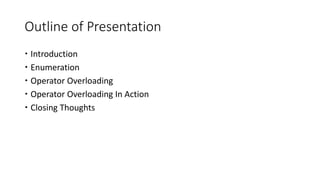
Introduction
 Who am I?
 Expected Background/Audience
 Source Material
Enumeration
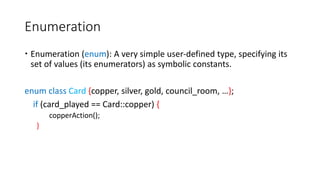
 Enumeration (enum): A very simple user-defined type, specifying its
set of values (its enumerators) as symbolic constants.
enum class Card {copper, silver, gold, council_room, …};
if (card_played == Card::copper) {
copperAction();
}
Operator Overloading
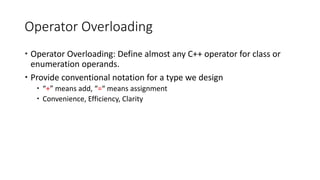
 Operator Overloading: Define almost any C++ operator for class or
enumeration operands.
 Provide conventional notation for a type we design
 “+” means add, “=“ means assignment
 Convenience, Efficiency, Clarity
Enumeration and Overloading Together
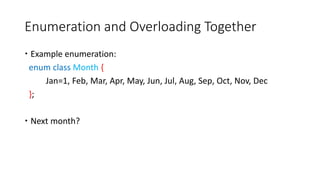
 Example enumeration:
enum class Month {
Jan=1, Feb, Mar, Apr, May, Jun, Jul, Aug, Sep, Oct, Nov, Dec
};
 Next month?
A Function!
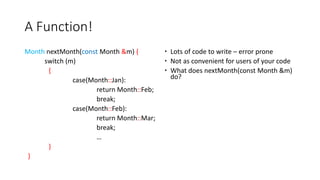
Month nextMonth(const Month &m) {
switch (m)
{
case(Month::Jan):
return Month::Feb;
break;
case(Month::Feb):
return Month::Mar;
break;
…
}
}
 Lots of code to write – error prone
 Not as convenient for users of your code
 What does nextMonth(const Month &m)
do?
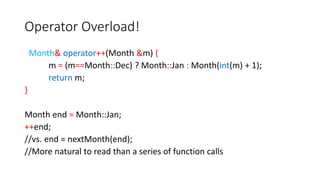
Operator Overload!
Month& operator++(Month &m) {
m = (m==Month::Dec) ? Month::Jan : Month(int(m) + 1);
return m;
}
Month end = Month::Jan;
++end;
//vs. end = nextMonth(end);
//More natural to read than a series of function calls
++ Operator Usage
for (Month n = Month::Jan; n < Month::Dec; ++n) {
cout << int(n) << endl;
}
Another example: ‘[]’ operator
 C++ strings
string name = “William”;
name[3] = ‘x’;
//name is now “Wilxiam”;
 Saves us from iterating through the string object, or using some
combination of other functions
Closing
 Enum helps make your code readable
 Card::copper vs. 7 (magic number)
 Operator overloading as well
 Define operators only with conventional meaning
 “+” should mean addition, not “tooblekane”
 Don’t define operators for a type unless you’re sure it will make
positive changes to your code
 The most interesting operators aren’t +, -, * and /, but =, ==, !=, [] and
().

Operator Overloading

  • 1.
    Operator Overloading Dustin Chase C++Lightning Talks December 14, 2015
  • 2.
    Outline of Presentation Introduction  Enumeration  Operator Overloading  Operator Overloading In Action  Closing Thoughts
  • 3.
    Introduction  Who amI?  Expected Background/Audience  Source Material
  • 4.
    Enumeration  Enumeration (enum):A very simple user-defined type, specifying its set of values (its enumerators) as symbolic constants. enum class Card {copper, silver, gold, council_room, …}; if (card_played == Card::copper) { copperAction(); }
  • 5.
    Operator Overloading  OperatorOverloading: Define almost any C++ operator for class or enumeration operands.  Provide conventional notation for a type we design  “+” means add, “=“ means assignment  Convenience, Efficiency, Clarity
  • 6.
    Enumeration and OverloadingTogether  Example enumeration: enum class Month { Jan=1, Feb, Mar, Apr, May, Jun, Jul, Aug, Sep, Oct, Nov, Dec };  Next month?
  • 7.
    A Function! Month nextMonth(constMonth &m) { switch (m) { case(Month::Jan): return Month::Feb; break; case(Month::Feb): return Month::Mar; break; … } }  Lots of code to write – error prone  Not as convenient for users of your code  What does nextMonth(const Month &m) do?
  • 8.
    Operator Overload! Month& operator++(Month&m) { m = (m==Month::Dec) ? Month::Jan : Month(int(m) + 1); return m; } Month end = Month::Jan; ++end; //vs. end = nextMonth(end); //More natural to read than a series of function calls
  • 9.
    ++ Operator Usage for(Month n = Month::Jan; n < Month::Dec; ++n) { cout << int(n) << endl; }
  • 10.
    Another example: ‘[]’operator  C++ strings string name = “William”; name[3] = ‘x’; //name is now “Wilxiam”;  Saves us from iterating through the string object, or using some combination of other functions
  • 11.
    Closing  Enum helpsmake your code readable  Card::copper vs. 7 (magic number)  Operator overloading as well  Define operators only with conventional meaning  “+” should mean addition, not “tooblekane”  Don’t define operators for a type unless you’re sure it will make positive changes to your code  The most interesting operators aren’t +, -, * and /, but =, ==, !=, [] and ().