Operator Overloadng
Operator Overloading

• Each C++ operator has a predefined meaning. Most of them
  are given additional meaning through the concept called
  operator overloading
• Main idea behind Operator overloading is to use C++
  operators with the class objects.
Eg:
      ‘+’ can be used to add 2 ints, floats or doubles, the
  same ‘+’ can be used to add 2 class objects, thereby ‘+’ gets
  overloaded.
• When an operator is overloaded, its original meaning is not
  lost.
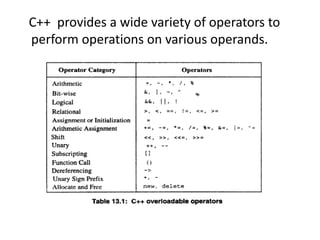
C++ provides a wide variety of operators to
perform operations on various operands.
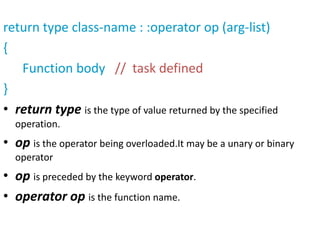
return type class-name : :operator op (arg-list)
{
   Function body // task defined
}
• return type is the type of value returned by the specified
  operation.
• op is the operator being overloaded.It may be a unary or binary
  operator
• op is preceded by the keyword operator.
• operator op is the function name.
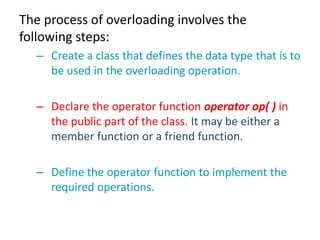
The process of overloading involves the
following steps:
  – Create a class that defines the data type that is to
    be used in the overloading operation.

  – Declare the operator function operator op( ) in
    the public part of the class. It may be either a
    member function or a friend function.

  – Define the operator function to implement the
    required operations.
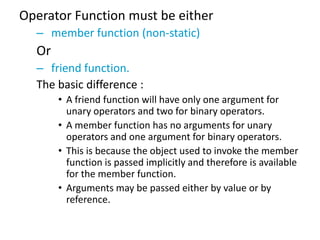
Operator Function must be either
  – member function (non-static)
  Or
  – friend function.
  The basic difference :
       • A friend function will have only one argument for
         unary operators and two for binary operators.
       • A member function has no arguments for unary
         operators and one argument for binary operators.
       • This is because the object used to invoke the member
         function is passed implicitly and therefore is available
         for the member function.
       • Arguments may be passed either by value or by
         reference.
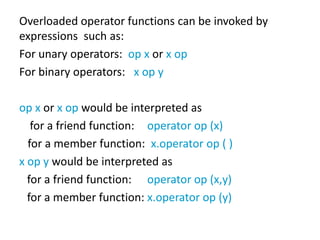
Overloaded operator functions can be invoked by
expressions such as:
For unary operators: op x or x op
For binary operators: x op y

op x or x op would be interpreted as
   for a friend function: operator op (x)
  for a member function: x.operator op ( )
x op y would be interpreted as
  for a friend function: operator op (x,y)
  for a member function: x.operator op (y)
Rules for Overloading Operators
– Only existing operators can be overloaded. New
  operators cannot be created.

– The overloaded operator must have at least one operand
  that is of user-defined type.


– We cannot change the basic meaning of an operator.


– Overloaded operators follow the syntax rules of the
  original operators.
Rules For Overloading Operators
                         continue…

– The following operators that cannot be overloaded:
   • Size of     Size of operator
   •   .         Membership operator
   •   .*        Pointer-to-member operator
   •   ::        Scope resolution operator
   •   ? ; Conditional operator
Rules For Overloading Operators
                         continue…

– The following operators can be over loaded with the use of
  member functions and not by the use of friend functions:
    • Assignment operator =
    • Function call operator( )
    • Subscripting operator [ ]
    • Class member access operator ->
– Unary operators, overloaded by means of a member
  function, take no explicit arguments and return no
  explicit values, but, those overloaded by means of a
  friend function, take one reference argument.
Rules For Overloading Operators
                         continue…

– Binary operators overloaded through a member function
  take one explicit argument and those which are overloaded
  through a friend function take two explicit arguments.
– When using binary operators overloaded through a
  member function, the left hand operand must be an object
  of the relevant class.
– Binary arithmetic operators such as +, -, * and / must
  explicitly return a value. They must not attempt to change
  their own arguments.

Operator overloadng

  • 1.
  • 2.
    Operator Overloading • EachC++ operator has a predefined meaning. Most of them are given additional meaning through the concept called operator overloading • Main idea behind Operator overloading is to use C++ operators with the class objects. Eg: ‘+’ can be used to add 2 ints, floats or doubles, the same ‘+’ can be used to add 2 class objects, thereby ‘+’ gets overloaded. • When an operator is overloaded, its original meaning is not lost.
  • 3.
    C++ provides awide variety of operators to perform operations on various operands.
  • 4.
    return type class-name: :operator op (arg-list) { Function body // task defined } • return type is the type of value returned by the specified operation. • op is the operator being overloaded.It may be a unary or binary operator • op is preceded by the keyword operator. • operator op is the function name.
  • 5.
    The process ofoverloading involves the following steps: – Create a class that defines the data type that is to be used in the overloading operation. – Declare the operator function operator op( ) in the public part of the class. It may be either a member function or a friend function. – Define the operator function to implement the required operations.
  • 6.
    Operator Function mustbe either – member function (non-static) Or – friend function. The basic difference : • A friend function will have only one argument for unary operators and two for binary operators. • A member function has no arguments for unary operators and one argument for binary operators. • This is because the object used to invoke the member function is passed implicitly and therefore is available for the member function. • Arguments may be passed either by value or by reference.
  • 7.
    Overloaded operator functionscan be invoked by expressions such as: For unary operators: op x or x op For binary operators: x op y op x or x op would be interpreted as for a friend function: operator op (x) for a member function: x.operator op ( ) x op y would be interpreted as for a friend function: operator op (x,y) for a member function: x.operator op (y)
  • 8.
    Rules for OverloadingOperators – Only existing operators can be overloaded. New operators cannot be created. – The overloaded operator must have at least one operand that is of user-defined type. – We cannot change the basic meaning of an operator. – Overloaded operators follow the syntax rules of the original operators.
  • 9.
    Rules For OverloadingOperators continue… – The following operators that cannot be overloaded: • Size of Size of operator • . Membership operator • .* Pointer-to-member operator • :: Scope resolution operator • ? ; Conditional operator
  • 10.
    Rules For OverloadingOperators continue… – The following operators can be over loaded with the use of member functions and not by the use of friend functions: • Assignment operator = • Function call operator( ) • Subscripting operator [ ] • Class member access operator -> – Unary operators, overloaded by means of a member function, take no explicit arguments and return no explicit values, but, those overloaded by means of a friend function, take one reference argument.
  • 11.
    Rules For OverloadingOperators continue… – Binary operators overloaded through a member function take one explicit argument and those which are overloaded through a friend function take two explicit arguments. – When using binary operators overloaded through a member function, the left hand operand must be an object of the relevant class. – Binary arithmetic operators such as +, -, * and / must explicitly return a value. They must not attempt to change their own arguments.