1
Topics on Inheritance
Subtyping and Code Reuse
Typing Conversions and Visibility
Abstract Base Classes
Multiple Inheritance
Inheritance and Design
Detailed C++ Considerations 
2 2
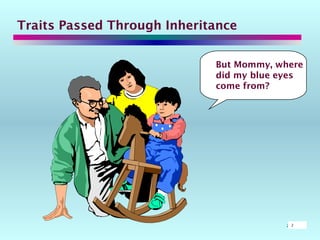
Traits Passed Through Inheritance
But Mommy, where
did my blue eyes
come from?
3
The Inheritance Mechanism
Means of deriving new class from
existing classes, called base classes
Reuses existing code eliminating tedious,
error prone task of developing new code
Derived class developed from base by
adding or altering code
Hierarchy of related types created that
share code & interface 
4
Single and Multiple Inheritance
Single inheritance occurs
when single base class
Multiple inheritance occurs
when more than
one base class
5
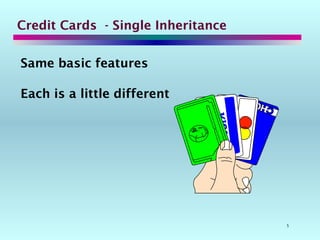
Credit Cards - Single Inheritance
Same basic features
Each is a little different
6
Voice Mail - Multiple Inheritance
Voice mail has features
of both mail and phone
7
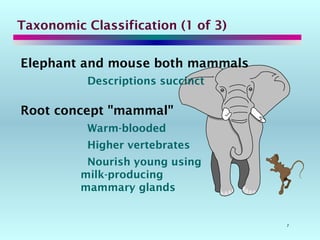
Taxonomic Classification (1 of 3)
Elephant and mouse both mammals
Descriptions succinct
Root concept "mammal"
Warm-blooded
Higher vertebrates
Nourish young using
milk-producing
mammary glands
8
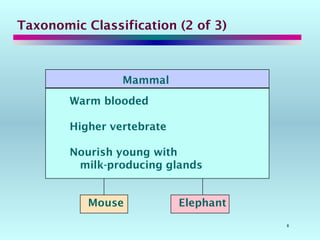
Taxonomic Classification (2 of 3)
Mammal
Warm blooded
Higher vertebrate
Nourish young with
milk-producing glands
Mouse Elephant
9
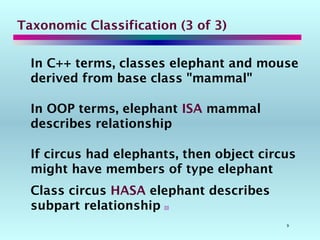
Taxonomic Classification (3 of 3)
In C++ terms, classes elephant and mouse
derived from base class "mammal"
In OOP terms, elephant ISA mammal
describes relationship
If circus had elephants, then object circus
might have members of type elephant
Class circus HASA elephant describes
subpart relationship 
10
Virtual Member Functions
Functions declared in base class and
redefined in derived class
Class hierarchy defined by public
inheritance creates related set of user
types, all of whose objects may be
pointed at by a base class pointer
By accessing virtual function through this
pointer, C++ selects appropriate function
definition at run-time 
11
Pure Polymorphism
Object being pointed at must carry
around type information so distinction
can be made dynamically
Feature typical of OOP code
Each object "knows" how it is acted on
Inheritance designed into software to
maximize reuse and allow natural
modeling of problem domain 
12
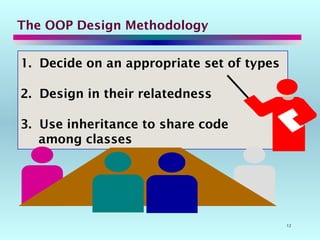
The OOP Design Methodology
1. Decide on an appropriate set of types
2. Design in their relatedness
3. Use inheritance to share code
among classes
13
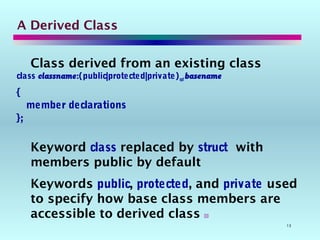
A Derived Class
Class derived from an existing class
class classname:(public|protected|private)optbasename
{
member declarations
};
Keyword class replaced by struct with
members public by default
Keywords public, protected, and private used
to specify how base class members are
accessible to derived class 
14
Students and Graduate Students
15
A Base Class: student
class student {
public:
enum year { fresh, soph, junior, senior,
grad };
student(char* nm, int id, double g,
year x);
void print() const;
protected:
int student_id;
double gpa;
year y;
char name[30];
};
16
A Derived Class: grad_student
class grad_student : public student {
public:
enum support { ta, ra, fellowship, other };
grad_student(char* nm, int id, double g,
year x, support t, char* d, char* th);
void print() const;
protected:
support s;
char dept[10];
char thesis[80];
};
17
Inheriting from the Base Class
Derived class is modification of base
class that inherits public and protected
members of base class
In grad_student, student members are
inherited
student_id gpa
name year
print 
18
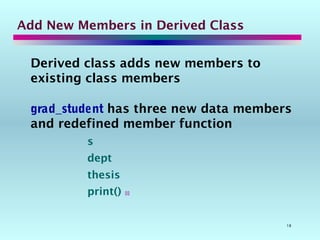
Add New Members in Derived Class
Derived class adds new members to
existing class members
grad_student has three new data members
and redefined member function
s
dept
thesis
print() 
19
Benefits of Inheritance
Code is reused
grad_student uses tested code from student
Reflects relationship in problem domain
Special grouping grad student
outgrowth of real world and treatment
of this group
Polymorphic mechanisms allow client
code to treat inherited class as subtype
of base class
Simplifies code, maintains subtype
20
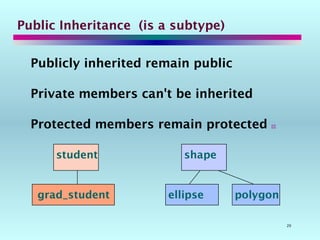
Public Inheritance (is a subtype)
Publicly inherited remain public
Private members can't be inherited
Protected members remain protected 
student
grad_student
shape
ellipse polygon
21
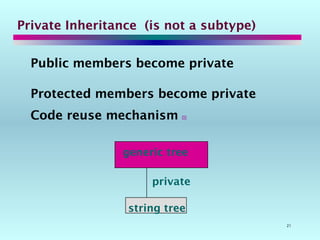
Private Inheritance (is not a subtype)
Public members become private
Protected members become private
Code reuse mechanism 
generic tree
string tree
private
22
Typing Conversions and Visibility
Publicly derived class is subtype of base
Variable of derived class treated as if it
were base class type
Pointer type pointer-to-base-class can
point to objects of derived class type
Subtle implicit conversions occur
between base and derived type
Difficult to follow what member is
accessed if base and derived class
overloaded same member name 
23
Students and Graduate Students
In many respects,
they are the same,
but in some they
differ.
24
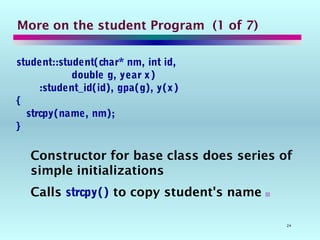
More on the student Program (1 of 7)
student::student(char* nm, int id,
double g, year x)
:student_id(id), gpa(g), y(x)
{
strcpy(name, nm);
}
Constructor for base class does series of
simple initializations
Calls strcpy() to copy student's name 
25
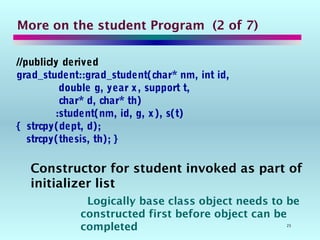
More on the student Program (2 of 7)
//publicly derived
grad_student::grad_student(char* nm, int id,
double g, year x, support t,
char* d, char* th)
:student(nm, id, g, x), s(t)
{ strcpy(dept, d);
strcpy(thesis, th); }
Constructor for student invoked as part of
initializer list
Logically base class object needs to be
constructed first before object can be
completed
26
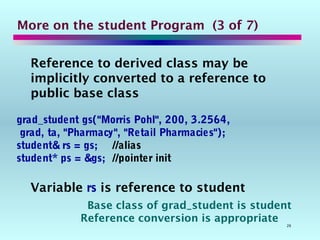
More on the student Program (3 of 7)
Reference to derived class may be
implicitly converted to a reference to
public base class
grad_student gs("Morris Pohl", 200, 3.2564,
grad, ta, "Pharmacy", "Retail Pharmacies");
student& rs = gs; //alias
student* ps = &gs; //pointer init
Variable rs is reference to student
Base class of grad_student is student
Reference conversion is appropriate
27
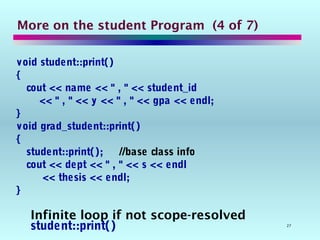
More on the student Program (4 of 7)
void student::print()
{
cout << name << " , " << student_id
<< " , " << y << " , " << gpa << endl;
}
void grad_student::print()
{
student::print(); //base class info
cout << dept << " , " << s << endl
<< thesis << endl;
}
Infinite loop if not scope-resolved
student::print()
28
More on the student Program (5 of 7)
#include "student.h"
main() //Test pointer conversion rules
{
student s("Mae Pohl", 100, 3.425, fresh),
*ps = &s;
grad_student gs("Morris Pohl",200, 3.2564,
grad, ta, "Pharmacy",
"Retail Pharmacies"), *pgs;
ps —> print(); //student::print
ps = pgs = &gs;
ps —> print(); //student::print
pgs —> print(); //grad_student::print
}
29
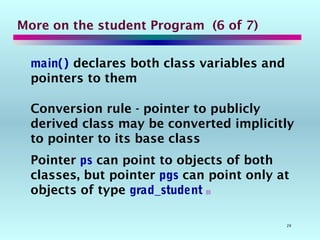
More on the student Program (6 of 7)
main() declares both class variables and
pointers to them
Conversion rule - pointer to publicly
derived class may be converted implicitly
to pointer to its base class
Pointer ps can point to objects of both
classes, but pointer pgs can point only at
objects of type grad_student 
30
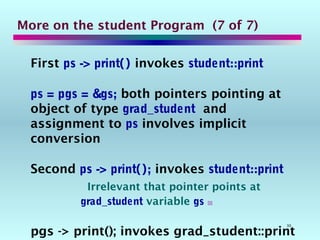
More on the student Program (7 of 7)
First ps -> print() invokes student::print
ps = pgs = &gs; both pointers pointing at
object of type grad_student and
assignment to ps involves implicit
conversion
Second ps -> print(); invokes student::print
Irrelevant that pointer points at
grad_student variable gs 
pgs -> print(); invokes grad_student::print
31
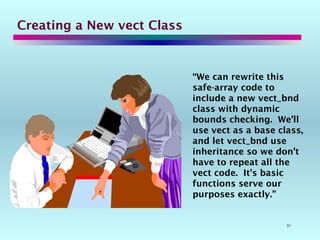
Creating a New vect Class
“We can rewrite this
safe-array code to
include a new vect_bnd
class with dynamic
bounds checking. We’ll
use vect as a base class,
and let vect_bnd use
inheritance so we don’t
have to repeat all the
vect code. It’s basic
functions serve our
purposes exactly.”
32
Dynamic Array Bounds (1 of 2)
Subscripting & assignment use these
properties
Right side, lvalue automatically
dereferenced
Left side specifies where value is
stored
Safe array vect_bnd produced by deriving
it from vect and invoking appropriate
constructors
function-header : base-class-name
(args) 
33
Dynamic Array Bounds (2 of 2)
Safe array has constructors, destructor
and overloaded subscripting operator
Constructors convert ordinary integer
array to safe array by allocating
sufficient memory
Upper and lower bounds checked
Subscript operator [] overloaded with
function which tests for out-of-bounds
condition on array access 
34
Reuse code and extend vect type to safe
array with dynamic bounds
More flexible and allows indices to
correspond directly to problem domain
Example: Fahrenheit temperatures of
water in its liquid state are is 32—212
degrees
Lower bound of 32 and upper bound
of 212
Safe array vect checked array bounds
for in range and created arrays using
Using Dynamic Array Bounds
35
Dynamic Array Bounds (1 of 8)
class vect {
public: //constructors & destructor
vect(); //create a size 10 array
vect(int l); //create a size l array
vect(const vect& v); //init by vect
vect(int a[], int l); //init by array
~vect() { delete [] p; }
int ub() const {return (size—1);}
int& operator[](int i); //range checked
vect& operator=(vect& v);
vect operator+(vect& v);
private:
int *p; //base pointer
int size; //number of elements
};
36
Dynamic Array Bounds (2 of 8)
class vect_bnd: public vect {
public:
vect_bnd();
vect_bnd(int, int);
int& operator[](int);
int ub() const { return (u_bnd); } //accessor
int lb() const { return (l_bnd); }
private:
int l_bnd, u_bnd;
};
Derived type members l_bnd and u_bnd
privately store lower and upper bounds
37
Dynamic Array Bounds (3 of 8)
Derived type reuses base type's
representation and code
Derived class constructors invoke base
class constructors
Syntax is same as member initialization
function header: base—class—name(args) 
38
u_bndl_bnd
Dynamic Array Bounds (4 of 8)
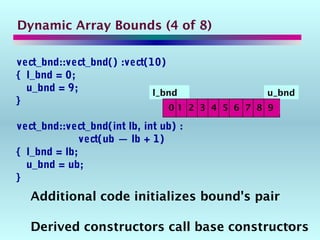
vect_bnd::vect_bnd() :vect(10)
{ l_bnd = 0;
u_bnd = 9;
}
vect_bnd::vect_bnd(int lb, int ub) :
vect(ub — lb + 1)
{ l_bnd = lb;
u_bnd = ub;
}
Additional code initializes bound's pair
Derived constructors call base constructors
0 1 2 3 4 5 6 7 8 9
39
Dynamic Array Bounds (5 of 8)
Alternatively, could be done in initializing
list
vect_bnd::vect_bnd(int lb, int ub)
vect(ub — lb + 1), l_bnd(lb),
u_bnd(ub) {}
40
Dynamic Array Bounds (6 of 8)
int& vect_bnd::operator[](int i)
{
if (i < l_bnd || u_bnd < i) {
cerr << "index out of range" << endl;
exit(1);
}
return (vect::operator[](i — l_bnd));
}
Reuse code in overloading indexing
operator []
Very inefficient - checking bounds
twice
41
Dynamic Array Bounds (7 of 8)
To avoid inefficient double bounds check,
make two changes
First change access privilege of vect::p to
protected so derived class has direct
access to previously private
implementation of vect
Allows us to make second change of
using p in vect_bnd::operator[]() 
42
Dynamic Array Bounds (8 of 8)
int& vect_bnd::operator[](int i)
{
if (i < l_bnd || u_bnd < i) {
cerr << "index out of rangen";
exit(1);
};
return (p[i — l_bnd]);
}
43
Determining Access Privilege
Tradeoff in code reuse and efficiency
Inheritance requires thinking about three
access boundaries
What is to be strictly private and what is
to be protected depends on what is
reusable 
44
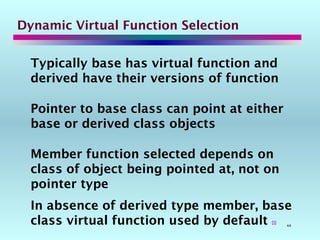
Dynamic Virtual Function Selection
Typically base has virtual function and
derived have their versions of function
Pointer to base class can point at either
base or derived class objects
Member function selected depends on
class of object being pointed at, not on
pointer type
In absence of derived type member, base
class virtual function used by default 
45
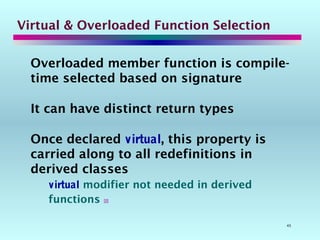
Virtual & Overloaded Function Selection
Overloaded member function is compile-
time selected based on signature
It can have distinct return types
Once declared virtual, this property is
carried along to all redefinitions in
derived classes
virtual modifier not needed in derived
functions 
46
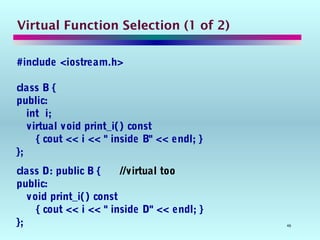
Virtual Function Selection (1 of 2)
#include <iostream.h>
class B {
public:
int i;
virtual void print_i() const
{ cout << i << " inside B" << endl; }
};
class D: public B { //virtual too
public:
void print_i() const
{ cout << i << " inside D" << endl; }
};
47
int main()
{
B b;
B* pb = &b; //point at a B object
D f;
f.i = 1 + (b.i = 1);
pb —> print_i(); //call B::print_i()
pb = &f; //point at a D object
pb —> print_i(); //call D::print_i()
}
Virtual Function Selection (2 of 2)
1 inside B
2 inside D
48
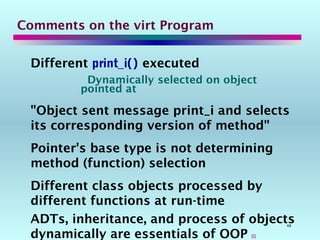
Comments on the virt Program
Different print_i() executed
Dynamically selected on object
pointed at
"Object sent message print_i and selects
its corresponding version of method"
Pointer's base type is not determining
method (function) selection
Different class objects processed by
different functions at run-time
ADTs, inheritance, and process of objects
dynamically are essentials of OOP 
49
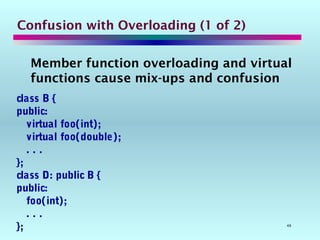
Confusion with Overloading (1 of 2)
Member function overloading and virtual
functions cause mix-ups and confusion
class B {
public:
virtual foo(int);
virtual foo(double);
. . .
};
class D: public B {
public:
foo(int);
. . .
};
50
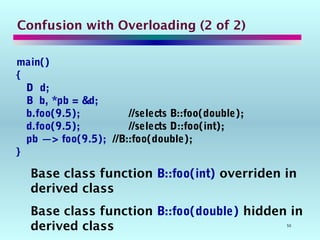
Confusion with Overloading (2 of 2)
main()
{
D d;
B b, *pb = &d;
b.foo(9.5); //selects B::foo(double);
d.foo(9.5); //selects D::foo(int);
pb —> foo(9.5); //B::foo(double);
}
Base class function B::foo(int) overriden in
derived class
Base class function B::foo(double) hidden in
derived class
51
Restrictions on virtual Functions
Only non-static member functions virtual
Virtual characteristic is inherited
Derived class function automatically
virtual virtual keyword not needed
Constructors cannot be virtual
Destructors can be virtual 
52
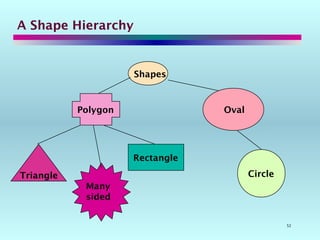
A Shape Hierarchy
Shapes
Polygon
Triangle
Many
sided
Rectangle
Oval
Circle
53
Using virtual (1 of 2)
class shape {
public:
virtual double area() const {return (0);} protected:
double x, y;
};
class rectangle: public shape {
public:
double area() const {return (height * width);}
private:
double height, width;
};
54
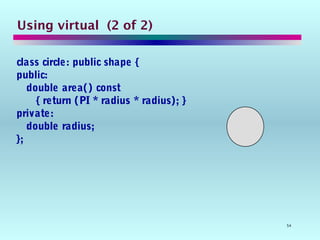
Using virtual (2 of 2)
class circle: public shape {
public:
double area() const
{ return (PI * radius * radius); }
private:
double radius;
};
55
Comments on the shapes Program
Virtual function allow run-time decisions
Different shapes derived from shape
base class
Derived classes correspond to important,
well understood types of shapes
Added to by deriving further classes
Area calculation is a local responsibility 
56
Client Code for shapes
shape* p[N];
. . .
for (i = 0; i < N; ++i)
tot_area += p[i] —> area();
Advantage that client code need not
change if new shapes added
Change managed locally and propagated
automatically by polymorphic character
of client code
57
Classes and Virtual Functions
Root class of hierarchy usually contains
number of virtual functions to provide
dynamic typing
Pure virtual function provides dummy
functions as placeholders in base class
which had specific functions in derived
classes 
5862
Pure Virtual Functions
Pure virtual function has body
virtual function prototype = 0;
Pure virtual function used to defer
implementation decision of the function
In OOP terminology - deferred method 
5963
Abstract Base Classes
Class with at least 1pure virtual function
Useful to have root class for type
hierarchy as abstract class
Basic common properties of derived
classes but cannot itself declare objects
Declare pointers that access subtype
objects derived from abstract class 
60
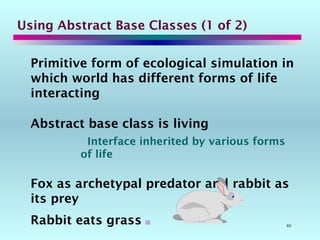
Using Abstract Base Classes (1 of 2)
Primitive form of ecological simulation in
which world has different forms of life
interacting
Abstract base class is living
Interface inherited by various forms
of life
Fox as archetypal predator and rabbit as
its prey
Rabbit eats grass 
61
Using Abstract Base Classes (2 of 2)
62
Predator - Prey (1 of 5)
hierarchy living
const int N = 40; //size of square board
enum state {EMPTY, GRASS, RABBIT, FOX, STATES} ;
const int DRAB = 3, DFOX = 6, CYCLES = 5;
class living; //forward declaration
typedef living* world[N][N];
Akin to Conway's "Game of Life"
simulation
Rules for who lives in next cycle given
populations in neighborhood of square
63
Predator - Prey (2 of 5)
class living { //what lives in the world
public:
virtual state who() = 0; //state id
virtual living* next(world w) = 0;
protected:
int row, column; //location
void sums(world w, int sm[]);
};
Virtual functions incur small added run-
time cost over normal member functions,
use only when necessary
64
Predator - Prey (3 of 5)
//currently only plant life
class grass : public living {
public:
grass(int r, int c):{row=r; column=c;}
state who() { return GRASS; }
living* next(world w);
};
Similar code developed for fox and rabbit
65
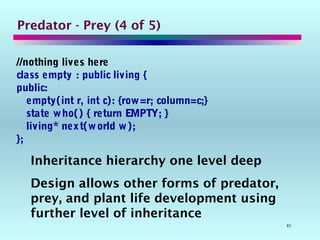
Predator - Prey (4 of 5)
//nothing lives here
class empty : public living {
public:
empty(int r, int c): {row=r; column=c;}
state who() { return EMPTY; }
living* next(world w);
};
Inheritance hierarchy one level deep
Design allows other forms of predator,
prey, and plant life development using
further level of inheritance
66
Predator - Prey (5 of 5)
living* grass::next(world w)
{
int sum[STATES];
sums(w, sum);
if (sum[GRASS] > sum[RABBIT]) //eat grass
return (new grass(row, column));
else
return (new empty(row, column));
}
If more grass than rabbits, grass remains;
otherwise grass eaten
Rabbits die of old age or eaten by foxes
foxes die of overcrowding and old age
67
Comment on the living Program
More interesting to simulate other
behaviors such as sexual reproduction,
where animals have gender and can mate
Array world is container for life forms
Has responsibility for creating current
pattern
Needs to have ownership of living
objects to allocate new ones and delete
old ones
Rules in versions of next() determine
possibly complex set of interactions 
68
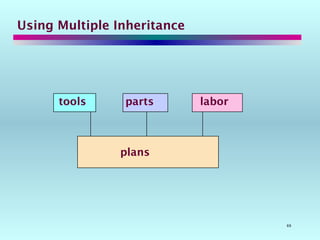
Multiple Inheritance
Derived class from more than one base
Can’t be circular, so no class may, through
its inheritance chain, inherit from itself
Ambiguities arise when deriving identically
named member from different classes
Virtual inheritance eliminated duplication of
subobjects having same name
Constructor invoke order may cause
problems, and should be explicit 
69
Using Multiple Inheritance
plans
tools parts labor
70
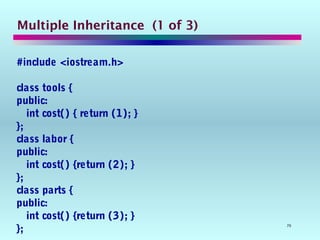
Multiple Inheritance (1 of 3)
#include <iostream.h>
class tools {
public:
int cost() { return (1); }
};
class labor {
public:
int cost() {return (2); }
};
class parts {
public:
int cost() {return (3); }
};
71
Multiple Inheritance (2 of 3)
class plans : public tools, public parts,
public labor {
public:
int tot_cost()
{return (parts::cost()+labor::cost());}
};
Header has base classes, privacy
designation
Publicly inherits members of all base
classes
72
Multiple Inheritance (3 of 3)
main()
{ int price;
plans* ptr;
tools t; labor l;
parts p; plans pl;
ptr = &pl;
price = ptr -> cost(); //ambiguous cost
price = ptr -> tools::cost();
cout << "ntools cost = " << t.cost()
<< " labor cost = " << l.cost()
<< " parts cost = " << p.cost()
<< " plans cost = " << pl.tot_cost()
<< " total cost = " << price << endl;
}
73
Virtual Inheritance
Two base classes derived from common
ancestor
If both base classes used in ordinary way
by derived class, that class will have two
subobjects of common ancestor
Duplication, if not desirable, eliminated
by using virtual inheritance 
74
Using Virtual Inheritance (1 of 2)
class under_grad: public virtual student {
. . .
};
class grad: public virtual student {
. . .
};
class attendee: public under_grad,
public grad {
. . .
};
75
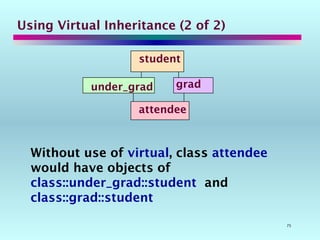
Without use of virtual, class attendee
would have objects of
class::under_grad::student and
class::grad::student
Using Virtual Inheritance (2 of 2)
student
under_grad grad
attendee
76
Constructors and Destructors
With all these
classes interacting,
how do the
constructors and
destructors get
invoked?
77
Constructor Destructor Execution (1 of 4)
Order for initializing constructors
Base classes initialized in declaration
order
Members initialized in declaration
order
Virtual base classes have special
precedence & are constructed before
their derived classes
Constructed before non-virtual base
classes
Construction order depends on their
DAG
78
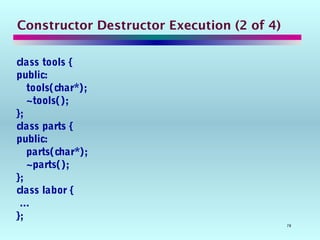
Constructor Destructor Execution (2 of 4)
class tools {
public:
tools(char*);
~tools();
};
class parts {
public:
parts(char*);
~parts();
};
class labor {
...
};
79
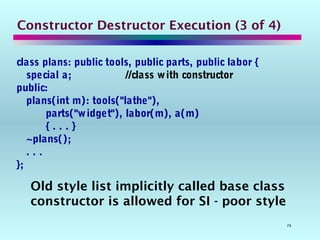
Constructor Destructor Execution (3 of 4)
class plans: public tools, public parts, public labor {
special a; //class with constructor
public:
plans(int m): tools("lathe"),
parts("widget"), labor(m), a(m)
{ . . . }
~plans();
. . .
};
Old style list implicitly called base class
constructor is allowed for SI - poor style
80
Constructor Destructor Execution (4 of 4)
Constructor initializing list and member
initializing list in declaration order
Good style - avoids confusion and
should match declaration order as
documentation
Since its constructor was last, ~a()
destructor is invoked first, followed by
~labor(), ~parts(), ~tools(), and ~plans()
Example of MI in iostream.h - derived
from istream and ostream 
81
Inheritance And Design
Inheritance is a code-sharing technique
Inheritance reflects understanding of
problem
Inheritance reflects relationships between
parts of problem space
82
The ISA Relationship
Public inheritance expression of ISA
relationship between base and derived
classes
Rectangle is shape
Make shape superclass
Allow behavior described by public
member functions interpretable on
objects within type hierarchy
Subclasses derived from it share its
interface 
83
Design Tradeoffs
Design involves tradeoffs between
objectives
Generality at odds with efficiency
Use class hierarchy for ISA relationships
Compartmentalize coding
relationships
Coding inefficiencies having various
layers of access to (hidden) state
description
Simplifies overall coding process 
8488
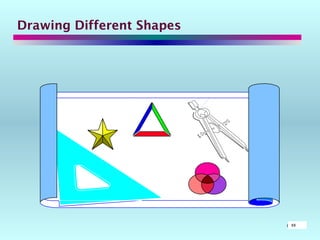
Drawing Different Shapes
85
Designing a Shape Drawing Package
Need not anticipate future additional
shapes
Class developer imports base class
"shape" interface and provides code that
implements operations such as "draw"
What is primitive or common remains
unchanged
Also unchanged is clients use of package

86
Concerns Affecting Class Development
Undue amount of decomposition imposes
its own complexity
Self-defeating
Granularity decision
Classes highly specialized do not
provide enough benefit
Better folded into larger concept 
87
Single vs.. Multiple Inheritance
Single Inheritance Multiple Inheritance
Credit Cards
Same basic features but
each a little different
Voice Mail
Features of both mail
phone
88
Deciding on Which Inheritance to Use
Generally types are best understood as SI
chains
Some programmers prefer SI and
aggregation to MI and composition
MI presents problems for type theorist
A student might be derived from
person
An employee might be derived from
person
What about a student-employee? 
89
What About Bats?
Is vampire bat mammal that flies, flying
machine that is mammal, or flying
machine and mammal?
Depending on what code is available,
developing proper class for vampire bat
might involve MI derivation or SI with
appropriate HASA members 
90
Subtyping Form
ADTs successful insofar as behave like
native types
Native types such as integer types in C
act as subtype hierarchy
Useful model for publicly derived type
hierarchies
Promotes ease of use through
polymorphism 
91
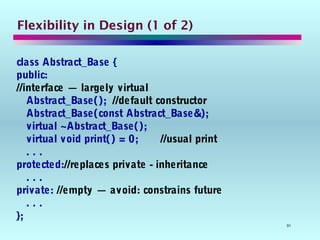
Flexibility in Design (1 of 2)
class Abstract_Base {
public:
//interface — largely virtual
Abstract_Base(); //default constructor
Abstract_Base(const Abstract_Base&);
virtual ~Abstract_Base();
virtual void print() = 0; //usual print
. . .
protected://replaces private - inheritance
. . .
private: //empty — avoid: constrains future
. . .
};
92
Flexibility in Design (2 of 2)
class D_is_AB: virtual public Abstract_Base {
public:
//interface — supports concrete instance
D_is_AB(); //default constructor
D_is_AB(const D_is_AB&); //copy
D_is_AB& operator=(const D_is_AB&);
void print(); //usual print expectation
. . .
protected://replace private for inheritance
. . .
private:
. . .
};
93
Comments on the abs_base Program
Usual to leave root of hierarchy as
abstract - yields most flexible design
Generally no concrete implementation
developed at this point
Pure virtual functions preclude from
declaring objects of this type
print() function is pure 
94
Operations expected of any subtype in
hierarchy
In general, basic constructors expected
and they may not be virtual
Most useful aggregates require explicit
definition of assignment that differs
from default assignment semantics 
First Design Level is Public (1 of 2)
95
First Design Level is Public (2 of 2)
Destructor virtual - response at run-time
and dependent on object's size
Virtual public inheritance ensures that in
MI schemes, no multiple copies of
abstract base class 
96
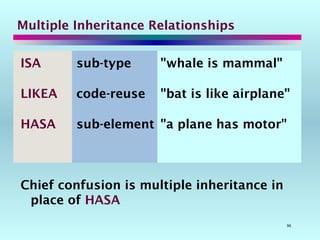
ISA sub-type "whale is mammal"
LIKEA code-reuse "bat is like airplane"
HASA sub-element "a plane has motor"
Chief confusion is multiple inheritance in
place of HASA
Multiple Inheritance Relationships
97
C++ and Virtual Functions
Virtual function and derived instances
having same signature must have same
return type
Virtual function redefinition is
overriding
Non-virtual member functions having
same signature can have different
return types
All member functions except
constructors, and overloaded new and
delete can be virtual 
98
C++ and Constructors and Destructors
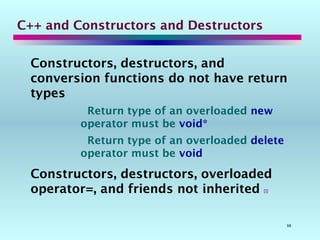
Constructors, destructors, and
conversion functions do not have return
types
Return type of an overloaded new
operator must be void*
Return type of an overloaded delete
operator must be void
Constructors, destructors, overloaded
operator=, and friends not inherited 
99
Operator Overloading
= , () , [] , and —> done only with non-
static member functions
new and delete done only with static
member functions
Other overloadable operators done with
either friend, member, or ordinary
functions 
100
Unions
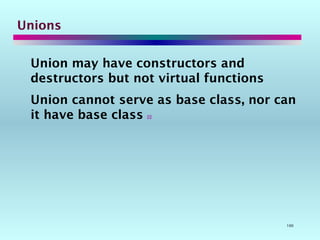
Union may have constructors and
destructors but not virtual functions
Union cannot serve as base class, nor can
it have base class 
101
C++ and Access Modification (1 of 2)
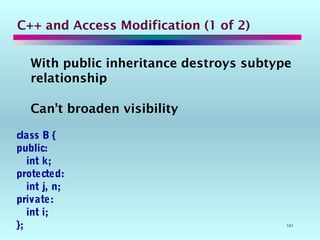
With public inheritance destroys subtype
relationship
Can’t broaden visibility
class B {
public:
int k;
protected:
int j, n;
private:
int i;
};
102
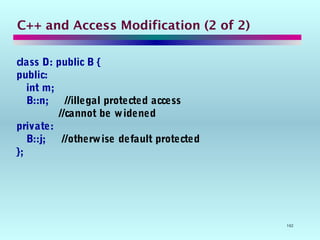
C++ and Access Modification (2 of 2)
class D: public B {
public:
int m;
B::n; //illegal protected access
//cannot be widened
private:
B::j; //otherwise default protected
};
103
Summary of Inheritance (1 of 6)
Inheritance is mechanism of deriving new
class from old one
Inherits base class code
Typically modifies & extends base
class
Existing class added to or altered to
create derived class
Inheritance allows creation of hierarchy
of related ADTs that share code 
104
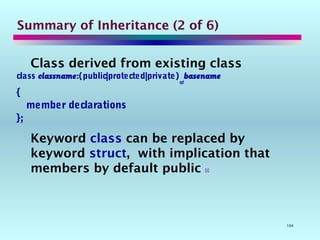
Summary of Inheritance (2 of 6)
Class derived from existing class
class classname:(public|protected|private)
opt
basename
{
member declarations
};
Keyword class can be replaced by
keyword struct, with implication that
members by default public 
105
Summary of Inheritance (3 of 6)
Keywords public, private, and protected
available as visibility modifiers for class
members
Public member visible throughout its
scope
Private member visible to other
member functions within its own class
Protected member visible to other
member functions within its class and
any class immediately derived from it
Derived class has its own constructors,
which invoke base class constructor 
106
Summary of Inheritance (4 of 6)
Special syntax to pass arguments from th
derived class constructor back to base
class constructor
function header: basename (argument list)
Publicly derived class subtype of its base
Variable of derived class treated as if it
were base class type
Pointer to base class can point to objects
of publicly derived class type 
107
Summary of Inheritance (5 of 6)
Reference to derived class may be
implicitly converted to reference to public
base class
Keyword virtual is function specifier that
provides mechanism to select at run-time
appropriate member function
Used only to modify member function
declarations and is called overriding
Pure polymorphism 
108
Summary of Inheritance (6 of 6)
Possible to declare reference to base class
and initialize it to reference an object of
publicly derived class
Public inheritance creates type hierarchy
Generality from additional implicit type
conversions
Run-time selection of overridden virtual
functions
ADTs, inheritance, ability to process
objects dynamically are essentials of OOP


Inheritance (1)

  • 1.
    1 Topics on Inheritance Subtypingand Code Reuse Typing Conversions and Visibility Abstract Base Classes Multiple Inheritance Inheritance and Design Detailed C++ Considerations 
  • 2.
    2 2 Traits PassedThrough Inheritance But Mommy, where did my blue eyes come from?
  • 3.
    3 The Inheritance Mechanism Meansof deriving new class from existing classes, called base classes Reuses existing code eliminating tedious, error prone task of developing new code Derived class developed from base by adding or altering code Hierarchy of related types created that share code & interface 
  • 4.
    4 Single and MultipleInheritance Single inheritance occurs when single base class Multiple inheritance occurs when more than one base class
  • 5.
    5 Credit Cards -Single Inheritance Same basic features Each is a little different
  • 6.
    6 Voice Mail -Multiple Inheritance Voice mail has features of both mail and phone
  • 7.
    7 Taxonomic Classification (1of 3) Elephant and mouse both mammals Descriptions succinct Root concept "mammal" Warm-blooded Higher vertebrates Nourish young using milk-producing mammary glands
  • 8.
    8 Taxonomic Classification (2of 3) Mammal Warm blooded Higher vertebrate Nourish young with milk-producing glands Mouse Elephant
  • 9.
    9 Taxonomic Classification (3of 3) In C++ terms, classes elephant and mouse derived from base class "mammal" In OOP terms, elephant ISA mammal describes relationship If circus had elephants, then object circus might have members of type elephant Class circus HASA elephant describes subpart relationship 
  • 10.
    10 Virtual Member Functions Functionsdeclared in base class and redefined in derived class Class hierarchy defined by public inheritance creates related set of user types, all of whose objects may be pointed at by a base class pointer By accessing virtual function through this pointer, C++ selects appropriate function definition at run-time 
  • 11.
    11 Pure Polymorphism Object beingpointed at must carry around type information so distinction can be made dynamically Feature typical of OOP code Each object "knows" how it is acted on Inheritance designed into software to maximize reuse and allow natural modeling of problem domain 
  • 12.
    12 The OOP DesignMethodology 1. Decide on an appropriate set of types 2. Design in their relatedness 3. Use inheritance to share code among classes
  • 13.
    13 A Derived Class Classderived from an existing class class classname:(public|protected|private)optbasename { member declarations }; Keyword class replaced by struct with members public by default Keywords public, protected, and private used to specify how base class members are accessible to derived class 
  • 14.
  • 15.
    15 A Base Class:student class student { public: enum year { fresh, soph, junior, senior, grad }; student(char* nm, int id, double g, year x); void print() const; protected: int student_id; double gpa; year y; char name[30]; };
  • 16.
    16 A Derived Class:grad_student class grad_student : public student { public: enum support { ta, ra, fellowship, other }; grad_student(char* nm, int id, double g, year x, support t, char* d, char* th); void print() const; protected: support s; char dept[10]; char thesis[80]; };
  • 17.
    17 Inheriting from theBase Class Derived class is modification of base class that inherits public and protected members of base class In grad_student, student members are inherited student_id gpa name year print 
  • 18.
    18 Add New Membersin Derived Class Derived class adds new members to existing class members grad_student has three new data members and redefined member function s dept thesis print() 
  • 19.
    19 Benefits of Inheritance Codeis reused grad_student uses tested code from student Reflects relationship in problem domain Special grouping grad student outgrowth of real world and treatment of this group Polymorphic mechanisms allow client code to treat inherited class as subtype of base class Simplifies code, maintains subtype
  • 20.
    20 Public Inheritance (isa subtype) Publicly inherited remain public Private members can't be inherited Protected members remain protected  student grad_student shape ellipse polygon
  • 21.
    21 Private Inheritance (isnot a subtype) Public members become private Protected members become private Code reuse mechanism  generic tree string tree private
  • 22.
    22 Typing Conversions andVisibility Publicly derived class is subtype of base Variable of derived class treated as if it were base class type Pointer type pointer-to-base-class can point to objects of derived class type Subtle implicit conversions occur between base and derived type Difficult to follow what member is accessed if base and derived class overloaded same member name 
  • 23.
    23 Students and GraduateStudents In many respects, they are the same, but in some they differ.
  • 24.
    24 More on thestudent Program (1 of 7) student::student(char* nm, int id, double g, year x) :student_id(id), gpa(g), y(x) { strcpy(name, nm); } Constructor for base class does series of simple initializations Calls strcpy() to copy student's name 
  • 25.
    25 More on thestudent Program (2 of 7) //publicly derived grad_student::grad_student(char* nm, int id, double g, year x, support t, char* d, char* th) :student(nm, id, g, x), s(t) { strcpy(dept, d); strcpy(thesis, th); } Constructor for student invoked as part of initializer list Logically base class object needs to be constructed first before object can be completed
  • 26.
    26 More on thestudent Program (3 of 7) Reference to derived class may be implicitly converted to a reference to public base class grad_student gs("Morris Pohl", 200, 3.2564, grad, ta, "Pharmacy", "Retail Pharmacies"); student& rs = gs; //alias student* ps = &gs; //pointer init Variable rs is reference to student Base class of grad_student is student Reference conversion is appropriate
  • 27.
    27 More on thestudent Program (4 of 7) void student::print() { cout << name << " , " << student_id << " , " << y << " , " << gpa << endl; } void grad_student::print() { student::print(); //base class info cout << dept << " , " << s << endl << thesis << endl; } Infinite loop if not scope-resolved student::print()
  • 28.
    28 More on thestudent Program (5 of 7) #include "student.h" main() //Test pointer conversion rules { student s("Mae Pohl", 100, 3.425, fresh), *ps = &s; grad_student gs("Morris Pohl",200, 3.2564, grad, ta, "Pharmacy", "Retail Pharmacies"), *pgs; ps —> print(); //student::print ps = pgs = &gs; ps —> print(); //student::print pgs —> print(); //grad_student::print }
  • 29.
    29 More on thestudent Program (6 of 7) main() declares both class variables and pointers to them Conversion rule - pointer to publicly derived class may be converted implicitly to pointer to its base class Pointer ps can point to objects of both classes, but pointer pgs can point only at objects of type grad_student 
  • 30.
    30 More on thestudent Program (7 of 7) First ps -> print() invokes student::print ps = pgs = &gs; both pointers pointing at object of type grad_student and assignment to ps involves implicit conversion Second ps -> print(); invokes student::print Irrelevant that pointer points at grad_student variable gs  pgs -> print(); invokes grad_student::print
  • 31.
    31 Creating a Newvect Class “We can rewrite this safe-array code to include a new vect_bnd class with dynamic bounds checking. We’ll use vect as a base class, and let vect_bnd use inheritance so we don’t have to repeat all the vect code. It’s basic functions serve our purposes exactly.”
  • 32.
    32 Dynamic Array Bounds(1 of 2) Subscripting & assignment use these properties Right side, lvalue automatically dereferenced Left side specifies where value is stored Safe array vect_bnd produced by deriving it from vect and invoking appropriate constructors function-header : base-class-name (args) 
  • 33.
    33 Dynamic Array Bounds(2 of 2) Safe array has constructors, destructor and overloaded subscripting operator Constructors convert ordinary integer array to safe array by allocating sufficient memory Upper and lower bounds checked Subscript operator [] overloaded with function which tests for out-of-bounds condition on array access 
  • 34.
    34 Reuse code andextend vect type to safe array with dynamic bounds More flexible and allows indices to correspond directly to problem domain Example: Fahrenheit temperatures of water in its liquid state are is 32—212 degrees Lower bound of 32 and upper bound of 212 Safe array vect checked array bounds for in range and created arrays using Using Dynamic Array Bounds
  • 35.
    35 Dynamic Array Bounds(1 of 8) class vect { public: //constructors & destructor vect(); //create a size 10 array vect(int l); //create a size l array vect(const vect& v); //init by vect vect(int a[], int l); //init by array ~vect() { delete [] p; } int ub() const {return (size—1);} int& operator[](int i); //range checked vect& operator=(vect& v); vect operator+(vect& v); private: int *p; //base pointer int size; //number of elements };
  • 36.
    36 Dynamic Array Bounds(2 of 8) class vect_bnd: public vect { public: vect_bnd(); vect_bnd(int, int); int& operator[](int); int ub() const { return (u_bnd); } //accessor int lb() const { return (l_bnd); } private: int l_bnd, u_bnd; }; Derived type members l_bnd and u_bnd privately store lower and upper bounds
  • 37.
    37 Dynamic Array Bounds(3 of 8) Derived type reuses base type's representation and code Derived class constructors invoke base class constructors Syntax is same as member initialization function header: base—class—name(args) 
  • 38.
    38 u_bndl_bnd Dynamic Array Bounds(4 of 8) vect_bnd::vect_bnd() :vect(10) { l_bnd = 0; u_bnd = 9; } vect_bnd::vect_bnd(int lb, int ub) : vect(ub — lb + 1) { l_bnd = lb; u_bnd = ub; } Additional code initializes bound's pair Derived constructors call base constructors 0 1 2 3 4 5 6 7 8 9
  • 39.
    39 Dynamic Array Bounds(5 of 8) Alternatively, could be done in initializing list vect_bnd::vect_bnd(int lb, int ub) vect(ub — lb + 1), l_bnd(lb), u_bnd(ub) {}
  • 40.
    40 Dynamic Array Bounds(6 of 8) int& vect_bnd::operator[](int i) { if (i < l_bnd || u_bnd < i) { cerr << "index out of range" << endl; exit(1); } return (vect::operator[](i — l_bnd)); } Reuse code in overloading indexing operator [] Very inefficient - checking bounds twice
  • 41.
    41 Dynamic Array Bounds(7 of 8) To avoid inefficient double bounds check, make two changes First change access privilege of vect::p to protected so derived class has direct access to previously private implementation of vect Allows us to make second change of using p in vect_bnd::operator[]() 
  • 42.
    42 Dynamic Array Bounds(8 of 8) int& vect_bnd::operator[](int i) { if (i < l_bnd || u_bnd < i) { cerr << "index out of rangen"; exit(1); }; return (p[i — l_bnd]); }
  • 43.
    43 Determining Access Privilege Tradeoffin code reuse and efficiency Inheritance requires thinking about three access boundaries What is to be strictly private and what is to be protected depends on what is reusable 
  • 44.
    44 Dynamic Virtual FunctionSelection Typically base has virtual function and derived have their versions of function Pointer to base class can point at either base or derived class objects Member function selected depends on class of object being pointed at, not on pointer type In absence of derived type member, base class virtual function used by default 
  • 45.
    45 Virtual & OverloadedFunction Selection Overloaded member function is compile- time selected based on signature It can have distinct return types Once declared virtual, this property is carried along to all redefinitions in derived classes virtual modifier not needed in derived functions 
  • 46.
    46 Virtual Function Selection(1 of 2) #include <iostream.h> class B { public: int i; virtual void print_i() const { cout << i << " inside B" << endl; } }; class D: public B { //virtual too public: void print_i() const { cout << i << " inside D" << endl; } };
  • 47.
    47 int main() { B b; B*pb = &b; //point at a B object D f; f.i = 1 + (b.i = 1); pb —> print_i(); //call B::print_i() pb = &f; //point at a D object pb —> print_i(); //call D::print_i() } Virtual Function Selection (2 of 2) 1 inside B 2 inside D
  • 48.
    48 Comments on thevirt Program Different print_i() executed Dynamically selected on object pointed at "Object sent message print_i and selects its corresponding version of method" Pointer's base type is not determining method (function) selection Different class objects processed by different functions at run-time ADTs, inheritance, and process of objects dynamically are essentials of OOP 
  • 49.
    49 Confusion with Overloading(1 of 2) Member function overloading and virtual functions cause mix-ups and confusion class B { public: virtual foo(int); virtual foo(double); . . . }; class D: public B { public: foo(int); . . . };
  • 50.
    50 Confusion with Overloading(2 of 2) main() { D d; B b, *pb = &d; b.foo(9.5); //selects B::foo(double); d.foo(9.5); //selects D::foo(int); pb —> foo(9.5); //B::foo(double); } Base class function B::foo(int) overriden in derived class Base class function B::foo(double) hidden in derived class
  • 51.
    51 Restrictions on virtualFunctions Only non-static member functions virtual Virtual characteristic is inherited Derived class function automatically virtual virtual keyword not needed Constructors cannot be virtual Destructors can be virtual 
  • 52.
  • 53.
    53 Using virtual (1of 2) class shape { public: virtual double area() const {return (0);} protected: double x, y; }; class rectangle: public shape { public: double area() const {return (height * width);} private: double height, width; };
  • 54.
    54 Using virtual (2of 2) class circle: public shape { public: double area() const { return (PI * radius * radius); } private: double radius; };
  • 55.
    55 Comments on theshapes Program Virtual function allow run-time decisions Different shapes derived from shape base class Derived classes correspond to important, well understood types of shapes Added to by deriving further classes Area calculation is a local responsibility 
  • 56.
    56 Client Code forshapes shape* p[N]; . . . for (i = 0; i < N; ++i) tot_area += p[i] —> area(); Advantage that client code need not change if new shapes added Change managed locally and propagated automatically by polymorphic character of client code
  • 57.
    57 Classes and VirtualFunctions Root class of hierarchy usually contains number of virtual functions to provide dynamic typing Pure virtual function provides dummy functions as placeholders in base class which had specific functions in derived classes 
  • 58.
    5862 Pure Virtual Functions Purevirtual function has body virtual function prototype = 0; Pure virtual function used to defer implementation decision of the function In OOP terminology - deferred method 
  • 59.
    5963 Abstract Base Classes Classwith at least 1pure virtual function Useful to have root class for type hierarchy as abstract class Basic common properties of derived classes but cannot itself declare objects Declare pointers that access subtype objects derived from abstract class 
  • 60.
    60 Using Abstract BaseClasses (1 of 2) Primitive form of ecological simulation in which world has different forms of life interacting Abstract base class is living Interface inherited by various forms of life Fox as archetypal predator and rabbit as its prey Rabbit eats grass 
  • 61.
    61 Using Abstract BaseClasses (2 of 2)
  • 62.
    62 Predator - Prey(1 of 5) hierarchy living const int N = 40; //size of square board enum state {EMPTY, GRASS, RABBIT, FOX, STATES} ; const int DRAB = 3, DFOX = 6, CYCLES = 5; class living; //forward declaration typedef living* world[N][N]; Akin to Conway's "Game of Life" simulation Rules for who lives in next cycle given populations in neighborhood of square
  • 63.
    63 Predator - Prey(2 of 5) class living { //what lives in the world public: virtual state who() = 0; //state id virtual living* next(world w) = 0; protected: int row, column; //location void sums(world w, int sm[]); }; Virtual functions incur small added run- time cost over normal member functions, use only when necessary
  • 64.
    64 Predator - Prey(3 of 5) //currently only plant life class grass : public living { public: grass(int r, int c):{row=r; column=c;} state who() { return GRASS; } living* next(world w); }; Similar code developed for fox and rabbit
  • 65.
    65 Predator - Prey(4 of 5) //nothing lives here class empty : public living { public: empty(int r, int c): {row=r; column=c;} state who() { return EMPTY; } living* next(world w); }; Inheritance hierarchy one level deep Design allows other forms of predator, prey, and plant life development using further level of inheritance
  • 66.
    66 Predator - Prey(5 of 5) living* grass::next(world w) { int sum[STATES]; sums(w, sum); if (sum[GRASS] > sum[RABBIT]) //eat grass return (new grass(row, column)); else return (new empty(row, column)); } If more grass than rabbits, grass remains; otherwise grass eaten Rabbits die of old age or eaten by foxes foxes die of overcrowding and old age
  • 67.
    67 Comment on theliving Program More interesting to simulate other behaviors such as sexual reproduction, where animals have gender and can mate Array world is container for life forms Has responsibility for creating current pattern Needs to have ownership of living objects to allocate new ones and delete old ones Rules in versions of next() determine possibly complex set of interactions 
  • 68.
    68 Multiple Inheritance Derived classfrom more than one base Can’t be circular, so no class may, through its inheritance chain, inherit from itself Ambiguities arise when deriving identically named member from different classes Virtual inheritance eliminated duplication of subobjects having same name Constructor invoke order may cause problems, and should be explicit 
  • 69.
  • 70.
    70 Multiple Inheritance (1of 3) #include <iostream.h> class tools { public: int cost() { return (1); } }; class labor { public: int cost() {return (2); } }; class parts { public: int cost() {return (3); } };
  • 71.
    71 Multiple Inheritance (2of 3) class plans : public tools, public parts, public labor { public: int tot_cost() {return (parts::cost()+labor::cost());} }; Header has base classes, privacy designation Publicly inherits members of all base classes
  • 72.
    72 Multiple Inheritance (3of 3) main() { int price; plans* ptr; tools t; labor l; parts p; plans pl; ptr = &pl; price = ptr -> cost(); //ambiguous cost price = ptr -> tools::cost(); cout << "ntools cost = " << t.cost() << " labor cost = " << l.cost() << " parts cost = " << p.cost() << " plans cost = " << pl.tot_cost() << " total cost = " << price << endl; }
  • 73.
    73 Virtual Inheritance Two baseclasses derived from common ancestor If both base classes used in ordinary way by derived class, that class will have two subobjects of common ancestor Duplication, if not desirable, eliminated by using virtual inheritance 
  • 74.
    74 Using Virtual Inheritance(1 of 2) class under_grad: public virtual student { . . . }; class grad: public virtual student { . . . }; class attendee: public under_grad, public grad { . . . };
  • 75.
    75 Without use ofvirtual, class attendee would have objects of class::under_grad::student and class::grad::student Using Virtual Inheritance (2 of 2) student under_grad grad attendee
  • 76.
    76 Constructors and Destructors Withall these classes interacting, how do the constructors and destructors get invoked?
  • 77.
    77 Constructor Destructor Execution(1 of 4) Order for initializing constructors Base classes initialized in declaration order Members initialized in declaration order Virtual base classes have special precedence & are constructed before their derived classes Constructed before non-virtual base classes Construction order depends on their DAG
  • 78.
    78 Constructor Destructor Execution(2 of 4) class tools { public: tools(char*); ~tools(); }; class parts { public: parts(char*); ~parts(); }; class labor { ... };
  • 79.
    79 Constructor Destructor Execution(3 of 4) class plans: public tools, public parts, public labor { special a; //class with constructor public: plans(int m): tools("lathe"), parts("widget"), labor(m), a(m) { . . . } ~plans(); . . . }; Old style list implicitly called base class constructor is allowed for SI - poor style
  • 80.
    80 Constructor Destructor Execution(4 of 4) Constructor initializing list and member initializing list in declaration order Good style - avoids confusion and should match declaration order as documentation Since its constructor was last, ~a() destructor is invoked first, followed by ~labor(), ~parts(), ~tools(), and ~plans() Example of MI in iostream.h - derived from istream and ostream 
  • 81.
    81 Inheritance And Design Inheritanceis a code-sharing technique Inheritance reflects understanding of problem Inheritance reflects relationships between parts of problem space
  • 82.
    82 The ISA Relationship Publicinheritance expression of ISA relationship between base and derived classes Rectangle is shape Make shape superclass Allow behavior described by public member functions interpretable on objects within type hierarchy Subclasses derived from it share its interface 
  • 83.
    83 Design Tradeoffs Design involvestradeoffs between objectives Generality at odds with efficiency Use class hierarchy for ISA relationships Compartmentalize coding relationships Coding inefficiencies having various layers of access to (hidden) state description Simplifies overall coding process 
  • 84.
  • 85.
    85 Designing a ShapeDrawing Package Need not anticipate future additional shapes Class developer imports base class "shape" interface and provides code that implements operations such as "draw" What is primitive or common remains unchanged Also unchanged is clients use of package 
  • 86.
    86 Concerns Affecting ClassDevelopment Undue amount of decomposition imposes its own complexity Self-defeating Granularity decision Classes highly specialized do not provide enough benefit Better folded into larger concept 
  • 87.
    87 Single vs.. MultipleInheritance Single Inheritance Multiple Inheritance Credit Cards Same basic features but each a little different Voice Mail Features of both mail phone
  • 88.
    88 Deciding on WhichInheritance to Use Generally types are best understood as SI chains Some programmers prefer SI and aggregation to MI and composition MI presents problems for type theorist A student might be derived from person An employee might be derived from person What about a student-employee? 
  • 89.
    89 What About Bats? Isvampire bat mammal that flies, flying machine that is mammal, or flying machine and mammal? Depending on what code is available, developing proper class for vampire bat might involve MI derivation or SI with appropriate HASA members 
  • 90.
    90 Subtyping Form ADTs successfulinsofar as behave like native types Native types such as integer types in C act as subtype hierarchy Useful model for publicly derived type hierarchies Promotes ease of use through polymorphism 
  • 91.
    91 Flexibility in Design(1 of 2) class Abstract_Base { public: //interface — largely virtual Abstract_Base(); //default constructor Abstract_Base(const Abstract_Base&); virtual ~Abstract_Base(); virtual void print() = 0; //usual print . . . protected://replaces private - inheritance . . . private: //empty — avoid: constrains future . . . };
  • 92.
    92 Flexibility in Design(2 of 2) class D_is_AB: virtual public Abstract_Base { public: //interface — supports concrete instance D_is_AB(); //default constructor D_is_AB(const D_is_AB&); //copy D_is_AB& operator=(const D_is_AB&); void print(); //usual print expectation . . . protected://replace private for inheritance . . . private: . . . };
  • 93.
    93 Comments on theabs_base Program Usual to leave root of hierarchy as abstract - yields most flexible design Generally no concrete implementation developed at this point Pure virtual functions preclude from declaring objects of this type print() function is pure 
  • 94.
    94 Operations expected ofany subtype in hierarchy In general, basic constructors expected and they may not be virtual Most useful aggregates require explicit definition of assignment that differs from default assignment semantics  First Design Level is Public (1 of 2)
  • 95.
    95 First Design Levelis Public (2 of 2) Destructor virtual - response at run-time and dependent on object's size Virtual public inheritance ensures that in MI schemes, no multiple copies of abstract base class 
  • 96.
    96 ISA sub-type "whaleis mammal" LIKEA code-reuse "bat is like airplane" HASA sub-element "a plane has motor" Chief confusion is multiple inheritance in place of HASA Multiple Inheritance Relationships
  • 97.
    97 C++ and VirtualFunctions Virtual function and derived instances having same signature must have same return type Virtual function redefinition is overriding Non-virtual member functions having same signature can have different return types All member functions except constructors, and overloaded new and delete can be virtual 
  • 98.
    98 C++ and Constructorsand Destructors Constructors, destructors, and conversion functions do not have return types Return type of an overloaded new operator must be void* Return type of an overloaded delete operator must be void Constructors, destructors, overloaded operator=, and friends not inherited 
  • 99.
    99 Operator Overloading = ,() , [] , and —> done only with non- static member functions new and delete done only with static member functions Other overloadable operators done with either friend, member, or ordinary functions 
  • 100.
    100 Unions Union may haveconstructors and destructors but not virtual functions Union cannot serve as base class, nor can it have base class 
  • 101.
    101 C++ and AccessModification (1 of 2) With public inheritance destroys subtype relationship Can’t broaden visibility class B { public: int k; protected: int j, n; private: int i; };
  • 102.
    102 C++ and AccessModification (2 of 2) class D: public B { public: int m; B::n; //illegal protected access //cannot be widened private: B::j; //otherwise default protected };
  • 103.
    103 Summary of Inheritance(1 of 6) Inheritance is mechanism of deriving new class from old one Inherits base class code Typically modifies & extends base class Existing class added to or altered to create derived class Inheritance allows creation of hierarchy of related ADTs that share code 
  • 104.
    104 Summary of Inheritance(2 of 6) Class derived from existing class class classname:(public|protected|private) opt basename { member declarations }; Keyword class can be replaced by keyword struct, with implication that members by default public 
  • 105.
    105 Summary of Inheritance(3 of 6) Keywords public, private, and protected available as visibility modifiers for class members Public member visible throughout its scope Private member visible to other member functions within its own class Protected member visible to other member functions within its class and any class immediately derived from it Derived class has its own constructors, which invoke base class constructor 
  • 106.
    106 Summary of Inheritance(4 of 6) Special syntax to pass arguments from th derived class constructor back to base class constructor function header: basename (argument list) Publicly derived class subtype of its base Variable of derived class treated as if it were base class type Pointer to base class can point to objects of publicly derived class type 
  • 107.
    107 Summary of Inheritance(5 of 6) Reference to derived class may be implicitly converted to reference to public base class Keyword virtual is function specifier that provides mechanism to select at run-time appropriate member function Used only to modify member function declarations and is called overriding Pure polymorphism 
  • 108.
    108 Summary of Inheritance(6 of 6) Possible to declare reference to base class and initialize it to reference an object of publicly derived class Public inheritance creates type hierarchy Generality from additional implicit type conversions Run-time selection of overridden virtual functions ADTs, inheritance, ability to process objects dynamically are essentials of OOP 