Operator Overloading
Customised behaviour of operators
Unit - III
Unit Introduction
This unit covers operator overloading
Unit Objectives
After covering this unit you will understand…
 Operator overloading
 Different types of operator and their
overloading
 Operators that cannot be overloaded
 Inheritance and overloading
 Automatic type conversion
4
Introduction
 Operator overloading
 Enabling C++’s operators to work with class
objects
 Using traditional operators with user-defined
objects
 Requires great care; when overloading is misused,
program difficult to understand
 Examples of already overloaded operators
 Operator << is both the stream-insertion operator and
the bitwise left-shift operator
 + and -, perform arithmetic on multiple types
 Compiler generates the appropriate code based on
the manner in which the operator is used
5
 Overloading an operator
 Write function definition as normal
 Function name is keyword operator followed by
the symbol for the operator being overloaded
 operator+ used to overload the addition
operator (+)
 Using operators
 To use an operator on a class object it must be
overloaded unless the assignment operator(=)or
the address operator(&)
 Assignment operator by default performs memberwise
assignment
 Address operator (&) by default returns the address of an
object
6
Restrictions on Operator Overloading
 ++ operators that can be overloaded
 C++ Operators that cannot be overloaded
Operators that cannot be overloaded
. .* :: ?: sizeof
COperators that can be overloaded
+ - * / % ^ & |
~ ! = < > += -= *=
/= %= ^= &= |= << >> >>=
<<= == != <= >= && || ++
-- ->* , -> [] () new delete
new[] delete[]
7
Restrictions on Operator Overloading
 Overloading restrictions
 Precedence of an operator cannot be changed
 Associativity of an operator cannot be changed
 Arity (number of operands) cannot be changed
 Unary operators remain unary, and binary operators
remain binary
 Operators &, *, + and - each have unary and binary
versions
 Unary and binary versions can be overloaded separately
 No new operators can be created
 Use only existing operators
 No overloading operators for built-in types
 Cannot change how two integers are added
 Produces a syntax error
Operator Functions as Class
Members vs. as friend Functions Member vs non-member
 In general, operator functions can be member or non-member
functions
 When overloading ( ), [ ], -> or any of the assignment
operators, must use a member function
 Operator functions as member functions
 Leftmost operand must be an object (or reference to an object)
of the class
 If left operand of a different type, operator function must be
a non-member function
 Operator functions as non-member functions
 Must be friends if needs to access private or protected
members
 Enable the operator to be commutative
8
9
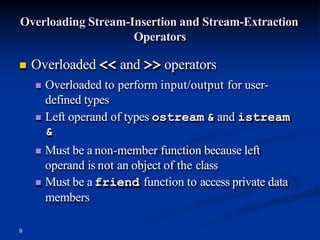
Overloading Stream-Insertion and Stream-Extraction
Operators
 Overloaded << and >> operators
 Overloaded to perform input/output for user-
defined types
 Left operand of types ostream & and istream
&
 Must be a non-member function because left
operand is not an object of the class
 Must be a friend function to access private data
members
10
Overloading Unary Operators
 Overloading unary operators
 Can be overloaded with no arguments or one
argument
 Should usually be implemented as member functions
 Avoid friend functions and classes because they
violate the encapsulation of a class
 Example declaration as a member function:
class String {
public:
bool operator!() const;
...
};
11
Overloading Unary Operators
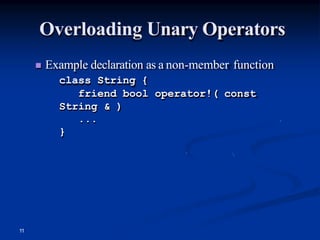
 Example declaration as a non-member function
class String {
friend bool operator!( const
String & )
...
}
12
Overloading Binary Operators
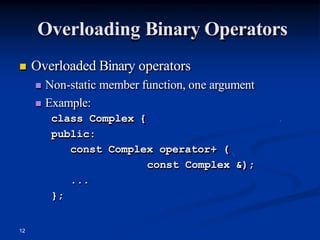
 Overloaded Binary operators
 Non-static member function, one argument
 Example:
class Complex {
public:
const Complex operator+ (
const Complex &);
...
};
13
Overloading Binary Operators
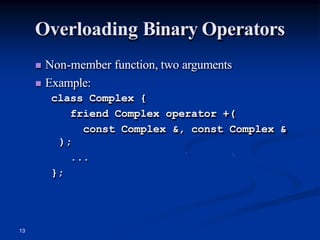
 Non-member function, two arguments
 Example:
class Complex {
friend Complex operator +(
const Complex &, const Complex &
);
...
};
Example: Operator Overloading
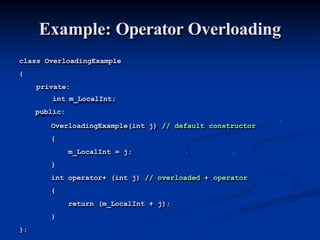
class OverloadingExample
{
private:
int m_LocalInt;
public:
OverloadingExample(int j) // default constructor
{
m_LocalInt = j;
}
int operator+ (int j) // overloaded + operator
{
return (m_LocalInt + j);
}
};
Example: Operator Overloading (contd.)
void main()
{
OverloadingExample object1(10);
cout << object1 + 10; // overloaded operator called
}
Types of Operator
 Unary operator
 Binary operator
Unary Operators
 Operators attached to a single operand (-a, +a, --
a, a--, ++a, a++)
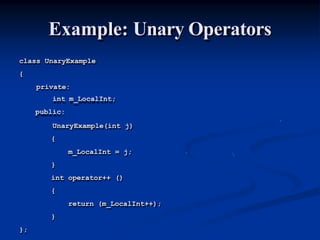
Example: Unary Operators
class UnaryExample
{
private:
int m_LocalInt;
public:
UnaryExample(int j)
{
m_LocalInt = j;
}
int operator++ ()
{
return (m_LocalInt++);
}
};
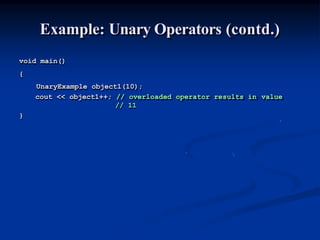
Example: Unary Operators (contd.)
void main()
{
UnaryExample object1(10);
cout << object1++; // overloaded operator results in value
// 11
}
Unary Overloaded Operators -- Member Functions
 Invocation in Two Ways-- Object@(Direct) or Object.operator@()(As a
Function)
class number{
int n;
public:
number(int x = 0):n(x){};
number operator-(){return number (-n);}
};
main()
{
number a(1), b(2), c, d;
//Invocation of "-" Operator -- direct
d = -b; //d.n = -2
//Invocation of "-" Operator -- Function
c = a.operator-(); //c.n = -1
}
20
21
Binary Overloaded Operators -- Member Functions
 Invocation in Two Ways-- ObjectA@ ObjectB(direct) or
ObjectA.operator@(ObjectB)(As a Function)
class number{
int n;
public:
number(int x = 0):n(x){};
number operator+(number ip)
{return number (ip.n + n);}
};
main()
{
number a(1), b(2), c, d;
//Invocation of "+" Operator -- direct
d = a + b; //d.n = 3
//Invocation of "+" Operator -- Function
c = d.operator+(b); //c.n = d.n + b.n = 5
}
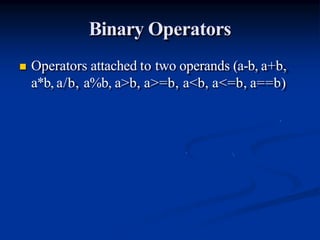
Binary Operators
 Operators attached to two operands (a-b, a+b,
a*b, a/b, a%b, a>b, a>=b, a<b, a<=b, a==b)
Example: Binary Operators
class BinaryExample
{
private:
int m_LocalInt;
public:
BinaryExample(int j)
{
m_LocalInt = j;
}
int operator+ (BinaryExample& rhsObj)
{
return (m_LocalInt + rhsObj.m_LocalInt);
}
};
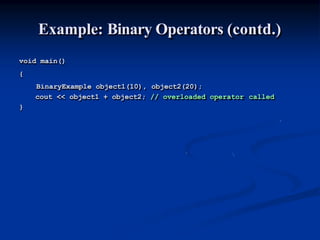
Example: Binary Operators (contd.)
void main()
{
BinaryExample object1(10), object2(20);
cout << object1 + object2; // overloaded operator called
}
Non-Overloadable Operators
 Operators that can not be overloaded due to
safety reasons:
 Member Selection ‘.’operator
 Member dereference ‘.*’operator
 Exponential ‘**’operator
 User-defined operators
 Operator precedence rules
Operator Overloading and Inheritance
 An operator is overloaded in super class but
not overloaded in derived class is called non-
member operator in derived class
 In above, if operator is also overloaded in
derived class it is called member-operator
 = ( ) []–> –>* operators must be member
operators
 Other operators can be non-member
operators
Automatic Type Conversion
 Automatic type conversion by the C++
compiler from the type that doesn’t fit, to the
type it wants
 Two types of conversion:
 Constructor conversion
 Operator conversion
Constructor Conversion
 Constructor having a single argument of another
type, results in automatic type conversion by the
compiler
 Prevention of constructor type conversion by
use of explicit keyword
Example: Constructor Conversion
class One
{
public:
One() {}
};
class Two
{
public:
Two(const One&) {}
};
void f(Two) {}
void main()
{
One one;
f(one); // Wants a Two, has a One
}
Operator Conversion
 Create a member function that takes the current
type
 Converts it to the desired type using the
operator keyword followed by the type you
want to convert to
 Return type is the name of the operator
overloaded
 Reflexivity - global overloading instead of
member overloading; for code saving
Example: Operator Conversion
class Three
{
int m_Data;
public:
Three(int ii = 0, int = 0) : m_Data(ii) {}
};
class Four
{
int m_Data;
public:
Four(int x) : m_Data(x) {}
operator Three() const
{
return Three(m_Data);
}
};
void g(Three) {}
Example: Operator Conversion (contd.)
void main()
{
Four four(1);
g(four);
g(1); // Calls Three(1,0)
}
Type Conversion Pitfalls
 Compiler performs automatic type conversion
independently, therefore it may have the
following pitfalls:
 Ambiguity with two classes of same type
 Automatic conversion to more than one type - fan-
out
 Adds hidden activities (copy-constructor etc)
Unit Summary
In this unit you have covered …
 Operator overloading
 Different types of operator
 Operators that cannot be overloaded
 Inheritance and overloading
 Automatic type conversion

Operator overloaing

  • 1.
  • 2.
    Unit Introduction This unitcovers operator overloading
  • 3.
    Unit Objectives After coveringthis unit you will understand…  Operator overloading  Different types of operator and their overloading  Operators that cannot be overloaded  Inheritance and overloading  Automatic type conversion
  • 4.
    4 Introduction  Operator overloading Enabling C++’s operators to work with class objects  Using traditional operators with user-defined objects  Requires great care; when overloading is misused, program difficult to understand  Examples of already overloaded operators  Operator << is both the stream-insertion operator and the bitwise left-shift operator  + and -, perform arithmetic on multiple types  Compiler generates the appropriate code based on the manner in which the operator is used
  • 5.
    5  Overloading anoperator  Write function definition as normal  Function name is keyword operator followed by the symbol for the operator being overloaded  operator+ used to overload the addition operator (+)  Using operators  To use an operator on a class object it must be overloaded unless the assignment operator(=)or the address operator(&)  Assignment operator by default performs memberwise assignment  Address operator (&) by default returns the address of an object
  • 6.
    6 Restrictions on OperatorOverloading  ++ operators that can be overloaded  C++ Operators that cannot be overloaded Operators that cannot be overloaded . .* :: ?: sizeof COperators that can be overloaded + - * / % ^ & | ~ ! = < > += -= *= /= %= ^= &= |= << >> >>= <<= == != <= >= && || ++ -- ->* , -> [] () new delete new[] delete[]
  • 7.
    7 Restrictions on OperatorOverloading  Overloading restrictions  Precedence of an operator cannot be changed  Associativity of an operator cannot be changed  Arity (number of operands) cannot be changed  Unary operators remain unary, and binary operators remain binary  Operators &, *, + and - each have unary and binary versions  Unary and binary versions can be overloaded separately  No new operators can be created  Use only existing operators  No overloading operators for built-in types  Cannot change how two integers are added  Produces a syntax error
  • 8.
    Operator Functions asClass Members vs. as friend Functions Member vs non-member  In general, operator functions can be member or non-member functions  When overloading ( ), [ ], -> or any of the assignment operators, must use a member function  Operator functions as member functions  Leftmost operand must be an object (or reference to an object) of the class  If left operand of a different type, operator function must be a non-member function  Operator functions as non-member functions  Must be friends if needs to access private or protected members  Enable the operator to be commutative 8
  • 9.
    9 Overloading Stream-Insertion andStream-Extraction Operators  Overloaded << and >> operators  Overloaded to perform input/output for user- defined types  Left operand of types ostream & and istream &  Must be a non-member function because left operand is not an object of the class  Must be a friend function to access private data members
  • 10.
    10 Overloading Unary Operators Overloading unary operators  Can be overloaded with no arguments or one argument  Should usually be implemented as member functions  Avoid friend functions and classes because they violate the encapsulation of a class  Example declaration as a member function: class String { public: bool operator!() const; ... };
  • 11.
    11 Overloading Unary Operators Example declaration as a non-member function class String { friend bool operator!( const String & ) ... }
  • 12.
    12 Overloading Binary Operators Overloaded Binary operators  Non-static member function, one argument  Example: class Complex { public: const Complex operator+ ( const Complex &); ... };
  • 13.
    13 Overloading Binary Operators Non-member function, two arguments  Example: class Complex { friend Complex operator +( const Complex &, const Complex & ); ... };
  • 14.
    Example: Operator Overloading classOverloadingExample { private: int m_LocalInt; public: OverloadingExample(int j) // default constructor { m_LocalInt = j; } int operator+ (int j) // overloaded + operator { return (m_LocalInt + j); } };
  • 15.
    Example: Operator Overloading(contd.) void main() { OverloadingExample object1(10); cout << object1 + 10; // overloaded operator called }
  • 16.
    Types of Operator Unary operator  Binary operator
  • 17.
    Unary Operators  Operatorsattached to a single operand (-a, +a, -- a, a--, ++a, a++)
  • 18.
    Example: Unary Operators classUnaryExample { private: int m_LocalInt; public: UnaryExample(int j) { m_LocalInt = j; } int operator++ () { return (m_LocalInt++); } };
  • 19.
    Example: Unary Operators(contd.) void main() { UnaryExample object1(10); cout << object1++; // overloaded operator results in value // 11 }
  • 20.
    Unary Overloaded Operators-- Member Functions  Invocation in Two Ways-- Object@(Direct) or Object.operator@()(As a Function) class number{ int n; public: number(int x = 0):n(x){}; number operator-(){return number (-n);} }; main() { number a(1), b(2), c, d; //Invocation of "-" Operator -- direct d = -b; //d.n = -2 //Invocation of "-" Operator -- Function c = a.operator-(); //c.n = -1 } 20
  • 21.
    21 Binary Overloaded Operators-- Member Functions  Invocation in Two Ways-- ObjectA@ ObjectB(direct) or ObjectA.operator@(ObjectB)(As a Function) class number{ int n; public: number(int x = 0):n(x){}; number operator+(number ip) {return number (ip.n + n);} }; main() { number a(1), b(2), c, d; //Invocation of "+" Operator -- direct d = a + b; //d.n = 3 //Invocation of "+" Operator -- Function c = d.operator+(b); //c.n = d.n + b.n = 5 }
  • 22.
    Binary Operators  Operatorsattached to two operands (a-b, a+b, a*b, a/b, a%b, a>b, a>=b, a<b, a<=b, a==b)
  • 23.
    Example: Binary Operators classBinaryExample { private: int m_LocalInt; public: BinaryExample(int j) { m_LocalInt = j; } int operator+ (BinaryExample& rhsObj) { return (m_LocalInt + rhsObj.m_LocalInt); } };
  • 24.
    Example: Binary Operators(contd.) void main() { BinaryExample object1(10), object2(20); cout << object1 + object2; // overloaded operator called }
  • 25.
    Non-Overloadable Operators  Operatorsthat can not be overloaded due to safety reasons:  Member Selection ‘.’operator  Member dereference ‘.*’operator  Exponential ‘**’operator  User-defined operators  Operator precedence rules
  • 26.
    Operator Overloading andInheritance  An operator is overloaded in super class but not overloaded in derived class is called non- member operator in derived class  In above, if operator is also overloaded in derived class it is called member-operator  = ( ) []–> –>* operators must be member operators  Other operators can be non-member operators
  • 27.
    Automatic Type Conversion Automatic type conversion by the C++ compiler from the type that doesn’t fit, to the type it wants  Two types of conversion:  Constructor conversion  Operator conversion
  • 28.
    Constructor Conversion  Constructorhaving a single argument of another type, results in automatic type conversion by the compiler  Prevention of constructor type conversion by use of explicit keyword
  • 29.
    Example: Constructor Conversion classOne { public: One() {} }; class Two { public: Two(const One&) {} }; void f(Two) {} void main() { One one; f(one); // Wants a Two, has a One }
  • 30.
    Operator Conversion  Createa member function that takes the current type  Converts it to the desired type using the operator keyword followed by the type you want to convert to  Return type is the name of the operator overloaded  Reflexivity - global overloading instead of member overloading; for code saving
  • 31.
    Example: Operator Conversion classThree { int m_Data; public: Three(int ii = 0, int = 0) : m_Data(ii) {} }; class Four { int m_Data; public: Four(int x) : m_Data(x) {} operator Three() const { return Three(m_Data); } }; void g(Three) {}
  • 32.
    Example: Operator Conversion(contd.) void main() { Four four(1); g(four); g(1); // Calls Three(1,0) }
  • 33.
    Type Conversion Pitfalls Compiler performs automatic type conversion independently, therefore it may have the following pitfalls:  Ambiguity with two classes of same type  Automatic conversion to more than one type - fan- out  Adds hidden activities (copy-constructor etc)
  • 34.
    Unit Summary In thisunit you have covered …  Operator overloading  Different types of operator  Operators that cannot be overloaded  Inheritance and overloading  Automatic type conversion