12th CENTRAL & EASTERN EUROPEAN
SOFTWARE ENGINEERING CONFERENCE IN RUSSIA
October 28 - 29, Moscow
Michael Wong (Codeplay Software, VP of Research and Development), Andrew Richards, CEO
ISOCPP.org Director, VP http://isocpp.org/wiki/faq/wg21#michael-wong
Head of Delegation for C++ Standard for Canada
Vice Chair of Programming Languages for Standards Council of Canada
Chair of WG21 SG5 Transactional Memory
Chair of WG21 SG14 Games Dev/Low Latency/Financial Trading/Embedded
Editor: C++ SG5 Transactional Memory Technical Specification
Editor: C++ SG1 Concurrency Technical Specification
http:://wongmichael.com/about
Heterogeneous Computing in C++ for
Self-driving cars
Agenda
 How do we get to programming self-driving cars?
 SYCL: The open Khronos standard
 A comparison of Heterogeneous Programming Models
 SYCL Design Philosophy: C++ end to end model for HPC and consumers
 The ecosystem:
 VisionCpp
 Parallel STL
 TensorFlow, Machine Vision, Neural Networks, Self-Driving Cars
 Codeplay ComputeCPP Community Edition: Free Download
How do we get from here…
… to
here
?
Level 1
• Adaptive
• Assist
Level 2
• Execute
• Automated
manoeuvres
Level 3
• Limited overall
control
Level 4
• Deep self control
• All conditions
Level 5
• Autonomous
• Stages from
very local to
extensive
journeys
Level 0
• Warnings
These are the SAE levels
for autonomous vehicles.
Similar challenges apply
in other embedded
intelligence industries
0
1
5
2
4
3
We have a mountain to climb
How do
we get
to the
top?
When we
don’t
know
what the
top looks
like...
… and we
want to get
there in
safe,
manageabl
e,
affordable
steps…
… without
getting lost
on our
own…
… or
climbing
the wrong
mountain
This presentation will focus on:
 The hardware and software platforms that will be able to
deliver the results
 The software tools to build up the solutions for those
platforms
 The open standards that will enable solutions to
interoperate
 How Codeplay can help deliver embedded intelligence
Codeplay
Standards
bodies
• HSA Foundation: Chair of software group,
spec editor of runtime and debugging
• Khronos: chair & spec editor of SYCL.
Contributors to OpenCL, Safety Critical,
Vulkan
• ISO C++: Chair of Low Latency, Embedded
WG; Editor of SG1 Concurrency TS
• EEMBC: members
Research
• Members of EU research consortiums:
PEPPHER, LPGPU, LPGPU2, CARP
• Sponsorship of PhDs and EngDs for
heterogeneous programming: HSA, FPGAs,
ray-tracing
• Collaborations with academics
• Members of HiPEAC
Open source
• HSA LLDB Debugger
• SPIR-V tools
• RenderScript debugger in AOSP
• LLDB for Qualcomm Hexagon
• TensorFlow for OpenCL
• C++ 17 Parallel STL for SYCL
• VisionCpp: C++ performance-portable
programming model for vision
Presentations
• Building an LLVM back-end
• Creating an SPMD Vectorizer for OpenCL
with LLVM
• Challenges of Mixed-Width Vector Code Gen
& Scheduling in LLVM
• C++ on Accelerators: Supporting Single-
Source SYCL and HSA
• LLDB Tutorial: Adding debugger support for
your target
Company
• Based in Edinburgh, Scotland
• 57 staff, mostly engineering
• License and customize technologies for
semiconductor companies
• ComputeAorta and ComputeCpp:
implementations of OpenCL, Vulkan and
SYCL
• 15+ years of experience in heterogeneous
systems tools
Codeplay build the software platforms that deliver massive performance
What our ComputeCpp users say about us
“We at Google have been working closely with
Luke and his Codeplay colleagues on this
project for almost 12 months now. Codeplay's
contribution to this effort has been
tremendous, so we felt that we should let them
take the lead when it comes down to
communicating updates related to OpenCL.
… we are planning to merge the work that
has been done so far… we want to put
together a comprehensive test infrastructure”
Benoit Steiner – Google TensorFlow engineer
“We work with royalty-free SYCL
because it is hardware vendor agnostic,
single-source C++ programming model
without platform specific keywords. This
will allow us to easily work with any
heterogeneous processor solutions using
OpenCL to develop our complex
algorithms and ensure future
compatibility”
ONERA
“My team and I are working with
Codeplay's ComputeCpp for almost a
year now and they have resolved every
issue in a timely manner, while
demonstrating that this technology can
work with the most complex C++
template code. I am happy to say that the
combination of Codeplay's SYCL
implementation with our HPX runtime
system has turned out to be a very
capable basis for Building a
Heterogeneous Computing Model for
the C++ Standard using high-level
abstractions.”
Hartmut Kaiser - HPX
It was a great pleasure this week for us,
that Codeplay released the ComputeCpp
project for the wider audience. We've
been waiting for this moment and
keeping our colleagues and students in
constant rally and excitement. We'd like
to build on this opportunity to increase
the awareness of this technology by
providing sample codes and talks to
potential users. We're going to give a
lecture series on modern scientific
programming providing field specific
examples.“
WIGNER Research Centre
for Physics
Where do we need to go?
“On a 100 millimetre-squared chip, Google needs something
like 50 teraflops of performance”
- Daniel Rosenband (Google’s self-driving car
project) at HotChips 2016
1
1
2
4
8
16
32
64
128
256
512
1,024
2,048
4,096
8,192
16,384
32,768
65,536
Google target
Desktop GPU
Integrated
GPU
Smartphone
GPU
Smartphone
CPU
Desktop CPU
Performance trends
GFLOPS
Year of introduction
These trend
lines seem
to violate
the rules of
physics…
How do we get there from here?
1.We need to write
software today
for platforms that
cannot be built yet
We need to start with
simpler systems
that are not fully
autonomous
We need to validate the
systems as safe
Two models of software development
Design a
model
Validate
model
Select
platform
Implement
on
platform
Write
software
Select
platform
Optimize for
platform
Validate whole
platform
Design next
version
Which method can get us all the way to full
autonomy?
Hardware
designer
writing
Software
Software designer
writing Software
Desirable Development
Well Defined Middleware
Software Application
Hardware & Low-Level Software
Write
software
Evaluate
Architecture
Select
Platform
Develop
Platform
Write
software
Optimize for
platform
Validate whole
platform
Evaluate
Software
The different levels of programming model
Device-specific
programming
•Assembly language
•VHDL
•Device-specific C-
like programming
models
Higher-level
language enabler
•NVIDIA PTX
•HSA
•OpenCL SPIR
•SPIR-V
C-level
programming
•OpenCL C
•DSP C
•MCAPI/MTAPI
C++-level
programming
•SYCL
•CUDA
•HCC
•C++ AMP
Graph
programming
•OpenCV
•OpenVX
•Halide
•VisionCpp
•TensorFlow
•Caffe
Device-specific programming
 Not a route to full
autonomy
 Does not allow
software developers
to invest today
Can deliver
quick results
today
Can…
hand-optimize
directly for the
device
Cannot …
develop software
today for future
platforms
The route to full autonomy
 Graph programming
 This is the most widely-adopted approach to machine vision
and machine learning
 Open standards
 This lets you develop today for future architectures
Why graph programming?
When you scale the
number of cores:
• You don’t scale the number
of memory ports
• Your compute performance
increases
• But your off-chip memory
bandwidth does not
increase
Therefore:
• You need to reduce
off-chip memory
bandwidth by
processing
everything on-chip
• This is achieved by
tiling
However, writing
tiled image
pipelines is hard
IIif we build up a graph of operations (e.g. convolutions) and then
have a runtime system split into fused tiled operations across an
entire system-on-chip, we get great performance
Graph programming: some numbers
0
10
20
30
40
50
60
70
80
90
100
OpenCV (nodes) OpenCV (graph) Halide (nodes) Halide (graph) SYCL (nodes) SYCL (graph)
Effect of combining graph nodes on performance
Kernel time (ms) Overhead time (ms)
In this example,
we perform 3
image
processing
operations on
an accelerator
and compare 3
systems when
executing
individual
nodes, or a
whole graph
Halide and
SYCL use
kernel fusion,
whereas
OpenCV does
not. For all 3
systems, the
performance
of the whole
graph is
significantly
better than
individual
nodes
executed on
their own
The system is an
AMD APU and the
operations are:
RGB->HSV,
channel masking,
HSV->RGB
Graph programming
 For both machine vision algorithms and machine learning,
graph programming is the most widely-adopted approach
 Two styles of graph programming that we commonly see:
C-style graph
programming
• OpenVX
• OpenCV
C++-style graph
programming
• Halide
• RapidMind
• Eigen (also inTensorFlow)
• VisionCpp
C-style graph programming
OpenVX: open standard
• Can be implemented by vendors
• Create a graph with CAPI, then map to an entire
SoC
OpenCV: open source
• Implemented on OpenCL
• Implemented on device-specific accelerators
• Create a graph with CAPI, then execute
& Device-Specific Programming
How do we adapt
it for all the graph
nodes we need?
Runtime
systems can
automatically
optimize the
graphs
Can …
develop software
today for future
platforms
What happens if
we invent our own
graph nodes?
C++-style graph programming
Examples in machine
vision/machine learning
• Halide
• RapidMind
• Eigen (also inTensorFlow)
• VisionCpp
C++ compilers that
support this style
• CUDA
• C++ OpenMP
• C++ 17 Parallel STL
• SYCL
C++ single-source programming
 C++ lets us build up graphs at compile-time
 This means we can map a graph to the processors offline
 C++ lets us write custom nodes ourselves
 This approach is called a C++ Embedded Domain-Specific
Language
 Very widely used, eg Eigen, Boost, TensorFlow,
RapidMind, Halide
Combining open
standards, C++
and graph
programming
SYCL combines C++ single-
source with OpenCL acceleration
OpenCL lets us
run on a very
wide range of
accelerators now
and in the future
Single-source is
most widely-
adopted machine
learning
programming
model
C++ single-
source lets us
create
customizable
graph models
Putting it all together: building it
Higher-level programming enablers
NVIDIA PTX
• NVIDIA CUDA-only
HSA
• Royalty-free open
standard
• HSAIL is the IR
• Provides a single
address space, with
virtual memory
• Low-latency
communication
OpenCL SPIR
• Defined for OpenCL
v1.2
• Based on Clang/LLVM
(the open-source
compiler)
SPIR-V
• Open standard
• Defined by Khronos
• Supports compute and
graphics (OpenCL,
Vulkan and OpenGL)
• Not tied to any
compiler
Open standard intermediate
representations enable tools to be
built on top and support a wide range
of platforms
Which model should we choose?
Device-specific
programming
•Assembly language
•VHDL
•Device-specific C-
like programming
models
Higher-level
language enabler
•NVIDIA PTX
•HSA
•OpenCL SPIR
•SPIR-V
C-level
programming
•OpenCL C
•DSP C
•MCAPI/MTAPI
C++-level
programming
•SYCL
•CUDA
•HCC
•C++ AMP
Graph
programming
•OpenCV
•OpenVX
•Halide
•VisionCpp
•TensorFlow
•Caffe
They are not alternatives, they are layers
Device-specific programming
Assembly language VHDL Device-specific C-like programming models
Higher-level language enabler
NVIDIA PTX HSA OpenCL SPIR SPIR-V
C/C++-level programming
SYCL CUDA HCC C++AMP OpenCL
Graph programming
OpenCV OpenVX Halide VisionCpp TensorFlow Caffe
Can specify, test and validate each layer
Device-specific programming
Device-specific specification Device-specific testing and validation
Higher-level language enabler
SPIR/SPIR-V/HSAIL specs Conformance testsuites
C/C++-level programming
OpenCL/SYCL specs Clsmith testsuite Conformance testsuites Wide range of other testsuites
Graph programming
Validate graph models Validate the code using standard tools
For Codeplay, these are our layer choices
Device-
specific
programming
• LLVM
Higher-level
language
enabler
• OpenCL SPIR
C/C++-
level
programming
• SYCL
Graph
programming
• TensorFlow
• OpenCV
We have chosen a layer of standards, based
on current market adoption
• TensorFlow and OpenCV
• SYCL
• OpenCL (with SPIR)
• LLVM as the standard compiler
back-end
The actual choice of standards may
change based on market dynamics,
but by choosing widely adopted
standards and a layering approach, it
is easy to adapt
For Codeplay, these are our products
Device-
specific
programming
• LLVM
Higher-level
language
enabler
• OpenCL SPIR
C/C++-
level
programming
• SYCL
Graph
programming
• TensorFlow
• OpenCV
Further information
 OpenCL https://www.khronos.org/opencl/
 OpenVX https://www.khronos.org/openvx/
 HSA http://www.hsafoundation.com/
 SYCL http://sycl.tech
 OpenCV http://opencv.org/
 Halide http://halide-lang.org/
 VisionCpp https://github.com/codeplaysoftware/visioncpp
Agenda
 How do we get to programming self-driving cars?
 SYCL: The open Khronos standard
 A comparison of Heterogeneous Programming Models
 SYCL Design Philosophy: C++ end to end model for HPC and consumers
 The ecosystem:
 VisionCpp
 Parallel STL
 TensorFlow, Machine Vision, Neural Networks, Self-Driving Cars
 Codeplay ComputeCPP Community Edition: Free Download
C++ support for massive parallel heterogeneous
devices
• Memory allocation (near, far memory)
• Better affinity for cpu and memory
• Templates (static, compile time)
• Exceptions
• Polymorphism
• Tasks blocks
• Execution Agents/Context
• Progress Guarantees
• Current Technical Specifications
– Concepts, Parallelism, Concurrency, TM
C++ Std Timeline/status
https://wongmichael.com/2016/06/29/c17-all-final-features-from-oulu-in-a-few-slides/
34
Pre-C++11 projects
ISO number Name Status What is it? C++17?
ISO/IEC TR 18015:2006
Technical Report on C++
Performance
Published 2006 (ISO store)
Draft: TR18015 (2006-02-
15)
C++ Performance report No
ISO/IEC TR 19768:2007
Technical Report on C++
Library Extensions
Published 2007-11-15 (ISO
store)
Draft: n1745 (2005-01-17)
TR 29124 split off, the rest
merged into C++11
Has 14 Boost libraries, 13 of
which was added to C++11.
N/A (mostly already included
into C++11)
ISO/IEC TR 29124:2010
Extensions to the C++
Library to support
mathematical special
functions
Published 2010-09-03 (ISO
Store)
Final draft: n3060 (2010-03-
06). Under consideration to
merge into C++17 by p0226
(2016-02-10)
Really, ORDINARY math
today with a Boost and
Dinkumware Implementation
YES
ISO/IEC TR 24733:2011
Extensions for the
programming language C++
to support decimal floating-
point arithmetic
Published 2011-10-25 (ISO
Store)
Draft: n2849 (2009-03-06)
May be superseded by a
future Decimal TS or merged
into C++ by n3871
Decimal Floating Point
decimal32
decimal64
decimal128
No. Ongoing work in SG6
Status after June Oulu C++ MeetingISO number Name Status links C++17?
ISO/IECTS 18822:2015
C++ File SystemTechnical
Specification
Published 2015-06-18. (ISO
store). Final draft: n4100
(2014-07-04)
Standardize Linux and
Windows file system
interface
YES
ISO/IECTS 19570:2015
C++ Extensions for
Parallelism
Published 2015-06-24. (ISO
Store). Final draft: n4507
(2015-05-05)
Parallel STL algorithms.
YES but removed dynamic
execution policy,
exception_lists, changed
some names
ISO/IECTS 19841:2015 Transactional MemoryTS
Published 2015-09-16, (ISO
Store). Final draft: n4514
(2015-05-08)
Composable lock-free
programming that scales
No.Already in GCC 6
release and waiting for
subsequent usage
experience.
ISO/IECTS 19568:2015
C++ Extensions for Library
Fundamentals
Published 2015-09-30, (ISO
Store). Final draft: n4480
(2015-04-07)
optional, any,
string_view and more
YES but moved Invocation
Traits and Polymorphic
allocators into LFTS2
ISO/IECTS 19217:2015
C++ Extensions for
Concepts
Published 2015-11-13. (ISO
Store). Final draft: n4553
(2015-10-02)
Constrained templates
No.Already in GCC 6
release and and waiting for
subsequent usage
experience.
Status after June Oulu C++ Meeting
ISO number Name Status What is it? C++17?
ISO/IECTS 19571:2016
C++ Extensions for
Concurrency
Published 2016-01-19.
(ISO Store) Final draft:
p0159r0 (2015-10-22)
improvements to
future, latches and
barriers, atomic smart
pointers
No.Already inVisual
Studio release and waiting
for subsequent usage
experience.
ISO/IEC DTS 19568:xxxx
C++ Extensions for
Library Fundamentals,
Version 2
DTS. Draft: n4564 (2015-
11-05)
source code information
capture and various
utilities
No. Resolution of
comments from national
standards bodies in
progress
ISO/IEC DTS 21425:xxxx RangesTS
In development, Draft
n4569 (2016-02-15)
Range-based algorithms
and views
No.Wording review of the
spec in progress
ISO/IEC DTS 19216:xxxx NetworkingTS
In development, Draft
n4575 (2016-02-15)
Sockets library based on
Boost.ASIO
No.Wording review of the
spec in progress.
Modules
In development, Draft
p0142r0 (2016-02-15) and
p0143r1 (2016-02-15)
A component system to
supersede the textual
header file inclusion model
No. InitialTS wording
reflects Microsoft’s design;
changes proposed by Clang
implementers expected.
Status after June Oulu C++ MeetingISO number Name Status What is it? C++17?
Numerics TS
Early development. Draft
p0101 (2015-09-27)
Various numerical facilities
No. Under active
development
ISO/IEC DTS 19571:xxxx Concurrency TS 2 Early development
Exploring executors,
synchronic types, lock-free,
atomic views, concurrent
data structures
No. Under active
development
ISO/IEC DTS 19570:xxxx Parallelism TS 2
Early development. Draft
n4578 (2016-02-22)
Exploring task blocks,
progress guarantees, SIMD.
No. Under active
development
ISO/IEC DTS 19841:xxxx Transactional Memory TS 2 Early development
Exploring on_commit,
in_transaction.
No. Under active
development.
Graphics TS
Early development. Draft
p0267r0 (2016-02-12)
2D drawing API
No. Wording review of the
spec in progress
ISO/IEC DTS 19569:xxxx Array Extensions TS
Under overhaul. Abandoned
draft: n3820 (2013-10-10)
Stack arrays whose size is not
known at compile time
No. Withdrawn; any future
proposals will target a
different vehicle
Status after June Oulu C++ MeetingISO number Name Status What is it? C++17?
Coroutine TS
Initial TS wording will reflect
Microsoft’s await design; changes
proposed by others expected.
Resumable functions No. Under active development
Reflection TS
Design direction for introspection
chosen; likely to target a future TS
Code introspection and (later)
reification mechanisms
No. Under active development
Contracts TS
Unified proposal reviewed
favourably. )
Preconditions, postconditions, etc. No. Under active development
Massive Parallelism TS Early development Massive parallelism dispatch No. Under active development.
Heterogeneous Device TS Early development. Support Hetereogeneous Devices
No. Under active development.
C++17 On track for 2017
Filesystem TS, Parallelism TS,
Library Fundamentals TS I, if
constexpr, and various other
enhancements are in. See slide 44-
47 for details.
YES
SG1 Par/Con
TS
SG5
Transactional
MemoryTS
SG14 Low
Latency
…
3
…
…
…
…
…
…
…
…
The Parallel and concurrency planets
of C++ today
C++1Y(1Y=17/20/22) SG1/SG5/SG14 Plan
red=C++17, blue=C++20? Black=future?
Parallelism
 Parallel Algorithms:
 Data-Based Parallelism.
(Vector, SIMD, ...)
 Task-based parallelism
(cilk, OpenMP, fork-join)
 Execution Agents
 Progress guarantees
 MapReduce
Concurrency
 Future++ (then, wait_any, wait_all):
 Executors:
 Resumable Functions, await (with
futures)
 Lock free techniques/Transactions
 Synchronics
 Atomic Views
 Co-routines
 Counters/Queues
 Concurrent Vector/Unordered
Associative Containers
 Latches and Barriers
 upgrade_lock
 Atomic smart pointers
Part 1: Parallel C++ Library
In C++17
42
Execution Policies Published 2015
using namespace std::experimental::parallelism;
std::vector<int> vec = ...
// previous standard sequential sort
std::sort(vec.begin(), vec.end());
// explicitly sequential sort
std::sort(std::seq, vec.begin(), vec.end());
// permitting parallel execution
std::sort(std::par, vec.begin(), vec.end());
// permitting vectorization as well
std::sort(std::par_unseq, vec.begin(), vec.end());
Part 2: Forward Progress
guarantees in C++17
44
ParallelSTL
 C++17 execution policies require concurrent or
parallel forward progress guarantees
 This means GPUs are not support by the standard execution
policies
 Executors intend to interface with execution policies
parallel_for_each(par.on(exec), vec.begin(), vec.end(),
[=](int&e){ /* … */ });
45
Forward Progress Guarantees
 C++17 forward progress guarantees are:
 Concurrent forward progress guarantees
 a thread of execution is required to make forward progress regardless of the
forward progress of any other thread of execution.
 Parallel forward progress guarantees
 a thread of execution is not required to make forward progress until an
execution step has occurred and from that point onward a thread of execution is
required to make forward progress regardless of the forward progress of any
other thread of execution.
 Weakly parallel forward progress guarantees
 a thread of execution is not required to make progress.
 These are not specific guarantees for GPUs
46
Part 3: Futures++ (.then,
wait_any, wait_all) in future C++
20
47
Futures & Continuations
 Extensions to C++11 futures
 MS-style .then continuations
 then()
 Sequential and parallel composition
 when_all() - join
 when_any() - choice
 Useful utilities:
 make_ready_future()
 is_ready()
 unwrap()
Summary Of Proposed Extensions (1)
template<typename F>
auto then(F&& func) -> future<decltype(func(*this))>;
template<typename F>
auto then(executor &ex, F&& func) -> future<decltype(func(*this))>;
template<typename F>
auto then(launch policy, F&& func) -> future<decltype(func(*this))>;
Summary Of Proposed Extensions (2)
template <typename T>
future<typename decay<T>::type> make_ready_future(T&& value);
future<void> make_ready_future();
bool is_ready() const;
template<typename R2>
future<R> future<R>::unwrap();
// R is a future<R2> or shared_future<R2>
Summary Of Proposed Extensions (3)
template <class InputIterator>
<...> when_all(InputIterator first, InputIterator last);
template <typename... T>
<...> when_all(T&&... futures);
template <class InputIterator>
<...> when_any(InputIterator first, InputIterator last);
template <typename... T>
<...> when_any(T&&... futures);
template <class InputIterator>
<see below> when_any_swapped(InputIterator first, InputIterator last);
Part 4: Executors in future
C++20
52
Executors
 Executors are to function execution what allocators are
to memory allocation
 If a control structure such as std::async() or the parallel
algorithms describe work that is to be executed
 An executor describes where and when that work is to
be executed
 http://www.open-
std.org/jtc1/sc22/wg21/docs/papers/2016/p0443r0.ht
ml
The Idea Behind Executors
Unified Interface for Execution
Several Competing Proposals
 P0008r0 (Mysen): Minimal interface for fire-and-forget
execution
 P0058r1 (Hoberock et al.): Functionality needed for
foundations of Parallelism TS
 P0113r0 (Kohlhoff): Functionality needed for
foundations of Networking TS
 P0285r0 (Kohlhoff): Executor categories &
customization points
Current Progress of Executors
 Closing in on minimal
proposal
 A foundation for later
proposals (for
heterogeneous
computing)
 Still work in progress
Current Progress of Executors
• An instruction stream is the
function you want to execute
• An executor is an interface that
describes where and when to
run an instruction stream
• An executor has one or more
execute functions
• An execute function executes
an instruction stream on light
weight execution agents such
as threads, SIMD units or GPU
threads
Current Progress of Executors
• An execution platform is a
target architecture such as
linux x86
• An execution resource is the
hardware abstraction that is
executing the work such as a
thread pool
• An execution context
manages the light weight
execution agents of an
execution resource during
the execution
Executors: Bifurcation
• Bifurcation of one-way vs two-way
• One-way –does not return anything
• Two-way –returns a future type
• Bifurcation of blocking vs non-blocking (WIP)
• May block –the calling thread may block forward progress until the execution is complete
• Always block –the calling thread always blocks forward progress until the execution is
complete
• Never block –the calling thread never blocks forward progress.
• Bifurcation of hosted vs remote
• Hosted –Execution is performed within threads of the device which the execution is
launched from, minimum of parallel forward progress guarantee between threads
• Remote –Execution is performed within threads of another remote device, minimum
Features of C++ Executors
• One-way non-blocking single execute executors
• One-way non-blocking bulk execute executors
• Remote executors with weakly parallel forward progress guarantees
• Top down relationship between execution context and executor
• Reference counting semantics in executors
• A minimal execution resource which supports bulk execute
• Nested execution contexts and executors
• Executors block on destruction
Create execution agents
Manage data they share
Advertise semantics
Mediate dependencies
class sample_executor
{
public:
using execution_category = ...;
using shape_type = tuple<size_t,size_t>;
template<class T> using future = ...;
template<class T> future<T>
make_ready_future(T&& value);
template<class Function, class Factory1,
class Factory2> future<...>
bulk_async_execute(Function f,
shape_type shape, Factory1
result_factory, Factory2
shared_factory);...
}
Executor Framework: Abstract Platform
details of execution.
Purpose of executors:where/how execution
 Placement is, by default, at discretion of the system.
 If the Programmer want to control placement:
Control relationship with Calling threads
 async (launch_flag, function)
 async (executor, function)
Executor Interface:semantic types exposed by
executors
Type Meaning
execution_category Scheduling semantics amongst agents in a task.
(sequenced, vector-parallel, parallel, concurrent)
shape_type Type for indexing bulk launch of agents.
(typically n-dimensional integer indices)
future<T> Type for synchronizing asynchronous activities.
(follows interface of std::future)
Executor Interface:core constructs for
launching work
Type of agent tasks Constructs
Single-agent tasks result sync_execute(Function f);
future<result> async_execute(Function f);
future<result> then_execute(Function f, Future& predecessor);
Multi-agent tasks result bulk_sync_execute(Function f,
shape_type shape, Factory result_factory, Factory shared_factory);
future<result> bulk_async_execute(Function f,
shape_type shape, Factory result_factory, Factory shared_factory);
future<result> bulk_then_execute(Function f, Future& predecessor,
shape_type shape, Factory result_factory, Factory shared_factory);
Vector SIMD Parallelism for Parallelism
TS2
 No standard!
 Boost.SIMD
 Proposal N3571 by Mathias Gaunard et. al., based on the Boost.SIMD
library.
 Proposal N4184 by Matthias Kretz, based on Vc library.
 Unifying efforts and expertise to provide an API to use SIMD portably
 Within C++ (P0203, P0214)
 P0193 status report
 P0203 design considerations
 Please see Pablo Halpern, Nicolas Guillemot’s and Joel Falcou’s talks on
Vector SPMD, and SIMD.
SIMD from Matthias Kretz and Mathias
Gaunard
 std::datapar<T, N, Abi>
 datapar<T, N> SIMD register holding N elements of type T
 datapar<T> same with optimal N for the currently targeted architecture
 Abi Defaulted ABI marker to make types with incompatible ABI different
 Behaves like a value of type T but applying each operation on the N values it contains,
possibly in parallel.
 Constraints
 T must be an integral or floating-point type (tuples/struct of those once we get reflection)
 N parameter under discussion, probably will need to be power of 2.
Operations on datapar
 Built-in operators
 All usual binary operators are
available, for all:
 datapar<T, N> datapar<U, N>
 datapar<T, N> U, U datapar<T, N>
 Compound binary operators and
unary operators as well
 datapar<T, N> convertible to
datapar<U, N>
 datapar<T, N>(U) broadcasts the
value
• No promotion:
• datapar<uint8_t>(255) +
datapar<uint8_t>(1) ==
datapar<uint8_t>(0)
• Comparisons and
conditionals:
• ==, !=, <, <=,> and >= perform
element-wise comparison return
mask<T, N, Abi>
• if(cond) x = y is written as
where(cond, x) = y
• cond ? x : y is written as
if_else(cond, x, y)
© Copyright Khronos Group, 2014 - Page 69
SYCL v1.2 release
Over 100 members worldwide
any company is welcome to join
BOARD OF PROMOTERS
SYCL is not magic
SYCL is a practical, open, royalty-free standard to deliver
high performance software on today’s highly-parallel systems
What is SYCL for?
 Modern C++ lets us separate the what from the how :
 We want to separate what the user wants to do: science, computer vision, AI …
 And enable the how to be: run fast on an OpenCL device
 Modern C++ supports and encourages this separation
What we want to achieve
 We want to enable a C++ ecosystem for OpenCL:
 C++ template libraries
 Tools: compilers, debuggers, IDEs, optimizers
 Training, example programs
 Long-term support for current and future OpenCL features
Why a new standard?
 There are already very established ways
to map C++ to parallel processors
 So we follow the established
approaches
 There are specifics to do with OpenCL we
need to map to C++
 We have worked hard to be an
enabler for other C++ parallel
standards
 We add no more than we need to
http://imgs.xkcd.com/comics/standards.png
What features of OpenCL do we need?
 We want to enable all OpenCL features in C++ with SYCL
 Images, work-groups, barriers, constant/global/local/private memory
 Memory sharing: mapping and DMA
 Platforms, contexts, events, queues
 Support wide range of OpenCL devices: CPUs, GPUs, FPGAs, DSPs…
 We want to make it easy to write high-performance OpenCL code in C++
 SYCL code in C++ must use memory and execute kernels efficiently
 We must provide developers with all the optimization options they have in OpenCL
 We want to enable OpenCL C code to interoperate with C++ SYCL code
 Sharing of contexts, memory objects etc
How do we bring OpenCL features to C++?
 Key decisions:
 We will not add any language extensions to C++
 We will work with existing C++ compilers
 We will provide the full OpenCL feature-set in C++
OpenCL / SYCL Stack
OpenCL Devices
SYCL for OpenCL
C++ template libraries C++ template libraries C++ template libraries
User application code
CPU
Other technologies
CPU
GPU DSP
FPGA
Custom Processor
Example SYCL Code
#include <CL/sycl.hpp>
int main ()
{
….
// Device buffers
buffer<float, 1 > buf_a(array_a, range<1>(count));
buffer<float, 1 > buf_b(array_b, range<1>(count));
buffer<float, 1 > buf_c(array_c, range<1>(count));
buffer<float, 1 > buf_r(array_r, range<1>(count));
queue myQueue;
myQueue.submit([&](handler& cgh)
{
// Data accessors
auto a = buf_a.get_access<access::read>(cgh);
auto b = buf_b.get_access<access::read>(cgh);
auto c = buf_c.get_access<access::read>(cgh);
auto r = buf_r.get_access<access::write>(cgh);
// Kernel
cgh.parallel_for<class three_way_add>(count, [=](id<> i)
{
r[i] = a[i] + b[i] + c[i];
})
);
});
….
}
Example SYCL Code
#include <CL/sycl.hpp>
void func (float *array_a, float *array_b, float *array_c,
float *array_r, size_t count)
{
buffer<float, 1 > buf_a(array_a, range<1>(count));
buffer<float, 1 > buf_b(array_b, range<1>(count));
buffer<float, 1 > buf_c(array_c, range<1>(count));
buffer<float, 1 > buf_r(array_r, range<1>(count));
queue myQueue (gpu_selector);
myQueue.submit([&](handler& cgh)
{
auto a = buf_a.get_access<access::read>(cgh);
auto b = buf_b.get_access<access::read>(cgh);
auto c = buf_c.get_access<access::read>(cgh);
auto r = buf_r.get_access<access::write>(cgh);
cgh.parallel_for<class three_way_add>(count, [=](id<1> i)
{
r[i] = a[i] + b[i] + c[i];
});
});
}
Encapsulate data in SYCL buffers
which be mapped or copied to or from
OpenCL devices
Create a queue, preferably on a GPU,
which can execute kernels
Submit to the queue all the work
described in the handler lambda that
follows
Create accessors which encapsulate the type
of access to data in the buffers
#include the SYCL header file
Execute in parallel the work over an ND
range (in this case ‘count’)
This code is executed in parallel on
the device
How did we come to our decisions?
What was our thinking?
How do we offload code to a heterogeneous device?
Compilation Model
CPU
Compiler
CPU
Object
x86 ISASource
File
Linker x86 CPU
Compilation Model
CPU
Compiler
CPU
Object
x86 ISASource
File
Linker x86 CPU
Compilation Model
CPU
Compiler
CPU
Object
x86 ISASource
File
Linker x86 CPU
GPU
How can we compile source code for a sub architectures?
 Separate source
 Single source
Separate Source Compilation Model
CPU
Compiler
CPU
Object
x86 ISASource
File
Linker x86 CPU
Device
Source
Online
Compiler
GPU
float *a, *b, *c;
…
kernel k = clCreateKernel(…, “my_kernel”, …);
clEnqueueWriteBuffer(…, size, a, …);
clEnqueueNDRange(…, k, 1, {size, 1, 1}, …);
clEnqueueWriteBuffer(…, size, c, …);
void my_kernel(__global float *a, __global float
*b,
__global float *c) {
int id = get_global_id(0);
c[id] = a[id] + b[id];
}
Here we’re using OpenCL as an example
Single Source Compilation Model
CPU
Compiler
CPU
Object
x86 ISASource
File
Linker x86 CPU
GPU
array_view<float> a, b, c;
extent<2> e(64, 64);
parallel_for_each(e, [=](index<2> idx) restrict(amp) {
c[idx] = a[idx] + b[idx];
});
Here we are using C++ AMP as an example
Single Source Compilation Model
Source
File
Devic
e
Sourc
e
Device
Compiler
Device
IR /
Object
CPU
Compiler
CPU
Object
x86 ISALinker x86 CPU
GPU
array_view<float> a, b, c;
extent<2> e(64, 64);
parallel_for_each(e, [=](index<2> idx) restrict(amp) {
c[idx] = a[idx] + b[idx];
});
Here we are using C++ AMP as an example
array_view<float> a, b, c;
extent<2> e(64, 64);
parallel_for_each(e, [=](index<2> idx) restrict(amp) {
c[idx] = a[idx] + b[idx];
});
Single Source Compilation Model
Device
Compiler
Device
IR /
Object
CPU
Compiler
CPU
Object
x86 ISA
Linker
x86 CPU
Source
File
Devic
e
Sourc
e
GPU
Here we are using C++ AMP as an example
Single Source Compilation Model
Device
Compiler
Device
IR /
Object
CPU
Compiler
CPU
Object
x86 ISA
(Embedded
Device IR /
Object)
Linker
x86 CPU
Source
File
Devic
e
Sourc
e
GPU
array_view<float> a, b, c;
extent<2> e(64, 64);
parallel_for_each(e, [=](index<2> idx) restrict(amp) {
c[idx] = a[idx] + b[idx];
});
Here we are using C++ AMP as an example
Benefits of Single Source
• Device code is written in the same source file as the host CPU code
• Allows compile-time evaluation of device code
• Supports type safety across host CPU and device
• Supports generic programming
• Removes the need to distribute source code
Describing Parallelism
How do you represent the different forms of parallelism?
 Directive vs explicit parallelism
 Task vs data parallelism
 Queue vs stream execution
Directive vs Explicit Parallelism
vector<float> a, b, c;
#pragma omp parallel for
for(int i = 0; i < a.size(); i++) {
c[i] = a[i] + b[i];
}
array_view<float> a, b, c;
extent<2> e(64, 64);
parallel_for_each(e, [=](index<2> idx)
restrict(amp) {
c[idx] = a[idx] + b[idx];
});
Examples:
• SYCL, CUDA, TBB, Fibers, C++11
Threads
Implementation:
• An API is used to explicitly enqueuer
one or more threads
Examples:
 OpenMP, OpenACC
Implementation:
 Compiler transforms code to be
parallel based on pragmas
Here we’re using C++ AMP as an exampleHere we’re using OpenMP as an example
Task vs Data Parallelism
vector<task> tasks = { … };
tbb::parallel_for_each(tasks.begin(),
tasks.end(), [=](task &v) {
task();
});
float *a, *b, *c;
cudaMalloc((void **)&a, size);
cudaMalloc((void **)&b, size);
cudaMalloc((void **)&c, size);
vec_add<<<64, 64>>>(a, b, c);
Examples:
 OpenMP, C++11 Threads, TBB
Implementation:
 Multiple (potentially different) tasks
are performed in parallel
Here we’re using CUDA as an exampleHere we’re using TBB as an example
Examples:
• C++ AMP, CUDA, SYCL, C++17
ParallelSTL
Implementation:
• The same task is performed across a
large data set
Queue vs Stream Execution
float *a, *b, *c;
cudaMalloc((void **)&a, size);
cudaMalloc((void **)&b, size);
cudaMalloc((void **)&c, size);
vec_add<<<64, 64>>>(a, b, c);
reduce void sum (float a<>,
reduce float r<>) {
r += a;
}
float a<100>;
float r;
sum(a,r);
Here we’re using BrookGPU as an example
Examples:
• BOINC, BrookGPU
Implementation:
• A function is executed on a
continuous loop on a stream of data
Here we’re using CUDA as an example
Examples:
• C++ AMP, CUDA, SYCL, C++17
ParallelSTL
Implementation:
• Functions are placed in a queue and
executed once per enqueuer
Data Locality & Movement
One of the biggest limiting factor in heterogeneous computing
 Cost of data movement in time and power consumption
Cost of Data Movement
 It can take considerable time to move data to a device
 This varies greatly depending on the architecture
 The bandwidth of a device can impose bottlenecks
 This reduces the amount of throughput you have on the device
 Performance gain from computation > cost of moving data
 If the gain is less than the cost of moving the data it’s not worth doing
 Many devices have a hierarchy of memory regions
 Global, read-only, group, private
 Each region has different size, affinity and access latency
 Having the data as close to the computation as possible reduces the
cost
Cost of Data Movement
• 64bit DP Op:
• 20pJ
• 4x64bit register read:
• 50pJ
• 4x64bit move 1mm:
• 26pJ
• 4x64bit move 40mm:
• 1nJ
• 4x64bit move DRAM:
• 16nJCredit: Bill Dally, Nvidia, 2010
How do you move data from the host CPU to a device?
 Implicit vs explicit data movement
Implicit vs Explicit Data Movement
array_view<float> ptr;
extent<2> e(64, 64);
parallel_for_each(e, [=](index<2> idx)
restrict(amp) {
ptr[idx] *= 2.0f;
});
float *h_a = { … }, d_a;
cudaMalloc((void **)&d_a, size);
cudaMemcpy(d_a, h_a, size,
cudaMemcpyHostToDevice);
vec_add<<<64, 64>>>(a, b, c);
cudaMemcpy(d_a, h_a, size,
cudaMemcpyDeviceToHost);
Examples:
 OpenCL, CUDA, OpenMP
Implementation:
 Data is moved to the device via
explicit copy APIs
Here we’re using C++ AMP as an example
Examples:
• SYCL, C++ AMP
Implementation:
• Data is moved to the device
implicitly via cross host CPU / device
data structures
Here we’re using CUDA as an example
How do you address memory between host CPU and device?
 Multiple address space
 Non-coherent single address space
 Cache coherent single address space
Comparison of Memory Models
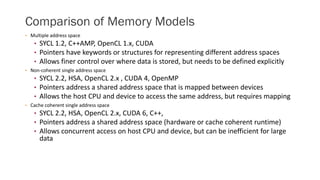
• Multiple address space
• SYCL 1.2, C++AMP, OpenCL 1.x, CUDA
• Pointers have keywords or structures for representing different address spaces
• Allows finer control over where data is stored, but needs to be defined explicitly
• Non-coherent single address space
• SYCL 2.2, HSA, OpenCL 2.x , CUDA 4, OpenMP
• Pointers address a shared address space that is mapped between devices
• Allows the host CPU and device to access the same address, but requires mapping
• Cache coherent single address space
• SYCL 2.2, HSA, OpenCL 2.x, CUDA 6, C++,
• Pointers address a shared address space (hardware or cache coherent runtime)
• Allows concurrent access on host CPU and device, but can be inefficient for large
data
SYCL: A New Approach to Heterogeneous Programming
in C++
SYCL for OpenCL
 Cross-platform, single-source, high-level, C++ programming layer
 Built on top of OpenCL and based on standard C++14
The SYCL Ecosystem
C++Application
C++Template Library
SYCL for OpenCL
OpenCL
C++Template LibraryC++Template Library
GPU APUCPU FPGAAccelerator DSP
How does SYCL improve heterogeneous offload and performance portability?
 SYCL is entirely standard C++
 SYCL compiles to SPIR
 SYCL supports a multi compilation single source model
Single Compilation Model
Device
Compiler
Device
Object
CPU
Compiler
CPU
Object
x86 ISA
(Embedded
Device
Object)
Linker
x86 CPUC++
Source
File
Devic
e
Sourc
e
GPU
Single Source Host & Device Compiler
Single Compilation Model
x86 ISA
(Embedded
Device
Object)
x86 CPUC++
Source
File
Devic
e
Sourc
e
GPU
Tied to a single
compiler chain
x86
CPU
Single Compilation Model
x86 ISA
(Embedded
AMD ISA)
AMD
GPU
C++
Source
File
C++
AMP
Sourc
eCUD
A
Sourc
eOpen
MP
Sourc
e
CUDA Compiler
C++AMP Compiler
OpenMP Compiler
x86 ISA
(Embedded
NVidia ISA)
x86 ISA
(Embedded
x86)
X86
CPU
NVidia
GPU
X86
CPU
SIMD
CPU
3 different
compilers
3 different language
extensions
3 different
executables
__global__ vec_add(float *a, float *b, float *c) {
return c[i] = a[i] + b[i];
}
float *a, *b, *c;
vec_add<<<range>>>(a, b, c);
vector<float> a, b, c;
#pragma parallel_for
for(int i = 0; i < a.size(); i++) {
c[i] = a[i] + b[i];
}
SYCL is Entirely Standard C++
cgh.parallel_for<class vec_add>(range, [=](cl::sycl::id<2> idx) {
c[idx] = a[idx] + c[idx];
}));
array_view<float> a, b, c;
extent<2> e(64, 64);
parallel_for_each(e, [=](index<2> idx) restrict(amp) {
c[idx] = a[idx] + b[idx];
});
SYCL Targets a Wide Range of Devices with SPIR
GPU APUCPU FPGAAccelerator DSP
Multi Compilation Model
SYCL
Compiler
SPIR
CPU
Compiler
CPU
Object
x86 ISA
(Embedded
SPIR)
Linker
x86 CPUC++
Source
File
Devic
e
Code GPU
Online
Finalizer
SYCL device compiler
Generating SPIR
Multi Compilation Model
SYCL
Compiler
SPIR
CPU
Compiler
CPU
Object
x86 ISA
(Embedded
SPIR)
Linker
x86 CPUC++
Source
File
Devic
e
Code GPU
Online
Finalizer
GCC, Clang,VisualC++,
Intel C++
Multi Compilation Model
SYCL
Compiler
SPIR
CPU
Compiler
CPU
Object
x86 ISA
(Embedded
SPIR)
Linker
x86 CPUC++
Source
File
Devi
ce
Cod
e
GPU
Online
Finalizer
Multi Compilation Model
SYCL
Compiler
SPIR
CPU
Compiler
CPU
Object
x86 ISA
(Embedded
SPIR)
Linker
x86 CPUC++
Source
File
Devic
e
Code
OpenCL
Online
Finalizer
SIMD
CPU
GPU
APU
FPGA
DSPDevice can be
selected at runtime
Standard IR allows for
better performance
portability
SYCL does not mandate
SPIR
Multi Compilation Model
SYCL
Compiler
SPIR
CPU
Compiler
CPU
Object
x86 ISA
(Embedded
SPIR)
Linker
x86 CPU
C++
Source
File
Devic
e
Code
OpenCL
Online
Finalizer
SIMD
CPU
GPU
APU
FPGA
DSP
SYCL
Compiler
PTX
Multi Compilation Model
SYCL
Compiler
SPIR
CPU
Compiler
CPU
Object
x86 ISA
(Embedded
SPIR)
Linker
x86 CPU
C++
Source
File
Devic
e
Code
OpenCL
Online
Finalizer
SIMD
CPU
GPU
APU
FPGA
DSP
SYCL
Compiler
PTX
PTX binary can be
selected for NVidia
GPUs at runtime
How does SYCL support different ways of representing parallelism?
 SYCL is an explicit parallelism model
 SYCL is a queue execution model
 SYCL supports both task and data parallelism
Representing Parallelism
cgh.single_task([=](){
/* task parallel task executed once*/
});
cgh.parallel_for(range<2>(64, 64), [=](id<2> idx){
/* data parallel task executed across a range */
});
How does SYCL make data movement more efficient?
 SYCL separates the storage and access of data
 SYCL can specify where data should be stored/allocated
 SYCL creates automatic data dependency graphs
Separating Storage & Access
Buffer
Accessor CPU
GPUAccessor
Buffers and
accessors type
safe access across
host and device
Accessors are used
to describe access
Buffers managed data
across host CPU and
one or more devices
Kernel
Storing/Allocating Memory in Different Regions
Buffer
Global
Accessor
Constant
Accessor
Local
Accessor
Memory stored in
global memory region
Memory stored in read-
only memory region
Memory allocated in
group memory region
Data Dependency Task Graphs
Buffer B
Buffer C
Buffer D
BufferA
Kernel B
Kernel C
Kernel A
Read Accessor
WriteAccessor
Read Accessor
WriteAccessor
Read Accessor
WriteAccessor
Read Accessor
Kernel
C
Kernel
A
Kernel
B
Benefits of Data Dependency Graphs
 Allows you to describe your problems in terms of relationships
Don’t need to en-queue explicit copies
 Removes the need for complex event handling
Dependencies between kernels are automatically
constructed
 Allows the runtime to make data movement optimizations
Pre-emptively copy data to a device before kernels
Avoid unnecessarily copying data back to the host after
execution on a device
Avoid copies of data that you don’t need
So what does SYCL look like?
 Here is a simple example SYCL application; a vector add
Example: Vector Add
Example: Vector Add
#include <CL/sycl.hpp>
template <typename T>
void parallel_add(std::vector<T> inA, std::vector<T> inB, std::vector<T> out) {
}
Example: Vector Add
#include <CL/sycl.hpp>
template <typename T>
void parallel_add(std::vector<T> inA, std::vector<T> inB, std::vector<T> out) {
cl::sycl::buffer<T, 1> inputABuf(inA.data(), out.size());
cl::sycl::buffer<T, 1> inputBBuf(inB.data(), out.size());
cl::sycl::buffer<T, 1> outputBuf(out.data(), out.size());
}
The buffers
synchronise upon
destruction
Example: Vector Add
#include <CL/sycl.hpp>
template <typename T>
void parallel_add(std::vector<T> inA, std::vector<T> inB, std::vector<T> out) {
cl::sycl::buffer<T, 1> inputABuf(inA.data(), out.size());
cl::sycl::buffer<T, 1> inputBBuf(inB.data(), out.size());
cl::sycl::buffer<T, 1> outputBuf(out.data(), out.size());
cl::sycl::queue defaultQueue;
}
Example: Vector Add
#include <CL/sycl.hpp>
template <typename T>
void parallel_add(std::vector<T> inA, std::vector<T> inB, std::vector<T> out) {
cl::sycl::buffer<T, 1> inputABuf(inA.data(), out.size());
cl::sycl::buffer<T, 1> inputBBuf(inB.data(), out.size());
cl::sycl::buffer<T, 1> outputBuf(out.data(), out.size());
cl::sycl::queue defaultQueue;
defaultQueue.submit([&] (cl::sycl::handler &cgh) {
});
}
Create a command group to
define an asynchronous task
Example: Vector Add
#include <CL/sycl.hpp>
template <typename T>
void parallel_add(std::vector<T> inA, std::vector<T> inB, std::vector<T> out) {
cl::sycl::buffer<T, 1> inputABuf(inA.data(), out.size());
cl::sycl::buffer<T, 1> inputBBuf(inB.data(), out.size());
cl::sycl::buffer<T, 1> outputBuf(out.data(), out.size());
cl::sycl::queue defaultQueue;
defaultQueue.submit([&] (cl::sycl::handler &cgh) {
auto inputAPtr = inputABuf.get_access<cl::sycl::access::read>(cgh);
auto inputBPtr = inputBBuf.get_access<cl::sycl::access::read>(cgh);
auto outputPtr = outputBuf.get_access<cl::sycl::access::write>(cgh);
});
}
Example: Vector Add
#include <CL/sycl.hpp>
template <typename T> kernel;
template <typename T>
void parallel_add(std::vector<T> inA, std::vector<T> inB, std::vector<T> out) {
cl::sycl::buffer<T, 1> inputABuf(inA.data(), out.size());
cl::sycl::buffer<T, 1> inputBBuf(inB.data(), out.size());
cl::sycl::buffer<T, 1> outputBuf(out.data(), out.size());
cl::sycl::queue defaultQueue;
defaultQueue.submit([&] (cl::sycl::handler &cgh) {
auto inputAPtr = inputABuf.get_access<cl::sycl::access::read>(cgh);
auto inputBPtr = inputBBuf.get_access<cl::sycl::access::read>(cgh);
auto outputPtr = outputBuf.get_access<cl::sycl::access::write>(cgh);
cgh.parallel_for<kernel<T>>(cl::sycl::range<1>(out.size())),
[=](cl::sycl::id<1> idx) {
}));
});
}
You must
provide a name
for the lambda
Create a parallel_for
to define the device
code
Example: Vector Add
#include <CL/sycl.hpp>
template <typename T> kernel;
template <typename T>
void parallel_add(std::vector<T> inA, std::vector<T> inB, std::vector<T> out) {
cl::sycl::buffer<T, 1> inputABuf(inA.data(), out.size());
cl::sycl::buffer<T, 1> inputBBuf(inB.data(), out.size());
cl::sycl::buffer<T, 1> outputBuf(out.data(), out.size());
cl::sycl::queue defaultQueue;
defaultQueue.submit([&] (cl::sycl::handler &cgh) {
auto inputAPtr = inputABuf.get_access<cl::sycl::access::read>(cgh);
auto inputBPtr = inputBBuf.get_access<cl::sycl::access::read>(cgh);
auto outputPtr = outputBuf.get_access<cl::sycl::access::write>(cgh);
cgh.parallel_for<kernel<T>>(cl::sycl::range<1>(out.size())),
[=](cl::sycl::id<1> idx) {
outputPtr[idx] = inputAPtr[idx] + inputBPtr[idx];
}));
});
}
Example: Vector Add
template <typename T>
void parallel_add(std::vector<T> inA, std::vector<T> inB, std::vector<T> out);
int main() {
std::vector<float> inputA = { /* input a */ };
std::vector<float> inputB = { /* input b */ };
std::vector<float> output = { /* output */ };
parallel_add(inputA, inputB, output, count);
}
Single-source vs C++ kernel language
 Single-source: a single-source file contains both host and device code
 Type-checking between host and device
 A single template instantiation can create all the code to kick off work, manage data
and execute the kernel
 e.g. sort<MyClass> (myData);
 The approach taken by C++ 17 Parallel STL as well as SYCL
 C++ kernel language
 Matches standard OpenCL C
 Proposed for OpenCL v2.1
 Being considered as an addition for SYCL v2.1
Why ‘name’ kernels?
 Enables implementers to have multiple, different compilers for host and different devices
 With SYCL, software developers can choose to use the best compiler for CPU and the
best compiler for each individual device they want to support
 The resulting application will be highly optimized for CPU and OpenCL devices
 Easy-to-integrate into existing build systems
 Only required for C++11 lambdas, not required for C++ functors
 Required because lambdas don’t have a name to enable linking between different
compilers
Buffers/images/accessors vs shared pointers
 OpenCL v1.2 supports a wide range of different devices and operating systems
 All shared data must be encapsulated in OpenCL memory objects: buffers and images
 To enable SYCL to achieve maximum performance of OpenCL, we follow OpenCL’s
memory model approach
 But, we apply OpenCL’s memory model to C++ with buffers, images and accessors
 Separation of data storage and data access
What can I do with SYCL?
Anything you can do with C++!
With the performance and portability of OpenCL
Progress report on the SYCL vision
Open, royalty-free standard: released
Conformance testsuite: going into adopters package
Open-source implementation: in progress (triSYCL)
Commercial, conformant implementation: in progress
C++ 17 Parallel STL: open-source in progress
 Template libraries for important C++ algorithms: getting going
 Integration into existing parallel C++ libraries: getting going
Building the SYCL for OpenCL ecosystem
 To deliver on the full potential of high-performance heterogeneous systems
 We need the libraries
 We need integrated tools
 We need implementations
 We need training and examples
 An open standard makes it much easier for people to work together
 SYCL is a group effort
 We have designed SYCL for maximum ease of integration
Agenda
 How do we get to programming self-driving cars?
 SYCL: The open Khronos standard
 A comparison of Heterogeneous Programming Models
 SYCL Design Philosophy: C++ end to end model for HPC and consumers
 The ecosystem:
 VisionCpp
 Parallel STL
 TensorFlow, Machine Vision, Neural Networks, Self-Driving Cars
 Codeplay ComputeCPP Community Edition: Free Download
Using SYCL to Develop Vision Tools
A high-level CV framework
for OpenCL promoting:
Cross-platform portability
Performance portability
• Separation of concern
• Portable between different programming models and
architectures
• No modification in application
computation
• OpenCL enabled devices
• CPU
Ease of use
• Applications
• Easy to write code
• Unified front end to client code (API)
• Easily able to add customisable operations
• Compile time graph validation
• Predictable memory usage
A worthy addition to your tool kit
ExecutionTime(ms)
Image
Size
0.968
3.579
13.51
57.291
1.603
4.513
13.375
[VALUE]
0
10
20
30
40
50
60
70
512 1024 2048 4096
VisionCPPFuse
OpenCV
Intel Core i7-4790K CPU 4.00GHz Image Size
ExecutionTime(ms)
Oland PRO Radeon R7 240
Parallel STL: Democratizing Parallelism in C++
 Various libraries offered STL-like interface for parallel algorithms
 Thrust, Bolt, libstdc++ Parallel Mode, AMP algorithms
 In 2012, two separate proposals for parallelism to C++ standard:
 NVIDIA (N3408), based on Thrust (CUDA-based C++ library)
 Microsoft and Intel (N3429), based on Intel TBB andPPL/C++AMP
 Made joint proposal (N3554) suggested by SG1
 Many working drafts for N3554, N3850, N3960, N4071, N4409
 Final proposal P0024R2 accepted for C++17 during Jacksonville
Existing implementations
 Following the evolution of the document
 Microsoft: http://parallelstl.codeplex.com
 HPX: http://stellar-
group.github.io/hpx/docs/html/hpx/manual/parallel.html
 HSA: http://www.hsafoundation.com/hsa-for-math-
science
 Thibaut Lutz: http://github.com/t-lutz/ParallelSTL
 NVIDIA: http://github.com/n3554/n3554
 Codeplay:
http://github.com/KhronosGroup/SyclParallelSTL
What is Parallelism TS v1 adding?
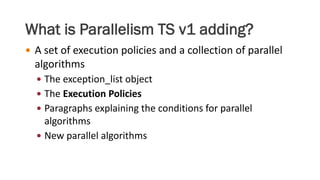
 A set of execution policies and a collection of parallel
algorithms
 The exception_list object
 The Execution Policies
 Paragraphs explaining the conditions for parallel
algorithms
 New parallel algorithms
std :: vector <int > data = { 8, 9, 1, 4 };
std :: sort ( std :: begin ( data ), std :: end( data
));
if ( std :: is_sorted ( data )) {
cout << " Data is sorted ! " << endl ;
}
Sorting with the STL
A sequential sort
std :: vector <int > data = { 8, 9, 1, 4 };
std :: sort ( std :: par , std :: begin ( data ), std :: end ( data
));
if ( std :: is_sorted ( data )) {
cout << " Data is sorted ! " << endl ;
}
A parallel sort
• par is an object of an Execution
Policy
• The sort will be executed in
parallel using an implementation-
defined method
template <typename KernelName = DefaultKernelName >
class sycl_execution_policy {
public :
using kernelName = KernelName ;
sycl_execution_policy () = default ;
sycl_execution_policy (cl :: sycl :: queue q);
cl :: sycl :: queue get_queue () const ;
};
The SYCL execution policy
std :: vector <int > data = { 8, 9, 1, 4 };
std :: sort ( sycl_policy , std :: begin (v), std :: end (v));
if ( std :: is_sorted ( data )) {
cout << " Data is sorted ! " << endl ;
}
• sycl_policy is an Execution Policy
• data is a standard stl::vector
• Technically, will use the device returned by
default_selector
Heterogeneous load balancing
Future work
https://github.com/KhronosGroup/SyclParallelSTL
Other projects – in progress
Eigen: C++
linear algebra
template
library
TensorFlow:
Google’s
machine
learning
library
+ others …
Conclusion
 Heterogeneous programming has been supported through OpenCL for years
 C++ is a prominent language for doing this but currently is only CPU-based
 Graph programming languages enables Neural network, machine vision
 SYCL allows you to program heterogeneous devices with standard C++ today
 ComputeCpp is available now for you to download and experiment
 For engineers/companies/consortiums producing embedded devices for automotive ADAS,
machine vision, or neural network
 Who want to deliver artificial intelligent devices that are also low power for e.g. self-driving cars,
smart homes
 But who are dissatisfied with the current single vendor locked in heterogeneous solution or
design/code with no reuse solution
 We provide performance-portable open-standard software across multiple platforms with long-
term support
 Unlike vertical locked in solutions such as CUDA, C++AMP, or HCC
 We have assembled a whole ecosystem of software accelerated by your parallel hardware enabling
reuse with open standards
Agenda
 How do we get to programming self-driving cars?
 SYCL: The open Khronos standard
 A comparison of Heterogeneous Programming Models
 SYCL Design Philosophy: C++ end to end model for HPC and consumers
 The ecosystem:
 VisionCpp
 Parallel STL
 TensorFlow, Machine Vision, Neural Networks, Self-Driving Cars
 Codeplay ComputeCPP Community Edition: Free Download
Community Edition
Available now for free!
Visit:
computecpp.codeplay.com
 Open source SYCL projects:
 ComputeCpp SDK - Collection of sample code and integration tools
 SYCL ParallelSTL – SYCL based implementation of the parallel algorithms
 VisionCpp – Compile-time embedded DSL for image processing
 Eigen C++ Template Library – Compile-time library for machine learning
All of this and more at: http://sycl.tech
Recommendations for the authors
 We encourage you to use this template, although it is not mandatory
 If you use your own template, please insert the CEE-SECR logo anywhere on
the title page. Just copy it from here:
 Consider the “Death by PowerPoint” recommendations:
http://www.slideshare.net/thecroaker/death-by-powerpoint

Массовый параллелизм для гетерогенных вычислений на C++ для беспилотных автомобилей

  • 1.
    12th CENTRAL &EASTERN EUROPEAN SOFTWARE ENGINEERING CONFERENCE IN RUSSIA October 28 - 29, Moscow Michael Wong (Codeplay Software, VP of Research and Development), Andrew Richards, CEO ISOCPP.org Director, VP http://isocpp.org/wiki/faq/wg21#michael-wong Head of Delegation for C++ Standard for Canada Vice Chair of Programming Languages for Standards Council of Canada Chair of WG21 SG5 Transactional Memory Chair of WG21 SG14 Games Dev/Low Latency/Financial Trading/Embedded Editor: C++ SG5 Transactional Memory Technical Specification Editor: C++ SG1 Concurrency Technical Specification http:://wongmichael.com/about Heterogeneous Computing in C++ for Self-driving cars
  • 2.
    Agenda  How dowe get to programming self-driving cars?  SYCL: The open Khronos standard  A comparison of Heterogeneous Programming Models  SYCL Design Philosophy: C++ end to end model for HPC and consumers  The ecosystem:  VisionCpp  Parallel STL  TensorFlow, Machine Vision, Neural Networks, Self-Driving Cars  Codeplay ComputeCPP Community Edition: Free Download
  • 3.
    How do weget from here… … to here ? Level 1 • Adaptive • Assist Level 2 • Execute • Automated manoeuvres Level 3 • Limited overall control Level 4 • Deep self control • All conditions Level 5 • Autonomous • Stages from very local to extensive journeys Level 0 • Warnings These are the SAE levels for autonomous vehicles. Similar challenges apply in other embedded intelligence industries 0 1 5 2 4 3
  • 4.
    We have amountain to climb How do we get to the top? When we don’t know what the top looks like... … and we want to get there in safe, manageabl e, affordable steps… … without getting lost on our own… … or climbing the wrong mountain
  • 5.
    This presentation willfocus on:  The hardware and software platforms that will be able to deliver the results  The software tools to build up the solutions for those platforms  The open standards that will enable solutions to interoperate  How Codeplay can help deliver embedded intelligence
  • 6.
    Codeplay Standards bodies • HSA Foundation:Chair of software group, spec editor of runtime and debugging • Khronos: chair & spec editor of SYCL. Contributors to OpenCL, Safety Critical, Vulkan • ISO C++: Chair of Low Latency, Embedded WG; Editor of SG1 Concurrency TS • EEMBC: members Research • Members of EU research consortiums: PEPPHER, LPGPU, LPGPU2, CARP • Sponsorship of PhDs and EngDs for heterogeneous programming: HSA, FPGAs, ray-tracing • Collaborations with academics • Members of HiPEAC Open source • HSA LLDB Debugger • SPIR-V tools • RenderScript debugger in AOSP • LLDB for Qualcomm Hexagon • TensorFlow for OpenCL • C++ 17 Parallel STL for SYCL • VisionCpp: C++ performance-portable programming model for vision Presentations • Building an LLVM back-end • Creating an SPMD Vectorizer for OpenCL with LLVM • Challenges of Mixed-Width Vector Code Gen & Scheduling in LLVM • C++ on Accelerators: Supporting Single- Source SYCL and HSA • LLDB Tutorial: Adding debugger support for your target Company • Based in Edinburgh, Scotland • 57 staff, mostly engineering • License and customize technologies for semiconductor companies • ComputeAorta and ComputeCpp: implementations of OpenCL, Vulkan and SYCL • 15+ years of experience in heterogeneous systems tools Codeplay build the software platforms that deliver massive performance
  • 7.
    What our ComputeCppusers say about us “We at Google have been working closely with Luke and his Codeplay colleagues on this project for almost 12 months now. Codeplay's contribution to this effort has been tremendous, so we felt that we should let them take the lead when it comes down to communicating updates related to OpenCL. … we are planning to merge the work that has been done so far… we want to put together a comprehensive test infrastructure” Benoit Steiner – Google TensorFlow engineer “We work with royalty-free SYCL because it is hardware vendor agnostic, single-source C++ programming model without platform specific keywords. This will allow us to easily work with any heterogeneous processor solutions using OpenCL to develop our complex algorithms and ensure future compatibility” ONERA “My team and I are working with Codeplay's ComputeCpp for almost a year now and they have resolved every issue in a timely manner, while demonstrating that this technology can work with the most complex C++ template code. I am happy to say that the combination of Codeplay's SYCL implementation with our HPX runtime system has turned out to be a very capable basis for Building a Heterogeneous Computing Model for the C++ Standard using high-level abstractions.” Hartmut Kaiser - HPX It was a great pleasure this week for us, that Codeplay released the ComputeCpp project for the wider audience. We've been waiting for this moment and keeping our colleagues and students in constant rally and excitement. We'd like to build on this opportunity to increase the awareness of this technology by providing sample codes and talks to potential users. We're going to give a lecture series on modern scientific programming providing field specific examples.“ WIGNER Research Centre for Physics
  • 8.
    Where do weneed to go? “On a 100 millimetre-squared chip, Google needs something like 50 teraflops of performance” - Daniel Rosenband (Google’s self-driving car project) at HotChips 2016
  • 9.
    1 1 2 4 8 16 32 64 128 256 512 1,024 2,048 4,096 8,192 16,384 32,768 65,536 Google target Desktop GPU Integrated GPU Smartphone GPU Smartphone CPU DesktopCPU Performance trends GFLOPS Year of introduction These trend lines seem to violate the rules of physics…
  • 10.
    How do weget there from here? 1.We need to write software today for platforms that cannot be built yet We need to start with simpler systems that are not fully autonomous We need to validate the systems as safe
  • 11.
    Two models ofsoftware development Design a model Validate model Select platform Implement on platform Write software Select platform Optimize for platform Validate whole platform Design next version Which method can get us all the way to full autonomy? Hardware designer writing Software Software designer writing Software
  • 12.
    Desirable Development Well DefinedMiddleware Software Application Hardware & Low-Level Software Write software Evaluate Architecture Select Platform Develop Platform Write software Optimize for platform Validate whole platform Evaluate Software
  • 13.
    The different levelsof programming model Device-specific programming •Assembly language •VHDL •Device-specific C- like programming models Higher-level language enabler •NVIDIA PTX •HSA •OpenCL SPIR •SPIR-V C-level programming •OpenCL C •DSP C •MCAPI/MTAPI C++-level programming •SYCL •CUDA •HCC •C++ AMP Graph programming •OpenCV •OpenVX •Halide •VisionCpp •TensorFlow •Caffe
  • 14.
    Device-specific programming  Nota route to full autonomy  Does not allow software developers to invest today Can deliver quick results today Can… hand-optimize directly for the device Cannot … develop software today for future platforms
  • 15.
    The route tofull autonomy  Graph programming  This is the most widely-adopted approach to machine vision and machine learning  Open standards  This lets you develop today for future architectures
  • 16.
    Why graph programming? Whenyou scale the number of cores: • You don’t scale the number of memory ports • Your compute performance increases • But your off-chip memory bandwidth does not increase Therefore: • You need to reduce off-chip memory bandwidth by processing everything on-chip • This is achieved by tiling However, writing tiled image pipelines is hard IIif we build up a graph of operations (e.g. convolutions) and then have a runtime system split into fused tiled operations across an entire system-on-chip, we get great performance
  • 17.
    Graph programming: somenumbers 0 10 20 30 40 50 60 70 80 90 100 OpenCV (nodes) OpenCV (graph) Halide (nodes) Halide (graph) SYCL (nodes) SYCL (graph) Effect of combining graph nodes on performance Kernel time (ms) Overhead time (ms) In this example, we perform 3 image processing operations on an accelerator and compare 3 systems when executing individual nodes, or a whole graph Halide and SYCL use kernel fusion, whereas OpenCV does not. For all 3 systems, the performance of the whole graph is significantly better than individual nodes executed on their own The system is an AMD APU and the operations are: RGB->HSV, channel masking, HSV->RGB
  • 18.
    Graph programming  Forboth machine vision algorithms and machine learning, graph programming is the most widely-adopted approach  Two styles of graph programming that we commonly see: C-style graph programming • OpenVX • OpenCV C++-style graph programming • Halide • RapidMind • Eigen (also inTensorFlow) • VisionCpp
  • 19.
    C-style graph programming OpenVX:open standard • Can be implemented by vendors • Create a graph with CAPI, then map to an entire SoC OpenCV: open source • Implemented on OpenCL • Implemented on device-specific accelerators • Create a graph with CAPI, then execute
  • 20.
    & Device-Specific Programming Howdo we adapt it for all the graph nodes we need? Runtime systems can automatically optimize the graphs Can … develop software today for future platforms What happens if we invent our own graph nodes?
  • 21.
    C++-style graph programming Examplesin machine vision/machine learning • Halide • RapidMind • Eigen (also inTensorFlow) • VisionCpp C++ compilers that support this style • CUDA • C++ OpenMP • C++ 17 Parallel STL • SYCL
  • 22.
    C++ single-source programming C++ lets us build up graphs at compile-time  This means we can map a graph to the processors offline  C++ lets us write custom nodes ourselves  This approach is called a C++ Embedded Domain-Specific Language  Very widely used, eg Eigen, Boost, TensorFlow, RapidMind, Halide
  • 23.
    Combining open standards, C++ andgraph programming SYCL combines C++ single- source with OpenCL acceleration OpenCL lets us run on a very wide range of accelerators now and in the future Single-source is most widely- adopted machine learning programming model C++ single- source lets us create customizable graph models
  • 24.
    Putting it alltogether: building it
  • 25.
    Higher-level programming enablers NVIDIAPTX • NVIDIA CUDA-only HSA • Royalty-free open standard • HSAIL is the IR • Provides a single address space, with virtual memory • Low-latency communication OpenCL SPIR • Defined for OpenCL v1.2 • Based on Clang/LLVM (the open-source compiler) SPIR-V • Open standard • Defined by Khronos • Supports compute and graphics (OpenCL, Vulkan and OpenGL) • Not tied to any compiler Open standard intermediate representations enable tools to be built on top and support a wide range of platforms
  • 26.
    Which model shouldwe choose? Device-specific programming •Assembly language •VHDL •Device-specific C- like programming models Higher-level language enabler •NVIDIA PTX •HSA •OpenCL SPIR •SPIR-V C-level programming •OpenCL C •DSP C •MCAPI/MTAPI C++-level programming •SYCL •CUDA •HCC •C++ AMP Graph programming •OpenCV •OpenVX •Halide •VisionCpp •TensorFlow •Caffe
  • 27.
    They are notalternatives, they are layers Device-specific programming Assembly language VHDL Device-specific C-like programming models Higher-level language enabler NVIDIA PTX HSA OpenCL SPIR SPIR-V C/C++-level programming SYCL CUDA HCC C++AMP OpenCL Graph programming OpenCV OpenVX Halide VisionCpp TensorFlow Caffe
  • 28.
    Can specify, testand validate each layer Device-specific programming Device-specific specification Device-specific testing and validation Higher-level language enabler SPIR/SPIR-V/HSAIL specs Conformance testsuites C/C++-level programming OpenCL/SYCL specs Clsmith testsuite Conformance testsuites Wide range of other testsuites Graph programming Validate graph models Validate the code using standard tools
  • 29.
    For Codeplay, theseare our layer choices Device- specific programming • LLVM Higher-level language enabler • OpenCL SPIR C/C++- level programming • SYCL Graph programming • TensorFlow • OpenCV We have chosen a layer of standards, based on current market adoption • TensorFlow and OpenCV • SYCL • OpenCL (with SPIR) • LLVM as the standard compiler back-end The actual choice of standards may change based on market dynamics, but by choosing widely adopted standards and a layering approach, it is easy to adapt
  • 30.
    For Codeplay, theseare our products Device- specific programming • LLVM Higher-level language enabler • OpenCL SPIR C/C++- level programming • SYCL Graph programming • TensorFlow • OpenCV
  • 31.
    Further information  OpenCLhttps://www.khronos.org/opencl/  OpenVX https://www.khronos.org/openvx/  HSA http://www.hsafoundation.com/  SYCL http://sycl.tech  OpenCV http://opencv.org/  Halide http://halide-lang.org/  VisionCpp https://github.com/codeplaysoftware/visioncpp
  • 32.
    Agenda  How dowe get to programming self-driving cars?  SYCL: The open Khronos standard  A comparison of Heterogeneous Programming Models  SYCL Design Philosophy: C++ end to end model for HPC and consumers  The ecosystem:  VisionCpp  Parallel STL  TensorFlow, Machine Vision, Neural Networks, Self-Driving Cars  Codeplay ComputeCPP Community Edition: Free Download
  • 33.
    C++ support formassive parallel heterogeneous devices • Memory allocation (near, far memory) • Better affinity for cpu and memory • Templates (static, compile time) • Exceptions • Polymorphism • Tasks blocks • Execution Agents/Context • Progress Guarantees • Current Technical Specifications – Concepts, Parallelism, Concurrency, TM
  • 34.
  • 35.
    Pre-C++11 projects ISO numberName Status What is it? C++17? ISO/IEC TR 18015:2006 Technical Report on C++ Performance Published 2006 (ISO store) Draft: TR18015 (2006-02- 15) C++ Performance report No ISO/IEC TR 19768:2007 Technical Report on C++ Library Extensions Published 2007-11-15 (ISO store) Draft: n1745 (2005-01-17) TR 29124 split off, the rest merged into C++11 Has 14 Boost libraries, 13 of which was added to C++11. N/A (mostly already included into C++11) ISO/IEC TR 29124:2010 Extensions to the C++ Library to support mathematical special functions Published 2010-09-03 (ISO Store) Final draft: n3060 (2010-03- 06). Under consideration to merge into C++17 by p0226 (2016-02-10) Really, ORDINARY math today with a Boost and Dinkumware Implementation YES ISO/IEC TR 24733:2011 Extensions for the programming language C++ to support decimal floating- point arithmetic Published 2011-10-25 (ISO Store) Draft: n2849 (2009-03-06) May be superseded by a future Decimal TS or merged into C++ by n3871 Decimal Floating Point decimal32 decimal64 decimal128 No. Ongoing work in SG6
  • 36.
    Status after JuneOulu C++ MeetingISO number Name Status links C++17? ISO/IECTS 18822:2015 C++ File SystemTechnical Specification Published 2015-06-18. (ISO store). Final draft: n4100 (2014-07-04) Standardize Linux and Windows file system interface YES ISO/IECTS 19570:2015 C++ Extensions for Parallelism Published 2015-06-24. (ISO Store). Final draft: n4507 (2015-05-05) Parallel STL algorithms. YES but removed dynamic execution policy, exception_lists, changed some names ISO/IECTS 19841:2015 Transactional MemoryTS Published 2015-09-16, (ISO Store). Final draft: n4514 (2015-05-08) Composable lock-free programming that scales No.Already in GCC 6 release and waiting for subsequent usage experience. ISO/IECTS 19568:2015 C++ Extensions for Library Fundamentals Published 2015-09-30, (ISO Store). Final draft: n4480 (2015-04-07) optional, any, string_view and more YES but moved Invocation Traits and Polymorphic allocators into LFTS2 ISO/IECTS 19217:2015 C++ Extensions for Concepts Published 2015-11-13. (ISO Store). Final draft: n4553 (2015-10-02) Constrained templates No.Already in GCC 6 release and and waiting for subsequent usage experience.
  • 37.
    Status after JuneOulu C++ Meeting ISO number Name Status What is it? C++17? ISO/IECTS 19571:2016 C++ Extensions for Concurrency Published 2016-01-19. (ISO Store) Final draft: p0159r0 (2015-10-22) improvements to future, latches and barriers, atomic smart pointers No.Already inVisual Studio release and waiting for subsequent usage experience. ISO/IEC DTS 19568:xxxx C++ Extensions for Library Fundamentals, Version 2 DTS. Draft: n4564 (2015- 11-05) source code information capture and various utilities No. Resolution of comments from national standards bodies in progress ISO/IEC DTS 21425:xxxx RangesTS In development, Draft n4569 (2016-02-15) Range-based algorithms and views No.Wording review of the spec in progress ISO/IEC DTS 19216:xxxx NetworkingTS In development, Draft n4575 (2016-02-15) Sockets library based on Boost.ASIO No.Wording review of the spec in progress. Modules In development, Draft p0142r0 (2016-02-15) and p0143r1 (2016-02-15) A component system to supersede the textual header file inclusion model No. InitialTS wording reflects Microsoft’s design; changes proposed by Clang implementers expected.
  • 38.
    Status after JuneOulu C++ MeetingISO number Name Status What is it? C++17? Numerics TS Early development. Draft p0101 (2015-09-27) Various numerical facilities No. Under active development ISO/IEC DTS 19571:xxxx Concurrency TS 2 Early development Exploring executors, synchronic types, lock-free, atomic views, concurrent data structures No. Under active development ISO/IEC DTS 19570:xxxx Parallelism TS 2 Early development. Draft n4578 (2016-02-22) Exploring task blocks, progress guarantees, SIMD. No. Under active development ISO/IEC DTS 19841:xxxx Transactional Memory TS 2 Early development Exploring on_commit, in_transaction. No. Under active development. Graphics TS Early development. Draft p0267r0 (2016-02-12) 2D drawing API No. Wording review of the spec in progress ISO/IEC DTS 19569:xxxx Array Extensions TS Under overhaul. Abandoned draft: n3820 (2013-10-10) Stack arrays whose size is not known at compile time No. Withdrawn; any future proposals will target a different vehicle
  • 39.
    Status after JuneOulu C++ MeetingISO number Name Status What is it? C++17? Coroutine TS Initial TS wording will reflect Microsoft’s await design; changes proposed by others expected. Resumable functions No. Under active development Reflection TS Design direction for introspection chosen; likely to target a future TS Code introspection and (later) reification mechanisms No. Under active development Contracts TS Unified proposal reviewed favourably. ) Preconditions, postconditions, etc. No. Under active development Massive Parallelism TS Early development Massive parallelism dispatch No. Under active development. Heterogeneous Device TS Early development. Support Hetereogeneous Devices No. Under active development. C++17 On track for 2017 Filesystem TS, Parallelism TS, Library Fundamentals TS I, if constexpr, and various other enhancements are in. See slide 44- 47 for details. YES
  • 40.
  • 41.
    C++1Y(1Y=17/20/22) SG1/SG5/SG14 Plan red=C++17,blue=C++20? Black=future? Parallelism  Parallel Algorithms:  Data-Based Parallelism. (Vector, SIMD, ...)  Task-based parallelism (cilk, OpenMP, fork-join)  Execution Agents  Progress guarantees  MapReduce Concurrency  Future++ (then, wait_any, wait_all):  Executors:  Resumable Functions, await (with futures)  Lock free techniques/Transactions  Synchronics  Atomic Views  Co-routines  Counters/Queues  Concurrent Vector/Unordered Associative Containers  Latches and Barriers  upgrade_lock  Atomic smart pointers
  • 42.
    Part 1: ParallelC++ Library In C++17 42
  • 43.
    Execution Policies Published2015 using namespace std::experimental::parallelism; std::vector<int> vec = ... // previous standard sequential sort std::sort(vec.begin(), vec.end()); // explicitly sequential sort std::sort(std::seq, vec.begin(), vec.end()); // permitting parallel execution std::sort(std::par, vec.begin(), vec.end()); // permitting vectorization as well std::sort(std::par_unseq, vec.begin(), vec.end());
  • 44.
    Part 2: ForwardProgress guarantees in C++17 44
  • 45.
    ParallelSTL  C++17 executionpolicies require concurrent or parallel forward progress guarantees  This means GPUs are not support by the standard execution policies  Executors intend to interface with execution policies parallel_for_each(par.on(exec), vec.begin(), vec.end(), [=](int&e){ /* … */ }); 45
  • 46.
    Forward Progress Guarantees C++17 forward progress guarantees are:  Concurrent forward progress guarantees  a thread of execution is required to make forward progress regardless of the forward progress of any other thread of execution.  Parallel forward progress guarantees  a thread of execution is not required to make forward progress until an execution step has occurred and from that point onward a thread of execution is required to make forward progress regardless of the forward progress of any other thread of execution.  Weakly parallel forward progress guarantees  a thread of execution is not required to make progress.  These are not specific guarantees for GPUs 46
  • 47.
    Part 3: Futures++(.then, wait_any, wait_all) in future C++ 20 47
  • 48.
    Futures & Continuations Extensions to C++11 futures  MS-style .then continuations  then()  Sequential and parallel composition  when_all() - join  when_any() - choice  Useful utilities:  make_ready_future()  is_ready()  unwrap()
  • 49.
    Summary Of ProposedExtensions (1) template<typename F> auto then(F&& func) -> future<decltype(func(*this))>; template<typename F> auto then(executor &ex, F&& func) -> future<decltype(func(*this))>; template<typename F> auto then(launch policy, F&& func) -> future<decltype(func(*this))>;
  • 50.
    Summary Of ProposedExtensions (2) template <typename T> future<typename decay<T>::type> make_ready_future(T&& value); future<void> make_ready_future(); bool is_ready() const; template<typename R2> future<R> future<R>::unwrap(); // R is a future<R2> or shared_future<R2>
  • 51.
    Summary Of ProposedExtensions (3) template <class InputIterator> <...> when_all(InputIterator first, InputIterator last); template <typename... T> <...> when_all(T&&... futures); template <class InputIterator> <...> when_any(InputIterator first, InputIterator last); template <typename... T> <...> when_any(T&&... futures); template <class InputIterator> <see below> when_any_swapped(InputIterator first, InputIterator last);
  • 52.
    Part 4: Executorsin future C++20 52
  • 53.
    Executors  Executors areto function execution what allocators are to memory allocation  If a control structure such as std::async() or the parallel algorithms describe work that is to be executed  An executor describes where and when that work is to be executed  http://www.open- std.org/jtc1/sc22/wg21/docs/papers/2016/p0443r0.ht ml
  • 54.
    The Idea BehindExecutors Unified Interface for Execution
  • 55.
    Several Competing Proposals P0008r0 (Mysen): Minimal interface for fire-and-forget execution  P0058r1 (Hoberock et al.): Functionality needed for foundations of Parallelism TS  P0113r0 (Kohlhoff): Functionality needed for foundations of Networking TS  P0285r0 (Kohlhoff): Executor categories & customization points
  • 56.
    Current Progress ofExecutors  Closing in on minimal proposal  A foundation for later proposals (for heterogeneous computing)  Still work in progress
  • 57.
    Current Progress ofExecutors • An instruction stream is the function you want to execute • An executor is an interface that describes where and when to run an instruction stream • An executor has one or more execute functions • An execute function executes an instruction stream on light weight execution agents such as threads, SIMD units or GPU threads
  • 58.
    Current Progress ofExecutors • An execution platform is a target architecture such as linux x86 • An execution resource is the hardware abstraction that is executing the work such as a thread pool • An execution context manages the light weight execution agents of an execution resource during the execution
  • 59.
    Executors: Bifurcation • Bifurcationof one-way vs two-way • One-way –does not return anything • Two-way –returns a future type • Bifurcation of blocking vs non-blocking (WIP) • May block –the calling thread may block forward progress until the execution is complete • Always block –the calling thread always blocks forward progress until the execution is complete • Never block –the calling thread never blocks forward progress. • Bifurcation of hosted vs remote • Hosted –Execution is performed within threads of the device which the execution is launched from, minimum of parallel forward progress guarantee between threads • Remote –Execution is performed within threads of another remote device, minimum
  • 60.
    Features of C++Executors • One-way non-blocking single execute executors • One-way non-blocking bulk execute executors • Remote executors with weakly parallel forward progress guarantees • Top down relationship between execution context and executor • Reference counting semantics in executors • A minimal execution resource which supports bulk execute • Nested execution contexts and executors • Executors block on destruction
  • 61.
    Create execution agents Managedata they share Advertise semantics Mediate dependencies class sample_executor { public: using execution_category = ...; using shape_type = tuple<size_t,size_t>; template<class T> using future = ...; template<class T> future<T> make_ready_future(T&& value); template<class Function, class Factory1, class Factory2> future<...> bulk_async_execute(Function f, shape_type shape, Factory1 result_factory, Factory2 shared_factory);... } Executor Framework: Abstract Platform details of execution.
  • 62.
    Purpose of executors:where/howexecution  Placement is, by default, at discretion of the system.  If the Programmer want to control placement:
  • 63.
    Control relationship withCalling threads  async (launch_flag, function)  async (executor, function)
  • 64.
    Executor Interface:semantic typesexposed by executors Type Meaning execution_category Scheduling semantics amongst agents in a task. (sequenced, vector-parallel, parallel, concurrent) shape_type Type for indexing bulk launch of agents. (typically n-dimensional integer indices) future<T> Type for synchronizing asynchronous activities. (follows interface of std::future)
  • 65.
    Executor Interface:core constructsfor launching work Type of agent tasks Constructs Single-agent tasks result sync_execute(Function f); future<result> async_execute(Function f); future<result> then_execute(Function f, Future& predecessor); Multi-agent tasks result bulk_sync_execute(Function f, shape_type shape, Factory result_factory, Factory shared_factory); future<result> bulk_async_execute(Function f, shape_type shape, Factory result_factory, Factory shared_factory); future<result> bulk_then_execute(Function f, Future& predecessor, shape_type shape, Factory result_factory, Factory shared_factory);
  • 66.
    Vector SIMD Parallelismfor Parallelism TS2  No standard!  Boost.SIMD  Proposal N3571 by Mathias Gaunard et. al., based on the Boost.SIMD library.  Proposal N4184 by Matthias Kretz, based on Vc library.  Unifying efforts and expertise to provide an API to use SIMD portably  Within C++ (P0203, P0214)  P0193 status report  P0203 design considerations  Please see Pablo Halpern, Nicolas Guillemot’s and Joel Falcou’s talks on Vector SPMD, and SIMD.
  • 67.
    SIMD from MatthiasKretz and Mathias Gaunard  std::datapar<T, N, Abi>  datapar<T, N> SIMD register holding N elements of type T  datapar<T> same with optimal N for the currently targeted architecture  Abi Defaulted ABI marker to make types with incompatible ABI different  Behaves like a value of type T but applying each operation on the N values it contains, possibly in parallel.  Constraints  T must be an integral or floating-point type (tuples/struct of those once we get reflection)  N parameter under discussion, probably will need to be power of 2.
  • 68.
    Operations on datapar Built-in operators  All usual binary operators are available, for all:  datapar<T, N> datapar<U, N>  datapar<T, N> U, U datapar<T, N>  Compound binary operators and unary operators as well  datapar<T, N> convertible to datapar<U, N>  datapar<T, N>(U) broadcasts the value • No promotion: • datapar<uint8_t>(255) + datapar<uint8_t>(1) == datapar<uint8_t>(0) • Comparisons and conditionals: • ==, !=, <, <=,> and >= perform element-wise comparison return mask<T, N, Abi> • if(cond) x = y is written as where(cond, x) = y • cond ? x : y is written as if_else(cond, x, y)
  • 69.
    © Copyright KhronosGroup, 2014 - Page 69 SYCL v1.2 release
  • 70.
    Over 100 membersworldwide any company is welcome to join BOARD OF PROMOTERS
  • 71.
    SYCL is notmagic SYCL is a practical, open, royalty-free standard to deliver high performance software on today’s highly-parallel systems
  • 72.
    What is SYCLfor?  Modern C++ lets us separate the what from the how :  We want to separate what the user wants to do: science, computer vision, AI …  And enable the how to be: run fast on an OpenCL device  Modern C++ supports and encourages this separation
  • 73.
    What we wantto achieve  We want to enable a C++ ecosystem for OpenCL:  C++ template libraries  Tools: compilers, debuggers, IDEs, optimizers  Training, example programs  Long-term support for current and future OpenCL features
  • 74.
    Why a newstandard?  There are already very established ways to map C++ to parallel processors  So we follow the established approaches  There are specifics to do with OpenCL we need to map to C++  We have worked hard to be an enabler for other C++ parallel standards  We add no more than we need to http://imgs.xkcd.com/comics/standards.png
  • 75.
    What features ofOpenCL do we need?  We want to enable all OpenCL features in C++ with SYCL  Images, work-groups, barriers, constant/global/local/private memory  Memory sharing: mapping and DMA  Platforms, contexts, events, queues  Support wide range of OpenCL devices: CPUs, GPUs, FPGAs, DSPs…  We want to make it easy to write high-performance OpenCL code in C++  SYCL code in C++ must use memory and execute kernels efficiently  We must provide developers with all the optimization options they have in OpenCL  We want to enable OpenCL C code to interoperate with C++ SYCL code  Sharing of contexts, memory objects etc
  • 76.
    How do webring OpenCL features to C++?  Key decisions:  We will not add any language extensions to C++  We will work with existing C++ compilers  We will provide the full OpenCL feature-set in C++
  • 77.
    OpenCL / SYCLStack OpenCL Devices SYCL for OpenCL C++ template libraries C++ template libraries C++ template libraries User application code CPU Other technologies CPU GPU DSP FPGA Custom Processor
  • 78.
    Example SYCL Code #include<CL/sycl.hpp> int main () { …. // Device buffers buffer<float, 1 > buf_a(array_a, range<1>(count)); buffer<float, 1 > buf_b(array_b, range<1>(count)); buffer<float, 1 > buf_c(array_c, range<1>(count)); buffer<float, 1 > buf_r(array_r, range<1>(count)); queue myQueue; myQueue.submit([&](handler& cgh) { // Data accessors auto a = buf_a.get_access<access::read>(cgh); auto b = buf_b.get_access<access::read>(cgh); auto c = buf_c.get_access<access::read>(cgh); auto r = buf_r.get_access<access::write>(cgh); // Kernel cgh.parallel_for<class three_way_add>(count, [=](id<> i) { r[i] = a[i] + b[i] + c[i]; }) ); }); …. }
  • 79.
    Example SYCL Code #include<CL/sycl.hpp> void func (float *array_a, float *array_b, float *array_c, float *array_r, size_t count) { buffer<float, 1 > buf_a(array_a, range<1>(count)); buffer<float, 1 > buf_b(array_b, range<1>(count)); buffer<float, 1 > buf_c(array_c, range<1>(count)); buffer<float, 1 > buf_r(array_r, range<1>(count)); queue myQueue (gpu_selector); myQueue.submit([&](handler& cgh) { auto a = buf_a.get_access<access::read>(cgh); auto b = buf_b.get_access<access::read>(cgh); auto c = buf_c.get_access<access::read>(cgh); auto r = buf_r.get_access<access::write>(cgh); cgh.parallel_for<class three_way_add>(count, [=](id<1> i) { r[i] = a[i] + b[i] + c[i]; }); }); } Encapsulate data in SYCL buffers which be mapped or copied to or from OpenCL devices Create a queue, preferably on a GPU, which can execute kernels Submit to the queue all the work described in the handler lambda that follows Create accessors which encapsulate the type of access to data in the buffers #include the SYCL header file Execute in parallel the work over an ND range (in this case ‘count’) This code is executed in parallel on the device
  • 80.
    How did wecome to our decisions? What was our thinking?
  • 81.
    How do weoffload code to a heterogeneous device?
  • 82.
  • 83.
  • 84.
  • 85.
    How can wecompile source code for a sub architectures?  Separate source  Single source
  • 86.
    Separate Source CompilationModel CPU Compiler CPU Object x86 ISASource File Linker x86 CPU Device Source Online Compiler GPU float *a, *b, *c; … kernel k = clCreateKernel(…, “my_kernel”, …); clEnqueueWriteBuffer(…, size, a, …); clEnqueueWriteBuffer(…, size, a, …); clEnqueueNDRange(…, k, 1, {size, 1, 1}, …); clEnqueueWriteBuffer(…, size, c, …); void my_kernel(__global float *a, __global float *b, __global float *c) { int id = get_global_id(0); c[id] = a[id] + b[id]; } Here we’re using OpenCL as an example
  • 87.
    Single Source CompilationModel CPU Compiler CPU Object x86 ISASource File Linker x86 CPU GPU array_view<float> a, b, c; extent<2> e(64, 64); parallel_for_each(e, [=](index<2> idx) restrict(amp) { c[idx] = a[idx] + b[idx]; }); Here we are using C++ AMP as an example
  • 88.
    Single Source CompilationModel Source File Devic e Sourc e Device Compiler Device IR / Object CPU Compiler CPU Object x86 ISALinker x86 CPU GPU array_view<float> a, b, c; extent<2> e(64, 64); parallel_for_each(e, [=](index<2> idx) restrict(amp) { c[idx] = a[idx] + b[idx]; }); Here we are using C++ AMP as an example
  • 89.
    array_view<float> a, b,c; extent<2> e(64, 64); parallel_for_each(e, [=](index<2> idx) restrict(amp) { c[idx] = a[idx] + b[idx]; }); Single Source Compilation Model Device Compiler Device IR / Object CPU Compiler CPU Object x86 ISA Linker x86 CPU Source File Devic e Sourc e GPU Here we are using C++ AMP as an example
  • 90.
    Single Source CompilationModel Device Compiler Device IR / Object CPU Compiler CPU Object x86 ISA (Embedded Device IR / Object) Linker x86 CPU Source File Devic e Sourc e GPU array_view<float> a, b, c; extent<2> e(64, 64); parallel_for_each(e, [=](index<2> idx) restrict(amp) { c[idx] = a[idx] + b[idx]; }); Here we are using C++ AMP as an example
  • 91.
    Benefits of SingleSource • Device code is written in the same source file as the host CPU code • Allows compile-time evaluation of device code • Supports type safety across host CPU and device • Supports generic programming • Removes the need to distribute source code
  • 92.
  • 93.
    How do yourepresent the different forms of parallelism?  Directive vs explicit parallelism  Task vs data parallelism  Queue vs stream execution
  • 94.
    Directive vs ExplicitParallelism vector<float> a, b, c; #pragma omp parallel for for(int i = 0; i < a.size(); i++) { c[i] = a[i] + b[i]; } array_view<float> a, b, c; extent<2> e(64, 64); parallel_for_each(e, [=](index<2> idx) restrict(amp) { c[idx] = a[idx] + b[idx]; }); Examples: • SYCL, CUDA, TBB, Fibers, C++11 Threads Implementation: • An API is used to explicitly enqueuer one or more threads Examples:  OpenMP, OpenACC Implementation:  Compiler transforms code to be parallel based on pragmas Here we’re using C++ AMP as an exampleHere we’re using OpenMP as an example
  • 95.
    Task vs DataParallelism vector<task> tasks = { … }; tbb::parallel_for_each(tasks.begin(), tasks.end(), [=](task &v) { task(); }); float *a, *b, *c; cudaMalloc((void **)&a, size); cudaMalloc((void **)&b, size); cudaMalloc((void **)&c, size); vec_add<<<64, 64>>>(a, b, c); Examples:  OpenMP, C++11 Threads, TBB Implementation:  Multiple (potentially different) tasks are performed in parallel Here we’re using CUDA as an exampleHere we’re using TBB as an example Examples: • C++ AMP, CUDA, SYCL, C++17 ParallelSTL Implementation: • The same task is performed across a large data set
  • 96.
    Queue vs StreamExecution float *a, *b, *c; cudaMalloc((void **)&a, size); cudaMalloc((void **)&b, size); cudaMalloc((void **)&c, size); vec_add<<<64, 64>>>(a, b, c); reduce void sum (float a<>, reduce float r<>) { r += a; } float a<100>; float r; sum(a,r); Here we’re using BrookGPU as an example Examples: • BOINC, BrookGPU Implementation: • A function is executed on a continuous loop on a stream of data Here we’re using CUDA as an example Examples: • C++ AMP, CUDA, SYCL, C++17 ParallelSTL Implementation: • Functions are placed in a queue and executed once per enqueuer
  • 97.
  • 98.
    One of thebiggest limiting factor in heterogeneous computing  Cost of data movement in time and power consumption
  • 99.
    Cost of DataMovement  It can take considerable time to move data to a device  This varies greatly depending on the architecture  The bandwidth of a device can impose bottlenecks  This reduces the amount of throughput you have on the device  Performance gain from computation > cost of moving data  If the gain is less than the cost of moving the data it’s not worth doing  Many devices have a hierarchy of memory regions  Global, read-only, group, private  Each region has different size, affinity and access latency  Having the data as close to the computation as possible reduces the cost
  • 100.
    Cost of DataMovement • 64bit DP Op: • 20pJ • 4x64bit register read: • 50pJ • 4x64bit move 1mm: • 26pJ • 4x64bit move 40mm: • 1nJ • 4x64bit move DRAM: • 16nJCredit: Bill Dally, Nvidia, 2010
  • 101.
    How do youmove data from the host CPU to a device?  Implicit vs explicit data movement
  • 102.
    Implicit vs ExplicitData Movement array_view<float> ptr; extent<2> e(64, 64); parallel_for_each(e, [=](index<2> idx) restrict(amp) { ptr[idx] *= 2.0f; }); float *h_a = { … }, d_a; cudaMalloc((void **)&d_a, size); cudaMemcpy(d_a, h_a, size, cudaMemcpyHostToDevice); vec_add<<<64, 64>>>(a, b, c); cudaMemcpy(d_a, h_a, size, cudaMemcpyDeviceToHost); Examples:  OpenCL, CUDA, OpenMP Implementation:  Data is moved to the device via explicit copy APIs Here we’re using C++ AMP as an example Examples: • SYCL, C++ AMP Implementation: • Data is moved to the device implicitly via cross host CPU / device data structures Here we’re using CUDA as an example
  • 103.
    How do youaddress memory between host CPU and device?  Multiple address space  Non-coherent single address space  Cache coherent single address space
  • 104.
    Comparison of MemoryModels • Multiple address space • SYCL 1.2, C++AMP, OpenCL 1.x, CUDA • Pointers have keywords or structures for representing different address spaces • Allows finer control over where data is stored, but needs to be defined explicitly • Non-coherent single address space • SYCL 2.2, HSA, OpenCL 2.x , CUDA 4, OpenMP • Pointers address a shared address space that is mapped between devices • Allows the host CPU and device to access the same address, but requires mapping • Cache coherent single address space • SYCL 2.2, HSA, OpenCL 2.x, CUDA 6, C++, • Pointers address a shared address space (hardware or cache coherent runtime) • Allows concurrent access on host CPU and device, but can be inefficient for large data
  • 105.
    SYCL: A NewApproach to Heterogeneous Programming in C++
  • 106.
    SYCL for OpenCL Cross-platform, single-source, high-level, C++ programming layer  Built on top of OpenCL and based on standard C++14
  • 107.
    The SYCL Ecosystem C++Application C++TemplateLibrary SYCL for OpenCL OpenCL C++Template LibraryC++Template Library GPU APUCPU FPGAAccelerator DSP
  • 108.
    How does SYCLimprove heterogeneous offload and performance portability?  SYCL is entirely standard C++  SYCL compiles to SPIR  SYCL supports a multi compilation single source model
  • 109.
    Single Compilation Model Device Compiler Device Object CPU Compiler CPU Object x86ISA (Embedded Device Object) Linker x86 CPUC++ Source File Devic e Sourc e GPU
  • 110.
    Single Source Host& Device Compiler Single Compilation Model x86 ISA (Embedded Device Object) x86 CPUC++ Source File Devic e Sourc e GPU Tied to a single compiler chain
  • 111.
    x86 CPU Single Compilation Model x86ISA (Embedded AMD ISA) AMD GPU C++ Source File C++ AMP Sourc eCUD A Sourc eOpen MP Sourc e CUDA Compiler C++AMP Compiler OpenMP Compiler x86 ISA (Embedded NVidia ISA) x86 ISA (Embedded x86) X86 CPU NVidia GPU X86 CPU SIMD CPU 3 different compilers 3 different language extensions 3 different executables
  • 112.
    __global__ vec_add(float *a,float *b, float *c) { return c[i] = a[i] + b[i]; } float *a, *b, *c; vec_add<<<range>>>(a, b, c); vector<float> a, b, c; #pragma parallel_for for(int i = 0; i < a.size(); i++) { c[i] = a[i] + b[i]; } SYCL is Entirely Standard C++ cgh.parallel_for<class vec_add>(range, [=](cl::sycl::id<2> idx) { c[idx] = a[idx] + c[idx]; })); array_view<float> a, b, c; extent<2> e(64, 64); parallel_for_each(e, [=](index<2> idx) restrict(amp) { c[idx] = a[idx] + b[idx]; });
  • 113.
    SYCL Targets aWide Range of Devices with SPIR GPU APUCPU FPGAAccelerator DSP
  • 114.
    Multi Compilation Model SYCL Compiler SPIR CPU Compiler CPU Object x86ISA (Embedded SPIR) Linker x86 CPUC++ Source File Devic e Code GPU Online Finalizer SYCL device compiler Generating SPIR
  • 115.
    Multi Compilation Model SYCL Compiler SPIR CPU Compiler CPU Object x86ISA (Embedded SPIR) Linker x86 CPUC++ Source File Devic e Code GPU Online Finalizer GCC, Clang,VisualC++, Intel C++
  • 116.
    Multi Compilation Model SYCL Compiler SPIR CPU Compiler CPU Object x86ISA (Embedded SPIR) Linker x86 CPUC++ Source File Devi ce Cod e GPU Online Finalizer
  • 117.
    Multi Compilation Model SYCL Compiler SPIR CPU Compiler CPU Object x86ISA (Embedded SPIR) Linker x86 CPUC++ Source File Devic e Code OpenCL Online Finalizer SIMD CPU GPU APU FPGA DSPDevice can be selected at runtime Standard IR allows for better performance portability SYCL does not mandate SPIR
  • 118.
    Multi Compilation Model SYCL Compiler SPIR CPU Compiler CPU Object x86ISA (Embedded SPIR) Linker x86 CPU C++ Source File Devic e Code OpenCL Online Finalizer SIMD CPU GPU APU FPGA DSP SYCL Compiler PTX
  • 119.
    Multi Compilation Model SYCL Compiler SPIR CPU Compiler CPU Object x86ISA (Embedded SPIR) Linker x86 CPU C++ Source File Devic e Code OpenCL Online Finalizer SIMD CPU GPU APU FPGA DSP SYCL Compiler PTX PTX binary can be selected for NVidia GPUs at runtime
  • 120.
    How does SYCLsupport different ways of representing parallelism?  SYCL is an explicit parallelism model  SYCL is a queue execution model  SYCL supports both task and data parallelism
  • 121.
    Representing Parallelism cgh.single_task([=](){ /* taskparallel task executed once*/ }); cgh.parallel_for(range<2>(64, 64), [=](id<2> idx){ /* data parallel task executed across a range */ });
  • 122.
    How does SYCLmake data movement more efficient?  SYCL separates the storage and access of data  SYCL can specify where data should be stored/allocated  SYCL creates automatic data dependency graphs
  • 123.
    Separating Storage &Access Buffer Accessor CPU GPUAccessor Buffers and accessors type safe access across host and device Accessors are used to describe access Buffers managed data across host CPU and one or more devices
  • 124.
    Kernel Storing/Allocating Memory inDifferent Regions Buffer Global Accessor Constant Accessor Local Accessor Memory stored in global memory region Memory stored in read- only memory region Memory allocated in group memory region
  • 125.
    Data Dependency TaskGraphs Buffer B Buffer C Buffer D BufferA Kernel B Kernel C Kernel A Read Accessor WriteAccessor Read Accessor WriteAccessor Read Accessor WriteAccessor Read Accessor Kernel C Kernel A Kernel B
  • 126.
    Benefits of DataDependency Graphs  Allows you to describe your problems in terms of relationships Don’t need to en-queue explicit copies  Removes the need for complex event handling Dependencies between kernels are automatically constructed  Allows the runtime to make data movement optimizations Pre-emptively copy data to a device before kernels Avoid unnecessarily copying data back to the host after execution on a device Avoid copies of data that you don’t need
  • 127.
    So what doesSYCL look like?  Here is a simple example SYCL application; a vector add
  • 128.
  • 129.
    Example: Vector Add #include<CL/sycl.hpp> template <typename T> void parallel_add(std::vector<T> inA, std::vector<T> inB, std::vector<T> out) { }
  • 130.
    Example: Vector Add #include<CL/sycl.hpp> template <typename T> void parallel_add(std::vector<T> inA, std::vector<T> inB, std::vector<T> out) { cl::sycl::buffer<T, 1> inputABuf(inA.data(), out.size()); cl::sycl::buffer<T, 1> inputBBuf(inB.data(), out.size()); cl::sycl::buffer<T, 1> outputBuf(out.data(), out.size()); } The buffers synchronise upon destruction
  • 131.
    Example: Vector Add #include<CL/sycl.hpp> template <typename T> void parallel_add(std::vector<T> inA, std::vector<T> inB, std::vector<T> out) { cl::sycl::buffer<T, 1> inputABuf(inA.data(), out.size()); cl::sycl::buffer<T, 1> inputBBuf(inB.data(), out.size()); cl::sycl::buffer<T, 1> outputBuf(out.data(), out.size()); cl::sycl::queue defaultQueue; }
  • 132.
    Example: Vector Add #include<CL/sycl.hpp> template <typename T> void parallel_add(std::vector<T> inA, std::vector<T> inB, std::vector<T> out) { cl::sycl::buffer<T, 1> inputABuf(inA.data(), out.size()); cl::sycl::buffer<T, 1> inputBBuf(inB.data(), out.size()); cl::sycl::buffer<T, 1> outputBuf(out.data(), out.size()); cl::sycl::queue defaultQueue; defaultQueue.submit([&] (cl::sycl::handler &cgh) { }); } Create a command group to define an asynchronous task
  • 133.
    Example: Vector Add #include<CL/sycl.hpp> template <typename T> void parallel_add(std::vector<T> inA, std::vector<T> inB, std::vector<T> out) { cl::sycl::buffer<T, 1> inputABuf(inA.data(), out.size()); cl::sycl::buffer<T, 1> inputBBuf(inB.data(), out.size()); cl::sycl::buffer<T, 1> outputBuf(out.data(), out.size()); cl::sycl::queue defaultQueue; defaultQueue.submit([&] (cl::sycl::handler &cgh) { auto inputAPtr = inputABuf.get_access<cl::sycl::access::read>(cgh); auto inputBPtr = inputBBuf.get_access<cl::sycl::access::read>(cgh); auto outputPtr = outputBuf.get_access<cl::sycl::access::write>(cgh); }); }
  • 134.
    Example: Vector Add #include<CL/sycl.hpp> template <typename T> kernel; template <typename T> void parallel_add(std::vector<T> inA, std::vector<T> inB, std::vector<T> out) { cl::sycl::buffer<T, 1> inputABuf(inA.data(), out.size()); cl::sycl::buffer<T, 1> inputBBuf(inB.data(), out.size()); cl::sycl::buffer<T, 1> outputBuf(out.data(), out.size()); cl::sycl::queue defaultQueue; defaultQueue.submit([&] (cl::sycl::handler &cgh) { auto inputAPtr = inputABuf.get_access<cl::sycl::access::read>(cgh); auto inputBPtr = inputBBuf.get_access<cl::sycl::access::read>(cgh); auto outputPtr = outputBuf.get_access<cl::sycl::access::write>(cgh); cgh.parallel_for<kernel<T>>(cl::sycl::range<1>(out.size())), [=](cl::sycl::id<1> idx) { })); }); } You must provide a name for the lambda Create a parallel_for to define the device code
  • 135.
    Example: Vector Add #include<CL/sycl.hpp> template <typename T> kernel; template <typename T> void parallel_add(std::vector<T> inA, std::vector<T> inB, std::vector<T> out) { cl::sycl::buffer<T, 1> inputABuf(inA.data(), out.size()); cl::sycl::buffer<T, 1> inputBBuf(inB.data(), out.size()); cl::sycl::buffer<T, 1> outputBuf(out.data(), out.size()); cl::sycl::queue defaultQueue; defaultQueue.submit([&] (cl::sycl::handler &cgh) { auto inputAPtr = inputABuf.get_access<cl::sycl::access::read>(cgh); auto inputBPtr = inputBBuf.get_access<cl::sycl::access::read>(cgh); auto outputPtr = outputBuf.get_access<cl::sycl::access::write>(cgh); cgh.parallel_for<kernel<T>>(cl::sycl::range<1>(out.size())), [=](cl::sycl::id<1> idx) { outputPtr[idx] = inputAPtr[idx] + inputBPtr[idx]; })); }); }
  • 136.
    Example: Vector Add template<typename T> void parallel_add(std::vector<T> inA, std::vector<T> inB, std::vector<T> out); int main() { std::vector<float> inputA = { /* input a */ }; std::vector<float> inputB = { /* input b */ }; std::vector<float> output = { /* output */ }; parallel_add(inputA, inputB, output, count); }
  • 137.
    Single-source vs C++kernel language  Single-source: a single-source file contains both host and device code  Type-checking between host and device  A single template instantiation can create all the code to kick off work, manage data and execute the kernel  e.g. sort<MyClass> (myData);  The approach taken by C++ 17 Parallel STL as well as SYCL  C++ kernel language  Matches standard OpenCL C  Proposed for OpenCL v2.1  Being considered as an addition for SYCL v2.1
  • 138.
    Why ‘name’ kernels? Enables implementers to have multiple, different compilers for host and different devices  With SYCL, software developers can choose to use the best compiler for CPU and the best compiler for each individual device they want to support  The resulting application will be highly optimized for CPU and OpenCL devices  Easy-to-integrate into existing build systems  Only required for C++11 lambdas, not required for C++ functors  Required because lambdas don’t have a name to enable linking between different compilers
  • 139.
    Buffers/images/accessors vs sharedpointers  OpenCL v1.2 supports a wide range of different devices and operating systems  All shared data must be encapsulated in OpenCL memory objects: buffers and images  To enable SYCL to achieve maximum performance of OpenCL, we follow OpenCL’s memory model approach  But, we apply OpenCL’s memory model to C++ with buffers, images and accessors  Separation of data storage and data access
  • 140.
    What can Ido with SYCL? Anything you can do with C++! With the performance and portability of OpenCL
  • 141.
    Progress report onthe SYCL vision Open, royalty-free standard: released Conformance testsuite: going into adopters package Open-source implementation: in progress (triSYCL) Commercial, conformant implementation: in progress C++ 17 Parallel STL: open-source in progress  Template libraries for important C++ algorithms: getting going  Integration into existing parallel C++ libraries: getting going
  • 142.
    Building the SYCLfor OpenCL ecosystem  To deliver on the full potential of high-performance heterogeneous systems  We need the libraries  We need integrated tools  We need implementations  We need training and examples  An open standard makes it much easier for people to work together  SYCL is a group effort  We have designed SYCL for maximum ease of integration
  • 143.
    Agenda  How dowe get to programming self-driving cars?  SYCL: The open Khronos standard  A comparison of Heterogeneous Programming Models  SYCL Design Philosophy: C++ end to end model for HPC and consumers  The ecosystem:  VisionCpp  Parallel STL  TensorFlow, Machine Vision, Neural Networks, Self-Driving Cars  Codeplay ComputeCPP Community Edition: Free Download
  • 144.
    Using SYCL toDevelop Vision Tools A high-level CV framework for OpenCL promoting: Cross-platform portability Performance portability • Separation of concern • Portable between different programming models and architectures • No modification in application computation • OpenCL enabled devices • CPU Ease of use • Applications • Easy to write code • Unified front end to client code (API) • Easily able to add customisable operations • Compile time graph validation • Predictable memory usage
  • 145.
    A worthy additionto your tool kit ExecutionTime(ms) Image Size 0.968 3.579 13.51 57.291 1.603 4.513 13.375 [VALUE] 0 10 20 30 40 50 60 70 512 1024 2048 4096 VisionCPPFuse OpenCV Intel Core i7-4790K CPU 4.00GHz Image Size ExecutionTime(ms) Oland PRO Radeon R7 240
  • 146.
    Parallel STL: DemocratizingParallelism in C++  Various libraries offered STL-like interface for parallel algorithms  Thrust, Bolt, libstdc++ Parallel Mode, AMP algorithms  In 2012, two separate proposals for parallelism to C++ standard:  NVIDIA (N3408), based on Thrust (CUDA-based C++ library)  Microsoft and Intel (N3429), based on Intel TBB andPPL/C++AMP  Made joint proposal (N3554) suggested by SG1  Many working drafts for N3554, N3850, N3960, N4071, N4409  Final proposal P0024R2 accepted for C++17 during Jacksonville
  • 147.
    Existing implementations  Followingthe evolution of the document  Microsoft: http://parallelstl.codeplex.com  HPX: http://stellar- group.github.io/hpx/docs/html/hpx/manual/parallel.html  HSA: http://www.hsafoundation.com/hsa-for-math- science  Thibaut Lutz: http://github.com/t-lutz/ParallelSTL  NVIDIA: http://github.com/n3554/n3554  Codeplay: http://github.com/KhronosGroup/SyclParallelSTL
  • 148.
    What is ParallelismTS v1 adding?  A set of execution policies and a collection of parallel algorithms  The exception_list object  The Execution Policies  Paragraphs explaining the conditions for parallel algorithms  New parallel algorithms
  • 149.
    std :: vector<int > data = { 8, 9, 1, 4 }; std :: sort ( std :: begin ( data ), std :: end( data )); if ( std :: is_sorted ( data )) { cout << " Data is sorted ! " << endl ; } Sorting with the STL A sequential sort std :: vector <int > data = { 8, 9, 1, 4 }; std :: sort ( std :: par , std :: begin ( data ), std :: end ( data )); if ( std :: is_sorted ( data )) { cout << " Data is sorted ! " << endl ; } A parallel sort • par is an object of an Execution Policy • The sort will be executed in parallel using an implementation- defined method
  • 150.
    template <typename KernelName= DefaultKernelName > class sycl_execution_policy { public : using kernelName = KernelName ; sycl_execution_policy () = default ; sycl_execution_policy (cl :: sycl :: queue q); cl :: sycl :: queue get_queue () const ; }; The SYCL execution policy std :: vector <int > data = { 8, 9, 1, 4 }; std :: sort ( sycl_policy , std :: begin (v), std :: end (v)); if ( std :: is_sorted ( data )) { cout << " Data is sorted ! " << endl ; } • sycl_policy is an Execution Policy • data is a standard stl::vector • Technically, will use the device returned by default_selector
  • 151.
  • 152.
  • 153.
    Other projects –in progress Eigen: C++ linear algebra template library TensorFlow: Google’s machine learning library + others …
  • 154.
    Conclusion  Heterogeneous programminghas been supported through OpenCL for years  C++ is a prominent language for doing this but currently is only CPU-based  Graph programming languages enables Neural network, machine vision  SYCL allows you to program heterogeneous devices with standard C++ today  ComputeCpp is available now for you to download and experiment  For engineers/companies/consortiums producing embedded devices for automotive ADAS, machine vision, or neural network  Who want to deliver artificial intelligent devices that are also low power for e.g. self-driving cars, smart homes  But who are dissatisfied with the current single vendor locked in heterogeneous solution or design/code with no reuse solution  We provide performance-portable open-standard software across multiple platforms with long- term support  Unlike vertical locked in solutions such as CUDA, C++AMP, or HCC  We have assembled a whole ecosystem of software accelerated by your parallel hardware enabling reuse with open standards
  • 155.
    Agenda  How dowe get to programming self-driving cars?  SYCL: The open Khronos standard  A comparison of Heterogeneous Programming Models  SYCL Design Philosophy: C++ end to end model for HPC and consumers  The ecosystem:  VisionCpp  Parallel STL  TensorFlow, Machine Vision, Neural Networks, Self-Driving Cars  Codeplay ComputeCPP Community Edition: Free Download
  • 156.
    Community Edition Available nowfor free! Visit: computecpp.codeplay.com
  • 157.
     Open sourceSYCL projects:  ComputeCpp SDK - Collection of sample code and integration tools  SYCL ParallelSTL – SYCL based implementation of the parallel algorithms  VisionCpp – Compile-time embedded DSL for image processing  Eigen C++ Template Library – Compile-time library for machine learning All of this and more at: http://sycl.tech
  • 158.
    Recommendations for theauthors  We encourage you to use this template, although it is not mandatory  If you use your own template, please insert the CEE-SECR logo anywhere on the title page. Just copy it from here:  Consider the “Death by PowerPoint” recommendations: http://www.slideshare.net/thecroaker/death-by-powerpoint