Open Standards:
Powering the Future of
Embedded Vision
Neil Trevett
President
The Khronos Group
Need for Embedded Acceleration Standards
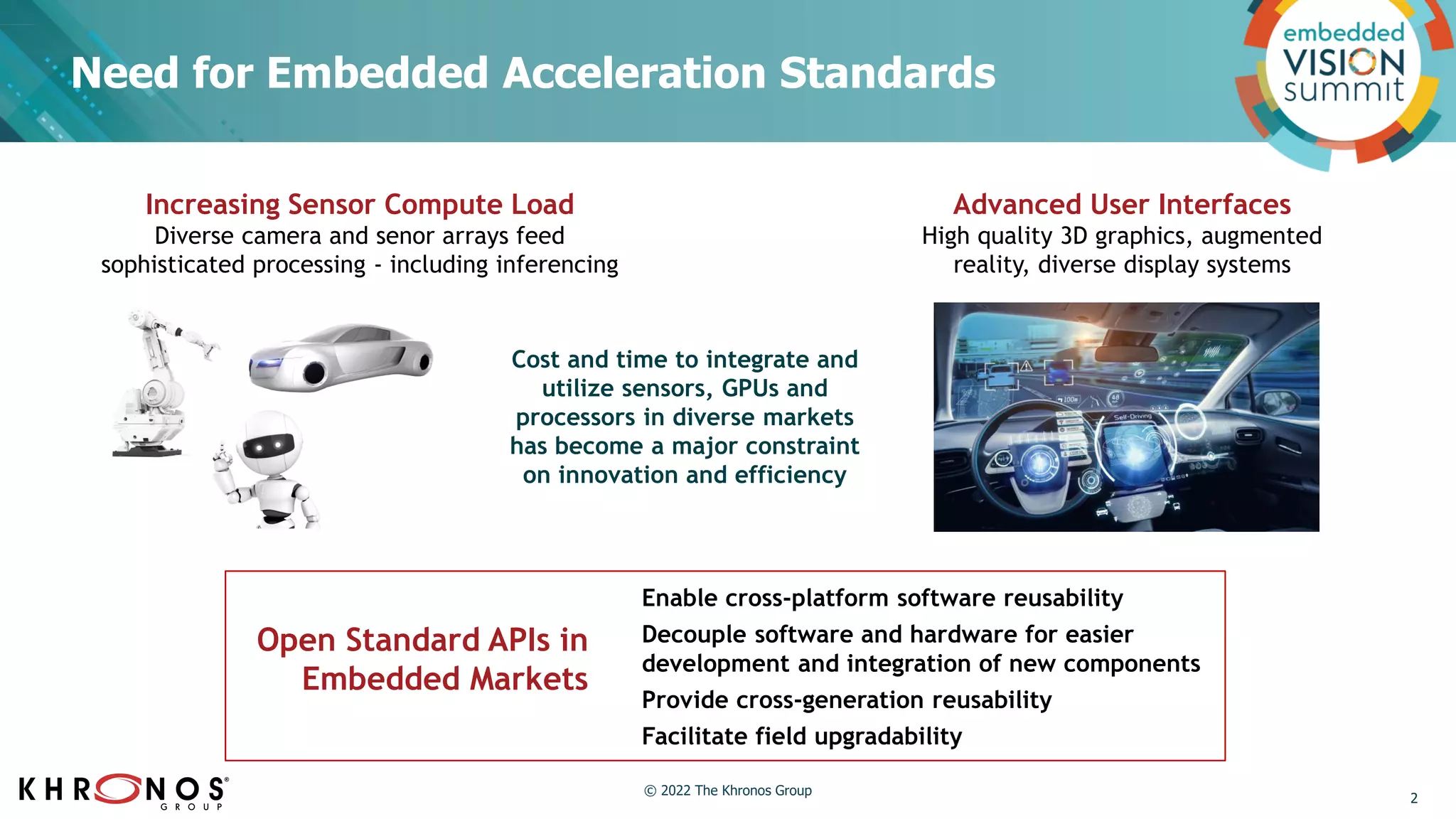
Increasing Sensor Compute Load
Diverse camera and senor arrays feed
sophisticated processing - including inferencing
Advanced User Interfaces
High quality 3D graphics, augmented
reality, diverse display systems
Cost and time to integrate and
utilize sensors, GPUs and
processors in diverse markets
has become a major constraint
on innovation and efficiency
Enable cross-platform software reusability
Decouple software and hardware for easier
development and integration of new components
Provide cross-generation reusability
Facilitate field upgradability
Open Standard APIs in
Embedded Markets
2
© 2022 The Khronos Group
Topics for this Session
Introduction to Khronos and open standard APIs for vision and compute acceleration
Khronos safety-critical APIs including Vulkan SC and the new SYCL SC Exploratory Forum
The new Khronos EMVA Camera Working Group
Details on how to get involved!
3
© 2022 The Khronos Group
Khronos Connects Software to Silicon
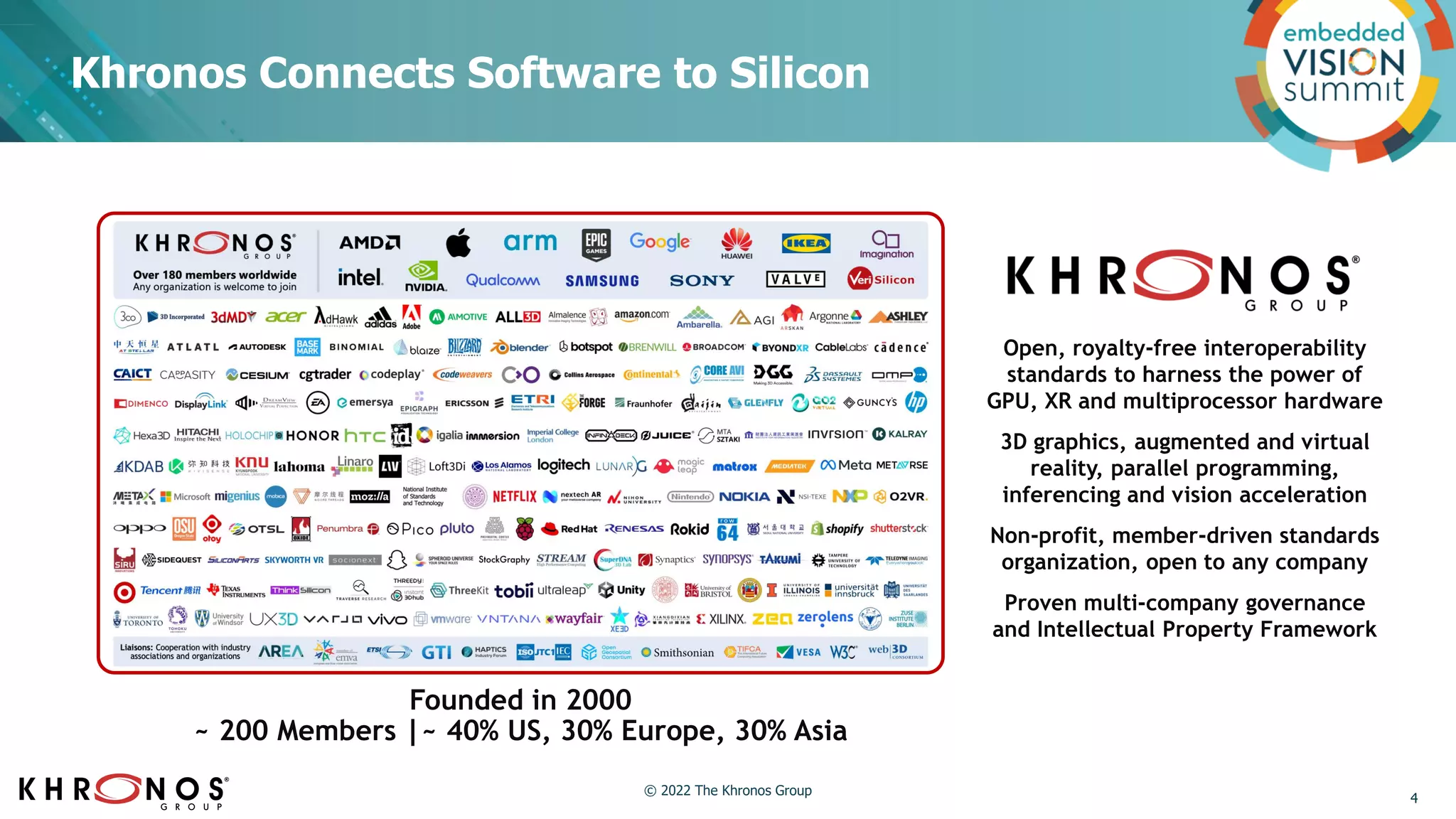
Open, royalty-free interoperability
standards to harness the power of
GPU, XR and multiprocessor hardware
3D graphics, augmented and virtual
reality, parallel programming,
inferencing and vision acceleration
Non-profit, member-driven standards
organization, open to any company
Proven multi-company governance
and Intellectual Property Framework
Founded in 2000
~ 200 Members |~ 40% US, 30% Europe, 30% Asia
4
© 2022 The Khronos Group
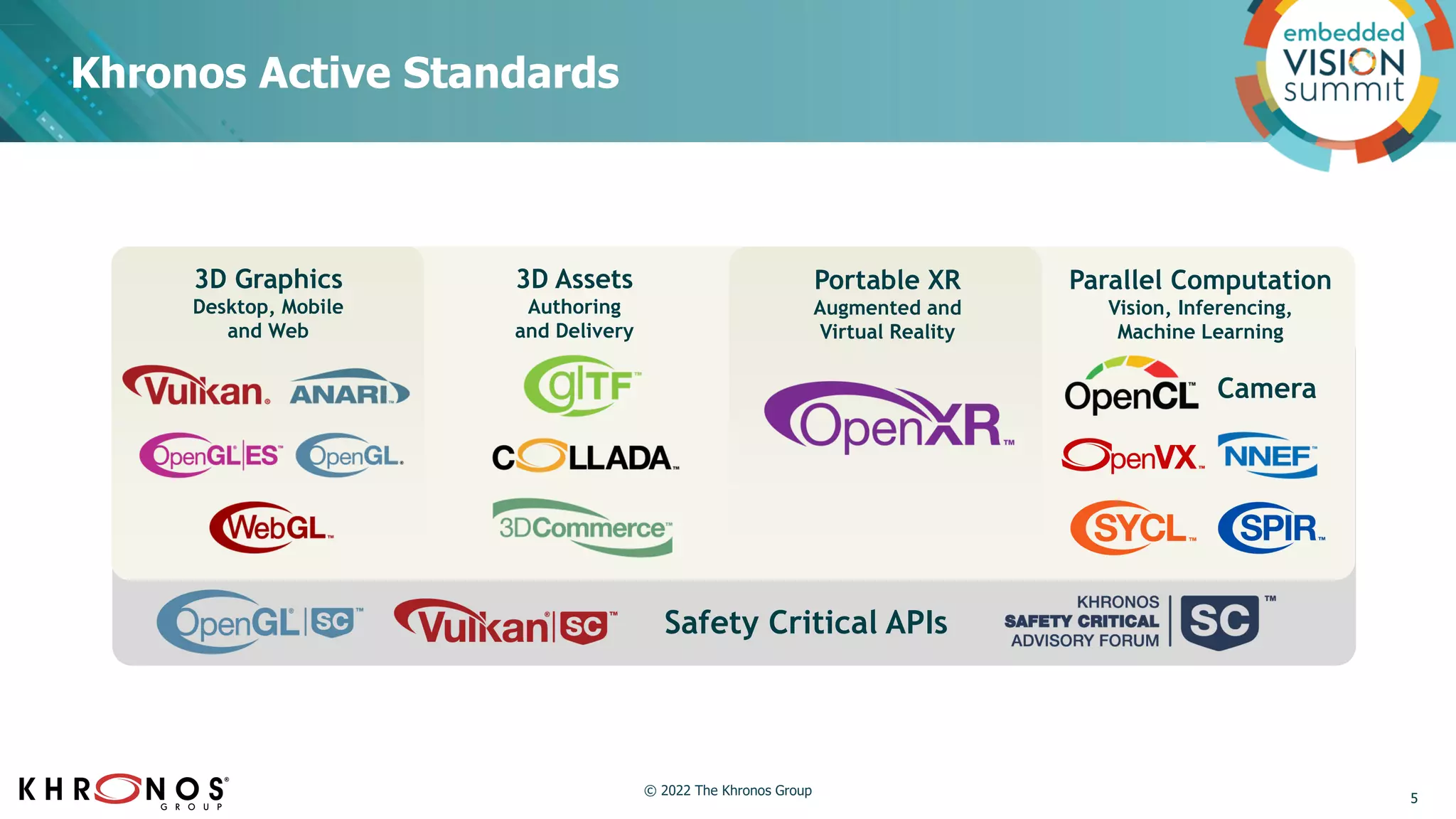
Khronos Active Standards
3D Graphics
Desktop, Mobile
and Web
3D Assets
Authoring
and Delivery
Portable XR
Augmented and
Virtual Reality
Parallel Computation
Vision, Inferencing,
Machine Learning
Safety Critical APIs
Camera
5
© 2022 The Khronos Group
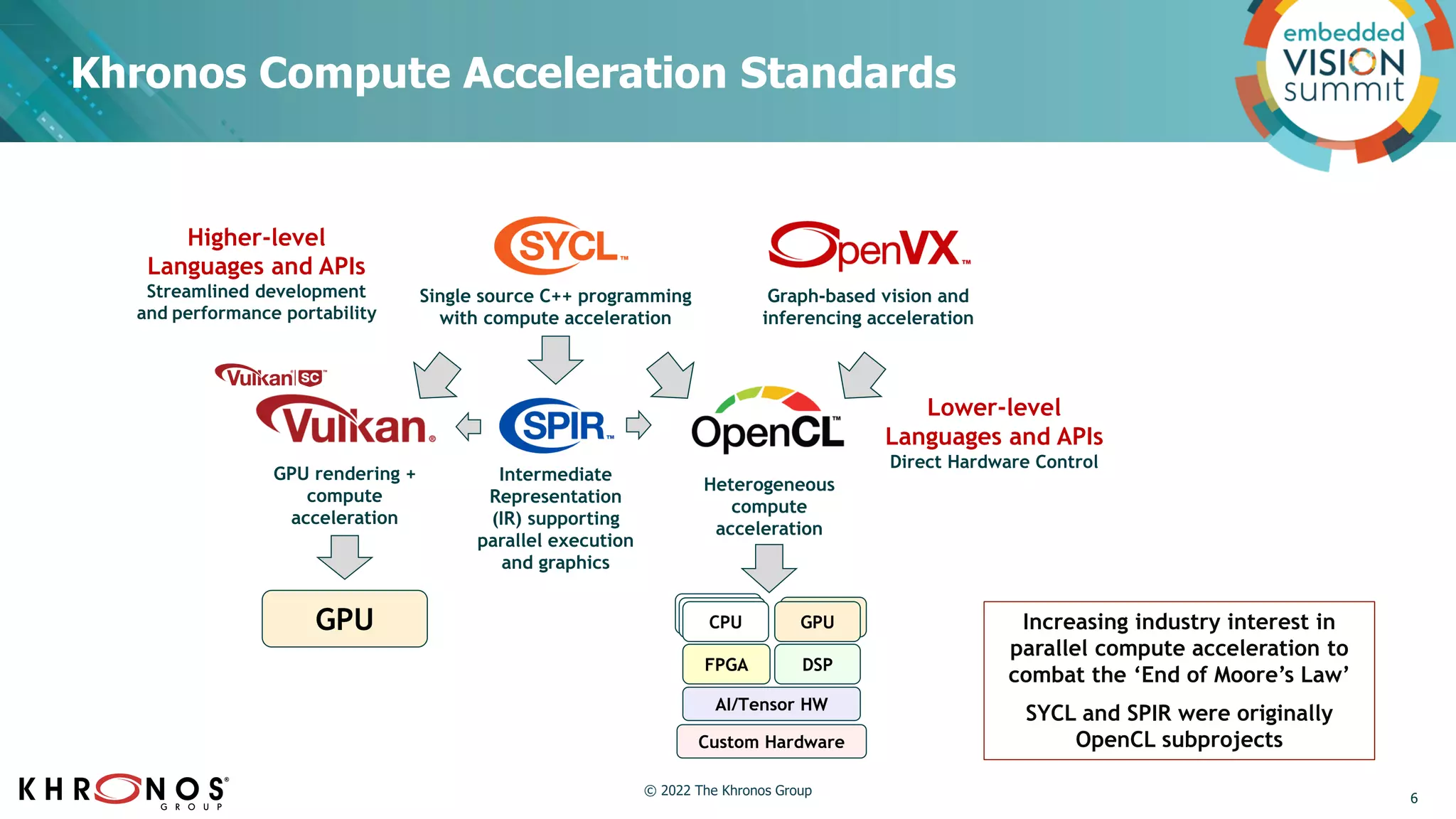
Khronos Compute Acceleration Standards
Increasing industry interest in
parallel compute acceleration to
combat the ‘End of Moore’s Law’
SYCL and SPIR were originally
OpenCL subprojects
GPU
GPU rendering +
compute
acceleration
Heterogeneous
compute
acceleration
Single source C++ programming
with compute acceleration
Graph-based vision and
inferencing acceleration
Intermediate
Representation
(IR) supporting
parallel execution
and graphics
Higher-level
Languages and APIs
Streamlined development
and performance portability
GPU
FPGA DSP
Custom Hardware
GPU
CPU
CPU
CPU
AI/Tensor HW
Lower-level
Languages and APIs
Direct Hardware Control
6
© 2022 The Khronos Group
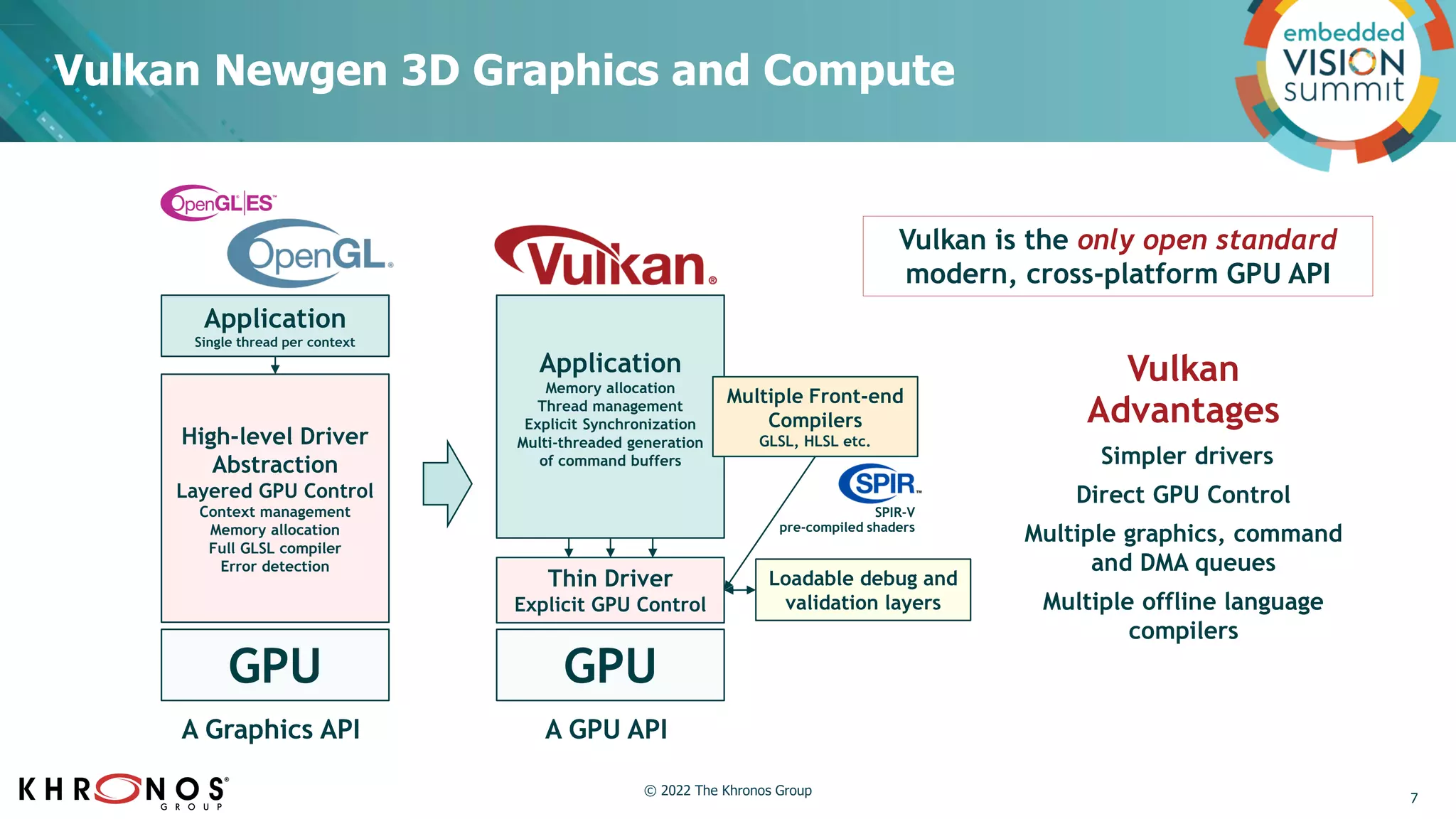
Vulkan Newgen 3D Graphics and Compute
GPU
High-level Driver
Abstraction
Layered GPU Control
Context management
Memory allocation
Full GLSL compiler
Error detection
Application
Single thread per context
GPU
Thin Driver
Explicit GPU Control
Application
Memory allocation
Thread management
Explicit Synchronization
Multi-threaded generation
of command buffers
Multiple Front-end
Compilers
GLSL, HLSL etc.
Loadable debug and
validation layers
SPIR-V
pre-compiled shaders
A Graphics API A GPU API
Vulkan is the only open standard
modern, cross-platform GPU API
Vulkan
Advantages
Simpler drivers
Direct GPU Control
Multiple graphics, command
and DMA queues
Multiple offline language
compilers
7
© 2022 The Khronos Group
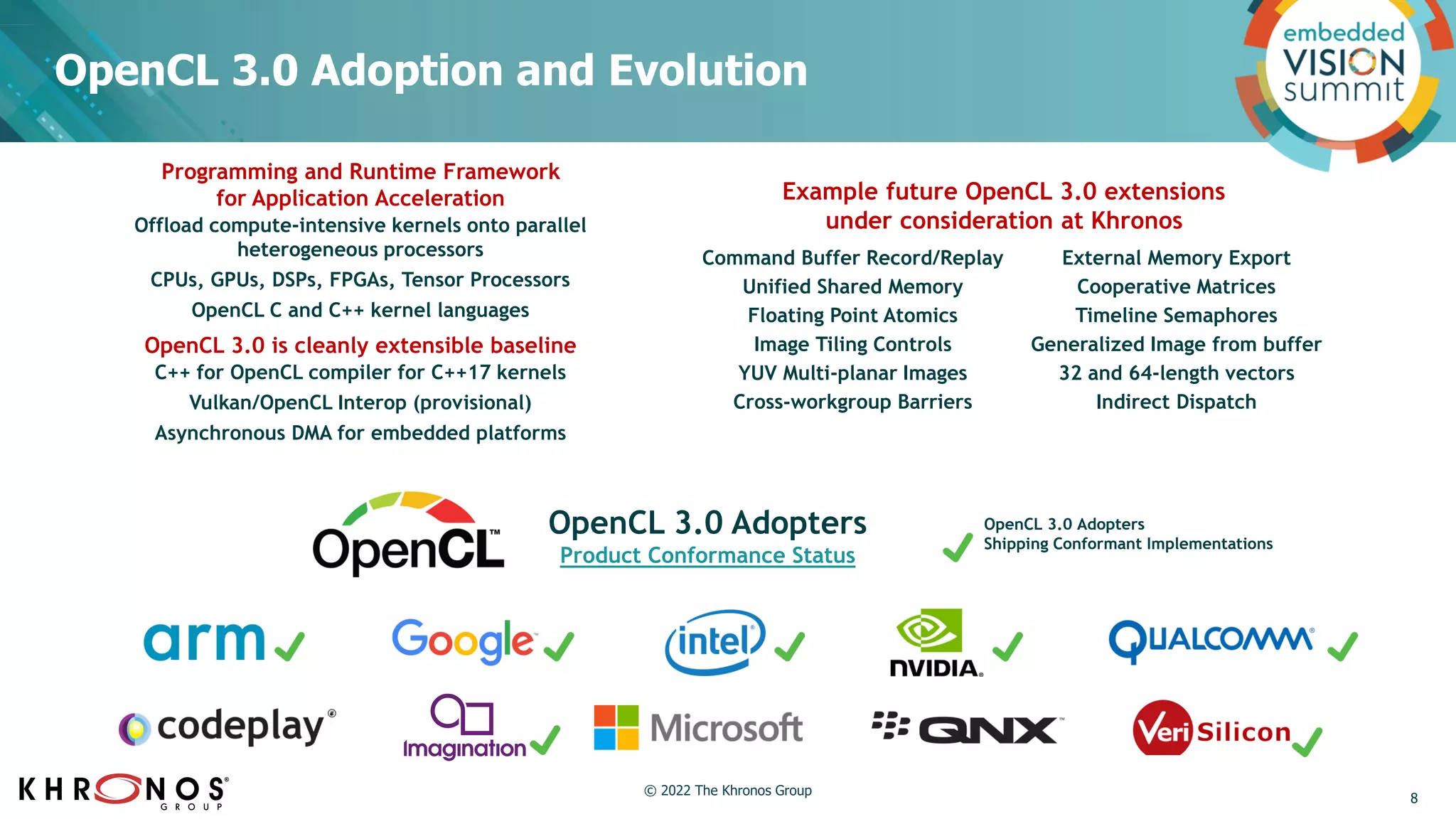
OpenCL 3.0 Adoption and Evolution
OpenCL 3.0 Adopters
Product Conformance Status
OpenCL 3.0 Adopters
Shipping Conformant Implementations
Programming and Runtime Framework
for Application Acceleration
Offload compute-intensive kernels onto parallel
heterogeneous processors
CPUs, GPUs, DSPs, FPGAs, Tensor Processors
OpenCL C and C++ kernel languages
OpenCL 3.0 is cleanly extensible baseline
C++ for OpenCL compiler for C++17 kernels
Vulkan/OpenCL Interop (provisional)
Asynchronous DMA for embedded platforms
Example future OpenCL 3.0 extensions
under consideration at Khronos
Command Buffer Record/Replay
Unified Shared Memory
Floating Point Atomics
Image Tiling Controls
YUV Multi-planar Images
Cross-workgroup Barriers
External Memory Export
Cooperative Matrices
Timeline Semaphores
Generalized Image from buffer
32 and 64-length vectors
Indirect Dispatch
8
© 2022 The Khronos Group
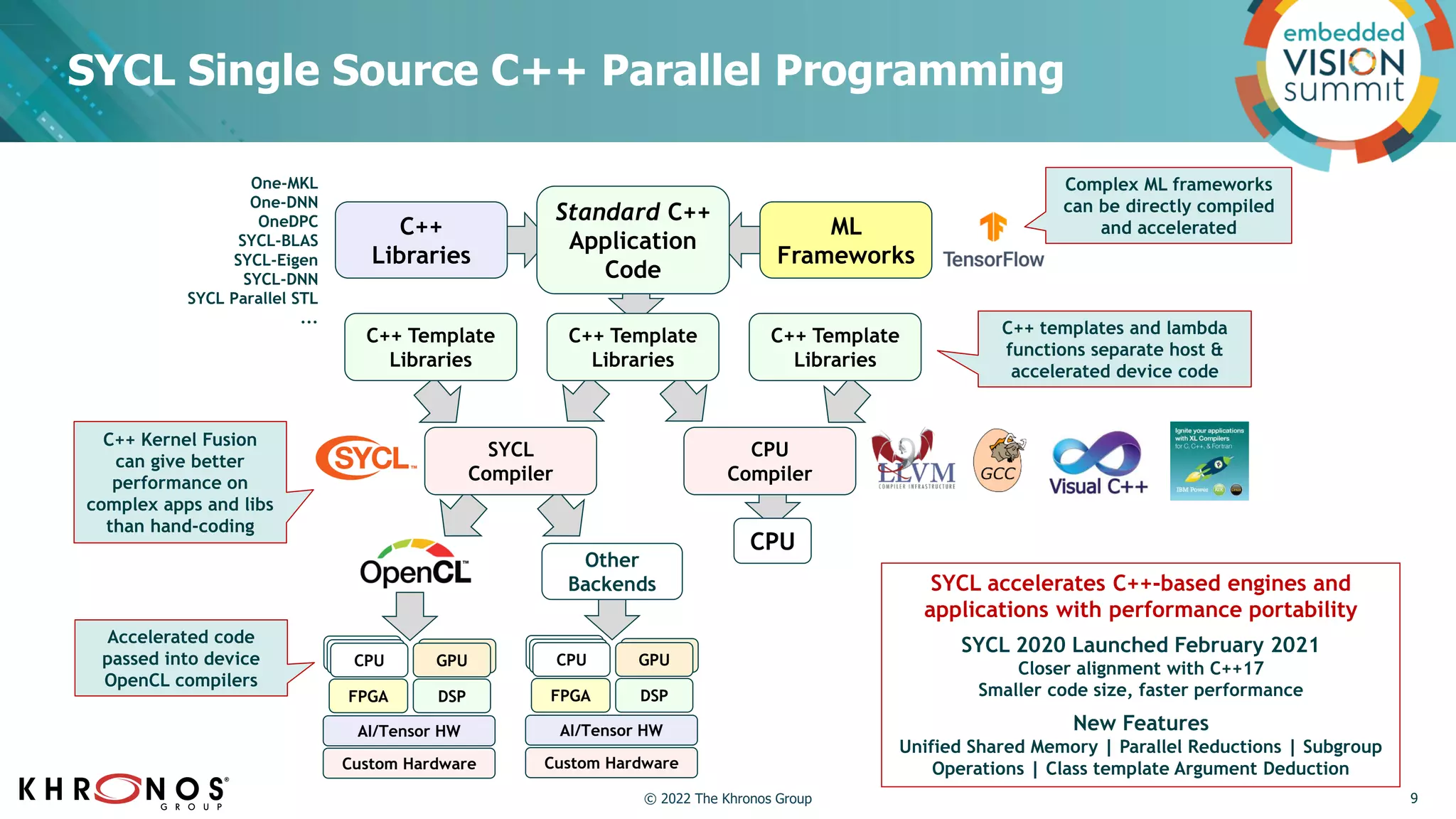
SYCL Single Source C++ Parallel Programming
GPU
FPGA DSP
Custom Hardware
GPU
CPU
CPU
CPU
Standard C++
Application
Code
C++
Libraries
ML
Frameworks
C++ Template
Libraries
C++ Template
Libraries
C++ Template
Libraries
SYCL
Compiler
CPU
Compiler
CPU
One-MKL
One-DNN
OneDPC
SYCL-BLAS
SYCL-Eigen
SYCL-DNN
SYCL Parallel STL
...
C++ templates and lambda
functions separate host &
accelerated device code
Accelerated code
passed into device
OpenCL compilers
Complex ML frameworks
can be directly compiled
and accelerated
SYCL accelerates C++-based engines and
applications with performance portability
SYCL 2020 Launched February 2021
Closer alignment with C++17
Smaller code size, faster performance
New Features
Unified Shared Memory | Parallel Reductions | Subgroup
Operations | Class template Argument Deduction
C++ Kernel Fusion
can give better
performance on
complex apps and libs
than hand-coding
AI/Tensor HW
GPU
FPGA DSP
Custom Hardware
GPU
CPU
CPU
CPU
AI/Tensor HW
Other
Backends
9
© 2022 The Khronos Group
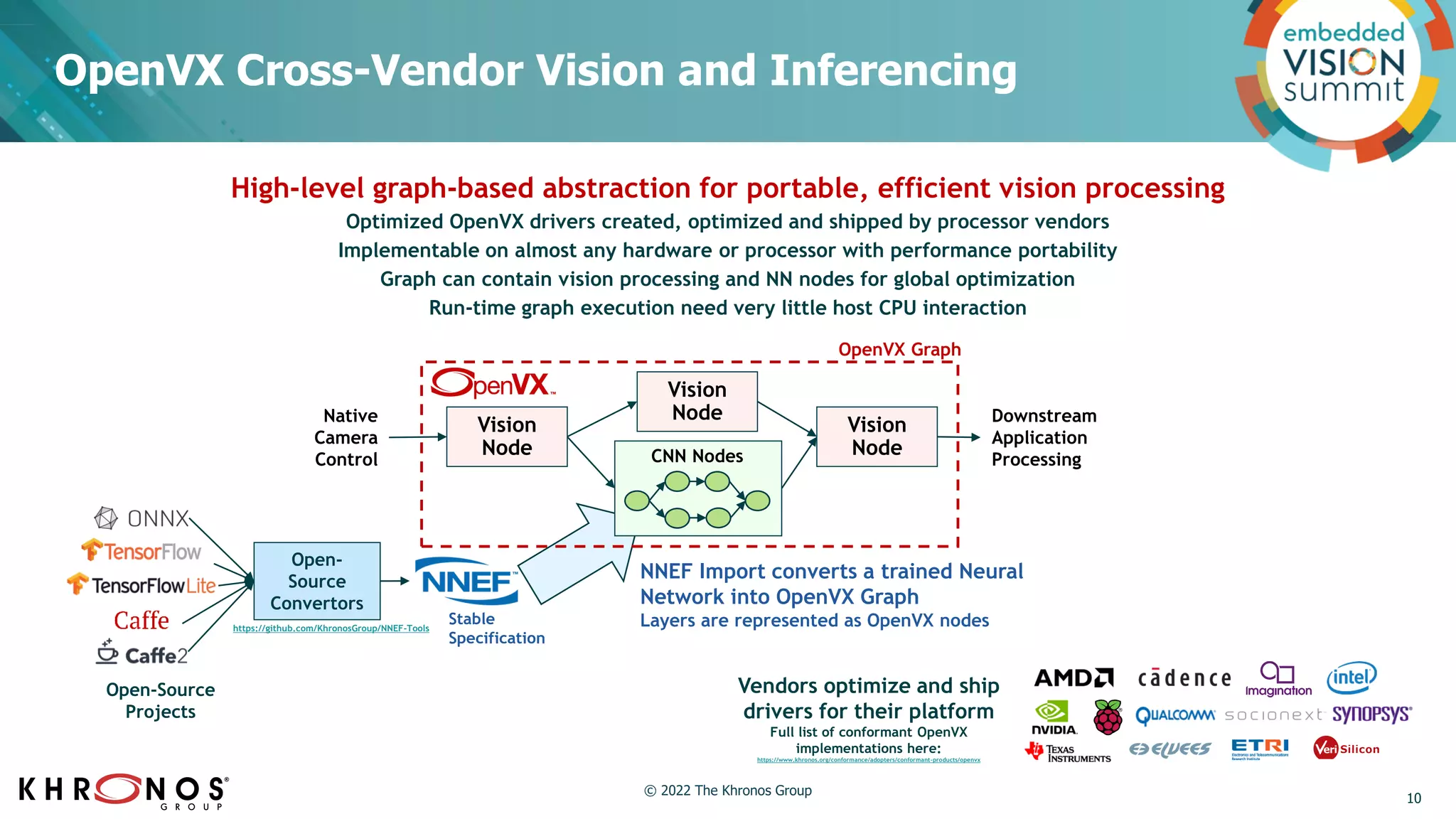
OpenVX Cross-Vendor Vision and Inferencing
High-level graph-based abstraction for portable, efficient vision processing
Optimized OpenVX drivers created, optimized and shipped by processor vendors
Implementable on almost any hardware or processor with performance portability
Graph can contain vision processing and NN nodes for global optimization
Run-time graph execution need very little host CPU interaction
Vision
Node
Vision
Node
Vision
Node
Downstream
Application
Processing
Native
Camera
Control CNN Nodes
NNEF Import converts a trained Neural
Network into OpenVX Graph
Layers are represented as OpenVX nodes
OpenVX Graph
Open-
Source
Convertors
https://github.com/KhronosGroup/NNEF-Tools
Stable
Specification
Open-Source
Projects
Vendors optimize and ship
drivers for their platform
Full list of conformant OpenVX
implementations here:
https://www.khronos.org/conformance/adopters/conformant-products/openvx
10
© 2022 The Khronos Group
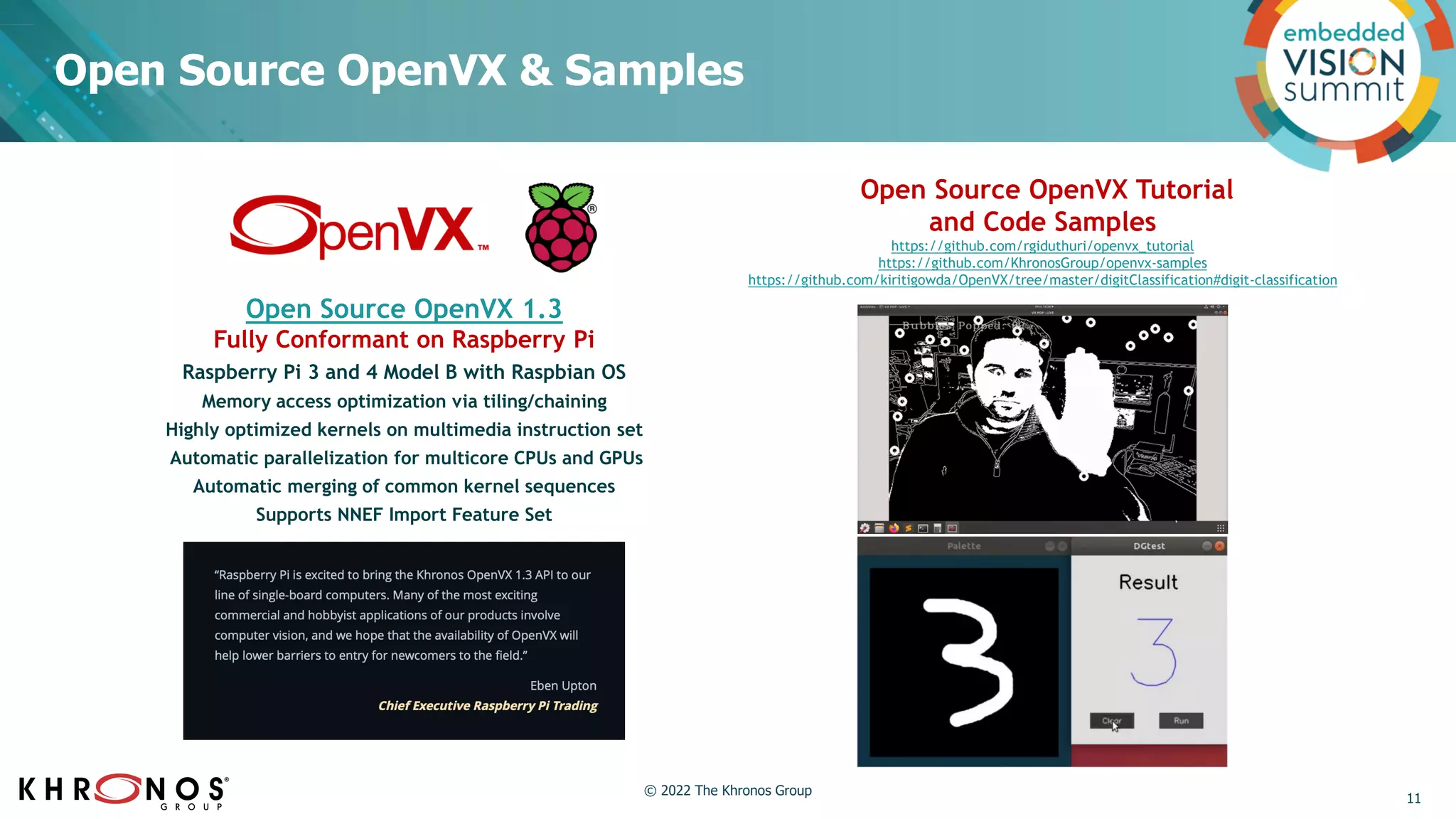
Open Source OpenVX & Samples
Open Source OpenVX Tutorial
and Code Samples
https://github.com/rgiduthuri/openvx_tutorial
https://github.com/KhronosGroup/openvx-samples
https://github.com/kiritigowda/OpenVX/tree/master/digitClassification#digit-classification
Open Source OpenVX 1.3
Fully Conformant on Raspberry Pi
Raspberry Pi 3 and 4 Model B with Raspbian OS
Memory access optimization via tiling/chaining
Highly optimized kernels on multimedia instruction set
Automatic parallelization for multicore CPUs and GPUs
Automatic merging of common kernel sequences
Supports NNEF Import Feature Set
11
© 2022 The Khronos Group
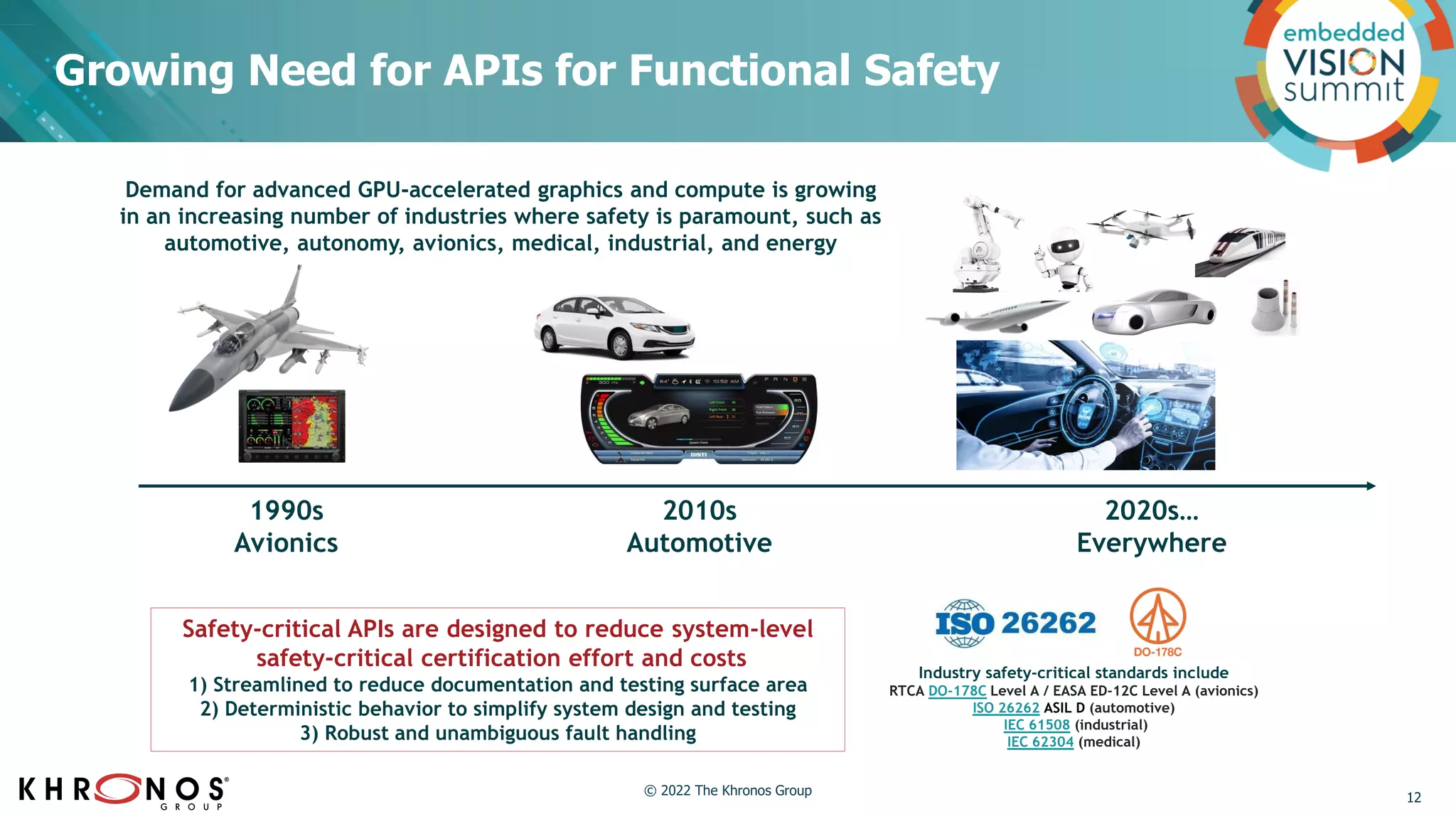
Growing Need for APIs for Functional Safety
1990s
Avionics
2010s
Automotive
2020s…
Everywhere
Demand for advanced GPU-accelerated graphics and compute is growing
in an increasing number of industries where safety is paramount, such as
automotive, autonomy, avionics, medical, industrial, and energy
Industry safety-critical standards include
RTCA DO-178C Level A / EASA ED-12C Level A (avionics)
ISO 26262 ASIL D (automotive)
IEC 61508 (industrial)
IEC 62304 (medical)
Safety-critical APIs are designed to reduce system-level
safety-critical certification effort and costs
1) Streamlined to reduce documentation and testing surface area
2) Deterministic behavior to simplify system design and testing
3) Robust and unambiguous fault handling
12
© 2022 The Khronos Group
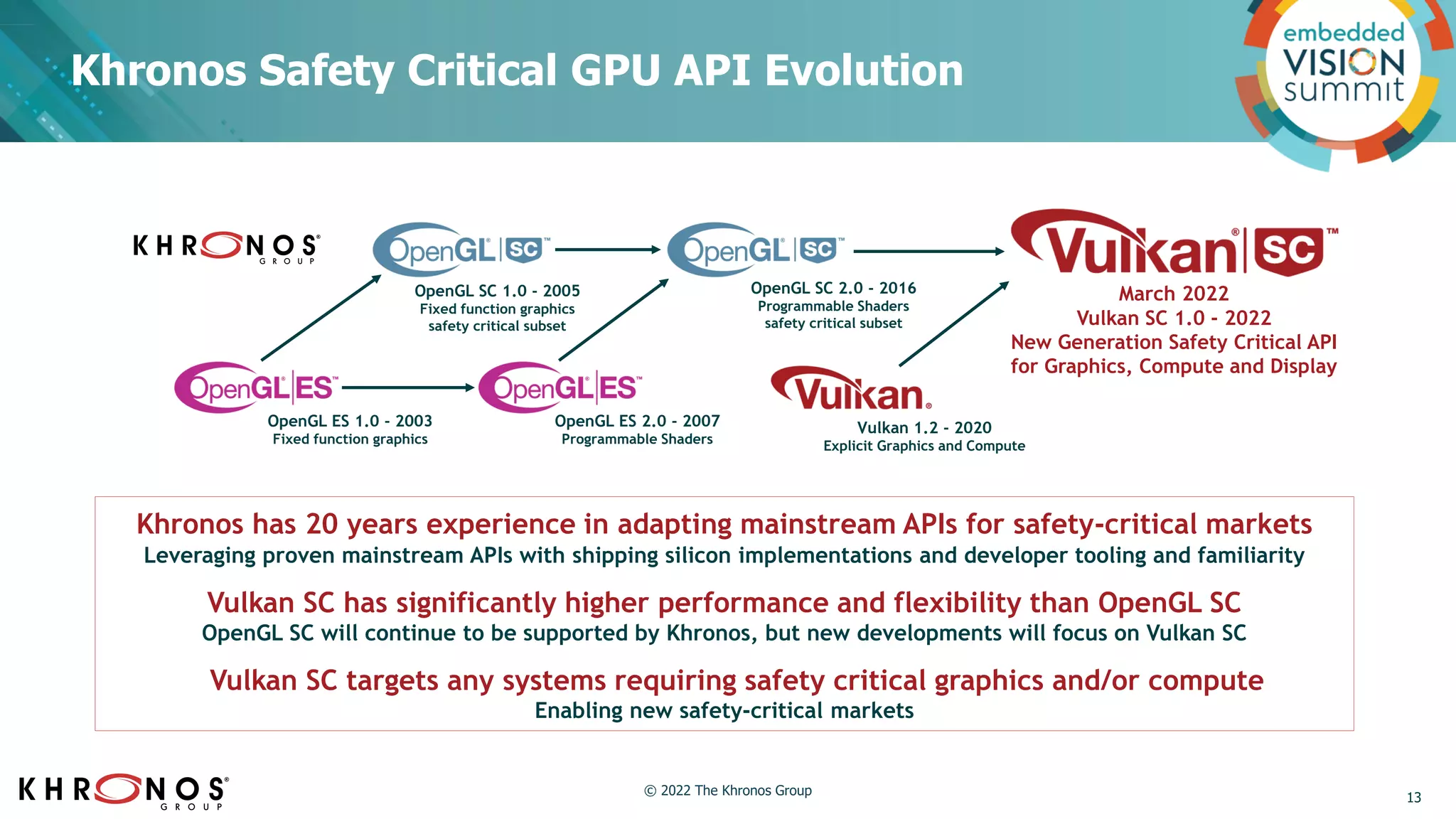
Khronos Safety Critical GPU API Evolution
Khronos has 20 years experience in adapting mainstream APIs for safety-critical markets
Leveraging proven mainstream APIs with shipping silicon implementations and developer tooling and familiarity
Vulkan SC has significantly higher performance and flexibility than OpenGL SC
OpenGL SC will continue to be supported by Khronos, but new developments will focus on Vulkan SC
Vulkan SC targets any systems requiring safety critical graphics and/or compute
Enabling new safety-critical markets
OpenGL ES 1.0 - 2003
Fixed function graphics
OpenGL ES 2.0 - 2007
Programmable Shaders
OpenGL SC 1.0 - 2005
Fixed function graphics
safety critical subset
OpenGL SC 2.0 - 2016
Programmable Shaders
safety critical subset
Vulkan 1.2 - 2020
Explicit Graphics and Compute
March 2022
Vulkan SC 1.0 - 2022
New Generation Safety Critical API
for Graphics, Compute and Display
13
© 2022 The Khronos Group
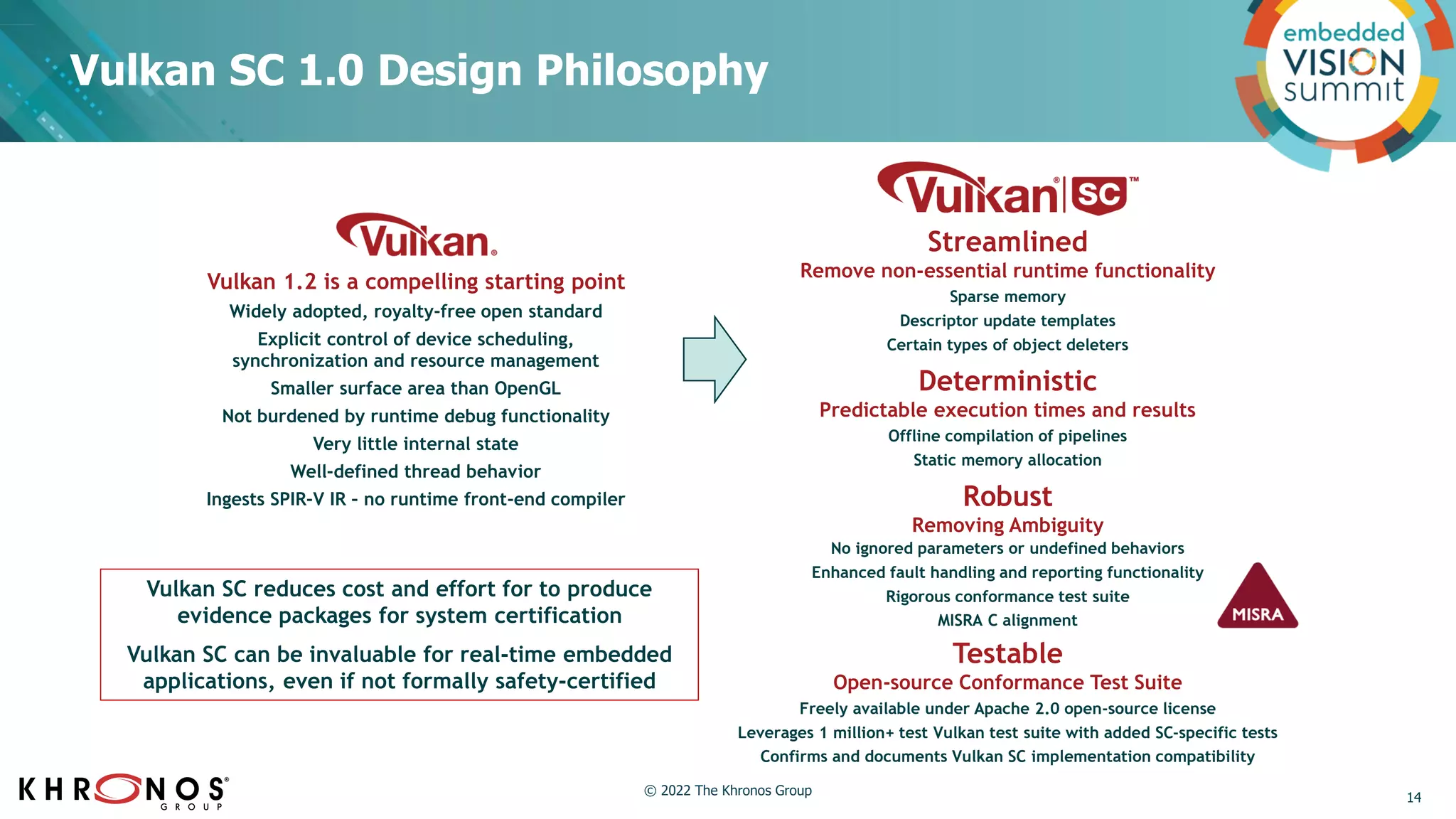
Vulkan SC 1.0 Design Philosophy
Vulkan 1.2 is a compelling starting point
Widely adopted, royalty-free open standard
Explicit control of device scheduling,
synchronization and resource management
Smaller surface area than OpenGL
Not burdened by runtime debug functionality
Very little internal state
Well-defined thread behavior
Ingests SPIR-V IR – no runtime front-end compiler
Vulkan SC reduces cost and effort for to produce
evidence packages for system certification
Vulkan SC can be invaluable for real-time embedded
applications, even if not formally safety-certified
Streamlined
Remove non-essential runtime functionality
Sparse memory
Descriptor update templates
Certain types of object deleters
Deterministic
Predictable execution times and results
Offline compilation of pipelines
Static memory allocation
Robust
Removing Ambiguity
No ignored parameters or undefined behaviors
Enhanced fault handling and reporting functionality
Rigorous conformance test suite
MISRA C alignment
Testable
Open-source Conformance Test Suite
Freely available under Apache 2.0 open-source license
Leverages 1 million+ test Vulkan test suite with added SC-specific tests
Confirms and documents Vulkan SC implementation compatibility
14
© 2022 The Khronos Group
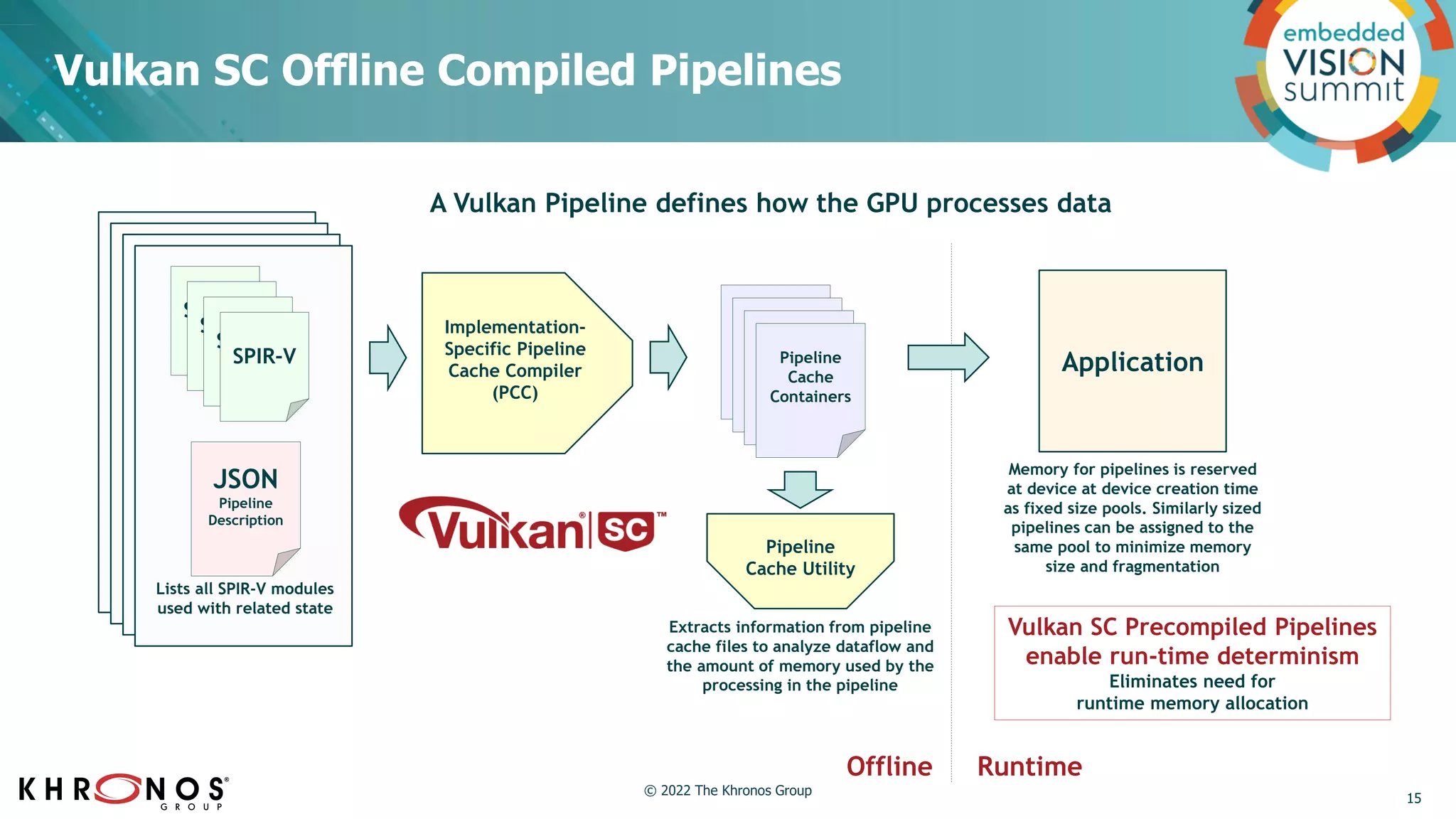
Vulkan SC Offline Compiled Pipelines
JSON
Pipeline
Description
Lists all SPIR-V modules
used with related state
A Vulkan Pipeline defines how the GPU processes data
SPIR-V
SPIR-V
SPIR-V
SPIR-V
Implementation-
Specific Pipeline
Cache Compiler
(PCC)
Extracts information from pipeline
cache files to analyze dataflow and
the amount of memory used by the
processing in the pipeline
Pipeline
Cache Utility
Offline Runtime
Application
Memory for pipelines is reserved
at device at device creation time
as fixed size pools. Similarly sized
pipelines can be assigned to the
same pool to minimize memory
size and fragmentation
Pipeline
Cache
Containers
Pipeline
Cache
Containers
Pipeline
Cache
Containers
Pipeline
Cache
Containers
Vulkan SC Precompiled Pipelines
enable run-time determinism
Eliminates need for
runtime memory allocation
15
© 2022 The Khronos Group
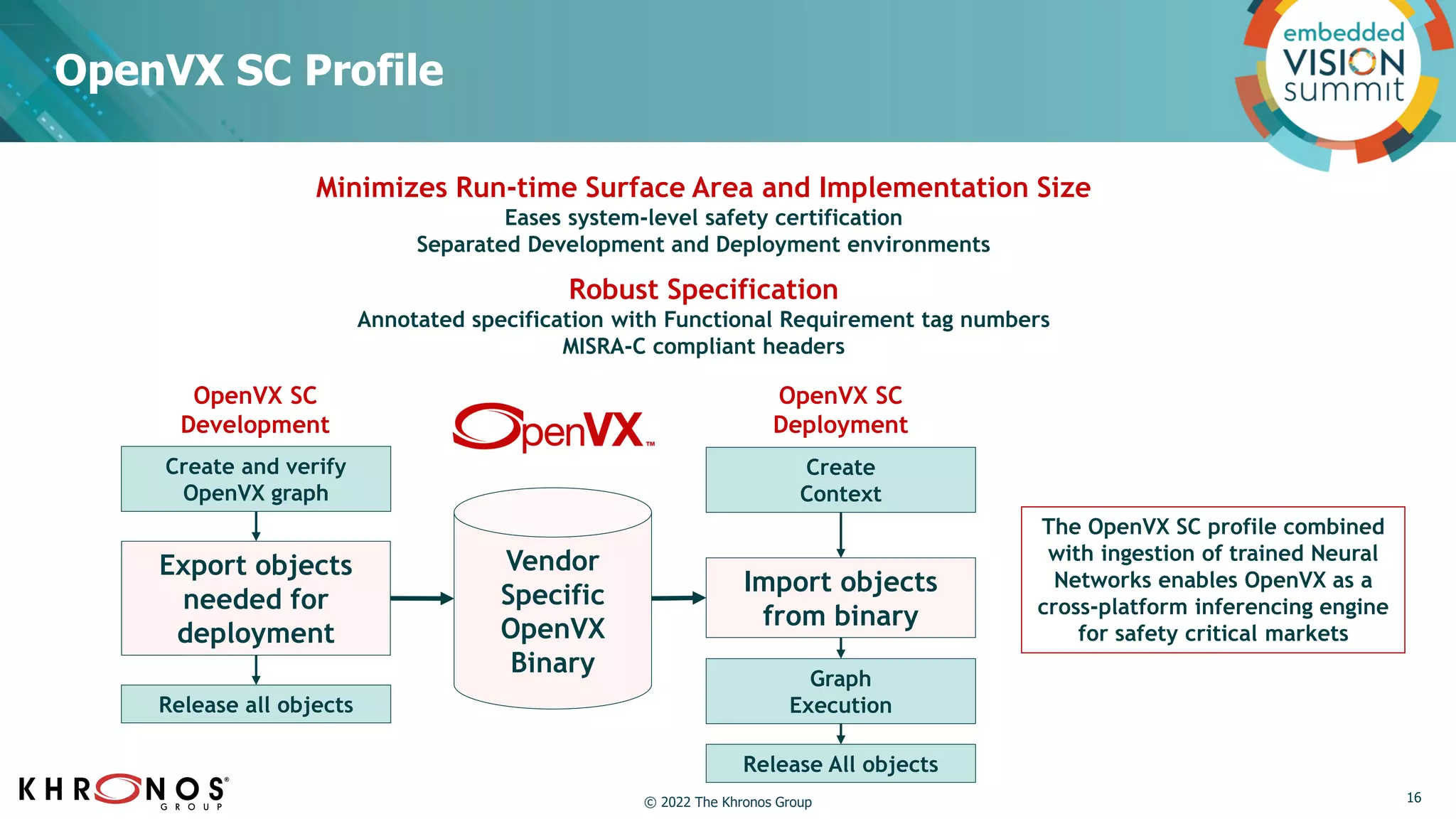
OpenVX SC Profile
Minimizes Run-time Surface Area and Implementation Size
Eases system-level safety certification
Separated Development and Deployment environments
Robust Specification
Annotated specification with Functional Requirement tag numbers
MISRA-C compliant headers
Create and verify
OpenVX graph
Export objects
needed for
deployment
Release all objects
Vendor
Specific
OpenVX
Binary
Create
Context
Import objects
from binary
Graph
Execution
Release All objects
OpenVX SC
Development
OpenVX SC
Deployment
The OpenVX SC profile combined
with ingestion of trained Neural
Networks enables OpenVX as a
cross-platform inferencing engine
for safety critical markets
16
© 2022 The Khronos Group
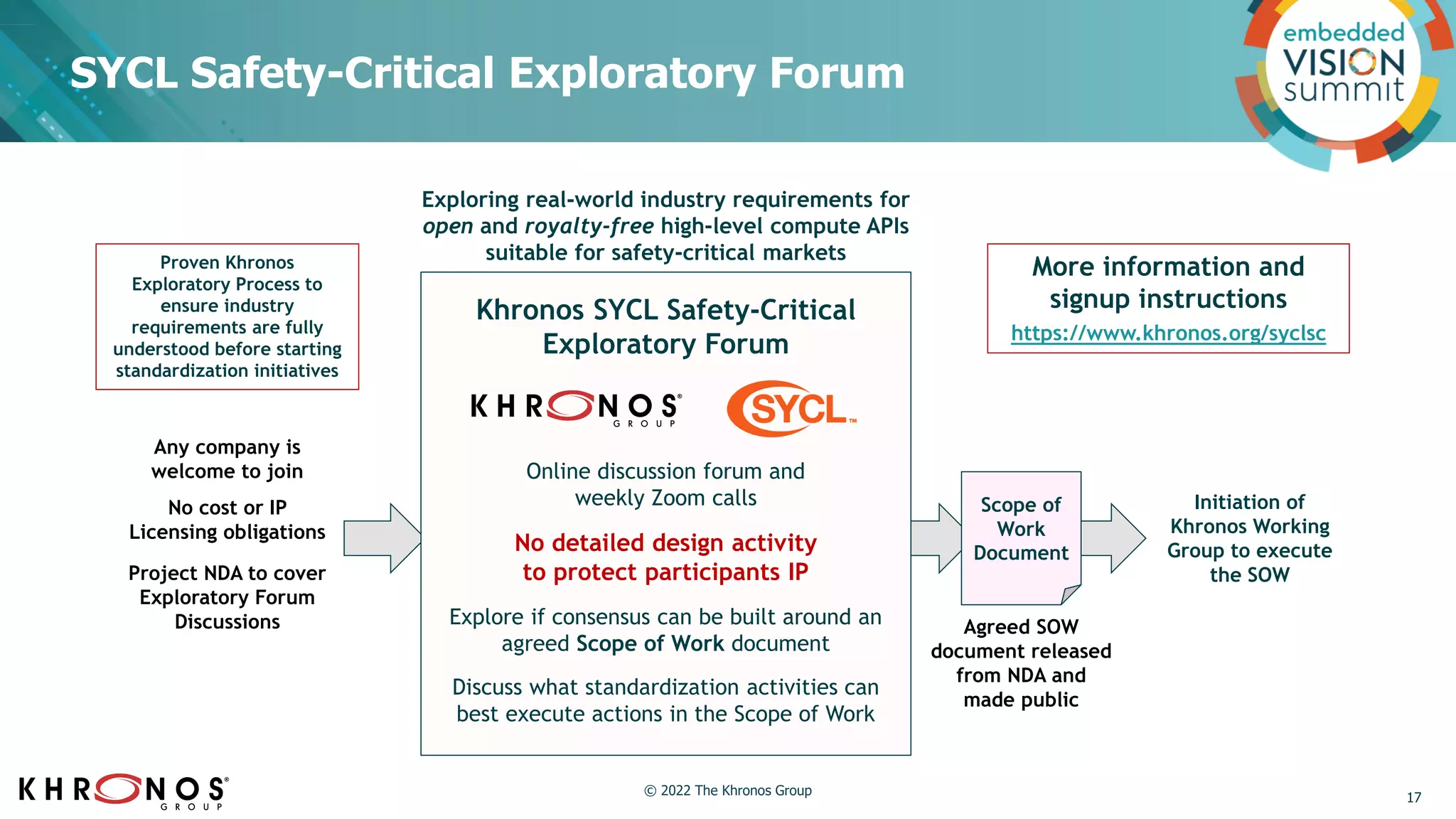
SYCL Safety-Critical Exploratory Forum
Khronos SYCL Safety-Critical
Exploratory Forum
Online discussion forum and
weekly Zoom calls
No detailed design activity
to protect participants IP
Explore if consensus can be built around an
agreed Scope of Work document
Discuss what standardization activities can
best execute actions in the Scope of Work
Any company is
welcome to join
No cost or IP
Licensing obligations
Project NDA to cover
Exploratory Forum
Discussions
Scope of
Work
Document
Agreed SOW
document released
from NDA and
made public
Initiation of
Khronos Working
Group to execute
the SOW
Proven Khronos
Exploratory Process to
ensure industry
requirements are fully
understood before starting
standardization initiatives
Exploring real-world industry requirements for
open and royalty-free high-level compute APIs
suitable for safety-critical markets
More information and
signup instructions
https://www.khronos.org/syclsc
17
© 2022 The Khronos Group
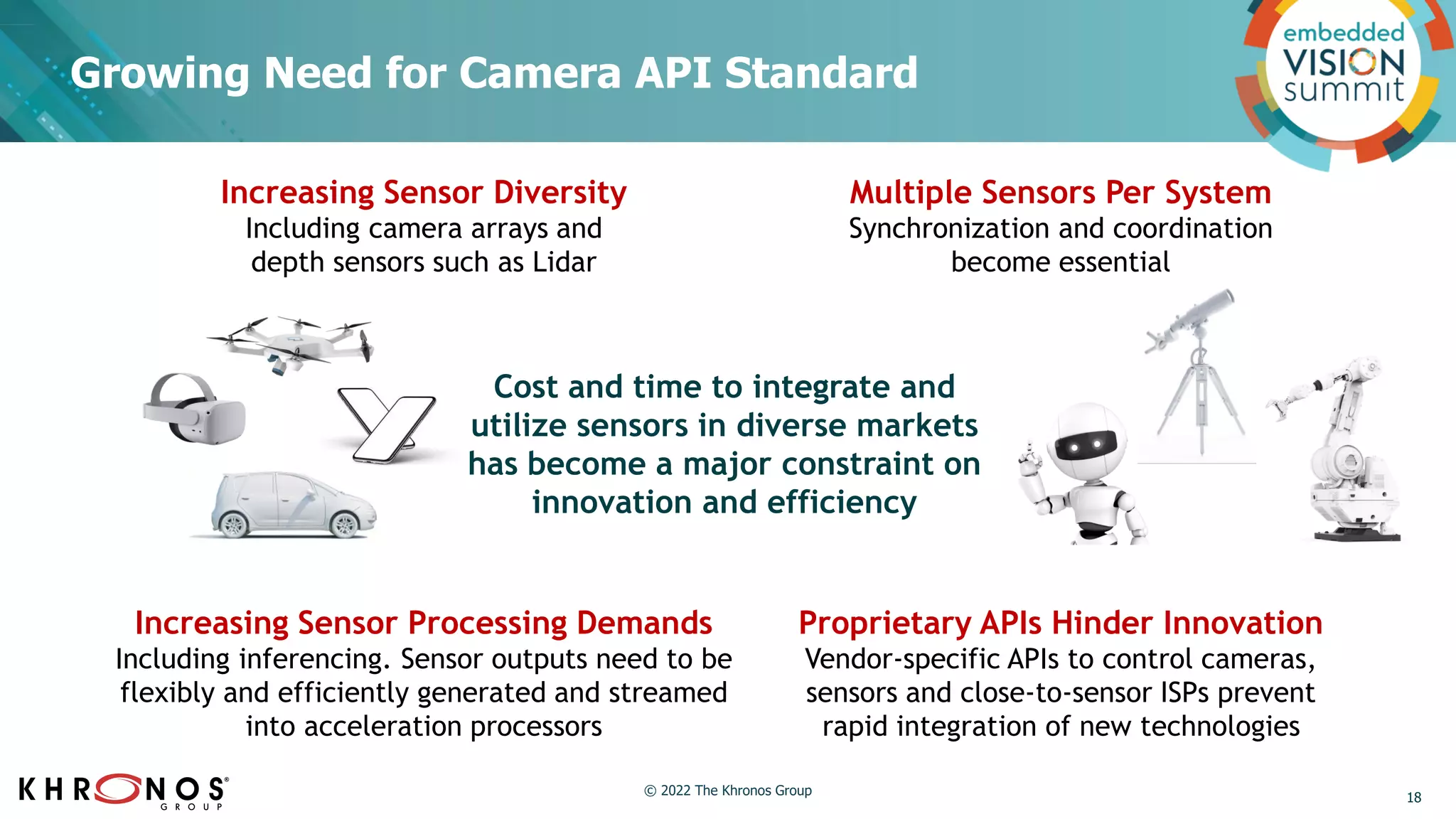
Growing Need for Camera API Standard
Increasing Sensor Diversity
Including camera arrays and
depth sensors such as Lidar
Increasing Sensor Processing Demands
Including inferencing. Sensor outputs need to be
flexibly and efficiently generated and streamed
into acceleration processors
Multiple Sensors Per System
Synchronization and coordination
become essential
Proprietary APIs Hinder Innovation
Vendor-specific APIs to control cameras,
sensors and close-to-sensor ISPs prevent
rapid integration of new technologies
Cost and time to integrate and
utilize sensors in diverse markets
has become a major constraint on
innovation and efficiency
18
© 2022 The Khronos Group
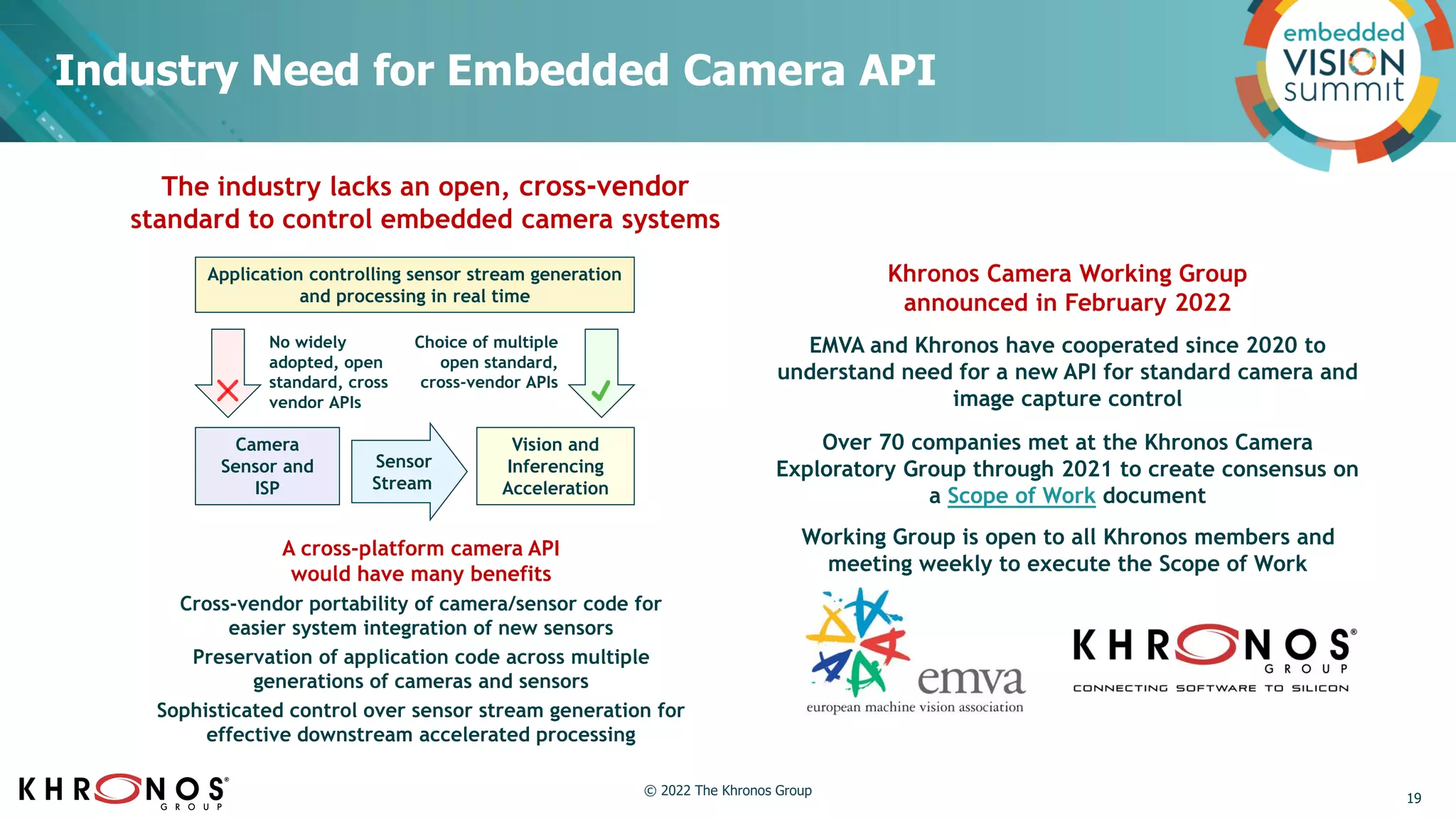
Camera
Sensor and
ISP
Vision and
Inferencing
Acceleration
Sensor
Stream
Application controlling sensor stream generation
and processing in real time
Choice of multiple
open standard,
cross-vendor APIs
No widely
adopted, open
standard, cross
vendor APIs
A cross-platform camera API
would have many benefits
Cross-vendor portability of camera/sensor code for
easier system integration of new sensors
Preservation of application code across multiple
generations of cameras and sensors
Sophisticated control over sensor stream generation for
effective downstream accelerated processing
Industry Need for Embedded Camera API
Khronos Camera Working Group
announced in February 2022
EMVA and Khronos have cooperated since 2020 to
understand need for a new API for standard camera and
image capture control
Over 70 companies met at the Khronos Camera
Exploratory Group through 2021 to create consensus on
a Scope of Work document
Working Group is open to all Khronos members and
meeting weekly to execute the Scope of Work
The industry lacks an open, cross-vendor
standard to control embedded camera systems
19
© 2022 The Khronos Group
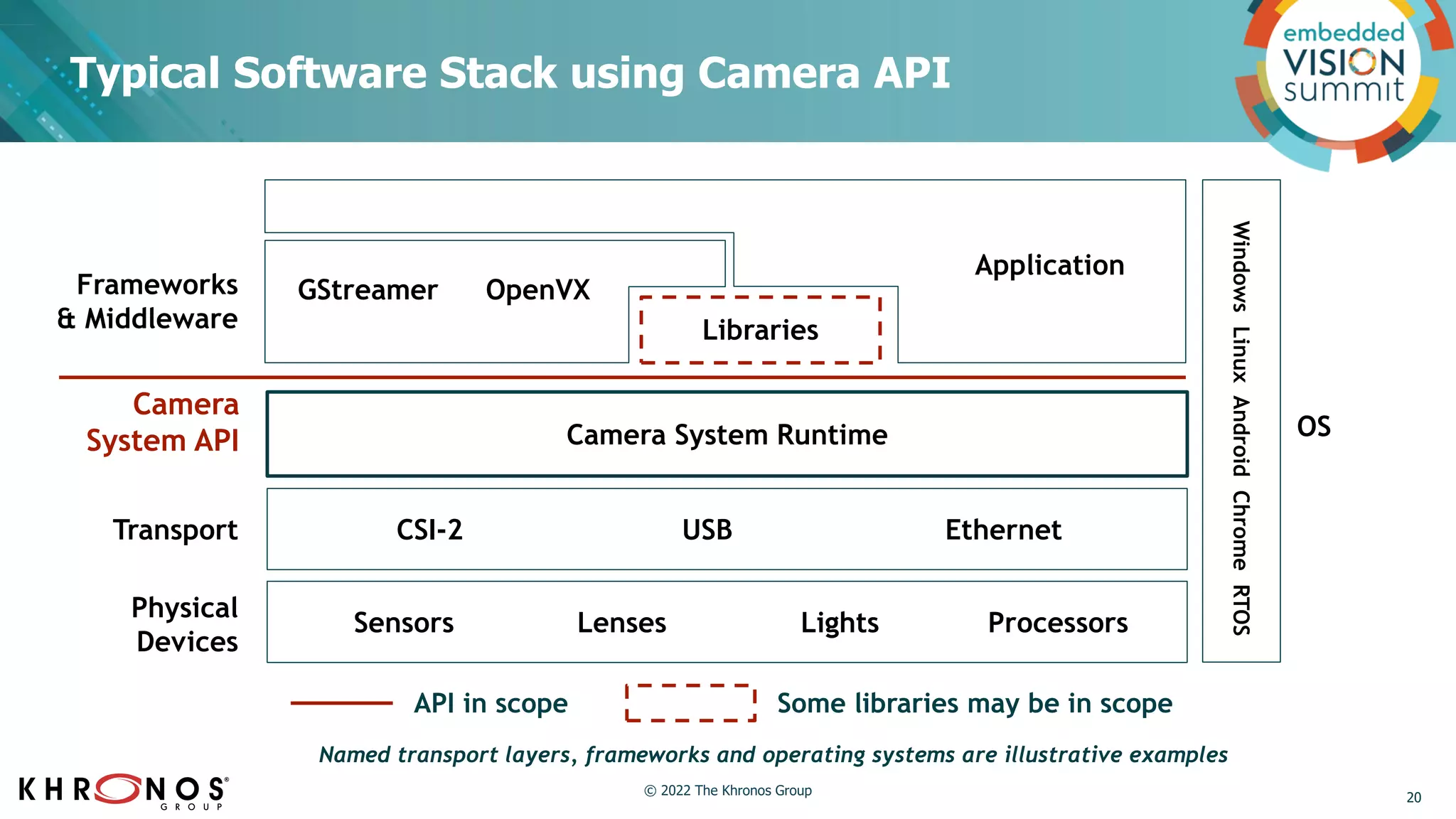
Frameworks
& Middleware
OS
GStreamer
Sensors
Physical
Devices
Lenses Lights Processors
Camera System Runtime
Typical Software Stack using Camera API
Windows
Linux
Android
Chrome
RTOS
Transport CSI-2 USB Ethernet
Application
OpenVX
Libraries
API in scope Some libraries may be in scope
Camera
System API
Named transport layers, frameworks and operating systems are illustrative examples
20
© 2022 The Khronos Group
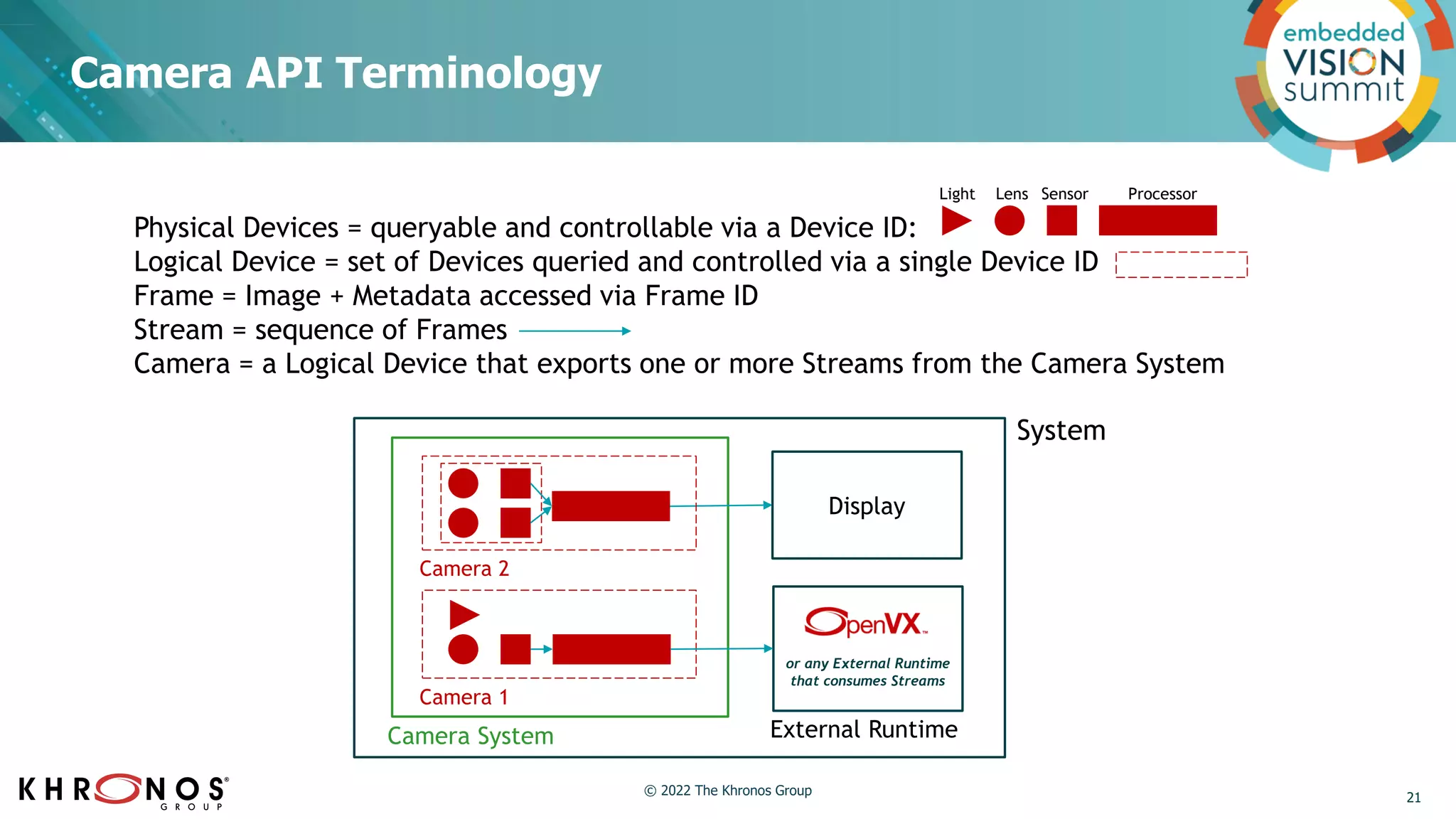
Physical Devices = queryable and controllable via a Device ID:
Logical Device = set of Devices queried and controlled via a single Device ID
Frame = Image + Metadata accessed via Frame ID
Stream = sequence of Frames
Camera = a Logical Device that exports one or more Streams from the Camera System
System
Lens
Light Sensor Processor
Camera System
Camera 1
Camera 2
Display
External Runtime
or any External Runtime
that consumes Streams
Camera API Terminology
21
© 2022 The Khronos Group
Get Involved!
Khronos is developing a growing family of open, royalty-free API
standards relevant to embedded and safety-critical markets
22
Any company is welcome to join Khronos to influence standards development!
All Khronos members can participate in the new Camera Working Group!
Get involved in the new SYCL SC Exploratory Forum at zero cost!
© 2022 The Khronos Group
Additional Resources
2022 Embedded Vision Summit
Come talk to Khronos at the
Exhibition Booth: #525
Khronos Resources
Joining Khronos
https://www.khronos.org/members/
memberservices@khronosgroup.org
OpenCL, OpenVX, Vulkan SC
https://www.khronos.org/opencl/
https://www.khronos.org/openvx/
https://www.khronos.org/vulkansc/
Camera Working Group
https://www.khronos.org/camera
SYCL SC Exploratory Group
https://www.khronos.org/camera
23
© 2022 The Khronos Group

“Open Standards: Powering the Future of Embedded Vision,” a Presentation from the Khronos Group

  • 1.
    Open Standards: Powering theFuture of Embedded Vision Neil Trevett President The Khronos Group
  • 2.
    Need for EmbeddedAcceleration Standards Increasing Sensor Compute Load Diverse camera and senor arrays feed sophisticated processing - including inferencing Advanced User Interfaces High quality 3D graphics, augmented reality, diverse display systems Cost and time to integrate and utilize sensors, GPUs and processors in diverse markets has become a major constraint on innovation and efficiency Enable cross-platform software reusability Decouple software and hardware for easier development and integration of new components Provide cross-generation reusability Facilitate field upgradability Open Standard APIs in Embedded Markets 2 © 2022 The Khronos Group
  • 3.
    Topics for thisSession Introduction to Khronos and open standard APIs for vision and compute acceleration Khronos safety-critical APIs including Vulkan SC and the new SYCL SC Exploratory Forum The new Khronos EMVA Camera Working Group Details on how to get involved! 3 © 2022 The Khronos Group
  • 4.
    Khronos Connects Softwareto Silicon Open, royalty-free interoperability standards to harness the power of GPU, XR and multiprocessor hardware 3D graphics, augmented and virtual reality, parallel programming, inferencing and vision acceleration Non-profit, member-driven standards organization, open to any company Proven multi-company governance and Intellectual Property Framework Founded in 2000 ~ 200 Members |~ 40% US, 30% Europe, 30% Asia 4 © 2022 The Khronos Group
  • 5.
    Khronos Active Standards 3DGraphics Desktop, Mobile and Web 3D Assets Authoring and Delivery Portable XR Augmented and Virtual Reality Parallel Computation Vision, Inferencing, Machine Learning Safety Critical APIs Camera 5 © 2022 The Khronos Group
  • 6.
    Khronos Compute AccelerationStandards Increasing industry interest in parallel compute acceleration to combat the ‘End of Moore’s Law’ SYCL and SPIR were originally OpenCL subprojects GPU GPU rendering + compute acceleration Heterogeneous compute acceleration Single source C++ programming with compute acceleration Graph-based vision and inferencing acceleration Intermediate Representation (IR) supporting parallel execution and graphics Higher-level Languages and APIs Streamlined development and performance portability GPU FPGA DSP Custom Hardware GPU CPU CPU CPU AI/Tensor HW Lower-level Languages and APIs Direct Hardware Control 6 © 2022 The Khronos Group
  • 7.
    Vulkan Newgen 3DGraphics and Compute GPU High-level Driver Abstraction Layered GPU Control Context management Memory allocation Full GLSL compiler Error detection Application Single thread per context GPU Thin Driver Explicit GPU Control Application Memory allocation Thread management Explicit Synchronization Multi-threaded generation of command buffers Multiple Front-end Compilers GLSL, HLSL etc. Loadable debug and validation layers SPIR-V pre-compiled shaders A Graphics API A GPU API Vulkan is the only open standard modern, cross-platform GPU API Vulkan Advantages Simpler drivers Direct GPU Control Multiple graphics, command and DMA queues Multiple offline language compilers 7 © 2022 The Khronos Group
  • 8.
    OpenCL 3.0 Adoptionand Evolution OpenCL 3.0 Adopters Product Conformance Status OpenCL 3.0 Adopters Shipping Conformant Implementations Programming and Runtime Framework for Application Acceleration Offload compute-intensive kernels onto parallel heterogeneous processors CPUs, GPUs, DSPs, FPGAs, Tensor Processors OpenCL C and C++ kernel languages OpenCL 3.0 is cleanly extensible baseline C++ for OpenCL compiler for C++17 kernels Vulkan/OpenCL Interop (provisional) Asynchronous DMA for embedded platforms Example future OpenCL 3.0 extensions under consideration at Khronos Command Buffer Record/Replay Unified Shared Memory Floating Point Atomics Image Tiling Controls YUV Multi-planar Images Cross-workgroup Barriers External Memory Export Cooperative Matrices Timeline Semaphores Generalized Image from buffer 32 and 64-length vectors Indirect Dispatch 8 © 2022 The Khronos Group
  • 9.
    SYCL Single SourceC++ Parallel Programming GPU FPGA DSP Custom Hardware GPU CPU CPU CPU Standard C++ Application Code C++ Libraries ML Frameworks C++ Template Libraries C++ Template Libraries C++ Template Libraries SYCL Compiler CPU Compiler CPU One-MKL One-DNN OneDPC SYCL-BLAS SYCL-Eigen SYCL-DNN SYCL Parallel STL ... C++ templates and lambda functions separate host & accelerated device code Accelerated code passed into device OpenCL compilers Complex ML frameworks can be directly compiled and accelerated SYCL accelerates C++-based engines and applications with performance portability SYCL 2020 Launched February 2021 Closer alignment with C++17 Smaller code size, faster performance New Features Unified Shared Memory | Parallel Reductions | Subgroup Operations | Class template Argument Deduction C++ Kernel Fusion can give better performance on complex apps and libs than hand-coding AI/Tensor HW GPU FPGA DSP Custom Hardware GPU CPU CPU CPU AI/Tensor HW Other Backends 9 © 2022 The Khronos Group
  • 10.
    OpenVX Cross-Vendor Visionand Inferencing High-level graph-based abstraction for portable, efficient vision processing Optimized OpenVX drivers created, optimized and shipped by processor vendors Implementable on almost any hardware or processor with performance portability Graph can contain vision processing and NN nodes for global optimization Run-time graph execution need very little host CPU interaction Vision Node Vision Node Vision Node Downstream Application Processing Native Camera Control CNN Nodes NNEF Import converts a trained Neural Network into OpenVX Graph Layers are represented as OpenVX nodes OpenVX Graph Open- Source Convertors https://github.com/KhronosGroup/NNEF-Tools Stable Specification Open-Source Projects Vendors optimize and ship drivers for their platform Full list of conformant OpenVX implementations here: https://www.khronos.org/conformance/adopters/conformant-products/openvx 10 © 2022 The Khronos Group
  • 11.
    Open Source OpenVX& Samples Open Source OpenVX Tutorial and Code Samples https://github.com/rgiduthuri/openvx_tutorial https://github.com/KhronosGroup/openvx-samples https://github.com/kiritigowda/OpenVX/tree/master/digitClassification#digit-classification Open Source OpenVX 1.3 Fully Conformant on Raspberry Pi Raspberry Pi 3 and 4 Model B with Raspbian OS Memory access optimization via tiling/chaining Highly optimized kernels on multimedia instruction set Automatic parallelization for multicore CPUs and GPUs Automatic merging of common kernel sequences Supports NNEF Import Feature Set 11 © 2022 The Khronos Group
  • 12.
    Growing Need forAPIs for Functional Safety 1990s Avionics 2010s Automotive 2020s… Everywhere Demand for advanced GPU-accelerated graphics and compute is growing in an increasing number of industries where safety is paramount, such as automotive, autonomy, avionics, medical, industrial, and energy Industry safety-critical standards include RTCA DO-178C Level A / EASA ED-12C Level A (avionics) ISO 26262 ASIL D (automotive) IEC 61508 (industrial) IEC 62304 (medical) Safety-critical APIs are designed to reduce system-level safety-critical certification effort and costs 1) Streamlined to reduce documentation and testing surface area 2) Deterministic behavior to simplify system design and testing 3) Robust and unambiguous fault handling 12 © 2022 The Khronos Group
  • 13.
    Khronos Safety CriticalGPU API Evolution Khronos has 20 years experience in adapting mainstream APIs for safety-critical markets Leveraging proven mainstream APIs with shipping silicon implementations and developer tooling and familiarity Vulkan SC has significantly higher performance and flexibility than OpenGL SC OpenGL SC will continue to be supported by Khronos, but new developments will focus on Vulkan SC Vulkan SC targets any systems requiring safety critical graphics and/or compute Enabling new safety-critical markets OpenGL ES 1.0 - 2003 Fixed function graphics OpenGL ES 2.0 - 2007 Programmable Shaders OpenGL SC 1.0 - 2005 Fixed function graphics safety critical subset OpenGL SC 2.0 - 2016 Programmable Shaders safety critical subset Vulkan 1.2 - 2020 Explicit Graphics and Compute March 2022 Vulkan SC 1.0 - 2022 New Generation Safety Critical API for Graphics, Compute and Display 13 © 2022 The Khronos Group
  • 14.
    Vulkan SC 1.0Design Philosophy Vulkan 1.2 is a compelling starting point Widely adopted, royalty-free open standard Explicit control of device scheduling, synchronization and resource management Smaller surface area than OpenGL Not burdened by runtime debug functionality Very little internal state Well-defined thread behavior Ingests SPIR-V IR – no runtime front-end compiler Vulkan SC reduces cost and effort for to produce evidence packages for system certification Vulkan SC can be invaluable for real-time embedded applications, even if not formally safety-certified Streamlined Remove non-essential runtime functionality Sparse memory Descriptor update templates Certain types of object deleters Deterministic Predictable execution times and results Offline compilation of pipelines Static memory allocation Robust Removing Ambiguity No ignored parameters or undefined behaviors Enhanced fault handling and reporting functionality Rigorous conformance test suite MISRA C alignment Testable Open-source Conformance Test Suite Freely available under Apache 2.0 open-source license Leverages 1 million+ test Vulkan test suite with added SC-specific tests Confirms and documents Vulkan SC implementation compatibility 14 © 2022 The Khronos Group
  • 15.
    Vulkan SC OfflineCompiled Pipelines JSON Pipeline Description Lists all SPIR-V modules used with related state A Vulkan Pipeline defines how the GPU processes data SPIR-V SPIR-V SPIR-V SPIR-V Implementation- Specific Pipeline Cache Compiler (PCC) Extracts information from pipeline cache files to analyze dataflow and the amount of memory used by the processing in the pipeline Pipeline Cache Utility Offline Runtime Application Memory for pipelines is reserved at device at device creation time as fixed size pools. Similarly sized pipelines can be assigned to the same pool to minimize memory size and fragmentation Pipeline Cache Containers Pipeline Cache Containers Pipeline Cache Containers Pipeline Cache Containers Vulkan SC Precompiled Pipelines enable run-time determinism Eliminates need for runtime memory allocation 15 © 2022 The Khronos Group
  • 16.
    OpenVX SC Profile MinimizesRun-time Surface Area and Implementation Size Eases system-level safety certification Separated Development and Deployment environments Robust Specification Annotated specification with Functional Requirement tag numbers MISRA-C compliant headers Create and verify OpenVX graph Export objects needed for deployment Release all objects Vendor Specific OpenVX Binary Create Context Import objects from binary Graph Execution Release All objects OpenVX SC Development OpenVX SC Deployment The OpenVX SC profile combined with ingestion of trained Neural Networks enables OpenVX as a cross-platform inferencing engine for safety critical markets 16 © 2022 The Khronos Group
  • 17.
    SYCL Safety-Critical ExploratoryForum Khronos SYCL Safety-Critical Exploratory Forum Online discussion forum and weekly Zoom calls No detailed design activity to protect participants IP Explore if consensus can be built around an agreed Scope of Work document Discuss what standardization activities can best execute actions in the Scope of Work Any company is welcome to join No cost or IP Licensing obligations Project NDA to cover Exploratory Forum Discussions Scope of Work Document Agreed SOW document released from NDA and made public Initiation of Khronos Working Group to execute the SOW Proven Khronos Exploratory Process to ensure industry requirements are fully understood before starting standardization initiatives Exploring real-world industry requirements for open and royalty-free high-level compute APIs suitable for safety-critical markets More information and signup instructions https://www.khronos.org/syclsc 17 © 2022 The Khronos Group
  • 18.
    Growing Need forCamera API Standard Increasing Sensor Diversity Including camera arrays and depth sensors such as Lidar Increasing Sensor Processing Demands Including inferencing. Sensor outputs need to be flexibly and efficiently generated and streamed into acceleration processors Multiple Sensors Per System Synchronization and coordination become essential Proprietary APIs Hinder Innovation Vendor-specific APIs to control cameras, sensors and close-to-sensor ISPs prevent rapid integration of new technologies Cost and time to integrate and utilize sensors in diverse markets has become a major constraint on innovation and efficiency 18 © 2022 The Khronos Group
  • 19.
    Camera Sensor and ISP Vision and Inferencing Acceleration Sensor Stream Applicationcontrolling sensor stream generation and processing in real time Choice of multiple open standard, cross-vendor APIs No widely adopted, open standard, cross vendor APIs A cross-platform camera API would have many benefits Cross-vendor portability of camera/sensor code for easier system integration of new sensors Preservation of application code across multiple generations of cameras and sensors Sophisticated control over sensor stream generation for effective downstream accelerated processing Industry Need for Embedded Camera API Khronos Camera Working Group announced in February 2022 EMVA and Khronos have cooperated since 2020 to understand need for a new API for standard camera and image capture control Over 70 companies met at the Khronos Camera Exploratory Group through 2021 to create consensus on a Scope of Work document Working Group is open to all Khronos members and meeting weekly to execute the Scope of Work The industry lacks an open, cross-vendor standard to control embedded camera systems 19 © 2022 The Khronos Group
  • 20.
    Frameworks & Middleware OS GStreamer Sensors Physical Devices Lenses LightsProcessors Camera System Runtime Typical Software Stack using Camera API Windows Linux Android Chrome RTOS Transport CSI-2 USB Ethernet Application OpenVX Libraries API in scope Some libraries may be in scope Camera System API Named transport layers, frameworks and operating systems are illustrative examples 20 © 2022 The Khronos Group
  • 21.
    Physical Devices =queryable and controllable via a Device ID: Logical Device = set of Devices queried and controlled via a single Device ID Frame = Image + Metadata accessed via Frame ID Stream = sequence of Frames Camera = a Logical Device that exports one or more Streams from the Camera System System Lens Light Sensor Processor Camera System Camera 1 Camera 2 Display External Runtime or any External Runtime that consumes Streams Camera API Terminology 21 © 2022 The Khronos Group
  • 22.
    Get Involved! Khronos isdeveloping a growing family of open, royalty-free API standards relevant to embedded and safety-critical markets 22 Any company is welcome to join Khronos to influence standards development! All Khronos members can participate in the new Camera Working Group! Get involved in the new SYCL SC Exploratory Forum at zero cost! © 2022 The Khronos Group
  • 23.
    Additional Resources 2022 EmbeddedVision Summit Come talk to Khronos at the Exhibition Booth: #525 Khronos Resources Joining Khronos https://www.khronos.org/members/ memberservices@khronosgroup.org OpenCL, OpenVX, Vulkan SC https://www.khronos.org/opencl/ https://www.khronos.org/openvx/ https://www.khronos.org/vulkansc/ Camera Working Group https://www.khronos.org/camera SYCL SC Exploratory Group https://www.khronos.org/camera 23 © 2022 The Khronos Group