
OpenVL: A Developer-Friendly Abstraction for
Computer Vision on APU, GPU and CPU
Gregor Miller and Sidney Fels
Human Communication Technologies Laboratory
University of British Columbia
Vancouver, Canada
13th November 2013
AMD Developer Summit
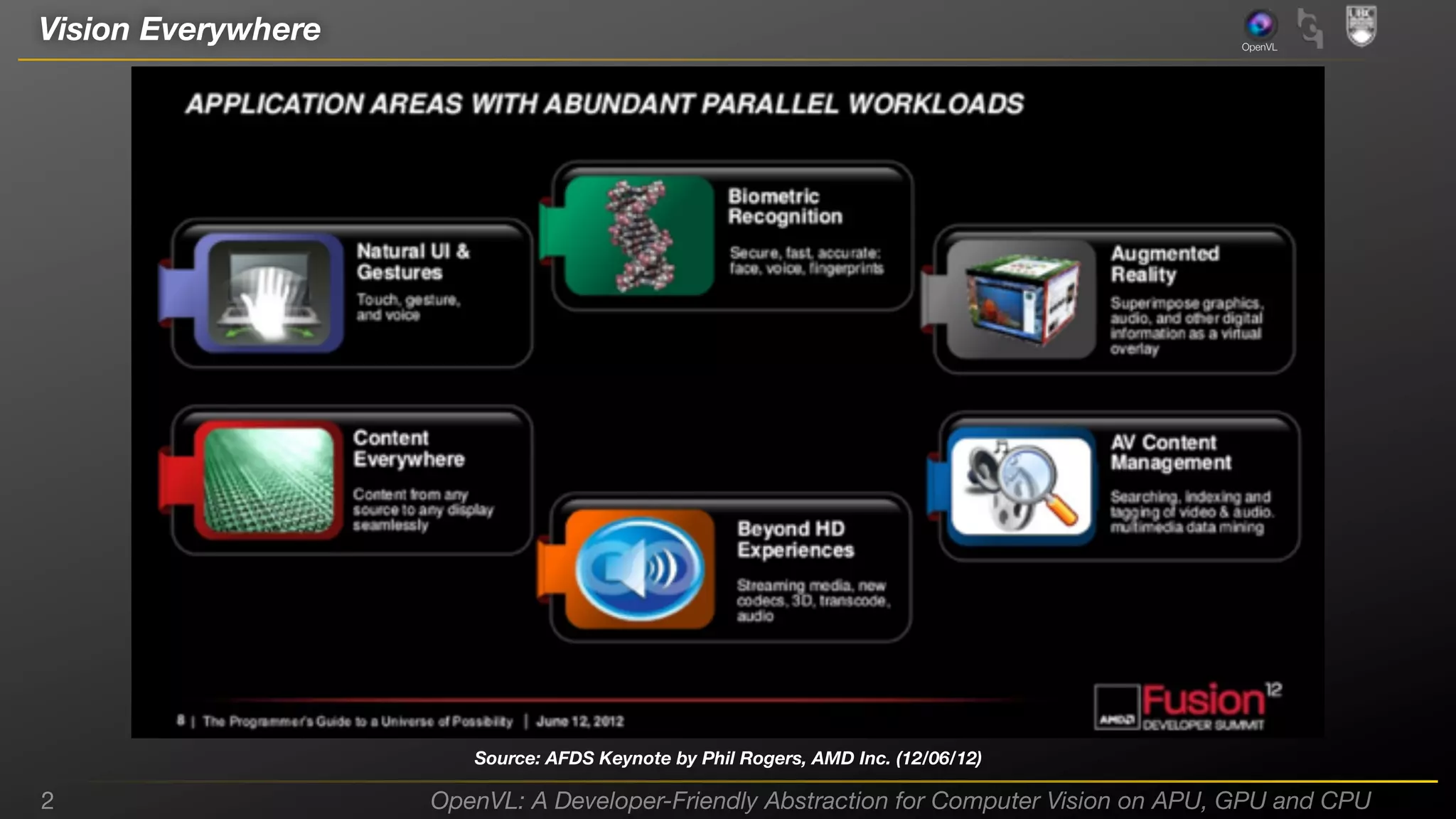
Vision Everywhere

OpenVL

Source: AFDS Keynote by Phil Rogers, AMD Inc. (12/06/12)

2

OpenVL: A Developer-Friendly Abstraction for Computer Vision on APU, GPU and CPU
What’s happening in the real world?

OpenVL

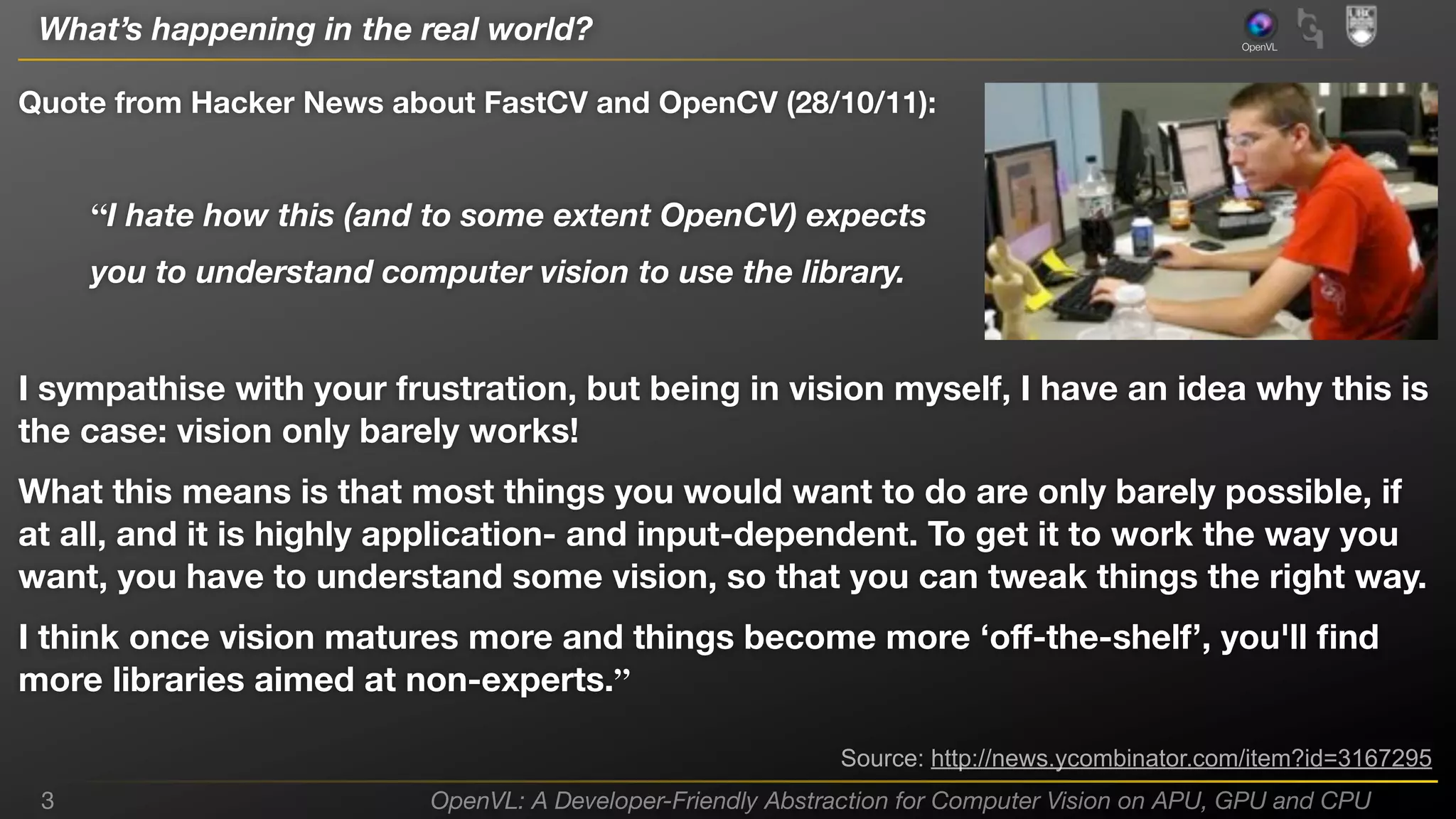
Quote from Hacker News about FastCV and OpenCV (28/10/11):

“I hate how this (and to some extent OpenCV) expects
you to understand computer vision to use the library.

I sympathise with your frustration, but being in vision myself, I have an idea why this is
the case: vision only barely works!
What this means is that most things you would want to do are only barely possible, if
at all, and it is highly application- and input-dependent. To get it to work the way you
want, you have to understand some vision, so that you can tweak things the right way.
I think once vision matures more and things become more ‘off-the-shelf’, you'll find
more libraries aimed at non-experts.”
Source: http://news.ycombinator.com/item?id=3167295
3

OpenVL: A Developer-Friendly Abstraction for Computer Vision on APU, GPU and CPU
Mainstream Developers are Key to Technology Adoption

OpenVL

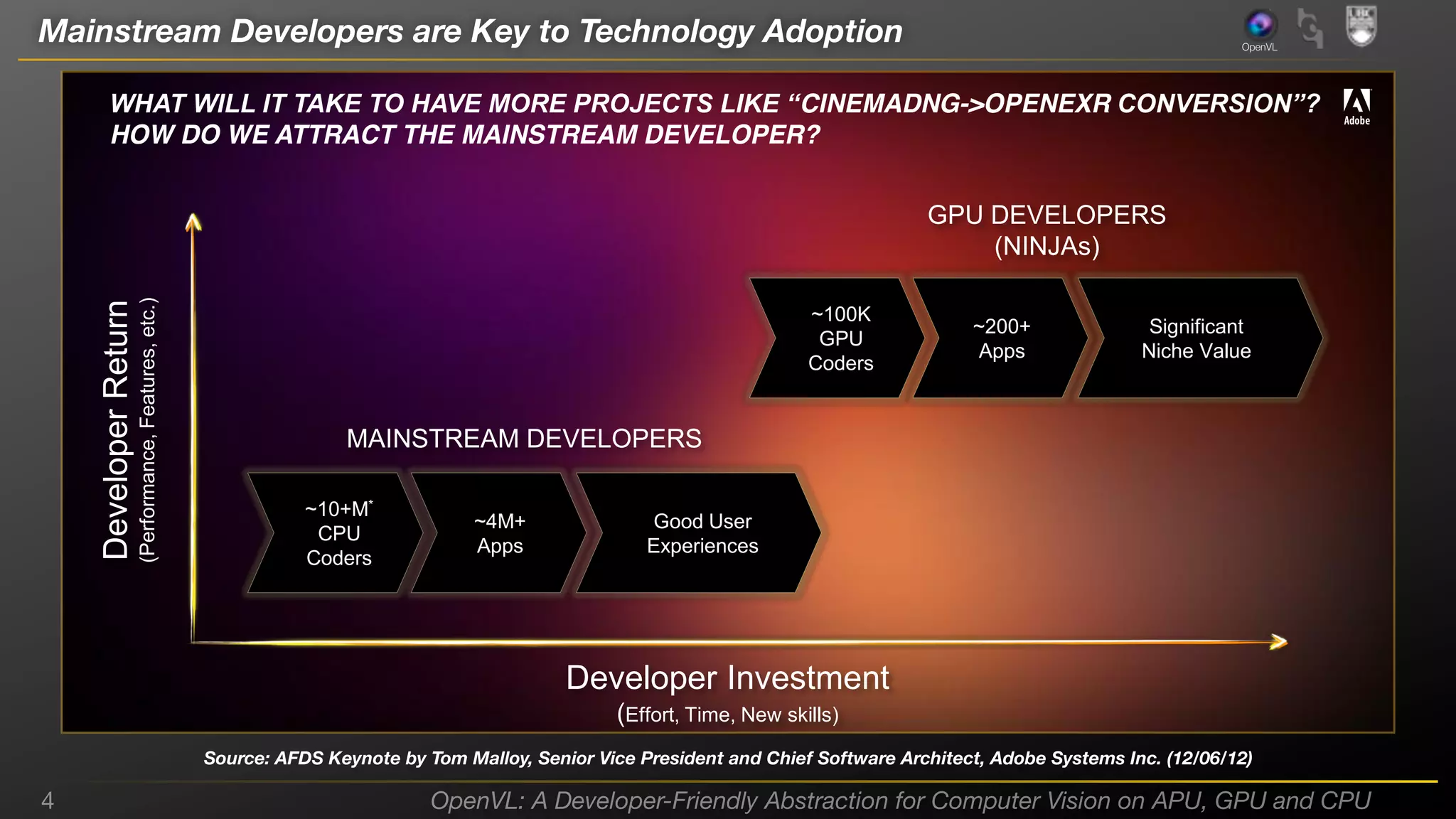
WHAT  WILL  IT  TAKE  TO  HAVE  MORE  PROJECTS  LIKE  “CINEMADNG->OPENEXR CONVERSION”?
HOW DO WE ATTRACT THE MAINSTREAM DEVELOPER?

(Performance, Features, etc.)

Developer Return

GPU DEVELOPERS
(NINJAs)
~100K
GPU
Coders

~200+
Apps

Significant
Niche Value

MAINSTREAM DEVELOPERS
~10+M*
CPU
Coders

~4M+
Apps

Good User
Experiences

Developer Investment
(Effort, Time, New skills)
*IDC
Source: AFDS Keynote by Tom Malloy, Senior Vice President and Chief Software Architect, Adobe Systems Inc. (12/06/12)
4

OpenVL: A Developer-Friendly Abstraction for Computer Vision on APU, GPU and CPU

13 |    The  Promise  of  Parallel:  Today’s  State  of  Heterogeneous  Computing    |    June  12,  2012
Higher-Level Abstractions are Needed

OpenVL

SOFTWARE CONSIDERATIONS
PLATFORMS (AND STANDARDS)

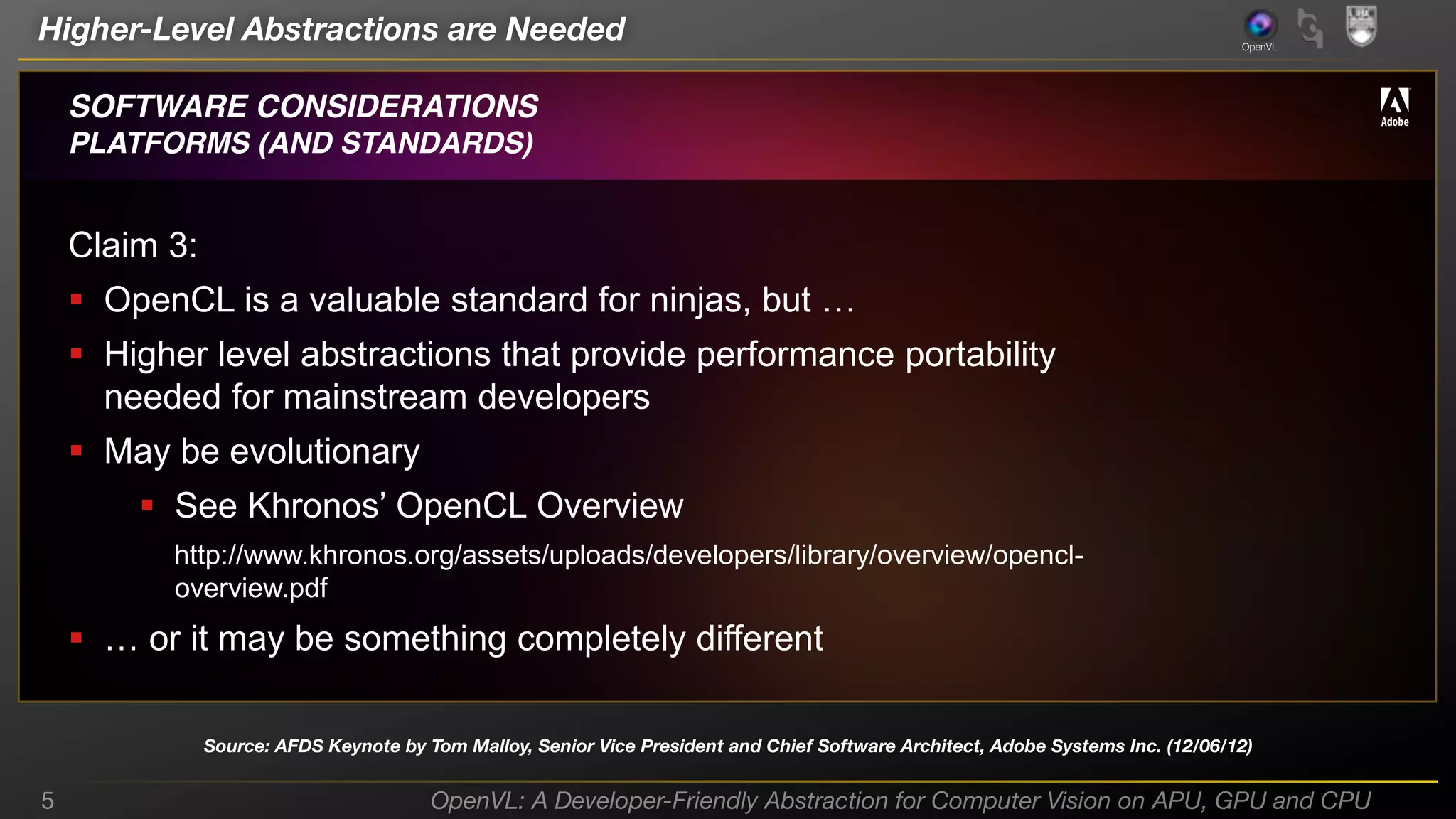
Claim 3:
 OpenCL is  a  valuable  standard  for  ninjas,  but  …
 Higher level abstractions that provide performance portability
needed for mainstream developers

 May be evolutionary
 See Khronos’  OpenCL Overview
http://www.khronos.org/assets/uploads/developers/library/overview/opencloverview.pdf

 …  or  it  may  be  something  completely  different
Source: AFDS Keynote by Tom Malloy, Senior Vice President and Chief Software Architect, Adobe Systems Inc. (12/06/12)

5

OpenVL: A Developer-Friendly Abstraction for Computer Vision on APU, GPU and CPU
Current Computer Vision Frameworks

OpenVL

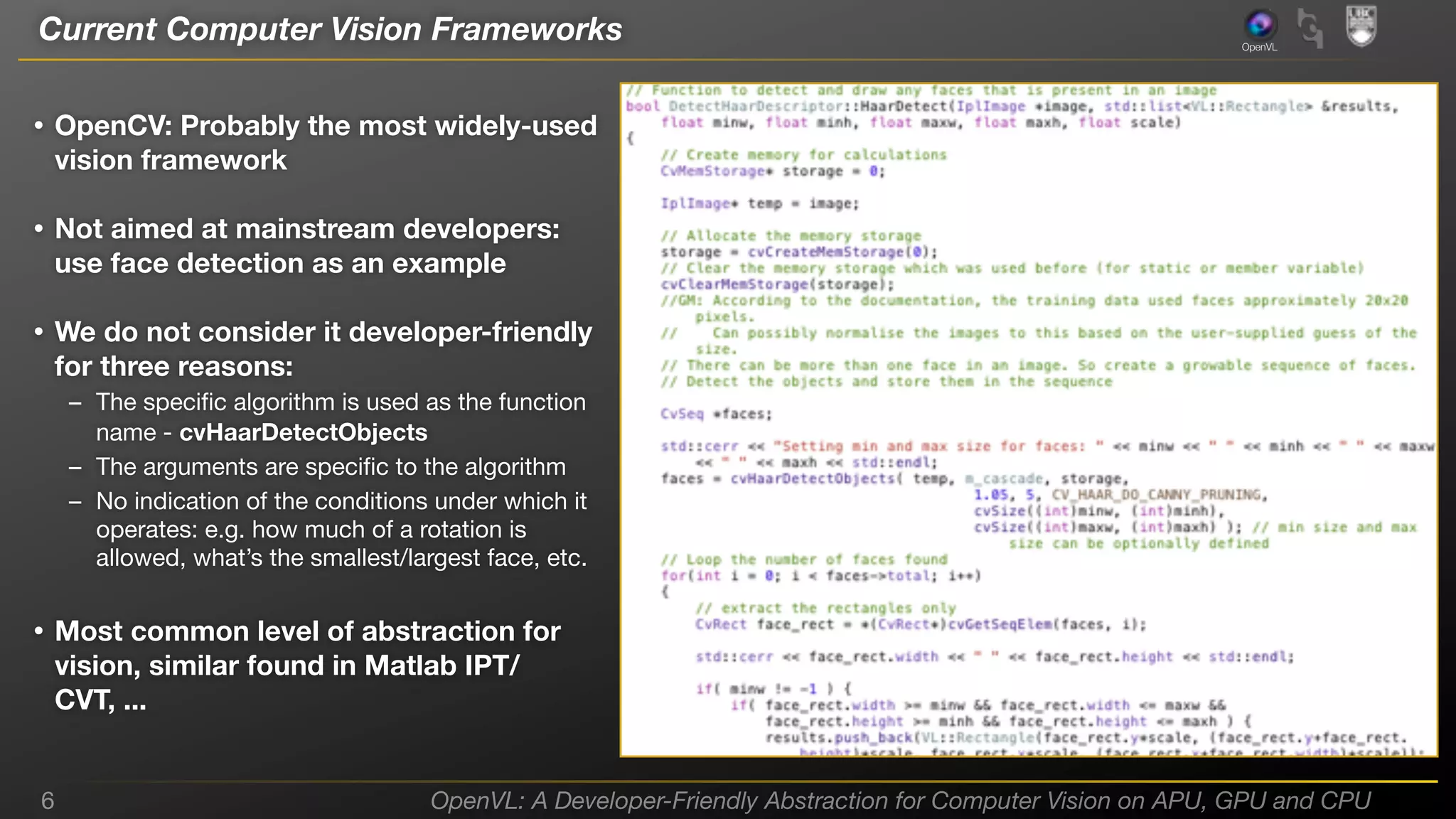
• OpenCV: Probably the most widely-used
vision framework

• Not aimed at mainstream developers:
use face detection as an example

• We do not consider it developer-friendly
for three reasons:

– The specific algorithm is used as the function
name - cvHaarDetectObjects
– The arguments are specific to the algorithm
– No indication of the conditions under which it
operates: e.g. how much of a rotation is
allowed, what’s the smallest/largest face, etc.

• Most common level of abstraction for
vision, similar found in Matlab IPT/
CVT, ...

6

OpenVL: A Developer-Friendly Abstraction for Computer Vision on APU, GPU and CPU
HCI for Vision, focussing on developers; Why?

OpenVL

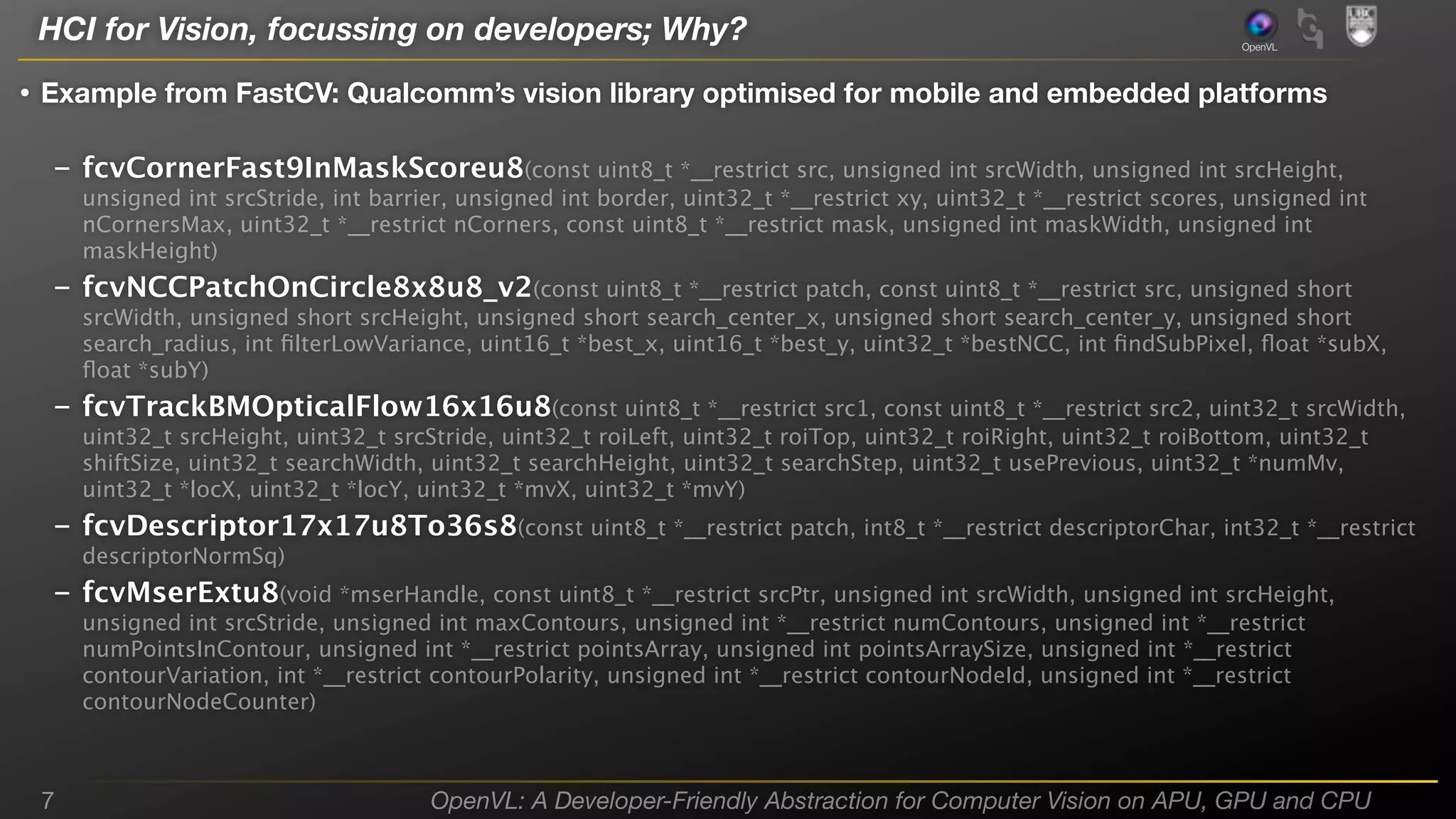
• Example from FastCV: Qualcomm’s vision library optimised for mobile and embedded platforms
– fcvCornerFast9InMaskScoreu8(const uint8_t *__restrict src, unsigned int srcWidth, unsigned int srcHeight,
unsigned int srcStride, int barrier, unsigned int border, uint32_t *__restrict xy, uint32_t *__restrict scores, unsigned int
nCornersMax, uint32_t *__restrict nCorners, const uint8_t *__restrict mask, unsigned int maskWidth, unsigned int
maskHeight)

– fcvNCCPatchOnCircle8x8u8_v2(const uint8_t *__restrict patch, const uint8_t *__restrict src, unsigned short
srcWidth, unsigned short srcHeight, unsigned short search_center_x, unsigned short search_center_y, unsigned short
search_radius, int filterLowVariance, uint16_t *best_x, uint16_t *best_y, uint32_t *bestNCC, int findSubPixel, float *subX,
float *subY)

– fcvTrackBMOpticalFlow16x16u8(const uint8_t *__restrict src1, const uint8_t *__restrict src2, uint32_t srcWidth,
uint32_t srcHeight, uint32_t srcStride, uint32_t roiLeft, uint32_t roiTop, uint32_t roiRight, uint32_t roiBottom, uint32_t
shiftSize, uint32_t searchWidth, uint32_t searchHeight, uint32_t searchStep, uint32_t usePrevious, uint32_t *numMv,
uint32_t *locX, uint32_t *locY, uint32_t *mvX, uint32_t *mvY)

– fcvDescriptor17x17u8To36s8(const uint8_t *__restrict patch, int8_t *__restrict descriptorChar, int32_t *__restrict
descriptorNormSq)

– fcvMserExtu8(void *mserHandle, const uint8_t *__restrict srcPtr, unsigned int srcWidth, unsigned int srcHeight,
unsigned int srcStride, unsigned int maxContours, unsigned int *__restrict numContours, unsigned int *__restrict
numPointsInContour, unsigned int *__restrict pointsArray, unsigned int pointsArraySize, unsigned int *__restrict
contourVariation, int *__restrict contourPolarity, unsigned int *__restrict contourNodeId, unsigned int *__restrict
contourNodeCounter)

7

OpenVL: A Developer-Friendly Abstraction for Computer Vision on APU, GPU and CPU
A Case for the Problem Description Layer

OpenVL

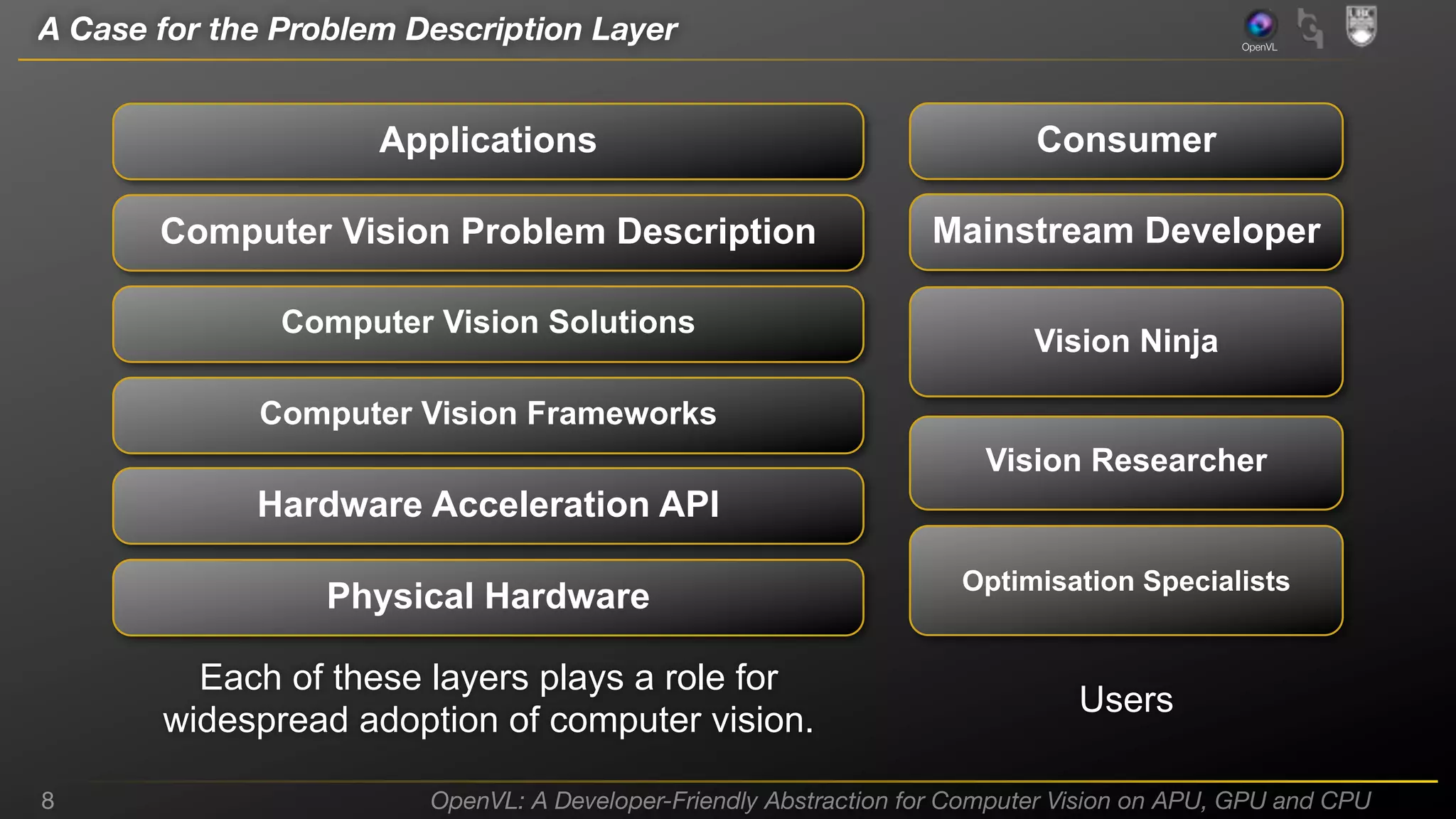
Applications

Consumer

Computer Vision Problem Description

Mainstream Developer

Computer Vision Solutions

Vision Ninja

Computer Vision Frameworks
Vision Researcher

Hardware Acceleration API
Physical Hardware
Each of these layers plays a role for
widespread adoption of computer vision.
8

Optimisation Specialists

Users

OpenVL: A Developer-Friendly Abstraction for Computer Vision on APU, GPU and CPU
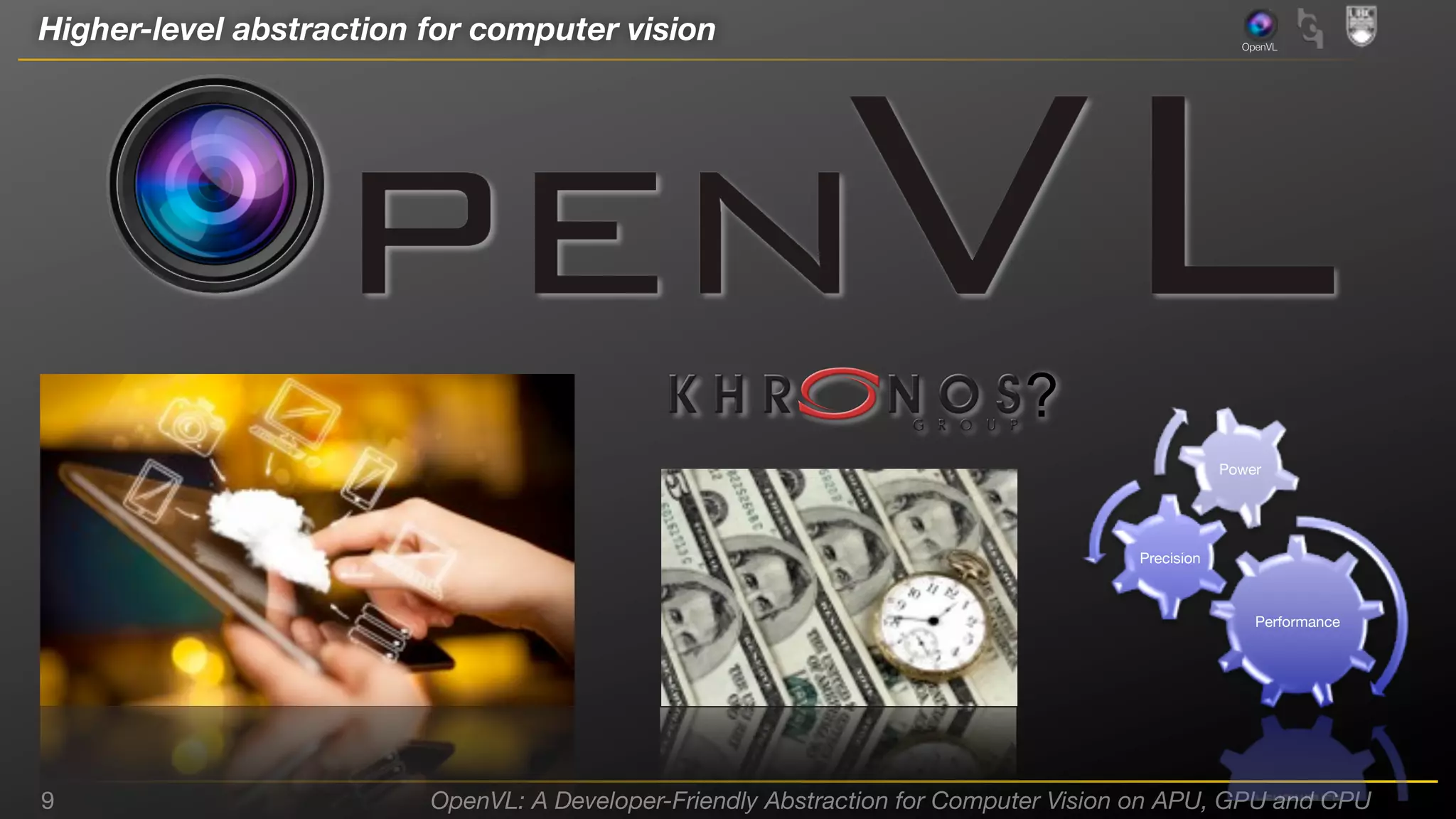
Higher-level abstraction for computer vision

OpenVL

?

Power
Power
Power
Precision
Precision
Precision
Performance
Performance
Performance

9

OpenVL: A Developer-Friendly Abstraction for Computer Vision on APU, GPU and CPU
Analysis using OpenVL: ‘What’ vs ‘How’

OpenVL

• Analysis using OpenVL
– High-level abstraction targeted towards mainstream
developers

• API based on problem description
– The description is interpreted to select algorithm(s) to
find the required solution

• Expressive interface: ‘what’ vs. ‘how’
– Describe what the task is, not how to solve it

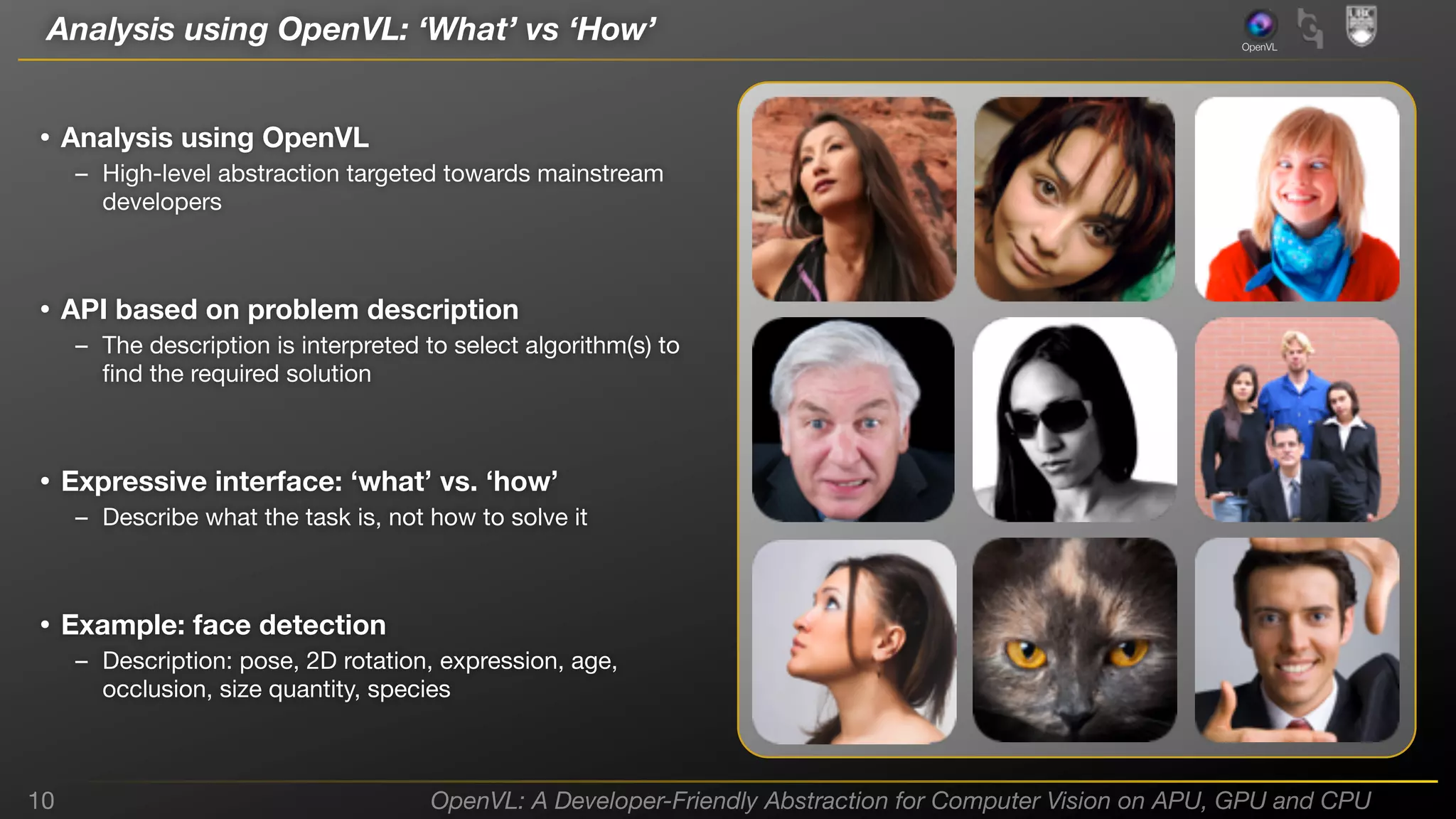
• Example: face detection
– Description: pose, 2D rotation, expression, age,
occlusion, size quantity, species

10

OpenVL: A Developer-Friendly Abstraction for Computer Vision on APU, GPU and CPU
OpenVL

OpenVL

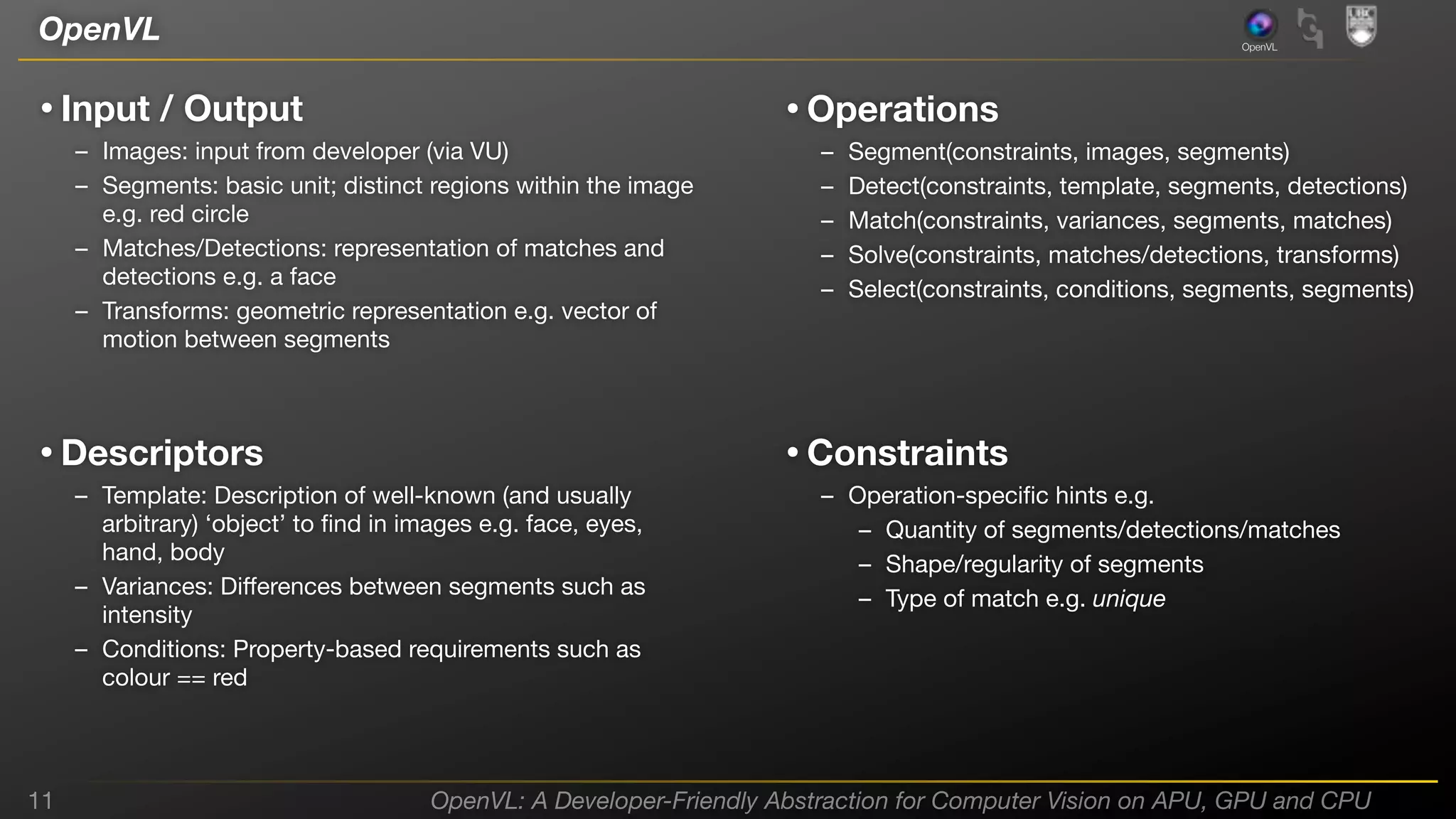
• Input / Output

• Operations

– Images: input from developer (via VU)
– Segments: basic unit; distinct regions within the image
e.g. red circle
– Matches/Detections: representation of matches and
detections e.g. a face
– Transforms: geometric representation e.g. vector of
motion between segments

• Descriptors

Segment(constraints, images, segments)
Detect(constraints, template, segments, detections)
Match(constraints, variances, segments, matches)
Solve(constraints, matches/detections, transforms)
Select(constraints, conditions, segments, segments)

• Constraints

– Template: Description of well-known (and usually
arbitrary) ‘object’ to find in images e.g. face, eyes,
hand, body
– Variances: Differences between segments such as
intensity
– Conditions: Property-based requirements such as
colour == red

11

–
–
–
–
–

– Operation-specific hints e.g.
– Quantity of segments/detections/matches
– Shape/regularity of segments
– Type of match e.g. unique

OpenVL: A Developer-Friendly Abstraction for Computer Vision on APU, GPU and CPU
Using Segments to Abstract Pixels

OpenVL

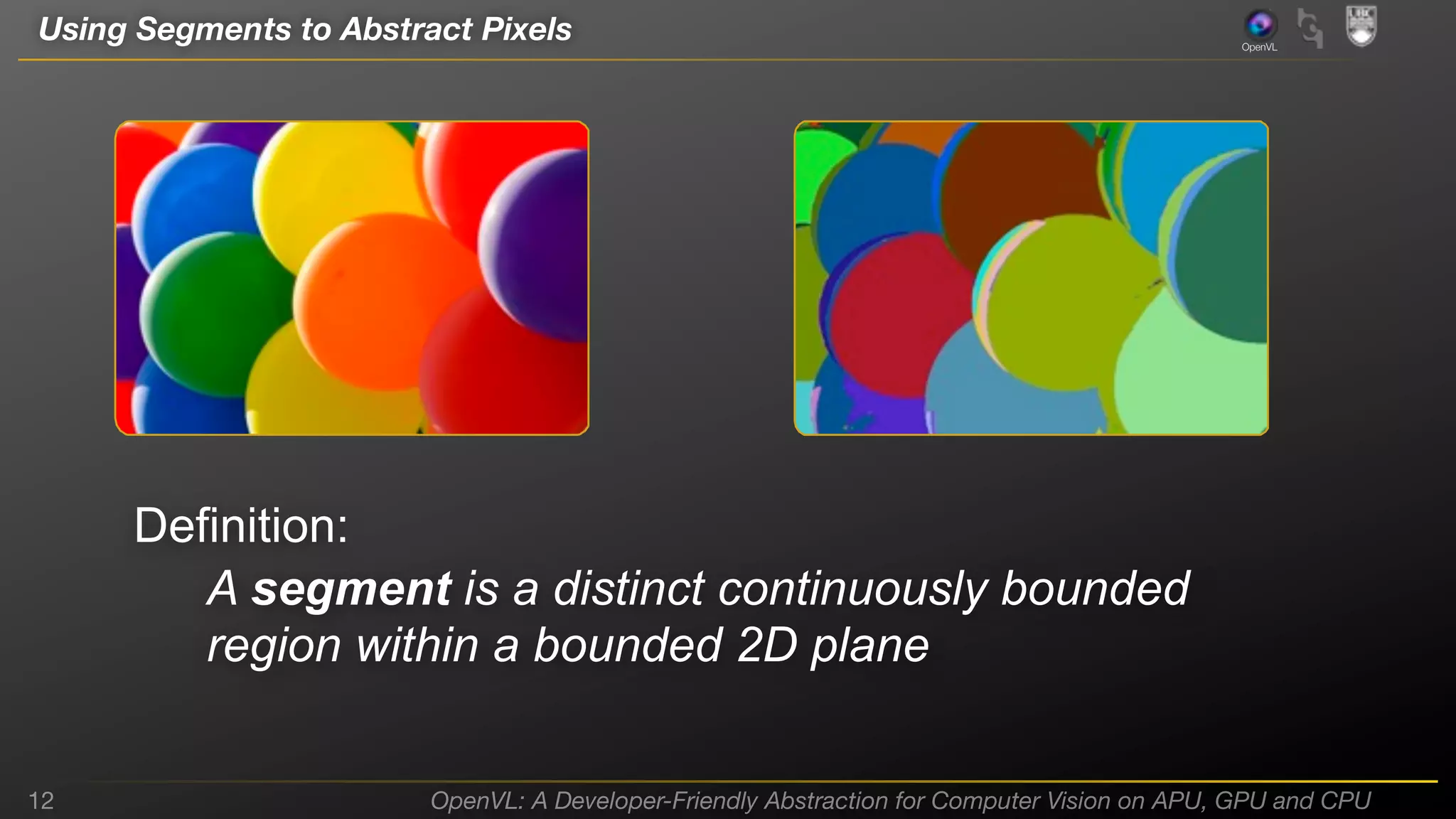
Definition:
A segment is a distinct continuously bounded
region within a bounded 2D plane
12

OpenVL: A Developer-Friendly Abstraction for Computer Vision on APU, GPU and CPU
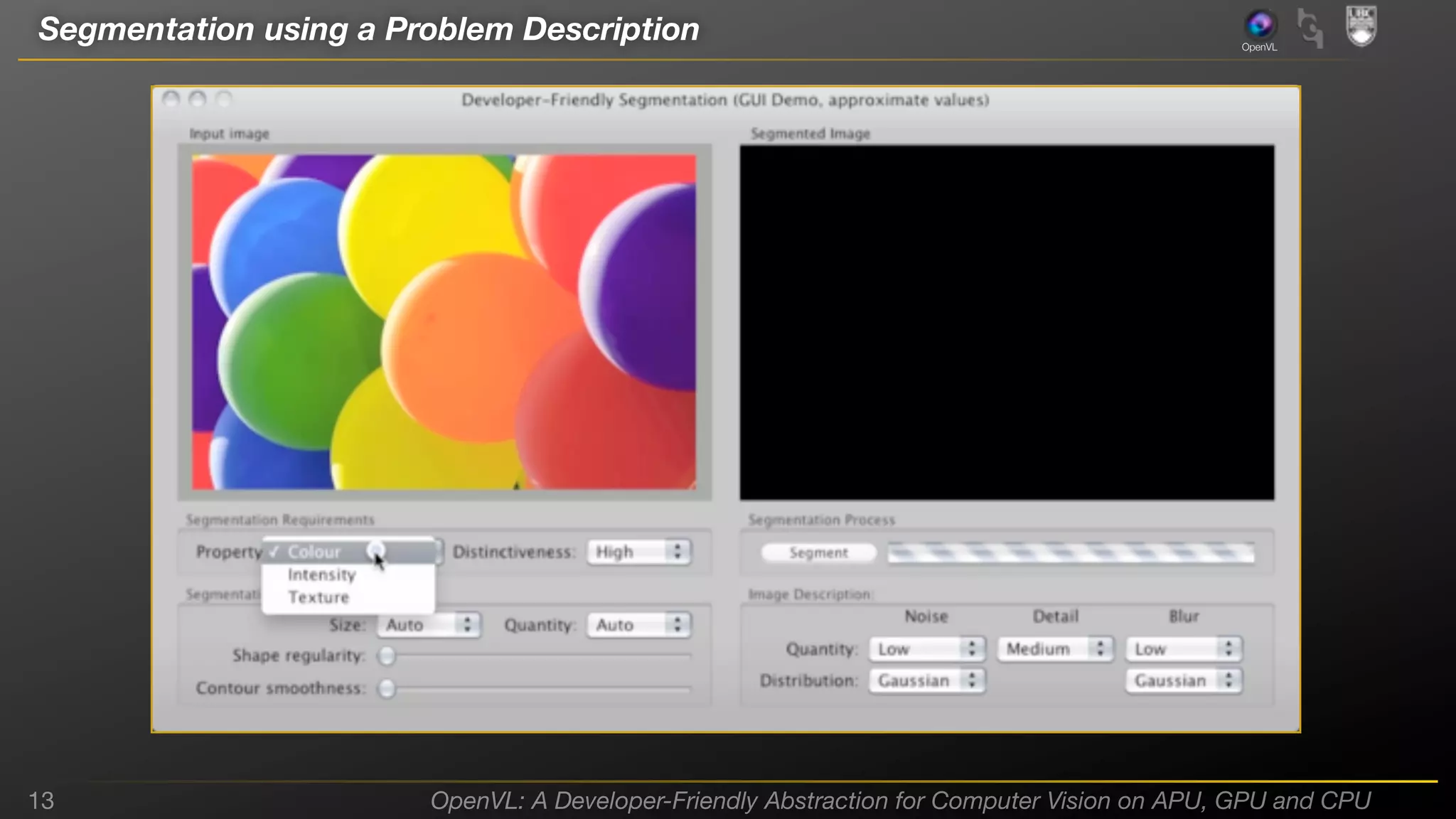
Segmentation using a Problem Description

13

OpenVL

OpenVL: A Developer-Friendly Abstraction for Computer Vision on APU, GPU and CPU
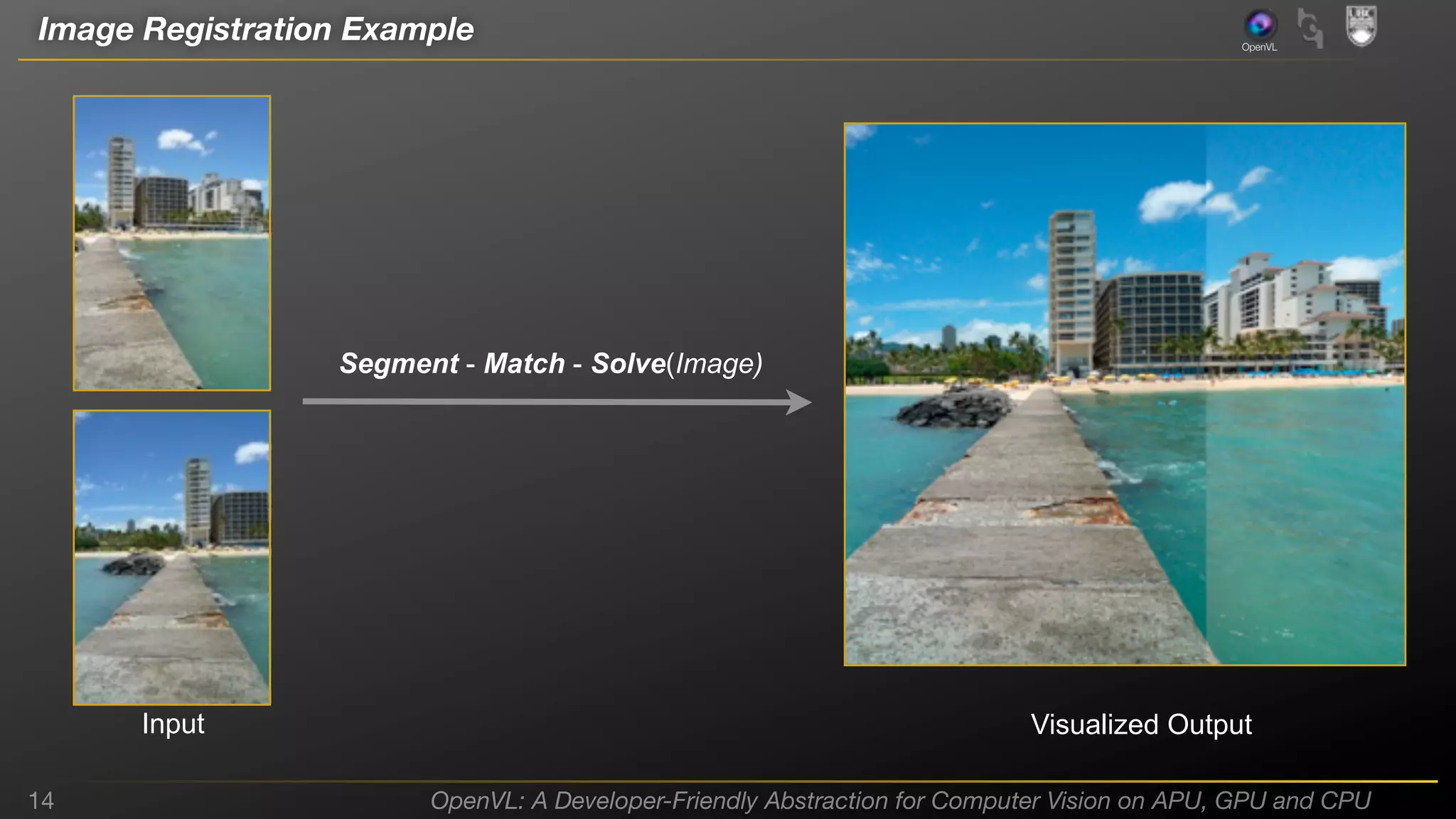
Image Registration Example

OpenVL

Segment - Match - Solve(Image)

Input
14

Visualized Output
OpenVL: A Developer-Friendly Abstraction for Computer Vision on APU, GPU and CPU
Flexibility of Operation Sequences

OpenVL

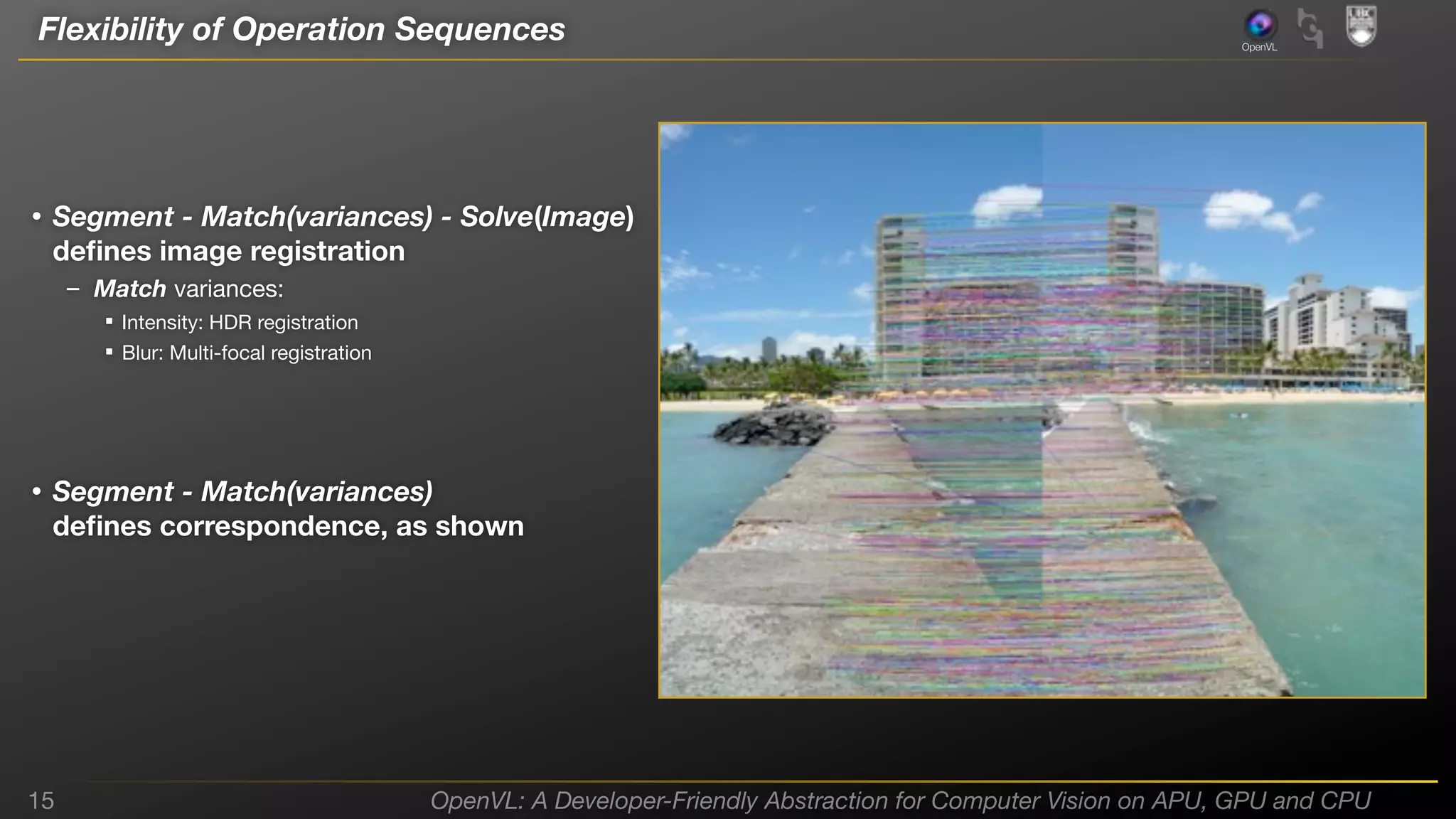
• Segment - Match(variances) - Solve(Image)
defines image registration
– Match variances:
 Intensity: HDR registration
 Blur: Multi-focal registration

• Segment - Match(variances)

defines correspondence, as shown

15

OpenVL: A Developer-Friendly Abstraction for Computer Vision on APU, GPU and CPU
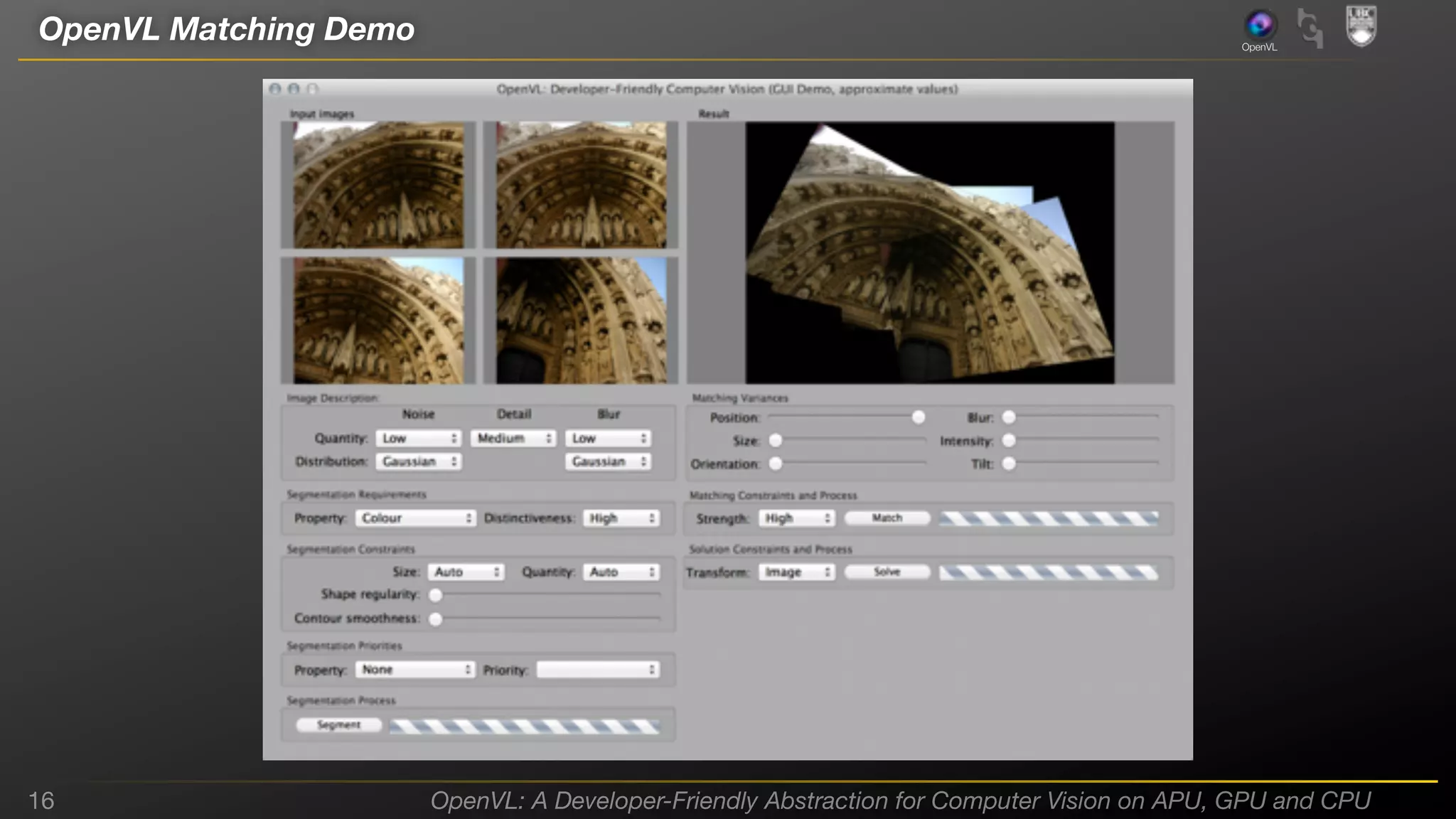
OpenVL Matching Demo

16

OpenVL

OpenVL: A Developer-Friendly Abstraction for Computer Vision on APU, GPU and CPU
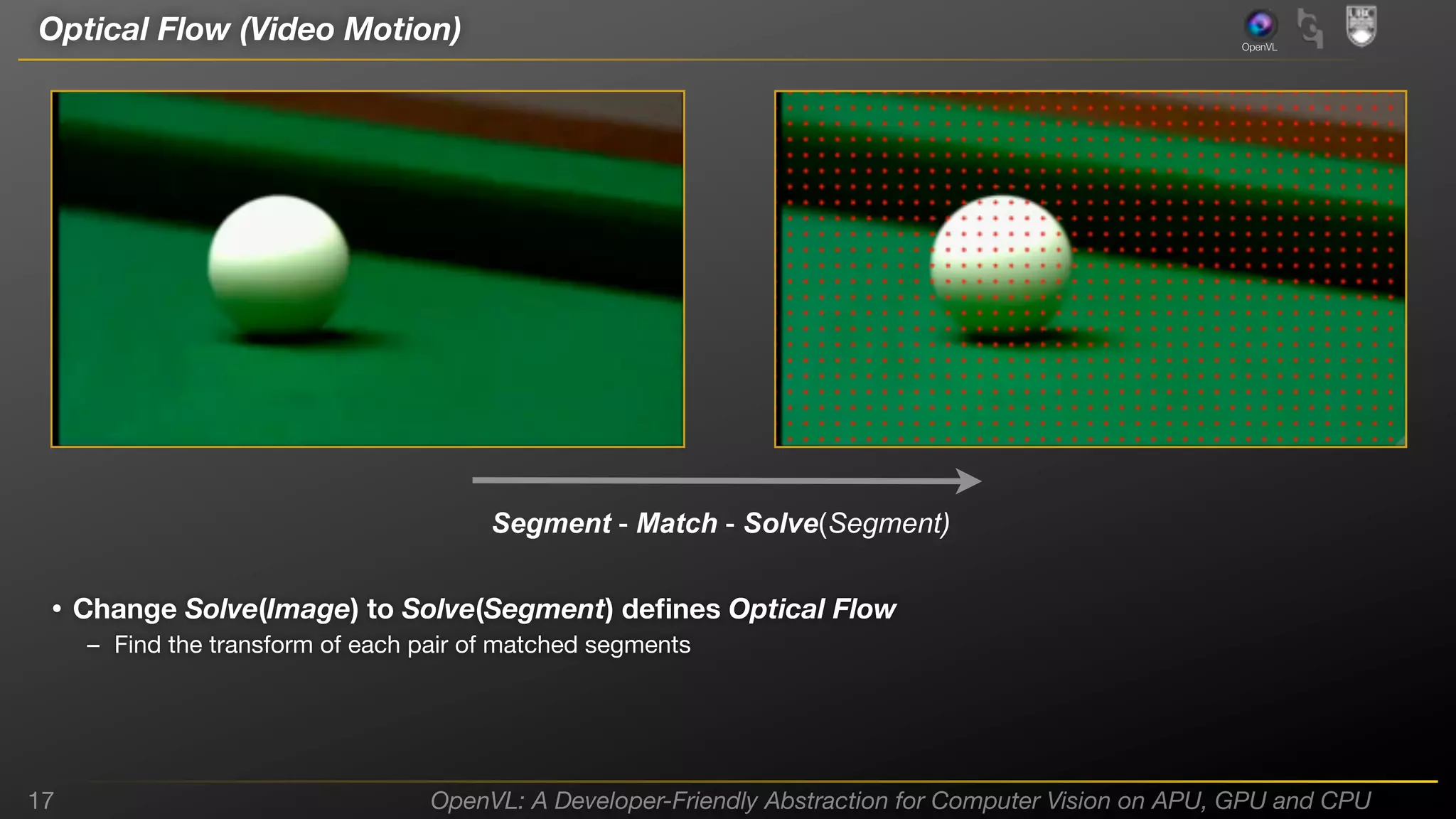
Optical Flow (Video Motion)

OpenVL

Segment - Match - Solve(Segment)

• Change Solve(Image) to Solve(Segment) defines Optical Flow
– Find the transform of each pair of matched segments

17

OpenVL: A Developer-Friendly Abstraction for Computer Vision on APU, GPU and CPU
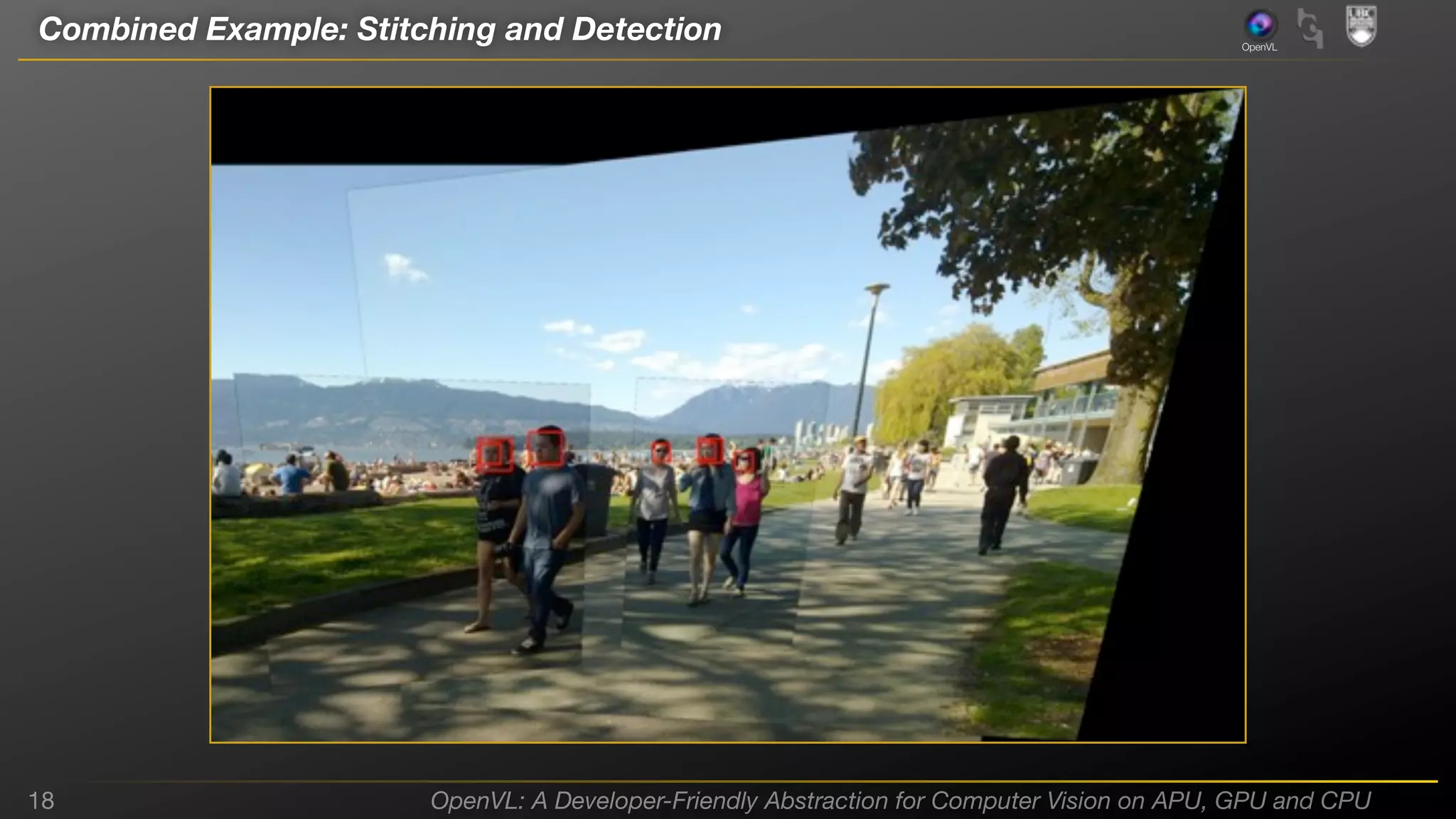
Combined Example: Stitching and Detection

18

OpenVL

OpenVL: A Developer-Friendly Abstraction for Computer Vision on APU, GPU and CPU
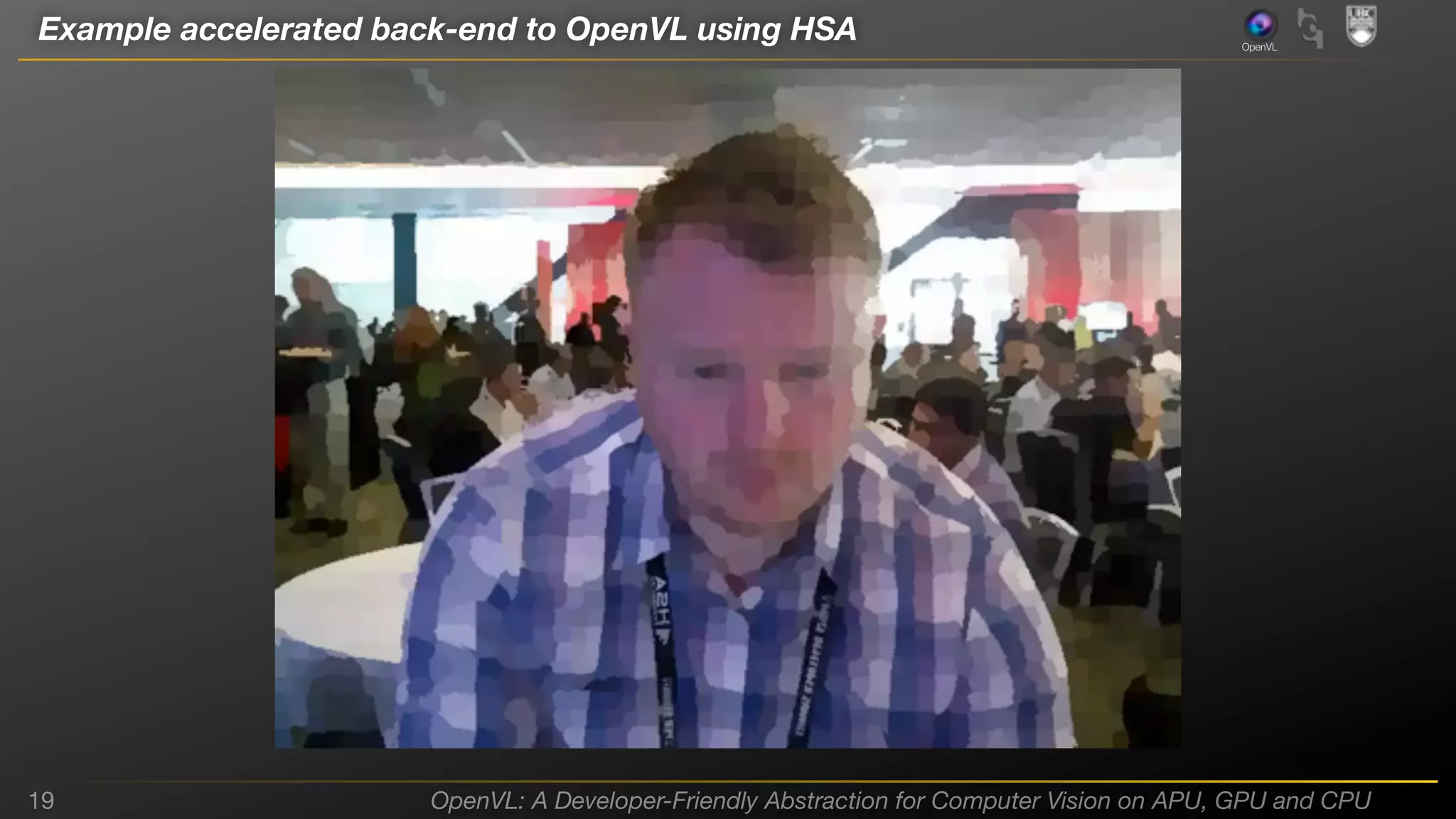
Example accelerated back-end to OpenVL using HSA

19

OpenVL

OpenVL: A Developer-Friendly Abstraction for Computer Vision on APU, GPU and CPU
Summary and Future Work

OpenVL

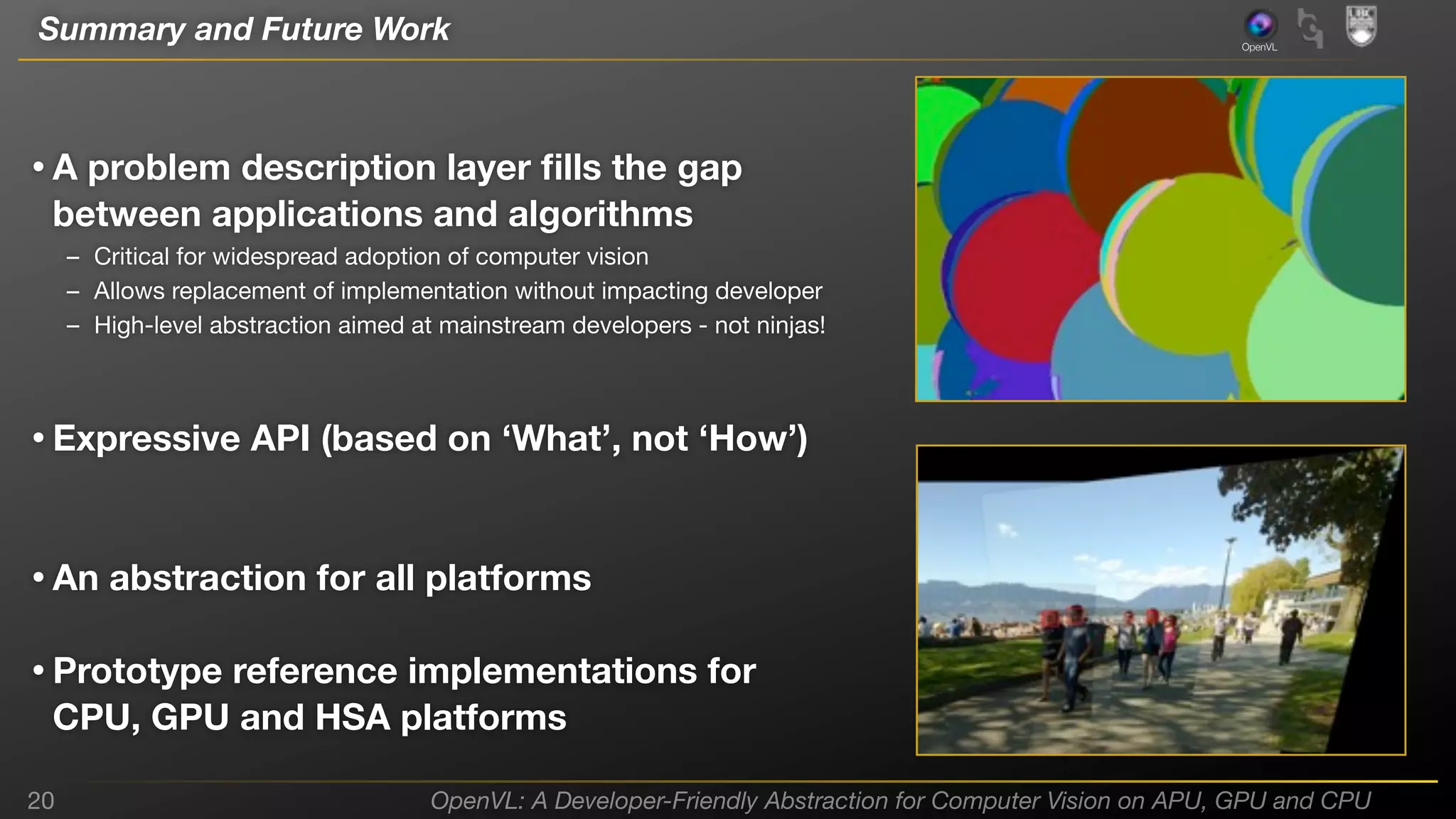
• A problem description layer fills the gap
between applications and algorithms

– Critical for widespread adoption of computer vision
– Allows replacement of implementation without impacting developer
– High-level abstraction aimed at mainstream developers - not ninjas!

• Expressive API (based on ‘What’, not ‘How’)
• An abstraction for all platforms
• Prototype reference implementations for
CPU, GPU and HSA platforms

20

OpenVL: A Developer-Friendly Abstraction for Computer Vision on APU, GPU and CPU
OpenVL has been released! (Image segmentation)

OpenVL

gregor@ece.ubc.ca | http://www.openvl.org
21

OpenVL: A Developer-Friendly Abstraction for Computer Vision on APU, GPU and CPU
Acknowledgements

22

OpenVL

OpenVL: A Developer-Friendly Abstraction for Computer Vision on APU, GPU and CPU

PL-4043, Accelerating OpenVL for Heterogeneous Platforms, by Gregor Miller

  • 1.
    OpenVL: A Developer-FriendlyAbstraction for Computer Vision on APU, GPU and CPU Gregor Miller and Sidney Fels Human Communication Technologies Laboratory University of British Columbia Vancouver, Canada 13th November 2013 AMD Developer Summit
  • 2.
    Vision Everywhere OpenVL Source: AFDSKeynote by Phil Rogers, AMD Inc. (12/06/12) 2 OpenVL: A Developer-Friendly Abstraction for Computer Vision on APU, GPU and CPU
  • 3.
    What’s happening inthe real world? OpenVL Quote from Hacker News about FastCV and OpenCV (28/10/11): “I hate how this (and to some extent OpenCV) expects you to understand computer vision to use the library. I sympathise with your frustration, but being in vision myself, I have an idea why this is the case: vision only barely works! What this means is that most things you would want to do are only barely possible, if at all, and it is highly application- and input-dependent. To get it to work the way you want, you have to understand some vision, so that you can tweak things the right way. I think once vision matures more and things become more ‘off-the-shelf’, you'll find more libraries aimed at non-experts.” Source: http://news.ycombinator.com/item?id=3167295 3 OpenVL: A Developer-Friendly Abstraction for Computer Vision on APU, GPU and CPU
  • 4.
    Mainstream Developers areKey to Technology Adoption OpenVL WHAT  WILL  IT  TAKE  TO  HAVE  MORE  PROJECTS  LIKE  “CINEMADNG->OPENEXR CONVERSION”? HOW DO WE ATTRACT THE MAINSTREAM DEVELOPER? (Performance, Features, etc.) Developer Return GPU DEVELOPERS (NINJAs) ~100K GPU Coders ~200+ Apps Significant Niche Value MAINSTREAM DEVELOPERS ~10+M* CPU Coders ~4M+ Apps Good User Experiences Developer Investment (Effort, Time, New skills) *IDC Source: AFDS Keynote by Tom Malloy, Senior Vice President and Chief Software Architect, Adobe Systems Inc. (12/06/12) 4 OpenVL: A Developer-Friendly Abstraction for Computer Vision on APU, GPU and CPU 13 |    The  Promise  of  Parallel:  Today’s  State  of  Heterogeneous  Computing    |    June  12,  2012
  • 5.
    Higher-Level Abstractions areNeeded OpenVL SOFTWARE CONSIDERATIONS PLATFORMS (AND STANDARDS) Claim 3:  OpenCL is  a  valuable  standard  for  ninjas,  but  …  Higher level abstractions that provide performance portability needed for mainstream developers  May be evolutionary  See Khronos’  OpenCL Overview http://www.khronos.org/assets/uploads/developers/library/overview/opencloverview.pdf  …  or  it  may  be  something  completely  different Source: AFDS Keynote by Tom Malloy, Senior Vice President and Chief Software Architect, Adobe Systems Inc. (12/06/12) 5 OpenVL: A Developer-Friendly Abstraction for Computer Vision on APU, GPU and CPU
  • 6.
    Current Computer VisionFrameworks OpenVL • OpenCV: Probably the most widely-used vision framework • Not aimed at mainstream developers: use face detection as an example • We do not consider it developer-friendly for three reasons: – The specific algorithm is used as the function name - cvHaarDetectObjects – The arguments are specific to the algorithm – No indication of the conditions under which it operates: e.g. how much of a rotation is allowed, what’s the smallest/largest face, etc. • Most common level of abstraction for vision, similar found in Matlab IPT/ CVT, ... 6 OpenVL: A Developer-Friendly Abstraction for Computer Vision on APU, GPU and CPU
  • 7.
    HCI for Vision,focussing on developers; Why? OpenVL • Example from FastCV: Qualcomm’s vision library optimised for mobile and embedded platforms – fcvCornerFast9InMaskScoreu8(const uint8_t *__restrict src, unsigned int srcWidth, unsigned int srcHeight, unsigned int srcStride, int barrier, unsigned int border, uint32_t *__restrict xy, uint32_t *__restrict scores, unsigned int nCornersMax, uint32_t *__restrict nCorners, const uint8_t *__restrict mask, unsigned int maskWidth, unsigned int maskHeight) – fcvNCCPatchOnCircle8x8u8_v2(const uint8_t *__restrict patch, const uint8_t *__restrict src, unsigned short srcWidth, unsigned short srcHeight, unsigned short search_center_x, unsigned short search_center_y, unsigned short search_radius, int filterLowVariance, uint16_t *best_x, uint16_t *best_y, uint32_t *bestNCC, int findSubPixel, float *subX, float *subY) – fcvTrackBMOpticalFlow16x16u8(const uint8_t *__restrict src1, const uint8_t *__restrict src2, uint32_t srcWidth, uint32_t srcHeight, uint32_t srcStride, uint32_t roiLeft, uint32_t roiTop, uint32_t roiRight, uint32_t roiBottom, uint32_t shiftSize, uint32_t searchWidth, uint32_t searchHeight, uint32_t searchStep, uint32_t usePrevious, uint32_t *numMv, uint32_t *locX, uint32_t *locY, uint32_t *mvX, uint32_t *mvY) – fcvDescriptor17x17u8To36s8(const uint8_t *__restrict patch, int8_t *__restrict descriptorChar, int32_t *__restrict descriptorNormSq) – fcvMserExtu8(void *mserHandle, const uint8_t *__restrict srcPtr, unsigned int srcWidth, unsigned int srcHeight, unsigned int srcStride, unsigned int maxContours, unsigned int *__restrict numContours, unsigned int *__restrict numPointsInContour, unsigned int *__restrict pointsArray, unsigned int pointsArraySize, unsigned int *__restrict contourVariation, int *__restrict contourPolarity, unsigned int *__restrict contourNodeId, unsigned int *__restrict contourNodeCounter) 7 OpenVL: A Developer-Friendly Abstraction for Computer Vision on APU, GPU and CPU
  • 8.
    A Case forthe Problem Description Layer OpenVL Applications Consumer Computer Vision Problem Description Mainstream Developer Computer Vision Solutions Vision Ninja Computer Vision Frameworks Vision Researcher Hardware Acceleration API Physical Hardware Each of these layers plays a role for widespread adoption of computer vision. 8 Optimisation Specialists Users OpenVL: A Developer-Friendly Abstraction for Computer Vision on APU, GPU and CPU
  • 9.
    Higher-level abstraction forcomputer vision OpenVL ? Power Power Power Precision Precision Precision Performance Performance Performance 9 OpenVL: A Developer-Friendly Abstraction for Computer Vision on APU, GPU and CPU
  • 10.
    Analysis using OpenVL:‘What’ vs ‘How’ OpenVL • Analysis using OpenVL – High-level abstraction targeted towards mainstream developers • API based on problem description – The description is interpreted to select algorithm(s) to find the required solution • Expressive interface: ‘what’ vs. ‘how’ – Describe what the task is, not how to solve it • Example: face detection – Description: pose, 2D rotation, expression, age, occlusion, size quantity, species 10 OpenVL: A Developer-Friendly Abstraction for Computer Vision on APU, GPU and CPU
  • 11.
    OpenVL OpenVL • Input /Output • Operations – Images: input from developer (via VU) – Segments: basic unit; distinct regions within the image e.g. red circle – Matches/Detections: representation of matches and detections e.g. a face – Transforms: geometric representation e.g. vector of motion between segments • Descriptors Segment(constraints, images, segments) Detect(constraints, template, segments, detections) Match(constraints, variances, segments, matches) Solve(constraints, matches/detections, transforms) Select(constraints, conditions, segments, segments) • Constraints – Template: Description of well-known (and usually arbitrary) ‘object’ to find in images e.g. face, eyes, hand, body – Variances: Differences between segments such as intensity – Conditions: Property-based requirements such as colour == red 11 – – – – – – Operation-specific hints e.g. – Quantity of segments/detections/matches – Shape/regularity of segments – Type of match e.g. unique OpenVL: A Developer-Friendly Abstraction for Computer Vision on APU, GPU and CPU
  • 12.
    Using Segments toAbstract Pixels OpenVL Definition: A segment is a distinct continuously bounded region within a bounded 2D plane 12 OpenVL: A Developer-Friendly Abstraction for Computer Vision on APU, GPU and CPU
  • 13.
    Segmentation using aProblem Description 13 OpenVL OpenVL: A Developer-Friendly Abstraction for Computer Vision on APU, GPU and CPU
  • 14.
    Image Registration Example OpenVL Segment- Match - Solve(Image) Input 14 Visualized Output OpenVL: A Developer-Friendly Abstraction for Computer Vision on APU, GPU and CPU
  • 15.
    Flexibility of OperationSequences OpenVL • Segment - Match(variances) - Solve(Image) defines image registration – Match variances:  Intensity: HDR registration  Blur: Multi-focal registration • Segment - Match(variances) defines correspondence, as shown 15 OpenVL: A Developer-Friendly Abstraction for Computer Vision on APU, GPU and CPU
  • 16.
    OpenVL Matching Demo 16 OpenVL OpenVL:A Developer-Friendly Abstraction for Computer Vision on APU, GPU and CPU
  • 17.
    Optical Flow (VideoMotion) OpenVL Segment - Match - Solve(Segment) • Change Solve(Image) to Solve(Segment) defines Optical Flow – Find the transform of each pair of matched segments 17 OpenVL: A Developer-Friendly Abstraction for Computer Vision on APU, GPU and CPU
  • 18.
    Combined Example: Stitchingand Detection 18 OpenVL OpenVL: A Developer-Friendly Abstraction for Computer Vision on APU, GPU and CPU
  • 19.
    Example accelerated back-endto OpenVL using HSA 19 OpenVL OpenVL: A Developer-Friendly Abstraction for Computer Vision on APU, GPU and CPU
  • 20.
    Summary and FutureWork OpenVL • A problem description layer fills the gap between applications and algorithms – Critical for widespread adoption of computer vision – Allows replacement of implementation without impacting developer – High-level abstraction aimed at mainstream developers - not ninjas! • Expressive API (based on ‘What’, not ‘How’) • An abstraction for all platforms • Prototype reference implementations for CPU, GPU and HSA platforms 20 OpenVL: A Developer-Friendly Abstraction for Computer Vision on APU, GPU and CPU
  • 21.
    OpenVL has beenreleased! (Image segmentation) OpenVL gregor@ece.ubc.ca | http://www.openvl.org 21 OpenVL: A Developer-Friendly Abstraction for Computer Vision on APU, GPU and CPU
  • 22.
    Acknowledgements 22 OpenVL OpenVL: A Developer-FriendlyAbstraction for Computer Vision on APU, GPU and CPU